
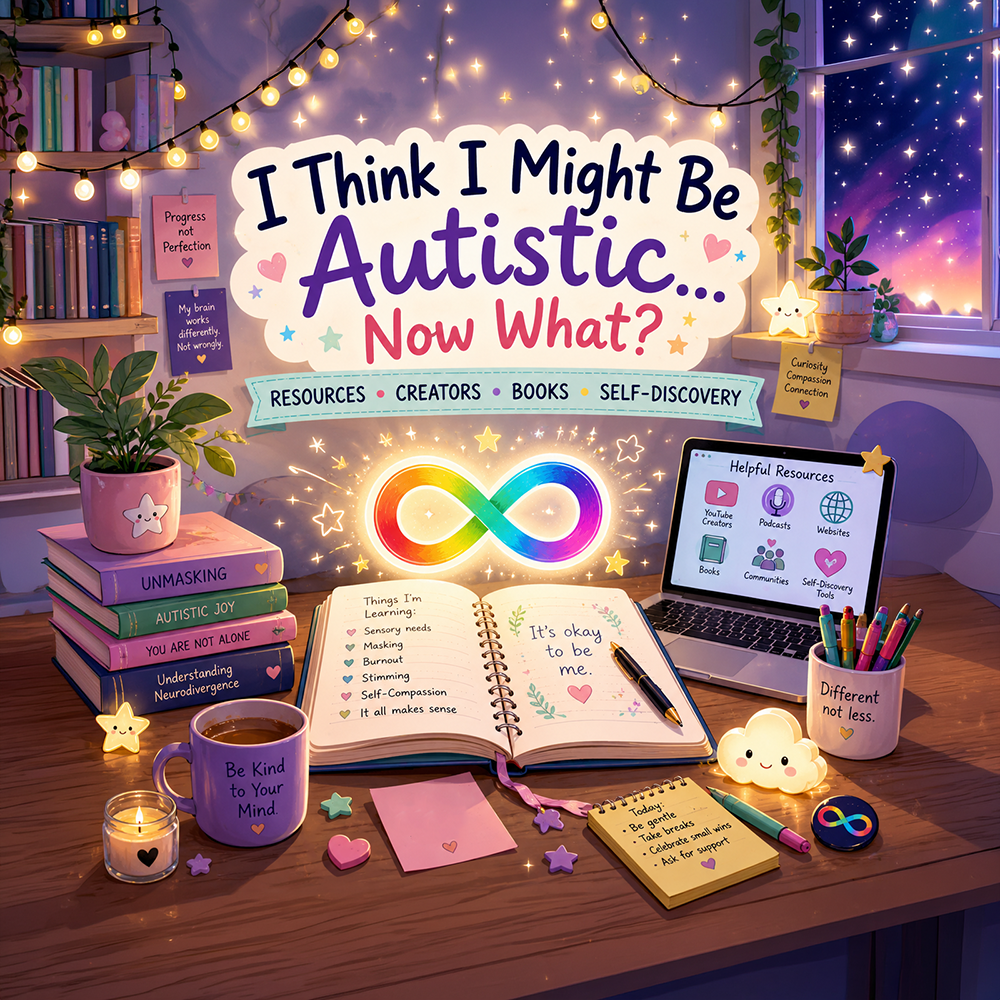
For many late-diagnosed autistic adults, discovering autism does not start in a doctor’s office.
Sometimes it starts with a video that feels strangely familiar.
A post that explains something you thought only you experienced.
A creator describing a lifelong struggle you never had words for.
For many adults — especially those who grew up without obvious external signs or who learned to mask heavily — autism discovery can begin through research, community, and hearing the lived experiences of other autistic people.
That was part of my journey, too.
Before receiving my official autism diagnosis at 33, I spent years researching autism, listening to autistic creators, taking self-assessments, and learning from people who explained experiences I had carried my entire life but never fully understood.
For those missed early in life, late-diagnosed autism resources for adults are crucial. While online resources cannot replace a professional assessment, they can be incredibly valuable tools for education, self-reflection, understanding, and realizing: “Maybe there was a valid reason things always felt different.” “Maybe I wasn't a broken human all this time.”
Table of Contents
Where Do I Start?
The amount of autism information online can feel overwhelming, especially when you first begin exploring neurodivergence.
Different resources may help with different parts of the journey:
If you are wondering, “Could I actually be autistic?”
→ Start with lived experiences, diagnostic information, and educational resources.
If you just received a diagnosis:
→ Learn about masking, burnout, sensory needs, accommodations, and self-advocacy.
If you feel exhausted after years of trying to keep up:
→ Research autistic burnout, nervous system regulation, and ways to create a life that works with your needs.
If you feel alone:
→ Look for autistic creators, communities, support groups, and spaces where people share similar experiences.
You do not need to understand everything overnight.
Learning about yourself is a process.
Common Terms You May Hear During Autism Discovery
When exploring autism resources, you may come across words that finally give language to experiences you have had for years.
Masking
Masking describes hiding, suppressing, or changing natural behaviors to blend into expectations around you.
This can include things like forcing eye contact, copying social behaviors, hiding sensory discomfort, suppressing stimming, or constantly monitoring yourself.
Many late-diagnosed autistic adults spent years masking without realizing they were doing it.
Unmasking
Unmasking is the process of understanding your authentic needs, allowing yourself to exist more naturally, and finding ways to support yourself.
It does not mean changing who you are.
It means discovering who you are when you are not constantly trying to perform.
Autistic Burnout
Autistic burnout can happen after prolonged stress, masking, overwhelm, and living without needed support.
It may involve exhaustion, increased difficulty functioning, greater sensory sensitivity, loss of skills, or feeling disconnected from yourself.
Stimming
Stimming (self-stimulatory behavior) refers to repetitive actions or sensory experiences that can help with regulation, expression, focus, or processing.
Examples may include movement, sounds, textures, or other sensory experiences.
Sensory Needs
Autistic people may experience sensory information differently.
Sounds, lights, textures, smells, movement, or environments may feel more intense, distracting, calming, or meaningful depending on the person.
Understanding your sensory needs can be an important part of creating a life that supports you.
Now, here are some creators and resources that helped me — along with others you may find useful.
Autism Education & Understanding Yourself
Meg - I'm Autistic, Now What? (UK)
Best for: late diagnosis, autistic identity, research-based explanations, community
I’m Autistic, Now What? creates educational autism content exploring autistic experiences, late diagnosis, misconceptions, accommodations, masking, burnout, and everyday autistic life.
Her videos often combine research with personal experience, making complicated topics easier to understand.
Helpful topics include:
- late autism diagnosis
- unmasking
- autistic burnout
- sensory differences
- autism myths
- navigating identity after diagnosis
For adults who spent years thinking, “Why do I feel different?” this type of content can help put language to lifelong experiences.
Taylor Heaton (US)
Best for: late-diagnosed adults, masking, internalized experiences
Mom on the Spectrum focuses heavily on the experiences of late-diagnosed autistic adults, especially those who may have gone unnoticed because they learned to mask.
Topics include:
- discovering autism as an adult
- understanding autistic traits
- relationships
- sensory needs
- communication differences
- everyday accommodations
Mom on the Spectrum's content can be especially helpful for people who thought autism only looked one specific way and are discovering the diversity of autistic experiences.
Orion Kelly (Australia)
Best for: adult autism, parenting, advocacy, real-life experiences
Orion Kelly shares autism education from the perspective of an autistic adult, discussing everyday experiences, misconceptions, communication differences, relationships, and advocacy.
His content helps challenge outdated stereotypes by showing autism as a full human experience rather than a checklist of deficits.
Sam Stein (UK)
Best for: autism in women, late diagnosis, masking
Yo Samdy Sam discusses autism, ADHD, mental health, and neurodivergent experiences with a focus on understanding yourself.
Her videos have been especially helpful for many people exploring:
- late diagnosis
- autism presentation differences
- masking
- self-acceptance
Paul Micallef (Australia)
Best for: emotional understanding and internal autistic experiences
Autism From The Inside focuses on explaining what autism feels like internally.
Topics often include:
- overwhelm
- communication
- relationships
- anxiety
- masking
- self-understanding
This perspective can be valuable because autism is often described externally (“what others see”) rather than internally (“what someone experiences”).
ADHD & AuDHD Resources
Jessica McCabe
Best for: ADHD education, strategies, executive functioning
How to ADHD creates accessible educational content about ADHD brains, challenges, strengths, and support strategies.
Topics include:
- executive functioning
- motivation
- emotional regulation
- productivity
- accommodations
- self-compassion
Especially helpful for AuDHD individuals (people who are both autistic and ADHD).
Her "Wall of Awful" video is what started my whole deep dive research into neurodivergence and autism.
ADHD Love
Best for: ADHD acceptance, relationships, daily life
ADHD Love creates relatable content around ADHD experiences, reducing shame, and understanding how ADHD impacts everyday life.
Topics include:
- executive dysfunction
- relationships
- household tasks
- emotional experiences
- self-acceptance
 Jessica Carey
Lived Experience, Late Diagnosis & Neurodivergent Identity
Kaelynn Partlow
Best for: autism education, support needs, advocacy, and challenging stereotypes
Kaelynn Partlow shares educational content rooted in lived autistic experience while also helping bridge understanding between autistic and non-autistic audiences.
Her work often explores:
- autism myths and misconceptions
- support needs across different presentations
- communication differences
- sensory experiences
- everyday autistic life
- advocacy and accessibility
One of the strengths of Kaelynn’s content is how she helps show that autism is not one narrow experience.
Her videos can be especially helpful for people who spent years thinking: “I don’t fit the stereotypes, so maybe I can’t be autistic.”
Morgan Foley
Best for: autism education, relatable experiences, and everyday understanding
Morgan Foley creates approachable content exploring autism, neurodivergence, identity, and lived experience.
Topics often include:
- discovering neurodivergence
- social experiences
- internal experiences that may not be obvious to others
- communication differences
- understanding needs and accommodations
For people early in their self-discovery journey, content like this can help normalize experiences that may have previously felt confusing or isolating.
Toren Wolf
Best for: autistic identity, lived experience, and community
Toren Wolf shares content centered around autistic experience, self-understanding, and navigating life as a neurodivergent person.
Topics may include:
- autistic traits and experiences
- identity and self-acceptance
- relationships and communication
- advocacy
- practical reflections on everyday life
Sometimes hearing someone describe an experience you have quietly carried for years can become a moment of recognition.
That recognition can be powerful.
The Thought Spot
Best for: reflective conversations, mental health, identity, and neurodivergence
The Thought Spot with Irene explores conversations around identity, neurodivergence, self-understanding, and navigating life differently.
This type of content can be valuable because not every resource needs to be clinical or educational.
Sometimes people simply need spaces that encourage reflection and curiosity.
Topics may include:
- identity
- self-understanding
- personal growth
- emotional experiences
- community conversations
Mental Health, Practical Tools & Professional Perspectives
Kojo Sarfo, DNP
Best for: accessible mental health education and neurodivergent discussions
Kojo Sarfo creates educational content focused on mental health and making psychological concepts easier to understand.
Topics often include:
- mental health awareness
- ADHD and executive functioning
- emotional experiences
- self-understanding
- reducing shame around support needs
Mental health education is not the same as diagnosis, but educational content can sometimes provide language that helps people better understand their experiences and know what questions to explore.
Embrace Autism
Best for: self-reflection, educational articles, and autism screeners
For many late-diagnosed adults, Embrace Autism has become one of the more widely known websites for learning about autism and exploring self-assessment tools.
The website includes:
- autism-related educational articles
- screening questionnaires
- information about autistic traits
- explanations of assessment concepts
During my own research journey before official diagnosis, this was one of many places I explored while trying to understand myself better.
Some of Embrace Autism's tests:
A gentle reminder: Self-assessments are not diagnostic tools.
But they can sometimes help people organize observations, notice patterns, and decide whether pursuing further evaluation or support makes sense.
The goal is not to collect labels.
The goal is understanding yourself better and identifying what support may help.
Different people pursue different paths. Some seek formal diagnosis for accommodations or personal understanding, while others may not have access to assessment or may choose self-understanding without one. Each path is valid.
Additional Helpful Autism & Neurodivergent Resources
Neurodivergent Insights
Best for: educational graphics, autism + ADHD information, and late discovery
Neurodivergent Insights provides resources explaining neurodivergence through accessible visuals, articles, and educational materials.
Topics include:
- autism
- ADHD
- AuDHD
- nervous system differences
- burnout
- executive functioning
- emotional regulation
Their resources can be especially helpful for people who learn better visually.
Dr. Devon Price
Best for: masking, unmasking, and understanding autistic identity
Dr. Devon Price is the author of Unmasking Autism and writes about neurodivergence, identity, and authenticity.
His work explores:
- why autistic people mask
- the emotional cost of hiding differences
- rebuilding identity
- creating a life that fits your needs
For many late-diagnosed autistic adults, unmasking is not about suddenly becoming a different person.
It is about discovering who you are underneath years of trying to meet expectations that were never designed for you.
Purple Ella
Best for: autism, ADHD, family life, and everyday accommodations
Purple Ella shares experiences as a neurodivergent creator discussing:
- autism
- ADHD
- daily life
- accommodations
- sensory needs
- family experiences
Her content helps normalize building a life that works with your brain instead of constantly fighting against it.
Autism Level UP!
Best for: practical tools, regulation, and neurodiversity-affirming resources
Autism Level UP! creates resources focused on understanding needs, building skills, and supporting autistic people in practical ways.
Topics include:
- regulation
- energy management
- sensory needs
- communication
- self-understanding
Autistic Self Advocacy Network (ASAN)
Best for: disability rights, advocacy, and autistic-led resources
ASAN is an autistic-led advocacy organization focused on disability rights and improving understanding of autism.
They provide resources about:
- advocacy
- accessibility
- policy
- inclusion
- autistic perspectives
Their guiding idea is that autistic people should have a voice in conversations and decisions that affect autistic lives.
AANE (Association for Autism and Neurodiversity)
Best for: adults, families, groups, and education
AANE provides education, community, and support for autistic and similarly neurodivergent people.
Resources may include:
- webinars
- groups
- educational materials
- community support
Sarah Hendrickx
Best for: late diagnosis, autism in women, and understanding overlooked presentations
Sarah Hendrickx is an autistic author, speaker, and autism educator known for discussing how autism can present differently across individuals.
Her work has been especially meaningful for many late-diagnosed adults because she explores why some autistic people go unnoticed for years.
Topics include:
- autism in adulthood
- late diagnosis
- masking
- relationships
- communication differences
- experiences of autistic women
For people who grew up thinking, “I cannot be autistic because I do not match the stereotype,” resources like this can help expand understanding of how diverse autistic experiences truly are.
Autism Inclusivity
Best for: neurodiversity-affirming perspectives and community learning
Autism Inclusivity shares resources and conversations focused on listening to autistic voices and increasing understanding.
Topics may include:
- autistic experiences
- accessibility
- acceptance
- advocacy
- communication
- creating supportive environments
Learning from autistic perspectives can be especially helpful because autism is not only something to study from the outside.
It is also a lived experience.
 Jessica Carey
Books for Understanding Autism & Neurodivergence
Videos, articles, and online communities can be wonderful starting points, but sometimes a deeper dive is helpful. Books can provide history, research, personal experiences, and practical tools for understanding autism beyond short-form content.
No single book represents every autistic experience, but these can provide different perspectives.
Unmasking Autism by Dr. Devon Price
Best for: identity, masking, and rebuilding after years of hiding
Many late-diagnosed autistic adults begin looking back and realizing how much energy went into appearing “fine.”
Unmasking Autism explores:
- why autistic people mask
- the impact of hiding differences
- reconnecting with yourself
- creating a more authentic life
Looking After Your Autistic Self by Niamh Garvey
Best for: practical support and everyday life after discovery
Understanding autism is one step.
Learning how to support yourself is another.
Looking After Your Autistic Self explores practical ways autistic people can better understand their needs, including:
- energy management
- sensory needs
- self-care
- daily supports
Different, Not Less by Chloé Hayden
Best for: self-acceptance and embracing neurodivergence
Different, Not Less explores autism, identity, and accepting yourself in a world that often misunderstands differences.
It focuses on:
- self-understanding
- acceptance
- lived experience
- embracing neurodivergent identity
Autism Feels: An Earthling's Guide by Orion Kelly
Best for: lived experience, late diagnosis, and understanding autism from the inside
Orion Kelly, creator of That Autistic Guy, shares his perspective as an autistic adult while exploring what autism feels like beyond stereotypes.
Autism Feels discusses:
- autistic identity
- emotional experiences
- relationships
- misconceptions about autism
- understanding yourself
For people newly exploring autism, lived experiences can sometimes provide the moment of: “That sounds like me.”
Sometimes understanding begins when someone finally explains the internal experience, not just the outside observations.
Women and Girls on the Autism Spectrum by Sarah Hendrickx
Best for: missed diagnosis, masking, and overlooked autistic experiences
For decades, many descriptions of autism were based primarily on how autism appeared externally in certain groups, contributing to many people being overlooked.
Sarah Hendrickx's Women and Girls on the Autism Spectrum explores experiences commonly reported by autistic women and girls, including:
- masking
- social expectations
- relationships
- diagnosis differences
- sensory experiences
- adulthood
This can be especially meaningful for late-diagnosed adults who spent years wondering why traditional descriptions of autism did not seem to fit.
NeuroTribes: The Legacy of Autism and the Future of Neurodiversity by Steve Silberman
Best for: autism history and understanding the neurodiversity movement
NeuroTribes explores the history of autism, changing understandings of neurodivergence, and the importance of recognizing neurological differences.
Topics include:
- autism history
- changing perspectives over time
- advocacy
- neurodiversity
- societal understanding of autism
This book can help readers see autism not only as an individual experience, but as part of a larger history and community.
The Autistic Brain: Helping Different Kinds of Minds Succeed by Temple Grandin and Richard Panek
Best for: neuroscience, thinking differences, and strengths-based perspectives
Temple Grandin explores autism through personal experience, science, and discussions about different ways people think.
Topics in The Autistic Brain include:
- brain differences
- thinking styles
- strengths
- talents and interests
- supporting different kinds of minds
This book can be helpful for people interested in understanding how different brains process and experience the world.
Autism understanding continues evolving, so readers may find some terminology or perspectives vary across generations of autism advocacy. As with all resources, take what helps and continue learning from a variety of autistic voices.
Connecting With The Autism Spectrum: How To Talk, How To Listen, And Why You Shouldn't Call It High-Functioning by Casey “Remrov” Vormer
Best for: communication, understanding, and moving beyond stereotypes
Connecting With The Autism Spectrum focuses on improving understanding between autistic and non-autistic people.
Topics include:
- communication differences
- listening to autistic experiences
- misconceptions about functioning labels
- acceptance
- practical understanding
It can be useful both for autistic people exploring their own experiences and for friends, family members, educators, or supporters who want to better understand.
Strong Female Character by Fern Brady
Best for: late diagnosis, masking, and lived experience
A memoir by an autistic comedian exploring:
- growing up undiagnosed
- feeling different
- mental health
- diagnosis
- understanding yourself later in life
Strong Female Character is less of an educational guide and more of a “someone finally put words to it” book.
The Electricity of Every Living Thing by Katherine May
Best for: late autism discovery and identity
Memoir about discovering autism in adulthood while walking the South West Coast Path.
The Electricity of Every Living Thing is good for:
- late discovery
- reflection
- processing identity
A Few Notes About Resources
Online content creators, websites, and books can be incredibly meaningful.
They can help people:
- learn new language for old experiences
- feel less alone
- discover accommodations
- hear perspectives they had never considered
- realize they are not broken
At the same time, no creator represents every autistic or neurodivergent experience.
One person’s experience may resonate deeply.
Another may not.
That does not make either experience less valid.
Take what helps.
Leave what does not.
Keep learning.
Things I Wish I Knew Earlier in My Autism Journey
Looking back, one of the biggest realizations was understanding that knowledge alone is only the beginning.
Learning you are autistic can explain so much — but then comes the process of learning what actually helps.
Personally, one of the biggest shifts was moving from constantly asking, “How do I force myself to function like everyone else?” toward asking, “What actually supports the way my brain works?”
That small change opened the door from self-criticism toward problem-solving.
Things that can be worth exploring:
- What environments drain or support me?
- What sensory needs have I been ignoring?
- Where have I been forcing myself instead of supporting myself?
- What accommodations or changes would make life more sustainable?
- What activities make me feel like myself again?
For many late-diagnosed adults, discovery is not just about understanding challenges.
It can also be about reconnecting with interests, creativity, joy, and parts of yourself that may have been pushed aside while trying to meet everyone else’s expectations.
 Jessica Carey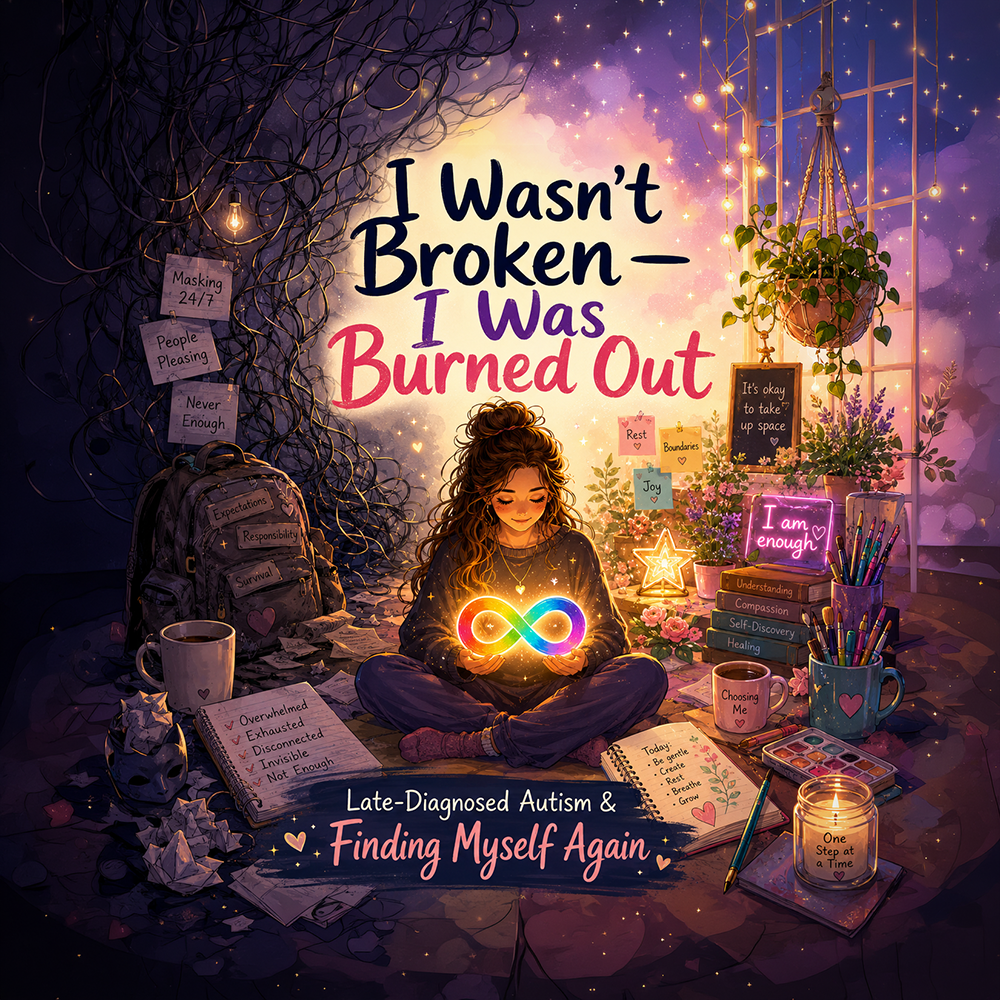
Okay, I Might Be Autistic… Now What?
Learning you are autistic — or realizing you might be — can bring a lot of emotions.
Relief.
Validation.
Confusion.
Grief.
Hope.
Sometimes all at once.
Many people finally receive an explanation for experiences they have carried their entire lives, but then immediately wonder: “What am I supposed to do now?”
There is no single correct path, but here are some places to begin.
Learn About Autism From Autistic Voices
Understanding autism from people who actually experience it can help you recognize things that may not appear in traditional descriptions.
Learning about masking, sensory needs, burnout, communication differences, and accommodations can help replace self-criticism with understanding.
Identify Your Needs
Many late-discovered autistic adults spent years asking: “How do I make myself handle this?”
A different question can be: “What support would make this more manageable?”
Start noticing:
- What environments drain me?
- What helps me recover?
- What sensory experiences overwhelm or comfort me?
- What expectations have I been forcing myself through?
- What accommodations might support me?
Experiment With Small Supports
You do not have to change your entire life overnight.
Small changes matter.
Examples:
- wearing headphones or ear protection
- adjusting lighting
- scheduling recovery time
- creating routines
- using reminders and visual supports
- allowing yourself healthier ways to regulate
Explore Accommodations
Accommodations are not advantages — they are tools that help reduce unnecessary barriers.
Depending on your needs, accommodations might include changes to communication, sensory environments, routines, workspaces, scheduling, or expectations.
Even small adjustments can make daily life more sustainable.
Find Community
Many late-diagnosed adults spent years feeling like they were the only one.
Finding others with similar experiences — whether online, through support groups, or local communities — can be incredibly validating.
Consider Professional Support if Accessible
Some people pursue formal assessment, therapy, occupational therapy, coaching, workplace accommodations, or disability supports.
Others may not have access or may not need those options.
Everyone’s path looks different.
The goal is not proving yourself.
The goal is understanding yourself and building a life that supports who you actually are.
 Jessica Carey
You Are Not Alone — You Are Finally Understanding Yourself
For many late-diagnosed autistic adults, discovering autism is not the end of the journey.
It is the beginning of seeing your story through a new lens.
The goal is not to collect labels. The goal is understanding.
Understanding your needs.
Understanding your strengths.
Understanding why certain things were difficult — and what supports may help moving forward.
You are not starting from nothing.
You are starting with more information about yourself than you had before.
Want even more content about creativity and art?
Be sure to check out all of our creative chronicles!
If you'd like to see examples of my work, you can find some of my art and creations at Redbubble and Gumroad!
Looking to learn more about my recent journey?
Check out these articles:
-The Difference Between Resting and Giving Up
 Jessica Carey