

Sometimes the hardest thing to do is stop.
Not because we do not need rest.
Not because we are not exhausted.
But because so many of us have been taught that stopping means we are doing something wrong.
We live in a world that often celebrates constant productivity.
Keep going.
Keep achieving.
Keep improving.
Keep pushing.
Do more.
Be more.
Handle more.
Like humans are machines that should be able to keep running as long as someone keeps adding more tasks.
But people are not machines.
We are living beings.
And living beings need care.
Maybe this message is for you if:
- You are exhausted but keep telling yourself you should be able to handle more
- You feel guilty whenever you slow down
- You struggle to rest because there is always something else you “should” be doing
- You have spent years caring for others but rarely offering yourself that same compassion
- You are afraid that stopping means you are failing
If so, this is your reminder: resting and giving up are not the same thing.
When Rest Starts Feeling Like Failure
For many people, rest sounds simple.
- “Just relax.”
- “Take a break.”
- “Slow down.”
But when you have spent years measuring your worth by how much you can do, resting can feel surprisingly uncomfortable.
Sometimes even terrifying.
Because somewhere along the way, many of us learned that our needs were obstacles instead of signals.
Exhaustion became something to overcome.
Stress became something to ignore.
Limits became something to push past.
Instead of asking: “What is my body trying to tell me?”
We learned to ask: “How do I make myself keep going anyway?”
For a while, that might even seem to work.
We can force ourselves through.
We can ignore the warning signs.
We can keep pouring from an empty cup.
Until eventually, there is nothing left to pour.
You Cannot Pour Forever From an Empty Cup
Many of us have heard the phrase: “You cannot pour from an empty cup.”
But many people still spend their lives trying.
Giving.
Helping.
Working.
Showing up.
Trying harder.
Pushing further.
And when they finally say:
- “I’m exhausted.”
- “I can’t keep doing this.”
- “I need support.”
They may not receive compassion.
They may hear:
- “Just change your mindset.”
- “Be more positive.”
- “Try harder.”
- “Push through.”
As if exhaustion is always an attitude problem.
As if someone struggling must simply not be trying enough.
But sometimes exhaustion is not a sign that someone needs more motivation.
Sometimes exhaustion is information.
A warning light.
A signal saying:
- Something needs attention
- Something needs care
- Something needs to change
When a phone battery reaches 1%, we do not criticize it for failing.
We charge it.
When a car runs out of gas, we do not tell it to develop a better mindset.
We refill the tank.
Humans need restoration, too.
 Jessica Carey
The Difference Between Resting and Giving Up
Somewhere along the way, many people start believing that slowing down means they have quit.
That needing a break means they are not dedicated enough.
That changing pace means they no longer care.
But resting and giving up are not the same thing.
They come from very different places.
Giving up from a place of hopelessness says: “Nothing matters anymore.”
Rest says: “This matters so much that I need to take care of myself if I want to continue.”
Giving up disconnects us from what we love.
Rest creates space to reconnect.
Giving up abandons hope.
Rest protects hope.
Sometimes the bravest thing someone can do is not keep pushing.
Sometimes the bravest thing someone can do is admit: “I cannot keep going this way.”
Because there is a difference between giving up on something you love… and realizing the way you have been carrying it is no longer sustainable.
Rest Is Maintenance, Not Failure
We understand maintenance almost everywhere else.
Cars need fuel.
Phones need charging.
Plants need water.
The earth itself has seasons.
Yet, somehow, many humans have been taught to see their own need for restoration as weakness.
Imagine looking at a flower that is not blooming in winter and saying:
- “You just need to try harder.”
- “Have a better attitude.”
- “Other flowers are blooming, so why aren’t you?”
It sounds ridiculous.
Because we understand that nature moves through seasons.
There are times of growth.
Times of blooming.
Times of change.
Times of quiet restoration.
The flower is not failing because it cannot bloom endlessly.
It is following a natural rhythm.
And humans are part of nature, too.
Putting Your Own Oxygen Mask On First
There is a reason airplane safety instructions tell people to put on their own oxygen mask before helping someone else.
Not because helping others does not matter.
Not because caring for others is wrong.
But because you cannot effectively help someone else if you cannot breathe.
The same idea applies beyond airplanes.
Compassion matters.
Generosity matters.
Supporting others matters.
But endlessly giving while ignoring your own needs is not sustainable.
You cannot pour from an empty cup forever.
Eventually, the cup needs to be refilled.
Rest is not the enemy of kindness.
Rest is what allows kindness to continue.
Taking care of yourself does not mean you stopped caring about everyone else.
Sometimes it means you finally included yourself as someone worthy of care, too.
 Jessica Carey
What Happens When We Ignore the Warning Signs
For many people, burnout does not happen overnight.
It happens slowly.
Quietly.
One ignored need at a time.
One crossed boundary at a time.
One “I’ll rest later” at a time.
We convince ourselves:
- “I just need to get through this week.”
- “I just need to finish this project.”
- “I just need to handle this one more thing.”
But sometimes “one more thing” keeps becoming another thing.
And another.
And another.
Until carrying too much starts feeling normal.
Sometimes we do not realize how heavy everything has become because we have adapted to carrying it.
I learned this lesson the hard way.
For years, I pushed myself far beyond what was sustainable.
I kept trying harder.
Doing more.
Giving more.
I kept believing that if I could just be stronger, more positive, more disciplined, more capable… maybe I could finally keep up.
But the problem was never that I was not trying.
The problem was that I had been trying for too long without enough support, rest, or room to breathe.
I was constantly pouring from an empty cup while being told the solution was to pour harder.
Eventually, something had to give.
For neurodivergent people, this can become even more complicated.
Many autistic and ADHD individuals spend years masking, adapting, and trying to meet expectations that were not built around how their brains and bodies work.
When you spend years hiding your struggles, pushing through overwhelm, and ignoring your limits, burnout can become more than simply feeling tired.
Sometimes recovery means learning how to listen to needs you spent years being taught to override, especially for those that are late diagnosed.
 Jessica Carey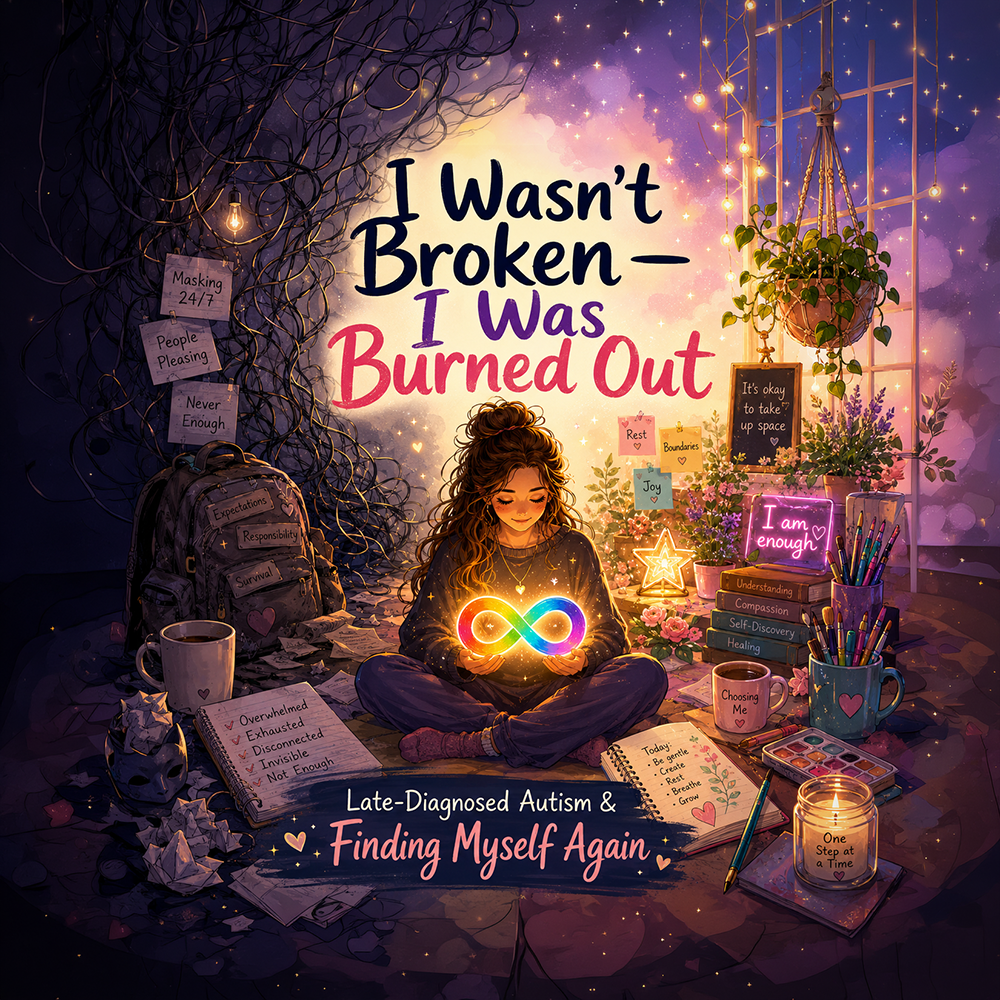
Burnout Is Not Always a Lack of Motivation
One of the most painful misunderstandings about burnout is the assumption that someone struggling must not care enough.
But many people who experience deep burnout are not people who cared too little.
They are often people who cared deeply.
People who kept showing up.
People who kept pushing.
People who kept carrying responsibilities even when they were already exhausted.
Burnout is not always the result of weakness.
Sometimes burnout is the result of being strong for too long without enough recovery.
A person can be determined and tired.
A person can be grateful and overwhelmed.
A person can care deeply and still need help.
Multiple things can be true at the same time.
“Trying Harder” Is Not Always the Answer
There are seasons when effort helps.
There are times when persistence, discipline, and determination are exactly what we need.
But there are also times when “try harder” becomes the very thing keeping us stuck.
If someone is exhausted because they are not putting effort in, encouragement to push forward may help.
But if someone is exhausted because they have been pushing for years?
More pressure is not the solution.
Someone drowning does not need someone standing on the shore yelling: “Swim harder!”
They need support.
They need a way back to safety.
They need a chance to breathe.
And sometimes, so do we.
Learning to Trust Rest Again
One of the hardest parts of recovering from burnout is not always physically stopping.
Sometimes the hardest part is allowing yourself to stop without guilt.
Because when you have spent years believing your value comes from what you do, rest can feel uncomfortable.
You might finally sit down… and your mind starts listing everything you “should” be doing.
The unfinished tasks.
The unanswered messages.
The responsibilities waiting for you.
The ways you feel behind.
Even when your body is still, your mind may keep running.
Because rest is not only physical.
Sometimes we have to learn emotional rest, too.
The ability to exist without constantly proving we deserve to.
Rest Does Not Have to Be Earned
Many of us treat rest like a reward.
Something we only receive after we finish everything.
After we accomplish enough.
After everyone else is taken care of.
After we finally become “productive enough” to deserve it.
But the problem is: life never completely runs out of things to do.
There will always be another task.
Another message.
Another responsibility.
Another expectation.
If we wait until everything is finished before we allow ourselves to rest… we may spend our entire lives waiting.
Rest is not something we earn by becoming useful enough.
Rest is part of being human.
We do not tell flowers they can only receive sunlight after they bloom.
We do not tell animals they can only sleep after they prove their worth.
Living things need care because they are living things.
And so do we.
Rest Can Look Different for Everyone
Rest does not always look like doing nothing.
Sometimes rest looks like sleep.
Sometimes it looks like quiet.
Sometimes it looks like setting a boundary.
Sometimes it looks like asking for help.
Sometimes it looks like creating without pressure.
Sometimes it looks like stepping away from something draining.
Sometimes it looks like finally allowing yourself to enjoy something without needing to justify it.
Different kinds of exhaustion may need different kinds of restoration.
A tired body may need sleep.
An overwhelmed mind may need quiet.
A lonely heart may need connection.
A burned-out spirit may need moments that remind you who you are.
Learning to rest often starts with learning to ask: “What kind of care do I actually need?”
Healing Requires Gentleness, Not Just Discipline
There is a place for discipline.
There is a place for goals.
There is a place for challenging ourselves and growing.
But healing requires something many of us were never taught:
Gentleness.
Listening.
Patience.
Trust.
Especially after burnout, forcing ourselves harder is often not what brings us back.
Sometimes recovery begins with tiny moments:
- Making a meal
- Sitting outside
- Creating without pressure
- Taking a shower
- Doing one small task
- Letting yourself enjoy something without needing it to become productive
- Remembering what makes you feel alive
When you have spent a long time disconnected from yourself, rebuilding does not happen overnight.
You do not shame a plant into growing faster.
You create the conditions where growth becomes possible.
Humans are not so different.
Finding Your Way Back After Burnout
One of the hardest parts about burnout is that it does not always just take away our energy.
Sometimes it feels like it takes away pieces of ourselves.
The things that once brought joy feel harder.
The hobbies we loved start collecting dust.
The dreams we carried become buried under survival.
And sometimes, after spending so long trying to be everything for everyone else, we realize:
- “I do not even know what I need anymore.”
- “I do not know what I enjoy.”
- “I do not know who I am outside of what I do for other people.”
That realization can be heartbreaking.
But it can also become a beginning.
Because recovering from burnout is not only about getting back to doing more.
It is about reconnecting with yourself.
 Jessica Carey
Healing Is Not About Returning to Who You Were Before
Sometimes we think recovery means going backward.
Returning to the old version of ourselves.
The version who could handle everything.
The version who pushed through.
The version who never stopped.
But sometimes that old version of ourselves was exhausted.
Sometimes that old version survived by ignoring their own needs.
Sometimes the goal is not to rebuild the same life that burned us out.
Sometimes the goal is to create something healthier.
Something more sustainable.
A life where rest exists before everything falls apart.
A life where boundaries are allowed.
A life where your needs matter, too.
Starting Small Still Counts
When we are rebuilding, it can be tempting to compare ourselves to who we used to be.
- “I used to be able to do more.”
- “I used to have more energy.”
- “I used to create more.”
- “I used to handle everything.”
But healing often happens through small steps.
Tiny moments.
Little reminders that we are still here.
A five-minute creative moment.
Opening the window and feeling the sunlight.
Writing one sentence.
Making one small choice that supports yourself.
Saying no when your body asks for rest.
Saying yes to something that brings you joy.
Small does not mean meaningless.
Seeds are small, too.
And entire forests begin with seeds.
Creating Tools for the Days When Rest Feels Hard
Understanding that rest matters is one thing.
Actually allowing ourselves to rest can be something entirely different.
Because even when we logically know we need care, old patterns do not always disappear overnight.
The guilt may still appear.
The pressure may still appear.
The voice saying:
- “You should be doing more.”
- “You are falling behind.”
- “You have not earned this yet.”
may still appear.
Learning a new way of treating ourselves takes practice.
Especially if we have spent years ignoring our needs.
Part of healing is rebuilding trust with ourselves.
Learning to notice:
- What drains me?
- What restores me?
- What am I actually feeling?
- What do I need today?
- What parts of myself have I been missing?
- What small moments help me feel like myself again?
Sometimes recovery begins with simply creating space to listen.
Rest Without Guilt: A Supportive Planner for Burnout Recovery
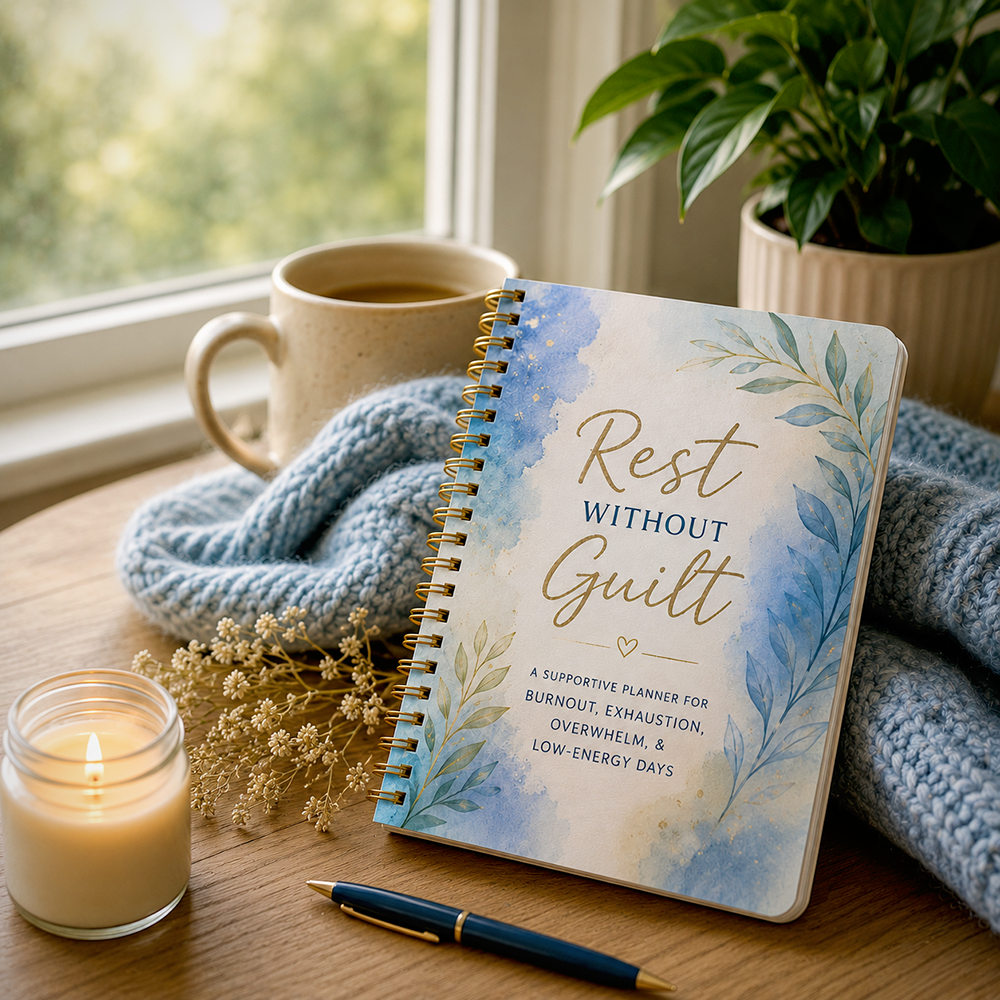
My own experiences with exhaustion, burnout, and learning to slow down inspired me to create Rest Without Guilt: A Supportive Planner for Burnout, Exhaustion, Overwhelm, & Low-Energy Days.
Not because a planner magically fixes burnout.
Healing is not a checklist.
Recovery is not another project to perfect.
Instead, I wanted to create a gentle space for reflection, self-compassion, and reconnecting with yourself.
A reminder that your worth is not measured by how much you accomplish.
Inside, there are pages designed to help explore things like:
- Recognizing what burnout looks like
- Understanding your needs and limits
- Checking in with your nervous system
- Supporting yourself on low-energy days
- Finding small moments of comfort and hope
- Remembering what brings you joy
- Reconnecting with parts of yourself that may have been buried under survival
Because sometimes the goal is not immediately becoming the most productive version of yourself again.
Sometimes the first step is simply remembering: “I am a person who deserves care, too.”
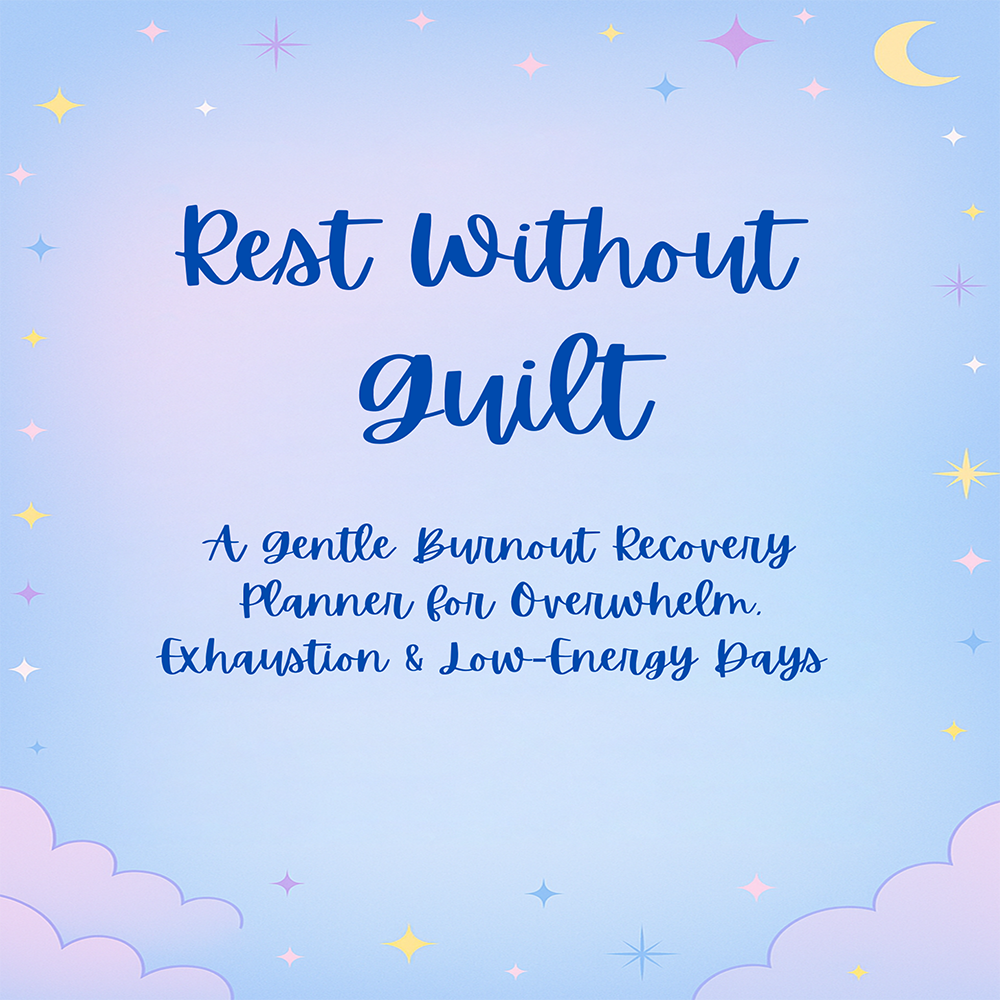
Rest Without Guilt
A Gentle Burnout Recovery Planner for Overwhelm, Exhaustion & Low-Energy Days
Rest Is How We Continue
Rest is not the opposite of growth.
Sometimes rest is what makes growth possible.
We live in a world that often celebrates constant movement.
The next achievement.
The next goal.
The next responsibility.
The next thing waiting to be checked off the list.
But humans were never meant to run endlessly without care.
We are not machines.
We are not batteries that can simply be replaced when we run out.
We are living, breathing beings who need moments of restoration.
Sometimes resting can feel like standing still.
But standing still is not always the same as being stuck.
A seed buried underground may look like nothing is happening.
But beneath the surface, something important is taking place.
Roots are growing.
Strength is forming.
A foundation is being created.
Not all growth is visible.
Maybe you are in a season of blooming.
Maybe you are in a season of rebuilding.
Maybe you are in a season where simply making it through the day takes more energy than anyone else realizes.
Wherever you are, your season matters.
You do not have to earn the right to care for yourself.
You do not have to break completely before you are allowed to rest.
Resting does not mean you stopped caring.
Resting does not mean you failed.
Resting does not mean your story is over.
Sometimes rest is the pause that allows the next chapter to exist.
Sometimes slowing down is how we finally hear ourselves again.
Sometimes taking care of ourselves is the very thing that allows us to keep sharing our light with the world.
Because you were never meant to spend your entire life proving you are worthy of rest.
You already are.
 Jessica Carey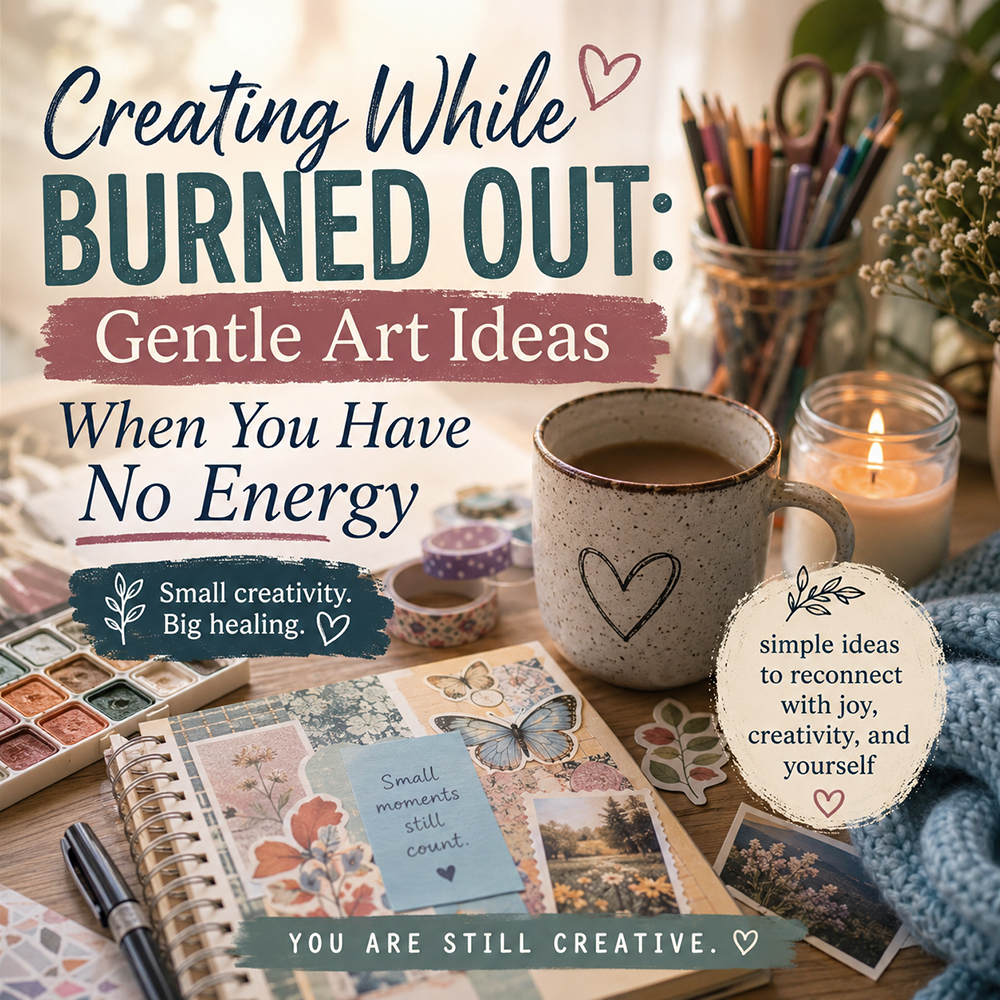
Want even more content about creativity and art?
Be sure to check out all of our creative chronicles!
If you'd like to see examples of my work, you can find some of my art and creations at Redbubble and Gumroad!
Want to check out art spaces and resources?
Check out some of these articles:
-Hidden Gems for St. Louis Artists
-Perennial Copper Jewelry Class
-Leftovers and Upcycle Treasure Box
 Jessica Carey