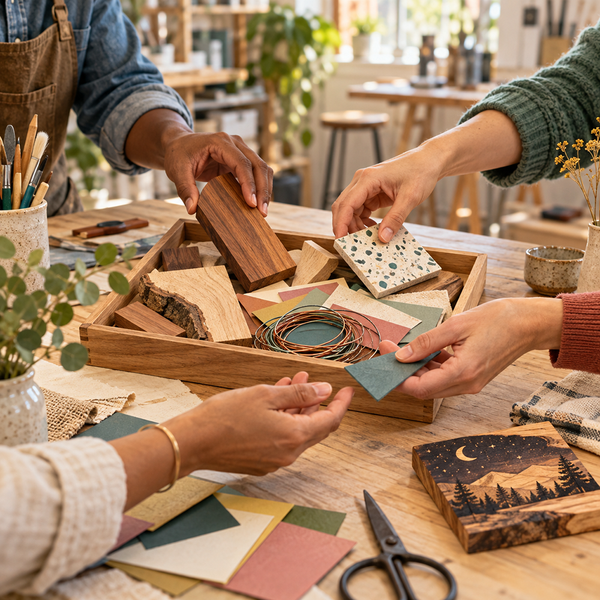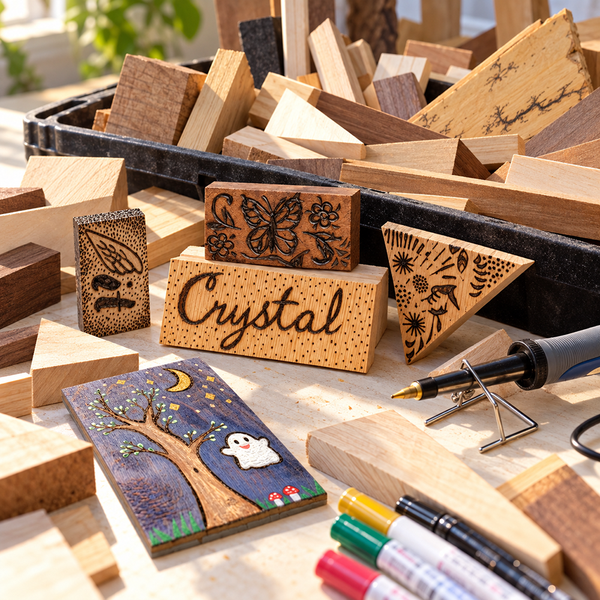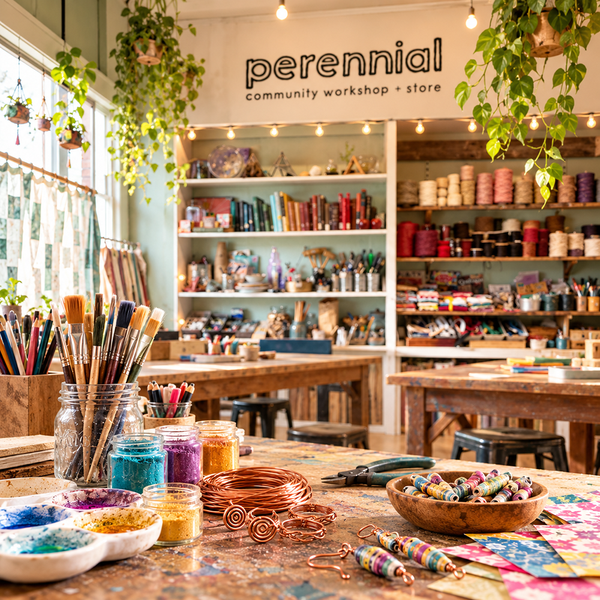

Sometimes creativity begins with a simple question: “What if this could become something else?”
A scrap of fabric.
An old piece of jewelry.
A discarded frame.
A leftover piece of wood.
A forgotten box of supplies.
A piece of copper wire hiding inside an old cord.
At first glance, these things may not seem special. They may look outdated, damaged, incomplete, or no longer useful.
But creativity has a way of asking us to look again.
Because sometimes the materials we need are already around us.
They are just waiting for someone to see their potential.
Table of Contents
- Creative Reuse Centers
- Salvage & Building Materials
- Electronics, Copper & Metal
- Thrift Stores & Secondhand Finds
- Community Marketplaces & Sharing
- Tools, Supplies & Skill Building
- Swaps, Repair & Keeping Resources Moving
- Feeling Overwhelmed? Start Here
- Quick St. Louis Resource Guide
 Jessica Carey
Discovering the Magic of Creative Reuse
Recently, I took an upcycled copper jewelry class at Perennial in St. Louis.
Instead of buying brand-new copper wire from a jewelry supplier, we learned how to transform salvaged electrical wire into handmade rings and bracelets.
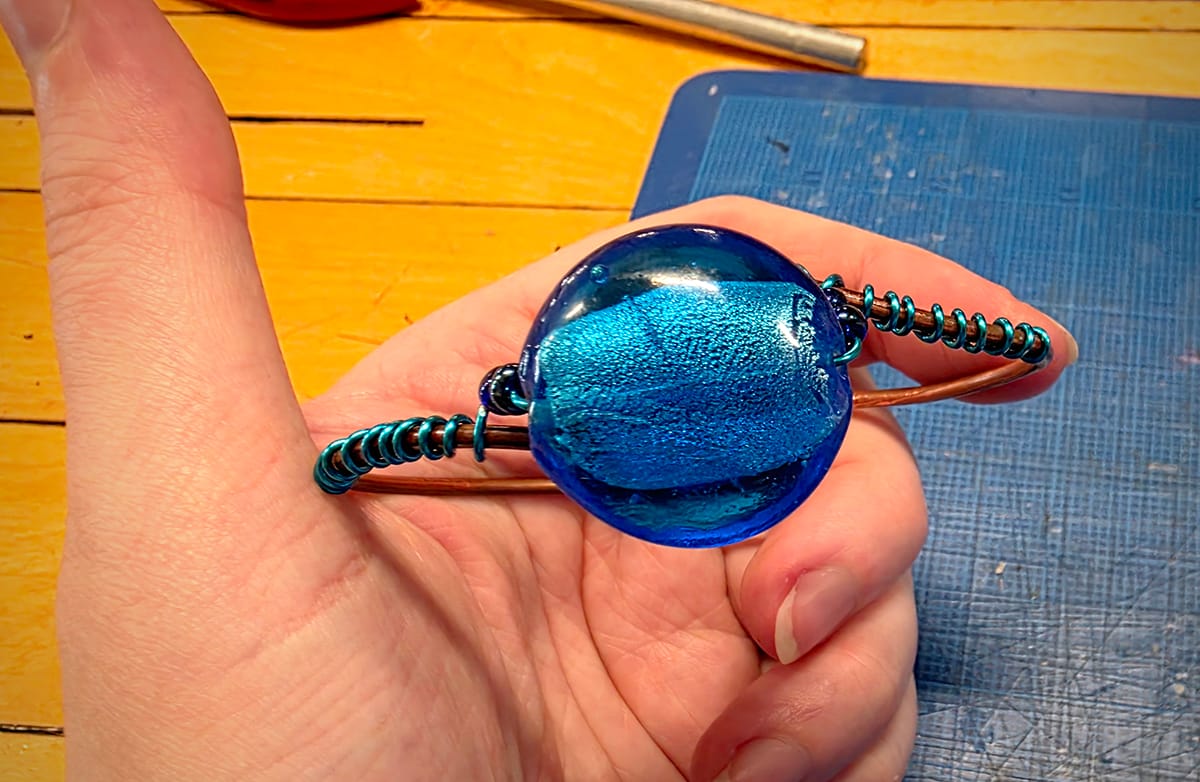
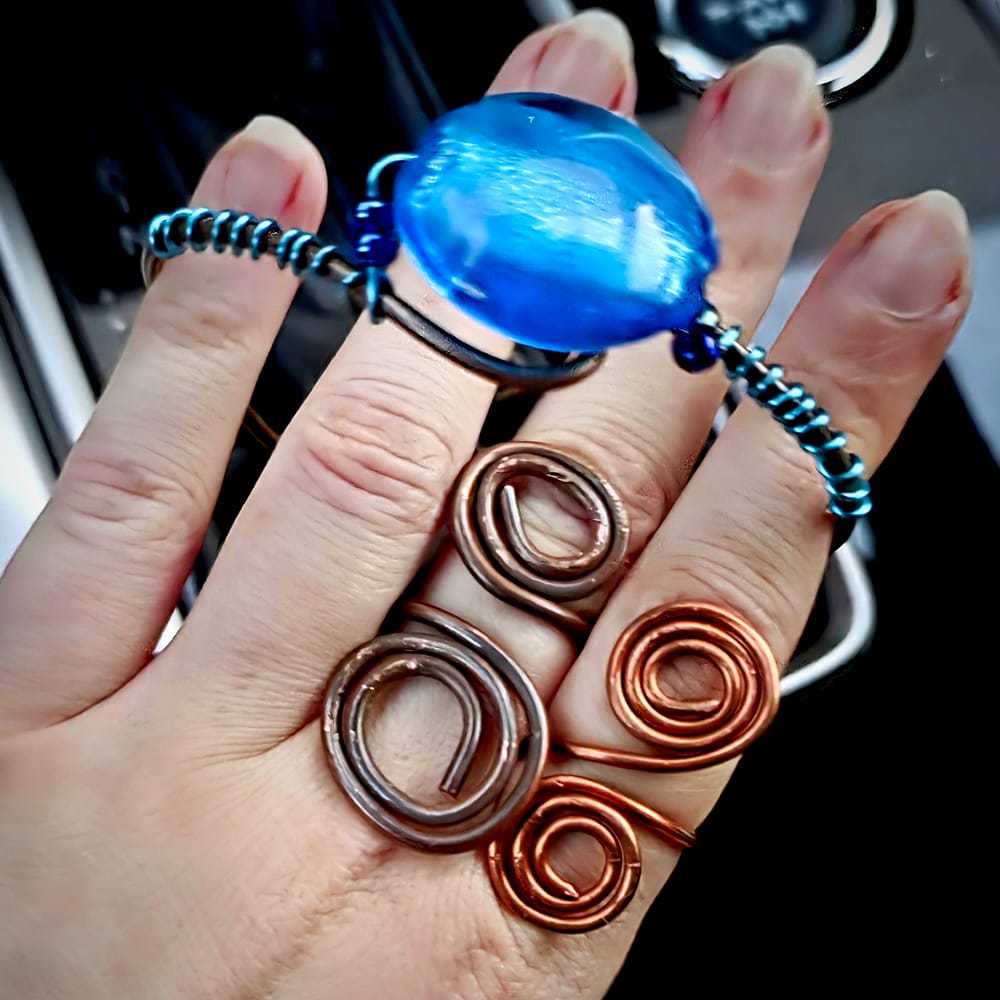
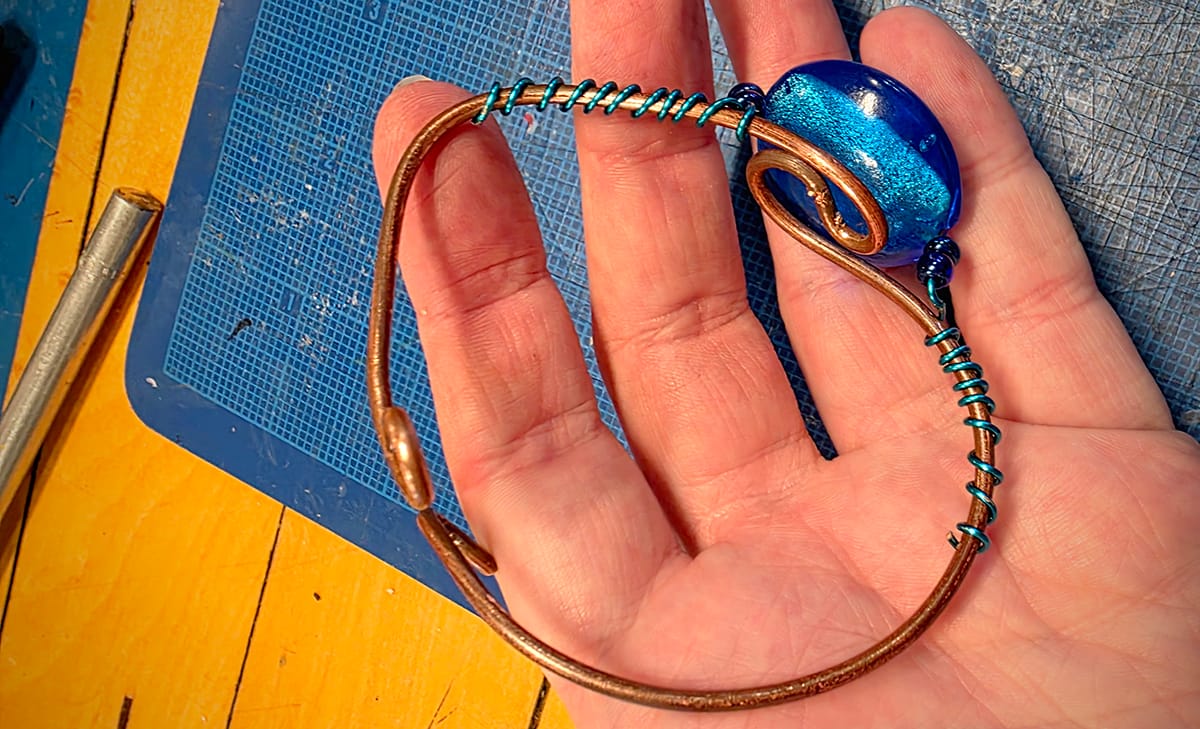
Something that could have easily been overlooked became something beautiful.
And honestly, that lesson went far beyond jewelry.
It changed the question from: “Where can I buy supplies?”
To: “What already exists that could be given another life?”
That small shift opens up an entirely different creative world.
Because artists, makers, and DIYers have always been experts at transformation.
We see possibilities.
We experiment.
We imagine.
We take what exists and create something new.
 Jessica Carey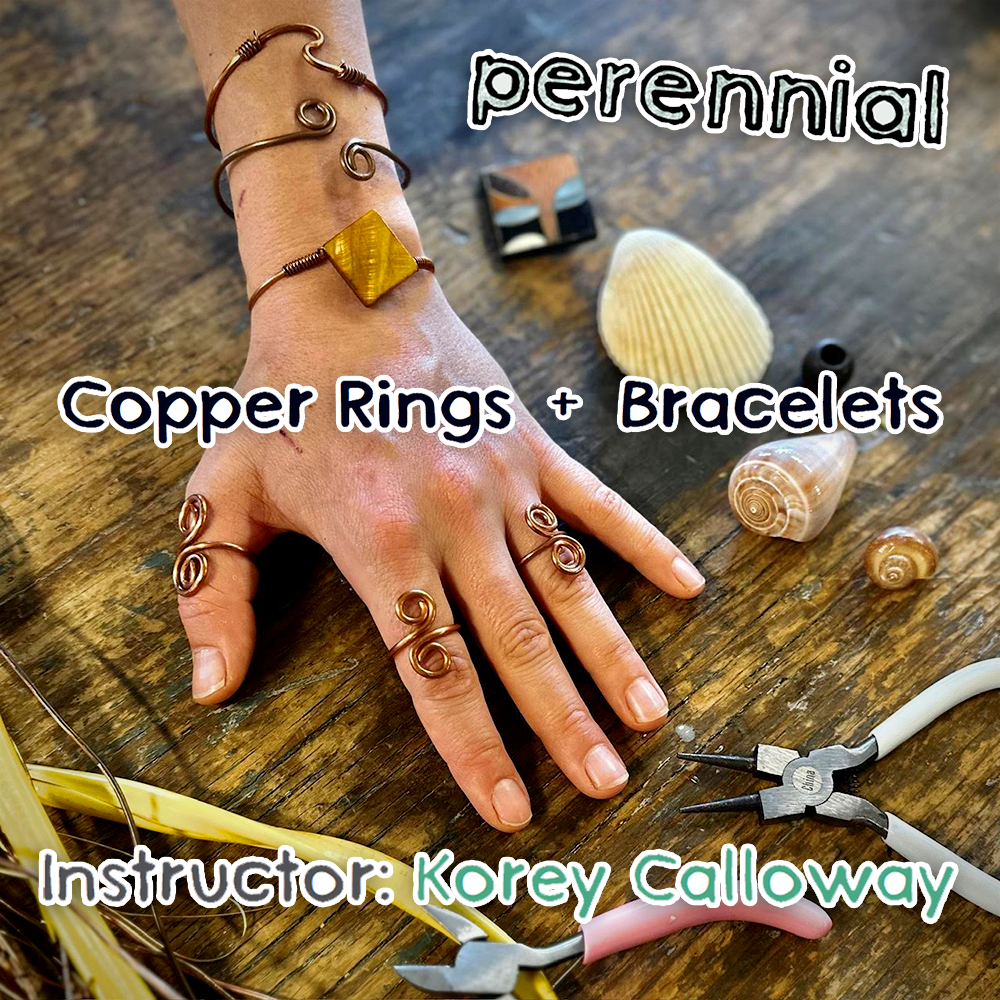
Why Creative Reuse Matters
Creative reuse is about more than saving money, although affordable materials can make a huge difference.
It is also about:
Reducing waste
Many usable materials end up discarded simply because they no longer serve their original purpose.
Creative reuse asks: “Could this become something else before it disappears?”
Making creativity more accessible
Art supplies can become expensive quickly.
When materials are affordable or reused, more people get the opportunity to create, learn, experiment, and discover new skills.
Creative reuse can be especially meaningful for people who have been priced out of traditional creative spaces. Everyone deserves opportunities to explore, experiment, and create.
Encouraging experimentation
Sometimes expensive supplies create pressure.
You might hesitate because you think:
- “What if I mess this up?”
- “What if I waste it?”
- “What if my idea doesn’t work?”
But creativity grows through exploration.
Lower-cost and reclaimed materials can give you permission to play.
To try.
To fail.
To learn.
To discover.
Some of the most interesting creative ideas happen when you stop chasing perfection and start asking: “What happens if I try?”
 Jessica Carey
Creative Reuse Centers: The Perfect Place to Begin
If you are interested in upcycling, mixed media, sustainable crafting, or affordable creativity, creative reuse centers are often the best starting point.
Unlike traditional stores, these places are constantly changing.
You usually cannot walk in with an exact shopping list.
Instead, it feels more like a treasure hunt.
You might find something you did not even know you were looking for.
A material.
A texture.
A color.
A strange little object that sparks an idea.
Creative reuse centers remind us that inspiration does not always come first.
Sometimes the material itself starts the story.
 Jessica Carey
Perennial — Creative Reuse, Classes & Sustainable Making
Location: 3762 South Broadway, St. Louis, MO 63118
Contact email: info@perennialstl.org
One of St. Louis’ most well-known creative reuse organizations is Perennial.
Perennial is built around the idea that discarded materials still have value.
Through their resale shop, workshops, and community programs, they help people rethink the relationship between creativity and waste.
Their shop can be a great place to search for secondhand creative materials, including things like:
- Fabric and fiber materials
- Paper
- Craft supplies
- Tools
- Jewelry-making materials
- Unique objects for creative projects
- Unexpected finds that change depending on donations
Beyond supplies, one of Perennial’s biggest strengths is education.
Their classes help people learn practical skills such as repairing, reusing, and transforming materials.
Whether someone is interested in sewing, woodworking, jewelry, home projects, or simply learning a new creative skill, spaces like this help make sustainable creativity feel possible.
Because sometimes the biggest barrier is not imagination.
It is simply needing someone to show: “Here is another way.”
Leftovers, etc. — Rescued Materials Waiting for a New Purpose
Location: 4349 Woodson Road, Suite 500, St. Louis, MO 63134
Contact email: resrecovery@sbcglobal.net
Another wonderful resource in the St. Louis region is Leftovers, etc.
The idea behind rescued resource centers is simple but powerful:
Materials that might be unwanted by one person can become exactly what someone else needs.
Instead of supplies sitting forgotten in storage or being thrown away, they are redirected into classrooms, studios, homes, and creative projects.
Places like Leftovers, etc. can be especially helpful for:
- Artists experimenting with new mediums
- Teachers looking for classroom materials
- Families creating together
- Makers searching for unusual supplies
- Anyone who enjoys the surprise of finding unexpected materials
One of the joys of creative reuse shopping is that you are not just buying supplies.
You are discovering possibilities.
STL Teachers Trading Post Upcycle Treasure Box — Turning Extra Materials Into Opportunities
Location: 5628 Gravois Avenue, St. Louis, MO 63116
Contact email: jenni@stlteachertradingpost.com
Another creative reuse resource is STL Teachers Trading Post’s Upcycle Treasure Box.
Although many people hear “teacher supplies” and think only educators can benefit, creative materials often overlap.
The same resources used for learning can become:
- Art projects
- Mixed media creations
- Craft experiments
- Journaling materials
- Community projects
Creative reuse centers create a bridge between people who have extra materials and people who can transform them.
Instead of asking: “Is this still useful for its original purpose?”
Artists ask: “What else could this become?”
And that question is where creativity begins.
 Jessica Carey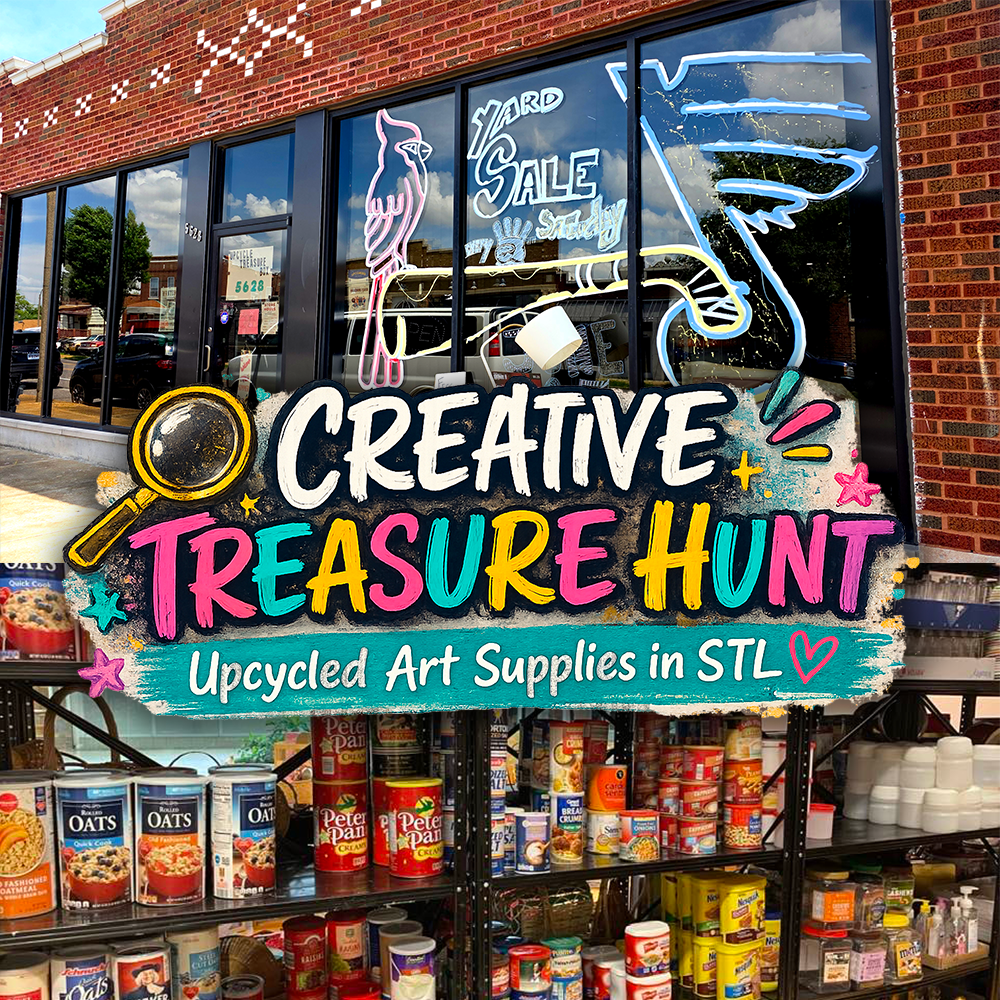
Beyond Art Supplies: Finding Creativity in Unexpected Places
One of the biggest lessons of creative reuse is learning to see materials differently.
A traditional art store organizes materials by what they are supposed to become.
Paint is for painting.
Clay is for sculpting.
Beads are for jewelry.
But upcycling asks a different question.
Not: “What was this made for?”
But: “What else could this become?”
That simple question changes everything.
Suddenly, creative supplies are not only found in craft aisles.
They might be hiding in:
- Salvage stores
- Recycling centers
- Thrift shops
- Garages
- Workshops
- Old furniture
- Broken objects
- Leftover materials
Because sometimes creativity is not about finding something new.
Sometimes it is about seeing something familiar in a completely new way.
 Jessica Carey
ReFab — Reclaimed Materials for Builders, Artists & Makers
Location: 2801 Gravois Avenue, St. Louis, MO 63118
Contact email: info@refabstl.org
One resource recommended after my upcycled copper jewelry class was ReFab, a St. Louis nonprofit focused on keeping usable materials from going to waste.
While many people think of reclaimed building materials for home projects, artists and makers can also find inspiration in these spaces.
Depending on what is available, salvage resources may carry materials like:
- Wood
- Hardware
- Fixtures
- Doors
- Cabinets
- Architectural pieces
- Unique materials with history
For creative people, these items can become much more than their original purpose.
Old wood can become:
- Signs
- Frames
- Sculptures
- Furniture transformations
Hardware can become:
- Mixed media art
- Assemblage pieces
- Jewelry
- Decorative elements
Architectural salvage is especially interesting because many pieces already carry a story.
Creative reuse allows that story to continue in a new form.
Habitat for Humanity ReStore — Secondhand Building Supplies & DIY Possibilities
Locations:
3830 South Grand Boulevard, St. Louis, MO 63118
2117 Sams Drive, Des Peres, MO 63131
186 Mid Rivers Center, St Peters, MO 63376
Contact link: https://www.habitat.org/contact/form
Another resource for makers and upcyclers is Habitat for Humanity ReStore.
ReStores collect donated home improvement materials and give them another chance to be used.
While many shoppers visit for home projects, artists can look at these materials through a creative lens.
Potential finds may include:
- Furniture
- Frames
- Cabinets
- Hardware
- Lighting
- Tile
- Wood
- Fixtures
- Storage solutions
For DIY creators, furniture flippers, and mixed media artists, these places can become treasure hunts.
A scratched table could become a restoration project.
An old cabinet door could become a painting surface.
A forgotten frame could become part of something completely new.
The key is practicing the creative reuse question: “What else could this become?”
 Jessica Carey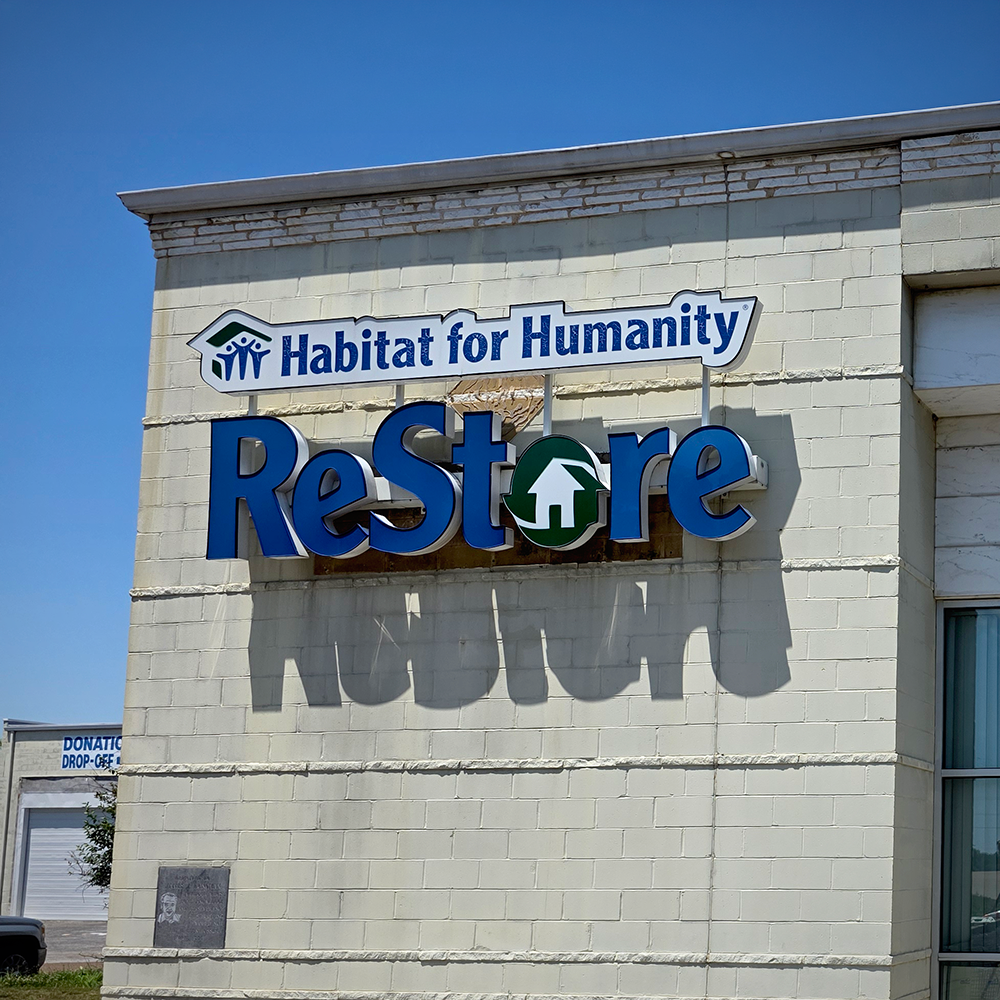
Electronics, Copper & Metal: Finding Beauty in Unexpected Materials
One of my favorite examples of creative reuse is turning salvaged copper electrical wire into jewelry.
Copper is commonly used in jewelry making because it is:
- Beautiful
- Flexible
- Durable
- Able to develop character over time
But buying new copper wire from jewelry suppliers can become expensive.
Learning that copper could be salvaged from existing materials completely changed how I viewed everyday objects.
An old cord was no longer just an old cord.
It was a possible ring.
A bracelet.
A pendant.
A future creation.
Earthbound Recycling — Salvaged Materials for Creative Projects
Location: 25 Truitt Drive, Eureka, MO 63025
Contact number: 636-938-1188
Another resource recommended after my copper jewelry class was Earthbound Recycling.
Unlike some recycling centers that only process materials, Earthbound Recycling was specifically recommended as a place where people can shop for electrical wire and other reclaimed materials.
For artists interested in:
- Copper jewelry
- Metal art
- Sculpture
- Mixed media
- Upcycled projects
places like this can be incredibly valuable.
They remind us that useful materials often already exist.
They just need someone willing to see their next chapter.
Scrap Metal & Recycling Businesses
Metal recycling businesses can also be interesting resources for artists.
Depending on the business and their policies, artists may be able to find materials such as:
- Copper
- Metal pieces
- Hardware
- Industrial materials
- Unique objects
These materials can be useful for:
- Jewelry making
- Sculpture
- Assemblage art
- Mixed media
However, every recycling business works differently.
Some allow individuals to purchase materials.
Some only process incoming materials.
Some have safety restrictions.
It is always best to contact businesses first and ask: “I’m a local artist creating with reclaimed materials. Do you allow artists to purchase small amounts of scrap materials for creative reuse?”
Sometimes asking one question opens an unexpected door.
A Note About Safely Reusing Materials
Transforming old materials can be exciting, but safety matters.
Before dismantling electronics or using unfamiliar materials:
- Research what you are working with
- Avoid materials that may contain hazardous components
- Use appropriate tools and protection
- Learn safe techniques before cutting, stripping, sanding, or heating materials
Creative reuse is about respecting resources.
That includes respecting yourself and creating safely.
Be cautious with:
- unknown chemicals
- old painted materials (especially very old paint)
- damaged batteries
- electronics components you cannot identify
- moldy materials
- anything with strong unknown residue
- materials that create unsafe dust/fumes when cut, heated, or sanded
When in doubt, research first. Creative reuse should protect both the planet and the person creating.
Thrift Stores: Learning to See Materials Instead of Objects
One of the most accessible resources for upcycling and creative reuse is something many communities already have:
Thrift stores.
But the secret is learning how to look.
When you walk through a thrift store, try not to only ask: “Do I want this item exactly as it is?”
Instead ask: “What materials are here?”
Because an upcycler sees things differently.
A damaged necklace is not only a damaged necklace.
It is:
- Beads
- Charms
- Chains
- Pendants
An outdated piece of clothing is not only clothing.
It is:
- Fabric
- Buttons
- Lace
- Texture
- Patterns
An old frame is not only a frame.
It is:
- Wood
- Glass
- A future painting surface
- Part of a mixed media project
Creative reuse invites us to look beyond an object’s first purpose and imagine another possibility.
What Artists Can Look for While Thrifting
Different artists will notice different treasures.
For jewelry makers:
- Broken jewelry
- Beads
- Chains
- Charms
- Interesting small objects
- Jewelry boxes for storage
For fiber artists:
- Clothing
- Scarves
- Curtains
- Blankets
- Tablecloths
- Fabric remnants
- Sewing supplies
For painters:
- Frames
- Canvases
- Wood pieces
- Containers
- Interesting surfaces
For mixed media artists:
- Old books
- Magazines
- Maps
- Photos
- Buttons
- Hardware
- Decorative objects
- Unique textures
For DIY creators:
- Furniture
- Storage pieces
- Home decor
- Lamps
- Items ready for transformation
The more you practice seeing materials instead of objects, the more possibilities appear.
St. Louis Area Thrift Stores to Explore
Luckily, the St. Louis area has many thrift stores where artists, makers, and upcyclers can search for creative materials.
Inventory changes constantly, so every visit is different.
Think of it as a treasure hunt rather than a traditional shopping trip.
Found by the Pound
Locations:
3232 South Grand, St. Louis, MO 63118
6325 Delmar Boulevard, St. Louis, MO 63130
6740 Romiss Court, Berkeley, MO 63134
Contact email: fbtp.rocks@gmail.com
Found by the Pound is especially interesting for upcyclers because it encourages a different kind of searching.
Instead of looking only for finished items, creators can search through secondhand materials and imagine what they could become.
For artists interested in:
- Textiles
- Wearable art
- Sewing projects
- Fabric reuse
- Creative experimentation
places like this can provide affordable opportunities to explore.
 Jessica Carey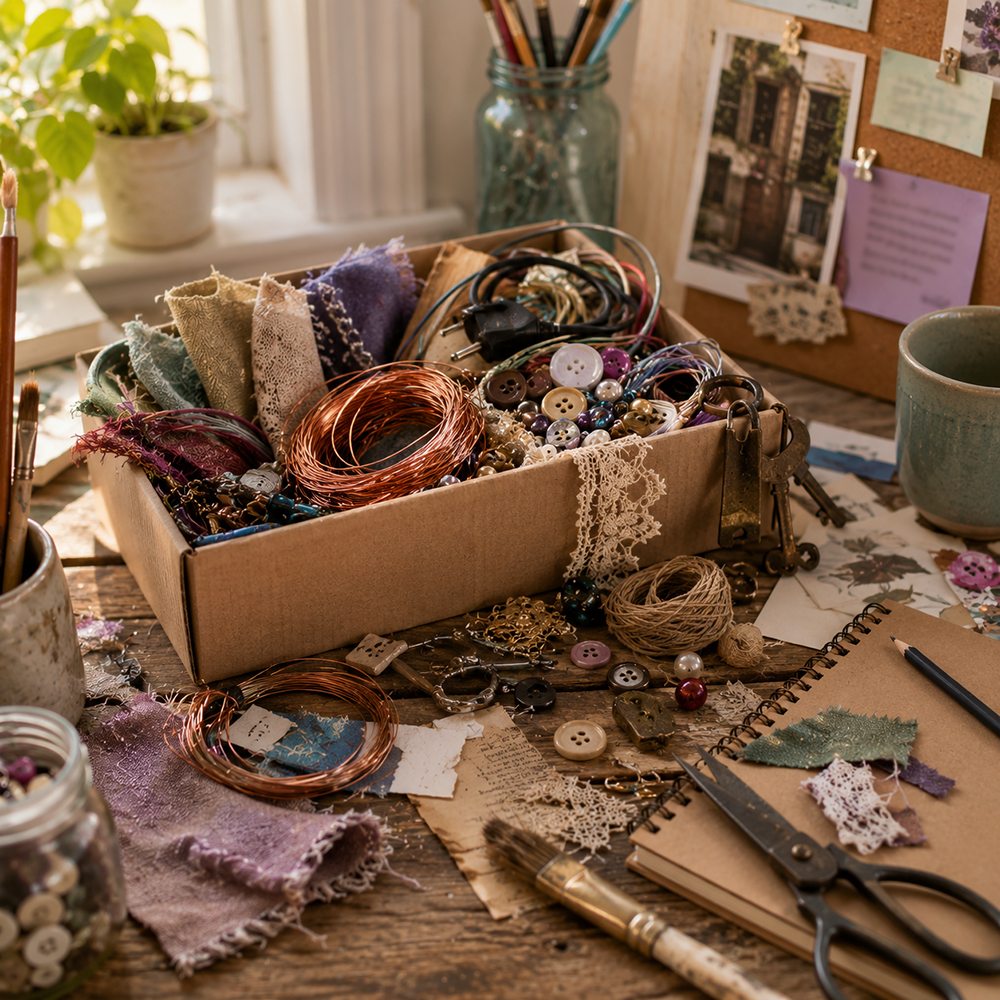
Savers
Locations:
9618 Watson Road, Sappington, MO 63126
13867 Manchester Road, Ballwin, MO 63011
1690 Country Club Plaza Drive, Saint Charles, MO 63303
Contact link: https://www.savers.com/contact-us
Savers is another thrift option in the St. Louis area where makers can look for secondhand materials.
Possible creative finds include:
- Clothing for fabric
- Frames
- Books
- Household items
- Storage containers
- Jewelry
- Craft supplies
For upcycling, sometimes the best finds are not in the craft aisle.
They are hidden throughout the store.
Society of St. Vincent de Paul Thrift Stores
Locations:
1310 Papin Street, St. Louis, MO 63103
2500 Lemay Ferry Road, St. Louis, MO 63125
4928 Christy Boulevard, St. Louis, MO 63116
11015 Olive Boulevard, St. Louis, MO 63141
Contact link: https://svdpstlouis.org/contact-us/
St. Vincent de Paul thrift stores can also be helpful places to explore.
Depending on donations, shoppers may discover:
- Furniture
- Home goods
- Books
- Frames
- Clothing
- Supplies for creative projects
Secondhand shopping also supports the idea that usable items deserve another opportunity instead of immediately becoming waste.
Goodwill
Location: Goodwill has many locations throughout the St. Louis region, including St. Louis City, St. Louis County, St. Charles County, and surrounding areas. Check their website for the closest location.
Contact link: https://mersgoodwill.org/contact-us/
Goodwill locations throughout the St. Louis area are another option for finding secondhand materials.
For artists, it can help to look beyond categories.
Instead of: “This is a shirt.”
Try: “This is fabric.”
Instead of: “This is outdated decor.”
Try: “What parts of this could become something new?”
A creative mindset can completely change what you notice.
Local & Independent Thrift Shops
Beyond larger thrift organizations, keep an eye out for smaller local thrift shops.
Independent stores can sometimes have unique items because donations and inventory vary so much.
Search:
- “thrift stores near me”
- “secondhand shops near me”
- “resale shops near me”
- “estate resale stores near me”
Some of the best creative finds happen unexpectedly.
A place you almost skipped may have exactly the material you needed.
Estate Sales, Garage Sales & Moving Sales
Another overlooked resource for artists is estate and garage sales.
These are especially helpful because you may find collections built over many years.
Look for:
- Craft rooms being cleared out
- Sewing supplies
- Tools
- Jewelry collections
- Art supplies
- Woodworking materials
- Office supplies
- Storage containers
Many people spend decades collecting creative materials.
Estate sales allow those supplies to continue inspiring someone new.
Community Marketplaces: Finding Materials Before They Become Waste
Not every creative resource comes from a store.
Sometimes the best materials are sitting unused in someone’s home.
Places to check:
- Facebook Marketplace
- Buy Nothing groups
- Craigslist Free section
- Nextdoor
These resources work especially well when you make specific requests.
Instead of: “Does anyone have art supplies?”
Try: “I make upcycled jewelry and am looking for broken jewelry, beads, old cables, or small materials that would otherwise be discarded.”
People may not realize they have creative materials until you help them see the possibility.
Someone else’s forgotten item could become your next creation.
 Jessica Carey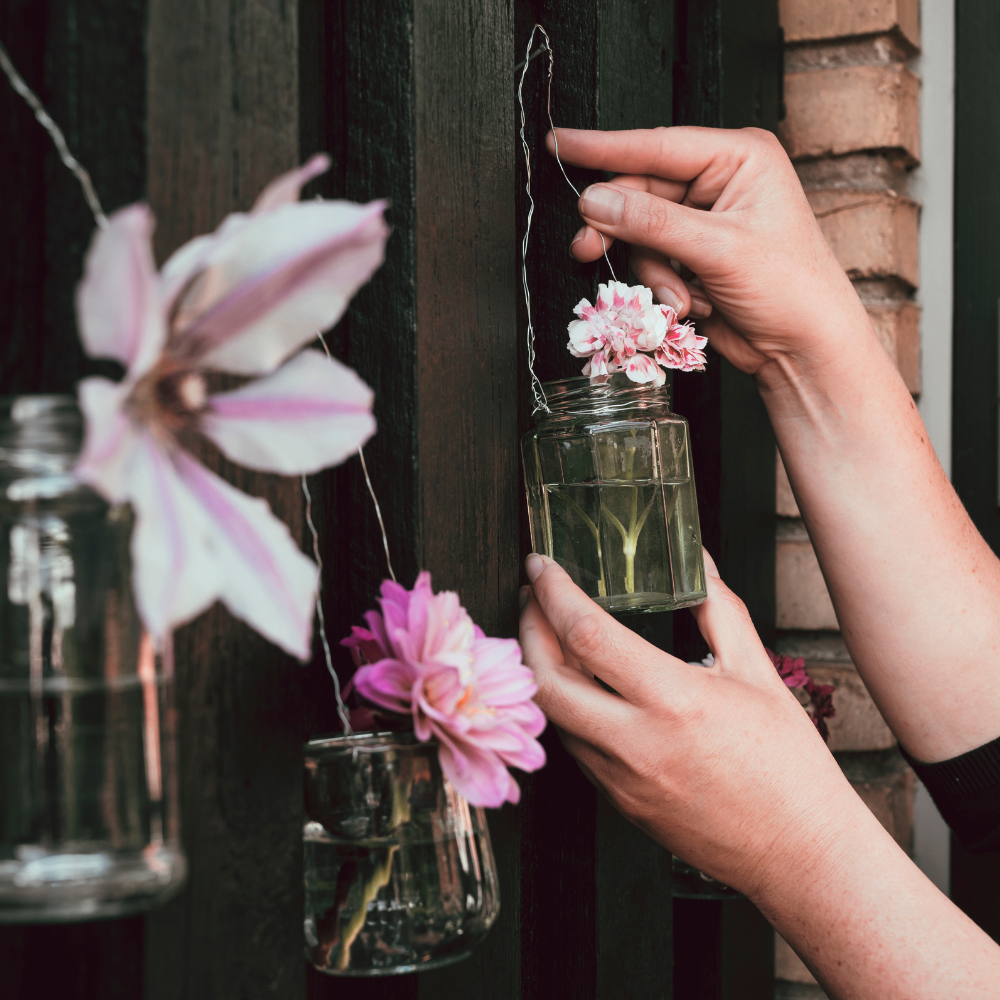
Tools, Skills & Learning: Turning Found Materials Into Finished Creations
Finding materials is an exciting first step.
But sometimes another question appears: “Now what do I do with it?”
A piece of copper wire has potential.
A thrifted piece of furniture has potential.
A pile of fabric has potential.
But transforming those materials often requires something else:
- Tools
- Knowledge
- Practice
Creative reuse is not about magically knowing what to do with every material you find.
It is about learning.
Experimenting.
Building skills one step at a time.
Luckily, there are resources that can help make those skills more accessible.
Affordable Tools: You Do Not Need Everything at Once
One common barrier when starting a new creative hobby is feeling like you need every possible tool before beginning.
Professional tools can be amazing.
But you do not always need a perfect studio setup to start.
Begin with: “What do I need for this specific project?”
Instead of: “What does every expert own?”
For example, after taking an upcycled copper jewelry class, the basic tools included:
- Round-nose pliers
- Needle-nose pliers
- Wire cutters
- Wire strippers
Those few tools open the door to many projects.
You can always expand your collection over time as you learn what you actually use.
Harbor Freight — Affordable Tools for Makers
Location: 7597 South Lindbergh Boulevard, St. Louis, MO 63125
Contact email: cs@harborfreight.com
While people may think of Harbor Freight mainly for mechanics, construction, and home projects, many makers use basic hardware tools for creative work.
Depending on your projects, you may find:
- Pliers
- Wire cutters
- Clamps
- Storage containers
- Safety equipment
- Hand tools
For artists exploring things like:
- Jewelry making
- Woodworking
- Sculpture
- Furniture restoration
- Mixed media
basic tools can make experimentation much easier.
Sometimes creativity is not limited by imagination.
Sometimes you simply need the right tool to bring an idea to life.
Schaefer’s Hobby Shop — Specialty Supplies & Creative Materials
Location: 11659 Gravois Road, St. Louis, MO 63126
Contact email: schaeferhobby@outlook.com
Another local resource recommended after the upcycled copper jewelry class was Schaefer’s Hobby Shop.
Local hobby shops can be valuable because they often carry materials and tools for more specific creative interests.
Depending on your craft, hobby shops may offer supplies for areas like:
- Jewelry making
- Models
- Miniatures
- Crafts
- Specialty projects
While creative reuse often focuses on salvaged materials, sometimes combining reclaimed materials with a few specific supplies helps complete a project.
A reused piece of copper wire.
A secondhand bead.
A new clasp or tool.
Creative reuse does not mean everything has to be salvaged.
It means being thoughtful about what you use and finding balance.
Classes & Workshops: Learning Skills That Last
One of the most valuable creative resources is not always a physical object.
Sometimes the best resource is knowledge.
A class can teach a skill you use for years.
A workshop can introduce you to a technique you never knew existed.
A teacher can show you possibilities you may not have discovered alone.
For example, learning how to transform salvaged electrical wire into jewelry did not only create one project.
It created a new way of seeing materials.
Now an old cord looks different.
A piece of wire looks different.
A discarded material becomes an opportunity.
Places to Learn Creative Skills
There are many organizations where people can explore new creative skills.
Look into resources like:
- Creative reuse workshops
- Community art classes
- Maker spaces
- Libraries
- Local studios
- Community education programs
Depending on your interests, you may find classes in:
- Sewing
- Repair skills
- Jewelry making
- Woodworking
- Painting
- Pottery
- Fiber arts
- Mixed media
You do not have to learn everything at once.
Every new skill expands what materials you can use.
Repair Skills Are Creative Skills Too
One of the most overlooked parts of creative reuse is repair.
Repair asks: “Can this continue?”
Instead of: “Should this be replaced?”
Learning basic repair skills can help with:
- Fixing clothing
- Restoring furniture
- Repairing jewelry
- Updating old objects
- Maintaining tools
Sometimes creativity does not mean making something completely new.
Sometimes creativity means helping something old continue its story.
Building Your Creative Toolkit Slowly
A creative toolkit is not built overnight.
Most artists collect supplies, tools, and knowledge gradually.
One class.
One project.
One experiment.
One discovered resource.
Over time, you begin creating your own collection of possibilities.
The goal is not having everything.
The goal is having enough to begin.
Because beginning is where creativity grows.
Community Sharing: Swaps, Repair & Keeping Resources Moving
Creative reuse is not only about finding materials.
It is also about changing our relationship with the things we already have.
In a world that often encourages us to constantly buy more, replace faster, and chase what is new, reuse invites us to slow down and ask different questions:
- “Could this still be useful?”
- “Could someone else use this?”
- “Could this become something completely different?”
Sometimes the most sustainable option is not finding something new.
It is helping existing resources continue moving.
Clothing Swaps: Giving Textiles Another Life
Clothing is one of the easiest places to start practicing reuse because almost everyone interacts with textiles.
Most people have experienced looking into their closet and finding something they no longer wear.
Maybe:
- It does not fit anymore
- Your style changed
- It needs a small repair
- You bought it for something specific
- It has been sitting untouched for years
But just because something no longer works for one person does not mean it has lost value.
For someone else, that same item might become:
- A new favorite outfit
- Fabric for sewing
- Material for quilting
- A costume piece
- Part of an art project
Perennial Clothing Swaps
In addition to creative reuse classes and supplies, Perennial hosts clothing swaps throughout the year.
Events like these are wonderful because they create a cycle:
Someone brings what they no longer need.
Someone else finds exactly what they were looking for.
Items stay useful.
Waste decreases.
Community grows.
A clothing swap is not just about getting clothes.
It is about remembering that resources can circulate.
Learning to See Clothing as Material
For artists and makers, secondhand clothing can become much more than clothing.
A thrifted shirt might become:
- Fabric patches
- Embroidery practice
- A sewing project
- Doll clothing
- Mixed media texture
An old sweater might become:
- Yarn
- Mittens
- Stuffed animals
- Fiber art
Jeans might become:
- Bags
- Quilts
- Repairs
- Wearable art
When you learn to see materials, possibilities multiply.
Repair Culture: Extending the Life of What Already Exists
Another important part of creative reuse is repair.
Sometimes the most creative thing you can do is not making something brand new.
Sometimes it is helping something continue.
Repair asks: “What does this need?”
Instead of: “What should replace it?”
Learning simple repair skills can help reduce waste while also saving money.
Examples:
- Sewing on buttons
- Patching clothing
- Fixing jewelry
- Repairing furniture
- Restoring old items
- Refreshing something outdated
Small skills can completely change how you interact with objects.
Repair Cafés & Community Fix-It Events
Some communities host events where people gather to repair items together.
These events may include help with things like:
- Clothing repairs
- Small household items
- Electronics
- Bikes
- Furniture
Even if you cannot fix something yourself, being around people who know how can help you learn.
Knowledge is a resource, too.
Someone’s skill can prevent another person’s item from being thrown away.
Libraries: More Than Books
Libraries are one of the most underrated community resources.
Many people think: “I do not need a library because I can find information online.”
But modern libraries often provide much more than books.
Depending on the library system, resources may include:
- Free classes
- Workshops
- Community events
- Technology access
- Creative programs
- Research tools
- Meeting spaces
Some libraries even offer things like:
- Makerspaces
- Equipment access
- Craft programs
- Tool lending programs
Libraries are built around one of the most powerful ideas:
Not everyone needs to individually own everything.
Sometimes access matters more than ownership.
 Jessica Carey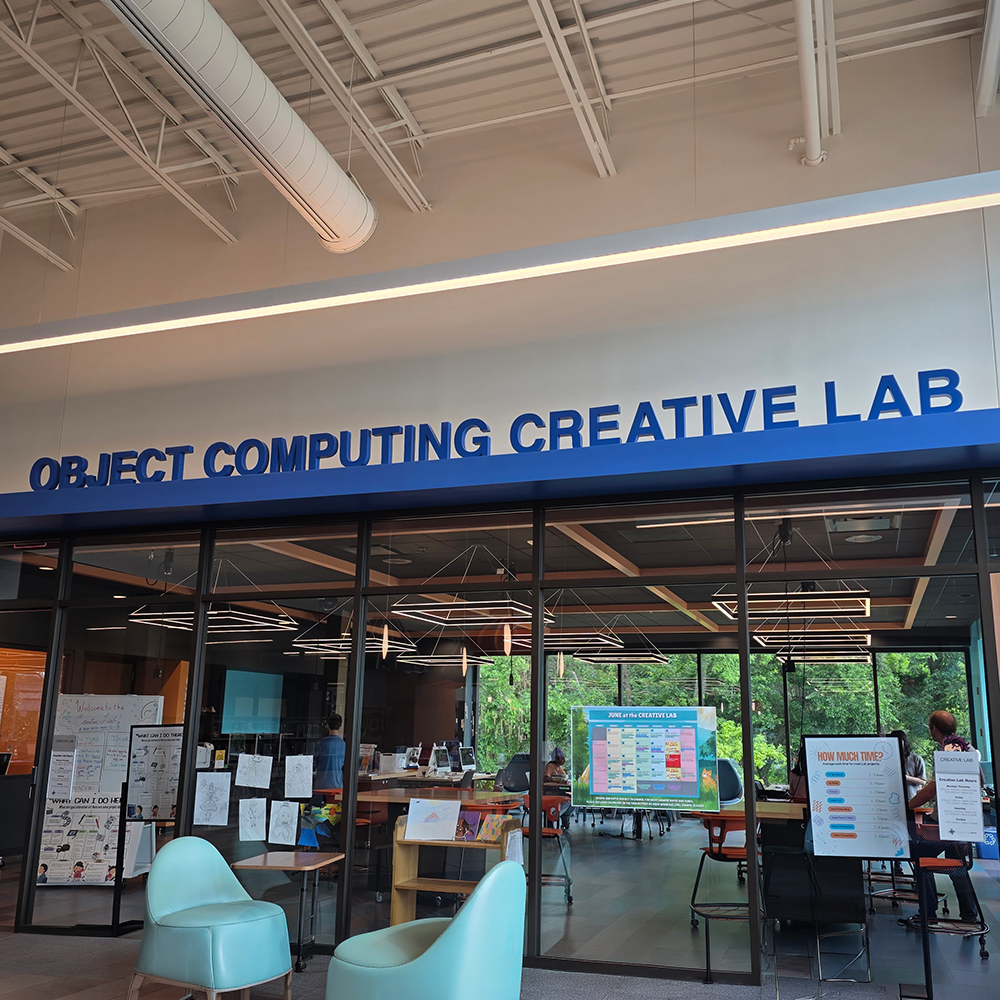
Sharing Instead of Everyone Starting From Zero
One challenge many creatives face is feeling like they need to personally own every possible supply.
Every tool.
Every material.
Every piece of equipment.
But community changes that.
Maybe one person has a tool they rarely use.
Someone else has leftover materials.
Someone else has knowledge.
Someone else knows about a helpful resource.
When those things are shared, everyone benefits.
That is how creative communities become stronger.
Creating Your Own Mini Resource Network
You do not need to wait for a formal organization to begin sharing.
A creative resource network can start small.
Maybe you:
- Trade supplies with another artist
- Share extra materials after finishing a project
- Tell someone about a helpful organization
- Offer supplies you no longer use
- Teach someone a skill you learned
One connection can become many.
Before Throwing Something Away, Ask Three Questions
Creative reuse does not mean keeping everything forever.
Clutter is not the goal.
The goal is thoughtful use.
Before getting rid of something, consider:
1. Can it be repaired?
Could a small fix give it more life?
2. Can it be transformed?
Could the material become something else?
3. Could someone else use it?
Is there a person, organization, artist, teacher, or maker who might need exactly this?
Sometimes the answer will still be no.
And that is okay.
But asking creates opportunities.
Building a Culture of Possibility
A creative reuse community is built one choice at a time.
One repaired item.
One shared resource.
One donated supply.
One transformed material.
One person saying: “Before this gets thrown away, could someone use it?”
The more we ask that question, the more possibilities we discover.
Feeling Overwhelmed? Start Here
After discovering how many creative reuse resources exist, you might feel excited.
But you might also feel overwhelmed.
Because suddenly there are so many possibilities:
Creative reuse centers.
Thrift stores.
Salvage shops.
Recycling resources.
Community groups.
Classes.
Workshops.
Materials everywhere.
And sometimes having too many options can make it harder to begin.
If that happens, remember:
You do not need to explore every resource immediately.
You do not need to master every skill.
You do not need to collect every possible material.
Creativity starts with one small step.
Step One: Choose the Project, Not the Supplies
When entering the world of creative reuse, it can be tempting to collect everything.
Because suddenly you start seeing potential everywhere.
That broken necklace?
Could become something.
Those fabric scraps?
Could become something.
That interesting container?
Could become something.
And while that possibility is exciting, it can also become overwhelming.
Instead of asking: “What supplies should I collect?”
Start with: “What do I want to create?”
Then work backwards.
If you want to make jewelry:
Look for:
- Wire
- Beads
- Chains
- Charms
- Small objects
Start with:
- Creative reuse centers
- Broken jewelry
- Electronics resources
- Thrift stores
If you want to sew:
Look for:
- Fabric
- Thread
- Notions
- Patterns
Start with:
- Clothing swaps
- Thrift stores
- Creative reuse centers
- Sewing communities
If you want to create mixed media:
Look for:
- Textures
- Paper
- Objects
- Layers
- Interesting materials
Start with:
- Reuse centers
- Estate sales
- Thrift shops
- Community groups
If you want to restore furniture:
Look for:
- Furniture pieces
- Wood
- Hardware
- Paint
- Tools
Start with:
- Habitat ReStore
- ReFab
- Thrift stores
- Community marketplaces
Following your curiosity helps prevent collecting materials you never actually use.
Creative reuse is about possibility, not pressure.
Step Two: Pick Three Places
One of the easiest ways to become overwhelmed is trying to visit every possible resource.
Instead, choose three.
For example:
A beginner interested in general crafting might try:
- A creative reuse center
- A thrift store
- A Buy Nothing group
A jewelry maker might try:
- Perennial or another reuse center
- Earthbound Recycling for wire
- Thrift stores for broken jewelry
A furniture upcycler might try:
- Habitat ReStore
- ReFab
- Facebook Marketplace
Start small.
Learn what resources match your creative style.
Then expand.
Step Three: Experiment Before Investing
One of the gifts of reclaimed materials is that they create room to explore.
Before buying expensive equipment or supplies, ask: “Can I try this first?”
Maybe you:
- Take a class
- Borrow a tool
- Find secondhand materials
- Practice with reclaimed supplies
You may discover you love something.
You may discover you do not.
Both answers are valuable.
Trying something and realizing it is not for you is not failure.
It is information.
Exploration is part of creativity.
Step Four: Create Your Own Resource List
Every artist slowly builds their own map.
Keep track of:
Places you love.
People you meet.
Classes you enjoyed.
Materials you find.
Helpful organizations.
Your list might start small:
- One store
- One workshop
- One person
- One idea
But over time, it grows.
Eventually you become the person saying: “Oh, I know a place for that.”
And then you can help someone else begin.
 Jessica Carey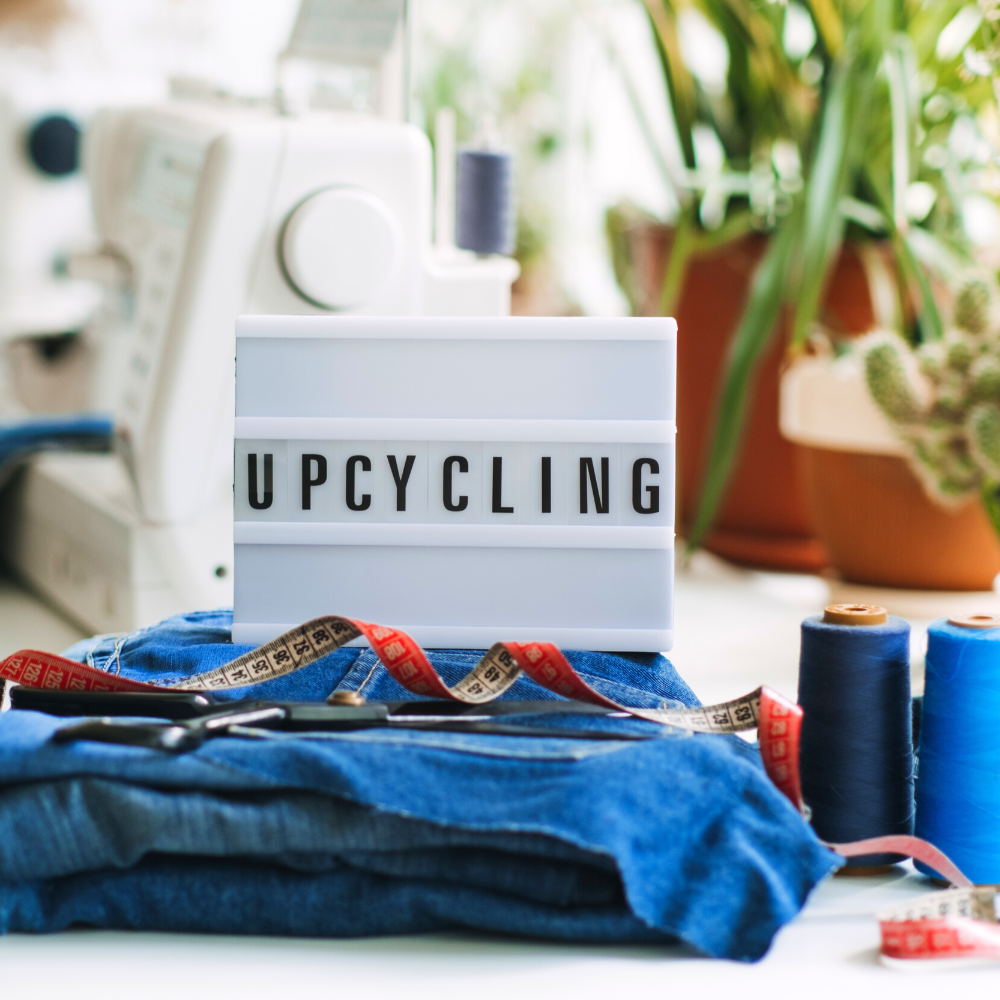
Quick St. Louis Creative Reuse Resource Guide
Need a place to start?
Here are some resources mentioned throughout this guide organized by what you are looking for.
General Creative Reuse & Affordable Supplies
Great for:
- Artists
- Crafters
- Teachers
- Makers
- Experimenting with new materials
Explore:
Reclaimed Building Materials & DIY Projects
Great for:
- Furniture flipping
- Wood projects
- Mixed media
- Home creativity
- Sculpture
Explore:
Copper, Metal & Salvaged Materials
Great for:
- Copper jewelry
- Metal art
- Assemblage
- Experimental projects
Explore:
- Earthbound Recycling
- Scrap/recycling resources
Secondhand Treasures
Great for:
- Fabric
- Frames
- Furniture
- Books
- Jewelry
- Unexpected materials
Explore:
- Local thrift stores
- Estate sales
- Garage sales
- Community marketplaces
 Jessica Carey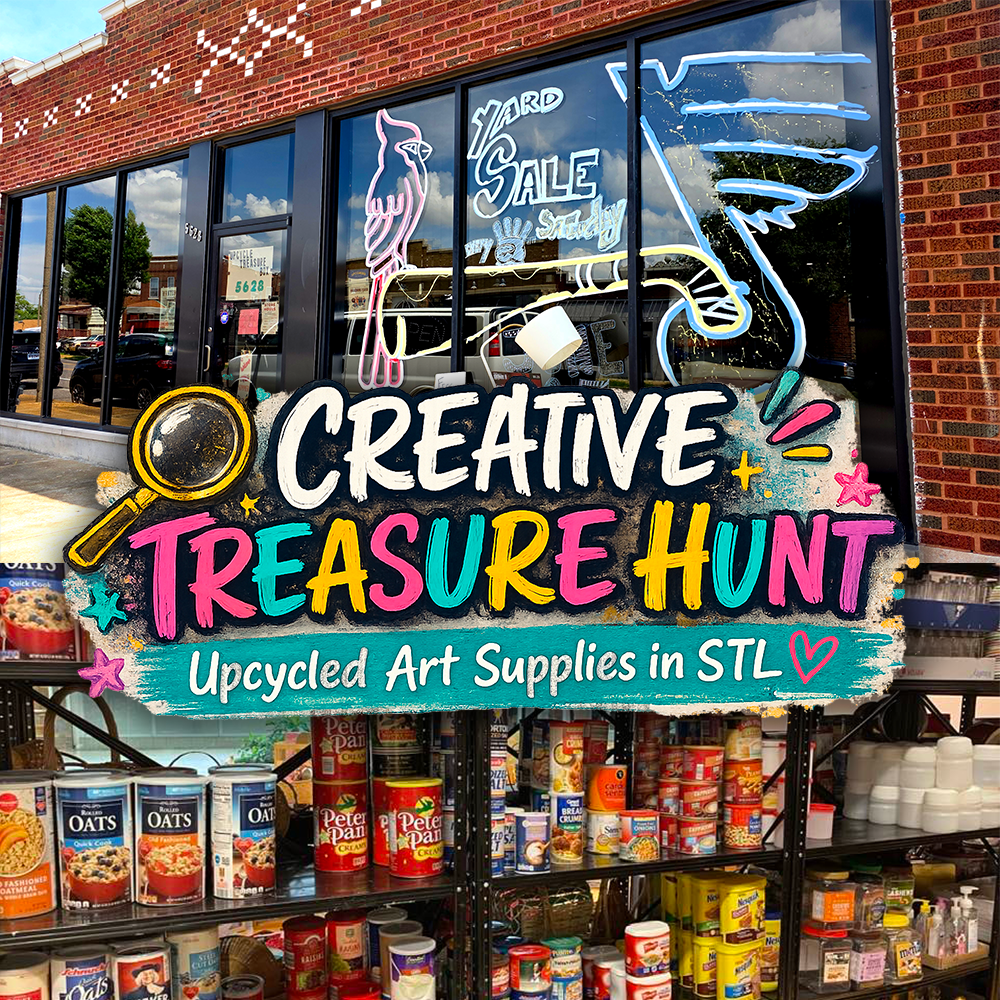
Tools & Specialty Supplies
Great for:
- Building your creative toolkit
- Finding specific materials
- Learning new techniques
Explore:
- Harbor Freight
- Schaefer’s Hobby Shop
- Local hobby and hardware stores
Classes & Skill Building
Great for:
- Learning techniques
- Trying new mediums
- Meeting creative people
Explore:
- Creative reuse workshops
- Art studios
- Libraries
- Community programs
- Maker spaces like MADE Makerspace
Remember: This list is not the end. It is the beginning.
Every resource you discover can become a doorway to another.
 Jessica Carey
Hidden Possibilities Are Everywhere
Creative reuse has a way of changing how you see the world.
At first, you might only notice the obvious.
A broken necklace.
An old piece of furniture.
A leftover piece of fabric.
A discarded cord.
A box of forgotten supplies.
But eventually, you start seeing something else:
Potential.
A broken necklace becomes beads for a new creation.
An old piece of furniture becomes a restoration project.
Fabric scraps become something stitched together with care.
A piece of copper wire becomes a handmade piece of jewelry.
The material did not change.
The way you looked at it did.
And that shift in perspective is where creativity lives.
Creativity Is About Seeing Possibility
Artists, makers, and creators have always done something incredible:
They see what could be.
A blank canvas is not just an empty space.
It is a beginning.
A lump of clay is not just clay.
It is something waiting to take shape.
A pile of mismatched materials is not just clutter.
It might be the start of something completely new.
Creative reuse reminds us that imagination is one of the most powerful tools we have.
Because before anything is created, someone first has to believe: “This could become something.”
Small Choices Create Bigger Change
Choosing reused materials may seem like a small action.
Saving one piece of fabric.
Repairing one item.
Giving one object another purpose.
Sharing one resource.
But small actions add up.
Every time we reuse, repair, share, or transform something, we participate in creating a different kind of relationship with the things around us.
One built less on:
- Use
- Discard
- Replace
And more on:
- Notice
- Care
- Transform
- Continue
Creative reuse does not mean everything must be saved forever.
It does not mean every object needs to become a project.
It simply means pausing long enough to ask: “Is there still possibility here?”
Sometimes the answer will be no.
But sometimes the answer will surprise you.
Creativity Grows Through Community
One of the most beautiful parts of exploring creative reuse is discovering that creativity was never meant to happen alone.
Someone donates supplies they no longer need.
Someone teaches a skill they learned.
Someone shares a resource they discovered.
Someone creates something new from what another person released.
The story continues.
That is how creative communities grow.
Not because everyone has unlimited resources.
But because people share the resources they have.
A single recommendation can help someone find a place they never knew existed.
A single class can introduce someone to a skill they use for years.
A single conversation can open a door.
Leave Breadcrumbs for the Next Person
Many resources remain hidden simply because people do not know they exist.
Someone may desperately need exactly what is available nearby.
They just have never been shown where to look.
That is why sharing resources matters.
If you discover a helpful organization, tell someone.
If you find a great reuse center, share it.
If you learn a new skill, encourage someone else.
If you find a doorway, consider leaving it open for the person behind you.
Because sometimes the hardest part is not walking through the door.
Sometimes the hardest part is knowing the door exists.
Have Extra Supplies? Keep the Cycle Going
Donate:
- unused art supplies
- fabric
- craft materials
- tools
- jewelry pieces
- office supplies
- educational materials
Possible places:
- Perennial
- Leftovers, etc.
- STL Teachers Trading Post
- thrift stores
- Buy Nothing groups
Keep Creating. Keep Exploring. Keep Seeing Possibility.
You do not need the most expensive supplies to begin.
You do not need a perfect studio.
You do not need to know everything.
Creativity has always grown from curiosity.
From experimentation.
From asking: “What if?”
- What if this old material became something beautiful?
- What if this forgotten object had another story?
- What if there were resources around me I had not discovered yet?
The world is full of hidden treasures.
Sometimes they are tucked away in reuse centers, thrift stores, workshops, and community spaces.
Sometimes they are sitting quietly in places we pass every day.
And sometimes finding them begins with simply learning how to look differently.
So, keep searching.
Keep creating.
Keep sharing what you discover.
Because creativity is not only about making something new.
Sometimes it is about recognizing the value that was already there.
Last Updated: June 2026
This is a living resource. Programs, hours, and opportunities may change. Please check directly with organizations for current details.
Want even more content about creativity and art?
Be sure to check out all of our creative chronicles!
If you'd like to see examples of my work, you can find some of my art and creations at Redbubble and Gumroad!
Ready to dive into the world of upcycling and recycled art?
Check out some of our other articles:
-How do you make recycled art?
-What are the best materials to upcycle?
 Jessica Carey