
Love is one of the first things we learn about and one of the last things many of us ever think to question.
We are told to love our families.
To be loyal to the people we care about.
To forgive.
To help.
To sacrifice.
To keep the peace.
To stand beside people when life becomes difficult.
And there is something beautiful in all of those things.
But somewhere along the way, many of us also absorb quieter lessons.
We learn that love means putting other people's needs ahead of our own.
That loyalty means staying no matter how much something hurts.
That forgiveness means giving someone unlimited chances.
That keeping the peace means staying quiet.
That being a good person means being endlessly accommodating.
That family should always have access to us simply because they are family.
That helping means fixing everyone's problems.
That setting a boundary is selfish.
That saying no means we don't care enough.
And sometimes, without realizing it, we begin calling things love that don't actually help anyone flourish.
Control gets mistaken for protection.
Possessiveness gets mistaken for devotion.
People-pleasing gets mistaken for kindness.
Silence gets mistaken for peace.
Endurance gets mistaken for loyalty.
Familiarity gets mistaken for safety.
Self-abandonment gets mistaken for sacrifice.
The words may sound loving.
The intentions may even be loving.
But the environment they create can feel very different.
That raises a surprisingly important question: what is love actually supposed to feel like?
Not what were you told love should look like.
Not what did the people around you call love.
Not what have you learned to tolerate because it was familiar.
But when human beings are genuinely loving one another well, what happens to the people inside that relationship?
- Do they become more afraid—or more secure?
- More guarded—or more honest?
- More dependent—or more capable?
- More ashamed—or more able to take responsibility and grow?
- Do they constantly worry about saying the wrong thing?
- Or can they speak honestly, disagree, make mistakes, apologize, repair, learn, laugh, rest, and continue belonging?
Perhaps one of the most useful ways to understand healthy connection is to stop asking only whether love is present and begin asking what kind of environment that love is creating.
Because relationships become environments.
Some relationships require enormous amounts of energy simply to survive.
We monitor moods.
Rehearse conversations.
Second-guess ourselves.
Try to anticipate what might upset someone.
Make ourselves smaller.
Ask for less.
Hide parts of ourselves.
Work endlessly to preserve a fragile peace.
Others feel remarkably different.
There is room to breathe.
Room to ask questions.
Room to say: “I see this differently.”
Room to admit: “I made a mistake.”
Room to say: “That hurt me.”
Room to hear those words without immediately becoming defensive.
Room to grow without another person's love being threatened by that growth.
Healthy relationships are not perfect relationships.
People still misunderstand one another.
They disappoint each other.
They have difficult days, different needs, conflicting perspectives, old wounds, bad timing, and moments they wish they had handled differently.
The difference is not that nothing ever goes wrong.
The difference is what the relationship makes possible when something does.
Healthy connection makes room for honesty, accountability, repair, boundaries, curiosity, forgiveness, growth, and each person's continued humanity.
That distinction became deeply important to me because, for much of my life, I thought relationships were simply supposed to hurt.
I learned to endure. To explain. To try harder. To become quieter. To be useful. To take care of other people's needs while slowly forgetting my own.
Eventually, I began asking questions I should have been able to answer long before:
- What does healthy love actually look like?
- What does respect really mean?
- What makes a relationship feel safe?
- Why can genuine care sometimes feel so unfamiliar?
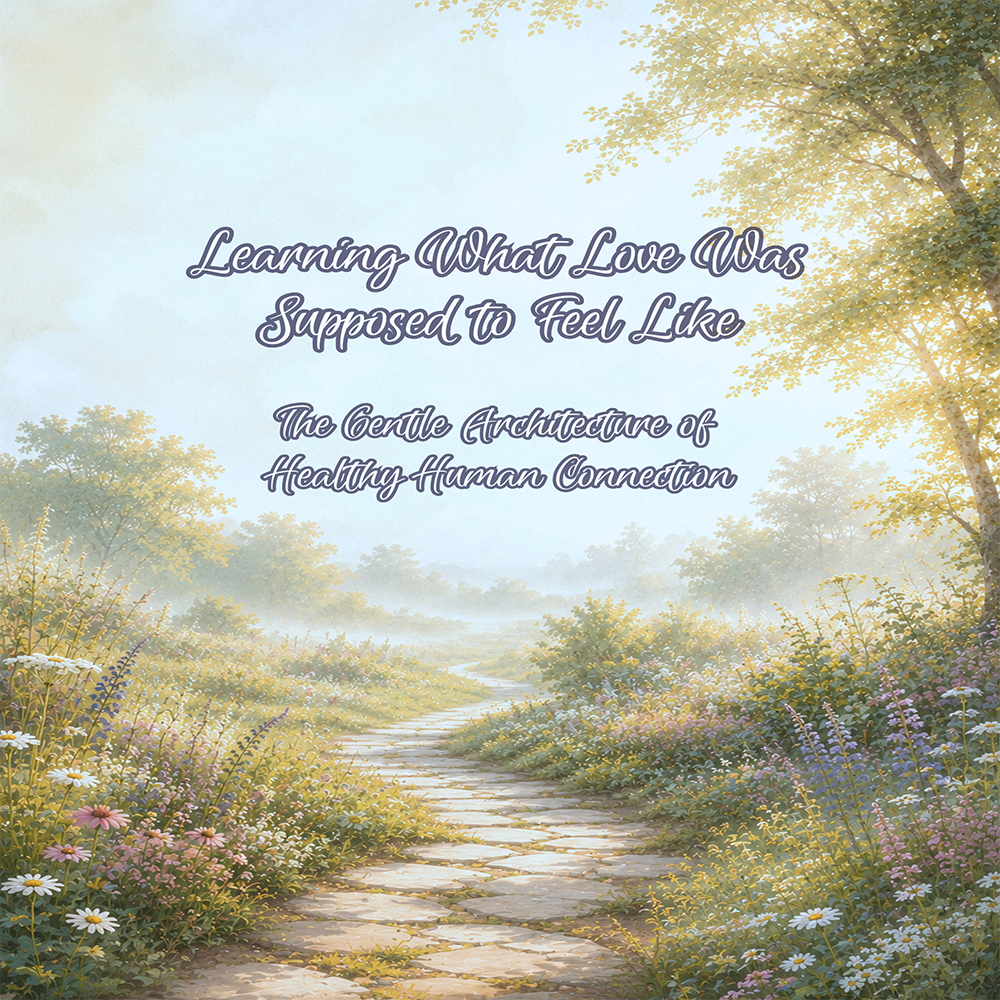
Those questions eventually became Learning What Love Was Supposed to Feel Like: The Gentle Architecture of Healthy Human Connection.
But they also became something larger than a book.
They became an invitation to reconsider the way we relate to one another.
Because perhaps love was never supposed to be measured by how much pain we can tolerate, how tightly we can hold onto another person, how useful we can make ourselves, or how thoroughly we can disappear to preserve a relationship.
Perhaps healthy love asks something entirely different: does my presence in your life help you flourish—and does this relationship make room for me to flourish, too?
That question lies at the heart of everything that follows.
Because healthy relationships don't ask us to become less of ourselves in order to belong.
They create enough safety, respect, honesty, freedom, and care for us to become more fully ourselves.
We Learn Relationships Before We Learn to Question Them
Long before most of us consciously think about relationships, we are already learning how relationships work.
We learn by watching.
By listening.
By noticing what happens when someone is upset.
By discovering which emotions are welcomed and which ones make other people uncomfortable.
By seeing whether disagreements lead to conversation or punishment.
By learning whether no is respected.
Whether apologies happen.
Whether mistakes can be repaired.
Whether love remains present when someone disappoints another person.
Whether people are allowed to change.
And perhaps most importantly, we learn what we have to do to remain connected to the people around us.
No one necessarily sits us down and says: “Here are the rules for love.”
Instead, those rules are quietly absorbed through thousands of ordinary interactions.
Maybe we learn that being easygoing earns approval.
Maybe expressing hurt creates conflict, so silence feels safer.
Maybe one person's emotions dominate the household, and everyone else learns to organize themselves around keeping that person happy.
Maybe affection is plentiful when we achieve, behave, help, agree, or make someone proud—but becomes distant when we disappoint them.
Maybe privacy is treated like secrecy.
Independence like rejection.
Boundaries like disrespect.
Disagreement like disloyalty.
Or maybe we grow up around relationships where people listen, apologize, respect one another's individuality, laugh together, repair after conflict, and allow each other to change.
Either way, we are learning.
And because these lessons often begin before we have anything to compare them to, they can become our definition of normal.
That is where things become complicated.
Because familiarity and health are not the same thing.
Something can feel normal because we have experienced it a thousand times.
Something can feel uncomfortable simply because we have never experienced it before.
A person accustomed to having their boundaries ignored may initially feel guilty when they begin saying no.
Someone accustomed to earning love through usefulness may feel strangely uncomfortable receiving care without immediately giving something in return.
Someone who learned that conflict threatens belonging may experience a respectful disagreement as frightening—even when the other person has no intention of leaving.
Someone accustomed to unpredictable relationships may mistake intensity for intimacy and steadiness for disinterest.
And someone who spent years monitoring other people's emotions may have difficulty believing that another adult's feelings are not automatically theirs to manage.
This doesn't mean there is something wrong with them.
It means human beings learn through experience.
We adapt to the environments we inhabit.
And sometimes the very behaviors that once helped us maintain connection can make healthier connection surprisingly difficult to recognize.
When Survival Skills Look Like Relationship Skills
This is one reason people-pleasing can become so confusing.
Kindness is beautiful.
Empathy is beautiful.
Generosity, flexibility, patience, forgiveness, and consideration are all essential parts of healthy relationships.
But there is a difference between: “I want to consider your needs because I care about you.”
And: “I have to keep you happy so that I remain safe, loved, or accepted.”
From the outside, those behaviors may look almost identical.
Both people might say yes.
Both might help.
Both might compromise.
Both might appear generous.
But internally, one is acting from freedom while the other is acting from fear.
That distinction matters.
Healthy love leaves room for choice.
You can give generously and sometimes say no.
You can care about someone's feelings without becoming responsible for regulating all of them.
You can compromise without continually surrendering yourself.
You can forgive without pretending something didn't hurt.
You can love someone while disagreeing with them.
You can appreciate everything someone has done for you without owing them unlimited access to the rest of your life.
And you can change.
That last one may be particularly important.
Sometimes the version of us that helped us belong in one environment is not the version of us we need to remain forever.
Familiar Doesn't Always Mean Safe
One of the most difficult parts of learning healthier relationships is that healthy connection may not immediately feel familiar.
Imagine spending years believing that love means constantly anticipating another person's needs.
Then someone enters your life and simply tells you what they need.
No guessing.
No tests.
No punishment for failing to read their mind.
At first, you might keep searching for the hidden expectation.
Or imagine being accustomed to disagreements that become accusations, silent treatment, guilt, or personal attacks.
Then you disagree with someone and they say: “I don't see it the same way, but I understand why you do.”
Nothing explodes.
Nobody threatens the relationship.
You are still loved.
You are still welcome.
The conversation simply continues.
That quietness can almost feel strange when chaos has been familiar.
This is why learning healthy relationships is not always as simple as creating a list of red and green flags.
Sometimes it requires relearning what safety itself feels like.
In Learning What Love Was Supposed to Feel Like, I describe emotional safety as something that gives us energy back.
When we don't feel safe, enormous amounts of energy can go toward watching, analyzing, second-guessing, preparing, and trying not to upset anyone.
When safety grows, that energy becomes available for curiosity, authenticity, creativity, rest, connection, and growth instead.
Perhaps that is one of the clearest differences between merely being connected to someone and being healthy together.
Healthy connection doesn't require us to spend all our energy maintaining it.
It gives us enough room to actually live.
We Can Question What We Inherited Without Condemning Everyone Who Taught It to Us
There is another important piece of this conversation.
Recognizing an unhealthy pattern does not require us to believe that every person who participated in it was intentionally cruel.
People inherit relationship patterns, too.
Parents learn from parents.
Families develop cultures.
Communities develop expectations.
Fear gets passed down as protection.
Control can be mistaken for care.
Emotional avoidance can be called strength.
Self-sacrifice can be praised as love.
Silence can be celebrated as keeping the peace.
People can sincerely believe they are loving someone while repeating patterns that cause harm.
Intent matters—but so does impact.
Understanding where a pattern came from can help us hold compassion for the people who learned it without requiring us to continue reproducing it ourselves.
We can say: “I understand why you learned this.”
And still say: “I don't want to keep building relationships this way.”
Those truths can coexist.
In fact, perhaps one of the most loving things we can do with what we inherit is examine it carefully enough to decide what deserves to continue.
Keep the generosity.
Keep the humor.
Keep the traditions that create belonging.
Keep the perseverance.
Keep the tenderness.
Keep whatever genuinely helps people flourish.
But perhaps we don't have to keep the fear.
The guilt.
The silence.
The control.
The self-abandonment.
The belief that love must hurt in order to count.
Awareness Gives Us a Choice
We cannot choose the first lessons we received about relationships.
But eventually, we can begin choosing what we do with them.
We can notice the moment we want to say yes because we're afraid of disappointing someone.
We can become curious about why disagreement feels dangerous.
We can notice when helping turns into rescuing.
When loyalty begins demanding silence.
When forgiveness becomes permission for the same harm to continue.
When love starts requiring someone to become smaller.
And instead of shaming ourselves for having learned those patterns, we can ask: what would something healthier look like here?
That question changes everything.
Because once we realize that relationships are learned, another possibility opens: they can also be relearned.
We can learn that boundaries and love can exist together.
That honesty does not have to destroy belonging.
That conflict can lead to understanding rather than punishment.
That another person's independence doesn't diminish our importance.
That accountability doesn't make someone unworthy of love.
That receiving care is as human as giving it.
That we can be deeply connected without possessing one another.
And perhaps that is where learning what love was supposed to feel like truly begins—not with blaming ourselves for what we were taught, but with becoming curious enough to imagine something different.
Because once we begin questioning the old architecture, we can finally start asking: what should we build in its place?
And perhaps the simplest answer is this: love should help people flourish.
Love Should Help People Flourish
If we begin questioning everything we've learned about love, an obvious question follows: how do we know what healthy love actually is?
There are countless ways to express love.
- Sometimes love looks like encouragement.
- Sometimes it means sitting quietly beside someone who is hurting.
- Sometimes it means helping.
- Sometimes it means telling an uncomfortable truth.
- Sometimes it means giving someone space.
- Sometimes it means staying.
- Sometimes it means letting go.
There is no single behavior that perfectly defines love because people, relationships, and circumstances are too complex for that.
But perhaps there is a deeper principle beneath all of them: healthy love seeks flourishing.
It asks: what helps this person become more fully alive, capable, honest, free, connected, and themselves?
And just as importantly: how can we build a relationship where both of us are able to flourish?
Healthy love isn't the flourishing of one person at the expense of another.
It isn't: “Your needs matter, so mine must disappear.”
Nor is it: “My needs matter, so yours are inconvenient.”
It recognizes something much more beautiful: your humanity matters, and so does mine.
Love Is Not the Same as Making Someone Comfortable
Sometimes loving someone will make their life easier.
Other times, it won't.
If someone we love is struggling, helping may be exactly what they need. But doing everything for them can sometimes prevent them from discovering their own capability.
If someone makes a mistake, compassion matters. But shielding them from every consequence can also prevent accountability and growth.
If someone is upset by a boundary, removing the boundary might restore temporary comfort—but it can also teach both people that one person's discomfort matters more than the other's well-being.
And if someone hurts us, pretending nothing happened may avoid conflict, but it also removes the possibility of genuine repair.
This is why love and comfort cannot always mean the same thing.
- Sometimes love comforts.
- Sometimes love encourages.
- Sometimes love challenges.
- Sometimes love says yes.
- Sometimes love says no.
Healthy love isn't constantly asking: “How do I keep you from ever feeling uncomfortable?”
It asks something deeper: “What response genuinely supports your well-being, dignity, growth, and humanity?”
Flourishing Requires Freedom
This is where love and control can become surprisingly easy to confuse.
Control often begins with fear.
We don't want someone to get hurt.
We don't want them to fail.
We don't want to lose them.
We don't want them to make a decision they'll regret.
Those fears can come from genuine care.
But caring about someone doesn't automatically give us ownership over their life.
Trust requires accepting something uncomfortable: we cannot control every choice another person makes or guarantee that nothing painful will ever happen to them.
Trying to eliminate that uncertainty through control can interfere with the very growth we're hoping to protect.
A flower cannot grow if we continually dig it up to check its roots.
A butterfly cannot strengthen its wings if someone breaks open the cocoon for it.
And human beings cannot fully discover their own strength if someone else is always making their choices, solving their problems, preventing their mistakes, or deciding who they should become.
Love can guide.
Warn.
Offer help.
Share wisdom.
Stand nearby when things become difficult.
But love must also make room for another person's agency.
Because flourishing requires freedom.
Love Makes Room for Individuality
Healthy connection does not require two people to become the same person.
We can deeply love someone who has different:
- interests
- personalities
- needs
- communication styles
- dreams
- strengths
- limitations
- opinions
- paths through life
Closeness does not require sameness.
One of the beautiful things about genuine connection is getting to know another human being as they actually are—not merely enjoying the parts of them that mirror us.
Healthy love stays curious.
It asks:
- Who are you?
- What matters to you?
- What makes you come alive?
- What do you need?
- What are you learning?
- Who are you becoming?
And then it leaves room for the answers to change.
People change.
They discover new interests.
Develop different boundaries.
Outgrow old beliefs.
Need more independence.
Become more confident.
Learn to speak when they once stayed silent.
Healthy love does not automatically interpret another person's growth as rejection.
It makes room for becoming.
Flourishing Doesn't Mean Perfection
Helping someone flourish does not mean expecting them to become an idealized version of themselves.
It doesn't mean constantly improving.
Achieving.
Healing.
Producing.
- Sometimes flourishing looks like growth.
- Sometimes it looks like rest.
- Sometimes it looks like trying something new.
- Sometimes it looks like admitting: “I can't do this right now.”
Human flourishing isn't a straight line toward becoming increasingly impressive.
It is having enough safety and freedom to be fully human.
That means having room to make mistakes, learn, take responsibility, grow, rest, grieve, receive help, and begin again without believing every difficult moment defines your worth.
Love doesn't stand over another person saying: “Become who I think you should be.”
It stands beside them saying: “I want to support you in becoming more fully who you are.”
A Different Question About Love
Perhaps instead of asking only: “Does this person love me?”
Or: “Do I love them?”
We can ask something more revealing: what is our love creating?
- Are we becoming more honest?
- More trusting?
- More able to say what we need?
- More respectful of one another's boundaries?
- More willing to apologize?
- More comfortable being ourselves?
- More curious?
- More compassionate?
- More alive?
Healthy love doesn't guarantee that every answer will always be yes.
Relationships move through seasons.
People struggle.
We make mistakes.
Sometimes we fail one another badly.
But over time, patterns tell a story.
And perhaps one of the clearest questions we can ask about any relationship is: what kind of people are we becoming in one another's presence?
Because love is more than a feeling we hold toward someone.
It is something we continually create together.
And when love is healthy, it gradually creates an environment where neither person has to surrender their humanity in order to remain connected.
That is flourishing.
And if flourishing is what healthy love seeks, the next question becomes: what actually allows that kind of love to stand?
Perhaps the answer is much like any structure meant to endure.
It needs a strong foundation—and pillars capable of holding its weight.
Healthy Relationships Are Built, Not Found
We often talk about healthy relationships as though they are something we simply find.
Find the right partner.
Find the right friends.
Find your people.
Find the family you always wished you had.
And finding compatible people certainly matters.
Not every person will be right for every relationship.
Sometimes two perfectly good people have different needs, values, communication styles, or visions for their lives.
But even the most compatible people cannot build a healthy relationship through compatibility alone.
Healthy relationships require practice.
They are created through hundreds—eventually thousands—of seemingly ordinary choices.
Listening when it would be easier to assume.
Telling the truth when honesty feels vulnerable.
Respecting a boundary even when we don't fully understand it.
Taking responsibility when defensiveness would be easier.
Apologizing.
Repairing.
Keeping our word.
Making room for another person's perspective.
Choosing curiosity over judgment.
Allowing people to grow.
None of these moments individually looks particularly extraordinary.
Together, however, they create something remarkably strong.
They create trust.
They create safety.
They create a relationship people can actually live inside.
Relationships Have an Architecture
This idea eventually became central to Learning What Love Was Supposed to Feel Like—so much so that the book carries the subtitle: The Gentle Architecture of Healthy Human Connection.
Because relationships have an architecture of their own.
If love is the foundation, certain qualities act almost like pillars holding the structure upright:
- Trust
- Respect
- Safety
- Boundaries
- Vulnerability
- Accountability
- Integrity
They are not separate ingredients we can neatly isolate from one another.
Trust makes vulnerability safer.
Boundaries strengthen respect.
Integrity makes trust possible.
Accountability allows repair.
Repair helps restore safety.
Safety allows honesty.
Honesty deepens intimacy.
Strengthen one pillar, and the others often become stronger alongside it; neglect one, and the entire structure may become less stable.
Trust: I Don't Have to Control You to Love You
Trust is sometimes misunderstood as certainty.
- I trust you, therefore I know you'll never disappoint me.
- I trust you, therefore nothing will go wrong.
But human relationships cannot offer that kind of certainty.
People make mistakes.
Circumstances change.
We misunderstand one another.
Life remains unpredictable.
Healthy trust doesn't eliminate uncertainty; it pays attention to patterns.
- Are words and actions aligned?
- Are promises generally kept?
- Does honesty continue when honesty is inconvenient?
- Can mistakes be acknowledged?
Trust isn't created because someone says, “Trust me.”
It is built because someone repeatedly becomes trustworthy.
And trusting another person also means accepting that we cannot control every choice they make. Love can care deeply without trying to manage another person's entire life.
Respect: Your Humanity Matters as Much as Mine
Respect is easy when two people agree.
The deeper practice comes when they don't.
Healthy respect remembers: you are not an extension of me.
You have your own thoughts, needs, preferences, limits, experiences, and choices.
We can disagree.
We can express concern.
We can offer another perspective.
We can decide what we ourselves will or will not participate in.
But respect doesn't require another person to surrender their humanity in order for ours to matter.
It makes room for two whole people.
Safety: I Can Be Human Here
Emotional safety doesn't mean nothing difficult ever happens.
It means difficulty doesn't automatically threaten your dignity or belonging.
- Can you ask a question without being humiliated?
- Can you make a mistake without becoming the mistake?
- Can you express hurt?
- Can you disagree?
- Can you say no?
- Can you change your mind?
- Can you be imperfect?
Safety grows through small, consistent experiences: someone keeping their word, listening before assuming, admitting a mistake, respecting a boundary, or choosing curiosity instead of judgment.
Eventually those experiences tell us: I don't have to spend all of my energy protecting myself here.
And when that happens, we have more energy left to actually connect.
Boundaries: We Can Be Close Without Losing Ourselves
Boundaries are sometimes treated as walls separating people.
But healthy boundaries can actually make intimacy possible because they tell us where one person ends and another begins.
- This is what I can give.
- This is what I cannot.
- This feels okay.
- This doesn't.
- This is my responsibility.
- That belongs to you.
I like to think of healthy boundaries as doors.
A healthy door isn't permanently locked, but neither is it permanently open.
It can welcome connection while still closing when privacy, protection, or rest is needed.
Boundaries don't necessarily say: “Stay away from me.”
Often they say: “I want us to be able to come close without either of us disappearing.”
Vulnerability: You Can Actually Know Me
Without vulnerability, relationships can remain polite without becoming deeply connected.
We can show people the polished version of ourselves.
The capable version.
The agreeable version.
The version we think they'll approve of.
But genuine connection eventually asks whether we're willing to become known.
Our hopes.
Our fears.
Our mistakes.
Our dreams.
Our grief.
Our unfinished places.
That doesn't mean telling everyone everything.
Healthy vulnerability includes discernment. Openness grows where trust, respect, kindness, and safety have already been demonstrated.
We don't owe everyone access to our inner world.
But deep intimacy requires eventually allowing trustworthy people to see more of who we really are.
Accountability: We Can Be Wrong Without Losing Our Worth
No healthy relationship exists without mistakes.
Eventually, we will misunderstand.
Become defensive.
Say something poorly.
Miss a need.
Make an assumption.
Hurt someone we care about.
Being loving does not make us incapable of causing harm.
What matters enormously is what happens next.
Can we listen?
Can we acknowledge the impact?
Can we say:
- “I was wrong.”
- “I'm sorry.”
- “What can I do differently?”
And then can our behavior actually change?
Accountability isn't humiliation.
It makes repair possible.
We can remain worthy human beings while still taking responsibility for the ways our choices affect other people.
Integrity: Who Am I Choosing to Be?
Integrity asks whether our values remain our values when practicing them becomes inconvenient.
It is easy to value honesty when the truth costs nothing.
Respect when everyone agrees with us.
Boundaries when nobody sets one we dislike.
Accountability when we're not the person who needs to apologize.
Kindness when we're in a good mood.
Integrity is what happens when those values are tested.
Healthy relationships cannot be sustained by knowing all the right language.
Someone can talk endlessly about boundaries while refusing to respect anyone else's.
Someone can preach kindness while behaving cruelly whenever they're challenged.
Someone can understand accountability intellectually while refusing to practice it personally.
Ultimately, relationships are built not merely by what we say we value.
They are built by what we repeatedly practice.
No Single Pillar Can Carry the Whole Relationship
Perhaps one of the most important things about this architecture is that none of these qualities works particularly well alone.
Vulnerability without safety can become exposure.
Boundaries without compassion can become rigid walls.
Compassion without boundaries can become self-abandonment.
Accountability without grace can become shame.
Grace without accountability can become permission for harm.
Honesty without kindness can become cruelty.
Kindness without honesty can become avoidance.
Healthy relationships require these qualities to balance and strengthen one another.
There isn't one perfect rule.
There is a living structure being continually adjusted, repaired, strengthened, and cared for by the people inside it.
Love Is Built in the Ordinary Moments
Perhaps that's why some of the healthiest relationships don't look particularly dramatic from the outside.
There may be no grand declarations.
No constant intensity.
No heroic sacrifices.
Instead, there are countless small moments.
- “I was wrong.”
- “Take the time you need.”
- “I don't agree, but I want to understand.”
- “You can say no.”
- “I remembered you said this was important to you.”
- “Do you want advice, help, or just someone to listen?”
- “That wasn't okay. Can we talk about what happened?”
- “You don't have to pretend with me.”
One moment doesn't build a relationship.
But thousands of them do.
And perhaps that is one of the most hopeful truths about healthy relationships:
We don't have to know how to do everything perfectly before we can begin building something better.
We begin with the next choice.
Listen.
Tell the truth.
Respect the boundary.
Stay curious.
Own the mistake.
Make the repair.
Keep the promise.
Allow another person to be fully human.
And then do it again.
Because healthy relationships aren't magical places we someday stumble upon.
They are places human beings learn to create together.
And once we understand what helps create them, we become better equipped to recognize something else, too:
the things that can look remarkably like love while quietly undermining the very connection they claim to protect.
Some of the Things We Call Love Are Counterfeits
Once we begin understanding what healthy connection is built from, something else becomes easier to see.
Not everything we have learned to call love actually functions like love.
Sometimes the confusion is obvious.
Other times, it is incredibly subtle because the unhealthy behavior has wrapped itself around something genuinely beautiful.
- Care
- Loyalty
- Forgiveness
- Protection
- Generosity
- Sacrifice
- Peace
- Commitment
These things are not inherently unhealthy.
Quite the opposite—they can be some of the most beautiful expressions of human connection.
The problem begins when their meaning quietly changes.
Care becomes control.
Helping becomes rescuing.
Loyalty becomes unquestioning allegiance.
Forgiveness becomes unlimited access.
Peace becomes silence.
Sacrifice becomes self-abandonment.
Protection becomes possession.
Commitment becomes endurance at any cost.
And because the original value is good, it can become surprisingly difficult to recognize when something has gone wrong.
We may think:
- But I'm only trying to help.
- I'm doing this because I love them.
- I'm just trying to keep the peace.
- Family doesn't give up on family.
- If I forgive them, shouldn't I move on?
- Isn't sacrifice what love is supposed to require?
Sometimes those questions come from genuinely loving hearts.
But good intentions alone cannot tell us whether a relationship pattern is healthy.
Eventually, we have to ask: what is this actually creating?
When Helping Becomes Rescuing
Helping another person can be one of the clearest expressions of love.
We all need help sometimes.
There are moments when another person's support carries us through something we genuinely could not have handled alone.
But helping and rescuing are not always the same thing.
Helping says: “You don't have to do everything alone.”
Rescuing can quietly begin saying: “You cannot handle this without me.”
The difference isn't always about what we do. It is often about whether our help ultimately supports another person's agency or begins replacing it.
Healthy support might involve listening, sharing resources, teaching a skill, offering encouragement, helping during a crisis, or temporarily carrying more when someone genuinely cannot.
But if we continually solve every problem, make every decision, prevent every consequence, manage every emotion, or assume responsibility for another person's growth, our help may eventually communicate something we never intended: I don't believe you can do this.
The book describes healthy support as offering encouragement rather than control, guidance rather than domination, and opportunities for people to discover their own strength rather than removing every challenge from their path.
Sometimes the most loving thing we can offer isn't a rescue.
It's companionship: “I believe in you. I'm here. What kind of support would actually help?”
When Keeping the Peace Requires Someone to Disappear
Peace sounds unquestionably good.
Most of us don't want constant conflict.
We want homes, friendships, partnerships, workplaces, and communities where people can coexist with kindness.
But there is a profound difference between peace and peacekeeping.
Sometimes what looks peaceful from the outside exists only because someone has learned not to speak.
- Don't bring that up.
- Don't disagree.
- Don't tell them you're hurt.
- Don't challenge the family narrative.
- Don't ask the uncomfortable question.
- Don't set the boundary.
- Don't make anyone upset.
- Just keep the peace.
Eventually, one person becomes responsible for preventing conflict by continually swallowing whatever might create it.
But silence is not necessarily peace.
Two people can avoid every difficult conversation and still live with enormous tension.
Your book puts the distinction beautifully: true peace isn't the absence of conflict; it is the presence of a relationship strong enough to hold truth with grace.
Healthy peace has room for:
- “I disagree.”
- “That hurt.”
- “I need something different.”
- “Can we talk about what happened?”
- “No.”
Because if a relationship can remain peaceful only while nobody tells the truth, that peace is extraordinarily fragile.
Real peace doesn't require someone to disappear in order to preserve it.
When Loyalty Becomes Losing Yourself
Loyalty is another beautiful quality.
There is something deeply meaningful about people who remain beside one another through difficult seasons.
Who don't abandon someone simply because life becomes inconvenient.
Who keep promises.
Who work through conflict.
Who remain present through grief, illness, mistakes, uncertainty, and change.
But loyalty can become distorted when it stops asking us to remain committed to love and begins asking us to remain committed to a relationship regardless of what that relationship becomes.
Then loyalty starts sounding like:
- “If you loved me, you'd stay no matter what.”
- “Family always comes first.”
- “Real friends don't question each other.”
- “After everything I've done for you…”
Now loyalty is no longer freely given.
It has become a debt.
And guilt becomes the collector.
Your book makes an important distinction: healthy loyalty doesn't protect people from accountability.
It protects the relationship by making accountability possible.
Sometimes loyalty means staying.
Sometimes it means having the difficult conversation.
Sometimes it means refusing to enable something harmful.
Sometimes it means allowing consequences.
Sometimes it means creating distance.
And sometimes a relationship reaches the painful point where one person has to recognize that they cannot create mutual respect, honesty, accountability, or repair through their effort alone.
Relationships are shared.
One person cannot do both people's part.
Loyalty was never meant to be measured by how much of yourself you can lose while proving that you stayed.
When Forgiveness Becomes Permission
Forgiveness can be profoundly freeing.
It can help us release the desire for revenge.
It can keep another person's choices from determining who we become.
It can loosen resentment's grip on our lives.
But forgiveness becomes dangerous when it is confused with pretending nothing happened.
- If you really forgave them, you wouldn't still be hurt.
- If you forgave them, you wouldn't need that boundary.
- If you forgave them, you'd trust them again.
- If you forgave them, you'd let them back in.
But forgiveness and reconciliation are not identical.
Your book draws this distinction clearly: forgiveness can occur within one person's heart, while reconciliation requires two people continually choosing trust, honesty, accountability, and repair together.
Someone can forgive and still remember what experience taught them.
Forgive and require change.
Forgive and maintain a boundary.
Forgive and decline reconciliation.
Forgive and love someone from a distance.
Even genuine change does not automatically entitle someone to renewed access.
Trust is rebuilt through consistent choices, and another person's willingness to offer it again remains theirs to decide.
Forgiveness can release the past without pretending the past never happened.
Grace does not require amnesia.
When Protection Becomes Control
Protection can also come from a deeply loving place.
When we care about someone, of course we don't want them to suffer.
We warn children about danger.
We tell friends when something worries us.
We intervene when someone genuinely cannot protect themselves.
We offer advice when someone is walking toward something painful.
But protection can quietly become control when another person's fear begins overriding our autonomy.
- I'm only doing this because I care.
- I know what's best for you.
- I'm trying to keep you safe.
Sometimes those statements are completely sincere.
And sometimes the result is still that another person loses the freedom to make choices, take reasonable risks, learn from mistakes, develop confidence, or become someone different from what we imagined.
This is why intention and impact have to remain in conversation with each other.
Someone can intend protection while creating restriction.
Intend help while creating dependence.
Intend peace while creating silence.
Intend closeness while creating suffocation.
Love doesn't become healthy merely because its intentions are loving.
It must also remain willing to examine what those intentions are actually producing.
When Sacrifice Becomes Self-Abandonment
Healthy relationships do involve sacrifice.
Sometimes we inconvenience ourselves for people we love.
We show up when we're tired.
We rearrange plans.
We give time, money, energy, attention, patience, or care.
There will even be seasons when relationships are deeply unequal because someone genuinely needs more.
That isn't inherently unhealthy.
The question is whether sacrifice remains something we can choose—or whether disappearing becomes the price of belonging.
There is a difference between: “I'm choosing to put your needs first right now because you need me.”
And: “My needs never get to matter because loving you means I shouldn't have any.”
Between generosity and depletion.
Between compromise and erasure.
Between patience and endless endurance.
Between loving another person deeply and abandoning yourself entirely.
Healthy love can ask us to stretch.
It can challenge selfishness.
It can call us toward generosity.
But it does not require one person's humanity to become permanently less important than everyone else's.
The Counterfeit Usually Contains a Piece of the Real Thing
Perhaps this is what makes these patterns so difficult to recognize.
A counterfeit works because it resembles something real.
Control can contain genuine concern.
Rescuing can contain genuine compassion.
Peacekeeping can contain a sincere desire for harmony.
Blind loyalty can contain deep commitment.
Self-sacrifice can contain generosity.
Unhealthy forgiveness can grow from a beautiful desire for grace.
We don't necessarily have to throw away the value underneath the distortion.
Instead, we can separate them.
- Keep the care. Release the control.
- Keep the generosity. Release the self-abandonment.
- Keep the loyalty. Release the silence.
- Keep the forgiveness. Release the belief that forgiveness requires unlimited access.
- Keep the peace. Make room for truth.
- Keep the support. Give people room to become capable.
That distinction matters because learning healthier relationships isn't about becoming colder.
It isn't about caring less.
Trusting no one.
Never sacrificing.
Never forgiving.
Never helping.
Never compromising.
It is about learning how to practice those beautiful qualities without losing the other ingredients healthy love needs to survive.
- Truth
- Freedom
- Boundaries
- Accountability
- Respect
- Discernment
- Reciprocity
- Human dignity
Because love separated from those things can slowly become something love was never meant to be.
And perhaps one of the clearest ways to tell the difference is this: healthy love makes room for two whole people.
Healthy Love Makes Room for Two Whole People
Perhaps one of the simplest ways to describe healthy connection is this: there is room for both of us here.
Your feelings matter.
And so do mine.
Your needs matter.
And so do mine.
Your dreams, boundaries, struggles, joy, and humanity matter.
And none of that requires mine to stop mattering.
It sounds obvious when written that way.
But many of us have experienced relationships where one person gradually occupies more and more space while the other learns to occupy less.
One person speaks; the other listens.
One person needs; the other provides.
One person struggles; the other rescues.
One person becomes upset; the other regulates the entire environment.
One person's boundaries are important; the other's are inconvenient.
Over time, the relationship may remain intact.
But one of the people inside it slowly disappears.
That isn't the kind of closeness healthy love is trying to create.
Reciprocity Isn't Keeping Score
When we talk about mutual relationships, it can be easy to imagine a ledger.
- I called you three times, so you should call me three times.
- I helped you, so now you owe me.
- I gave this much, so you should give exactly the same.
But reciprocity isn't about creating a perfectly balanced transaction.
Human relationships could never function that way.
People have different capacities.
Different resources.
Different ways of showing affection.
Different seasons of life.
Someone experiencing grief may receive far more support than they can currently return.
Someone facing illness or hardship may temporarily depend heavily upon other people.
One person may have more money to give while another has more time.
Someone may show care through practical help while someone else shows it through emotional presence.
Reciprocity isn't sameness.
It's the underlying understanding that care flows in more than one direction.
That everyone is allowed to need.
Everyone is allowed to receive.
Everyone is allowed to give.
Everyone's well-being matters.
There will be seasons when one person carries more.
Healthy relationships can hold that.
The deeper question is whether, over time, the people involved are carrying the relationship together.
Receiving Is Part of Relationship, Too
For some of us, giving feels much safer than receiving.
Being the helper can feel familiar.
We know how to listen.
How to fix.
How to encourage.
How to anticipate.
How to show up.
But then someone asks: “What do you need?”
And suddenly we don't know what to say.
Maybe we worry about becoming a burden.
Maybe receiving creates a sense of indebtedness.
Maybe we've learned that our value comes from what we provide rather than simply from who we are.
But healthy connection requires something surprisingly vulnerable: allowing other people to love us, too.
Not because we're helpless.
Not because someone needs to rescue us.
But because relationships aren't meant to be one-way streets.
Sometimes loving someone means carrying them.
Sometimes loving them means letting them carry you.
Caring Doesn't Mean Becoming Responsible for Someone
This distinction can be particularly important for deeply compassionate people.
There is a difference between caring about someone and becoming responsible for their entire emotional world.
We can listen without fixing.
Support without controlling.
Encourage without managing.
Offer advice without demanding that someone follow it.
Care about someone's disappointment without automatically changing our boundary to make the disappointment disappear.
Believe in someone's potential without making their growth our personal project.
Healthy connection recognizes: I can walk beside you without walking your path for you.
That protects both people.
It allows the person receiving support to retain their agency.
And it allows the person giving support to remain a person rather than becoming a permanent caretaker, fixer, manager, or rescuer.
One reader, Sage, reflected on this after reading the book:
“I often in past relationships was the fixer/rock for my partners. I did not necessarily expect much in return. Not in a tit for tat way, but I was the one calming them down, not the other way around. I think I did abandon myself to some degree because my desire for connection is so big; I can and have decided to change how I show up. Also, the amount of reciprocity I get is something I need to be on the look out for. I am not prince charming, and it's not my job to actually save everyone. I am a chronic people caretaker/manager.”
There is something important in that realization.
Not: “I shouldn't care so much.”
But: “My capacity for care doesn't require me to abandon myself.”
We don't have to become less compassionate in order to have healthier relationships.
We can simply begin including ourselves among the people deserving of our compassion.
Independence Isn't the Goal, Either
There is another extreme worth acknowledging.
If losing ourselves in other people can become unhealthy, the answer isn't necessarily: “I don't need anyone.”
Human beings need one another.
We need friendship.
Support.
Belonging.
Encouragement.
Community.
People to celebrate with.
People to grieve with.
People who remind us who we are when life becomes difficult.
There is strength in being capable.
There is also strength in being able to say: “I can't do this alone.”
Healthy connection exists somewhere between losing ourselves in another person and refusing to need anyone at all.
Interdependence says: I am a whole person, you are a whole person, and our lives can become richer because we choose to share parts of them.
I don't need to own you.
You don't need to complete me.
Neither of us needs to become indispensable to the other in order to be important.
We can stand on our own feet and still reach for each other's hands.
We Can Belong With One Another Without Belonging to One Another
People are not possessions.
Love does not grant ownership over another person's time, friendships, thoughts, privacy, identity, future, or choices.
Healthy closeness doesn't require us to absorb another person into ourselves.
Perhaps one of the deepest expressions of love is being able to say: “I love who you are even though who you are belongs to you.”
Another person's independence doesn't automatically threaten connection.
Their friendships don't diminish ours.
Their success doesn't reduce our worth.
Their boundaries aren't punishments.
Their need for solitude isn't necessarily rejection.
Their growth isn't abandonment.
Their difference isn't betrayal.
We can belong with one another without belonging to one another.
And being whole doesn't mean being unaffected by one another.
Healthy relationships change us.
People teach us.
Challenge us.
Comfort us.
Inspire us.
Help us discover things about ourselves we hadn't seen before.
Being our own person doesn't mean building an emotional fortress where nobody can touch us.
It means maintaining a sense of self while allowing genuine connection to matter.
A Relationship Should Have Room for Both People's Becoming
Nobody enters a relationship finished.
We continue learning.
Changing.
Failing.
Trying again.
Discovering new interests.
Reconsidering old beliefs.
Finding new dreams.
Learning new boundaries.
Growing into parts of ourselves that perhaps never had room to exist before.
Healthy love doesn't demand: “Remain exactly who you were when I became comfortable with you.”
It stays curious: “Who are you becoming—and how can I keep getting to know you?”
That leaves room for something much more alive than possession.
Two people continually meeting each other again as life changes them.
Two people learning how to give and receive.
Two people capable of closeness without erasure.
Two people who can say:
- I care about your flourishing.
- I care about mine.
- And I care about what we are creating between us.
Perhaps the goal of healthy connection was never to become two halves desperately holding one another together.
It was to become two whole people who can meet one another freely, love one another deeply, and create something beautiful in the space between them.
And when a relationship begins creating that kind of space, something else often changes, too.
We begin to discover what healthy love actually feels like from the inside.
What Healthy Relationships Actually Feel Like
We can talk about trust.
Respect.
Boundaries.
Accountability.
Communication.
Reciprocity.
We can create lists of healthy behaviors and learn language for relationship patterns we never knew how to name.
But eventually, there is another question: what does it actually feel like to live inside a healthy relationship?
Perhaps the answer is quieter than we expect.
Healthy relationships aren't necessarily the most dramatic relationships in our lives.
They may not produce constant emotional highs.
They don't require endless reassurance that everything is okay.
They don't keep us perpetually wondering where we stand.
Instead, healthy connection can feel almost ordinary.
Like walking into a familiar room and realizing you don't have to brace yourself.
Like sitting beside someone without needing to fill every silence.
Like telling the truth without rehearsing seventeen different versions first.
Like making a mistake and knowing the mistake can be addressed without becoming a verdict on your entire character.
Like laughing loudly.
Being weird.
Changing your mind.
Asking a question.
Needing help.
Saying no.
Saying yes because you genuinely mean it.
Being quiet because you're tired rather than because you're afraid.
Healthy relationships don't feel perfect. They feel safe enough to be human.
Peace Feels Like Safety, Not Silence
Perhaps one of the strangest things about healthy relationships is how calm they can feel.
Especially if we're accustomed to relationships where we have to constantly monitor what is happening.
- Are they mad at me?
- Did I say something wrong?
- What mood are they in?
- Should I bring this up?
- How do I phrase this so they don't take it badly?
- Is something about to happen?
When relationships require that kind of vigilance, enormous amounts of energy are spent simply trying to remain connected.
Healthy peace feels different.
Not because nobody ever becomes upset.
Not because disagreement disappears.
Not because every conversation ends with everyone perfectly understanding each other.
But because conflict doesn't automatically threaten belonging.
You can say:
- “I see this differently.”
- “That hurt me.”
- “Can we talk about what happened?”
And those words don't automatically become declarations of war.
Your book describes this distinction beautifully: two people can avoid difficult conversations and still live in constant tension.
Healthy peace has room for disagreement because disagreement does not have to mean rejection, ridicule, or retaliation.
Sometimes the most peaceful relationships aren't the ones where nothing difficult is ever said.
They're the ones where difficult things are safe enough to say.
You Don't Have to Constantly Earn Your Place
Healthy connection also carries a quieter sense of belonging.
You don't have to perform every moment to remain worthy of being there.
You don't have to be endlessly useful.
Interesting.
Happy.
Productive.
Easygoing.
Helpful.
Successful.
Strong.
You are allowed to have days when you don't have much to offer.
- Days when you're tired
- Days when you're struggling
- Days when you need more than you can give
- Days when you're joyful and overflowing with energy
- Days when you want company
- Days when you need solitude
Your worth within the relationship isn't recalculated every morning according to what you can provide.
That doesn't mean relationships require nothing from us.
Healthy connection still involves effort, consideration, responsibility, and reciprocity.
But those things grow from relationship.
They aren't entrance fees for belonging.
You don't have to continually prove why you're worth loving.
Honesty Becomes Less Dangerous
There is something incredibly freeing about realizing you can tell another person the truth.
Not cruelty disguised as honesty.
Not saying whatever we want without considering its impact.
But genuine honesty.
- “I'm struggling.”
- “I don't understand.”
- “I need some time.”
- “I don't agree.”
- “I'm scared.”
- “I made a mistake.”
- “I need help.”
- “That isn't something I can do.”
- “I changed my mind.”
- “That hurt me.”
Healthy relationships don't guarantee that every truth will be pleasant to hear.
Sometimes honesty disappoints people.
Sometimes it changes plans.
Sometimes it reveals problems that need attention.
Sometimes it asks both people to grow.
But honesty doesn't have to become dangerous.
When vulnerability is met repeatedly with care rather than ridicule, punishment, gossip, dismissal, or shame, we gradually learn that we don't have to hide every unfinished part of ourselves.
Your book describes healthy vulnerability as something that grows where trust, respect, kindness, and safety have been consistently practiced.
And slowly, we become less interested in performing who we think we need to be.
We begin allowing ourselves to be known.
Mistakes Can Become Repair Instead of Rupture
Healthy relationships aren't relationships where nobody hurts anyone.
That simply isn't realistic.
Two imperfect human beings will eventually misunderstand each other.
Someone will forget.
Someone will become defensive.
Someone will speak poorly.
Someone will assume instead of ask.
Someone will fail to notice something important.
The difference is what happens afterward.
Can we come back?
Can someone say:
- “I've been thinking about what you said.”
- “I understand why that hurt.”
- “I shouldn't have handled it that way.”
- “I'm sorry.”
- “What would help repair this?”
- “I'll try to do this differently next time.”
And then actually try?
Repair teaches us something incredibly important: a relationship can experience difficulty without being destroyed by it.
We don't have to pretend nothing happened.
We don't have to punish someone forever.
We don't have to decide that one mistake defines an entire person.
We can acknowledge what happened, take responsibility, learn, change, and continue.
That creates a very different kind of safety from perfection.
Perfection says: “Nothing can ever go wrong.”
Healthy repair says: “Things will go wrong, and we can learn how to meet them together.”
You Can Stop Reading Between Every Line
Another quiet sign of healthy connection is clarity.
You don't constantly have to decode hidden meanings.
- They said they're fine, but are they actually angry?
- Was that a test?
- Am I supposed to know what they wanted without them saying it?
- Was that joke actually a criticism?
- Are they expecting me to offer something?
- Does "do whatever you want" actually mean I'll be punished if I do?
Healthy communication isn't always perfect or perfectly direct.
People still struggle to articulate what they need.
But there is an underlying willingness to clarify rather than manipulate.
You can ask: “What did you mean by that?”
And clarification is welcomed.
You can say: “I'm not sure what you're asking me to do.”
You don't have to pass secret tests to prove that you care.
Over time, that clarity creates rest.
Because when people communicate rather than continually expecting one another to guess, the relationship stops feeling like a puzzle you can fail without knowing the rules.
Joy Has Room to Breathe
One of the most overlooked signs of healthy connection may simply be joy.
Not manufactured positivity.
Not pretending everything is wonderful.
But genuine lightness.
Inside jokes.
Ridiculous conversations.
Shared hobbies.
Unexpected adventures.
Making something together.
Sending someone something because it reminded you of them.
Sitting outside.
Cooking dinner.
Watching a terrible movie and laughing through the whole thing.
Celebrating someone's success without making it a competition.
Getting excited about their weird niche interest because you love watching them light up.
Healthy relationships don't exist solely to process problems.
They also give us people with whom we can experience being alive.
And perhaps that's partly why safety matters so much.
When we aren't constantly protecting ourselves, more of us becomes available for curiosity.
Creativity.
Play.
Wonder.
Affection.
Connection.
Rest.
Your book describes this beautifully: when emotional safety increases, energy that once went toward watching, analyzing, second-guessing, and preparing for danger becomes available for creating, exploring, connecting, laughing, resting, and dreaming.
Safety gives life room to return.
You Become More Yourself, Not Less
Perhaps this is the thread connecting everything else.
Healthy relationships don't require us to continually shrink.
Instead, over time, we may notice ourselves becoming more...
Honest.
Playful.
Curious.
Confident.
Creative.
Peaceful.
Courageous.
Able to ask for help.
Able to say no.
Able to receive love.
Able to give love without losing ourselves.
Able to make mistakes without collapsing into shame.
Able to celebrate another person's growth without fearing what it means for us.
Able to imagine a future.
More ourselves.
Not because another person created our identity for us.
Not because they completed us.
Not because our worth suddenly came from being loved by someone else.
But because healthy connection gave us enough room to stop spending so much energy defending our right to exist as we are.
And perhaps that is one of the most beautiful things another human being can offer: not permission to become who they want us to be, but an environment where we feel safe enough to discover who we are.
Sometimes Healthy Love Feels Like an Exhale
Maybe that is ultimately the simplest description.
An exhale.
Not because life has become easy.
Not because nothing hurts.
Not because nobody ever disappoints us.
But because the relationship itself isn't another thing we constantly have to survive.
We can breathe there.
We can speak there.
We can rest there.
We can laugh there.
We can change there.
We can repair there.
We can belong there.
We can be human there.
The book describes healthy relationships almost like environments we inhabit—like entering a home where we instinctively exhale.
Their presence creates an atmosphere where honesty, joy, growth, and life become easier to breathe.
And maybe that is why experiencing healthier connection can change our understanding of love so profoundly.
Sometimes we don't realize how much energy we've spent surviving relationships until we encounter one where survival is no longer required.
We experience care without control.
Closeness without possession.
Honesty without punishment.
Boundaries without abandonment.
Support without rescue.
Conflict without war.
Love without losing ourselves.
And somewhere inside that experience, a quiet realization can begin to form: oh, maybe this is what love was supposed to feel like.
And for me, that realization didn't simply change the way I understood relationships.
It became the reason I needed to write this book.
Why I Wrote Learning What Love Was Supposed to Feel Like
I didn't write this book because I had relationships figured out.
I wrote it because I didn't.
For much of my life, I believed relationships were simply supposed to hurt.
I learned how to endure.
How to explain.
How to try harder.
How to become quieter when speaking seemed to make things worse.
How to be useful.
How to pay attention to what everyone else needed.
How to make myself smaller if being fully myself created too much discomfort.
And like many things we learn early, I didn't necessarily recognize these patterns as unusual.
They were simply normal.
When something is the water you've always been swimming in, it can take a long time to realize there are other ways to live.
Eventually, though, I began asking questions.
Not because I had suddenly discovered all the answers, but because the answers I had inherited no longer made sense.
- What does healthy love actually look like?
- What does respect really mean?
- What makes someone emotionally safe?
- Where is the line between helping someone and taking responsibility for their life?
- Can you love someone and still tell them no?
- Can you forgive someone and still need distance?
- Can loyalty exist without self-abandonment?
- Can disagreement exist without becoming war?
And perhaps the question beneath all of them: what was love actually supposed to feel like?
Those questions became the beginning of this book.
I Wasn't Looking for Another List of Red Flags
There is value in learning to recognize unhealthy behavior.
Sometimes having language for manipulation, coercion, emotional harm, control, people-pleasing, or dysfunctional relationship patterns can help us finally understand experiences that previously felt confusing.
Naming something matters.
But eventually I realized that knowing what I didn't want wasn't enough.
I wanted to understand what came next.
- If control isn't love, what is?
- If silence isn't peace, what does genuine peace look like?
- If rescuing isn't always helping, what does healthy support look like?
- If self-abandonment isn't loyalty, what does commitment look like when both people's humanity matters?
- If boundaries aren't rejection, what kind of closeness can boundaries actually help create?
- If relationships aren't supposed to make us disappear, what are they supposed to help us become?
I didn't want to spend my entire life becoming an expert in everything that could go wrong between human beings.
I wanted to understand what could go right.
That changed the direction of the book.
I Wanted a Blueprint, Not Just an Inspection Report
Imagine walking through a house that is falling apart.
You can identify the cracks.
The leaking roof.
The unstable floorboards.
The broken windows.
The foundation beginning to shift.
Knowing what is wrong is important.
But if you want to build something different, eventually you need more than an inspection report.
You need a blueprint.
That is what this book gradually became for me.
Not simply an examination of harmful relationships, but an exploration of the architecture beneath healthy human connection.
- What allows people to trust?
- What creates emotional safety?
- How can boundaries strengthen rather than destroy closeness?
- What makes repair possible after someone has been hurt?
- How do we support one another without taking over?
- What allows two people to remain fully themselves while becoming deeply connected?
Those questions carried me beyond identifying what was broken and toward something much more hopeful: learning how we might build something better.
This Book Was Written From the Middle, Not the Mountaintop
I think this distinction matters.
Learning What Love Was Supposed to Feel Like was not written from a place of having perfected any of this.
I am still learning.
- Still noticing old patterns.
- till discovering what safety feels like.
- Still learning when to help and when to step back.
- Still learning that another person's feelings don't automatically become mine to manage.
- Still learning what reciprocity feels like.
- Still learning that being loved doesn't have to depend upon being useful.
- Still learning how different genuine connection can feel when people are allowed to remain themselves.
The book emerged inside that process.
That means these pages aren't me standing at the finish line telling everyone else how to get there.
They're closer to field notes from the journey.
- Things I've questioned
- Things I've experienced
- Things I've observed
- Things I've finally found words for
- Things I've had to unlearn
- And things I'm choosing to practice differently
There is something important about admitting that.
Because healthy relationships aren't something we graduate into knowing how to do perfectly.
They are a lifelong practice.
Sometimes We Need Language Before We Can Understand Our Experience
One of the strangest parts of learning about relationships is realizing how difficult it can be to explain something you have felt for years.
You know something feels wrong.
Or exhausting.
Or confusing.
Or strangely lonely.
But you don't know why.
Then eventually you encounter a distinction that gives the feeling language.
- That's the difference between helping and rescuing.
- That's why keeping the peace never actually felt peaceful.
- That's why being constantly needed didn't necessarily make me feel loved.
- That's why an apology without changed behavior never restored trust.
- That's why I felt lonely even when I wasn't alone.
- That's why a boundary felt terrifying even though I needed one.
Sometimes language doesn't create the realization.
It gives shape to something we already knew somewhere inside ourselves.
That became another reason I wanted to write this book.
Not to tell readers what every relationship in their lives means.
Not to diagnose people I've never met.
Not to decide whom someone should forgive, trust, stay with, or leave.
But to offer language.
Questions.
Distinctions.
Possibilities.
Something readers can hold beside their own experiences and ask: does this help me understand something I couldn't name before?
I Wasn't the Only One Asking These Questions
One of the most meaningful parts of sharing early versions of this writing was discovering how strongly other people recognized themselves in it.
Some recognized the confusion between love and obligation.
Others recognized their tendency to become the caretaker, fixer, or emotional rock in relationships.
Some reflected on reciprocity.
Some on self-abandonment.
Some simply told me that the writing gave words to ideas they were already beginning to explore in their own lives.
One early reader, Jayla, reflected:
“We tend to get love confused, and it's something new I'm learning. This definitely described in detail the difference.”
That sentence stayed with me because “we tend to get love confused” captures so much of what led to this book.
Not because human beings are incapable of loving one another.
But because love can become tangled with so many other things.
- Fear
- Obligation
- History
- Expectation
- Loneliness
- Guilt
- Hope
- Attachment
- Family patterns
- Our own unmet needs
Sometimes we need to gently untangle those threads before we can see what love itself is trying to become.
I Wanted to Write the Book I Needed
Maybe that is the simplest explanation.
I wanted something that didn't merely tell me: “This is unhealthy.”
I wanted something that asked: “What does healthy look like instead?”
- What does love look like when boundaries don't threaten it?
- When honesty doesn't threaten belonging?
- When accountability doesn't threaten someone's worth?
- When disagreement doesn't threaten connection?
- When another person's independence doesn't threaten closeness?
- When helping strengthens people rather than making them smaller?
- When two whole human beings can meet one another and continually learn how to love better?
That is the book I went looking for.
Eventually, it became the book I wrote.
Not because I had reached the end of this journey.
But because I realized there might be value in documenting what I was learning along the way.
And once I began looking closely at healthy human connection, I realized there was far more to explore than I ever expected.
What began as one question—what was love supposed to feel like?—gradually became an exploration of the architecture beneath our relationships.
And that became The Gentle Architecture of Healthy Human Connection.
The Gentle Architecture of Human Connection
Once I started asking these questions, I discovered something unexpected: you can't really explore love without eventually exploring almost everything around it.
Love influences the way we communicate.
The way we handle conflict.
The way we respond when someone tells us no.
The way we help.
The way we forgive.
The way we apologize.
The way we handle another person's vulnerability.
The way we respond to differences.
The way we create families, friendships, homes, neighborhoods, and communities.
That is how a question about love gradually became a book of more than 450 pages.
Not because healthy relationships need to be impossibly complicated, but because human connection touches nearly every part of being human.
And somewhere along the way, I began thinking about relationships as a kind of architecture.
Why “Architecture”?
A building doesn't become safe because one part of it is strong.
A beautiful roof cannot compensate for a collapsing foundation.
A sturdy wall cannot make an unsafe staircase safe.
Every piece affects the structure around it.
Relationships work much the same way.
Love matters deeply.
But love without respect can become possessive.
Vulnerability without safety can become exposure.
Forgiveness without accountability can leave the same wounds continually reopening.
Helping without respect for agency can become rescuing.
Honesty without compassion can become cruelty.
Peace without truth can become silence.
Healthy connection is something we construct from many interdependent pieces.
And unlike a physical building, relationships are never really finished.
We're continually building them.
Maintaining them.
Repairing them.
Learning what another person needs.
Learning what we need.
Sometimes realizing that something we thought was supporting the structure was actually making it less stable.
That is the gentle architecture this book explores.
Not a rigid formula for perfect relationships.
A way of understanding what allows human beings to create relationships where people can remain fully human.
Part One: Returning to What Connection Was Supposed to Be
Before we can build something healthier, sometimes we have to question what we've already learned.
That is where the book begins.
- What is love?
- What isn't love?
- What happens when fear disguises itself as care?
- When obsession gets confused with devotion?
- When control gets called protection?
- What makes someone family beyond biology?
- What transforms a physical space into a genuine home?
- What makes friendship meaningful?
- What creates actual community rather than simply putting people near one another?
Beneath these questions sits an even larger one: what are relationships actually for?
Maybe love isn't about possession.
Maybe belonging isn't about conformity.
Maybe family isn't merely biology.
Maybe home isn't merely an address.
Maybe genuine connection is something we continually create.
Part Two: The Pillars of Healthy Relationships
Once we've questioned the old blueprint, we can begin asking what actually makes a relationship strong.
This part explores seven foundational pillars:
- Trust
- Respect
- Safety
- Boundaries
- Vulnerability
- Accountability
- Integrity
Rather than existing separately, these qualities continually interact.
Trust makes vulnerability safer.
Boundaries support respect.
Accountability makes repair possible.
Integrity helps turn values into consistent behavior.
Together, they create the underlying structure that allows healthier connection to grow.
Part Three: How Healthy Connection Functions Day-to-Day
Knowing what healthy relationships value is one thing.
Living those values on an ordinary Tuesday afternoon is another.
This part moves from principles into practice.
- How do we communicate when we're frustrated?
- How do we disagree without turning another person into the enemy?
- How do we handle difficult emotions?
- How do we tell uncomfortable truths with kindness?
- How do we support someone without taking over?
- How do we repair after hurting one another?
Because love isn't practiced only in grand gestures.
It lives in conversations.
Misunderstandings.
Changed plans.
Bad moods.
Hard decisions.
Apologies.
Questions.
Listening.
The architecture of relationship is built in ordinary life.
Part Four: Recognizing the Counterfeit Versions
Then the book turns toward some of the most confusing relationship patterns of all: the ones that resemble love.
Helping can become rescuing.
Peace can become peacekeeping.
Loyalty can become self-abandonment.
Forgiveness can become permission for repeated harm.
These patterns are difficult precisely because they contain something good.
We should help one another.
Peace matters.
Loyalty matters.
Forgiveness matters.
The goal isn't to discard those values.
It's to recognize when they have become disconnected from the other qualities healthy love needs—things like freedom, accountability, honesty, boundaries, and respect.
Perhaps the goal isn't to become less loving.
It's to learn how to love without abandoning wisdom.
Part Five: Building Something Better
And then comes the part that matters most to me.
Because identifying unhealthy relationships was never where I wanted this journey to end.
Eventually, we have to ask: what are we going to create instead?
The final part turns toward building.
The joy of healthy connection.
The courage to become genuinely known.
The realization that we become part of one another's environments.
And ultimately, what it can feel like when a relationship becomes something like a safe haven—not perfect, but safe enough for honesty, growth, laughter, repair, rest, creativity, and humanity.
This is where the book's exploration moves beyond simply understanding relationships and toward consciously participating in them.
Because the relationships around us don't merely affect what happens between people.
They can affect who people are able to become.
More Than a Book About “Relationships”
That's why I don't really think of Learning What Love Was Supposed to Feel Like as a book only about romantic relationships.
It isn't.
It's about human connection.
- Partners
- Friends
- Parents
- Children
- Siblings
- Chosen family
- Neighbors
- Communities
And even the brief relationships we create simply by moving through the world alongside other human beings.
The principles underneath healthy connection aren't confined to one kind of love.
- Trust matters.
- Respect matters.
- Safety matters.
- Boundaries matter.
- Accountability matters.
- Kindness matters.
- Human dignity matters.
And perhaps that is why examining relationships eventually becomes something much larger than asking: “How do I find healthier people?”
It also asks: “How do I become someone capable of helping create healthier relationships?”
The book isn't intended only as a lens we point outward at everyone else.
It is a mirror, too.
- Where do I need to listen more carefully?
- Do I respect other people's boundaries as much as I want mine respected?
- Can I apologize when I'm the one who caused harm?
- Can I let people change?
- Can I support someone without controlling the outcome?
- Can I remain curious when another person's perspective challenges mine?
- Can I become a safer place for honesty?
Those questions transform relationship work from: “How do I identify everything wrong with everyone around me?”
Into: “What am I helping build?”
And perhaps that is the deepest meaning behind The Gentle Architecture of Healthy Human Connection.
We inherit some pieces.
We learn others.
Some need to be repaired.
Some may need to be dismantled entirely.
And some we may be building for the very first time.
But every day, through seemingly ordinary choices, we are building something.
The question is what kind of place our relationships are becoming.
And importantly, whatever we build will still be built by imperfect human beings.
Because the goal was never to create perfect relationships.
The Goal Isn't Perfect Relationships
After spending so much time exploring healthy connection, it would be easy to come away with an impossible expectation:
- Healthy people always communicate perfectly.
- Healthy relationships never hurt.
- Emotionally safe people never become defensive.
- Good friends always know what we need.If someone truly loves us, they'll never disappoint us.
But that isn't what healthy relationships look like.
Because healthy relationships are still made of human beings.
We get tired.
We misunderstand.
We forget.
We become overwhelmed.
We communicate poorly.
We make assumptions.
We bring our histories into new relationships.
Sometimes we say something badly.
Sometimes we don't realize we've hurt someone until they tell us.
Sometimes we love someone deeply and still get something completely wrong.
Healthy doesn't mean flawless.
It means there is enough safety, humility, care, and accountability for imperfection to be addressed.
A Mistake Is Not the Same as a Pattern
This distinction matters enormously.
- If someone forgets something important once, that tells us something very different from someone repeatedly disregarding what matters to us.
- If someone becomes defensive during a difficult conversation and later returns to apologize and listen, that is different from someone consistently refusing accountability.
- If someone misunderstands a boundary and genuinely works to respect it after clarification, that is different from someone repeatedly violating the boundary because they don't believe we should have it.
- If someone says something hurtful, recognizes the impact, repairs the harm, and changes their behavior, that is different from repeatedly causing the same harm and expecting forgiveness to erase it.
Patterns matter.
One isolated moment rarely tells the entire story of a relationship.
Over time, however, repeated choices begin revealing what kind of relationship is actually being built.
- Do mistakes lead to reflection?
- Does feedback lead to curiosity or retaliation?
- Do apologies lead to changed behavior?
- Does trust gradually strengthen?
- Or does the same harm continue happening with different excuses?
Healthy discernment allows us to hold two truths at once: people deserve room to be imperfect.
And: repeated patterns still mean something.
Compassion does not require us to ignore evidence.
Conflict Isn't Automatically a Sign Something Is Wrong
Two whole people will eventually disagree.
We have different histories.
Different needs.
Different sensitivities.
Different preferences.
Different ways of processing information.
Different interpretations of the same situation.
Healthy connection doesn't eliminate those differences.
It gives us healthier ways to meet them.
- Can we disagree without humiliating one another?
- Can we ask instead of assume?
- Can we remain curious?
- Can we take time to cool down and return to the conversation?
- Can we acknowledge that someone else's perspective may be valid even when it isn't ours?
- Can we stay connected without demanding agreement?
A relationship without disagreement isn't necessarily healthy.
Sometimes it simply means someone has stopped speaking.
True peace isn't created by eliminating every conflict.
It grows when a relationship becomes safe enough to hold truth, difference, and difficult conversations without turning them into threats to someone's dignity or belonging.
What Happens After the Mistake Matters
Perhaps one of the clearest differences between perfection and health is what happens when something goes wrong.
Can someone say:
- “I've been thinking about what you said.”
- “I understand why that hurt.”
- “I was wrong.”
- “I'm sorry.”
- “What can I do differently?”
And then actually try to do something differently?
An apology cannot rewrite the past.
But it can help shape the future.
That is what makes repair different from repeatedly resetting the relationship to zero.
Healthy repair says: “What happened matters enough that I don't want to keep recreating it.”
Change may not happen instantly.
People have deeply ingrained habits.
There may be slips.
There may need to be additional conversations.
But there should be movement.
Otherwise, I'm sorry can slowly become another way of asking someone to tolerate the same thing again.
Sometimes Something Going Wrong Teaches Us That a Relationship Is Safe
It may sound strange, but sometimes a relationship becomes safer because something went wrong.
Not because the hurt itself was good.
But because of what happened afterward.
Maybe you finally tell someone: “That hurt me.”
And instead of becoming angry, they listen.
Maybe someone misunderstands your boundary.
You clarify it.
They apologize.
And then they respect it.
Maybe you have your first serious disagreement with a friend and discover that neither of you leaves.
You talk.
You cool down.
You come back.
You understand one another better.
Suddenly, you know something about the relationship you didn't know before: it can survive difficulty.
Before the conflict, you may have believed the relationship was safe.
After healthy repair, you have evidence.
Not evidence that nothing will ever go wrong.
Evidence that when something does, there is a path forward.
Repair Requires Participation
There is another side of this that deserves honesty.
Not every relationship can be repaired.
One person can reflect.
One person can apologize.
One person can communicate differently.
One person can set healthier boundaries.
One person can offer an opportunity for conversation.
But one person cannot create mutuality alone.
Repair requires participation.
Reconciliation requires participation.
Trust requires trustworthy behavior.
Connection requires some degree of mutual willingness to connect.
Sometimes loving ourselves and another person means accepting what we cannot build together.
That doesn't make every imperfect relationship unhealthy.
It simply acknowledges something fundamental: a relationship is something people create together.
No matter how hard one person works, they cannot do both people's part.
Maybe “Healthy” Is a Direction
Perhaps this is ultimately why perfection is the wrong goal.
Perfection leaves nowhere to go.
Growth assumes we are unfinished.
Maybe healthy relationship isn't a destination we permanently arrive at.
Maybe it's a direction.
Toward greater honesty.
Greater safety.
Greater respect.
Greater accountability.
Greater freedom.
Greater reciprocity.
Greater understanding.
Greater capacity for repair.
Greater room for everyone involved to remain fully human.
Sometimes we'll move beautifully in that direction.
Sometimes we'll stumble.
Sometimes we'll realize an old pattern followed us farther than we thought.
Sometimes another person will show us something about ourselves we couldn't see.
Sometimes we'll need to apologize.
Sometimes we'll need a boundary.
Sometimes we'll need another chance.
The goal isn't to perform healthy relationships perfectly.
The goal is to keep choosing what helps create them.
Again.
And again.
And again.
Because ultimately, Learning What Love Was Supposed to Feel Like isn't an invitation to become perfect at loving.
It's an invitation to become more conscious about the kind of love we're practicing.
To notice.
To question.
To learn.
To repair.
To grow.
And perhaps most importantly, to ask not only what we hope to receive from our relationships, but: what kind of relationship am I helping create for the people who share their lives with me?
That question leads us toward the final piece of this journey.
Not simply recognizing healthy love.
Not simply finding it.
But becoming the kind of connection we long for.
Becoming the Kind of Connection We Long For
It is one thing to recognize healthy love when we receive it.
It is another to learn how to create it.
Maybe we've spent years wishing someone would listen to us.
Respect our boundaries.
Celebrate our growth.
Apologize sincerely.
Ask instead of assume.
Make room for our differences.
Believe us when we say something hurts.
Allow us to rest.
Love us without requiring us to earn our place.
Those desires matter.
But eventually, learning about healthy relationships invites another question: can I become that kind of person for someone else, too?
- Can I listen without immediately preparing my defense?
- Can I respect a boundary even when it disappoints me?
- Can I celebrate someone's growth when that growth changes our relationship?
- Can I apologize without making my intentions more important than someone's experience?
- Can I let another person have feelings I cannot fix?
- Can I remain curious when I don't understand?
- Can I allow someone to say no without making them responsible for my disappointment?
- Can I support without controlling?
- Can I receive feedback without treating it as rejection?
- Can I create enough safety for another person to become more fully themselves?
These questions are harder than simply identifying what everyone else is doing wrong.
But they may also be where some of the most meaningful change begins.
The Book Is a Mirror, Not a Weapon
Relationship language can be incredibly empowering.
Suddenly we have words for things we couldn't explain before:
- Boundaries
- Emotional safety
- Accountability
- People-pleasing
- Manipulation
- Reciprocity
- Repair
- Self-abandonment
Those words can help us understand our experiences.
But there is also a temptation to turn them exclusively outward.
- They don't respect boundaries.
- They're unhealthy.
- They're controlling.
- They're the problem.
Sometimes those observations may be accurate.
Discernment matters.
But if everything we learn about healthy relationships becomes another tool for diagnosing everyone around us, we've missed part of the invitation.
Because the principles we want other people to practice also apply to us.
- If I want my boundaries respected, how do I respond to someone else's no?
- If I want people to listen to me, how well do I listen when someone's experience challenges my understanding of myself?
- If I want accountability, what happens when I'm the one who caused harm?
- If I want freedom to grow, can I allow the people I love to change in ways I didn't choose?
- If I want emotional safety, what happens when someone tells me something difficult?
Healthy relationship knowledge isn't meant to become ammunition.
It's meant to become practice.
We Become Part of One Another's Environment
This is one of the ideas that most deeply changed the way I think about relationships:
We become part of one another's environment.
Our reactions teach people things.
- When someone tells us the truth and we punish them for it, they learn something about whether honesty is safe with us.
- When someone says no and we respect it without guilt or retaliation, they learn something about whether their boundaries matter.
- When someone makes a mistake and we address it without humiliating them, they learn something about whether imperfection threatens belonging.
- When someone succeeds and we celebrate rather than compete, they learn something about whether their flourishing is welcome.
- When someone tells us they've been hurt and we become curious rather than immediately defensive, they learn something about whether vulnerability can survive in our presence.
And the reverse is true, too.
Other people's responses become part of the environment we inhabit.
We are continually shaping the emotional atmosphere around one another.
Which means the question isn't only: “Who makes me feel safe?”
It is also: “What does it feel like to be human around me?”
We Don't Have to Become Everything for Everyone
Becoming a healthier person does not mean becoming endlessly available.
It doesn't mean everyone should feel comfortable with every choice we make.
It doesn't mean never disappointing anyone.
Never saying no.
Never becoming angry.
Never needing space.
Never getting something wrong.
Sometimes becoming safer means becoming clearer.
Sometimes kindness looks like honesty.
Sometimes respect means allowing another person to experience disappointment rather than changing ourselves to prevent it.
Sometimes love means helping.
Sometimes love means stepping back.
Healthy love doesn't ask: “How can I make sure nobody ever experiences discomfort because of me?”
That's impossible.
Instead, perhaps it asks: “How can I move through relationships with as much honesty, care, respect, accountability, and integrity as I can?”
That's something we can practice.
Small Choices Create Relational Culture
It can be easy to think cultural change happens somewhere far away from us.
Through institutions.
Policies.
Movements.
Organizations.
And those things matter.
But culture is also created at kitchen tables.
In text conversations.
At work.
In classrooms.
Between friends.
Inside families.
In the moment someone admits they were wrong.
In the moment another person's no is respected.
In the moment someone asks: “Do you want advice, help, or just someone to listen?”
In the moment a child learns that making a mistake doesn't make them unlovable.
In the moment a friend celebrates someone's success without comparison.
In the moment a difficult truth is received with curiosity.
In the moment someone chooses not to repeat something harmful simply because “that's how our family has always done it.”
Those moments may look small.
But repeated moments become patterns.
Patterns become relationships.
Relationships become families and communities.
And families and communities help create culture.
The way we treat one another scales.
We Can Become Some of What We Needed
There can be something bittersweet about learning healthy relationships later than we wish we had.
Sometimes knowledge comes with grief.
- I wish someone had told me this sooner.
- I wish I had known I could say no.
- I wish I had known love wasn't supposed to feel like fear.
- I wish someone had apologized.
- I wish I hadn't spent so long believing I had to earn belonging.
Learning something better doesn't erase what happened before we knew it.
But perhaps there is another possibility beside the grief:
We can become part of what comes next.
We can become someone who listens.
Someone who respects boundaries.
Someone who apologizes.
Someone who makes room for differences.
Someone who celebrates growth.
Someone who asks instead of assumes.
Someone who offers kindness without demanding indebtedness.
Someone who can say “I was wrong.”
Someone whose love leaves people freer rather than smaller.
That doesn't mean becoming the person everyone else needs at the expense of ourselves.
It doesn't mean trying to retroactively fix the past by rescuing everyone we meet.
It means recognizing that we have some say in what travels forward through us.
Maybe nobody modeled healthy conflict.
We can learn it.
Maybe boundaries were treated as rejection.
We can practice something different.
Maybe apologies were rare.
We can become people who repair.
Maybe love was transactional.
We can practice generosity without keeping score.
Maybe vulnerability wasn't safe.
We can learn how to handle another person's truth carefully.
Maybe home never felt like somewhere we could breathe.
We can begin creating more of that feeling in the spaces we inhabit now.
We are shaped by what happened to us.
But shaped is not the same as sentenced.
The architecture we inherited doesn't have to be the architecture we continue building.
Maybe This Is How Something Better Begins
Perhaps healthy relationships don't begin with finally finding flawless people.
Perhaps they begin when ordinary, imperfect human beings decide to practice something different.
- To become curious instead of controlling
- Honest instead of performative
- Accountable instead of defensive
- Supportive without rescuing
- Boundaried without becoming closed
- Vulnerable without abandoning discernment
- Loyal without abandoning integrity
- Forgiving without abandoning wisdom
- Connected without abandoning themselves
And then we find other people willing to practice those things, too.
Not perfectly.
But sincerely.
Consistently enough that trust begins to grow.
Consistently enough that honesty becomes safer.
Consistently enough that relationship begins to feel less like something we survive and more like somewhere we can live.
That is what I ultimately hope Learning What Love Was Supposed to Feel Like offers.
Not a formula.
Not a verdict on every relationship in your life.
Not a checklist for deciding who is good and who is bad.
And certainly not an expectation that you become perfect.
But perhaps a language.
A compass.
A collection of questions.
A gentler blueprint.
Something that helps us recognize what love can become when fear, control, obligation, and self-abandonment are no longer mistaken for its foundation.
Because maybe the question isn't only: “Will I ever find the kind of love I've been longing for?”
Maybe another question belongs beside it: “How can I help create it?”
In my friendships.
In my family.
In my partnerships.
In my community.
In the way I treat strangers.
In the way I handle someone's vulnerability.
In the way I respond when I'm wrong.
In the spaces where another human being has trusted me enough to show up as themselves.
Perhaps that is how we build something better.
Person by person.
Choice by choice.
Relationship by relationship.
Until the kind of connection we once thought was rare becomes something we know how to recognize, receive, and give.
Because healthy love was never supposed to make us disappear.
It was supposed to create enough room for all of us to become more fully human.
And perhaps that is what love was supposed to feel like all along.
An Invitation to Learn What Love Was Supposed to Feel Like
If you've ever found yourself wondering: is this really what love is supposed to feel like?
- If you've struggled to understand the difference between love and obligation, helping and rescuing, loyalty and self-abandonment, forgiveness and unlimited access, peace and silence...
- If you've felt lonely while surrounded by people...
- If you're learning to set boundaries without closing your heart...
- If you're trying to understand what trust, emotional safety, reciprocity, accountability, and genuine belonging actually look like...
- Or if you simply want to become more intentional about the kind of relationships you create...
Learning What Love Was Supposed to Feel Like: The Gentle Architecture of Healthy Human Connection was written for that exploration.
Across more than 450 pages, the book moves from questioning what we've learned about love to examining the foundations of healthy relationships, the everyday practices that sustain them, the counterfeit versions we can easily mistake for love, and ultimately the kind of connection we might choose to build instead.
It explores love not only in romantic relationships, but across the many places human connection takes shape:
- Family
- Friendship
- Home
- Community
- Boundaries
- Trust
- Communication
- Conflict
- Forgiveness
- Loyalty
- Support
- Belonging
And the countless ordinary ways we become part of one another's lives.
This isn't a book about becoming perfect or learning how to diagnose everyone around us.
It's about becoming more conscious of the relationships we're creating—learning that boundaries and love can coexist, that we can care without controlling, receive as well as give, apologize and repair when we get things wrong, and remain ourselves while loving other people deeply.
Healthy relationships aren't built through perfection. They're built through practice.
The next honest conversation.
The next respected boundary.
The next sincere apology.
The next curious question.
The next choice not to control.
The next opportunity to listen.
The next moment when we decide: we can do this differently.
What Early Readers Have Said
One of the most meaningful parts of creating this book has been seeing other people recognize pieces of their own experiences within it.
Jenny reflected on its central theme of love not being conditional or transactional:
“You're a really good writer, Jessica! Your thoughts are worded clearly and flow well! So cool that you have your own blog! I like your whole theme of love not being conditional/transaction-based!”
Iris described the writing simply:
“Love your emotionally moving writing, Jessica :)”
And Hannah reflected:
“Jessica, you are a beautiful writer! I love how you are able to process the things you are learning and to verbalize it clearly. That is a gift not given to all!”
But one response from Sage particularly captured the kind of reflection I hoped these pages might invite:
“I think I did abandon myself to some degree because my desire for connection is so big; I can and have decided to change how I show up. Also, the amount of reciprocity I get is something I need to be on the look out for.”
That is what I hope this book can offer.
Not: who can I blame?
But:
- What am I noticing?
- What am I learning?
- What do I deserve to receive?
- What do I want to give?
- What do I want to do differently?
- What kind of relationships do I want to help create?
Perhaps We Can Build Something Better
I don't think learning what love was supposed to feel like means discovering one perfect definition and never questioning relationships again.
Maybe it means developing a compass.
Learning to recognize the direction of:
- Respect
- Safety
- Freedom
- Reciprocity
- Honesty
- Accountability
- Compassion
- Integrity
- Repair
- Human dignity
And then, when relationships become complicated—as human relationships inevitably do—we have something to help us find our way back.
Because perhaps healthy love was never supposed to feel like constantly proving our worth.
Or earning our belonging.
Or abandoning ourselves.
Or controlling another person tightly enough that we never have to face uncertainty.
Perhaps it was supposed to feel more like two human beings continually saying:
- Your humanity matters here.
- And so does mine.
- Let's learn how to care for both.
That is the kind of love I wanted to understand.
The kind of connection I wanted to put into words.
And ultimately, the kind of world I hope we can create more of.
One relationship at a time.
Learning What Love Was Supposed to Feel Like: The Gentle Architecture of Healthy Human Connection is my invitation to explore what that might look like.
Not because any of us will do it perfectly.
But because we can learn.
We can repair.
We can grow.
We can choose differently.
And together, perhaps we can create relationships where fewer people have to wonder whether love was supposed to hurt this much—and more people get to experience what it feels like when love gives them room to breathe.
Healthy relationships don't ask us to become less of ourselves in order to belong.
They help us become more fully ourselves because we already do.
Learning What Love Was Supposed to Feel Like
The Gentle Architecture of Healthy Human Connection (ebook)
Want even more content about creativity and art?
Be sure to check out all of our creative chronicles!
If you'd like to see examples of my work, you can find some of my art and creations at Redbubble and Gumroad!
Looking to learn more about my recent journey?
Check out some of these articles:
-Hidden Gems for St. Louis Artists
-Hidden Gems for Autistic & Neurodivergent Adults
-I Wasn't Broken--I'm Burned Out
-The Difference Between Resting and Giving Up
 Jessica Carey