
Art should belong to everyone.
Not just people with disposable income.
Not just people who can afford expensive supplies.
Not just people with large studios, endless free time, perfect circumstances, or traditional paths into the art world.
Everyone.
Because creativity is one of the most human things we have.
Throughout history, humans have created. We painted on cave walls. We told stories. We made music. We decorated everyday objects. We created not because someone gave us permission, but because expression is part of who we are.
Yet today, so many people feel disconnected from their creativity.
And sometimes, it’s not because they stopped loving art.
Sometimes life just made creating harder.
Art supplies are expensive.
Classes cost money.
Studio space can feel impossible.
Selling your work can feel confusing.
Finding opportunities can feel overwhelming.
And if you are disabled, neurodivergent, dealing with financial hardship, recovering from difficult life circumstances, or simply trying to survive a challenging season, those barriers can become even bigger.
When your energy is already going toward getting through each day, researching resources can feel like another mountain to climb.
But here is something I have learned:
Help often exists.
The problem is finding it.
Table of Contents
- Finding Hidden Resources
- Asking for Help
- Creative Spaces & Artist Resources
- Artists First
- Creative Reuse & Affordable Supplies
- Classes & Workshops
- Artist Growth & Professional Resources
- Funding & Opportunities
- Local Art Supply Stores
- Selling Your Artwork
- Community Support
- Disability Support
- Help This Resource Grow
Quick Resource Directory:
🎨 Open Studios:
♻️ Affordable Supplies:
🖌 Art Stores:
📚 Classes:
🛠 Creative Spaces, Tools & Technology:
⭐ Artist Growth & Professional Resources:
💰 Funding:
🥫 Community Support:
Last Updated: October 2026
This is a living resource. Programs, hours, and opportunities may change. Please check directly with organizations for current details.
The Resources Are There — But Finding Them Can Feel Impossible
Over the past several months, I have spent countless hours searching for resources throughout the St. Louis area.
Not because I magically knew where to look.
I didn’t.
I started with one question.
Then another.
Then another.
One organization led me to another organization. One conversation revealed another possibility. One email created another connection.
Slowly, piece by piece, I started discovering this entire hidden network of people and places trying to help.
A fellow neurodivergent artist friend joked with me: “Girl! How do you find all this stuff?”
And honestly?
The answer is that I kept asking.
I kept searching.
I kept following the breadcrumbs.
But that experience made me realize something:
Most people are never taught how to find help.
We are often taught the opposite.
We are taught that needing help means we failed.
We are taught independence means doing everything alone.
We are taught to push through, figure it out, and not inconvenience anyone.
But humans were never meant to survive alone.
Community has always been part of humanity.
We are supposed to share knowledge. Share resources. Share opportunities. Hold doors open for the next person.
That is why I wanted to create this guide.
Because no one should have to spend months searching just to discover support that was already there.
Asking for Help Is a Skill — And It’s Okay If You Were Never Taught It
One of the biggest barriers to finding resources isn’t always availability.
Sometimes the hardest part is asking.
Many people hesitate because they think:
- “Someone else probably needs this more.”
- “I don’t want to bother anyone.”
- “They’ll probably say no.”
- “I should be able to handle this myself.”
- “I’m embarrassed.”
If that sounds familiar, you are not alone.
But here is a different way to look at it: Organizations exist because people need them.
Open art studios like Artists First exist because artists need creative spaces.
Food pantries exist because people experience food insecurity.
Community programs exist because communities are supposed to support each other.
Using resources does not take away your dignity.
It allows those resources to fulfill their purpose.
The Question That Opens Doors
One of the most powerful things I have learned is to ask: “Do you know of any other resources that might be able to help?”
This one question changes everything.
Because even if one organization cannot help you, they may know someone who can.
Many resources are connected through networks.
A nonprofit may know another nonprofit.
An artist may know another artist.
A community organizer may know programs you’ve never heard of.
Sometimes the answer is not a locked door.
Sometimes it is: “We aren’t the right place, but let me introduce you to someone who might be.”
How to Search for Hidden Resources in Your Own Area
If you are outside St. Louis, there may still be hidden gems near you.
Try searching phrases like:
For artists:
- “artist resources near me”
- “artist grants near me”
- “community art studio near me”
- “open art studio near me”
- “creative reuse center near me”
- “artist collective near me”
- “local arts council”
- “public art opportunities”
For affordable supplies:
- “creative reuse store”
- “craft supply swap”
- “free art supplies”
- “Buy Nothing group”
- “maker space”
For disability support:
- “disabled artist resources”
- “adaptive art programs”
- “vocational rehabilitation”
- “disability nonprofit near me”
- “autism resources near me”
For financial/basic needs:
- “community assistance programs”
- “food pantry near me”
- “benevolence fund”
- “utility assistance”
- “mutual aid”
Sometimes changing your search wording completely changes what you find.
One of the easiest ways to discover opportunities is following organizations online and joining their newsletters. Many grants, workshops, free events, and calls for artists are shared through email lists before people ever hear about them elsewhere.
Example Message When You Don’t Know What to Say
If reaching out feels intimidating, you can keep it simple:
“Hello,
My name is ______ and I am an artist looking for resources and support in the area.
I recently discovered your organization and was wondering if you offer any programs, assistance, opportunities, or know of other resources that might be helpful.
I am especially looking for support with ______.
Thank you so much for your time and for any guidance you can offer.
Sincerely,”
You do not need a perfect message.
You just need a starting point.
Sometimes one email can become the first breadcrumb.
Creative Spaces & Artist Resources in the St. Louis Area
One of the biggest things I discovered while searching for resources is that support can come in many different forms.
Sometimes support looks like financial assistance.
Sometimes it looks like someone handing you supplies.
Sometimes it looks like a safe space where you can sit down, breathe, and create without needing to have everything figured out.
Creativity requires more than materials.
It requires space.
It requires encouragement.
It requires being around people who understand that creating something matters—even if you aren’t selling thousands of pieces, even if you aren’t famous, even if you are simply making something because your heart needs to make something.
For artists who are struggling financially, disabled artists, neurodivergent artists, beginners, or anyone rebuilding their creative confidence, these spaces can be incredible starting points.
Artists First — Inclusive Open Art Studio & Creative Community
Location: Maplewood, Missouri
Out of all the resources I discovered, Artists First is one that truly represents the idea that creativity should be accessible to everyone.
Many people underestimate how many barriers exist between a person and making art.
People often say:
- “Just paint.”
- “Just start creating.”
- “Just make something.”
But sometimes it is not that simple.
What if someone cannot afford supplies?
What if they do not have a safe or peaceful place to create?
What if they have a disability and traditional environments do not support their needs?
What if they have spent years being told their creativity does not matter?
Access changes everything.
Artists First provides an inclusive open studio environment where artists can explore, create, and connect.
Resources include:
- Open studio hours
- Access to a wide variety of art supplies
- Supportive art facilitators
- Opportunities to experiment with different materials
- Creative community
- Exhibitions and events
- Opportunities to sell artwork
- Support options for disabled artists
One of the most powerful parts of an open studio is that it removes the pressure of needing everything yourself.
You do not necessarily need to spend hundreds of dollars buying supplies before discovering whether you even enjoy a medium.
You can explore.
You can experiment.
You can learn.
Maybe you have always wanted to paint but never owned quality paints.
Maybe you wanted to try mixed media but didn’t know where to start.
Maybe you used to love making art but lost that connection somewhere along the way.
Spaces like this can help reopen that door.
 Jessica Carey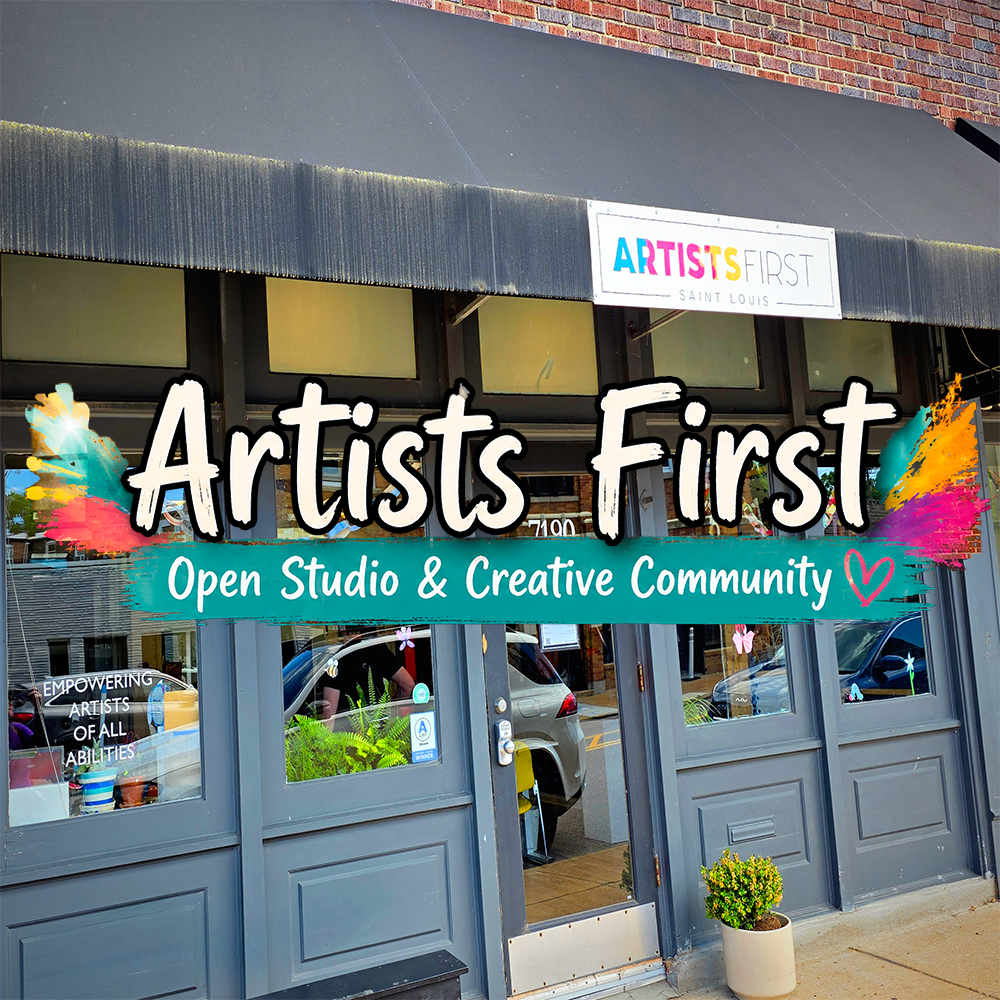
Why Access to Supplies Matters
Something many people outside the creative world do not realize is how expensive creating can become.
A single art supply may not seem overwhelming.
A sketchbook here.
Some paint there.
A few brushes.
Some canvases.
But when you add everything together, creating can quickly become financially inaccessible.
And for many artists, especially those with limited income, that creates a painful situation:
The very thing that helps them cope, heal, express themselves, and connect with the world becomes something they cannot afford.
Community art spaces challenge that.
They say: Creativity is not only for people who can buy their way in. Creativity belongs to everyone.
Selling Your Artwork & Being Seen
Another incredible part of Artists First is that they do not only help artists create—they help artists share their work.
For many emerging artists, selling artwork can feel like a mystery.
Questions start appearing:
- Where do I sell?
- How do people find my work?
- How do I know if my art is good enough?
- How do I become part of exhibitions?
Having opportunities to display and sell artwork can help artists take those first steps.
Sometimes the difference between someone seeing themselves as “someone who makes things” and “an artist” is simply being given the opportunity to be seen.
ARTICA Festival: Community Art Opportunities
Another example of the creative opportunities available in St. Louis is ARTICA, a multidisciplinary outdoor arts festival celebrating artistic expression.
Festivals and community events can give artists opportunities to:
- Share creative projects
- Connect with other artists
- Try something outside traditional spaces
- Participate in the larger creative community
Opportunities like festivals, exhibitions, and calls for artists often change yearly, so following local arts organizations can help you discover what is currently available.
Perennial: Affordable Supplies & Creative Reuse
Location: St. Louis, Missouri
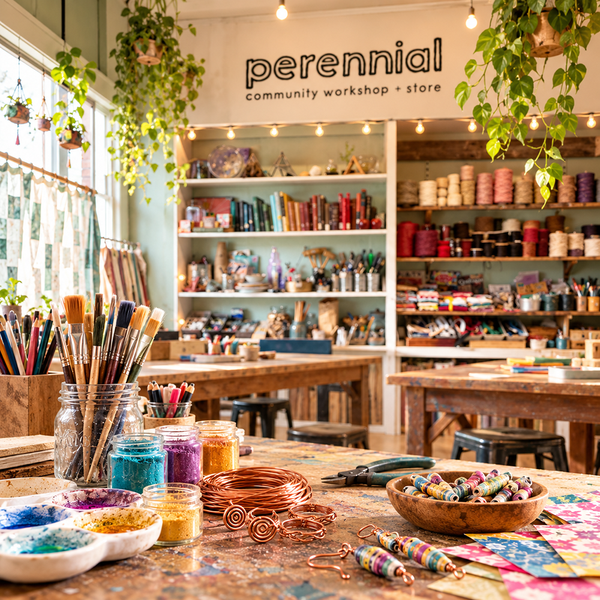
Another incredible hidden gem in St. Louis is Perennial.
Perennial focuses on creative reuse: taking materials that could have been discarded and transforming them into something new.
Their work exists at a beautiful intersection of:
Creativity.
Sustainability.
Accessibility.
Community.
For artists, makers, crafters, and curious beginners, this kind of resource can be amazing.
 Jessica Carey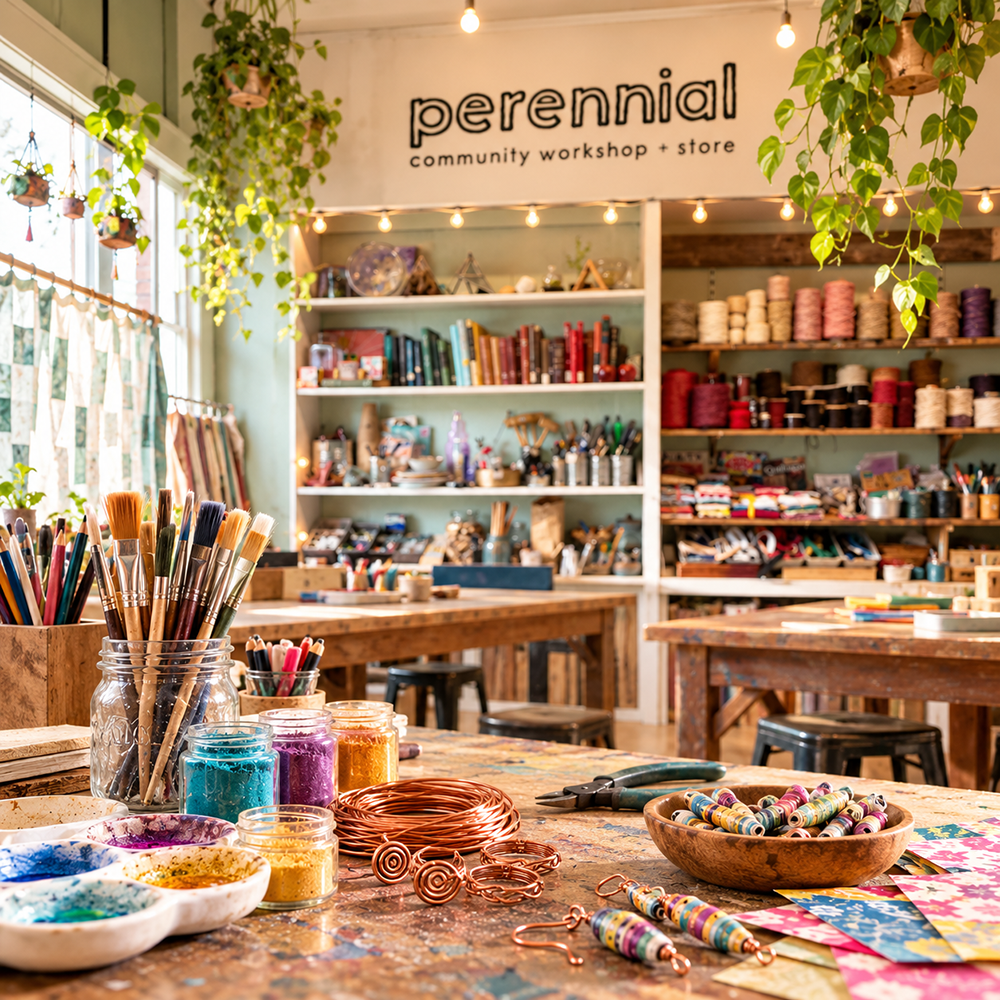
Perennial offers:
- Affordable secondhand creative supplies
- A resale shop
- Classes
- Workshops
- Scholarship opportunity
- Community events
- Clothing swaps
- Opportunities to learn new skills
The resale shop especially can be valuable for artists on a budget.
Depending on available donations, creative reuse centers may carry materials like:
- Fabric
- Yarn
- Paper
- Frames
- Craft supplies
- Sewing materials
- Mixed media materials
- Tools
- Jewelry supplies
- Unique items waiting for transformation
One of the beautiful lessons of creative reuse is:
Something does not have to be new to become something amazing.
Sometimes creativity is looking at what already exists and seeing possibility.
 Jessica Carey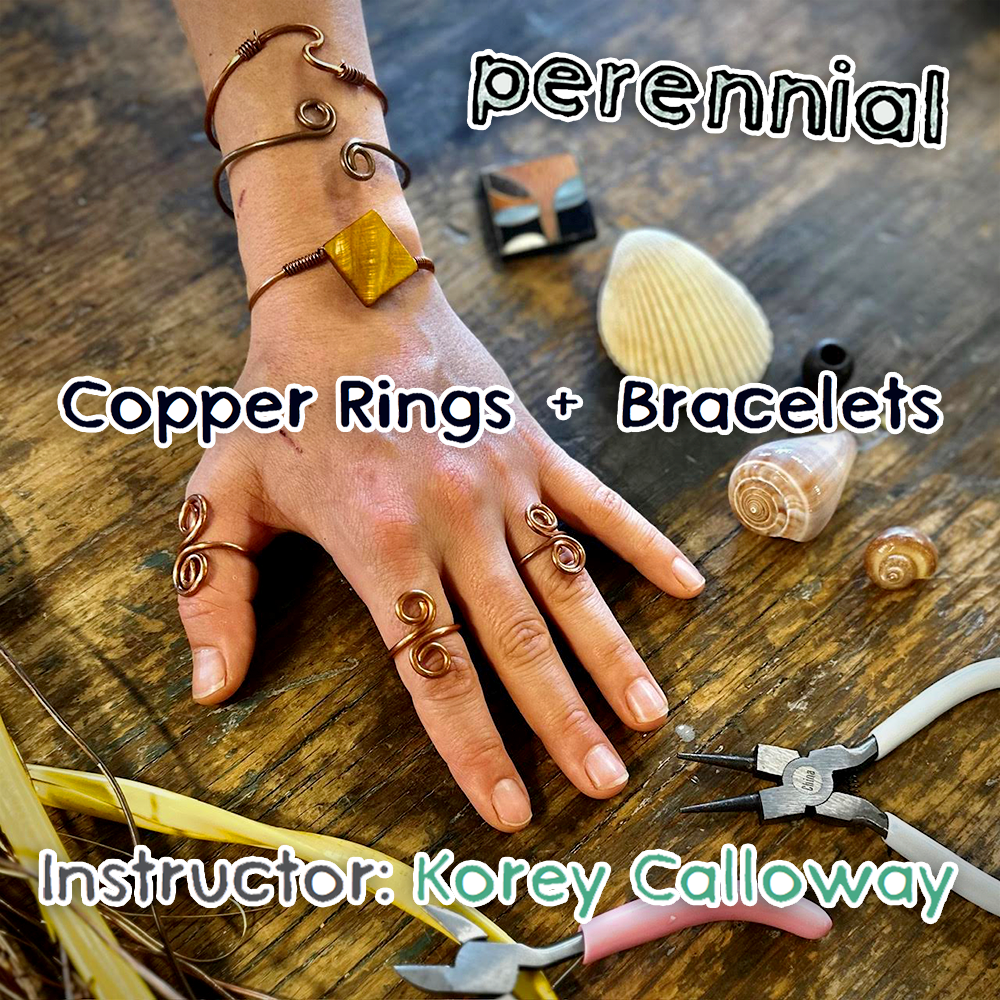
 Jessica Carey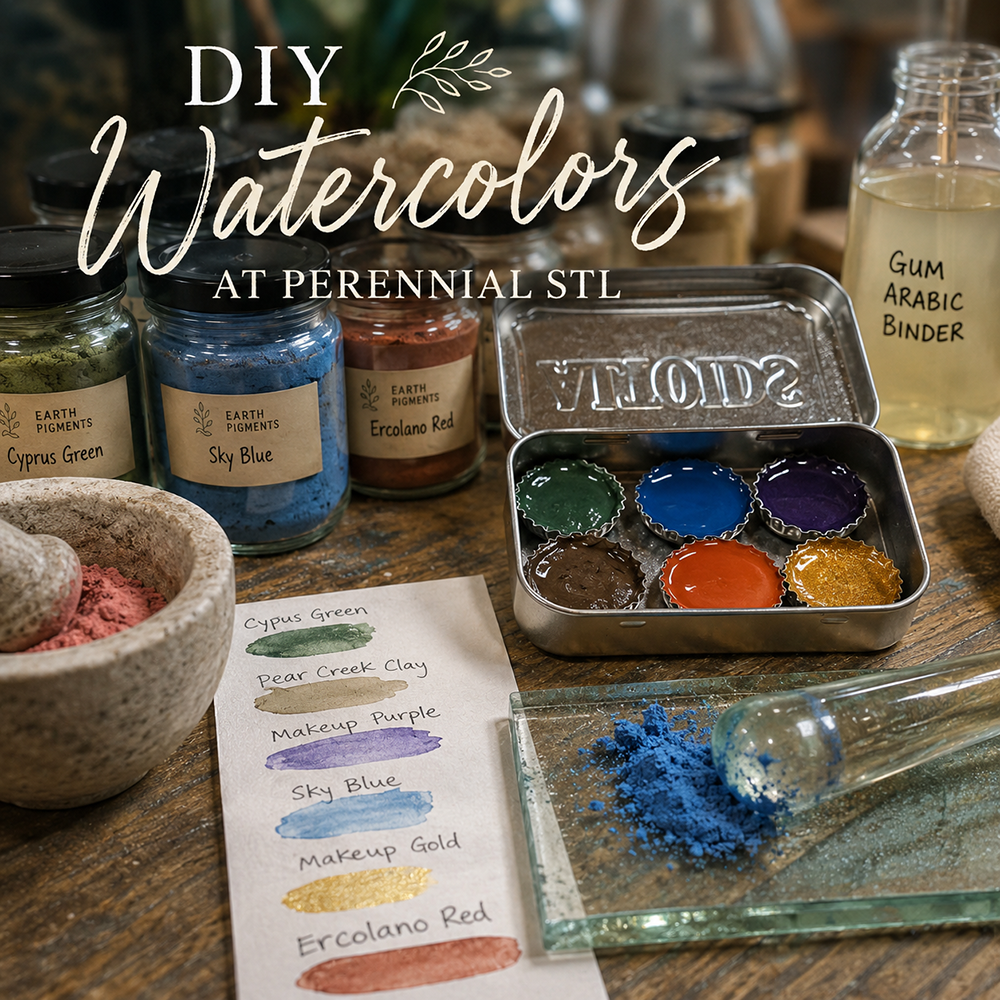
 Jessica Carey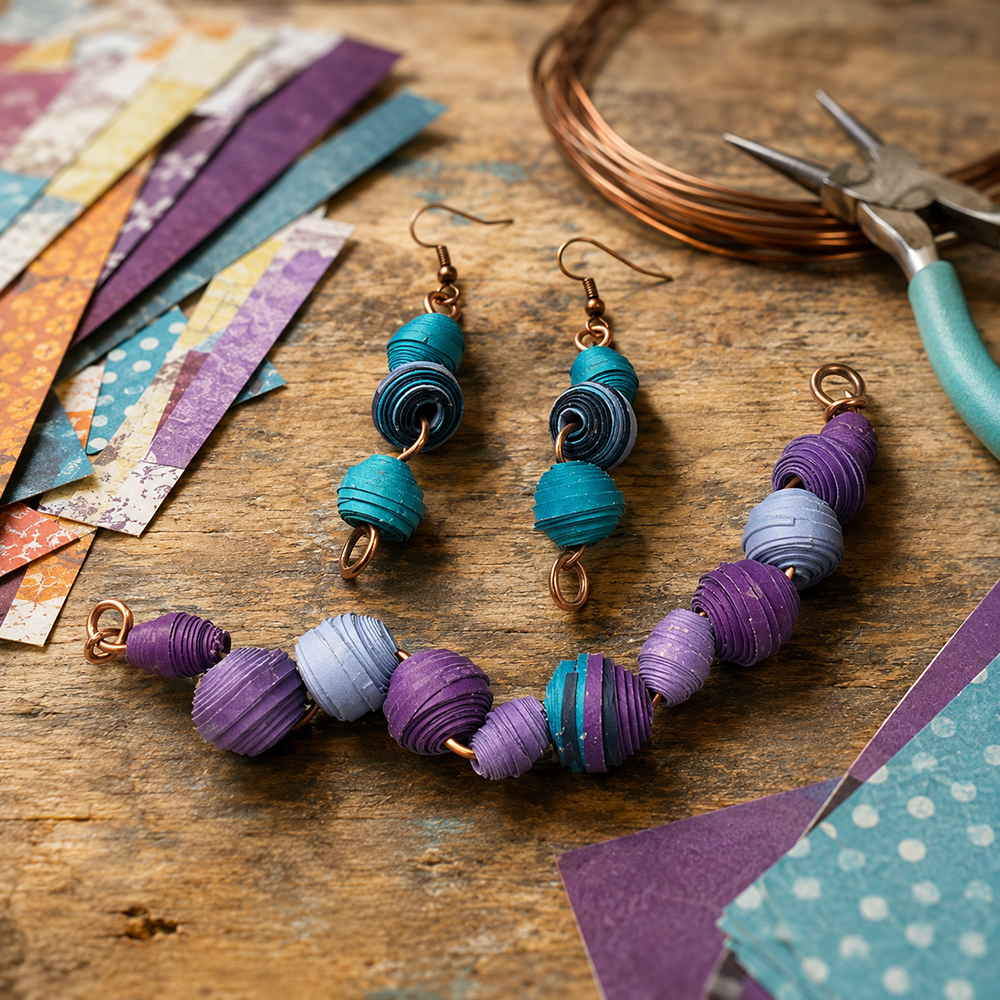
Leftovers, etc.
Another creative reuse resource in the St. Louis area is Leftovers, etc., a donation-based rescued resource center focused on giving materials a second life.
Instead of creative materials ending up unused or thrown away, resources are collected and made available for artists, educators, scouts, families, and makers.
They offer:
- Affordable rescued materials
- DIY workshops
- Scout workshops
- After-school programs
- Creative learning opportunities
For artists working with limited resources, places like Leftovers, etc. are especially valuable because they encourage experimentation. When materials are accessible, creativity becomes less about worrying whether you can afford to make something and more about exploring what something could become.
STL Teachers Trading Post — Upcycle Treasure Box
STL Teachers Trading Post’s Upcycle Treasure Box is another creative reuse center helping connect people with affordable materials.
Creative reuse centers are especially powerful because they solve two problems at once:
- They reduce waste.
- And they put creative possibilities into the hands of people who can use them.
Teachers, artists, families, and makers can find unexpected treasures and transform them into something new.
 Jessica Carey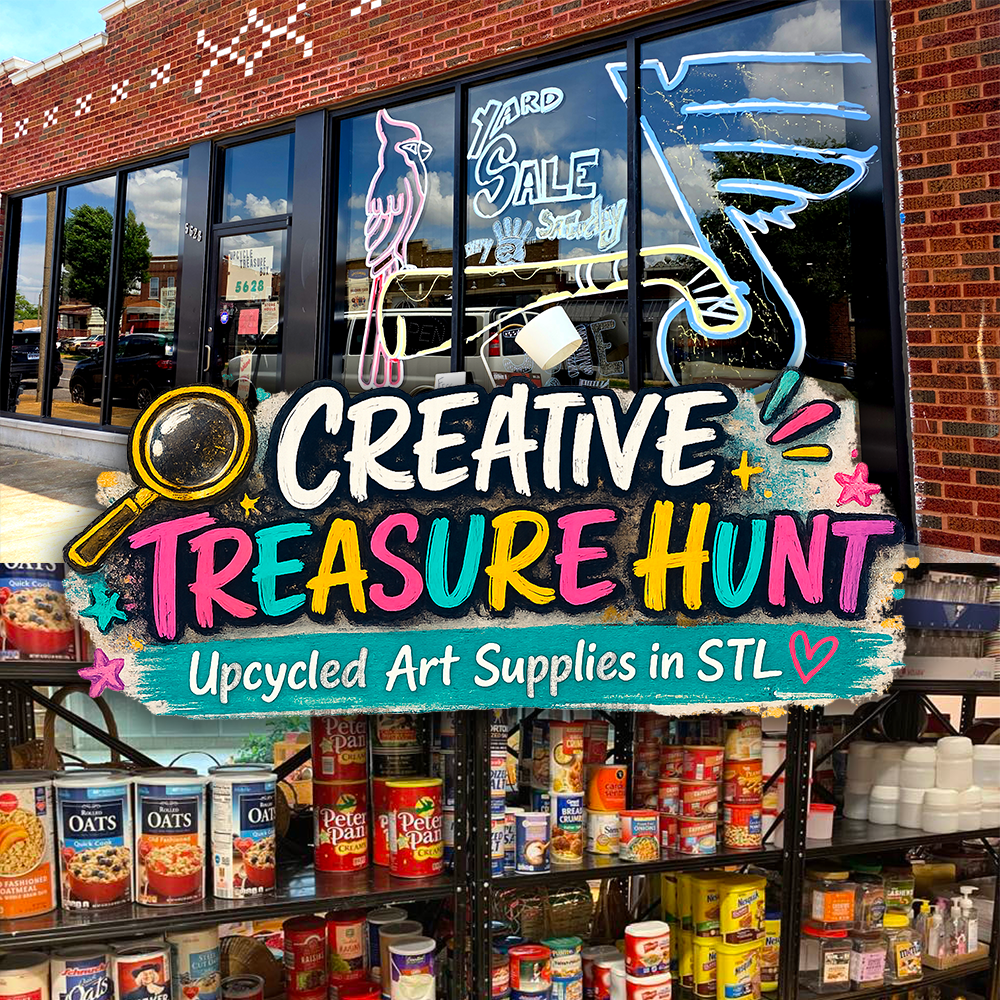
Permission to Experiment
Affordable supplies matter because experimentation matters.
Sometimes artists get stuck because supplies feel too precious.
When every canvas costs money, every brushstroke can start feeling stressful.
You might think:
- “What if I ruin it?”
- “What if I waste materials?”
- “What if this idea doesn’t work?”
But creativity grows through exploration.
Some of the best ideas come from trying things without knowing exactly where they will lead.
Affordable and reused materials give artists room to play again.
And play is where creativity thrives.
Marnie's Creative Outlet: Classes, Workshops & Creative Community
Location: Webster Groves, Missouri
Another creative resource in the St. Louis area is Marnie’s Creative Outlet.
Marnie’s offers creative experiences including:
- Art workshops
- Classes
- Art parties (usually $30-45 a person depending on the project)
- Group creative experiences
- A gallery space for selling art (20% commission for Marnie's Creative Outlet)
Classes and workshops can be valuable because they provide structure and guidance.
Sometimes getting started is the hardest part.
You might have supplies sitting at home but feel stuck.
You might want to learn something new but feel overwhelmed watching tutorials.
You might want creative community instead of always creating alone.
Workshops create a space where you can simply show up.
The materials are there.
The instruction is there.
The invitation to create is there.
 Jessica Carey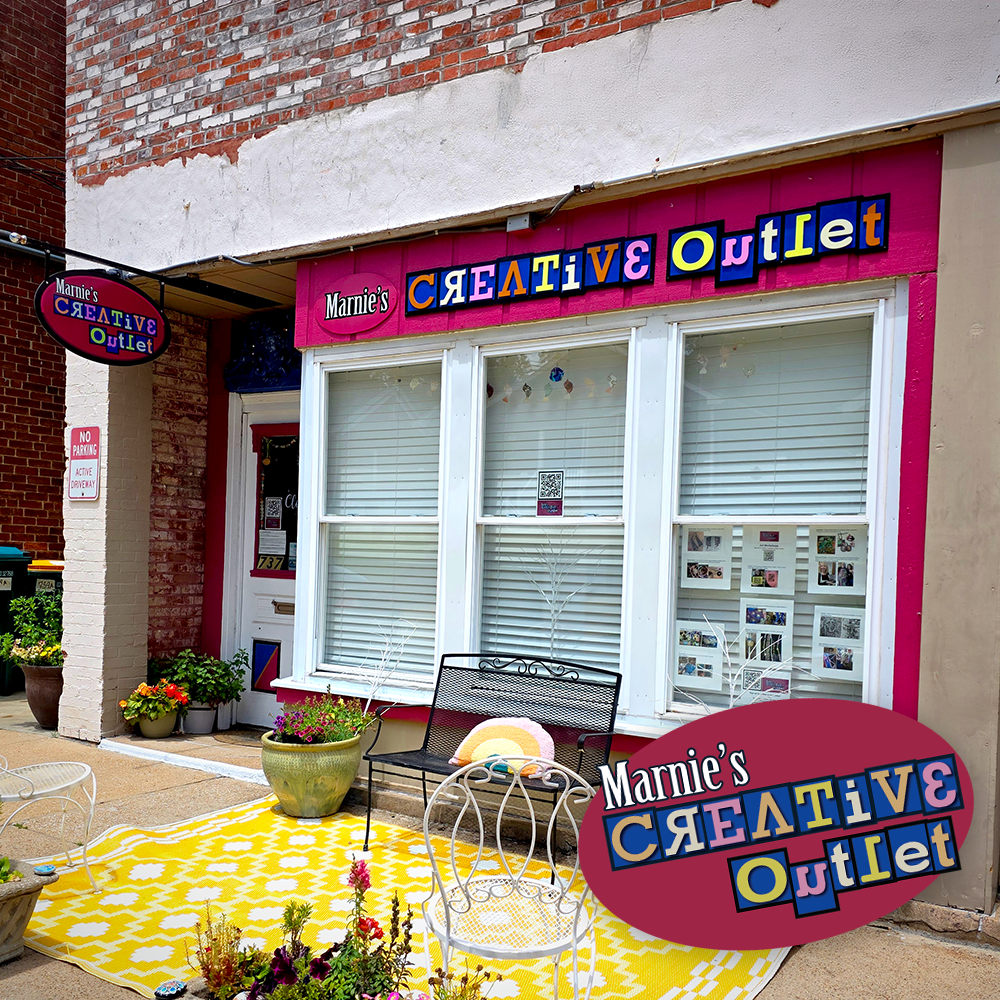
 Jessica Carey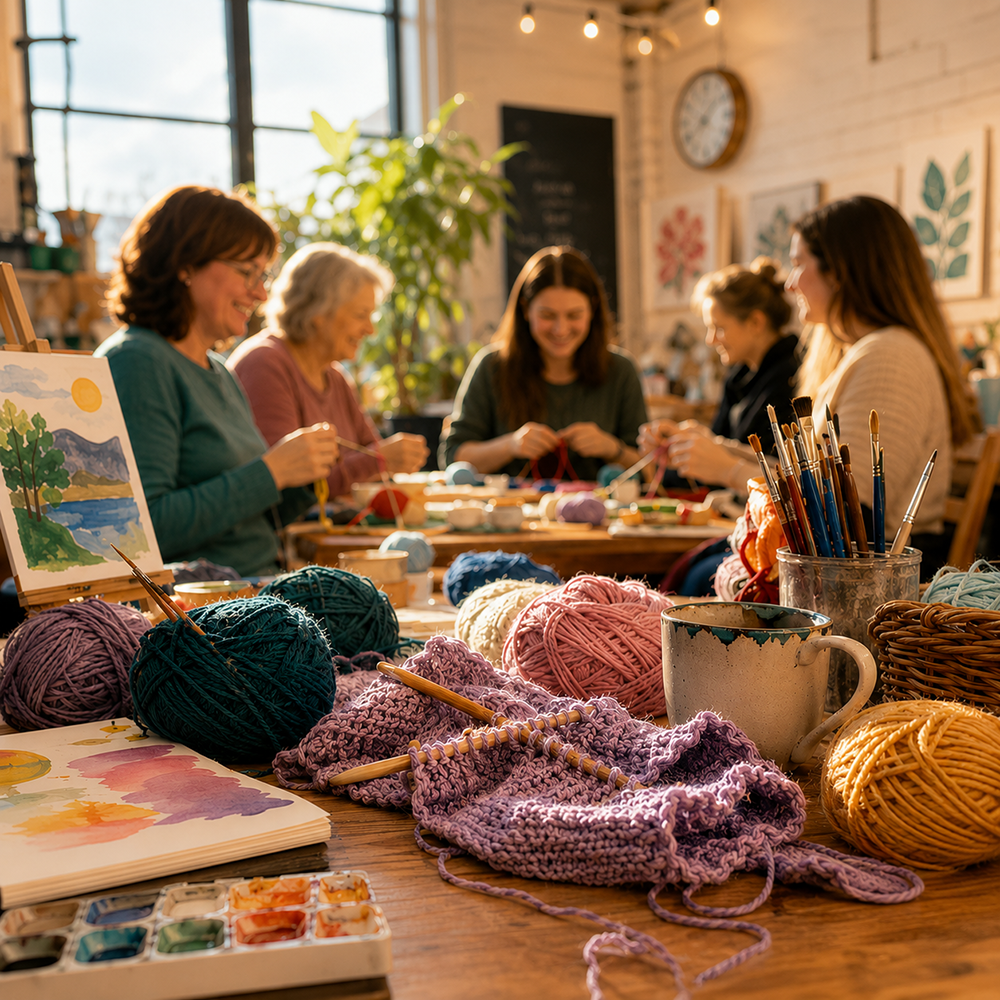
Magenta Door Art Studio: Creativity, Healing & Connection
Location: St. Louis, Missouri
Another beautiful creative connection I discovered through exploring local art spaces was Maria Ojascastro and Magenta Door Art Studio.
Maria is an artist, educator, and well-being instructor whose work focuses on using creativity as a way to build connection, healing, and community.
Through art experiences, workshops, and creative guidance, Magenta Door Art Studio reflects something I deeply believe:
Art is not only about what we make.
It is also about expression, discovery, connection, and remembering the creative parts of ourselves.
Resources like this are another reminder that creativity is not reserved for professional artists. Creativity belongs to everyone.
Craft Alliance — Learning, Exhibitions & Building Creative Community
Location: Delmar Loop, St. Louis, Missouri
For artists who want to continue developing their skills, explore new mediums, and connect more deeply with the creative community, Craft Alliance is another wonderful St. Louis resource.
As a nonprofit arts organization, Craft Alliance supports creativity through education, exhibitions, and community engagement.
They offer opportunities such as:
- Art classes and workshops
- Learning from experienced artists and instructors
- Scholarship opportunity
- Gallery exhibitions
- Exposure to different craft mediums
- Community events
- Opportunities to connect with other creatives
Craft Alliance also offers scholarships for up to 50% off classes, so feel free to check out their scholarship application!
Craft Alliance is especially valuable because some creative practices require access to specialized tools, equipment, or instruction that many people do not have at home.
Mediums like:
- Ceramics
- Metalsmithing
- Fiber arts
- Glass
- Printmaking
- Mixed media
can feel intimidating when you are starting alone.
- Where do you begin?
- What supplies do you buy?
- What tools do you need?
- How do you learn techniques safely?
Classes and community spaces help remove those barriers.
They create an environment where artists can explore without needing to already have all the answers.
St. Louis Artists’ Guild: Exhibitions, Classes, and Creative Community
Location: St. Louis, Missouri
The St. Louis Artists’ Guild is another resource for artists looking for connection, education, and opportunities.
Many artists create independently, but having spaces to meet other creatives can be incredibly valuable.
The Artists’ Guild offers opportunities such as:
- Exhibitions
- Classes
- Artist events
- Creative community
- Ways to connect with other makers
Whether someone is just beginning their creative journey or has been making art for years, finding other artists can help creativity continue to grow.
MADE Makerspace: Tools, Technology & Room to Create
Location: St. Louis, Missouri
Another amazing resource for creators in the St. Louis area is MADE Makerspace.
Sometimes the biggest barrier for artists and makers is not creativity.
It is access.
Access to tools.
Access to equipment.
Access to space.
Access to opportunities to learn.
MADE helps bridge that gap by offering a shared creative space where makers can explore ideas and bring projects to life.
Depending on your creative interests, makerspaces can provide access to resources such as:
- Woodworking tools
- Digital fabrication equipment
- Technology
- Creative workspaces
- Classes
- Workshops
- Opportunities to learn new skills
For artists, inventors, DIY creators, and curious beginners, spaces like MADE can open doors that may otherwise feel impossible.
Not everyone has room for a workshop at home.
Not everyone can purchase expensive tools for a single project.
Community makerspaces create opportunities for people to experiment, learn, and create without needing to own everything themselves.
Sometimes creativity is not about needing more ideas.
Sometimes it is simply needing access to the right tools to bring those ideas into reality.
 Jessica Carey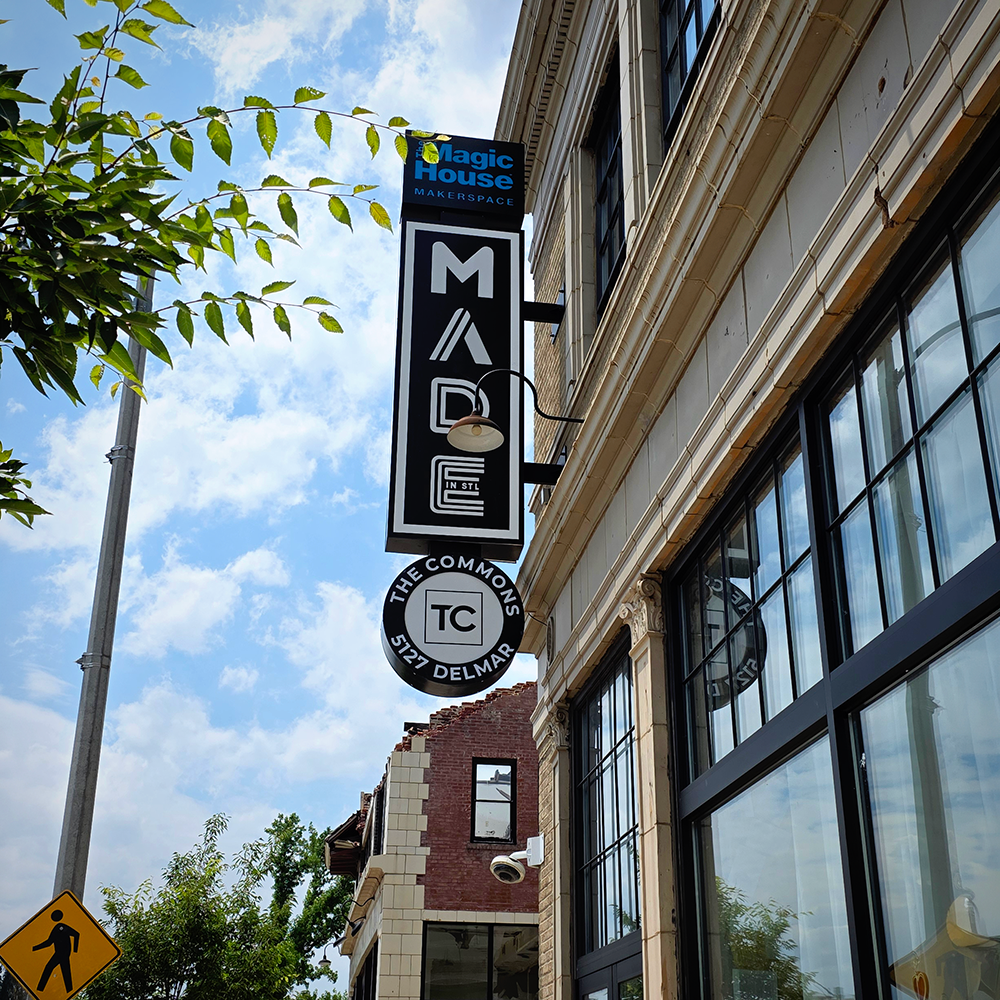
Yucandu Art Studio
Yucandu Art Studio is another space for creative exploration, offering arts and crafts experiences, workshops, and opportunities to try new creative mediums.
Spaces like this are valuable because sometimes creativity grows through permission to play.
You do not always need a specific goal.
Sometimes trying something new is how you rediscover inspiration.
COCA: Creative Classes & Accessibility
Continuing to learn is part of being an artist.
The Center of Creative Arts (COCA) offers creative learning opportunities, including sliding scale tuition options designed to make participation more accessible.
Accessible classes help more people explore creativity regardless of financial circumstances.
St. Louis County Library Creative Lab: Free Tools, Technology & Creative Exploration
Location: Clark Family Branch — St. Louis, Missouri
One of the most overlooked creative resources in the St. Louis area might be somewhere many people already know: the library.
Modern libraries have grown far beyond books. They have become community spaces where people can learn skills, access technology, explore ideas, and create.
The St. Louis County Library’s Creative Lab is an incredible resource for artists, makers, writers, musicians, entrepreneurs, content creators, and curious beginners.
One of the biggest barriers for creators is access.
Professional equipment can be expensive.
Software subscriptions add up.
Buying specialized tools before knowing if you enjoy something can feel impossible.
The Creative Lab helps remove some of those barriers by providing access to resources such as:
- 3D printers
- Glowforge laser cutter
- Cricut machines
- Adobe Creative Suite
- Recording studio
- Green screen
- Creative workstations
- Classes and learning opportunities
Whether someone wants to experiment with digital art, create handmade products, record music, start a podcast, design stickers, build a small business, or simply try something new, resources like this create opportunities.
The library also offers additional support through resources like:
- Books and learning materials
- Digital resources
- Workshops and events
- Study spaces
- Meeting rooms
- Technology access
- Monthly printing credits
For creators who do not have a dedicated studio, expensive equipment, or the ability to invest hundreds of dollars into trying something new, community resources like the Creative Lab can make a huge difference.
Sometimes creativity does not begin because someone buys everything they need.
Sometimes it begins because they finally discover a place where they are allowed to explore.
 Jessica Carey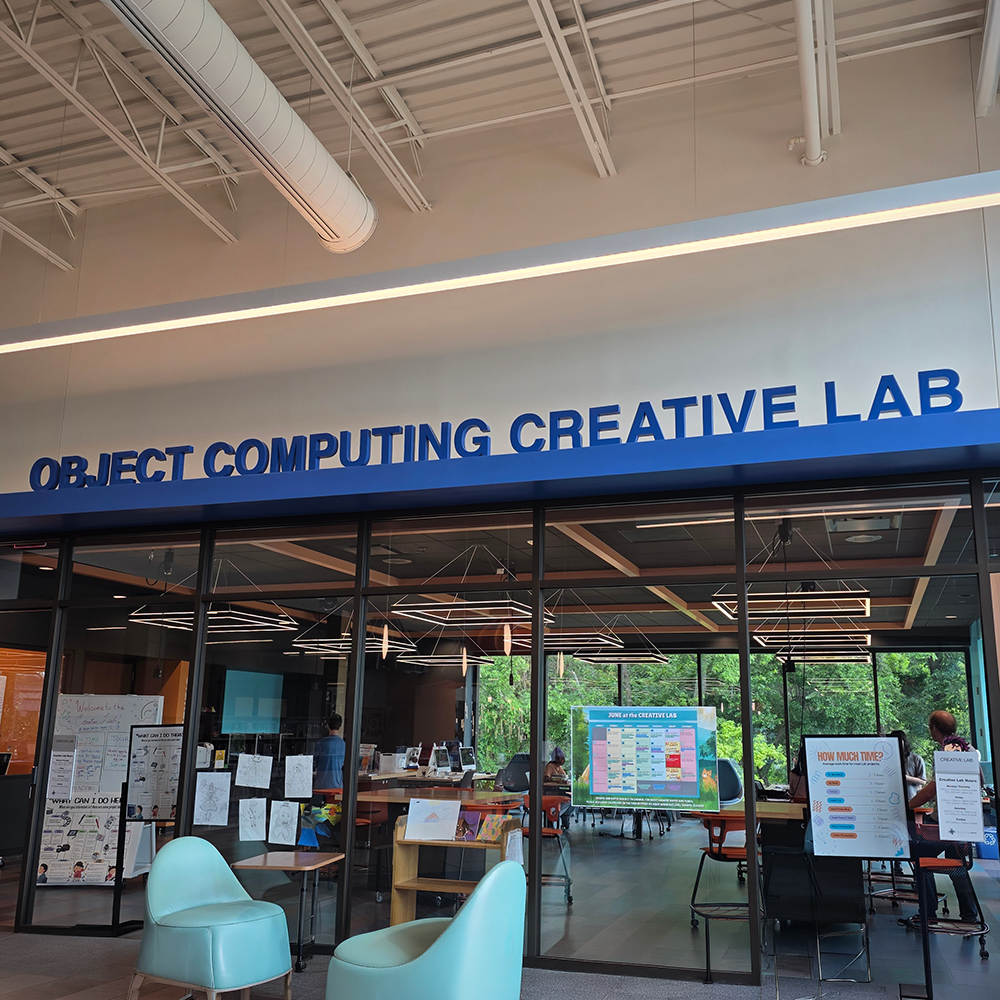
Growing From Beginner to Artist
Something important to remember is that every artist is always learning.
There can sometimes be a misconception that you need to become “good enough” before entering creative spaces.
But creative spaces exist because people are learning.
You do not have to master something before you begin.
You begin, and the learning happens along the way.
Organizations like Craft Alliance help support that lifelong creative journey—from curiosity, to exploration, to skill-building, to sharing your work with others.
Whether someone wants to try a new medium for fun, reconnect with creativity, develop their artistic voice, or take steps toward a professional creative practice, having spaces dedicated to craft helps keep creativity alive in the community.
Artist Growth as well as Professional Support & Resources
While supplies and creative spaces are important, artists often need more than materials. Building a sustainable creative practice can also involve finding community, professional guidance, funding opportunities, and support systems.
Here are additional St. Louis and regional resources that help artists continue growing.
Artist INC: Professional Development for Artists
Location: Available in different cities, including St. Louis opportunities
One challenge many artists face is that we are often taught how to create artwork, but not always taught how to build a sustainable creative practice.
Artist INC helps bridge that gap.
This professional development program supports artists as they explore topics like:
- Talking about their artwork
- Setting creative goals
- Building sustainable practices
- Understanding the business side of art
- Connecting with other artists
Through workshops, peer learning, and community conversations, Artist INC helps support the artist behind the artwork.
Applications open periodically, so artists interested in participating should check current opportunities.
Mid-America Arts Alliance: Artist Opportunities & Professional Growth
Sometimes the hardest part of finding artist opportunities is simply knowing they exist.
Mid-America Arts Alliance helps connect artists with resources, professional development opportunities, programs, and creative networks.
Their opportunities may include:
- Artist development programs
- Peer learning opportunities
- Calls for artists
- Funding information
- Creative career resources
Joining newsletters from organizations like M-AAA can help artists discover opportunities they may not find on their own.
Springboard for the Arts: Supporting Sustainable Creative Lives
Another helpful artist resource is Springboard for the Arts, an organization focused on helping artists build stronger and more sustainable creative practices.
Their resources explore topics such as:
- Artist careers
- Creative entrepreneurship
- Community connection
- Professional development
Resources like this recognize something important:
Artists are not only creators.
They are people building creative lives.
Volunteer Lawyers and Accountants for the Arts (VLAA): Legal & Business Support for Creatives
Location: St. Louis, Missouri
Creating artwork is only one part of being an artist. Many creatives eventually run into questions about the practical side:
- Copyright
- Contracts
- Selling artwork
- Creative businesses
- Taxes and finances
These topics can feel overwhelming, especially because many artists are trained creatively but not always taught business skills.
VLAA helps artists access education and resources around these important areas so they can better protect and support their creative work.
The Importance of Creative Community
One theme connects all of these resources:
Artists need more than supplies.
They need connection.
So many creative people make things alone.
And solitude can absolutely be beautiful.
But isolation can also convince people that their work does not matter.
Being around other creative people reminds us:
Everyone starts somewhere.
Everyone experiments.
Everyone learns.
Everyone creates imperfect things.
Art is not about proving you deserve to create.
Creating is how you discover.
How you process.
How you grow.
How you connect.
The world needs more spaces where people are handed supplies and told: “Welcome. You belong here. Let’s make something.”
 Jessica Carey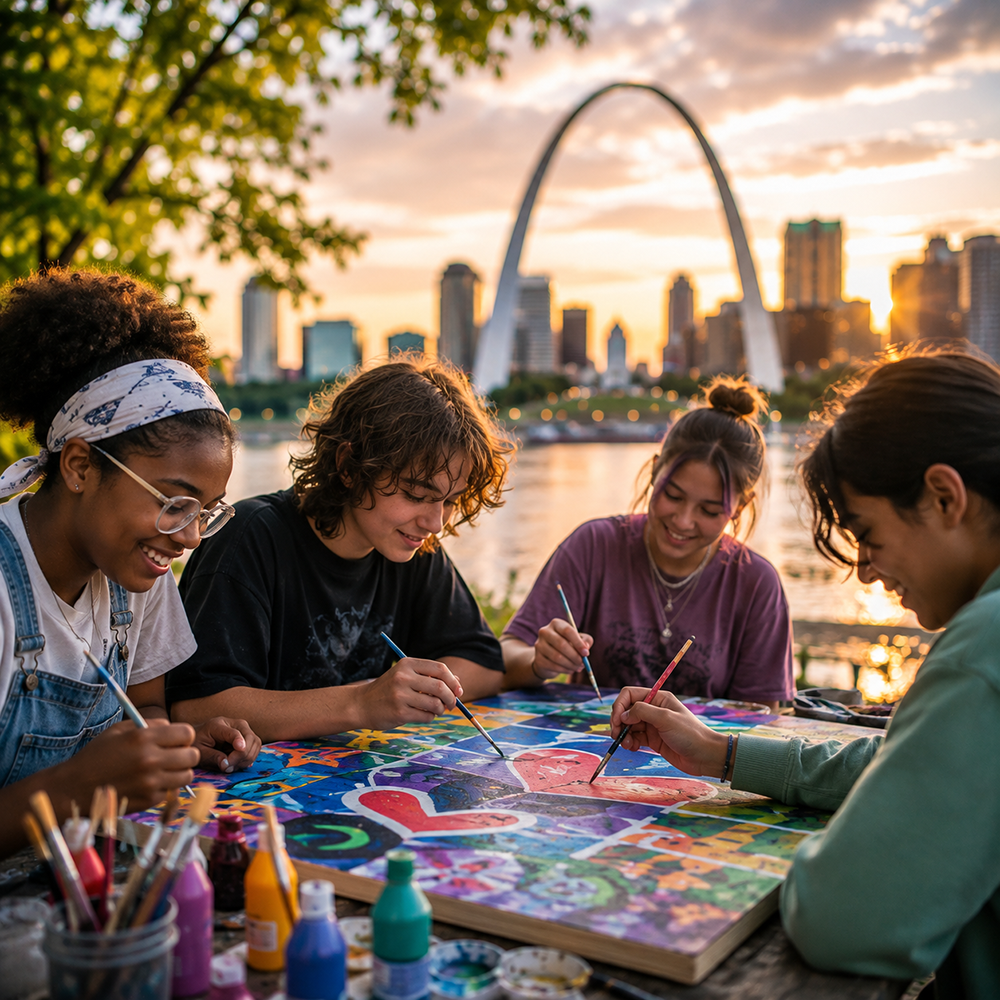
Finding Supplies, Funding & Opportunities When You Are Starting With Very Little
One of the hardest parts about being an artist during a difficult season is that creating often requires resources before you ever have the chance to earn anything from your creativity.
People may say: “Start selling your art.”
But creating inventory takes supplies.
People may say: “Improve your skills.”
But classes cost money.
People may say: “Put yourself out there.”
But finding opportunities requires knowing where those opportunities exist.
It can become an exhausting cycle:
You need resources to create opportunities.
But you need opportunities to gain resources.
This is why accessible programs, community support, and resource sharing matter so much.
They can become the bridge between where someone is now and where they are trying to go.
Blick Art Materials — Donation Requests & Asking for Creative Support
Most artists know Blick as an art supply store.
What many people may not know is that Blick also has a donation request process.
This is something important I learned while searching for resources:
Sometimes you have to ask.
Many artists struggle with asking for help.
We love creating things for other people.
We love giving.
We love encouraging others.
But when it comes time to say: “Actually, I could use support too,” that can feel uncomfortable.
However, asking does not mean demanding.
It does not mean expecting.
It simply means opening a door and giving someone the opportunity to walk through it.
A closed mouth rarely receives help because people often do not know help is needed.
Regional Arts Commission of St. Louis (RAC)
For artists looking beyond supplies and classes, the Regional Arts Commission of St. Louis is one of the biggest arts resources in the region.
RAC supports and strengthens the local arts ecosystem through funding, opportunities, programs, and community investment.
While grant availability changes from year to year (and 2026 is being used as a planning year rather than offering their typical grants), RAC is still an important organization for St. Louis artists to know about.
When looking for grants with groups like RAC:
- check regularly
- sign up for newsletters
- watch opportunities
- follow local arts organizations
Why? Because resources change.
Just because a grant isn’t open today doesn’t mean the organization is useless.
Beyond funding individual projects, organizations like RAC are part of a larger creative ecosystem that helps support artists throughout the St. Louis region.
Grants and artist resources can help creators:
- Access materials
- Develop projects
- Share their work with the community
- Continue growing professionally
Creative work has value, and funding opportunities help make creative ideas possible.
CERF+ (Craft Emergency Relief Fund): Support for Craft Artists
Artists are people first, and unexpected challenges can affect anyone.
CERF+ focuses on helping craft artists build stronger, more sustainable creative practices through emergency readiness, resources, and support.
Their work recognizes that protecting artists also protects creativity.
Field-Specific Grants & Creative Funding
Some funding opportunities are created for specific creative fields.
For example, We Are Moving The Needle offers MicroGrants designed to support music creators such as producers, engineers, and songwriters.
While every opportunity will not apply to every artist, discovering these programs is another reason creative networks matter.
Your specific medium may have resources, grants, or communities you never knew existed.
How to Ask for Support
When reaching out to organizations, businesses, or potential supporters, try to explain:
- Who you are
- What you create
- Why creating matters to you
- What obstacle you are facing
- What specific support would help
- How that support would impact your life or community
Specific requests are usually stronger than vague requests.
Instead of: “I need help.”
Try: “I am an artist rebuilding my creative practice and access to supplies would help me continue creating.”
Or: “I am looking for opportunities to display my artwork, connect with other artists, and grow.”
People often want to help.
Sometimes they simply need to understand how.
Finding Free & Affordable Art Supplies
Art supplies can be one of the biggest barriers for creatives.
A fully stocked creative space can represent years of collecting materials.
Paint.
Brushes.
Markers.
Paper.
Canvas.
Clay.
Tools.
Fabric.
Storage.
Equipment.
When someone loses access to their supplies, is starting over, or is struggling financially, rebuilding everything can feel impossible.
But there are creative ways to begin.
For instance, the Little Free Art Supply Library at Cherokee Street and Iowa Avenue in St. Louis lets artists take and donate arts and craft supplies. Sadly, it's temporarily closed, but there are these hidden gems out there!
How Artists Find Materials Without Existing Connections
One thing I have discovered while exploring creative reuse is that many artists find resources through relationships.
Someone knows an electrician with leftover wire.
Someone knows a teacher with extra classroom supplies.
Someone knows a business getting rid of materials.
These connections are wonderful, but they can also leave beginners wondering: “What if I don’t know anyone?”
The good news is that connections can be created.
Many creative resources begin with simply asking the right people the right questions.
Instead of only searching for finished art supplies, think about who regularly encounters the materials you need.
For example:
- Jewelry artists looking for copper wire might contact electricians, repair shops, electronics recyclers, or community reuse centers.
- Fiber artists might connect with sewing groups, thrift stores, or people clearing out fabric collections.
- Mixed media artists might explore creative reuse centers, estate sales, salvage stores, or community giveaway groups.
- Woodworkers might ask cabinet makers, contractors, or furniture repair businesses about leftover scraps.
A helpful question to ask is: “Do you ever have leftover materials that are too small for your projects but could be reused for art?”
Sometimes what one person sees as scraps can become another person’s creative treasure.
You can also reach out through:
- Buy Nothing groups
- Neighborhood groups
- Local artist communities
- Community bulletin boards
- Libraries
- Makerspaces
Try explaining not only what you need, but why: “I’m an artist trying to reuse materials that would otherwise go to waste.”
Many people love knowing something they no longer need will become something meaningful.
Creativity has always been about seeing possibility.
Sometimes finding materials is just another part of the creative process.
 Jessica Carey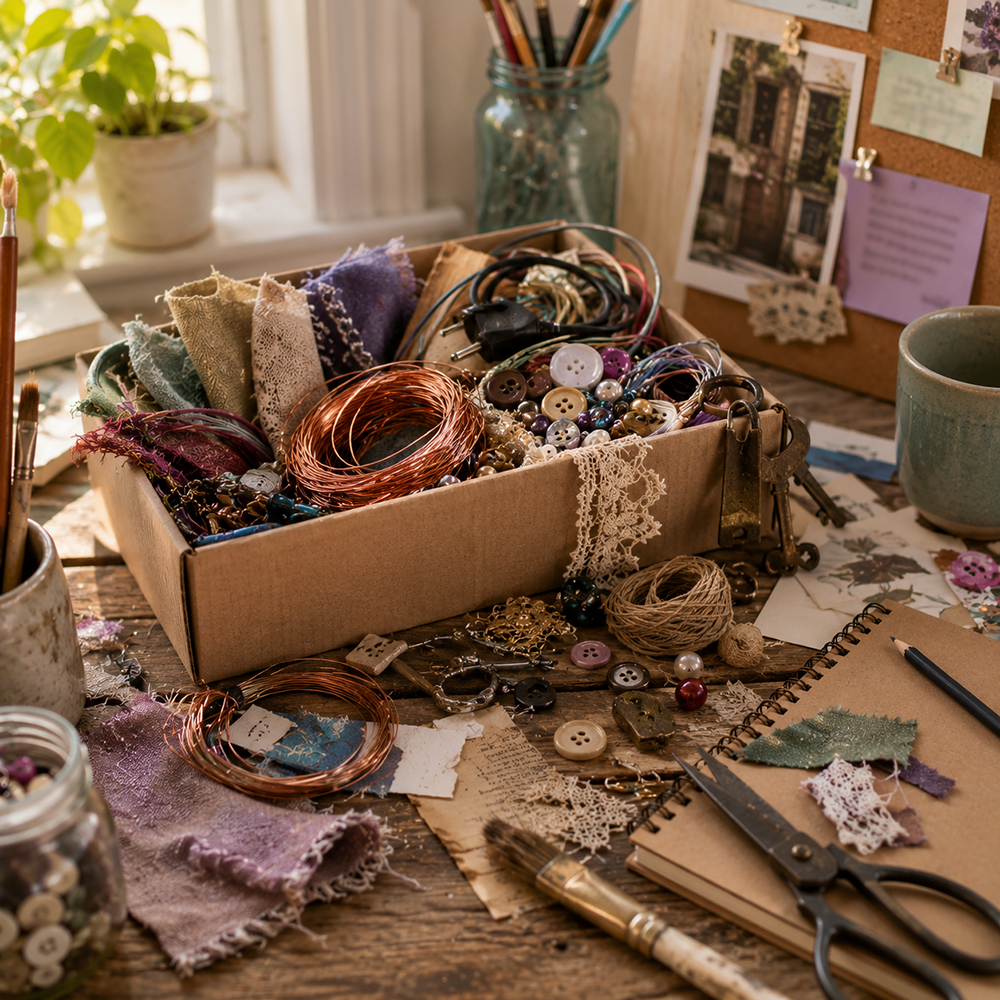
Creative Reuse Centers
Search: “creative reuse center near me”
Creative reuse centers collect donated materials and make them available to the community.
Depending on the location, you might find:
- Paint
- Fabric
- Yarn
- Paper
- Frames
- Office supplies
- Craft materials
- Sewing supplies
- Scrapbooking supplies
- Jewelry supplies
- Random treasures waiting for a new purpose
These places are wonderful because they support two things at once:
Artists get affordable materials.
Items stay out of landfills.
Creativity and sustainability work together.
Buy Nothing Groups & Community Giving
Another resource many people overlook is local giving communities.
Search: “Buy Nothing” + your city/neighborhood
These groups are built around neighbors freely giving items they no longer need.
People often give away:
- Craft supplies
- Storage containers
- Furniture
- Books
- Tools
- Fabric
- Art materials
You can also make requests.
Something as simple as: “Hi everyone! I’m an artist looking for unused art or craft supplies. If anyone has materials sitting around that need a new home, I would love to create with them.”
Many people have supplies sitting untouched in closets.
Sometimes the supplies someone else forgot about are exactly what another person has been hoping for.
Unexpected Places to Find Creative Materials
Sometimes the best creative supplies are not found in traditional art stores.
Artists have always transformed ordinary materials into something new.
For mixed media artists, sculptors, makers, DIY creators, and upcyclers, unexpected materials can become part of the creative process.
Consider exploring places like:
- Habitat for Humanity ReStore
- Salvage stores
- Thrift shops
- Estate sales
- Secondhand shops
- Reuse centers
 Jessica Carey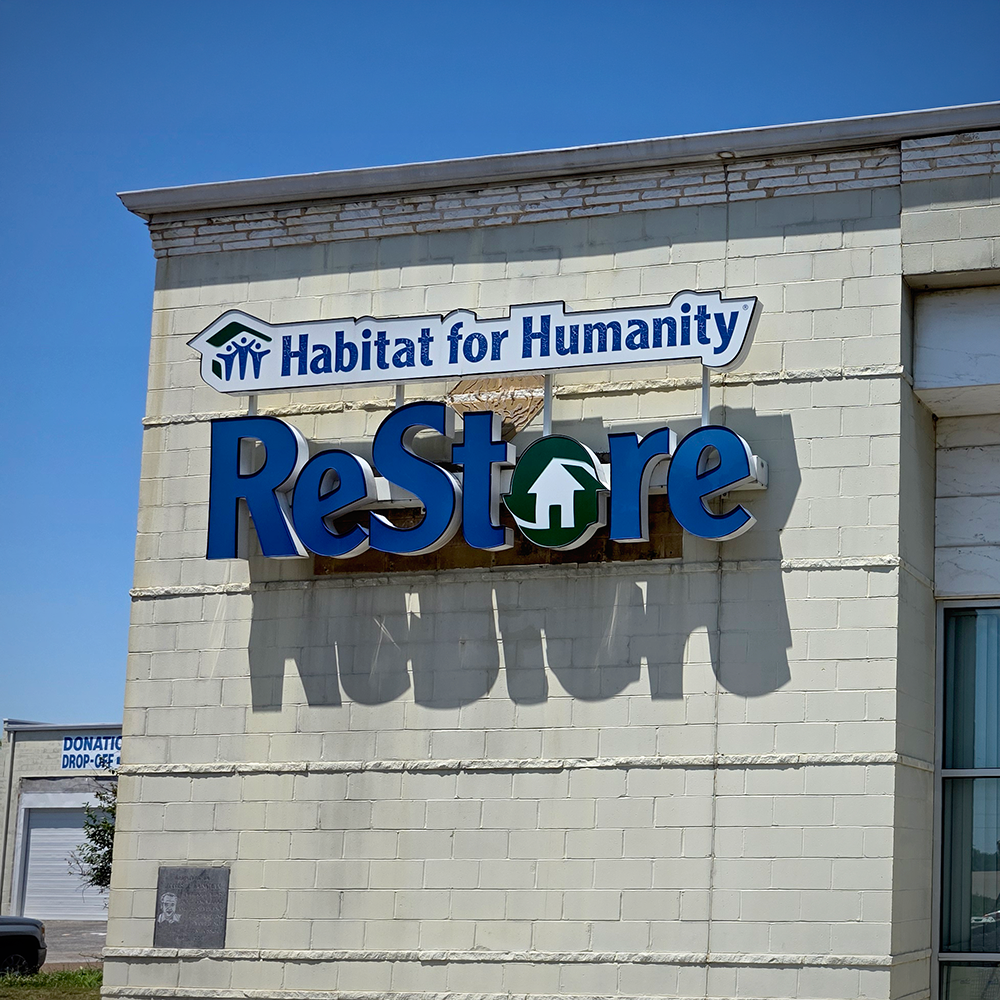
Depending on availability, you may find materials like:
- Wood
- Frames
- Hardware
- Tiles
- Fixtures
- Furniture pieces
- Fabric or textiles
- Unique objects for mixed media projects
Before something becomes waste, sometimes it just needs someone with imagination to see a new possibility. A scrap metal place can absolutely be interesting for artists who work with:
- sculpture
- assemblage art
- jewelry
- metal art
- mixed media
- found-object art
Artists use salvaged:
- copper
- aluminum
- steel pieces
- interesting hardware
- mechanical parts
- metal objects
Metal artists and mixed-media creators may also want to explore local salvage and recycling businesses. Some scrap metal businesses and recycling centers allow artists to purchase reclaimed materials such as metal pieces, hardware, or interesting industrial materials, but policies vary—always contact the business first.
 Jessica Carey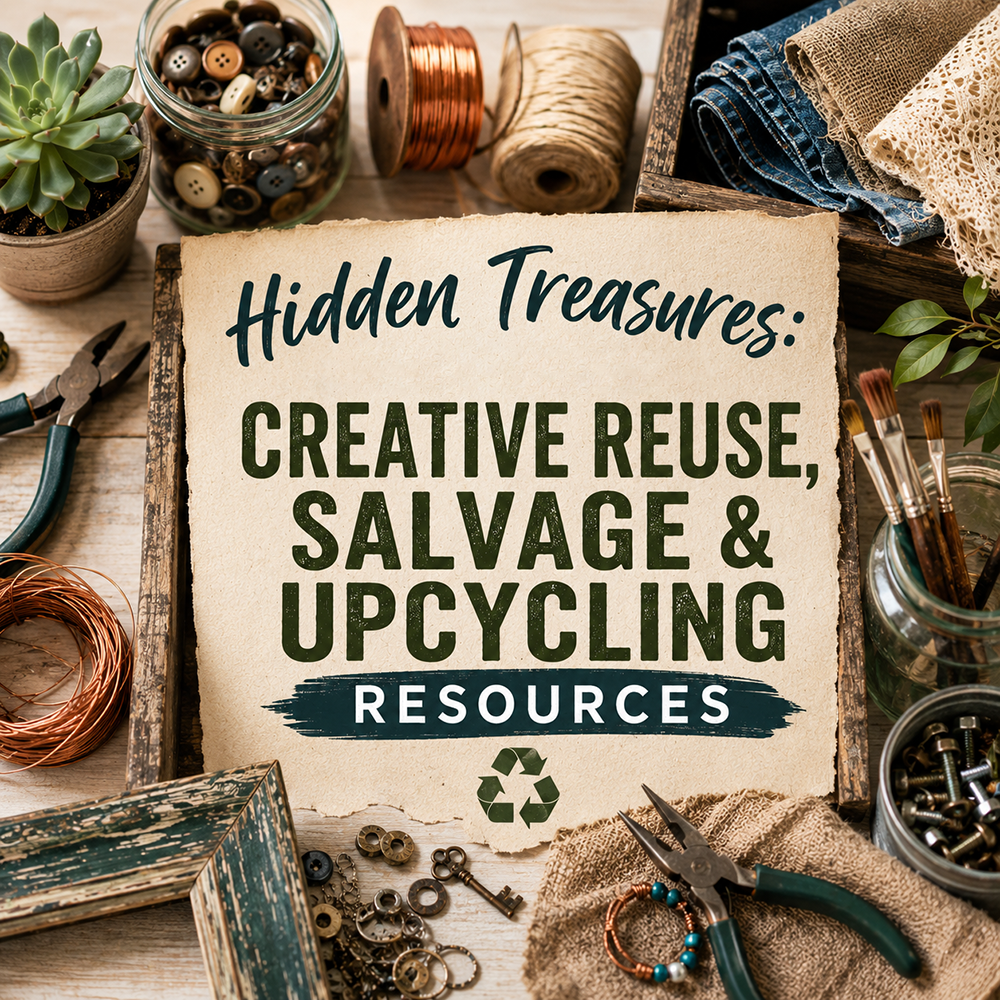
Libraries: One of the Most Underrated Creative Resources
Libraries are incredible resources that many people underestimate.
They are not just places to borrow books anymore.
Depending on your local library system, you may find:
- Free classes
- Creative workshops
- Technology access
- Business resources
- Online learning platforms
- Community events
- Research databases
- Meeting spaces
Some libraries even have makerspaces with access to equipment like:
- 3D printers
- Recording equipment
- Craft tools
- Design software
- Creative technology
For artists trying to build creative businesses, libraries can also help with:
- Marketing research
- Learning business skills
- Finding grants
- Building digital skills
If you haven’t explored your library recently, it may be worth looking again.
Supporting Local Art Supply Stores
While affordable and free resources are incredibly important, local creative businesses are also valuable parts of the artistic community.
Independent art stores often provide more than products—they provide knowledge, recommendations, and connections.
St. Louis Art Supply
St Louis Art Supply includes:
- art materials
- specialty supplies
- local creative business
- good for artists looking for quality materials
Krueger Pottery Supply
For ceramic artists, access to equipment can be one of the biggest barriers.
Unlike some art forms, pottery often requires materials and tools many people cannot easily have at home:
- Kilns
- Wheels
- Clay
- Glazes
- Firing access
Krueger Pottery Supply in Webster Groves helps support ceramic artists by offering supplies, equipment, classes, and firing services.
This is important because firing services are HUGE.
Someone can hand draw anywhere.
Someone can paint at a kitchen table.
Ceramics often requires infrastructure.
Learning Art Skills Without Spending Hundreds
Growing as an artist should not require spending thousands of dollars.
Paid classes can absolutely be valuable, but they are not the only path.
Look into:
YouTube
Thousands of artists share tutorials about:
- Drawing
- Painting
- Digital art
- Crafting
- Sewing
- Photography
- Creative business
Community Centers
Many offer:
- Low-cost classes
- Workshops
- Creative events
Nonprofits
Look for organizations focused on:
- Arts education
- Accessibility
- Community creativity
Local Colleges
Some colleges offer:
- Community workshops
- Public lectures
- Continuing education opportunities
Learning never has to stop.
And there is no single “correct” path to becoming an artist.
Finding Places to Sell Your Artwork
Another overwhelming step for many artists is moving from creating privately to sharing publicly.
Selling art can feel intimidating because many artists wonder: “Where do I even begin?”
Start small.
Look for:
- Local art fairs
- Community markets
- Coffee shops displaying local art
- Library exhibits
- Local galleries
- Artist collectives
- Online shops
- Print-on-demand platforms
- Commission opportunities
You do not have to jump straight into a huge gallery.
Small steps still count.
Search Terms for Finding Artist Opportunities
Try searching:
- “call for artists St. Louis”
- “artist opportunities near me”
- “local art fair applications”
- “artist vendor opportunities”
- “community gallery submissions”
- “public art opportunities”
- “artist grants”
- “emerging artist programs”
The words you search matter.
Sometimes resources are not missing.
They are just hiding behind different terminology.
Tip: Join artist newsletters.
Many grants, applications, festivals, exhibitions, and opportunities are announced through organization newsletters before you ever stumble across them through searching.
 Jessica Carey
Resourcefulness Is Part of Creativity
Artists have always been resourceful.
Throughout history, people have created beauty with whatever they had available.
Expensive supplies do not create meaningful art.
People do.
Your creativity is not measured by the cost of your materials.
Your creativity is your ability to imagine possibilities.
To transform.
To express.
To see something ordinary and create something extraordinary.
Start where you are.
Use what you can find.
Ask questions.
Follow the breadcrumbs.
You never know which small opportunity will open the next door.
Supporting the Artist Means Supporting the Person
Something that does not get talked about enough in creative spaces is that artists are human beings first.
Sometimes advice for artists focuses only on productivity:
- Create more
- Post more
- Sell more
- Promote yourself more
- Keep going
And while persistence is important, there is another side of the conversation: people need support systems.
It is incredibly difficult to create when your basic needs are not being met.
It is difficult to paint when you are worried about groceries.
It is difficult to brainstorm when you are overwhelmed by stress.
It is difficult to build a creative future when all your energy is going toward surviving the present.
Creativity may be powerful and healing, but artists are still people.
People need rest.
People need nourishment.
People need community.
People need help sometimes.
And needing support during a difficult season does not mean your dreams are unrealistic.
Sometimes support is exactly what helps someone keep moving toward those dreams.
Creative Sustainability & Burnout Support
Another important part of supporting artists is protecting the person behind the creativity.
Resources focused on burnout recovery and sustainable living, such as Global Burnout Recovery, can help open conversations around:
- Rest
- Recovery
- Nervous system care
- Sustainable expectations
- Protecting creative energy
Because the goal is not simply to create more.
The goal is creating a life where creativity can continue.
 Jessica Carey
Food & Community Support Resources
Food insecurity can happen to many different people for many different reasons.
Job loss.
Disability.
Unexpected expenses.
Health challenges.
Major life transitions.
Difficult circumstances.
Sometimes people hesitate to use food resources because they think: “Someone else probably needs it more.”
But these resources exist because communities understand that people go through difficult seasons.
If receiving some extra food support helps someone pay another bill, reduce stress, or simply breathe a little easier—that matters.
Grace Church Fuel Packs — Free Food Support
Location: Maryland Heights, Missouri
Grace Church offers Fuel Packs, providing free food support for anyone who needs it.
Availability:
- 2nd and 4th Monday of each month
- Starting at 11 AM
- Open to anyone
One of the beautiful things about programs like the Fuel Packs program is the simplicity: If you need support, you can receive support.
Sometimes a bag of groceries is more than food.
Sometimes it represents breathing room.
Sometimes it represents one less thing to carry alone.
All Hands on Deck STL — Community Food Sharing
Another example of neighbors helping neighbors is All Hands on Deck STL, a community food-sharing resource.
Mutual aid and community sharing groups are built around the idea that communities are stronger when people look out for one another.
These kinds of groups may help redistribute food, reduce waste, and connect resources with people who can use them.
Resources like this are also a reminder that support does not always come only through large organizations. Sometimes help grows from everyday people choosing to care for their community.
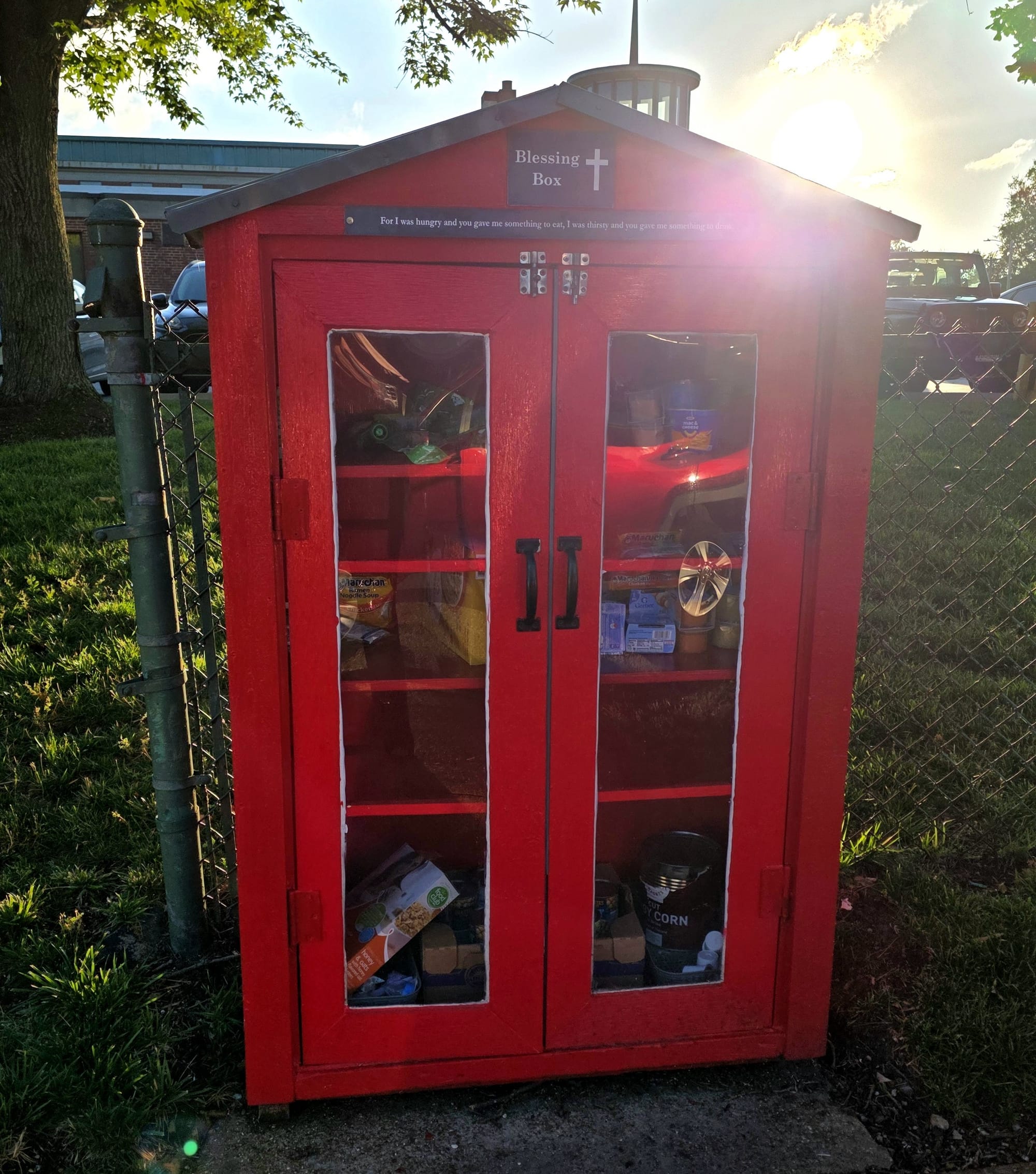
Blessing Boxes & Little Free Pantries
Another wonderful community resource is blessing boxes, sometimes also called little free pantries.
These are small community-supported boxes where people can:
Leave what they can.
Take what they need.
Many blessing boxes include items like:
- Shelf-stable food
- Canned goods
- Personal care items
- Hygiene products
- Household essentials
One especially helpful part is accessibility.
Many blessing boxes are outdoors and available 24/7.
That means they can help people who:
- Work unusual hours
- Have transportation challenges
- Feel uncomfortable asking directly for help
- Need something outside traditional pantry hours
Known St. Louis-area locations include:
- St. Peters blessing box on Clay Avenue in Kirkwood
- First Presbyterian Church blessing box on Adams Avenue in Kirkwood
- Aloha Laulima Helping Hands blessing box on Chopin Drive in Kirkwood
- Crossings STL blessing box in Maryland Heights on Smiley Road
- Gethsemane blessing boxes in St. Louis at Hampton Pernod Avenues
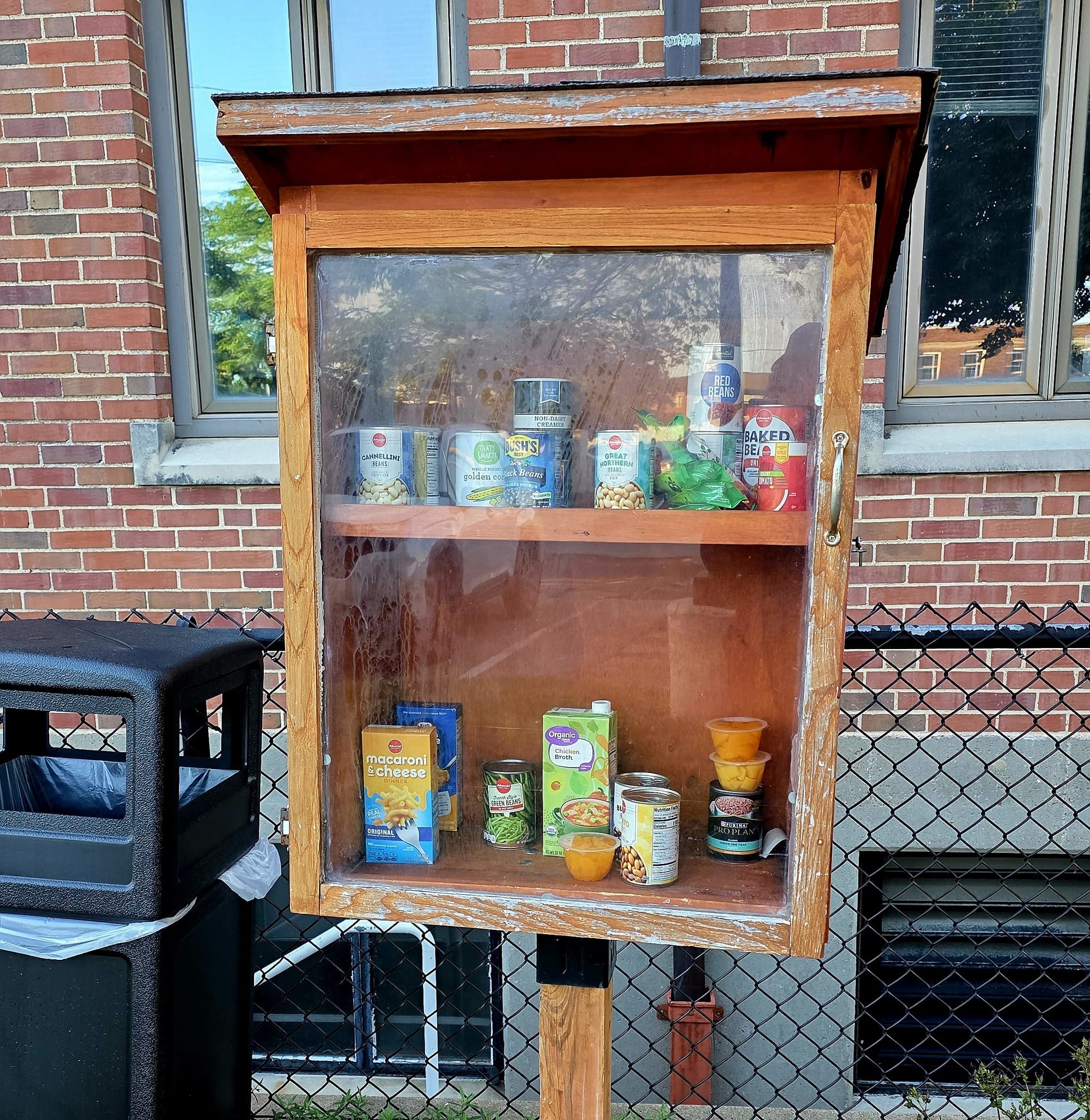
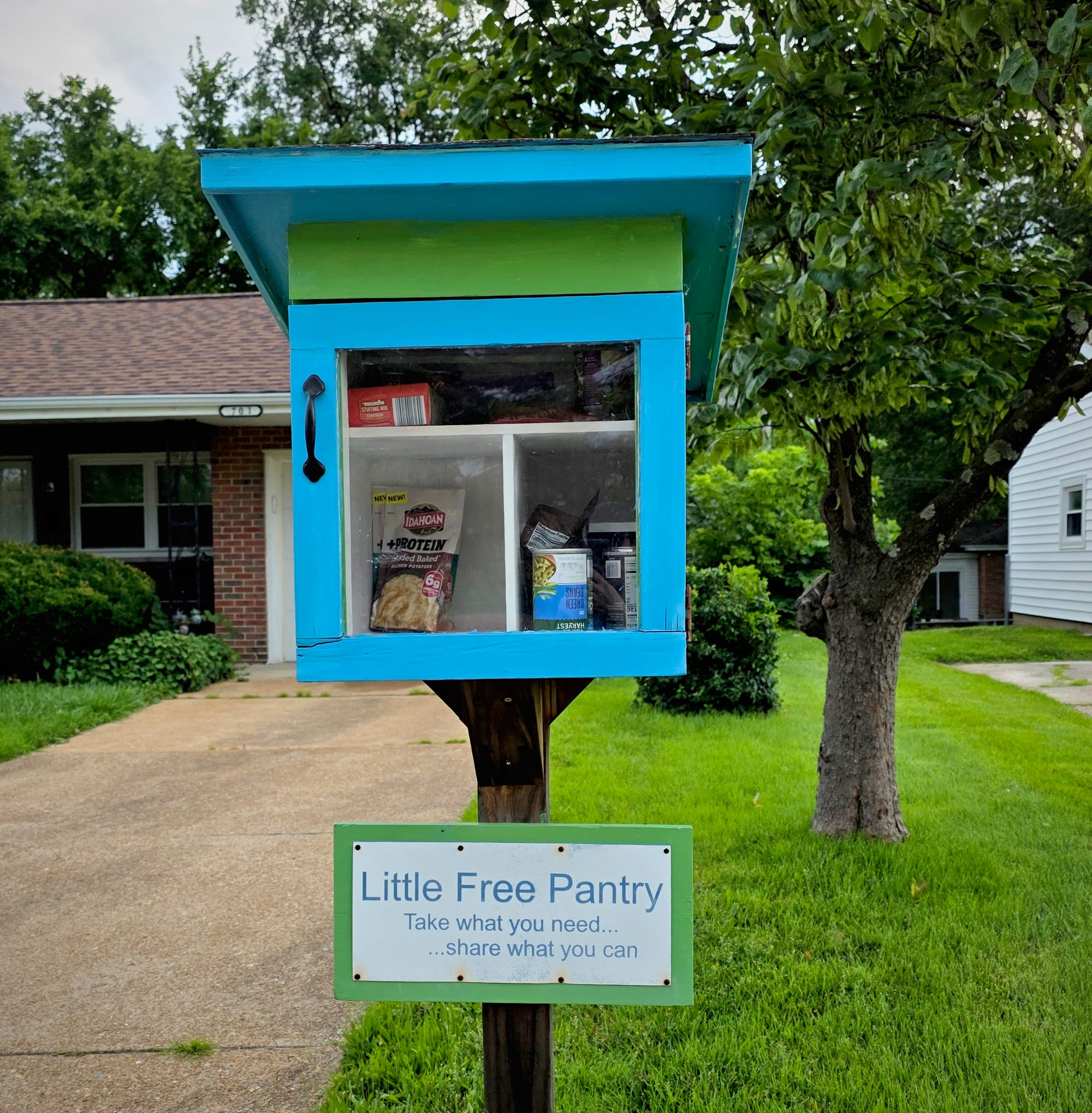
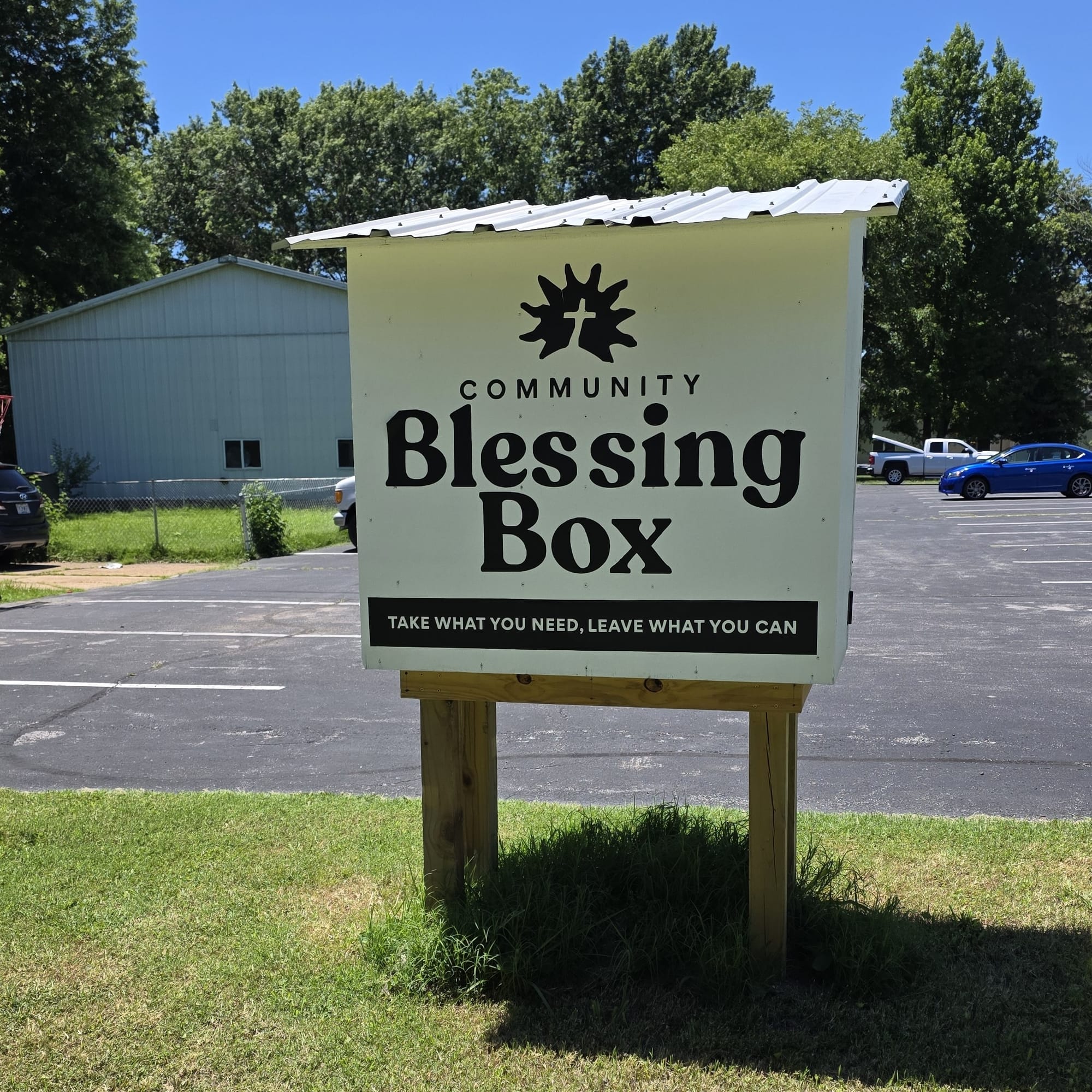
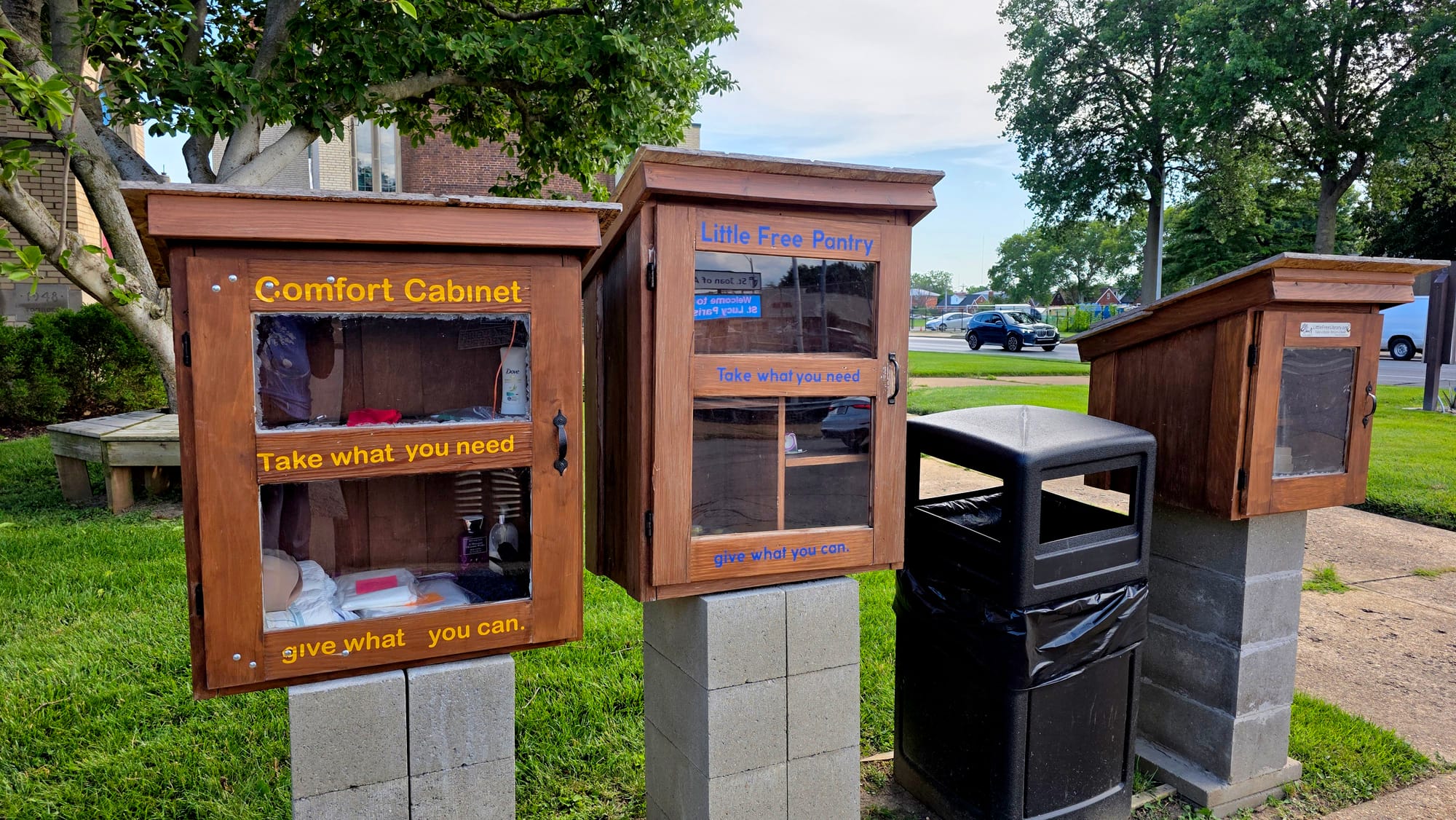
You can search for more by checking Little Free Pantry or by looking up:
- “blessing box near me”
- “little free pantry near me”
- “community pantry near me”
St. Martha’s Drop-In Center — Community Support & Resources
Another St. Louis community resource is St. Martha’s Drop-In Center.
Community support spaces can be incredibly important because people often need more than one type of assistance during difficult seasons.
Depending on current programs and availability, drop-in centers may provide connections to resources such as basic needs support, community assistance, and a welcoming place where people can find guidance.
When life feels overwhelming, sometimes the hardest part is knowing where to begin. Spaces designed around community care can become that first connection point.
As always, check directly with the organization for current services, hours, and eligibility information.
Local Churches & Community Assistance Programs
Even if someone is not religious, churches are often major sources of community support.
Many churches have outreach programs designed specifically to help people experiencing hardship.
Depending on the organization, assistance may include:
- Food pantries
- Community meals
- Clothing closets
- Household items
- Emergency assistance
- Utility assistance
- Benevolence funds
A benevolence fund is money set aside specifically to help people facing financial hardship.
Each organization has different requirements and availability, but it can be worth asking.
Try searching:
- “church benevolence fund near me”
- “church assistance programs near me”
- “food pantry near me”
- “utility assistance near me”
 Jessica Carey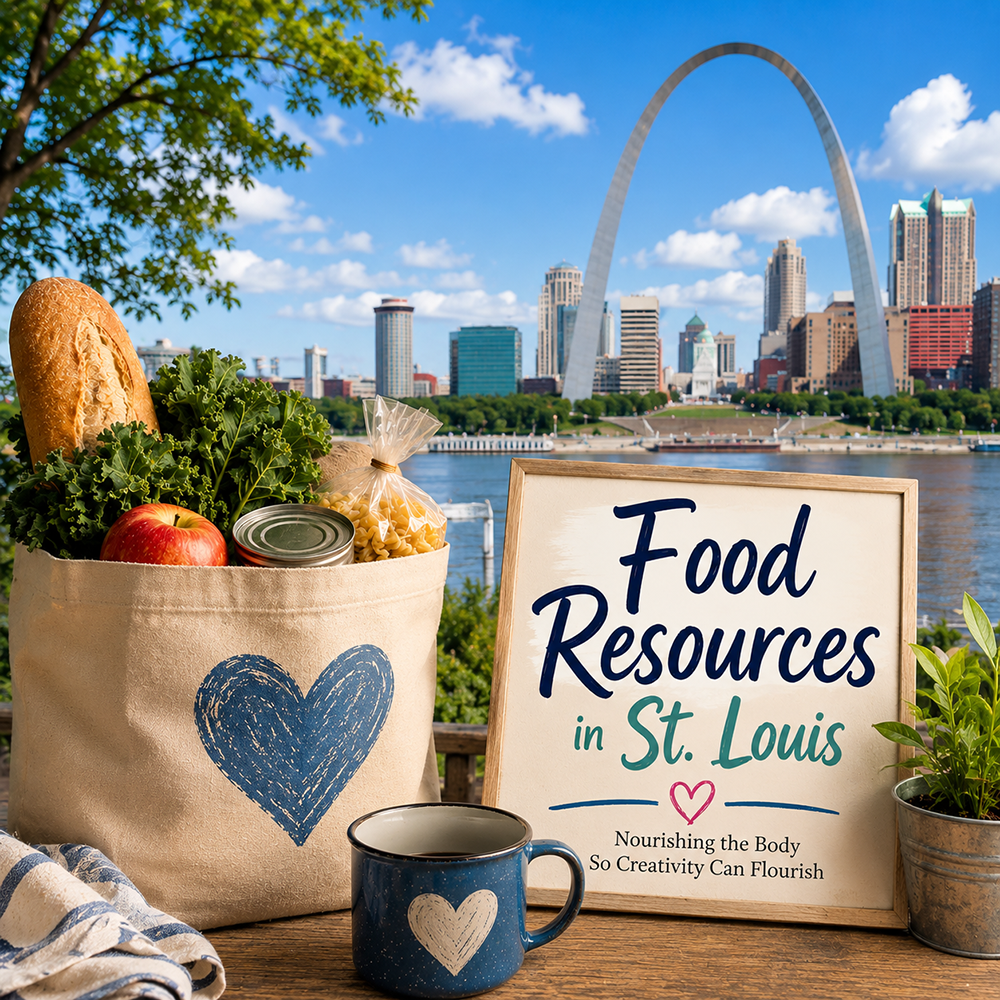
211 — Finding Local Help When You Don’t Know Where to Start
Sometimes the hardest part of needing help is not knowing who to contact.
211 exists as a resource connection service that helps people find local assistance.
Depending on your area, they may be able to help connect you with resources related to:
- Food
- Housing
- Utility assistance
- Healthcare resources
- Crisis support
- Transportation
- Community programs
When you are overwhelmed, having somewhere to start can make a huge difference.
You do not have to already know every organization.
Sometimes the first step is simply finding someone who can point you toward the next step.
Disability & Neurodivergent Support Resources
For disabled and neurodivergent artists, support can be especially important.
Many creative people have unique ways of thinking, feeling, processing, and interacting with the world.
Those differences can bring incredible creativity.
They can also mean traditional systems are not always built with your needs in mind.
If you are disabled or neurodivergent, consider looking into:
- Disability organizations
- Autism support organizations
- Independent living centers
- Vocational rehabilitation programs
- Adaptive recreation programs
- Disability-focused grants
Helpful searches:
- “disabled artist resources”
- “autism resources near me”
- “disability financial assistance”
- “adaptive art programs”
- “vocational rehabilitation”
Missouri Vocational Rehabilitation
For disabled artists interested in employment, self-employment, or building work opportunities around their skills, vocational rehabilitation may be another resource to explore with Missouri Vocational Rehabilitation.
Programs vary depending on eligibility and circumstances, but vocational rehabilitation services are designed to help people with disabilities work toward employment goals.
For creative individuals, that conversation may include exploring:
- Skills
- Strengths
- Training needs
- Workplace support
- Career goals
Every person’s path looks different.
The important thing is knowing these resources exist so you can decide whether they fit your journey.
Creating a World Where Creativity Is Accessible
After months of searching, asking questions, sending emails, and following one resource to another, the biggest lesson I learned is this:
There is more help out there than most people realize.
But finding it can be incredibly difficult.
Resources are often scattered.
Information gets buried.
Programs change.
Opportunities come and go.
And many people who need support the most are already exhausted from trying to navigate everything else in life.
That is why sharing resources matters.
A single recommendation might not seem like a big deal.
But to someone else?
It could be the open door they have been searching for.
Share What You Find
If you discover a helpful organization, tell people.
If you find an affordable supply shop, share it.
If you learn about a grant, workshop, food pantry, community program, or opportunity, pass it along.
You never know who needs exactly what you found.
Sometimes we assume: “Everyone probably already knows about this.”
But they often do not.
There may be someone living ten minutes away from an incredible resource who has no idea it exists.
There may be someone who stopped creating because they thought they could never afford supplies again.
There may be someone sitting alone thinking: “I wish there was somewhere I belonged.”
And the answer might already exist.
They just need someone to help them find it.
If You Are Searching for Support Right Now
If you found this article because you are struggling, I want you to know something:
You are allowed to ask.
You are allowed to need community.
You are allowed to start again.
You do not need to have everything figured out before reaching out.
You do not need to already be successful before deserving support.
You do not need a perfect plan.
Sometimes the first step is simply saying: “I’m trying. Does anyone know where I can begin?”
That question alone can open doors.
Creativity Is Not a Luxury
One of the biggest misconceptions about creativity is that it is extra.
Something optional.
Something people do after all the “important” things are handled.
But humans have always created.
During beautiful times.
During painful times.
During uncertain times.
We create to celebrate.
We create to process.
We create to communicate.
We create to remember.
We create to imagine something different.
Creativity is part of being human.
And everyone deserves access to it.
Your Creativity Matters
Whether you create professionally or personally.
Whether you have a studio or a kitchen table.
Whether you have expensive supplies or whatever materials you could find.
Whether you sell your work or make things only for yourself.
Your creativity still matters.
The world does not only need polished, perfect, finished masterpieces.
It needs expression.
It needs imagination.
It needs people brave enough to create something that did not exist before.
 Jessica Carey
Help This Resource Grow
This guide was created from months of searching, conversations, recommendations, and following little breadcrumbs along the way.
But there are always more resources out there.
More organizations helping quietly.
More communities creating opportunities.
More hidden gems waiting to be discovered.
Do you know of another St. Louis-area creative space, affordable supply source, grant, workshop, disability resource, or community program?
Send it my way so this guide can continue helping more people find support.
If you know of additional resources for:
- Artists
- Creatives
- Disabled artists
- Neurodivergent individuals
- Affordable supplies
- Classes and workshops
- Grants and opportunities
- Community support
please share them. And share any resources for other locations with your community.
The more we exchange information, the easier it becomes for the next person.
Keep Creating
Start small.
Use what you have.
Ask questions.
Follow the breadcrumbs.
Accept the helping hands you find along the way.
And when you discover something that helps you?
Consider leaving a breadcrumb behind for someone else.
Because creativity grows best when it is shared.
Not locked away.
Not reserved for a select few.
Shared.
Creativity belongs to all of us.
And sometimes changing someone’s creative journey begins with something simple:
An open door.
A shared resource.
A kind person saying: “Here. I found something that might help.”
Want even more content about creativity and art?
Be sure to check out all of our creative chronicles!
If you'd like to see drawings made with oil pastel and other media, you can find some of my art and creations at Redbubble and Gumroad!
Looking to learn more about my recent journey?
Check some of these articles:
-Hidden Gems for Autistic & Neurodivergent Adults
-I Think I Might Be Autistic... Now What?
-I Wasn't Broken--I'm Burned Out
 Jessica Carey