

There is something remarkable about living in this moment of history.
Never before have ordinary people had access to so much knowledge.
Within seconds we can search almost any question imaginable.
We can learn another language, watch a master craftsperson at work, read centuries of philosophy, explore the stars through satellite imagery, or speak face-to-face with someone living halfway around the world.
We carry more information in our pockets than entire civilizations once possessed.
By nearly every measurable standard, humanity has become astonishingly informed.
Yet something doesn't quite add up.
Despite this unprecedented access to knowledge, anxiety continues to rise. Loneliness has become widespread.
Public conversations often feel increasingly hostile.
Many people feel overwhelmed rather than enlightened, connected yet isolated, informed yet uncertain about how to live.
It raises an uncomfortable but important question: if information alone transformed people, shouldn't we be wiser by now?
Perhaps the problem isn't that we know too little.
Perhaps it's that information and wisdom are not the same thing.
Information teaches us what.
Wisdom teaches us how.
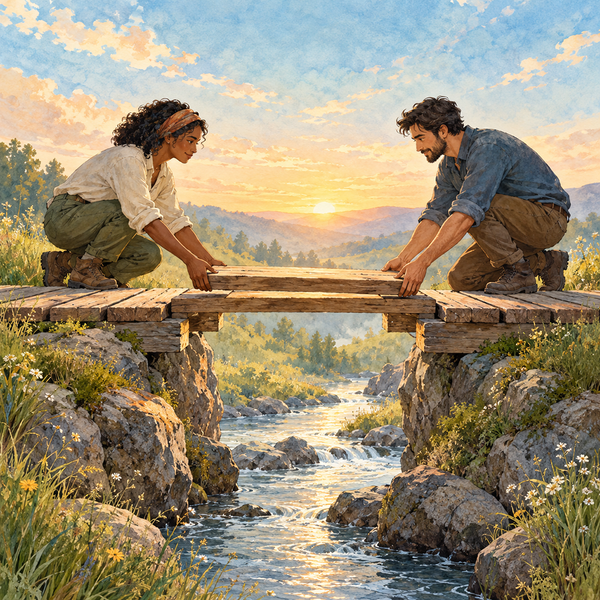
Information tells us how a bridge is built.
Wisdom asks whether it serves the people who will cross it.
Information explains how words influence the brain.
Wisdom chooses words that heal rather than wound.
Information can identify hundreds of edible plants.
Wisdom knows which ones to harvest, which ones to leave behind, and how to care for the land so future generations may flourish as well.
One expands our understanding.
The other shapes our character.
Genuine education has always been about more than accumulating facts.
At its best, it participates in formation—not only expanding the mind, but shaping the person.
One asks what fills the mind, and the other asks what shapes the person.
Modern society has become exceptionally good at producing information.
Every day, millions of articles are published, countless videos are uploaded, and artificial intelligence can answer questions in moments that once required hours of searching.
Knowledge has become increasingly accessible.
But wisdom has never been something we could download.
It grows more slowly.
It asks for humility instead of certainty.
Reflection instead of reaction.
Practice instead of performance.
It is formed not merely by collecting answers, but by learning to live them.
Across cultures, philosophies, and spiritual traditions, some version of this distinction appears again and again.
While these traditions often disagree about many things, they repeatedly return to a similar insight: a meaningful life is not built simply by acquiring knowledge, but by cultivating wisdom.
Perhaps that is the invitation before us today.
Information helps us understand the world.
Wisdom helps us become the kind of people who can care for it well.
Not merely to ask: "What do I know?"
But to begin asking a far more transformative question: "How should I live?"
Knowledge Has Never Been Easier to Find
Information is one of humanity's greatest gifts.
It allows us to learn from people we've never met, preserve discoveries across generations, and build upon the insights of those who came before us.
Every scientific breakthrough, medical advancement, historical record, artistic technique, and technological innovation depends upon the ability to gather, share, and expand knowledge.
Knowledge matters.
Without it, civilizations could not progress.
The problem isn't that we have too much information.
The problem is that information was never meant to carry the entire weight of human flourishing.
Information answers questions like:
- What happened?
- How does this work?
- When did this occur?
- Where can I find it?
These are important questions because they help us understand the world around us.
But sooner or later, every person encounters questions that information alone cannot fully answer.
Questions like:
- What kind of person do I want to become?
- How do I respond when someone hurts me?
- When should I speak—and when should I remain silent?
- What does it mean to live with integrity?
- How do I love someone without trying to control them?
- What makes a life meaningful?
These are not merely informational questions.
They are questions of wisdom.
A search engine can explain the biology of grief.
It cannot grieve beside you.
A psychology textbook can describe empathy.
It cannot choose compassion for you.
An article can outline the steps of forgiveness.
It cannot tell you when forgiveness is healthy, when boundaries are necessary, or how to hold both grace and truth together.
Likewise, a book can explain what makes a healthy friendship.
It can describe trust, mutual respect, accountability, and care.
But eventually, there comes a moment when the pages end and life begins—when someone disappoints you, misunderstands you, or offers a sincere apology.
No amount of reading can make those choices for you.
Information can illuminate the path.
It cannot walk it.
Perhaps this is one of the quiet misunderstandings of our age.
Because information is so abundant, we sometimes mistake familiarity for transformation.
We assume that because we've watched a video, read an article, listened to a podcast, or agreed with an idea, we've somehow become different.
But knowing that exercise is good for us isn't the same as developing the habit of moving our bodies.
Knowing that listening strengthens relationships isn't the same as setting aside our distractions to truly hear another person.
Knowing that gratitude benefits our well-being isn't the same as becoming a grateful person.
There is a profound difference between understanding an idea and allowing that idea to reshape the way we live.
One expands the intellect.
The other transforms the heart, the character, and the habits that quietly shape an entire life.
Many of the most important truths are surprisingly simple.
Be honest.
Keep your word.
Treat others with dignity.
Care for those who are vulnerable.
Admit when you've made a mistake.
Choose humility over pride.
Listen before you speak.
These principles have been taught for thousands of years across cultures and generations.
Their challenge has never been understanding them.
The challenge has always been living them.
Perhaps wisdom begins at the moment we stop asking: "Have I learned something new?" and begin asking a different question: "How is what I already know inviting me to live differently?"
There is another distinction worth noticing.
Education has often been measured by what a person knows.
Wisdom quietly asks a different question: who are they becoming?
Knowing and being are not the same.
Two people may read the same books.
Attend the same schools.
Listen to the same lectures.
Study under the same teachers.
Yet one becomes compassionate while the other becomes cynical.
One grows in humility.
The other grows in pride.
One uses knowledge to serve.
The other uses it to dominate.
The information was the same.
The people they became were different.
Knowledge fills the mind.
Wisdom shapes the person.
It transforms not only what we understand, but who we become through what we understand.
At its best, it cultivates character.
It forms people who are not only capable of solving problems, but also prepared to carry the responsibility that comes with that knowledge.
Because the greatest question education can ask is not merely: "What have you learned?"
But: "Who are you becoming as you learn?"
 Jessica Carey
So Why Aren't We Becoming Wiser?
If humanity has access to more information than at any other point in history, why doesn't it always feel as though we're becoming wiser?
It's a question worth sitting with.
Not because our generation lacks intelligence.
Not because previous generations somehow had everything figured out.
Every era has had its own blind spots, failures, and struggles.
But each age also develops habits that quietly shape the people living within it.
Our modern world excels at helping us find answers.
Wisdom, however, often begins by asking better questions.
That difference matters.
Information is designed to move quickly.
Wisdom usually grows slowly.
Information can be gathered in moments.
Wisdom is often formed over years.
It develops through experience, reflection, relationships, mistakes, humility, and the willingness to keep learning long after we've stopped being beginners.
Perhaps one of the greatest obstacles to wisdom today is not a lack of intelligence, but a lack of space.
We move from notification to notification.
Headline to headline.
Video to video.
Conversation to conversation.
Before one thought has settled, another is already demanding our attention.
Our minds become full.
But fullness is not the same as depth.
A library contains millions of books.
It does not become wise simply because it holds information.
Likewise, our minds can become crowded with facts, opinions, headlines, and advice without those pieces ever finding their proper place within us.
Wisdom requires more than exposure.
It requires integration.
It asks us to pause long enough for knowledge to become understanding, understanding to become discernment, and discernment to become the way we actually live.
That kind of transformation cannot be rushed.
Another obstacle is our increasing discomfort with uncertainty.
When faced with complex questions, we often feel pressure to reach an immediate conclusion. Social media rewards confident declarations.
News cycles demand instant reactions.
Algorithms tend to amplify certainty more readily than thoughtful hesitation.
Yet wisdom is rarely hurried.
It is comfortable saying:
- "I don't know yet."
- "I need to learn more."
- "Help me understand your perspective."
- "I may be wrong."
Far from being signs of weakness, these responses often reflect intellectual humility—the recognition that reality is usually more nuanced than our first impressions.
In many ways, wisdom begins where the need to appear certain ends.
The ancient Greek philosopher Socrates became known not because he claimed to possess all the answers, but because he recognized the limits of his own understanding.
His famous insight—"I know that I know nothing"—wasn't a celebration of ignorance; it was an expression of humility.
It acknowledged that genuine learning begins when we become willing to question our assumptions instead of defending them at all costs.
That same spirit appears in many wisdom traditions around the world.
Growth begins not with pretending we've arrived, but with remaining teachable.
There is another subtle trap as well.
We sometimes mistake consuming information for personal growth.
Reading a book about compassion is not the same as becoming compassionate.
Watching videos about healthy communication is not the same as learning to communicate well.
Collecting inspiring quotes is not the same as allowing those truths to reshape our habits.
It is possible to know an extraordinary amount while remaining unchanged.
In fact, one of the greatest illusions of the information age is believing that exposure alone produces transformation.
But wisdom has always asked for more than agreement.
It asks for practice.
It asks us to embody what we claim to value.
To return to it on ordinary Tuesdays.
To choose patience when we're frustrated.
To apologize when our pride resists.
To listen when we'd rather defend ourselves.
To forgive wisely without abandoning healthy boundaries.
To extend kindness not because it's easy, but because it reflects the kind of person we're becoming.
Perhaps this is why wisdom has always been described less as a destination than as a way of life.
It is not a trophy we earn.
It is a path we choose, one small decision at a time.
The invitation, then, is not simply to ask ourselves: "What new information should I seek today?"
It is also to ask:
- What truth do I need to practice today?
- What assumption might I need to question?
- Where am I reacting when I could be reflecting?
- What kind of person are my daily habits quietly shaping me into?
Because in the end, wisdom is not measured by the number of facts we can recall.
It is revealed by the lives we gradually build.
The Difference Between Information and Wisdom
If information tells us what is true, wisdom helps us discern what is good, what is fitting, and how to respond.
The two are deeply connected, but they are not interchangeable.
The same distinction can be seen between intelligence and wisdom.
Intelligence is a remarkable gift.
It helps us recognize patterns, solve problems, analyze complexity, invent new technologies, and deepen our understanding of the world.
Wisdom does not replace intelligence.
It gives intelligence direction.
Intelligence asks,
"What can be done?"
Wisdom asks,
"What should be done?"
Intelligence discovers possibilities.
Wisdom considers consequences.
Intelligence builds powerful tools.
Wisdom determines how those tools ought to be used.
Intelligence may help us win an argument.
Wisdom asks whether winning is more important than understanding.
Intelligence often seeks the most efficient solution.
Wisdom remembers that human beings are more than problems waiting to be solved.
History offers many examples of remarkable intelligence being used for both extraordinary good and profound harm.
It also offers countless examples of ordinary people with little formal education whose wisdom quietly transformed the lives around them.
The highest calling is not choosing between intelligence and wisdom.
It is allowing wisdom to guide intelligence toward what is true, just, and life-giving.
Imagine someone handing two people the exact same map.
Both now possess the same information.
Yet one rushes ahead without paying attention to changing weather, difficult terrain, or the needs of those traveling beside them.
The other adjusts their pace, notices when someone is struggling, chooses the safer path when conditions change, and knows when it's time to rest.
The information was identical.
The wisdom was not.
This is because wisdom is not merely about accumulating facts.
It is about learning to see reality more clearly.
It is about recognizing that life is rarely made up of isolated pieces. Every choice ripples outward, affecting ourselves, others, and often generations yet to come.
Information tends to separate.
Wisdom learns to connect.
Information often begins by dividing reality into understandable parts.
Biology studies living organisms.
Chemistry studies matter.
Physics studies energy.
Psychology studies the mind.
Economics studies markets.
Each discipline helps us see something important.
Yet life itself is never experienced in isolated categories.
A child is not simply biology.
A friendship is not merely psychology.
A forest is not only ecology.
A community cannot be understood through economics alone.
Reality is beautifully interconnected.
We often learn by separating reality into pieces.
We become wise by learning how those pieces belong together.
Wisdom helps us remember what specialization sometimes causes us to forget.
It asks not only,
"What are the parts?"
but also,
"How do these parts belong together?"
It notices how our physical health affects our emotional well-being.
How our emotional lives influence our relationships.
How our relationships shape our communities.
How our communities impact the environment.
How the choices we make today ripple outward into generations we may never meet.
Wisdom resists the illusion that anything exists entirely on its own.
It recognizes patterns of relationship.
Interdependence.
Mutual influence.
Belonging.
This way of seeing appears in many places.
Ecologists describe the interconnectedness of ecosystems.
Systems thinkers observe how changing one part of a system often affects every other part.
Many spiritual traditions remind us that our lives are inseparable from our relationships—with one another, with the natural world, and, for many people, with the Divine.
Each approaches the question differently.
Yet all point toward a similar insight:
Nothing truly exists in isolation.
Perhaps wisdom begins when we stop asking: "How can I understand this one thing?"
And begin asking: "How does this fit within the larger whole?"
Because understanding individual pieces may produce information.
Learning how those pieces belong together is where wisdom begins.
It asks not only: "Is this accurate?" but also:
- Is it true?
- Is it beneficial?
- Is it loving?
- Is it just?
- What consequences might follow?
- Who might this affect?
- What kind of person will this choice help me become?
These are questions that cannot always be answered by a search engine.
They require discernment.
And discernment grows through experience, humility, attentive observation, and the willingness to keep learning.
Discernment is the ability to notice that life is rarely divided into simple categories of black and white.
It weighs competing goods.
It recognizes context.
It asks not only: "Is this technically correct?"
But: "Is this the most loving, truthful, and fitting response here?"
Across cultures and throughout history, humanity has returned to this insight again and again.
The ancient Hebrew wisdom literature found in the Book of Proverbs repeatedly reminds readers that wisdom is not simply intellectual ability.
It is something to be sought, treasured, and lived.
Again and again, Proverbs connects wisdom with humility, integrity, justice, self-control, and the recognition that our choices shape our lives.
The Greek philosopher Socrates approached wisdom from a different direction.
Rather than presenting himself as someone with all the answers, he questioned assumptions and invited others to examine their own thinking.
For him, wisdom began with recognizing the limits of one's own understanding.
Humility was not the enemy of knowledge—it was the doorway into it.
Aristotle saw wisdom not merely as knowing what was good but as cultivating the habits that made goodness possible.
Character, he believed, was formed through repeated actions.
We become courageous by practicing courage, generous by practicing generosity, and just by repeatedly choosing justice.
Wisdom was something embodied, not merely admired.
Many Buddhist teachings similarly emphasize careful awareness.
Rather than being swept away by every impulse, emotion, or thought, wisdom grows through observing reality with greater clarity and responding intentionally instead of reactively.
Awareness creates space between stimulus and response, allowing compassion and discernment to emerge where automatic reactions might otherwise take over.
The Baháʼí Faith offers another important perspective through its emphasis on the independent investigation of truth.
Rather than accepting beliefs solely because they are inherited, popular, or taught by authority figures, each person is encouraged to sincerely seek truth for themselves with humility, openness, and a willingness to learn.
Genuine wisdom, from this perspective, requires both thoughtful inquiry and a heart that remains teachable.
 Jessica Carey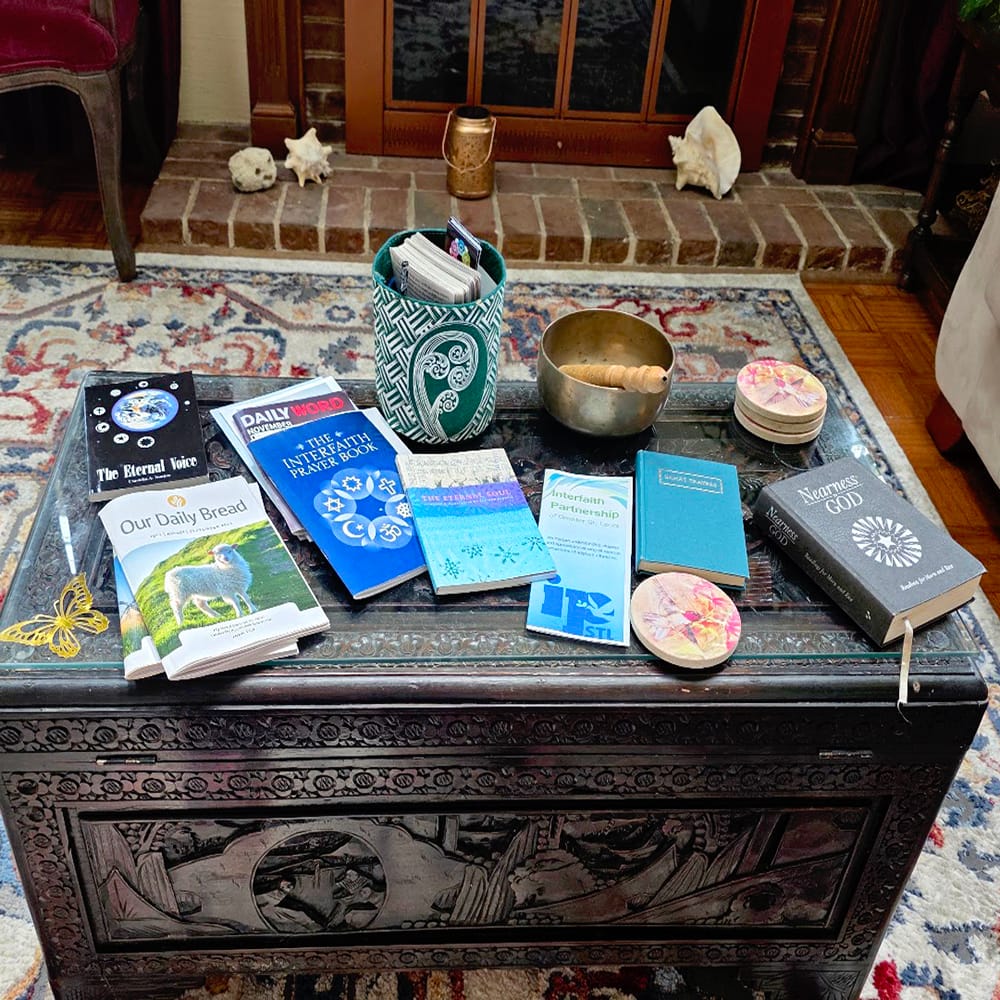
Many Indigenous traditions likewise remind us that wisdom is deeply relational.
Human beings are not separate from the natural world but participants within it.
Decisions are often understood in light of their impact on the wider community, future generations, and the land itself.
Wisdom, in this sense, is measured not only by what benefits the individual today but by what sustains life over time.
These traditions differ in important ways—in their theology, philosophy, practices, and understanding of reality. It would be misleading to suggest otherwise.
Yet each invites us beyond the accumulation of knowledge toward the cultivation of character.
Perhaps that is one of wisdom's defining qualities.
It changes not only what we think, but how we live.
It teaches us that intelligence without compassion can become manipulation.
Knowledge without humility can become arrogance.
Power without integrity can become exploitation.
Success without purpose can become emptiness.
Wisdom asks a different set of questions altogether.
Not simply: "Can I?"
But: "Should I?"
Not simply: "Will this benefit me?"
But: "Will this contribute to the flourishing of others as well?"
Not simply: "How do I win?"
But: "How do we all become more fully human?"
This principle feels especially relevant in an age where information travels faster than discernment.
Every day we encounter headlines, videos, opinions, and carefully crafted algorithms competing for our attention.
It becomes remarkably easy to mistake repetition for truth or popularity for accuracy.
Independent investigation of truth invites something different.
It encourages us to slow down.
To ask thoughtful questions.
To seek multiple perspectives.
To examine our own assumptions with the same honesty we examine the assumptions of others.
It reminds us that wisdom is not merely about protecting our existing beliefs.
It is about loving truth enough to follow it wherever it leads—even when doing so requires us to change our minds.
This kind of investigation also asks something difficult of us.
It asks us to examine not only the claims of others, but our own.
We all carry assumptions shaped by our families, cultures, experiences, fears, and hopes.
Wisdom does not ask us to abandon those influences.
It asks us to become aware of them.
Genuine truth-seeking requires enough humility to ask: "If I am mistaken, would I want to know?"
That question may be one of the clearest signs of a teachable mind.
Perhaps this is why wisdom often feels quieter than information.
Information competes for our attention.
Wisdom patiently waits for our attention.
Information fills our minds.
Wisdom gradually reshapes our hearts.
Information can be acquired in an afternoon.
Wisdom is cultivated over a lifetime.
It is less like downloading a file...
and more like tending a garden.
One seed.
One season.
One faithful choice at a time.
Cultivating Wisdom in Everyday Life
If wisdom cannot simply be accumulated, how do we grow it?
The answer is both encouraging and challenging.
Wisdom is less about discovering a secret than about practicing a way of life.
It is not something reserved for philosophers, religious leaders, scholars, or those with advanced degrees.
It is cultivated in ordinary moments.
In everyday conversations.
In difficult decisions.
In how we respond when no one is watching.
While information often arrives instantly, wisdom develops gradually through habits that shape both our minds and our character.
One of those habits is learning to slow down.
Many of us have become accustomed to reacting immediately.
We respond to messages before thinking, form opinions before gathering context, and rush toward conclusions because waiting can feel uncomfortable.
Wisdom invites a different rhythm.
It asks us to pause before speaking.
To observe before judging.
To understand before trying to be understood.
Sometimes the wisest response is not an immediate answer but a thoughtful silence that creates room for deeper understanding.
Another habit is cultivating humility.
Humility is often misunderstood as thinking less of ourselves.
In reality, humility is seeing ourselves honestly.
It allows us to recognize both our strengths and our limitations.
It frees us from the exhausting need to always appear right.
A humble person is not afraid to say:
- "I don't know."
- "I made a mistake."
- "You've given me something to think about."
Far from diminishing us, these moments often become the beginning of genuine growth.
Humility keeps curiosity alive.
And curiosity may be one of wisdom's greatest companions.
Curiosity asks questions before making assumptions.
It seeks understanding before passing judgment.
Instead of asking: "How can I prove that I'm right?"
It wonders: "What might I be missing?"
That posture transforms conversations.
Rather than becoming debates to win, they become opportunities to learn.
The Character of a Wise Mind
Wisdom is shaped not only by moral virtues, but also by intellectual ones.
When we think about virtue, we often think about qualities like kindness, generosity, or courage.
Yet there are also virtues that shape the way we think.
Some philosophers call these intellectual virtues—habits of mind that help us pursue truth with integrity rather than simply defending our own opinions.
These include qualities such as:
- Humility — recognizing the limits of our understanding.
- Curiosity — remaining eager to learn.
- Honesty — following evidence even when it challenges us.
- Patience — allowing difficult questions time to unfold.
- Open-mindedness — considering perspectives without abandoning discernment.
- Intellectual courage — being willing to change our minds when truth requires it.
- Discernment — weighing information carefully instead of reacting impulsively.
Notice that none of these virtues requires us to know everything.
Instead, they shape how we seek knowledge.
Perhaps wisdom is not measured by having all the answers.
Perhaps it is measured by the character we bring to our search for them.
Listening also plays an essential role.
In a world filled with voices competing to be heard, deep listening has become surprisingly rare.
Yet wisdom often grows through listening—to other people, to our own experiences, to the quiet stirrings of conscience, and to perspectives that challenge our assumptions.
Listening does not require agreement.
Nor does it require abandoning discernment.
Rather, it reflects a willingness to recognize that no single person sees the whole picture.
Every life carries experiences we have not lived.
Every person notices something we may have overlooked.
To listen well is to acknowledge that reality is often richer and more complex than our own perspective alone.
Wisdom also grows through reflection.
Experience by itself does not always teach us.
Two people can live through the same event and emerge with entirely different insights.
The difference often lies in whether they take time to reflect upon what happened.
Reflection asks:
- What did this experience reveal?
- What assumptions did it challenge?
- How did I contribute to what happened?
- What might I do differently next time?
- What kind of person am I becoming through this?
Without reflection, experiences can simply repeat themselves.
With reflection, even painful seasons can become teachers.
This does not mean every hardship carries a hidden lesson or arrives for a particular reason.
Some suffering is simply tragic, unjust, or the result of human choices.
Yet even in those circumstances, people sometimes discover new depths of courage, compassion, resilience, or clarity—not because the suffering itself was good, but because of how they chose to respond to it.
Perhaps most importantly, wisdom grows through practice.
No one becomes patient by reading about patience.
No one becomes courageous by admiring courage from a distance.
No one becomes compassionate simply because they agree that compassion is important.
Character is formed through repeated choices.
One honest conversation.
One act of generosity.
One apology.
One boundary.
One moment of forgiveness.
One decision to tell the truth when deception would be easier.
Over time, these seemingly ordinary choices become the architecture of an extraordinary life.
Perhaps that is why wisdom has always seemed so accessible and so demanding at the same time.
It does not ask us to know everything.
It asks us to faithfully live what we already know.
It reminds us that the measure of a life is not how many ideas we collected, but how deeply those ideas took root within us.
Like a tree, wisdom does not grow overnight.
Its roots deepen quietly beneath the surface long before anyone notices its branches reaching toward the sky.
And perhaps that is exactly as it should be.
The strongest trees are rarely those that grew the fastest.
They are the ones that remained rooted through changing seasons, patiently drawing nourishment day after day until their lives became a source of shelter, strength, and fruit for others.
 Jessica Carey
Choosing Wisdom in an Age of Information
We are living through one of the most remarkable periods in human history.
Every day, new discoveries expand our understanding of the universe.
Scientists continue to unravel mysteries that previous generations could scarcely imagine.
Technology connects people across continents in seconds.
Medical advances save lives.
Ideas travel farther and faster than ever before.
These are extraordinary achievements.
Knowledge has helped humanity accomplish incredible things, and there is every reason to continue pursuing it with curiosity, integrity, and wonder.
But perhaps our greatest challenge is no longer simply learning more.
It is learning how to live well with what we know.
Every new discovery places new responsibilities into our hands.
The more powerful our tools become, the more important our character becomes.
Knowledge can teach us how to create artificial intelligence.
Wisdom asks how it should serve humanity.
Knowledge can reveal astonishing insights into genetics.
Wisdom asks how those discoveries ought to be used.
Knowledge can amplify a single voice until it reaches millions.
Wisdom asks whether that voice is spreading truth, compassion, and understanding—or fear, manipulation, and division.
Throughout history, humanity has repeatedly discovered that progress and wisdom do not always grow at the same pace.
Our inventions often advance faster than our character.
Our abilities expand more quickly than our discernment.
The challenge has never simply been: "Can we?"
It has always also been: "Should we?"
And perhaps even more importantly: "Who are we becoming while we do it?"
Because every age is ultimately shaped not only by its innovations, but by the people who choose how those innovations will be used.
Technology itself is neither compassionate nor cruel.
Information itself is neither loving nor hateful.
Tools amplify the intentions of the hands that hold them.
A hammer can build a home or destroy one.
The internet can spread life-saving knowledge or harmful misinformation.
Artificial intelligence can help solve complex problems or be used irresponsibly.
The question has never been whether knowledge is powerful.
The question is whether the people wielding that power are growing in wisdom alongside it.
Perhaps this is why wisdom has remained relevant in every generation.
The world changes.
Human nature remains remarkably familiar.
We still long to be loved.
We still wrestle with fear, pride, envy, grief, hope, and belonging.
We still search for meaning.
We still face difficult choices that no algorithm can make on our behalf.
No amount of information can answer the deeply human questions that each of us must eventually face:
- What kind of person will I become?
- What values will guide my life?
- How will I treat those who disagree with me?
- What does love require here?
- What am I willing to sacrifice for what is good?
- How do I leave the world gentler than I found it?
Perhaps these have always been the questions that matter most.
And perhaps wisdom is less about having perfect answers than learning to keep asking faithful questions.
Questions that call us toward greater humility.
Greater compassion.
Greater courage.
Greater honesty.
Greater love.
The invitation, then, is not to choose between information and wisdom.
We need both.
Information expands our understanding of the world.
Wisdom teaches us how to inhabit it well.
Information fills libraries.
Wisdom builds communities.
Information increases our capabilities.
Wisdom guides our character.
Information helps us understand life.
Wisdom helps us live it.
As we continue into an age where knowledge becomes ever more abundant, may we remember that a well-informed society is not necessarily a wise one.
Wisdom cannot be measured by the speed of our internet connections, the size of our databases, or the sophistication of our technology.
It is measured in quieter ways.
In whether we tell the truth when it is difficult.
In whether we listen before judging.
In whether we seek understanding rather than victory.
In whether we use our knowledge to serve rather than to dominate.
In whether our lives become places where others encounter justice, kindness, humility, and hope.
Perhaps, in the end, wisdom is not the accumulation of answers.
It is the lifelong practice of becoming the kind of person who knows what to do with them.
And maybe that is the question worth carrying with us long after we close this article:
Not simply: "What do I know?"
But: "Who is my knowledge helping me become?"
A Continuing Invitation
Perhaps wisdom has never been about arriving.
Perhaps it has always been about remaining willing to learn.
There is something beautifully freeing about that realization.
None of us sees the whole picture.
None of us understands everything there is to know.
None of us will make every decision perfectly.
Wisdom does not ask us to become flawless.
It asks us to become faithful—to keep returning to what is true, to remain teachable, and to allow our lives to be continually shaped by love, humility, and integrity.
In many ways, wisdom resembles tending a garden more than completing a checklist.
A garden is never truly "finished."
It changes with the seasons.
Some plants flourish.
Others require pruning.
New seeds are planted.
Unexpected storms arrive.
Growth often happens quietly beneath the surface long before it becomes visible.
Our inner lives are much the same.
There are seasons when learning comes easily and seasons when it feels painfully slow.
There are moments when we recognize old assumptions no longer serve us, and moments when entirely new ways of seeing begin to emerge.
Wisdom invites us to trust that this, too, is part of the journey.
It reminds us that becoming is rarely dramatic.
More often, it happens through small choices repeated over time.
Choosing patience when frustration feels easier.
Choosing honesty when deception would be more convenient.
Choosing curiosity over assumptions.
Choosing compassion over contempt.
Choosing to repair relationships when repair is possible.
Choosing healthy boundaries when it is not.
These moments may seem ordinary.
Yet it is within ordinary moments that extraordinary character is formed.
Perhaps that is one of wisdom's quietest truths:
The life we hope to build tomorrow is being shaped by the choices we make today.
This is also why wisdom can never be separated from relationships.
It influences how we speak.
How we listen.
How we disagree.
How we care for children.
How we treat strangers.
How we exercise power.
How we steward the natural world.
How we respond to suffering.
How we build communities where people can flourish.
Every act of wisdom reaches beyond the individual.
Like ripples spreading across still water, our choices influence families, friendships, neighborhoods, workplaces, and generations we may never meet.
The opposite is true as well.
When wisdom is neglected, the consequences rarely remain private.
Pride damages relationships.
Fear fuels division.
Unchecked power harms communities.
Indifference allows suffering to continue.
Our choices matter because we do not live in isolation.
We belong to one another.
And perhaps this is why wisdom has always been considered one of humanity's greatest treasures.
Not because it makes us impressive.
But because it helps us become people who contribute to the flourishing of others.
If there is one hope woven throughout this essay, it is not that we would reject information.
The world needs good science.
Thoughtful scholarship.
Careful research.
Creative innovation.
Honest journalism.
Lifelong learning.
These are gifts.
The invitation is simply that our pursuit of knowledge would be matched by an equal commitment to cultivating wisdom.
That as our minds expand, our hearts would expand as well.
That as our capabilities increase, so would our compassion.
That as our technologies become more sophisticated, our character would grow deeper.
Because a wiser world will not be created merely by faster computers, larger databases, or more efficient algorithms.
It will be created by ordinary people who choose, day after day, to live with humility, courage, integrity, and love.
Perhaps wisdom has always begun there.
Not in having every answer.
But in becoming the kind of person who keeps asking:
- What is true?
- What is good?
- What is loving?
- And how, today, can I live in a way that leaves this small corner of the world a little wiser, a little kinder, and a little more whole than I found it?
 Jessica Carey
Want even more content about creativity and art?
Be sure to check out all of our creative chronicles!
If you'd like to see examples of my work, you can find some of my art and creations at Redbubble and Gumroad!
Looking to learn more about my recent journey?
Check some of these articles:
-Hidden Gems for St. Louis Artists
-Hidden Gems for Autistic & Neurodivergent Adults
-I Think I Might Be Autistic... Now What?
 Jessica Carey