


Why creativity, meaningful attention, and small acts of care still matter when capacity is limited
When energy is severely limited, life can become a list of have tos.
I have to answer this message.
I have to complete this form.
I have to attend this appointment, solve this problem, pay this bill, make this decision, and prepare for the next unavoidable demand.
People sometimes tell me that because I am living with chronic autistic burnout, C-PTSD, limited income, housing instability, and very little dependable support, I should conserve my energy for necessities.
I should focus only on what must be done and cut out activities that require energy without solving an immediate problem.
To an extent, I understand the reasoning.
Limited capacity requires prioritization.
Some tasks cannot be postponed, and continuing to push beyond our limits can deepen burnout rather than resolve it.
There are times when rest must come before another project—even one we genuinely want to pursue.
But I also believe something important gets lost when every activity is measured only by whether it completes an obligation.
A life cannot be sustained by demands alone.
Creating art requires energy, but it does not only take energy from me.
Creativity helps regulate and ground me.
It gives form to experiences I cannot always explain in ordinary language.
It reconnects me with parts of myself that can become buried beneath survival, exhaustion, paperwork, uncertainty, and other people’s expectations.
It reminds me that I am more than the problems I am trying to solve.
If I removed every activity that brought joy, meaning, identity, or connection because it was not strictly necessary, I might preserve a little energy for the next demand—but I would also be removing some of what helps me keep meeting those demands at all.
This does not mean that joy eliminates exhaustion or that creativity can replace food, shelter, income, healthcare, rest, and practical support.
Art cannot solve every material problem in my life; it cannot erase burnout or make an unstable situation safe.
But it can help make life more inhabitable while I move through those realities.
The “have tos” may help maintain a life; joy helps the person inside that life remain present.
This means energy cannot always be measured only by what an activity costs; we must also consider what it returns.
Sometimes what looks unnecessary from the outside is quietly helping keep something essential alive within us.
 Jessica Carey

Energy Spent Is Not Always Energy Lost
When capacity is scarce, it can be tempting to imagine energy as a simple equation: every activity takes something away, so the safest choice is to do as little as possible beyond what is absolutely required.
Sometimes that is true; rest can be the most necessary and responsible choice.
Even enjoyable activities can become depleting when they involve deadlines, sensory overload, social pressure, perfectionism, or the expectation that we must produce something impressive.
But not every use of energy affects us in the same way.
Some tasks consume energy while returning very little; they may be necessary, but they leave us more depleted than when we began.
Other activities require effort while also giving something back: regulation, focus, curiosity, pleasure, confidence, connection, or relief from the relentless awareness of everything that remains unresolved.
The body may be tired after both experiences, but they do not necessarily leave the spirit in the same condition.
Creativity can offer me a place where life is not only happening to me.
So much of living with limited resources and unstable circumstances involves reacting: responding to emergencies, navigating systems, completing applications, explaining my needs, following other people’s requirements, and trying to prevent another problem from becoming a crisis.
Creating allows me to make choices.
I can select the colors, materials, subject, and direction.
I can follow an unexpected possibility instead of another demand.
I can transform something limited, discarded, or ordinary into something meaningful.
That agency matters.
Art can also give my mind somewhere safe to focus; it does not make chronic autistic burnout disappear, but it can sometimes quiet the constant pressure long enough for me to reconnect with myself.
It can provide steadiness in circumstances I cannot immediately control.
This does not mean that I should force myself to create whenever I am exhausted.
Restorative creativity cannot be prescribed like another task on a recovery checklist.
Something that replenishes me one day may overwhelm me on another.
Capacity changes, and honoring that change is part of caring for myself.
The better question is not whether an activity is conventionally productive—or whether it requires any effort at all.
It is whether the activity leaves us more connected to life or further removed from it.
We might ask:
- Does this feel chosen, or does it feel demanded?
- Does it regulate me, or add more pressure?
- Can I adapt it to the capacity I have today?
- Am I creating because it brings meaning, or because I feel obligated to perform?
- What remains in me afterward: depletion alone, or some measure of steadiness, joy, or renewal?
Energy is finite, but its movement is not always one-directional; sometimes we spend a little energy on something meaningful and receive enough of ourselves back to make the expenditure worthwhile.
 Jessica Carey

Creativity Helps Us Remain Connected to Ourselves
When life becomes dominated by survival, identity can begin to narrow.
We become the person completing the forms, attending the appointments, managing the crisis, stretching the budget, explaining the limitation, or trying to make it through another day.
The demands may be real and unavoidable, but they can gradually take up so much space that we lose contact with the person carrying them.
Creativity reminds me that I am still here.
Art is not merely an activity I do after everything more important has been completed; it is part of how I process life, communicate, experiment, notice possibilities, and understand myself.
It helps me translate experiences that may feel too complex, layered, or overwhelming to explain directly.
It also connects me with continuity.
Circumstances have changed.
My capacity has changed.
I have lost access to spaces, resources, materials, relationships, and versions of life that once felt familiar.
Chronic autistic burnout has changed what I can sustain and how carefully I must use my energy.
But when I create, I can still recognize myself.
Not the version of me who could meet every demand without consequence.
Not the version other people expected me to become.
Just the curious, attentive person who wonders what a material could do, notices relationships between colors and forms, and asks: what could this become?
That question does more than begin an artwork. It keeps possibility alive.
Creativity also allows me to work with reality rather than waiting for perfect conditions.
I may not have every material, tool, workspace, or resource I would choose.
Sometimes I create with remnants, samples, donated supplies, reclaimed objects, or whatever is within reach.
The limitation remains real, but it does not have to be the only thing that is real.
There can also be experimentation.
There can be beauty.
There can be a small experience of agency within circumstances I did not choose.
This is why removing creativity from my life would not simply free energy for more practical responsibilities; it would remove one of the places where I remember that I am a person rather than a collection of problems requiring solutions.
For someone else, that sustaining practice may be music, gardening, cooking, reading, walking, caring for animals, studying something fascinating, repairing objects, prayer, humor, or time with trusted people.
It does not need to produce income, recognition, improvement, or something that can be displayed.
Its value may be that it helps us return to ourselves.
Perhaps an activity should not be dismissed as unnecessary until we ask what part of a person it is helping preserve.
 Jessica Carey

Attention Is a Form of Love
Recently, I created a birthday present for a friend whose birthday is approaching.
They love their cat, Auri.
They love the color purple.
So I created a deeply personalized purple artwork featuring Auri, incorporating the cat’s name and details intended specifically for the person receiving it.
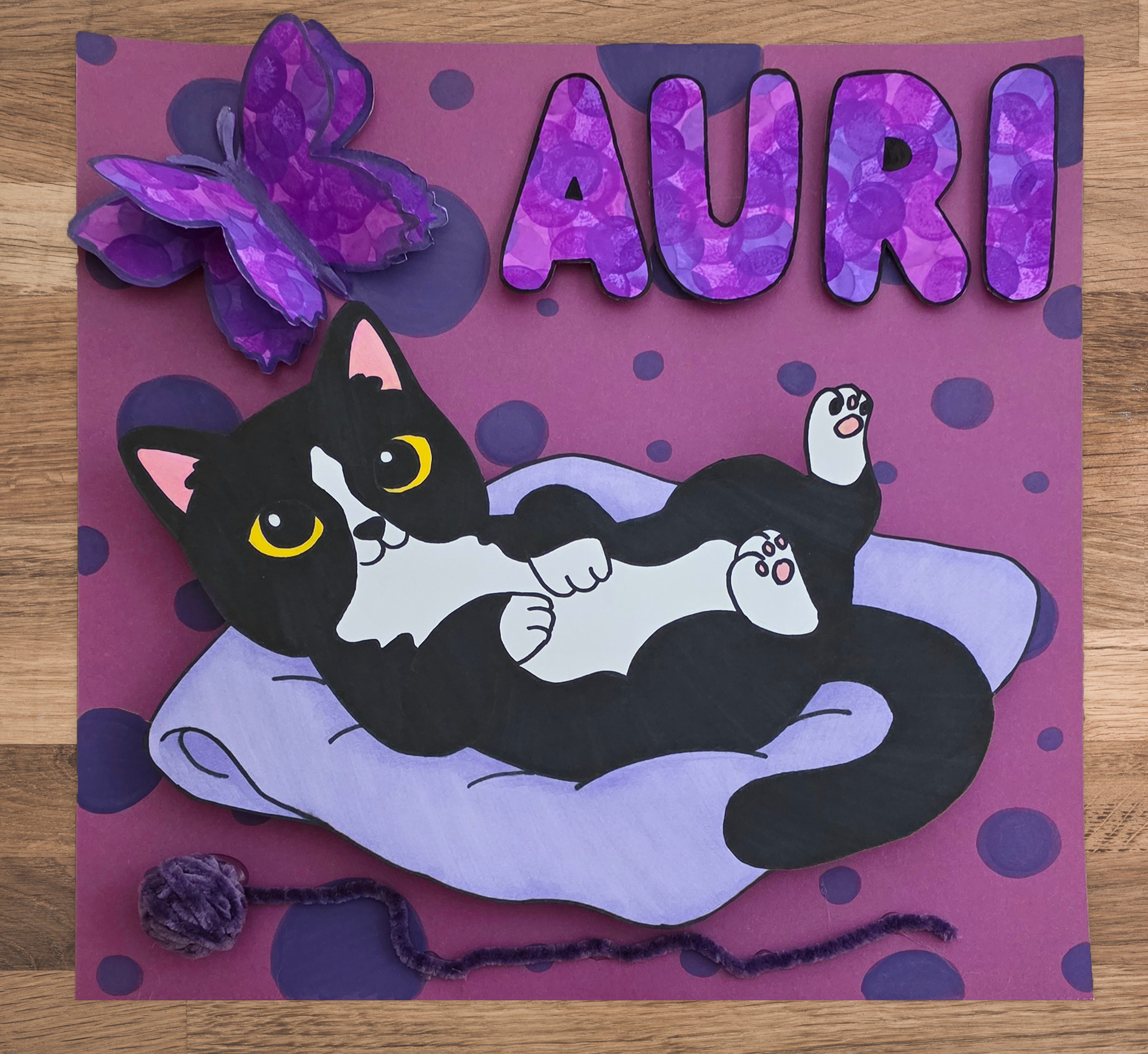
The gift will not solve any of the practical problems in my life.
It will not create income, secure stable housing, complete an application, or restore the energy burnout has taken from me.
From a strictly utilitarian perspective, someone might say that making it was not necessary—that I should have conserved the energy for something more important.
But I believe the gift is important for a different reason.
It says:
- I notice you.
- I remember what matters to you.
- I paid attention.
- You are worth the time it took to create something that could belong only to you.
Those messages matter deeply in a world where many interactions can feel rushed, generic, distracted, or performative.
People may care about one another, but care can remain invisible when it is never translated into attention.
A meaningful gift does not have to be expensive or elaborate; its power often comes from its specificity—from the small details that reveal someone was listening.
I know what it feels like when no one seems to notice those details.
For much of my life, I was overlooked within relationships that were supposed to know and love me most.
My feelings, needs, limits, interests, and inner world disappeared beneath what other people expected from me.
I know the pain of falling through the cracks while those around me continue as though nothing important has been missed.
I do not want that pain to become permission to stop noticing others; I want it to deepen my attention.
That does not mean I can ensure that no one I love ever feels unseen; I am human.
I will forget things, miss signals, misunderstand needs, and have seasons when my capacity is too limited to show care in the ways I would prefer.
But attentiveness is still part of the person I want to be.
Creating personalized gifts is one way I practice that value; it allows me to turn observation into something tangible—to take what I know about a person and create evidence that their particular existence registered with me.
The artwork for my friend may look like a small birthday present.
But perhaps small acts become significant because of what they carry.
A favorite color.
A beloved companion.
A remembered detail.
A quiet message that says: you did not pass through my life unnoticed.
 Jessica Carey

Small Acts Help Create the World We Want
It is easy to believe that making a difference requires something enormous.
We may imagine that meaningful change belongs to people with more money, influence, energy, resources, or authority.
If we cannot transform an entire system, solve someone’s crisis, or reach thousands of people, our contribution may feel too small to matter.
But much of human life is shaped through smaller encounters.
A person remembers who listened without rushing them.
They remember who followed up after a difficult day.
They remember who learned how to pronounce their name, accommodated a need without making it humiliating, celebrated something important to them, or noticed the interest that made their face light up.
These actions rarely attract public attention, but they influence whether people experience the world as indifferent or humane.
We often speak about wanting a kinder and more connected society.
Yet that society cannot be built only through declarations, awareness campaigns, or beautiful statements about love; it must also be practiced in ordinary moments between people.
Remembering someone’s favorite color will not repair every social failure.
Creating a gift will not eliminate loneliness.
One compassionate interaction cannot undo years of neglect.
But these acts still matter because they interrupt indifference; they create a different experience, even if only for one person in one moment.
Attention says: you are not interchangeable.
Care says: your particular needs and joys matter.
Follow-through says: what you shared with me did not vanish as soon as the conversation ended.
These are small ways of restoring dignity in a culture that often treats people as tasks, audiences, customers, categories, or background characters in someone else’s story.
Creating for others is one way I contribute with what I currently have.
I may not possess abundant energy, money, stability, or materials.
I cannot meet every need or help everyone who is struggling.
But I can sometimes use my attention, creativity, and existing skills to make one person feel remembered.
That is not everything, but it is not nothing.
 Jessica Carey

Small acts also have a way of traveling beyond the original moment.
Someone who feels seen may become more able to notice another person.
A thoughtful gesture may inspire a different gesture.
Care can become evidence that relationships do not have to remain rushed, impersonal, or performative.
We may never know the full reach of what we offer.
The goal is not to make every small action carry the weight of changing the world; it is to recognize that the world is continually being shaped through the ways we treat the people directly in front of us.
Perhaps creating a more attentive society begins exactly there: not with the certainty that we can do something enormous, but with the willingness to do something genuine.
 Jessica Carey

Joy Should Not Become Another Obligation
There is an important caution within all of this: recognizing the value of creativity, joy, and thoughtful care should not turn them into additional standards we must exhaust ourselves trying to meet.
A meaningful life does not require handmade gifts for every occasion.
Love is not measured by how much energy, money, time, or pain we sacrifice to prove it.
Creativity does not remain restorative when it becomes another demand accompanied by guilt, perfectionism, deadlines, or fear of disappointing someone.
There will be times when creating a personal gift feels joyful and grounding.
There may be other times when sending a short message is all we can manage.
Care might look like remembering an important date, sharing a photograph, checking in later, offering a small found object, or simply telling someone: “I thought about you today.”
And sometimes our capacity may be so limited that we cannot do even that.
Being exhausted, overwhelmed, disabled, or in crisis does not make us uncaring.
The principle is not that we must always do more.
It is that we should not automatically eliminate everything meaningful because it does not resemble a conventional necessity.
This distinction is especially important for people conditioned to earn belonging through usefulness.
Acts of care can become another form of self-abandonment when we believe we must continually give, create, solve, anticipate, and remember while never allowing ourselves to receive the same consideration.
That is not the kind of life I want to recreate.
I do not want generosity to require my disappearance.
I want to offer what I can honestly offer, within the capacity I genuinely have.
I want my creative work to remain connected to choice and meaning rather than becoming another performance I must maintain to prove that I am good, loving, or valuable.
The same care we extend toward others must include us.
Sometimes protecting joy means making something elaborate.
Sometimes it means using simpler materials, reducing the scale, leaving imperfections visible, or allowing an idea to wait.
Sometimes it means resting without turning the inability to create into another reason to criticize ourselves.
Capacity changes; the form of care can change with it.
What matters is not the size of the gesture but its integrity.
Joy should be protected because it helps life remain meaningful—not exploited until it becomes another source of depletion.
The invitation is not: do more to prove that you care.
It is: protect what brings you back to life, and allow care to take forms that both your heart and your capacity can sustain.
A Life Needs More Than Maintenance
Bills, meals, appointments, transportation, forms, deadlines, and other responsibilities help maintain a life; they matter.
Ignoring them indefinitely can create real consequences, and limited energy sometimes requires making painful choices about what must come first.
But maintenance is not the whole purpose of being alive.
A perfectly completed list cannot replace meaning.
Efficiency cannot substitute for connection.
And conserving every possible bit of energy does little good if the life being preserved becomes empty of everything that helps us want to remain within it.
Creativity cannot erase chronic autistic burnout, secure housing, create income, heal trauma, or replace the material support I still need.
But it can help me remain connected to myself while I seek those things.
It can offer choice within circumstances containing very little of it, transform limited materials into possibility, and show another person that the details of their life were remembered.
That, too, is part of what makes a life feel inhabited.
Perhaps balance does not mean completing every obligation before we permit ourselves to experience joy.
For many people—especially those living with disability, burnout, caregiving demands, poverty, instability, or ongoing crisis—that day may never arrive.
There will always be another task, another concern, or another reason to postpone what replenishes us.
If joy is allowed only after everything difficult has been resolved, it may be postponed forever.
We need discernment.
We need rest.
We need to honor capacity and recognize when even a beloved activity has become too much.
But we also need permission to protect the things that remind us why survival matters.
The “have tos” may keep life functioning.
Joy helps keep us connected to the life we are working so hard to preserve.
I cannot do everything.
I cannot help everyone.
I cannot create my way out of every hardship.
But I can sometimes make something meaningful with what is already in my hands.
I can remain attentive.
I can offer one person evidence that they were seen.
And I can protect a small flame of joy that helps me continue becoming myself.
Perhaps that is not an irresponsible use of limited energy.
Perhaps it is part of what the energy is for.
What appears unnecessary from the outside but helps keep something essential alive within you?
 Jessica Carey

Want even more content about creativity and art?
Be sure to check out all of our creative chronicles!
If you'd like to see examples of my work, you can find some of my art and creations at Redbubble and Gumroad!
Looking to learn more about my recent journey?
Check out some of these articles:
-Hidden Gems for St. Louis Artists
-Hidden Gems for Autistic & Neurodivergent Adults
-Learning What Love Was Supposed to Feel Like
-I Wasn't Broken--I'm Burned Out
-What Chronic Autistic Burnout Actually Feels Like
-Building a Life from What Remains
 Jessica Carey