

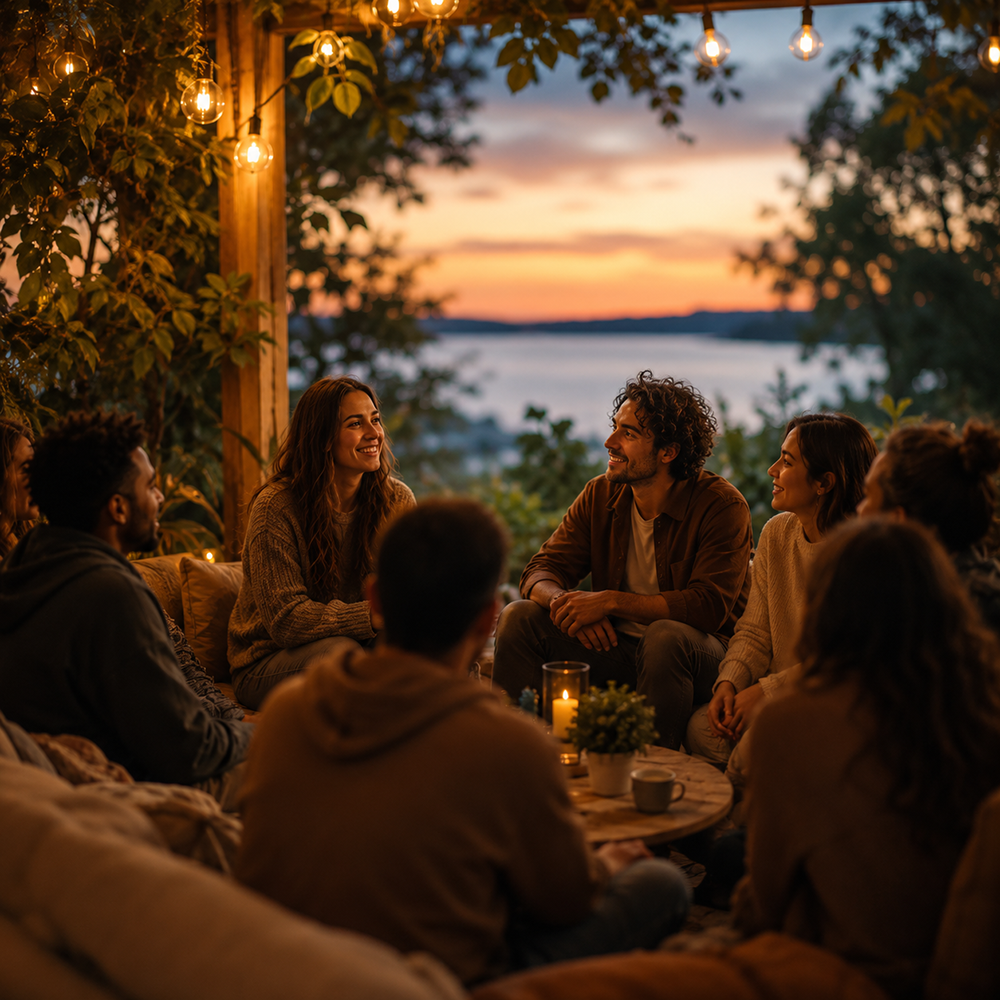
There is a quiet ache that seems to be echoing through much of the modern world.
It crosses generations.
Cultures.
Political beliefs.
Neighborhoods.
It can be found in crowded cities and rural towns, among students and retirees, parents and young adults alike.
Many people struggle to put words to it.
They simply know something feels missing.
Not necessarily information.
Not necessarily opportunity.
Not even people.
Something deeper.
Perhaps you've experienced it yourself.
You've sat in a room full of people and somehow felt completely alone.
You've laughed with coworkers while quietly wondering if anyone actually knows you.
You've scrolled through endless updates from friends, family, and strangers, yet finished feeling more disconnected than when you began.
Perhaps you've moved to a new city.
Started a new school.
Joined a new church.
Accepted a new job.
Or simply looked around one ordinary afternoon and found yourself asking a question that feels surprisingly difficult to answer: "Where do I truly belong?"
This question seems increasingly common.
Despite living in one of the most connected periods in human history, many people describe feeling profoundly alone.
We can send messages across continents in seconds.
Join online communities built around almost any interest imaginable.
Attend virtual meetings with people we've never met in person.
Stay informed about the daily lives of hundreds—or even thousands—of people.
By many measures, we have more ways to connect than any generation before us.
Yet connection and belonging are not the same thing.
We can exchange messages without feeling understood.
Share photos without feeling seen.
Participate in conversations without feeling heard.
Spend time with people without feeling safe enough to be ourselves.
Perhaps this is one of the great paradoxes of our age:
We have become remarkably connected.
Yet many of us still struggle to feel that we truly belong.
Maybe that is because belonging has never simply been about proximity.
It has never been measured by the number of people around us, the number of followers we have, the number of invitations we receive, or the size of our social circle.
Belonging is something much deeper.
It is the experience of being genuinely known.
Of being welcomed rather than merely tolerated.
Of discovering that our presence is not simply accepted, but valued.
It is finding places where we do not have to spend every moment proving that we deserve to exist.
Where we can contribute without needing to perform.
Where our differences do not automatically become reasons for exclusion.
Where we are free to become more fully ourselves rather than carefully constructing someone we hope others will accept.
Perhaps this is why the crisis of belonging feels so significant.
Human beings do not simply need relationships.
We need places where our humanity can unfold.
Places where we can be honest without fear.
Curious without shame.
Different without isolation.
Needed without being used.
Loved without having to earn it.
When those places are absent, something within us quietly begins searching.
Not merely for more people.
But for somewhere our soul can finally exhale.
Because perhaps belonging has never been about finding a crowd.
Perhaps it has always been about finding a place where we can fully exist.
 Jessica Carey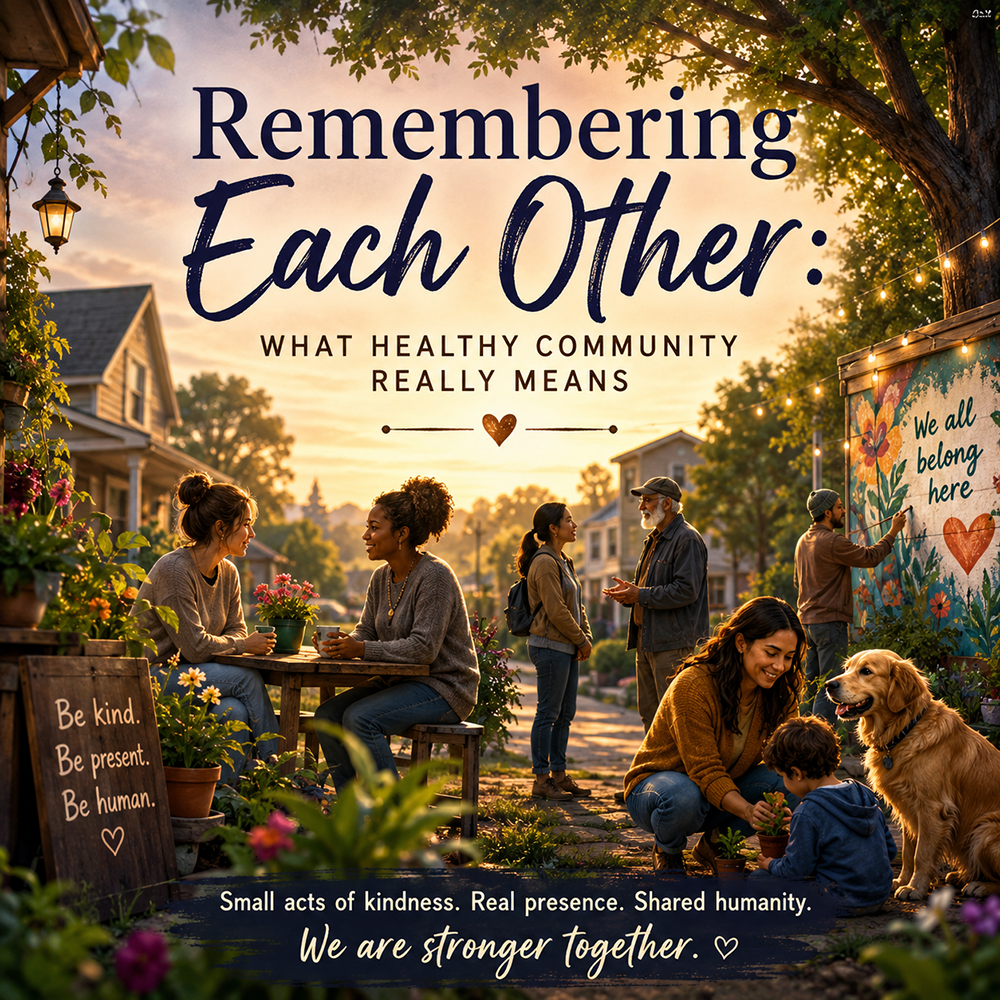
Loneliness Is Not the Same as Solitude
One of the greatest misunderstandings about belonging is the assumption that loneliness and being alone are the same thing.
They are not.
Many people have experienced peaceful moments of solitude.
An early morning walk before the world awakens.
Reading beneath a favorite tree.
Creating art in a quiet studio.
Watching rain fall outside the window.
Sitting beside a lake as the sun disappears beyond the horizon.
These moments are not empty.
They are often deeply nourishing.
Solitude is not the absence of relationship.
It is the presence of enough inner peace to enjoy your own company.
Many people find that some of life's clearest insights emerge not in crowded rooms but in quiet moments of reflection.
Throughout history, artists, writers, scientists, philosophers, and spiritual seekers have intentionally stepped away from constant activity—not because they rejected human connection, but because solitude created space to listen, to create, and to remember what truly mattered.
Loneliness is something different.
Loneliness is not measured by how many people surround us.
It is measured by how deeply we feel seen, understood, and connected.
A person may live alone and rarely feel lonely because they are surrounded by relationships marked by trust, love, and genuine care.
Another may spend every day in classrooms, offices, restaurants, or family gatherings and quietly feel invisible.
One person eats dinner by themselves and feels content.
Another sits at a crowded table yet feels as though no one would notice if they disappeared.
The difference is not proximity.
It is belonging.
Perhaps this is why loneliness can feel so confusing.
We often assume that if people are surrounded by others, they must feel connected.
Yet human beings do not simply long to be near one another.
We long to be known.
To have someone notice when our smile is hiding exhaustion.
To have someone remember what matters to us.
To be asked genuine questions rather than polite ones.
To feel safe enough to speak honestly without worrying that our authenticity will cost us acceptance.
Without these experiences, loneliness can quietly persist even within marriages, families, workplaces, schools, neighborhoods, and communities.
This also helps explain why simply telling lonely people to "get out more" or "meet new people" often falls short.
More interactions do not automatically create deeper relationships.
A calendar full of events cannot replace a single relationship built on trust.
A thousand casual conversations cannot substitute for one person who truly knows your heart.
Belonging grows through quality far more than quantity.
It is less about how many people recognize our face...
and more about how many recognize our soul.
Perhaps this is why belonging cannot be manufactured through constant activity.
It cannot be achieved by collecting invitations, followers, or acquaintances.
Belonging grows slowly.
Conversation by conversation.
Act of trust by act of trust.
Shared joy.
Shared grief.
Repair after misunderstanding.
The quiet confidence that someone is glad we are here—not because of what we produce, accomplish, or provide, but simply because we are ourselves.
This is also why solitude and belonging are not opposites.
In fact, they often strengthen one another.
When we know we belong somewhere, we are free to enjoy healthy solitude without fearing abandonment.
And when we become comfortable spending time with ourselves, we often enter relationships with greater authenticity rather than desperate dependence.
Neither constant togetherness nor constant independence is the goal.
Human flourishing has always involved a rhythm between meaningful connection and restorative solitude.
Perhaps loneliness is not simply the absence of people.
Perhaps it is the absence of places where love, trust, and mutual understanding have had time to take root.
And perhaps belonging begins the moment another person quietly communicates something every human heart longs to hear: "I'm glad you're here."
 Jessica Carey
Why Being Surrounded by People Isn't Enough
If belonging were simply a matter of being around other people, the solution to loneliness would be surprisingly straightforward.
Attend more events.
Join another club.
Find another social group.
Fill the calendar.
For some people, those steps genuinely help.
Human connection matters.
Yet countless people have discovered that proximity alone cannot satisfy the deeper longing to belong.
It is entirely possible to spend every day surrounded by people and still feel invisible.
Perhaps this is because many of us have experienced different forms of connection that looked meaningful from the outside but never reached the heart.
Being invited is not always the same as being welcomed.
Being included is not always the same as belonging.
Being noticed is not always the same as being known.
Acceptance says: "You may stay."
Belonging says: "We're genuinely glad you're here."
These differences matter.
A person may be appreciated for what they contribute while quietly wondering whether anyone would still value them if they had nothing left to give.
Another may be admired for their accomplishments while feeling immense pressure to maintain an image that leaves little room for honesty.
Someone else may faithfully care for everyone around them, becoming indispensable to a family, workplace, or community, yet quietly wonder what would happen if they were the one who needed help.
These experiences can create a subtle but painful loneliness.
Not because people are absent.
But because the relationship begins to revolve around performance rather than presence.
Perhaps this is why so many people become exhausted.
They begin to believe that belonging must be earned.
By being useful.
Productive.
Funny.
Successful.
Easygoing.
Strong.
Helpful.
Entertaining.
Knowledgeable.
Needed.
The message may never be spoken aloud.
Yet over time, it quietly settles into the heart:
- "Maybe people don't really love me."
- "Maybe they love what I do for them."
When this happens, relationships can slowly become performances.
We carefully edit our personalities.
Hide our struggles.
Minimize our needs.
Suppress parts of ourselves that feel inconvenient or different.
We become increasingly skilled at being accepted while feeling progressively less known.
Perhaps this is one of belonging's greatest paradoxes:
The more we believe we must pretend in order to be accepted, the more acceptance begins to feel hollow.
After all, if people only know the version of us we perform... who is actually being loved?
Belonging asks something very different.
It creates space where masks become unnecessary.
Where strengths can be celebrated without pretending weakness doesn't exist.
Where people are free to succeed without becoming idols and free to struggle without becoming burdens.
This does not mean healthy relationships require us to reveal every thought or emotion to every person we meet.
Vulnerability is not indiscriminate openness.
It is the gradual process of allowing trustworthy people to know us more honestly over time.
Belonging grows through wisdom as much as through openness.
Trust is built.
It is not demanded.
This is also why belonging cannot be manufactured through popularity.
A person may be widely admired yet deeply lonely.
Public recognition often answers the question: "Do people know who I am?"
Belonging answers a different question: "Does anyone know who I really am?"
The difference is profound.
One seeks visibility.
The other seeks relationship.
One fills the spotlight.
The other fills the heart.
Perhaps this is why healthy belonging always involves mutuality.
It is not built upon one person constantly giving while another constantly receiving.
Nor does it revolve around one person's needs, opinions, or identity.
Healthy belonging grows through reciprocal care.
Each person is both known and knowing.
Both giving and receiving.
Both supported and supporting.
No one must disappear for someone else to belong.
Instead, everyone becomes more fully themselves.
Perhaps this is why belonging feels less like finding an audience... and more like coming home.
Not because everyone is identical.
Not because conflict never happens.
But because there is a shared commitment to protecting one another's dignity, even through disagreement.
That is the kind of environment where people begin to exhale.
Where they stop asking: "How do I earn my place here?"
and slowly begin believing something far more life-giving: "Perhaps I was never meant to earn belonging in the first place."
Perhaps one of the quietest ways belonging grows is through the decision to remain genuinely interested in one another.
Every person we meet is carrying a story we cannot immediately see.
Every conversation is an opportunity to discover something we did not know before.
Belonging flourishes where people never stop learning one another.
 Jessica Carey
What Actually Creates Belonging?
If belonging cannot be reduced to proximity, popularity, or participation, then what does create it?
Perhaps belonging is less like joining a group... and more like growing a garden.
Gardens cannot be forced into bloom overnight.
They require the right conditions.
Healthy soil.
Light.
Water.
Patience.
Care.
In much the same way, belonging grows where certain conditions are consistently nurtured.
One of those conditions is psychological safety.
Human beings are remarkably perceptive.
Long before we consciously evaluate a space, we often begin asking quiet questions:
- Is it safe to be honest here?
- Will my mistakes be used against me?
- Can I ask questions without being ridiculed?
- Will I still be treated with dignity if I disagree?
- Is there room for me to grow?
These questions are not signs of weakness.
They are part of being human.
Belonging begins wherever people no longer feel they must constantly protect themselves from rejection.
Another essential condition is being known.
Every person carries an inner world that remains invisible to everyone else.
Our hopes.
Our fears.
Our joys.
Our grief.
Our questions.
Our dreams.
Belonging grows whenever another person becomes genuinely curious about that inner world—not to analyze or fix it, but simply to understand it.
To be known is one of the deepest human longings.
Not because we want attention.
But because we want someone to say:
- "I see you."
- "I want to understand your experience."
- "Your life matters to me."
Many of us spend years becoming known for our roles before we are ever known as people.
We become known as the dependable coworker.
The responsible oldest sibling.
The funny friend.
The successful entrepreneur.
The helpful volunteer.
The talented artist.
The quiet student.
The strong one.
The caregiver.
The leader.
These roles may describe what we do.
They may even reflect genuine parts of who we are.
But they are not the whole story.
Behind every role is a person carrying hopes and fears, questions and dreams, strengths and struggles that few people ever see.
Sometimes people become so accustomed to relating to our roles that they stop becoming curious about the person beneath them.
Without intending to, they begin interacting with what we provide rather than who we are.
Over time, this can create a subtle loneliness.
People know our responsibilities.
Our achievements.
Our opinions.
Perhaps even our routines.
Yet they may never know what brings us peace.
What keeps us awake at night.
What we quietly hope for.
Or what makes us feel most alive.
Being known asks us to move beyond labels.
It invites us to become curious about the whole person standing before us.
Not simply asking: "What do you do?"
But wondering: "Who are you becoming?"
Being known also requires something difficult: vulnerability.
Belonging cannot exist where every relationship remains carefully managed behind polished masks.
If everyone performs perfection, no one is actually known.
Yet vulnerability is often misunderstood.
It does not mean telling everyone everything.
Nor does it require immediate trust.
Healthy vulnerability grows gradually.
It responds to demonstrated character.
Trustworthy people create environments where honesty becomes safer over time.
Being known is also an ongoing process.
No one is fully understood in a single conversation.
Human beings continue growing throughout their lives.
Our perspectives deepen.
Our dreams change.
Our understanding of ourselves expands.
Healthy relationships leave room for that growth.
Rather than assuming they have us completely figured out, they remain curious.
They continue asking questions.
They keep listening.
They allow us to surprise them.
Perhaps one of the greatest gifts we can offer another person is genuine curiosity.
Not curiosity that seeks information.
Curiosity that seeks understanding.
There is a profound difference.
Information asks: "What happened?"
Understanding gently wonders: "What was that like for you?"
One gathers facts.
The other draws near to the heart.
Perhaps this is why curiosity so often becomes the doorway to belonging.
People flourish where they are not merely observed... but sincerely understood.
Belonging flourishes where vulnerability is honored rather than exploited.
Perhaps this is one of the greatest expressions of love: not believing we already know everything about another person... but remaining interested in discovering who they are becoming.
Trust also grows through consistency.
Grand gestures are memorable.
Consistent presence is transformative.
Checking in.
Keeping promises.
Showing up.
Listening.
Remembering birthdays.
Asking about yesterday's difficult conversation.
Celebrating victories.
Remaining present through grief.
These seemingly ordinary moments quietly communicate something extraordinary: "You matter enough for me to remember."
Perhaps this is why belonging rarely appears through dramatic moments alone.
It is built through countless ordinary acts of care repeated over months and years.
Repair is another often-overlooked ingredient.
No healthy community is free from misunderstanding.
People disappoint one another.
Words are misunderstood.
Needs are overlooked.
Mistakes are made.
The question is not whether conflict happens.
The question is what happens next.
Communities where belonging grows are not communities without conflict.
They are communities that learn how to repair.
People apologize.
People listen.
People take responsibility.
People forgive wisely.
Trust is rebuilt through honesty rather than ignored through avoidance.
Every healthy relationship eventually encounters imperfection.
Belonging depends far less on perfection than on a shared commitment to repair.
Belonging also requires mutual contribution.
Healthy communities are not built around consumers.
Nor are they sustained by a handful of exhausted caretakers doing everything for everyone else.
Instead, people contribute according to their gifts, abilities, seasons, and circumstances.
Sometimes we receive.
Sometimes we give.
Often we do both.
Belonging allows every person to matter without demanding that every person contribute in exactly the same way.
This is one reason belonging often feels so different from performance.
Performance asks: "How valuable can I make myself?"
Belonging asks: "How can we help one another flourish?"
Notice the difference.
One is rooted in earning.
The other is rooted in relationship.
Perhaps this is why healthy communities often feel surprisingly ordinary.
There is laughter.
Shared meals.
Honest conversations.
People noticing when someone has been absent.
Children learning from elders.
Neighbors helping one another after storms.
Friends sitting quietly beside someone who has run out of words.
These moments rarely become headlines.
Yet they quietly shape lives.
Love is rarely sustained by assumptions.
It is sustained by ongoing curiosity.
Perhaps belonging has never been built primarily through extraordinary events.
Perhaps it has always been cultivated through ordinary faithfulness.
Through people who consistently choose curiosity over assumptions.
Presence over performance.
Listening over winning.
Compassion over convenience.
Repair over resentment.
Love over fear.
These choices may appear small in isolation.
Together, they become the conditions in which belonging grows.
Because perhaps belonging has never been something we discover waiting for us.
Perhaps it is something we patiently create together.
 Jessica Carey
Why Healthy Communities Feel Like Ecosystems
One of the most beautiful things about belonging is that it rarely grows in isolation.
While belonging is deeply personal, it is also profoundly communal.
The places where we feel most at home are often places where many people are quietly helping create an environment in which everyone can flourish.
Perhaps this is why healthy communities resemble ecosystems more than audiences.
An audience gathers to observe.
An ecosystem exists to sustain life.
The difference is profound.
An audience asks people to perform.
An ecosystem allows people to grow.
An audience often measures value by visibility.
An ecosystem recognizes that every part contributes, even when its work goes unnoticed.
Healthy ecosystems make room for every season.
There are seasons of abundance.
Seasons of growth.
Seasons of rest.
Seasons of grief.
Healthy communities understand that human beings move through seasons as well.
Sometimes we are able to give generously.
Sometimes we need to receive.
Belonging allows room for both.
Seasons are not signs that something is wrong.
They are part of how life grows.
Consider a healthy forest.
Towering trees capture sunlight.
Shrubs provide shelter.
Wildflowers attract pollinators.
Fungi quietly recycle nutrients beneath the soil.
Streams nourish countless forms of life.
Even fallen leaves, which may appear lifeless, gradually return their nutrients to the earth, making new growth possible.
No single part of the forest exists for itself alone.
Each contributes to the flourishing of the whole.
Human communities are not identical to forests.
But perhaps they reveal a similar truth.
Healthy communities are not built by asking everyone to become the same.
They grow by creating conditions where different gifts, personalities, perspectives, experiences, and seasons of life can enrich one another.
Some people naturally lead.
Others quietly encourage.
Some organize.
Others create.
Some teach.
Others listen.
Some build.
Others nurture.
Some bring laughter.
Others bring wisdom born from suffering.
No gift is insignificant.
Not because every contribution looks the same.
But because every contribution helps sustain the life of the whole.
This also changes how we think about strength.
Many societies celebrate independence as though needing others were a sign of weakness.
Yet ecosystems tell a different story.
Life flourishes through relationship.
Trees exchange nutrients through underground fungal networks.
Pollinators depend upon flowers.
Flowers depend upon pollinators.
Rivers nourish forests.
Forests protect rivers.
Strength emerges not from isolation but from healthy interdependence.
Human beings are remarkably similar.
We are shaped by countless relationships.
Teachers.
Neighbors.
Friends.
Parents.
Mentors.
Coworkers.
Volunteers.
Artists.
Strangers who offer unexpected kindness.
Each leaves fingerprints upon our lives.
None of us becomes fully ourselves alone.
Healthy communities recognize this interdependence without slipping into unhealthy dependence.
Interdependence is not losing ourselves within a group.
Nor is it expecting others to carry responsibilities that belong to us.
Rather, it is recognizing that our lives inevitably influence one another.
Our words can encourage or discourage.
Our actions can build trust or diminish it.
Our presence can help another person feel welcomed—or overlooked.
Whether we realize it or not, we are always helping shape the environments we inhabit.
This truth carries both responsibility and hope.
Responsibility, because every interaction contributes something to the culture around us.
Hope, because belonging is not created only by leaders, institutions, or large organizations.
It is built one conversation at a time.
One act of kindness.
One apology.
One invitation.
One shared meal.
One person choosing curiosity instead of assumption.
One neighbor learning another's name.
Healthy communities are not perfect because every individual is perfect.
They are healthy because many ordinary people continue choosing practices that allow trust to grow.
Perhaps this is also why belonging cannot be manufactured through uniformity.
When communities demand that everyone think alike, look alike, worship alike, vote alike, or express themselves in identical ways before they are welcomed, they often confuse conformity with unity.
True belonging asks something different.
It makes room for diversity without abandoning shared values.
People need not become identical in order to become connected.
Indeed, some of the richest communities are those where differences become opportunities for learning rather than reasons for division.
This does not mean every idea is equally wise or every behavior equally healthy.
Healthy communities still establish boundaries.
They protect people from harm.
They encourage accountability.
They cultivate shared commitments that help everyone flourish.
But they also recognize that dignity is not something people earn by fitting perfectly into a mold.
It belongs to every human being.
Perhaps this is why belonging feels so life-giving.
Healthy communities do not merely gather people into the same space.
They help people become more fully themselves.
Rather than shrinking to fit expectations, people begin unfolding into the unique individuals they were created to be.
Ironically, the more people are free to become themselves, the more richly the community itself begins to flourish.
Difference becomes strength.
Curiosity replaces fear.
Mutual care replaces competition.
And the community becomes something larger than the sum of its individual parts.
Perhaps that is what belonging has always been.
Not finding a perfect group.
Not discovering people who never disappoint us.
But helping cultivate an environment where human beings can grow together.
Like a healthy ecosystem, its greatest beauty is not found in any one individual.
It is found in the life that emerges between them.
 Jessica Carey
Rebuilding Belonging
It is easy to look at the crisis of belonging and feel overwhelmed.
The problem feels enormous.
Loneliness has become widespread.
Communities often feel fragmented.
Public conversations can become increasingly hostile.
Many people carry wounds from relationships where they were misunderstood, excluded, manipulated, or made to feel that they had to earn the right to belong.
In moments like these, it is tempting to believe that belonging is something someone else must create.
That it depends on finding the perfect family.
The perfect friends.
The perfect workplace.
The perfect neighborhood.
The perfect community.
Certainly, environments matter.
Healthy communities make an extraordinary difference.
Yet every healthy community begins with ordinary people making small choices that gradually shape the culture around them.
Belonging is rarely built through grand gestures.
More often, it grows through quiet faithfulness.
It grows when someone remembers your name.
When they ask how your interview went because they remembered you were nervous.
When they notice you've been absent and gently check in.
When they make room for another voice at the table.
When they apologize sincerely after causing harm.
When they celebrate another person's success without jealousy.
When they choose curiosity instead of assumptions.
When they listen—not simply to respond, but to understand.
These moments may seem almost insignificant.
Yet they quietly answer one of the deepest questions every human being carries: "Do I matter here?"
Perhaps belonging is built one affirmation at a time.
One act of hospitality.
One conversation.
One invitation.
One repaired misunderstanding.
One shared meal.
One sincere apology.
One expression of gratitude.
One person deciding that another person's dignity is worth protecting.
Belonging also asks something of us that can feel surprisingly difficult:
It asks us to become the kind of people who make room for others.
Not merely people who seek belonging...
but people who extend it.
This requires humility.
Curiosity.
Patience.
The willingness to admit when we are wrong.
The courage to welcome perspectives different from our own.
The wisdom to hold healthy boundaries while still treating every person with dignity.
Healthy belonging is neither endless accommodation nor rigid exclusion.
It is the ongoing practice of balancing truth with compassion, individuality with community, and freedom with responsibility.
It recognizes that every person has inherent worth while also acknowledging that trust is built through character and mutual care.
This means belonging is not the same as saying yes to everything.
Healthy communities still establish boundaries.
They protect people from abuse.
They address harmful behavior.
They encourage accountability.
In fact, healthy boundaries often make deeper belonging possible because they create environments where people can feel genuinely safe.
Belonging without boundaries becomes fragile.
Boundaries without belonging become cold.
Communities that avoid boundaries often become unsafe.
Communities that only emphasize boundaries often become fearful.
Healthy belonging requires both love and wisdom.
Compassion and discernment.
Welcome and accountability.
Healthy communities need both.
Perhaps one of the greatest obstacles to belonging is the temptation to divide the world into us and them.
History reminds us how easily fear can convince people that differences are threats rather than opportunities for learning.
Yet nearly every meaningful relationship begins with someone choosing to move toward another person with openness rather than suspicion.
This does not mean abandoning discernment.
Trust should be earned.
Wisdom matters.
Not every relationship is healthy.
Not every environment is safe.
Some situations require distance rather than deeper connection.
Healthy belonging never asks people to remain where they are harmed or continually devalued.
Instead, it invites us to keep believing that healthier relationships are possible—and to help create them wherever we can.
The remarkable thing about belonging is that it often spreads.
One person who feels genuinely welcomed is more likely to welcome someone else.
One act of compassion makes the next act a little easier.
One community shaped by kindness quietly becomes an example for another.
Like seeds carried by the wind, belonging has a way of taking root in places we never expected.
Perhaps this is how lasting change has always happened.
Not only through laws or institutions, important though they are.
But through countless ordinary people choosing, day after day, to create environments where others can breathe a little easier.
Where dignity is protected.
Where differences are welcomed.
Where truth is spoken with love.
Where no one has to spend every moment proving they deserve to exist.
This work may never attract headlines.
It may unfold quietly around dinner tables, in classrooms, workplaces, neighborhoods, volunteer groups, art studios, libraries, places of worship, and conversations between friends.
Yet these ordinary places are often where the future is shaped.
Because every time we help another person feel seen... heard... valued... and safe enough to be themselves... we participate in something larger than ourselves.
We become builders of belonging.
And perhaps that is one of the most meaningful ways we can help heal a world that is quietly longing to come home.
Imagine if every person left each interaction asking one simple question: "Did the people around me leave feeling more seen, more valued, and more able to be themselves because I was here?"
We cannot create belonging everywhere we go.
We cannot control how others respond.
But we can choose the kind of environment our own presence creates.
Sometimes belonging begins not with finding the right place... but with becoming someone who helps make places feel more like home.
 Jessica Carey
A Continuing Invitation
Perhaps one of the greatest misconceptions about belonging is that it is something we either find or fail to find.
Something that happens to us.
Something that depends entirely upon discovering the right people or the right place.
Certainly, there is truth in that.
The environments we inhabit profoundly shape our lives.
Some places nurture us.
Others diminish us.
Some relationships make room for us to grow.
Others ask us to become smaller in order to stay.
Finding healthy people and healthy communities matters.
But perhaps belonging is also something we help create.
There is a beautiful reciprocity at the heart of belonging.
Every one of us longs to be welcomed.
Every one of us also has opportunities to become someone who welcomes.
We long to be understood.
We also have the chance to become better listeners.
We hope others will make room for us.
We can choose to make room for them.
Belonging is not only a gift we hope to receive.
It is also a gift we can continually offer.
Every conversation becomes an opportunity to communicate: "You matter."
Every act of genuine listening reminds another person that their voice is worth hearing.
Every thoughtful question says: "Your story is worth knowing."
Every apology protects the dignity of the relationship.
Every act of hospitality quietly whispers: "There is room for you here."
These moments may seem small.
Yet they are often the places where belonging begins.
We rarely remember every conversation we've had.
But many of us remember the people who made us feel safe enough to be ourselves.
The teacher who believed in us before we believed in ourselves.
The neighbor who welcomed us.
The friend who stayed.
The mentor who listened.
The coworker who noticed we weren't ourselves.
The stranger whose unexpected kindness arrived precisely when we needed it most.
These moments remind us that belonging is not merely an abstract idea.
It is something experienced.
Something embodied.
Something that quietly changes the way we understand ourselves and one another.
Perhaps this is why belonging matters so deeply.
When people know they belong, they often become freer to create, to contribute, to take healthy risks, to ask honest questions, and to extend the same welcome they have received.
Belonging does more than comfort individuals.
It strengthens families.
Enriches friendships.
Builds healthier workplaces.
Creates more compassionate schools.
Shapes neighborhoods.
Nourishes communities.
And, little by little, helps cultivate a more humane society.
The effects ripple outward in ways we may never fully see.
In a world that often encourages comparison, performance, and constant self-promotion, choosing to create belonging can feel surprisingly countercultural.
It asks us to slow down enough to notice one another.
To become curious instead of making assumptions.
To protect dignity rather than demanding perfection.
To value people not only for what they accomplish, but for who they are.
Perhaps this work will never be finished.
Each new generation will face its own challenges.
New technologies will change how we communicate.
Communities will evolve.
Cultures will shift.
Yet one truth seems remarkably constant across time and place:
Human beings flourish where they are genuinely known, loved, and valued.
Perhaps that has always been the heart of belonging.
Not simply finding people who accept us.
But helping create places where every person's humanity has room to breathe.
Where differences need not become divisions.
Where truth and compassion walk together.
Where dignity is protected.
Where love is expressed not merely through words but through the countless ordinary choices that make another person's life a little lighter.
Perhaps belonging has never been about finding a perfect community.
Perhaps it has always been about ordinary people choosing, day after day, to help build one.
Because every time we help another person feel seen... heard... welcomed... valued... and safe enough to become more fully themselves... we help create the kind of world so many hearts have quietly been searching for.
And perhaps that is one of the most meaningful gifts we can offer one another:
Not merely a place to stand.
But a place to belong.
Perhaps, generations from now, people will not remember most of our accomplishments.
They may not remember our titles.
Our awards.
Our follower counts.
Or even many of the words we spoke.
But they may remember who they were able to become in our presence.
Whether they became smaller... or more fully themselves.
Whether our lives became places where dignity was protected... where curiosity was welcomed... where hope quietly grew.
Perhaps that is one of the deepest legacies any of us can leave: helping another human being know what it feels like to belong.
 Jessica Carey
Want even more content about creativity and art?
Be sure to check out all of our creative chronicles!
If you'd like to see examples of my work, you can find some of my art and creations at Redbubble and Gumroad!
Looking to learn more about my recent journey?
Check some of these articles:
-Hidden Gems for St. Louis Artists
-Hidden Gems for Autistic & Neurodivergent Adults
-I Think I Might Be Autistic... Now What?
 Jessica Carey