


Content note: This article discusses childhood abuse and neglect, parental control, family dysfunction, parentification, substance misuse, violated boundaries, animal mistreatment, eating disorders, and complicated grief following an abusive parent’s death. Please read with care.
People had recommended Jennette McCurdy’s memoir, I’m Glad My Mom Died, to me for quite some time.
Recently, a former classmate I reconnected with this year—who now works with the St. Louis Arc—shared the audiobook with me.
Because I am experiencing severe chronic autistic burnout, listening was more accessible than sitting down to read, so I spent much of the day moving through Jennette’s story in her own voice.
Our lives are not identical.
I was not forced into child acting or fame.
I did not grow up inside the entertainment industry, and the specific ways Jennette’s mother controlled her food, appearance, career, privacy, and body were different from what happened to me.
Yet the emotional architecture of her story felt painfully familiar.
I recognized what it is like for a child to be treated less like a separate person and more like an extension of the adults around them.
I recognized the pressure to perform a role, protect a parent’s emotional state, accept someone else’s version of reality, and mistake control for love.
I recognized what happens when a child’s boundaries, needs, distress, and developing identity become inconvenient to the family story.
Most of all, I recognized how adults can look directly at a suffering child and still fail to become curious about what they are seeing.
At certain points in the memoir, adults celebrated Jennette’s ability to produce extraordinarily intense emotions while acting.
They praised the crying, screaming, and emotional eruptions because those reactions created a successful performance.
Acting ability alone is not proof of abuse; some children possess remarkable emotional range, imagination, and technical skill.
It would be irresponsible to diagnose a child’s home life from one convincing performance, but context matters.
When a child who often appears stiff, anxious, nervous, or uncomfortable can suddenly access extreme distress with startling intensity, that should at least inspire curiosity.
Intense emotions do not necessarily reveal one particular experience, but neither should they be treated as though they emerged from nowhere—especially when other warning signs are present.
The question should not have been only: how useful is this for the performance?
Someone should also have wondered:
- What is happening inside this child?
- What experiences, imagination, coaching, or inner emotional material is she drawing upon to access this much fear, panic, or pain?
- Does she feel safe?
- What is her life like when the cameras are gone?
Instead, the adults around her often seemed more interested in what her distress could produce than in what it might be communicating.
That unsettled me because I have watched similar patterns unfold in families, schools, institutions, and my own life.
Adults see a child explode, withdraw, stop attending school, become depressed, use substances, compulsively perform, shut down, or disappear into perfectionism.
Rather than asking what has happened to the child—or what the surrounding environment may be doing to them—people label the child difficult, dramatic, lazy, defiant, unstable, ungrateful, or troubled.
The behavior becomes the problem.
The conditions beneath it remain protected.
All four children in my family expressed serious distress in different ways
Some of us exploded outward, while others imploded inward.
There were screaming matches, physical confrontations, depression, school avoidance, substance problems, attempts to numb overwhelming stress, and desperate desires to escape.
Those responses were not healthy, interchangeable, or caused by only one thing.
Each of us was an individual with our own experiences and choices, but when multiple children living within the same family system are deteriorating, it should prompt questions about more than the supposed defects of each child.
At some point, someone must become willing to examine the environment.
Instead, people can remain devoted to the belief that the parents are “wonderful people.”
They may point to good intentions, public kindness, financial provision, generational trauma, or moments of genuine affection as though these automatically disprove everything that happened behind closed doors.
Multiple truths can coexist.
Parents can have their own wounds and still wound their children.
They can believe they are doing their best and still cause devastating harm.
They can possess positive qualities and still behave abusively.
They can love according to their understanding of love while remaining unsafe.
Context may help explain behavior, but it does not erase consequences.
Generational trauma deserves compassion, but it cannot become a permanent free pass that requires the next generation to absorb the same damage in silence.
The deepest problem is not human imperfection; every parent will misunderstand something, lose patience, make a poor decision, or unintentionally hurt their child.
The deeper danger appears when adults refuse to listen, sincerely apologize, accept responsibility, seek help, change their behavior, or repair what they damaged.
Then the family’s survival depends upon denying reality and blaming whoever continues to name it.
That is part of what made I’m Glad My Mom Died so difficult—and so important—for me to hear.
Jennette’s circumstances were uniquely hers, but the larger pattern is tragically familiar: a child can be surrounded by adults, praised for what they produce, and spoken about as deeply loved while no one asks whether they are safe, known, or allowed to belong to themselves.
A family can celebrate the idea of a child while failing to see the actual child standing in front of them.
And sometimes the child’s pain is not invisible because it was carefully hidden.
Sometimes it is invisible because everyone around them has decided not to understand what they are seeing.
While listening, I kept thinking about an episode of Bluey that made me cry several years ago; it took place during Bingo’s birthday party.
The house was filled with people supposedly gathered to celebrate her, yet almost no one noticed where she was or what she was trying to share.
Jennette’s childhood and Bingo’s fictional birthday are not comparable in severity, but they illuminate the same unsettling possibility: adults can be looking directly at a child—even celebrating the child—without genuinely seeing them.
Between Jennette’s story, Bingo’s handstand, and my own experiences, I kept returning to one question: what happens when adults become more invested in the performance of love than in the child they claim to love?
 Jessica Carey

When One Parent Controls and the Other Disappears
One of the dynamics I recognized in Jennette’s story was the presence of an intensely controlling mother alongside a father who seemed largely detached from what was happening.
Control and absence may appear to be opposites, but within a family they can reinforce one another.
One parent dominates the emotional atmosphere, while the other retreats, avoids responsibility, or becomes absorbed in television, games, work, substances, or anything that allows them not to engage.
The controlling parent grows increasingly resentful and explosive because they feel burdened with everything.
The disengaged parent continues withdrawing because participation feels unpleasant or demanding.
Then the children are pulled into the space between them.
My father was physically present at times without being meaningfully available.
When I was a baby, he told me that he would drape a blanket over me to make me sleep so he could play video games rather than respond to me.
By the time I was four years old, I was changing my baby brother’s diapers because my father would refuse to get out of bed.
He later spoke almost proudly about knowing nothing about the household finances or bills because my mother handled them.
This was not an equal division of responsibilities that both adults had thoughtfully chosen; it reflected a broader pattern in which he wanted as little involvement as possible in the practical and emotional labor of family life.
My mother responded to the pressure of carrying so much through control, rage, guilt, and unpredictability.
She frequently lamented that no one helped her, even while refusing assistance because everyone else would supposedly “do it wrong.”
We could be punished for failing to help and punished for helping incorrectly.
We were expected to anticipate what she wanted without being given meaningful autonomy over how anything was done; there was no safe answer.
A home with children will sometimes be messy, noisy, spontaneous, and inconvenient, but ordinary childhood messes could trigger screaming, stomping, thrown objects, slammed doors, and an atmosphere in which everyone had to monitor her emotional state.
We were not simply expected to contribute to the household. We were expected to prevent her from becoming upset.
Even activities presented as enrichment could become exercises in control.
One summer, she required us to write about what we had done each day.
After attending a library reading kickoff with treats and a petting zoo, my siblings and I excitedly wrote about a turtle we had found beside the road; that was what had captured our attention.
Rather than appreciating what had fascinated her children, she became upset because we had not written the story she had already decided we should tell.
She wanted the library event to be important to us, and our genuine interest in the turtle was treated almost like disobedience; she still complains about it to this day.
That small memory illustrates something much larger.
When adults are committed to controlling the family narrative, children are not allowed to determine what matters to them.
Their interests, memories, feelings, and interpretations must conform to the adult’s preferred version of events.
The child does not merely have to behave correctly; the child must experience reality correctly.
My parents also repeatedly pulled me into their conflicts and demanded that I validate one side against the other.
They could argue furiously over something as insignificant as which side of a car had a scratch, then insist that I choose who was right even when I had not witnessed it.
Remaining neutral did not protect me. Refusing to cast a vote was treated as another offense.
At a family birthday party for my toddler cousin, their fighting escalated into screaming and physical aggression.
Later, when my mother waited until my father left the room before saying something positive about him, he returned and pressured me to repeat it.
Even their rare moments of appreciation became something I was expected to carry between them.
I was not allowed simply to be their child; I was expected to serve as witness, messenger, referee, ally, emotional regulator, and evidence.
Yet I was also blamed for choices over which I had no control.
If another family member behaved inappropriately, the response could somehow become: “He’s your father,” or “She’s your sister.”
The implication was that their behavior belonged to me—that I possessed some invisible power over the adults and siblings around me and had failed by not using it.
That is an impossible role for any child.
The same expectation followed me into adulthood: peace did not mean that everyone was safe; peace meant that I silently absorbed whatever happened so no one else had to feel uncomfortable.
Meanwhile, my siblings and I expressed distress in different ways.
That distinction followed me throughout my life.
Peace did not mean that everyone was safe; peace meant that I silently absorbed whatever happened so no one else had to feel uncomfortable.
Meanwhile, my siblings and I expressed distress in different ways.
Some exploded outward through screaming, fighting, substance use, school refusal, and desperate attempts to escape.
Others retreated inward through depression, silence, perfectionism, and emotional disappearance.
I tried to become as undemanding and flawless as possible.
I needed less, spoke less, and gradually became a shell of myself.
None of us responded identically, and none of our later choices can be attributed to one cause with absolute certainty.
We remain individual people responsible for what we do.
But when multiple children raised in the same home are struggling profoundly, the responsible response is not to invent a separate character defect for every child; it is to examine the environment they shared.
A child’s behavior is not always proof of what happened to them, but behavior is information.
Depression, rage, withdrawal, school avoidance, substance use, hypervigilance, compulsive perfectionism, and desperate attempts to leave should provoke curiosity—especially when several children from one household are displaying them.
Instead, the environment was protected by a familiar declaration: your parents are wonderful people.
Perhaps they possessed good qualities.
Perhaps they genuinely believed they were doing their best.
Perhaps generational trauma, untreated wounds, dysfunctional models, and overwhelming responsibilities influenced much of their behavior.
Those possibilities may help explain what happened, but they do not make what happened harmless.
The deepest issue was not that my parents were imperfect people; the issue was that when harm was named, they would not listen, take sincere responsibility, offer meaningful apologies, seek change, or repair what their choices had damaged.
The family’s preferred image had to remain intact, even if preserving it required portraying the harmed child as unstable, hateful, dishonest, or responsible for everyone else.
One controlling parent and one disengaged parent do not balance each other into a healthy family.
Sometimes they create a system in which one adult produces the storm, the other refuses to shelter the children, and a child is eventually blamed for getting wet.
 Jessica Carey

When “No” Is Treated as an Invitation to Negotiate
One of the most damaging lessons a child can learn is that their clear answer does not matter.
Jennette’s mother repeatedly treated her daughter’s body, career, appearance, food, privacy, and developing identity as things she was entitled to manage.
Jennette’s discomfort did not carry the same authority as her mother’s wishes.
That pattern was familiar to me.
In my family, saying no rarely ended a conversation; it often began a campaign to wear me down.
Alcohol is one example.
I have never wanted to drink.
When I turned twenty-one, my parents wanted to take me to a bar; I declined, but my lack of interest was not accepted as a complete answer.
They tried to make alcohol sound appealing by describing drinks with “fun” names, such as Purple Pirate.
When that did not work, they told me about flavors resembling cupcakes or Cinnamon Toast Crunch.
My answer remained the same.
If I wanted a cupcake or Cinnamon Toast Crunch, I could have the actual food; I did not need an alcoholic imitation of it.
This should have been an ordinary difference in preference; they enjoyed something I did not want, and my decision affected no one else.
Yet my refusal became something they felt entitled to challenge.
My father later tried to claim credit for the fact that I do not drink; he proudly recalled tricking me when I was approximately six years old by telling me that his apple-flavored alcohol was apple juice.
It was not.
The taste was disgusting, but the deeper injury was the betrayal; I trusted an adult who knowingly gave me something different from what he said it was.
My lack of informed consent became a humorous family story and, years later, something he reframed as his proud accomplishment.
That incident influenced my feelings about alcohol, as did finding the wine at my First Communion unpleasant, but neither was the primary reason I chose not to drink.
The main reason was what alcohol repeatedly did within my family.
I watched people pass out throughout the house, vomit on the carpet, and end up in places such as the bathtub.
I witnessed screaming matches, frightening personality changes, damaged belongings, and adults behaving in ways that made the environment unpredictable and unsafe.
When I was young, one intoxicated relative violently beat a metal cookie tin until it could never close correctly again.
Another relative, who ordinarily showed me little physical affection, once clung to me, stroked my hair, and whispered that I was pretty—but that she “knew” I hated her.
I repeatedly told her that I did not, but she would not believe me.
What might have appeared to someone else as an overly emotional display of affection felt terrifying to the child trapped inside it; I could not make her release the story alcohol and insecurity had created about me.
Once again, my actual feelings mattered less than what an adult had decided I felt.
People also passed out in my bed, turning the place that should have belonged to me into another space over which I had little control.
My decision not to drink was therefore not based upon an abstract judgment that everyone who consumes alcohol is bad; many adults drink moderately without behaving this way.
My choice came from witnessing what unhealthy relationships with alcohol repeatedly cost the people around me—and what their behavior cost the children who had no ability to leave.
I did not want that substance in my body or that pattern in my life.
My youngest brother’s experience made the danger even harder to ignore; he was exposed to alcohol far too young and repeatedly sought it out as a child, sneaking into the adults' drinks.
From my perspective, the adults around him helped create an early and dangerous relationship with alcohol, yet treated the warning signs far less seriously than they should have.
As an adult, he has experienced major consequences connected to alcohol, including losing his license after drinking and driving.
Those later choices belong to him, but adulthood does not erase the environment in which his relationship with substances began.
Once again, the family preferred to focus on the struggling individual rather than examine what the adults had modeled, encouraged, ignored, or normalized.
This does not mean that every person raised around harmful substance use will develop the same relationship with it.
My siblings and I reacted differently; the others participated in the family’s patterns, while I moved as far away from them as I could.
But my refusal was not evidence that I was cold, judgmental, boring, or unwilling to belong; it was discernment.
I had watched the same substance transform family gatherings into scenes of fear, volatility, humiliation, and neglect; I understood that something being common did not make it safe.
Something being offered playfully did not make it harmless.
Something being called a family tradition did not obligate me to continue it.
Most importantly, I understood that no should mean no even when other people dislike the answer.
Healthy love does not require someone to ingest a substance they do not want.
It does not use teasing, peer pressure, “fun” flavors, family loyalty, or repeated persuasion to overcome a clearly stated boundary.
It does not deceive a child and later celebrate the deception as a joke.
A loving response would have been simple: “You do not want to drink. We respect that.”
Instead, my family repeatedly behaved as though my boundaries were challenges to defeat.
That same pattern appeared far beyond alcohol.
My feelings were debated.
My limits were overridden.
My account of events was rewritten.
Other people told me what I supposedly wanted, needed, believed, or felt—and became angry when I continued knowing myself.
I saw the same disregard extended toward animals in our “home.”
Our cats could hiss, growl, scream, scratch, bite, struggle, and desperately attempt to escape someone’s grip, yet family members still insisted that the animals “wanted” or “loved” the attention being forced upon them; their distress could be laughed at while their resistance was treated as something to overcome.
The cats often sought refuge with me because I paid attention to their boundaries.
I could hold or comfort them because I also released them when they had had enough.
Their trust did not come from overpowering them; it came from allowing their signals to mean something.
Watching people rename obvious fear as love taught me something that applied far beyond animals: when the more powerful person gets to define what the vulnerable being supposedly feels, even unmistakable resistance can be erased.
This is one reason family dysfunction can remain so difficult to recognize from the outside.
Each individual incident may be dismissed as teasing, tradition, concern, affection, humor, or an adult making an imperfect choice, but patterns matter.
When a child’s boundaries are repeatedly treated as unimportant, they are being taught that belonging requires surrendering ownership of themselves.
When adults disregard a child’s no, they do more than override one decision; they teach the child that other people’s desires carry more authority than the child’s own body, perception, and inner warning system.
I spent much of my life being told that I was the person creating problems.
But declining alcohol did not create my family’s substance problems.
Naming frightening behavior did not cause it.
Establishing boundaries did not ruin family gatherings.
And refusing to participate in a harmful pattern was not a rejection of love.
Sometimes the person accused of rejecting the family is simply the person who has finally stopped allowing the family to reject their humanity.
 Jessica Carey

The Pedestal Built Around Parents and Family
Our culture frequently speaks about parents—especially mothers—as though the title itself proves love, sacrifice, wisdom, and moral goodness.
We repeat familiar phrases:
- Your mother only wants what is best for you.
- No one will ever love you like your family.
- Parents make mistakes, but they always love their children.
- You only get one mother.
- Family is everything.
These statements may feel true to people whose families provided safety, affection, accountability, and support, but when they are treated as universal laws, they become dangerous.
A role is not proof of how someone fulfills it.
Giving birth does not automatically make a person emotionally safe.
Providing food, shelter, gifts, education, or opportunities does not erase control, humiliation, coercion, neglect, violence, or violations of a child’s autonomy.
Saying “I love you” does not transform harmful behavior into love.
Parents are human beings; that means they can be loving, wounded, generous, controlling, frightened, self-sacrificing, neglectful, nurturing, abusive, or many conflicting things at once.
Some parents work sincerely to recognize their limitations, repair mistakes, and stop harmful patterns from continuing into another generation.
Others use the sacred cultural status of parenthood as protection from scrutiny.
The idealization of motherhood can be particularly powerful.
Mothers are often imagined as inherently selfless figures who understand their children intuitively and would never deliberately harm them.
When a child describes a mother as controlling, manipulative, cruel, intrusive, or unsafe, people may instinctively search for a kinder interpretation.
Perhaps the mother was overwhelmed.
Perhaps she had trauma.
Perhaps she did not know better.
Perhaps she sacrificed more than the child appreciates.
Perhaps the child misunderstood.
Perhaps the child is angry, ungrateful, unstable, or unwilling to forgive.
Any of those contextual factors might contain some truth.
A parent can be overwhelmed.
Generational trauma can profoundly influence behavior.
People often reproduce what was modeled for them before they have the language or support to recognize it.
But context and accountability are not enemies.
We can understand how someone became harmful without pretending they were not harmful.
We can feel compassion for the wounded child a parent once was while refusing to sacrifice the children later placed in that adult’s care.
Generational trauma explains why a pattern exists, but it does not make continuing the pattern acceptable.
Otherwise, every generation becomes responsible for protecting the previous generation from discomfort while passing the same wound forward to the next.
Fathers can receive a different kind of cultural protection.
A controlling mother may dominate the emotional life of a family, while a detached father is described as quiet, easygoing, hardworking, or simply “not good with feelings.”
Because he is not always the person screaming, manipulating, or directing every decision, people may treat him as harmless.
But absence within a family is not neutral.
A parent who refuses responsibility leaves someone else carrying it.
A parent who watches abuse without intervening communicates that the harmed child is not worth the conflict required to protect them.
A parent who remains absorbed in entertainment, work, substances, or personal comfort may appear less frightening than the explosive parent while still contributing to the conditions that make the home unsafe.
The controlling parent creates the storm.
The disengaged parent may stand nearby holding the umbrella over only themselves.
Children are then told that both parents love them because those adults occupy the roles of mother and father; the title is used as evidence even when the behavior contradicts what the title is supposed to mean.
This is part of what makes I’m Glad My Mom Died so confronting.
Before someone understands Jennette McCurdy’s experiences, the title may sound cruel, shocking, or disrespectful.
It violates the cultural expectation that a daughter must publicly honor her mother—especially after death—regardless of what happened in private.
People may become more disturbed by a daughter expressing relief than by the conditions that made relief possible.
But relief after the death or permanent absence of an unsafe person is not necessarily hatred.
It may be the nervous system recognizing that a threat has ended.
It can coexist with grief, confusion, love, anger, longing, guilt, and sorrow for the relationship that should have existed but never truly did.
A survivor can miss someone and still be safer without them.
They can recognize a parent’s humanity without denying the parent’s behavior.
They can remember good moments without allowing those moments to erase the rest.
They can understand the parent’s history without volunteering to remain the final destination of its harm.
Society often demands a simplified story: your parent loved you, so you must forgive and remain close.
Or: your parent harmed you, so you must feel nothing but hatred.
Real lives are more complicated.
A person may love a parent while knowing that contact is unsafe.
They may grieve a death while also experiencing freedom.
They may wish the parent had healed without believing it was the child’s responsibility to heal them.
They may eventually forgive, reject the concept entirely, or understand it in a way that never includes reconciliation or restored access.
None of those possibilities changes what happened.
When survivors tell the truth about family harm, they are frequently accused of attacking the entire institution of family.
But naming abusive parenting is not an attack on loving parents; it honors the difference.
A safe mother deserves to be distinguished from someone who uses motherhood to demand control.
A protective father deserves to be distinguished from someone who abandons children emotionally while remaining physically present.
A healthy family deserves to be distinguished from a system that preserves unity by silencing whoever is being harmed.
If every parental behavior must be called love, then the word loses its meaning.
Love cannot mean protection and violation.
It cannot mean respect and coercion.
It cannot mean listening and continually rewriting another person’s reality.
It cannot mean caring for a child’s development while punishing them for becoming a separate person.
Parents do not need to be perfect; perfection is impossible, and children do not require flawless adults.
They need adults who are willing to notice, listen, apologize, learn, seek help, respect boundaries, and change harmful behavior.
A mistake followed by accountability is different from a pattern followed by denial.
The problem is not that parents sometimes fail; the problem is the cultural belief that children must protect parents from the consequences of refusing to repair those failures.
Jennette did not owe the world a comforting story about her mother.
I do not owe anyone a version of my family that makes what happened easier to hear.
No survivor should have to call harm love merely because the person causing it held a sacred family title; the title of parent deserves respect only when we also respect the children whom parenthood is supposed to protect.
When Protecting the Family Story Matters More Than Protecting the Child
Dysfunctional families often depend upon a shared story.
The story may be that the family is loving, close, generous, funny, faithful, respectable, or simply imperfect in the way every family is imperfect.
Certain members may be cast as hardworking providers, devoted parents, peacemakers, or perpetual victims who sacrificed everything for everyone else.
The story becomes more important than the evidence.
When someone reveals information that contradicts it, the family has a choice; it can become curious, acknowledge harm, accept responsibility, and change—or it can protect the story by discrediting the person who told the truth.
Too often, it chooses the story.
This is how the person identifying a problem becomes accused of creating it.
 Jessica Carey

The conversation shifts away from: what happened?
And becomes:
- Why are you being so negative?
- Why are you trying to ruin the family?
- Why can’t you let things go?
- Why do you hate us?
- Why are you making such a big deal out of nothing?
The original behavior disappears from the discussion; the survivor’s tone, timing, memory, emotions, boundaries, or character becomes the new subject.
I experienced this repeatedly.
When I raised concerns about aggression, manipulation, neglect, double standards, violated boundaries, or unsafe behavior, the response rarely stayed focused on what had happened.
Somehow, the problem became my reaction to it.
- If I spoke calmly, I was cold and unloving.
- If I became emotional, I was unstable and irrational.
- If I remained silent, that silence was treated as proof that nothing was wrong.
- If I left the room to prevent myself from becoming overwhelmed, I was accused of ruining the occasion.
There was no acceptable way to tell a truth that the family did not want acknowledged.
Even outside intervention did not necessarily change the pattern.
On one occasion, I called the police because the situation had escalated beyond what I could safely manage.
My parents agreed in front of the officers to communicate calmly, rationally, respectfully, and civilly.
As soon as the police left, the agreement disappeared.
My mother began screaming at me again; when I reminded her of what she had just promised, the conversation did not become about her broken agreement.
Instead, she created a story about me supposedly screaming at a toddler cousin’s birthday party earlier that month and making my aunt cover her ears.
When I later asked my aunt about it, she was confused, and she said the incident had not occurred.
The invented story served a purpose; it shifted attention away from what my mother was doing in the present and gave her a reason to portray me as the person whose behavior required examination.
Reality became whatever protected the family’s preferred hierarchy.
My father responded to the police with a similar denial, insisting that there had been no reason for them to be present; the emergency itself became treated as evidence that I had overreacted rather than evidence that the environment had become unsafe enough for me to seek outside help.
This pattern continued when I finally fled.
I was thirty-two years old and had left because I believed remaining in that environment placed my life in danger, yet my family publicly claimed that I had disappeared without reason or warning.
They created a social-media message saying they had no idea why I had gone, and they initiated a missing-person report despite knowing I was an adult who had repeatedly described why I no longer felt safe.
My explanations had not been absent; they had been rejected.
Saying “We do not know why” was easier than saying: she told us, but accepting her answer would require us to examine ourselves.
The missing-person narrative also transformed an autonomous adult leaving an unsafe environment into a confused or endangered daughter who needed to be located and returned.
My decision could be treated as evidence that something was wrong with me rather than a boundary they did not want to respect.
This is one reason survivors sometimes struggle when asked: “Did you tell them how you felt?”
Many of us told them repeatedly.
We explained gently, urgently, emotionally, logically, verbally, and in writing.
We tried different words, different moments, different tones, and different levels of detail.
We asked for apologies, boundaries, counseling, accountability, and changed behavior.
The problem was not always a failure to communicate.
Sometimes the other person understood enough to recognize that listening would cost them something.
They might have to relinquish control, accept consequences, repair damage, reconsider their identity, or admit that the person they blamed was responding to harm rather than causing it.
Denial protects them from that discomfort; it does not protect the child.
Families may also recruit other people into preserving the story.
Relatives, family friends, religious communities, professionals, and authorities hear a simplified version in which the parents are loving and bewildered while the child is angry, unstable, difficult, estranged, or influenced by someone else.
The survivor is then expected to explain years of complex history while the family needs only a familiar cultural script: we did everything for them, and this is how they repay us.
People often believe that script because it is emotionally easier.
Accepting the survivor’s account might require them to reconsider someone they like, confront behavior they overlooked, or recognize similar patterns within their own families.
The truth carries obligations.
Once we know that someone is being harmed, neutrality becomes less comfortable; we may have to intervene, believe an inconvenient person, establish boundaries with someone we love, or admit that maintaining family unity has required another person’s silence.
It is easier to call the survivor unforgiving.
Yet refusing to erase what happened is not the same as refusing to heal.
Accountability is not vengeance.
A boundary is not punishment.
Distance is not hatred.
And telling the truth about a family does not destroy whatever was healthy within it.
Truth reveals which parts were healthy enough to withstand honesty and which parts depended upon no one looking too closely.
A loving family does not require a designated person to absorb everyone else’s dysfunction.
It does not preserve peace by silencing the person being harmed.
It does not respond to a plea for repair by manufacturing a new accusation.
And it does not have to chase an adult who leaves if it has truly created a home to which that person can safely return.
The person who breaks the silence is often accused of breaking the family.
But the silence was not holding the family together; it was holding the truth underneath it.
 Jessica Carey

The Birthday Party Where No One Saw the Birthday Child
Several years ago, I watched an episode of Bluey with a former friend’s daughter called “Handstand.”
The episode takes place during Bingo’s birthday party.
The house is full of family, friends, food, games, movement, and noise.
Adults are preparing the celebration. Children are running around playing.
Everyone is busy doing something connected to Bingo’s birthday, yet no one is actually paying attention to Bingo.
All she wants is for someone to watch her perform a handstand.
She tries repeatedly.
People briefly say that they will watch, but their attention is pulled elsewhere before she can finish.
Each missed attempt is small.
No one is deliberately trying to hurt her.
No one tells her that she is unimportant.
They simply keep failing to remain present; meanwhile, the party continues around her, and that was what made the episode so painful.
Everything was supposedly for Bingo—the food, the decorations, the guests, the games, and eventually the birthday cake.
On the surface, she was clearly loved and being celebrated, but when it was time to gather around the cake, the adults did not even know where the birthday child was.
They had become so absorbed in creating the event for Bingo that they lost sight of Bingo herself.
I cried while watching it.
The scene touched something old and deep inside me: the experience of being surrounded by people while remaining unseen.
It reflected what it felt like to fall through the cracks again and again—to have people speak about family, love, celebrations, responsibilities, and what was supposedly being done for me without becoming curious about what I actually felt or needed.
Bingo was not asking for an elaborate gift or a larger party; she wanted someone to watch her handstand.
She wanted another person to enter her moment and communicate through their attention:
- I see what you are trying to do.
- What matters to you matters to me.
- You do not have to become louder, more impressive, more distressed, or more useful to deserve my presence.
That need can appear small to an adult, but to a child, it can carry the weight of the world.
Children discover who they are partly through the attention of the people around them.
When they point to a picture they drew, bring us a rock, perform a dance, tell a winding story, or ask us to watch the same movement repeatedly, they are not always seeking praise; often, they are asking for connection.
They are saying:
- Will you enter my world for a moment?
- Do I exist in your awareness when I am not causing a problem?
- Is my joy worth your attention?
- Will you remain with me long enough to see what I am trying to show you?
No adult can respond perfectly every time.
Caregivers have responsibilities, limited energy, competing needs, and moments when immediate attention is impossible.
Missing one handstand does not make someone neglectful or abusive.
The pain emerges through patterns.
It develops when the child repeatedly learns that everyone else’s activities, emotions, preferences, crises, and expectations take priority.
It grows when adults notice the child primarily when they are misbehaving, achieving, helping, performing, or inconveniencing someone.
Eventually, some children stop asking to be watched.
They may become fiercely independent and insist they need nothing.
They may retreat into private interests, imagination, art, books, games, animals, or online spaces.
They may become perfectionists, hoping an extraordinary achievement will finally make someone stay present.
They may become louder and more disruptive because calm bids for connection never worked.
Or they may become quiet enough to disappear within the family while still physically living there.
I chose disappearance.
I worked desperately to become helpful, undemanding, responsible, and easy to overlook.
I tried to anticipate needs, avoid mistakes, prevent conflict, and solve problems before anyone could blame me for them.
I learned to suppress emotions and manage distress alone because needing comfort often created more danger rather than bringing care.
I became the child who appeared capable partly because I had learned not to expect anyone to come.
That is another reason Bingo’s unanswered request affected me so strongly; I could see the moment before a child stops asking.
But the episode does not end with Bingo remaining invisible.
Nana is also moving through the party feeling unnecessary; she wants to help, but everyone keeps telling her that the tasks are already handled.
Like Bingo, she is surrounded by people but struggling to find a place where her presence matters.
Then Bingo and Nana find each other.
Bingo performs her handstand, and Nana watches.
Nothing about the wider party dramatically changes.
The adults do not gather for a public apology.
No one delivers a speech about emotional attunement.
Nana does something much simpler; she pays attention.
For Bingo, that attention transforms the moment.
For Nana, being able to offer it gives her somewhere meaningful to direct her care.
One person needs to be seen while the other needs someone to see.
Their connection reminds us that genuine care is not always found in grand gestures.
Sometimes it is found in the person who stops moving long enough to notice.
This is where Bluey and I’m Glad My Mom Died meet for me.
Jennette McCurdy was surrounded by adults who watched her perform.
Directors, producers, coaches, family members, audiences, and industry professionals paid close attention to what she could produce.
But watching a performance is not the same as seeing the child performing it.
People noticed whether she could deliver a line, cry on command, remain thin, book a role, generate income, or satisfy an adult’s ambition.
Far fewer appeared to ask who she was beneath those demands—or what the performance was costing her.
Bingo’s handstand was not valuable because it advanced someone’s dream or produced money.
It mattered because it mattered to Bingo.
Nana’s attention did not turn Bingo into a product; it affirmed her as a person.
That may be one of the clearest differences between healthy attention and exploitation.
Exploitation asks: what can this child produce for us?
Love asks: what is this child trying to show us?
A child can have a party, a career, praise, photographs, gifts, applause, and adults constantly looking in their direction while still remaining emotionally unseen.
Sometimes the most loving thing we can offer is not another opportunity, lesson, performance, correction, or celebration.
Sometimes it is simply our undivided presence:
- Go ahead.
- Show me.
- I’m watching.
Celebrating a Child Is Not the Same as Seeing Them
Families often point to celebrations as evidence of love.
There are birthday parties, holiday traditions, photographs, gifts, vacations, school events, special meals, and carefully preserved memories.
From the outside, these moments can appear to prove that a child was cherished.
Sometimes they do.
But the existence of a celebration does not automatically reveal what it felt like to be the person supposedly being celebrated.
A birthday party can be beautiful while the birthday child remains emotionally invisible.
A family photograph can capture everyone smiling seconds after someone was threatened, humiliated, or ordered to perform happiness.
A holiday can include food, decorations, and presents while one person spends the entire day monitoring everyone else’s moods.
The picture records who was present, but it does not necessarily record who felt safe.
In my family, appearances often carried more importance than my actual experience.
If someone wanted to take a photograph and I politely declined, my boundary could be transformed into an accusation that I “hated” a relative—even when that relative was not present and had nothing to do with the picture.
My refusal was not treated as a simple preference; it was assigned an extreme moral meaning that pressured me to comply.
The message was clear: your face must appear in the image so the family can preserve the story it wants to tell.
Whether I felt comfortable, overwhelmed, or emotionally safe mattered less than producing visible evidence of togetherness.
The same pattern appeared during holidays.
When my youngest brother’s large, untrained dog repeatedly climbed and jumped on me, leaving scratches and bruises, I eventually removed myself before my overwhelm turned into a reaction I would regret.
That decision was responsible; I recognized my limit, protected myself, and prevented the situation from escalating.
Yet my absence disrupted the desired Christmas scene.
My father followed me upstairs, screamed that I was ruining Christmas, and demanded that I return because we were a family and I needed to “suck it up and deal.”
The definition of family being enforced in that moment had little to do with mutual care.
It meant remaining physically present regardless of what that presence cost me.
It meant allowing my body and boundaries to be disregarded so everyone else could maintain the appearance of a successful gathering.
The goal was not for every family member to feel safe; the goal was for every family member to occupy the assigned position.
This is one reason public displays of care can become so confusing for children living in harmful families.
They may receive presents and still be neglected.
They may hear “We love you” while being taught that love requires them to surrender every boundary.
They may be included in photographs while being excluded from decisions about their own lives.
They may be praised publicly and belittled privately.
They may be given opportunities that serve a parent’s ambitions while being denied the freedom to discover what they actually want.
Then, when they finally name the harm, other people point to the visible evidence:
- But your parents did so much for you.
- Look at all those celebrations.
- Look at those family photographs.
- Look at the opportunities you received.
- You looked happy.
A photograph cannot reveal what someone had to suppress in order to smile.
An opportunity cannot tell us whether the child was permitted to decline it.
A gift cannot erase coercion.
And a party cannot substitute for knowing the person whose name is written on the cake.
Jennette McCurdy’s childhood contained extraordinary public celebration.
She became famous, appeared on television, received praise for her talent, and achieved the dream her mother wanted for her.
From the outside, it could be interpreted as an incredible story of parental devotion and a child’s success, but an achievement can be real while the path to it remains harmful.
The applause does not tell us whether the child wanted the life being applauded.
People often assume that positive outcomes justify whatever produced them.
If a child becomes accomplished, disciplined, mature, helpful, academically successful, financially productive, or publicly admired, adults may conclude that the parenting must have worked.
But survival adaptations can resemble virtues.
A child may appear:
- mature because no adult allowed them to depend upon anyone;
- responsible because they were parentified;
- quiet because speaking was dangerous;
- independent because help was unreliable;
- agreeable because disagreement brought punishment;
- perceptive because they constantly monitored adults for signs of danger;
- successful because failure threatened their access to love;
- or talented because performance offered one of the few available paths to approval.
These qualities may become genuine strengths, but appreciating the strength should not require romanticizing the conditions that forced it to develop.
A flower growing through concrete is remarkable, but that does not mean the concrete was good soil.
This is also why listening to the adult survivor matters.
Outsiders may see the finished performance, degree, career, book, artwork, family photograph, or holiday gathering.
The survivor remembers the fear, pressure, exhaustion, and loss of self that the image does not contain.
Both realities may exist:
- Something meaningful was created.
- The process still caused harm.
Seeing a child requires more than recognizing what they accomplish.
It requires noticing what brings them alive and what makes them disappear.
It means learning the difference between their genuine enthusiasm and their practiced compliance.
It means caring whether the child feels free to say no without losing affection, safety, belonging, or access to basic needs.
A child who is truly seen does not have to earn attention by performing pain, perfection, usefulness, or happiness.
They are not loved only when they contribute to the family’s preferred story.
They are allowed to dislike the drink, decline the photograph, leave the overwhelming room, choose the turtle over the official event, and become someone the parent did not script in advance.
Celebration says: look at everything we have done for you.
Attunement asks: how are you experiencing what is being done?
Celebration can be beautiful.
But without attunement, it may become another performance—one in which everyone appears to love the child while no one notices that the child has disappeared.
Telling the Truth Is Not Hatred
The title I’m Glad My Mom Died is deliberately confronting.
Before someone knows Jennette McCurdy’s story, the words may appear cruel, cold, disrespectful, or designed merely to shock.
Many people have been taught that speaking negatively about a parent is unacceptable—especially when that parent is no longer alive to respond.
But the discomfort created by a survivor’s words should not become more important than the experiences that made those words true.
Jennette was not expressing casual hatred toward a mother who had made a few ordinary parenting mistakes.
Her title emerged from a life in which control, manipulation, boundary violations, enmeshment, and abuse had become inseparable from the relationship.
Her mother’s death did not instantly make the past painless, but it did end her mother’s ability to continue controlling the future; that distinction matters.
When an unsafe person dies, leaves, or permanently loses access to someone they harmed, the survivor may experience grief and relief simultaneously.
They may mourn the person, the good moments, the possibility of change, and the loving relationship they should have received.
They may also recognize that they are finally free.
Those feelings are not mutually exclusive.
A person can miss someone and still be safer without them.
They can love parts of a parent while refusing to protect the parent’s reputation from the truth.
They can grieve what existed and what never existed.
They can feel relief without celebrating suffering or wishing harm upon anyone.
Society often permits only a narrow version of grief.
The dead are idealized; their harmful behavior is softened into imperfection, complicated personalities, good intentions, or private family matters.
Survivors are expected to speak graciously, remember the best moments, forgive everything, and avoid saying anything that might make others uncomfortable.
Death can then become the final layer of protection around an abusive person.
The survivor is left carrying both the harm and the responsibility of preserving the person who caused it.
But someone’s death does not rewrite how they lived.
It does not transform control into care, coercion into guidance, neglect into sacrifice, or abuse into love.
Nor does speaking honestly about someone’s actions prevent us from recognizing their humanity.
A person can have trauma, mental illness, positive qualities, painful history, and genuine moments of affection while also causing profound harm.
Truth does not require turning people into monsters; it requires refusing to turn them into saints.
I understand the pressure to protect a family story even when doing so requires abandoning myself.
When I named what my family had done, people accused me of being hateful, bitter, unforgiving, negative, or obsessed with the past.
When I asked for sincere apologies, accountability, repair, and changed behavior, those requests were framed as evidence that I was unwilling to let things go.
But “letting go” usually meant allowing everyone else to avoid responsibility.
It meant acting as though nothing had happened.
It meant returning access to people who had not become safer.
It meant participating in holidays, photographs, conversations, and family performances without acknowledging what they required me to suppress.
It meant calling the absence of open conflict peace while the conditions producing the harm remained untouched.
That is not healing.
Silence can make a family appear calmer, but it does not repair what the silence is covering.
Forgiveness—however someone understands or practices it—cannot substitute for accountability.
 Jessica Carey

It cannot force trust to return where trustworthy behavior has not been established.
It cannot require reconciliation with someone who denies the harm, blames the survivor, or continues the same pattern.
And forgiveness should never be extracted from a harmed person to relieve everyone else’s discomfort.
Sometimes the survivor is pressured to forgive before anyone has sincerely apologized.
They are asked to release anger before anyone has stopped hurting them.
They are urged to restore the relationship before anyone has examined what made distance necessary.
They are told to move forward while the people who caused the damage refuse to move at all.
That is not forgiveness; it is another demand that the harmed person perform emotional labor for the people who harmed them.
My desire for accountability has never been about vengeance.
I do not want people to suffer simply because I suffered.
I want harmful behavior to stop.
I want wrongs to be acknowledged, preventable damage repaired where possible, and other vulnerable beings protected from experiencing the same things.
Wanting justice is not the same as wanting revenge.
Justice asks:
- What happened?
- Who was harmed?
- What responsibility belongs to whom?
- What can be repaired?
- What must change so the pattern does not continue?
A family committed to healing could ask those questions without requiring anyone to declare themselves irredeemably evil.
Accountability does not demand self-destruction; it asks people to care enough about their impact to become safer.
The refusal to do that work is what keeps the wound open.
This is one reason I wrote Learning What Love Was Supposed to Feel Like.
 Jessica Carey
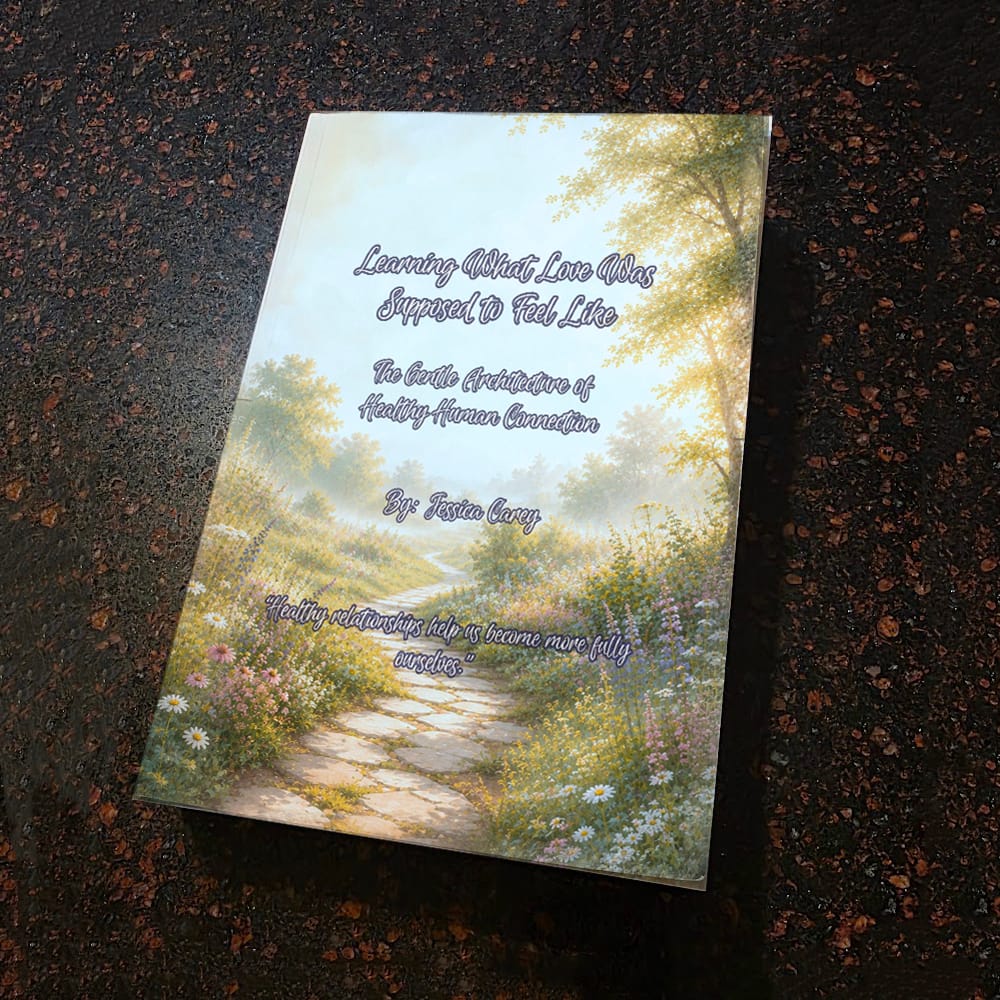
I had spent much of my life being told that harmful, coercive, controlling, neglectful, or abusive behavior was love.
I was told that family should be accepted no matter what it did.
Boundaries were interpreted as cruelty.
Truth-telling was called negativity.
Distance was treated as hatred.
I needed to separate the word love from everything people had used it to excuse.
Jennette and I have different stories.
Her memoir belongs to her, just as my story belongs to me, but both works confront a similar cultural lie: a parent’s declaration of love does not automatically define the child’s experience of that love.
The child is also a witness.
Their body remembers whether the environment felt safe.
Their nervous system records what the family narrative omits.
Their adult life may reveal the cost of adaptations everyone praised when they were young.
When that child eventually finds language for what happened, their honesty should not be mistaken for hatred.
Sometimes the title that sounds cruel from the outside is the first sentence the survivor has ever written without protecting the person who hurt them.
Sometimes anger is not evidence that healing has failed; it is evidence that the survivor has finally recognized that what happened was unacceptable.
Sometimes relief is not heartlessness; it is the experience of danger ending.
And sometimes telling the truth about a parent is not an attempt to destroy the family; it is the moment the child stops allowing the family’s story to destroy them.
 Jessica Carey

What Children Are Owed From the Adults Around Them
Children do not need perfect parents.
No adult will respond flawlessly in every moment.
Parents become tired, overwhelmed, frightened, impatient, distracted, and uncertain.
They misunderstand what a child is communicating.
They repeat patterns they have not yet recognized.
They make decisions that later prove unhelpful or harmful.
Perfection is impossible, but safety, curiosity, accountability, and repair are not unreasonable expectations.
Children deserve adults who remember that a child is a person—not property, a project, an emotional support system, a second chance at an abandoned dream, or evidence of the adult’s success.
They deserve the freedom to become someone their parents did not script in advance.
That means a child should be able to possess:
- interests that differ from the family’s;
- emotions that inconvenience the adults;
- boundaries that are respected;
- age-appropriate privacy;
- developing bodily autonomy;
- needs that cannot always be expressed perfectly;
- relationships outside the family;
- opinions that evolve;
- and dreams that belong to them.
A child should not have to perform happiness to prove that the parenting is good.
They should not have to become exceptional to earn attention.
They should not be required to manage an adult’s emotions before anyone responds to theirs.
They should not be made responsible for preserving the family’s reputation, mediating parental conflicts, raising younger siblings, or absorbing harm so everyone else can remain comfortable.
Most importantly, they should be allowed to say no.
A child’s autonomy is necessarily different from an adult’s.
Caregivers must make decisions about safety, health, education, and development that children may not fully understand or appreciate.
But parental responsibility is not unlimited ownership.
There is a difference between requiring a child to receive necessary medical care and violating their body because the adult feels entitled to it.
There is a difference between teaching household responsibility and making a child carry adult duties.
There is a difference between offering guidance and demanding that the child surrender their identity.
Healthy authority remains accountable to the child’s well-being.
It does not interpret every boundary as defiance.
It does not make obedience the sole measure of goodness.
It does not insist that the adult’s intention determines whether the child was harmed.
When children begin changing in concerning ways, adults also owe them curiosity.
If a child suddenly withdraws, becomes aggressive, stops attending school, uses substances, loses interest in activities, becomes intensely fearful, develops unusual eating behaviors, appears constantly exhausted, or undergoes another significant behavioral change, the first question should not be: how do we make this behavior stop inconveniencing us?
It should be: what is this behavior communicating?
That does not mean assuming abuse in every case.
Children can struggle for many reasons, including disability, bullying, illness, grief, social difficulties, academic pressure, mental-health conditions, developmental changes, family instability, or experiences they do not yet know how to describe.
The point is not to decide the answer in advance; the point is to investigate with care.
Adults should ask:
- What changed?
- When did it begin?
- Where does the child feel safer or less safe?
- What happens before and after the behavior?
- Is anyone controlling, frightening, humiliating, threatening, or violating them?
- Are sensory, developmental, medical, emotional, or accessibility needs being missed?
- Has the child tried to explain something that adults dismissed?
- What support might help without treating the child as the entire problem?
Behavior is information.
It may not tell us the complete story, but it should not be treated only as misconduct to suppress; this responsibility extends beyond parents.
Teachers, relatives, coaches, directors, medical professionals, neighbors, religious leaders, and other adults may notice things that a child’s caregivers ignore or conceal.
They may see a child regularly enough to recognize a change in demeanor, energy, eating, attendance, emotional regulation, hygiene, injuries, or social behavior.
They should not become amateur detectives who leap to conclusions, but neither should they celebrate, punish, or explain away concerning behavior without becoming curious about its source.
In Jennette McCurdy’s case, many adults saw pieces of what was happening.
They saw a nervous child being pushed through an adult industry.
They saw intense performances, anxiety, physical changes, and a mother exercising extraordinary involvement and control.
Different people may not have known the whole story, and some may have possessed only fragments that did not appear alarming in isolation.
But when adults share responsibility for a child, someone must be willing to connect the fragments.
Someone must ask the question that could disrupt the successful production: is this child okay?
The entertainment industry is an especially visible example, but the same failure occurs in ordinary communities.
A school may praise a child’s perfect attendance without asking why they are terrified to remain home.
A church may celebrate obedience without noticing fear.
A family may admire maturity without acknowledging parentification.
A coach may reward endurance while ignoring injury.
A teacher may punish incomplete work without investigating exhaustion, disability, neglect, or chaos outside the classroom.
Institutions often respond to what children produce.
Care asks what producing it costs them.
When harm does occur, children are owed more than an explanation of the adult’s intention.
They deserve an apology that names what happened:
- I frightened you.
- I ignored what you were telling me.
- I gave you a responsibility that belonged to an adult.
- I pressured you after you said no.
- I cared more about the appearance of the family than your experience within it.
They deserve repair where repair is possible.
They deserve changed behavior.
They deserve adults who seek support rather than demanding that children absorb untreated trauma indefinitely.
An apology cannot undo every injury; trust may not return immediately—or at all.
But accountability teaches a child something essential: your experience matters enough to change me.
That is profoundly different from: my intentions matter more than what happened to you.
Children also deserve adults who will believe them without requiring impossible proof.
Listening does not mean accepting every statement without thought, context, or investigation.
Memories can be incomplete, and children can misunderstand situations just as adults can.
But skepticism should not begin from the assumption that the adult is credible and the child is defective.
A child should not have to build a legal case before anyone becomes concerned; they should not need multiple witnesses, visible injuries, perfect recall, calm delivery, or language far beyond their age before their distress deserves attention.
Sometimes their first disclosure will be indirect.
It may sound like:
- I do not want to go there.
- That person is weird.
- My stomach hurts.
- I cannot sleep.
- Please do not leave me alone.
- I hate school.
- I want to stay in my room.
- I do not know why, but I feel scared.
Adults need enough patience to hear what may exist beneath the words.
Children deserve to be loved in ways that make them more fully themselves—not smaller, quieter, more useful, or easier to control.
They deserve protection without possession.
Guidance without humiliation.
Structure without fear.
Attention without exploitation.
Correction without contempt.
Freedom without abandonment.
And when adults fail, as all adults sometimes will, children deserve people willing to return, listen, take responsibility, and try again differently.
No child should have to become talented enough, troubled enough, silent enough, sick enough, or publicly broken enough before someone finally pays attention.
Sometimes the most important thing an adult can do is pause the performance, set aside the family story, and ask the child directly: what is happening to you?
Then remain present long enough to hear the answer.
Watch the Handstand
Perhaps loving a child begins with something both simple and difficult: pay attention.
Not only when they are succeeding.
Not only when they are misbehaving.
Not only when their pain becomes disruptive enough that it can no longer be ignored.
Pay attention when they quietly ask us to enter their world.
Watch the handstand.
Listen to the story about the turtle, even if we expected them to write about the library party.
Notice when the child who never causes trouble has become almost unnaturally quiet.
Ask why the responsible child believes they must manage everything alone.
Become curious when several children in the same home are expressing distress in different ways.
Look beneath the performance, the achievement, the compliance, the anger, the substance use, the withdrawal, and the family photograph.
Children do not always possess the language to say:
- I am overwhelmed.
- I am afraid of what happens when no one else is watching.
- I do not feel like my body belongs to me.
- I am carrying responsibilities that are too heavy for my age.
- I have learned that being perfect is the closest I can come to being safe.
- I need someone to believe me.
Sometimes they communicate through behavior because behavior is the only language their environment has left available.
That does not mean every struggle proves abuse or that adults should approach children with predetermined conclusions; it means distress deserves curiosity before condemnation.
Jennette McCurdy deserved adults who looked beyond what she could produce.
She deserved people who recognized that being talented did not mean she was safe, that earning money did not mean she had chosen her life, and that a mother’s declaration of love did not make every expression of that love healthy.
She deserved to be a child before she was expected to be a performer, provider, emotional regulator, or fulfillment of someone else’s dream.
I deserved that, too.
I deserved adults who understood that my silence was not proof that everything was fine.
I deserved to have my boundaries respected without being accused of hatred.
I deserved to leave an overwhelming, harmful room without being told I had ruined the celebration.
I deserved to be a child instead of a helper, referee, witness, messenger, scapegoat, and emotional container for adults who would not take responsibility for themselves.
My siblings deserved adults who became curious about their distress rather than dismissing, provoking, enabling, or punishing it.
The animals in our home deserved to have their fear and resistance recognized rather than laughed at, overridden, or renamed as enjoyment.
No vulnerable being should have to become violent, broken, or nearly destroyed before someone accepts that their boundaries were real.
None of us deserved what happened.
Saying that plainly is not self-pity.
It is not bitterness, hatred, or an attempt to remain trapped in the past.
It is moral clarity.
Children are not responsible for making adult behavior appear acceptable.
Survivors are not responsible for editing their histories until the people who failed them can listen comfortably.
Truth may create discomfort, but discomfort is not the same as harm; sometimes discomfort is the conscience recognizing that something should have been different.
This is why stories such as I’m Glad My Mom Died matter.
They interrupt the reassuring myth that every mother is safe, every family acts from love, every successful child must have been supported, and every estranged adult is simply ungrateful.
They give language to people who may have spent years believing that no one else would understand.
They also give the rest of society a choice.
We can recoil from the title and defend the sacred image of motherhood without examining the mother’s behavior or we can ask what a child must endure before relief at a parent’s death becomes possible.
We can criticize the survivor for breaking the silence or we can question the conditions that required silence in the first place.
We can insist that family must be preserved at any cost or we can recognize that a family worth preserving should not require the destruction of one of its members.
Jennette’s book does not ask every reader to share her feelings about her mother; her feelings were shaped by a life only she lived.
The value of her honesty is not that it provides a universal instruction for how survivors should feel; it gives people permission to tell a complicated truth.
Some survivors grieve.
Some feel relief.
Some feel anger, longing, numbness, love, disgust, guilt, freedom, or several of those emotions at once.
Some forgive.
Some do not.
Some maintain distance.
Some attempt reconciliation.
No single emotional path proves that someone has healed correctly.
What matters is that survivors are permitted to experience their own lives without once again being forced to perform the response that makes everyone else comfortable.
For me, the image I keep returning to is not a television set, stage, family photograph, police report, or carefully constructed celebration.
It is Bingo attempting a handstand.
Everyone is busy around her; the party carries her name, yet she has almost disappeared inside it.
Then one person stops; Nana looks.
Bingo tries again, and this time someone remains present long enough to see her.
That moment cannot erase every previous disappointment.
One attentive person cannot single-handedly repair an entire harmful system, but being witnessed can give someone evidence that their inner world is real and that their joy, pain, effort, and existence matter.
Perhaps that is where change begins.
Not with another performance of family love.
Not with defending the adults’ intentions.
Not with demanding that the child become easier to celebrate.
It begins when someone notices that the person at the center of everything has gone missing.
It begins when we stop asking what a child can produce, absorb, conceal, or endure for us.
It begins when we ask:
- Who are you?
- What happened to you?
- What do you need?
- What are you trying to show me?
Then we listen without rewriting the answer.
Jennette deserved to be seen beneath the performance.
I deserved to be seen beneath the role my family assigned me.
Every child does.
Please watch the handstand.
 Jessica Carey

Questions for Reflection
- Were you seen as a separate person growing up, or primarily valued for the role you performed?
- Have you ever been publicly celebrated while feeling privately invisible?
- What childhood behaviors did adults praise or punish without asking what they might be communicating?
- Why does society sometimes react more strongly to a survivor’s honesty than to the experiences being described?
- Who paid attention when you needed to be seen?
- Is there someone in your life whose “handstand” you may need to stop and watch?
Want even more content about creativity and art?
Be sure to check out all of our creative chronicles!
If you'd like to see examples of my work, you can find some of my art and creations at Redbubble and Gumroad!
Looking to learn more about my recent journey?
Check out some of these articles:
-Hidden Gems for St. Louis Artists
-Hidden Gems for Autistic & Neurodivergent Adults
-I Wasn't Broken--I'm Burned Out
-What Chronic Autistic Burnout Actually Feels Like
-When You Had to Raise Yourself
-Building a Life from What Remains
 Jessica Carey