
Creating should not only belong to people with unlimited resources.
It should not only belong to people who can walk into an art store and buy every supply they need without worrying about the cost.
It should not only belong to people who already know the right people, live near the right opportunities, or have an established creative community.
Creativity belongs to everyone.
But sometimes there is a very real barrier between wanting to create and being able to create:
Access.
Art supplies can be expensive.
A single shopping trip can quickly add up.
Paint.
Brushes.
Markers.
Paper.
Canvas.
Clay.
Fabric.
Tools.
Equipment.
Storage.
Specialty materials.
For someone trying a new hobby, rebuilding after hardship, living on a limited income, dealing with disability, or simply trying to be more sustainable, the cost of creating can become overwhelming.
And one of the most frustrating things is hearing advice like: “Just ask around.”
Because while that advice can be true, it leaves out something important:
- How?
- Ask who?
- Ask where?
- What do you even say?
- How do you find resources when you do not already have resources?
This guide is for you if:
- You want to create but supplies feel financially out of reach
- You are rebuilding your creative practice after a difficult season
- You are trying a new medium and cannot afford hundreds of dollars upfront
- You care about sustainability and reducing waste
- You are overwhelmed by vague advice like “just network” or “ask around”
- You feel like everyone else has connections you were never given
You do not need to know the right people to begin. You can learn how to find resources, build relationships, and create your own connections one step at a time.
The Invisible Advantage of Having Connections
Many artists who seem incredibly resourceful have something that is not always visible:
A network.
Maybe they know an electrician who saves copper wire scraps.
Maybe their neighbor gives them leftover wood.
Maybe another artist lets them know when someone is clearing out a studio.
Maybe their family member works somewhere that regularly has unused materials.
Maybe they have spent years building relationships in creative communities.
Those connections are wonderful.
They are part of how communities work.
People helping people.
Resources being shared.
Materials finding new homes.
But what happens when someone is starting from zero?
What happens when someone moves to a new city?
What happens when someone does not come from a creative family?
What happens when someone has spent years isolated?
What happens when someone simply does not know where to begin?
The answer is not: “You’re out of luck.”
The answer is: You can learn how resourceful people think.
Because the secret usually is not that they magically found a hidden treasure chest.
The secret is that they learned where to look.
 Jessica Carey
Step One: Stop Looking for Products and Start Looking for Materials
This is one of the biggest mindset shifts in creative reuse.
Most of us are taught to think like shoppers.
We decide what we want.
We search for a store.
We buy the finished product.
For example: “I want to make jewelry.”
So we search: “Jewelry supplies.”
And where does that lead?
Usually:
- craft stores
- jewelry suppliers
- online shops
- specialty retailers
Those places can absolutely be useful.
But they are only one pathway.
Creative reuse requires a different question.
Not: “Where do I buy this?”
But: “Where does this material already exist?”
That single question changes everything.
A jewelry artist does not only need “jewelry supplies.”
They may need:
- metal
- wire
- beads
- stones
- chains
- interesting objects
Suddenly, the possibilities expand.
Copper wire might come from:
- old electronics
- cables
- electricians
- repair shops
- reuse centers
Beads might come from:
- broken jewelry
- thrift stores
- estate sales
- people cleaning out collections
Charms might come from:
- old keychains
- discarded accessories
- vintage items
A fiber artist does not only need “fabric.”
They need textiles.
That could mean:
- old clothing
- curtains
- sheets
- upholstery samples
- fabric remnants
- damaged items that can be transformed
A mixed media artist does not need a package labeled “mixed media supplies.”
They need interesting materials:
- paper
- metal
- texture
- images
- objects
- pieces with history
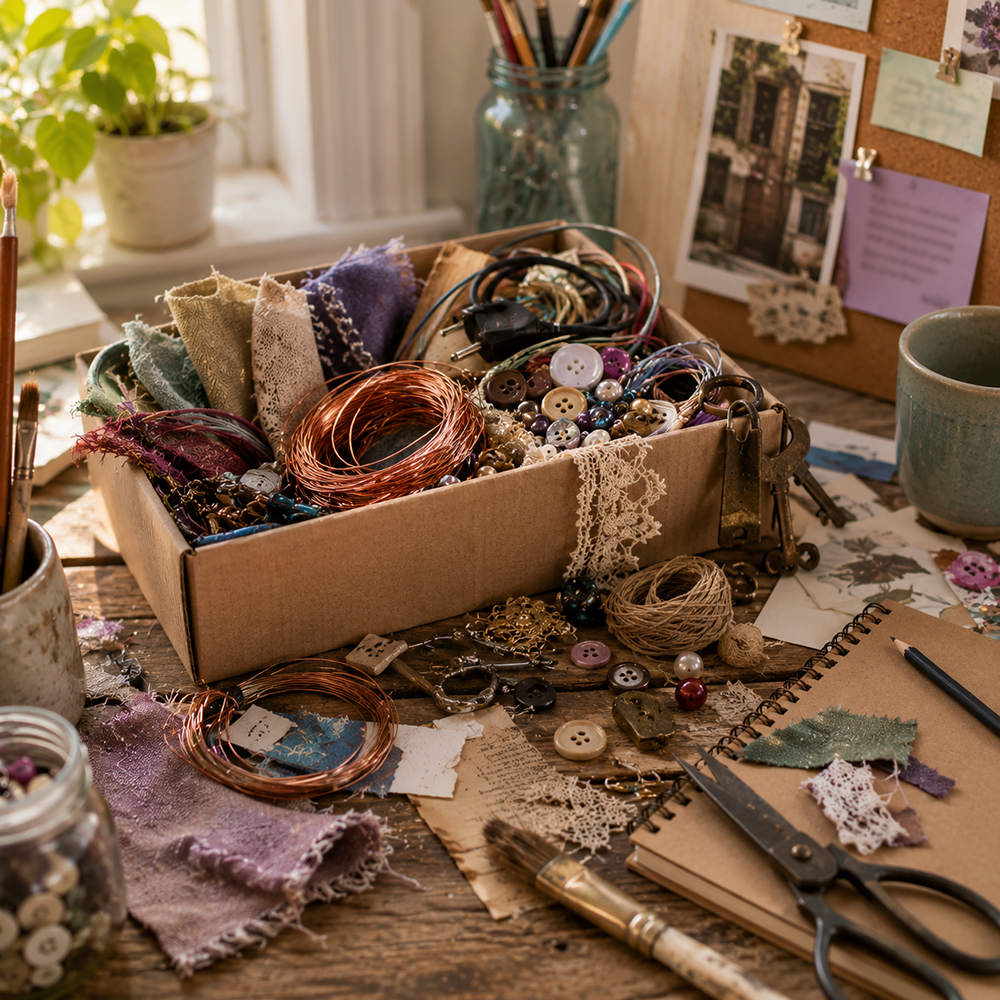
A forgotten box of buttons.
A broken watch.
A damaged book.
A scrap of lace.
A piece of hardware.
Things other people overlook can become part of something meaningful.
Step Two: Find the People Who Naturally Create Leftovers
A powerful question artists can ask is: “Who has leftovers of what I need?”
Because many materials become available at transition points.
Someone finished a project.
Someone moved.
Someone changed hobbies.
Someone upgraded equipment.
Someone cleaned storage.
Someone retired.
A business completed a job.
A school changed curriculum.
A company remodeled.
Those moments create resources.
The goal is learning where those moments happen.
 Jessica Carey
The Creative Resource Map
Instead of searching everywhere at once, think in circles.
Start with the easiest places first.
This prevents overwhelm.
Circle One: Places Already Designed for Reuse
Start here because these places already understand the mission.
You do not need to explain why you want random materials.
They already believe materials deserve another chance.
Search:
- “creative reuse center near me”
- “art supply thrift store”
- “craft supply resale”
- “reuse center”
- “maker supply swap”
Examples of what you may find:
- paint
- fabric
- yarn
- paper
- frames
- beads
- tools
- craft kits
- office supplies
- containers
- unusual objects
The important thing about reuse centers is understanding they are not traditional stores.
You usually cannot walk in with an exact shopping list.
Instead, think: “What possibilities are here today?”
Creative reuse is partly treasure hunting.
Circle Two: People Who Want Things Gone
The next easiest source is people already trying to remove clutter.
Their problem: “I have stuff I do not need.”
Your problem: “I need materials.”
That is a perfect match.
Places to check:
- Buy Nothing groups
- neighborhood groups
- Facebook Marketplace free section
- community boards
- local artist groups
But the secret is making specific requests.
Do not just say: “Does anyone have art supplies?”
Most people will think: “No.”
Because they are imagining paint tubes and canvases.
Instead say: “I’m creating upcycled jewelry and looking for broken jewelry, old cords, unwanted beads, or interesting small objects.”
Now people think: “Oh wait. I actually have something like that.”
Specific requests help people recognize resources they did not realize were resources.
Circle Three: Businesses With Useful Scraps
This is where you start creating the connections other artists already have.
Many businesses naturally create leftovers.
Not trash.
Not worthless materials.
Just things that no longer serve their original purpose.
The key is approaching the right businesses for the right materials.
Instead of asking random places, match your art form to their leftovers.
That is how you stop wasting energy knocking on doors unlikely to open.
Matching Materials With the People Who Have Them
Once you stop asking, “Where do I buy this?” and start asking, “Where does this material already exist?” an entirely different world of possibilities opens.
This is where you begin creating the connections that other people already have.
The goal is not to randomly ask every person and business you find.
That leads to frustration.
Instead, become curious:
- Who naturally interacts with this material?
- Who ends up with extra?
- Who replaces it?
- Who repairs it?
- Who removes it?
- Who collects it?
- Who throws it away?
That is where your search begins.
For Jewelry Artists: Finding Metal, Beads & Small Treasures
Jewelry is a perfect example of how creative reuse can completely change the way you think.
When someone says: “I need jewelry supplies,” most people immediately think: craft store.
But jewelry can come from so many places.
Copper Wire & Metal
Copper is commonly used in jewelry because it is beautiful, workable, and develops character over time.
But buying new copper wire can become expensive.
Instead, ask: “Who already uses copper?”
Potential sources:
- Electricians
- Electrical contractors
- Electronics repair shops
- Computer repair shops
- Appliance repair businesses
- Creative reuse centers
- Electronics recycling organizations
Electricians especially may end up with pieces that are not useful for professional jobs anymore.
A piece too short for wiring a house may still be plenty for earrings, pendants, wrapping stones, or experimenting.
The important distinction: You are usually not asking for valuable materials someone still needs.
You are asking: “Is there anything left over that would otherwise be discarded or recycled?”
 Jessica Carey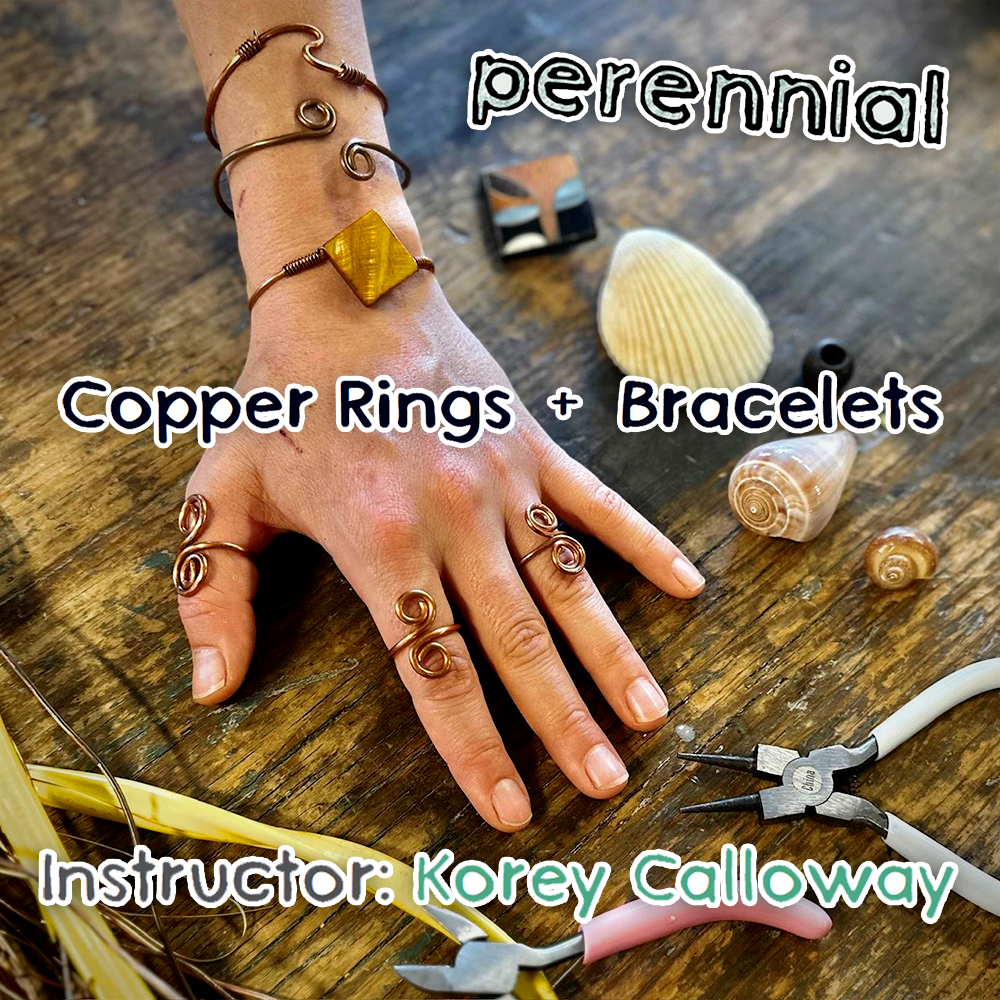
Broken Jewelry
Another overlooked resource: jewelry that already exists.
Search for:
- broken necklaces
- damaged bracelets
- single earrings
- outdated jewelry
- tangled jewelry lots
Places to check:
- thrift stores
- garage sales
- estate sales
- Buy Nothing groups
- family/friend cleanouts
Many people have jewelry boxes filled with pieces they no longer wear.
Maybe the clasp broke.
Maybe one earring disappeared.
Maybe it is no longer their style.
But an artist sees:
Beads.
Chains.
Charms.
Texture.
Color.
Possibility.
For Fiber Artists: Fabric, Yarn & Textiles
Fabric is another material hiding everywhere.
Instead of only searching: “fabric store,” ask: “Where does fabric already exist?”
Potential sources:
Thrift Stores
Look beyond the craft aisle.
Consider:
- clothing
- curtains
- blankets
- sheets
- tablecloths
- scarves
A large secondhand curtain might provide more fabric than buying a small piece new.
Upholstery Businesses
Furniture businesses often work with:
- fabric samples
- discontinued patterns
- remnants
- scraps
A tiny leftover piece that cannot cover a chair may be perfect for:
- quilting
- collage
- small sewing projects
- mixed media
Sewing & Quilting Communities
Many people who sew collect materials for years.
Sometimes they eventually:
- downsize
- move
- change hobbies
- clear storage
Connecting with creative communities can help those supplies find someone excited to use them.
For Painters: Canvases, Surfaces & Frames
Painters often think supplies have to come directly from an art store.
But painting surfaces are everywhere.
Look for:
- secondhand canvases
- old framed artwork
- wood panels
- furniture pieces
- cardboard
- reclaimed materials
Thrift stores frequently have old artwork.
You may not want the picture.
But you might want:
- the frame
- the canvas
- the backing
- the surface
For Mixed Media Artists: Everything Is Potential Material
Mixed media artists have perhaps the biggest playground.
Because the question changes from: “What is this supposed to be?”
to: “What could this become?”
Look for:
- buttons
- keys
- hardware
- maps
- books
- magazines
- packaging
- fabric scraps
- beads
- broken objects
- natural materials
A drawer someone cleans out could become an entire collection.
For Digital Creators & Creative Businesses: Finding Tools, Knowledge & Support
Not every creative resource is something you can hold in your hands.
Sometimes the thing a creator needs is not paint, fabric, or wire.
Sometimes it is:
- Access to technology
- A place to work
- Education
- Guidance
- Software
- Equipment
- Business knowledge
- Community
Digital artists, writers, photographers, content creators, and creative entrepreneurs may need different types of resources, but the same question still applies: “Where does this resource already exist?”
For technology access, look into:
- Libraries
- Community centers
- Makerspaces
- Universities or community programs
- Nonprofit organizations
Depending on your area, you may find access to:
- Computers
- Internet
- Printers
- Scanners
- Recording equipment
- Creative software
- Digital tools
For learning new skills, look for:
- Free library resources
- Online classes
- Workshops
- Community education programs
- Business development organizations
Learning how to photograph your artwork, build a website, market your creations, write descriptions, manage finances, or sell online are all creative resources too.
Sometimes the missing piece is not another supply.
Sometimes it is information.
For creative businesses, search:
- “small business resources near me”
- “entrepreneur support near me”
- “maker spaces near me”
- “free business workshops near me”
- “artist professional development”
Many communities have organizations designed to help people build skills, but those resources can be difficult to discover if you do not know the right words to search.
Just like physical materials, knowledge grows when shared.
A tutorial.
A workshop.
A conversation.
A helpful resource.
A piece of advice someone wishes they had known earlier.
Those things can become creative tools too.
 Jessica Carey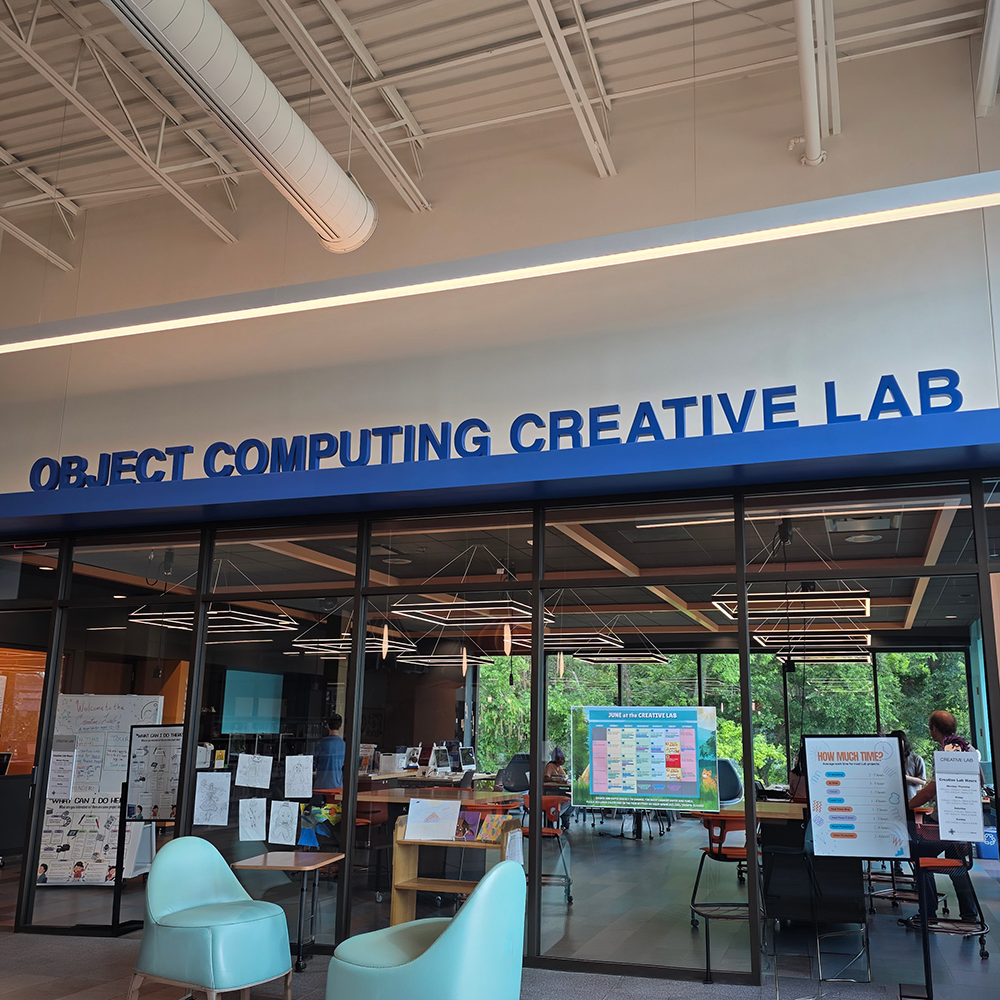
The Places People Forget to Check
Some of the best resources are overlooked because people do not think of them as “art places.”
But creativity does not only live in art stores.
Estate Sales
Estate sales can be incredible because they often represent decades of collected materials.
Look for:
- sewing rooms
- workshops
- garages
- craft rooms
- office supplies
- tools
Many lifelong creatives have accumulated beautiful supplies.
Estate sales help those materials continue their story.
Garage Sales
Especially near the end of the day, people often want items gone.
Craft supplies, old hobbies, and unfinished projects are common finds.
Libraries
Many libraries offer more than books.
Depending on location, they may have:
- craft programs
- maker spaces
- tool libraries
- equipment access
- community boards
- classes
Some libraries also offer free access to resources people do not realize exist, such as:
- online classes
- research tools
- creative software
- small business resources
- databases
- meeting rooms
- community connections
Libraries are often resource hubs hiding in plain sight.
Schools & Community Organizations
Teachers and organizations regularly sort through materials.
Possible resources:
- old classroom supplies
- craft materials
- paper
- organizational supplies
Always ask respectfully.
Organizations may have rules about donations or disposal.
But sometimes asking creates an opportunity they never considered.
The Real Secret: Think Like a Problem Solver
Finding materials is not about knowing everyone.
It is about learning how to follow the path.
Material → Person who uses it → Place it becomes extra → Opportunity for reuse
That is the pattern.
Once you learn that pattern, you can apply it almost anywhere.
How to Reach Out When You Don’t Know Anyone
Finding possible resources is only half of the process.
The next step is often the scariest:
Actually reaching out.
This is where many people get stuck.
They find a possible organization.
They discover a local business.
They see a community group.
And then the doubts begin:
- What if I bother them?”
- “What if this is a weird question?”
- “What if they think I’m asking for too much?”
- “What if they say no?”
Those feelings are common.
But something important to remember is:
A question is not a demand.
Asking gives someone an opportunity.
They can say yes.
They can say no.
They can point you somewhere else.
But if you never ask, the answer is automatically no because the conversation never happens.
Many opportunities begin with one simple question.
Change the Goal From “Getting Something” to “Creating a Connection”
One reason asking can feel uncomfortable is because people often imagine it as taking.
But creative reuse is different.
You are not simply asking: “What can someone give me?”
You are asking: “Is there something that already exists that could be given another purpose?”
That is a completely different exchange.
Many people feel guilty throwing things away.
They have supplies sitting unused.
They have materials taking up space.
They have items they always meant to do something with.
Sometimes people are actually relieved when someone says: “I can use that.”
Because now the item gets a second life.
How to Contact a Business
When contacting a business, keep your message:
- friendly
- clear
- specific
- respectful
Do not make someone guess what you need.
For example: “Do you have anything for artists?” is difficult to answer.
The person may think: “No, we are an electrical company.”
But: “I create upcycled copper jewelry and was wondering if you ever have small leftover pieces of wire from projects that cannot be used professionally anymore but could be repurposed into artwork?”
That creates a picture.
Now they understand what you are looking for.
Example Message for Businesses
“Hello,
My name is ______ and I am a local artist who creates ______.
I am working on using more reclaimed materials and reducing waste whenever possible.
I was wondering if your business ever has leftover ______ that is too small, damaged, or no longer useful for your projects but could potentially be reused for artwork.
If not, no worries at all. I appreciate your time and would also be grateful if you know of another resource that might be a better fit.
Thank you!”
Why That Last Sentence Matters
The sentence: “Do you know of another resource that might be a better fit?” is one of the most powerful questions you can ask.
Why? Because people have networks.
Maybe that person cannot help.
But they know someone.
Maybe the electrician already recycles everything.
But they know another contractor.
Maybe the store cannot donate supplies.
But they know an organization that does.
This is how connections grow.
Not usually through one magical yes.
But through a trail of breadcrumbs.
What To Do When Someone Says No
You will hear no sometimes.
Everyone does.
A no does not necessarily mean:
- “You asked the wrong question.”
- “This was embarrassing.”
- “You should stop trying.”
Sometimes no simply means:
Wrong timing.
Wrong person.
Wrong organization.
Wrong situation.
A business might say no because:
- they already recycle materials
- they have company policies
- they cannot give materials away
- they do not currently have extras
- they are busy
That is okay.
The goal is not a 100% success rate.
The goal is finding the right matches.
Keep a Resource List
One difference between people who “have connections” and people who do not is organization.
People with connections often have information stored naturally:
- “My neighbor does woodworking.”
- “My cousin knows someone.”
- “My friend works there.”
When you are building your own network, write things down.
Create a simple resource list:
Contact:
Who did you talk to?
Resource:
What materials might they have?
Response:
What did they say?
Follow-Up:
Should you check again later?
Example:
Name:
ABC Electric
Material:
Copper wire scraps
Response:
Sometimes available
Follow-up:
Check every few months
Over time, this becomes your personal creative resource map.
You are no longer starting from zero every time.
Avoiding Research Overwhelm
One of the biggest mistakes people make when searching for resources is trying to find everything at once.
You start researching.
You open twenty tabs.
You find fifty possibilities.
Suddenly, instead of feeling excited, you feel exhausted.
Too many choices can become just as overwhelming as having no choices.
Try making the process smaller.
The Three-Door Method
Instead of contacting every possible resource:
Pick three doors.
That’s it.
For example, if you need copper wire:
Door 1: Creative reuse center
Door 2: Local electrician
Door 3: Buy Nothing group
Try those.
Wait.
See what happens.
Then choose three more.
You are not trying to solve your entire creative future in one afternoon.
You are following one breadcrumb at a time.
Make Your Requests Easy to Answer
Another helpful tip:
Give people a simple yes/no question.
Instead of: “I’m looking for materials and wondered if you have any ideas?” (which requires them to do the thinking)
Try: “I’m looking for leftover copper wire. Is that something your business ever has?”
Specific questions are easier to answer.
And easier questions get more responses.
Building Community Through Sharing
One beautiful thing about creative resources is that they multiply when shared.
Maybe someone gives you fabric scraps.
You use some.
Another artist needs fabric.
You share the extra.
Maybe someone tells you about a reuse center.
You tell another creator.
Maybe you discover an opportunity.
You pass it along.
That is how creative communities grow.
One connection becomes many.
One resource helps multiple people.
One open door leads to another.
When resources have been hard to find, it can be tempting to hold onto everything because you worry you may never find support again.
Keep what genuinely supports your creativity, but remember that community grows through circulation.
The supplies you cannot use may become exactly what another creator needs.
The Hidden Skill Is Not Finding Stuff
At first, it seems like the goal is finding materials.
The copper.
The paint.
The fabric.
The tools.
But the deeper skill is learning how to connect.
How to ask.
How to notice.
How to see possibilities.
Because once you learn that, you are not limited to one resource list.
You can create new paths wherever you go.
The Creative Reuse Starter Map: Where to Look First
Sometimes having endless possibilities is not freeing.
Sometimes it is overwhelming.
When someone says: “You can find materials anywhere!” that may technically be true.
But it can also leave someone thinking: “Okay… where exactly do I start?”
A person with limited time, energy, money, transportation, or capacity may not be able to visit twenty places hoping something works.
They need somewhere realistic to begin.
Think of this section as a starting map.
Not every option will work every time.
Not every place will have what you need.
But these are pathways that can help you stop staring at endless possibilities and take the next step.
If You Need General Art Supplies
Looking for:
- Paint
- Brushes
- Markers
- Paper
- Craft supplies
- Drawing materials
- Random creative tools
Start with:
1. Creative Reuse Centers
Best first stop because these places already collect creative materials.
Search:
- “creative reuse center near me”
- “art supply thrift store”
- “craft supply resale”
These spaces often understand artists, makers, teachers, and creators.
2. Community Giving Groups
Try:
- Buy Nothing groups
- neighborhood groups
- local creative groups
Post what you are specifically looking for.
Many people have unfinished hobbies sitting in closets:
The painting supplies from a class they took once.
The craft kit they never opened.
The markers their kids outgrew.
The supplies from a project they finished years ago.
Unused does not mean useless.
3. Thrift Stores & Secondhand Shops
Look beyond the obvious craft section.
Explore:
- office supplies
- books
- frames
- containers
- fabric
- household items
Creative supplies do not always look like creative supplies yet.
If You Need Jewelry Supplies
Looking for:
- Wire
- Beads
- Charms
- Chains
- Findings
- Small decorative objects
Start with:
1. Broken or Unwanted Jewelry
One of the easiest resources.
Look for:
- thrift store jewelry bags
- estate sales
- garage sales
- community groups
One broken necklace may become several new pieces.
2. Electronics & Repair Sources
For materials like copper wire, look into:
- old cords
- outdated electronics
- computer repair shops
- electronics recyclers
- electricians
Ask specifically about: “small leftover pieces that cannot be used professionally but could be reused for artwork.”
3. Family, Friends & Community Requests
Many people have:
- broken jewelry
- tangled necklaces
- single earrings
- old accessories
- unused pieces
They may never think to offer them because they do not realize artists can transform them.
If You Need Fabric or Fiber Materials
Looking for:
- Fabric
- Yarn
- Thread
- Sewing supplies
- Textiles
Start with:
1. Thrift Stores
Check:
- clothing
- sheets
- curtains
- blankets
- scarves
Think about the material, not the original purpose.
2. Sewing Communities
Try:
- quilting groups
- sewing groups
- online communities
Many fiber artists eventually have extra supplies.
The joke about having a “fabric stash” exists for a reason.
3. Estate Sales
Estate sales can be incredible for:
- sewing machines
- fabric collections
- thread
- patterns
- tools
Sometimes you are discovering materials collected over an entire lifetime.
If You Need Wood or Building Materials
Looking for:
- Wood pieces
- Frames
- Hardware
- Furniture parts
- Building materials
Start with:
1. Reuse Building Stores
Look for:
- Habitat ReStores
- architectural salvage stores
- building reuse centers
Possible finds:
- wood
- tile
- hardware
- fixtures
- doors
- furniture pieces
 Jessica Carey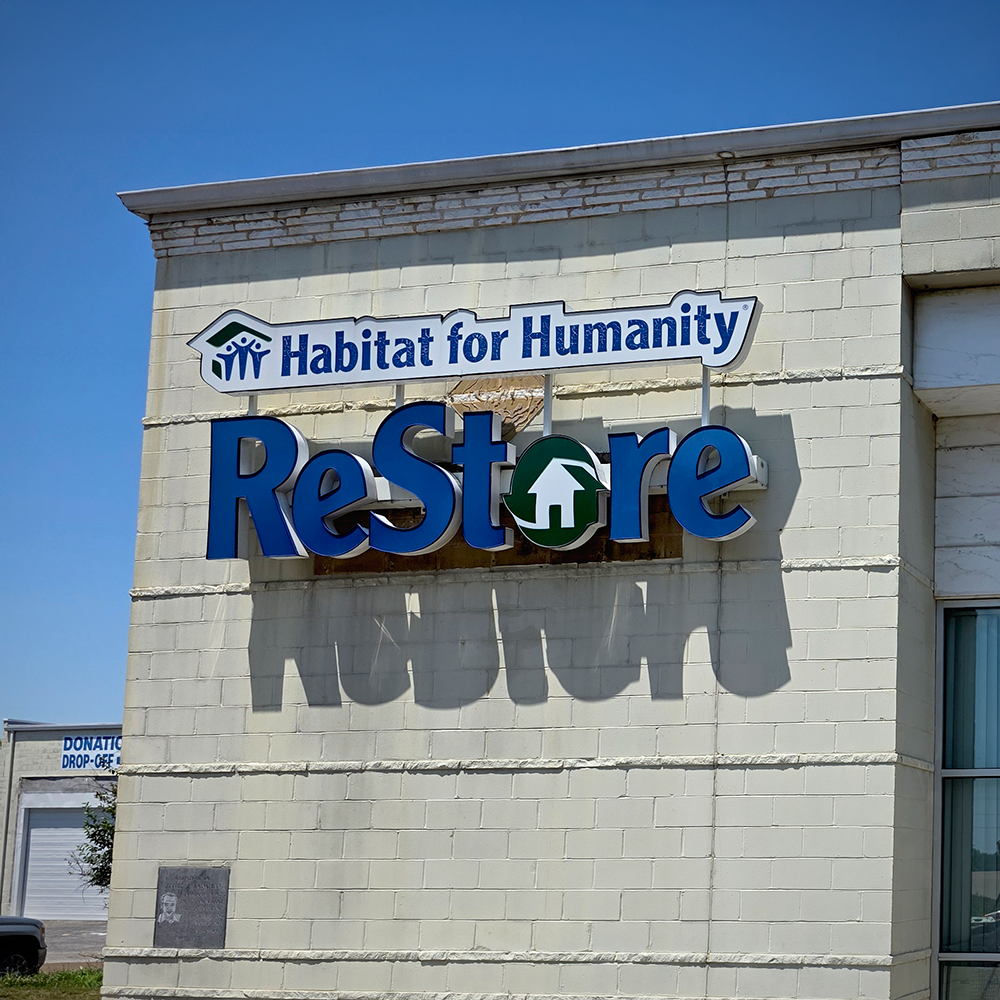
2. Woodworking Businesses
Try:
- cabinet makers
- furniture makers
- woodworking shops
Ask about:
- scraps
- cutoffs
- leftover pieces
Pieces too small for furniture may be perfect for art.
3. Community Giveaways
People often give away:
- old furniture
- shelves
- leftover project materials
Especially after moves or renovations.
If You Need Paper Materials
Looking for:
- Collage supplies
- Journaling materials
- Mixed media paper
- Decorative paper
Start with:
1. Secondhand Sources
Look for:
- old books
- magazines
- calendars
- maps
- greeting cards
2. Offices & Print Sources
Depending on availability, some places may have:
- paper scraps
- outdated samples
- misprints
Always ask first.
3. Community Groups
Many people have:
- scrapbooking supplies
- stickers
- paper collections
- stationery
that they no longer use.
If You Need Containers & Organization Supplies
One overlooked expense of creativity:
Storage.
Once you collect supplies, you need somewhere to put them.
Look for:
- jars
- boxes
- drawers
- shelves
- organizers
Try:
- thrift stores
- community giveaways
- reuse stores
- garage sales
A fancy storage system is not required to begin.
Sometimes a reused jar works perfectly.
What Not to Waste Your Limited Energy On
Resourcefulness does not mean exhausting yourself.
If you are spending more time searching for supplies than creating, adjust.
Remember: the goal is creativity.
Not endless hunting.
Give yourself limits:
- “I will check three places.”
- “I will ask three people.”
- “I will search for one hour.”
Then create with what you have.
Free Is Wonderful, But Your Time Matters Too
Sometimes the cheapest option financially is expensive in another way.
Driving across town for a tiny amount of supplies may not actually save you much.
Searching for weeks for the perfect free item may keep you from starting.
Balance matters.
Creative reuse is about possibility.
Not pressure.
Start With What Is Closest
The best resource is often not the “perfect” resource.
It is the one you can actually access.
The nearby thrift store.
The neighbor giving something away.
The library down the street.
The community group you can join today.
Small doors still open.
And sometimes small doors lead somewhere incredible.
 Jessica Carey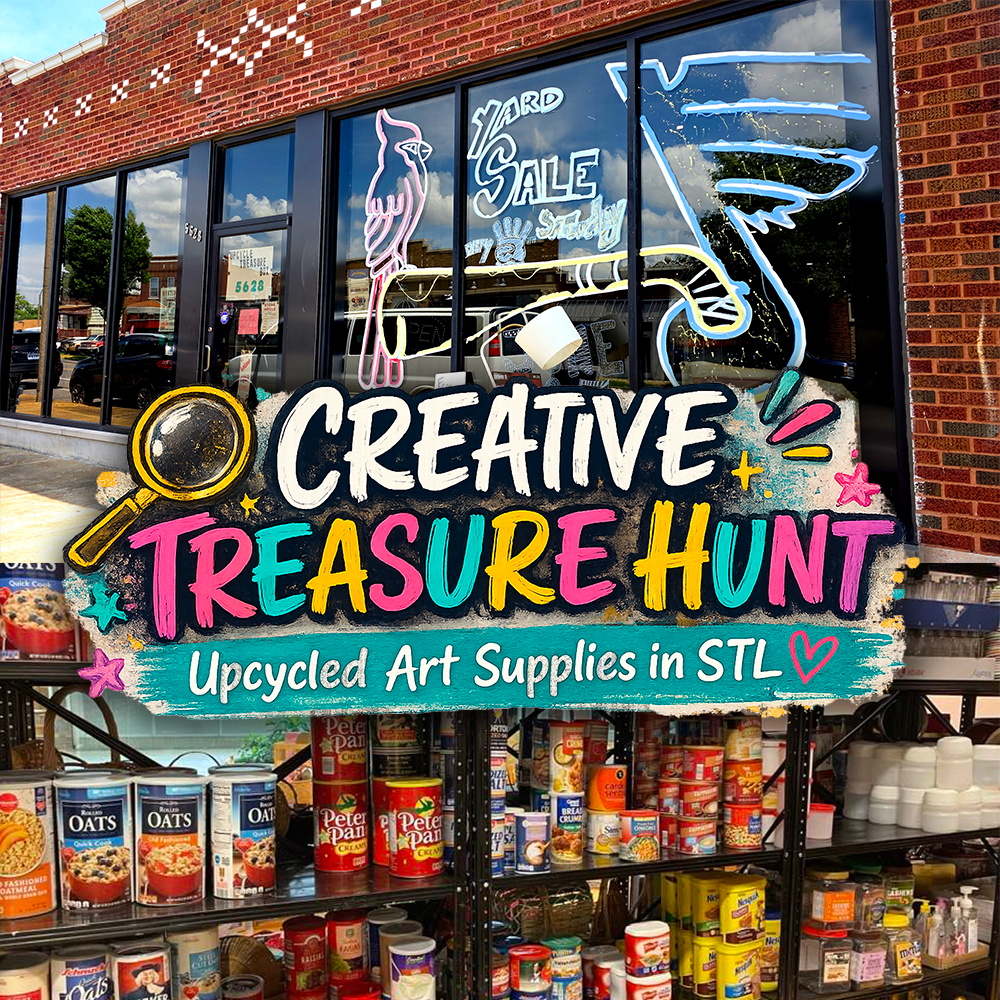
Creating Safely & Respectfully With Reclaimed Materials
Creative reuse is about seeing possibilities.
But it is also about being thoughtful.
Before using salvaged materials, take time to make sure they are safe and appropriate for your project.
Depending on what you are working with:
- Clean materials before use
- Research unfamiliar materials
- Wear protective equipment when needed
- Be careful when cutting, sanding, or altering objects
- Avoid using unknown materials in ways that could create safety concerns
- Ask before taking materials from businesses, organizations, or private property
Be especially mindful with:
- unknown chemicals
- old painted materials
- electronics components
- materials that create dust when sanded
- items that may contain sharp edges, rust, mold, or residue
Reusing materials is wonderful, but protecting yourself matters too.
Respect is part of creative reuse.
Respect for people.
Respect for materials.
Respect for the environment.
The goal is not simply finding free things.
The goal is creating a cycle where resources are valued instead of wasted.
Build Your Creative Resource Network One Connection at a Time
When you first start looking for resources, it can feel like everyone else already knows something you do not.
They know the right places.
They know the right people.
They know where opportunities are hiding.
But remember: most people were not handed every connection at once.
They built them slowly.
One conversation.
One class.
One community event.
One question.
One shared resource.
That is how networks grow.
Maybe today you discover a creative reuse center.
Maybe that leads you to a workshop.
Maybe that workshop introduces you to another artist.
Maybe that artist tells you about a supply swap.
Maybe that supply swap introduces you to another opportunity.
A path that changes your life might start with something incredibly small.
Share What You Find
One of the most beautiful parts of creative communities is that resources multiply when they are shared.
If you find an amazing place, tell someone.
If you discover a helpful organization, share it.
If you learn about a grant, a workshop, a supply swap, or a hidden gem in your community, pass it along.
Because there is probably someone else looking for exactly what you found.
Someone else is typing searches into Google.
Someone else is wondering where to begin.
Someone else is feeling discouraged because every answer seems to require money, connections, or knowledge they do not have yet.
Your discovery might become their starting point.
Leave Breadcrumbs Behind
Sometimes finding resources feels like following a trail of tiny breadcrumbs.
One person mentions a place.
One website links to another.
One conversation opens a door.
One question leads somewhere unexpected.
But the problem is: not everyone finds the breadcrumbs.
Some people never discover the hidden resources around them.
Not because they do not care.
Not because they are not trying.
But because they simply never knew where to look.
That is why sharing information matters.
Every time you share what you learn, you leave another breadcrumb on the path.
You make the journey easier for someone walking behind you.
 Jessica Carey
Creativity Has Always Been About Transformation
At its heart, creativity is transformation.
Taking something ordinary and seeing something extraordinary.
A blank page becomes a story.
A ball of clay becomes a sculpture.
A pile of fabric becomes something meaningful.
A discarded piece of wire becomes jewelry.
Artists are possibility seekers.
We look at what exists and imagine: “What else could this become?”
Creative reuse is simply another expression of that same idea.
Start Where You Are
You do not need a perfect studio.
You do not need every supply.
You do not need unlimited money.
You do not need to know all the right people.
Start with curiosity.
Start with what you have.
Start with one question: “What possibilities already exist around me?”
Maybe that question leads you to a community group.
Maybe it leads you to a creative reuse center.
Maybe it leads you to someone who was hoping their unused supplies would find a new home.
Maybe it leads somewhere you never expected.
Feeling Overwhelmed? Start Here.
Today:
☐ Pick one project
☐ List the actual materials needed
☐ Choose your top three places to look
☐ Send one message or ask one question
☐ Write down what you discover
You are not finding every resource today.
You are finding the next breadcrumb.
Your Creativity Is Worth Supporting
Sometimes people hesitate to look for resources because they feel like creativity is not important enough.
They think:
- “It’s just art.”
- “It’s just a hobby.”
- “It doesn’t really matter.”
But creativity has always mattered.
Humans have always created.
We create during joyful times.
We create during painful times.
We create when we are trying to understand ourselves.
We create when we are trying to connect with others.
We create because imagination is part of being human.
Finding affordable supplies is not just about saving money.
It is about keeping creativity accessible.
Because someone’s ability to create should not disappear simply because they cannot afford expensive materials.
The World Needs More Creative Possibility
Somewhere, there is a box of supplies sitting unused.
Somewhere, there is a material about to be thrown away.
Somewhere, there is someone who would happily share what they have if they knew another person needed it.
And somewhere, there is an artist waiting for the chance to create.
The connection between those two things often starts with a simple question.
A conversation.
A shared resource.
A willingness to see value where others may not.
So keep creating.
Keep exploring.
Keep asking.
Keep sharing what you discover.
The world already has so many hidden possibilities waiting to be found.
Sometimes creativity begins when someone finally sees them.
Want even more content about creativity and art?
Be sure to check out all of our creative chronicles!
If you'd like to see examples of my work, you can find some of my art and creations at Redbubble and Gumroad!
Looking to learn more about my recent journey?
Check out this article:
-Hidden Gems for Autistic & Neurodivergent Adults
-I Think I Might Be Autistic... Now What?
-I Wasn't Broken--I'm Burned Out
 Jessica Carey