
Sometimes creativity begins with the simplest question: “What could this become?”
A piece of scrap fabric.
An old magazine.
A leftover bead.
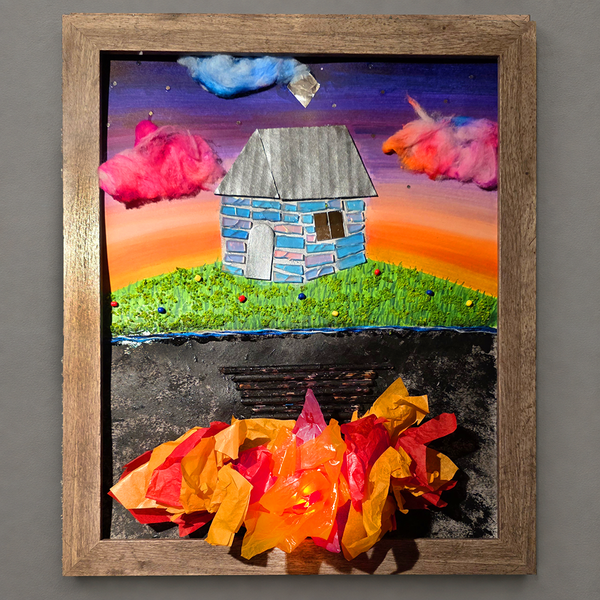
A forgotten frame.
A piece of electrical wire.
At first glance, these materials may not seem exciting. They may look ordinary, outdated, broken, or like something that has reached the end of its purpose.
But creativity has a beautiful way of seeing possibility where others might see waste.
A piece of fabric can become part of a quilt.
A discarded book can become a journal.
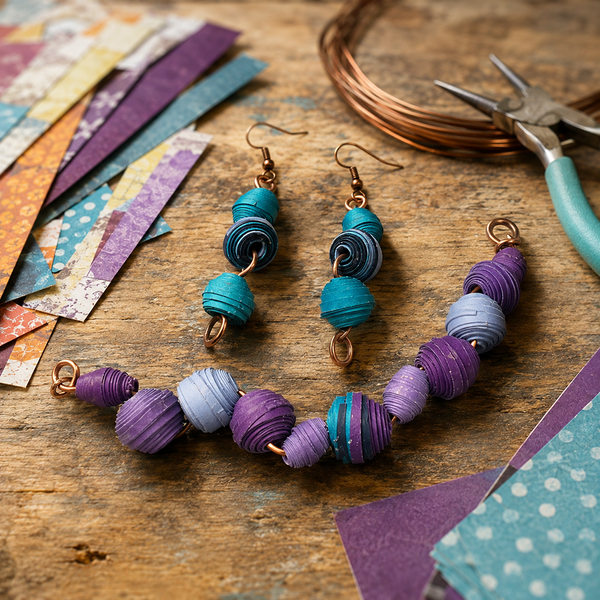
Scraps of paper can become handmade beads.
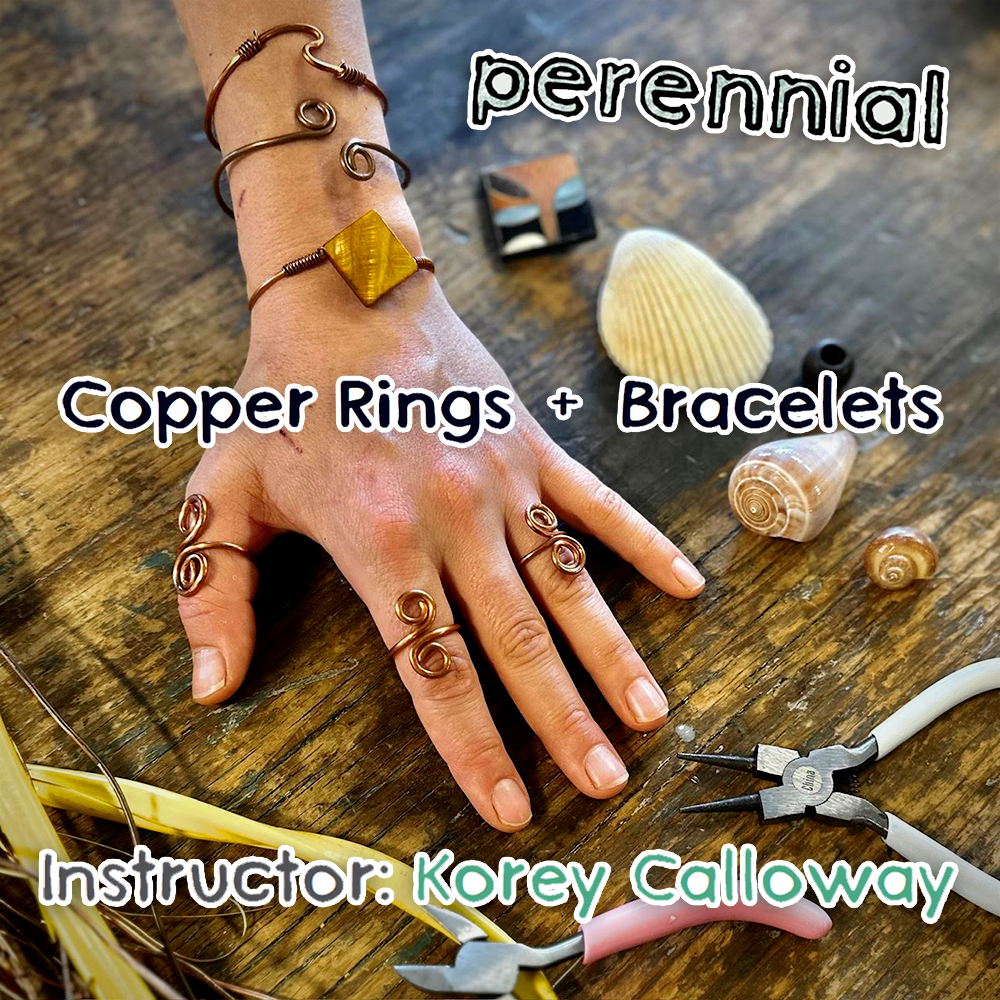
A piece of copper wire hidden inside electronics can become a ring wrapped around someone’s finger.
Sometimes creativity is less about having the newest or most expensive supplies and more about learning to see the world differently.
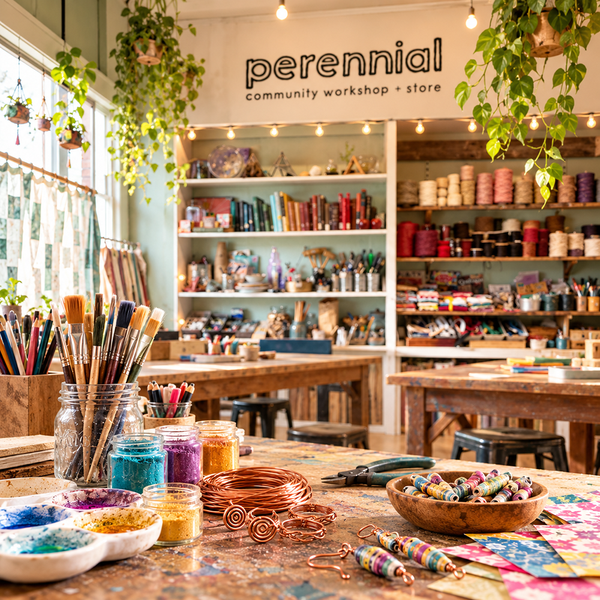
That is one of the reasons I was so excited to visit Perennial in St. Louis, Missouri.
I love finding hidden gems that make creativity feel more accessible. Places that remind people that art is not only for those with expensive supplies, professional studios, or years of experience.
As someone with a background in art education, I have always loved exploring different materials and helping people discover that creativity does not have to fit inside one specific box.
Recently, I’ve been exploring more local resources around St. Louis that make creativity accessible, affordable, and community-centered. That journey led me to Perennial.
Creativity belongs to everyone.
And Perennial beautifully embodies that idea.
 Jessica Carey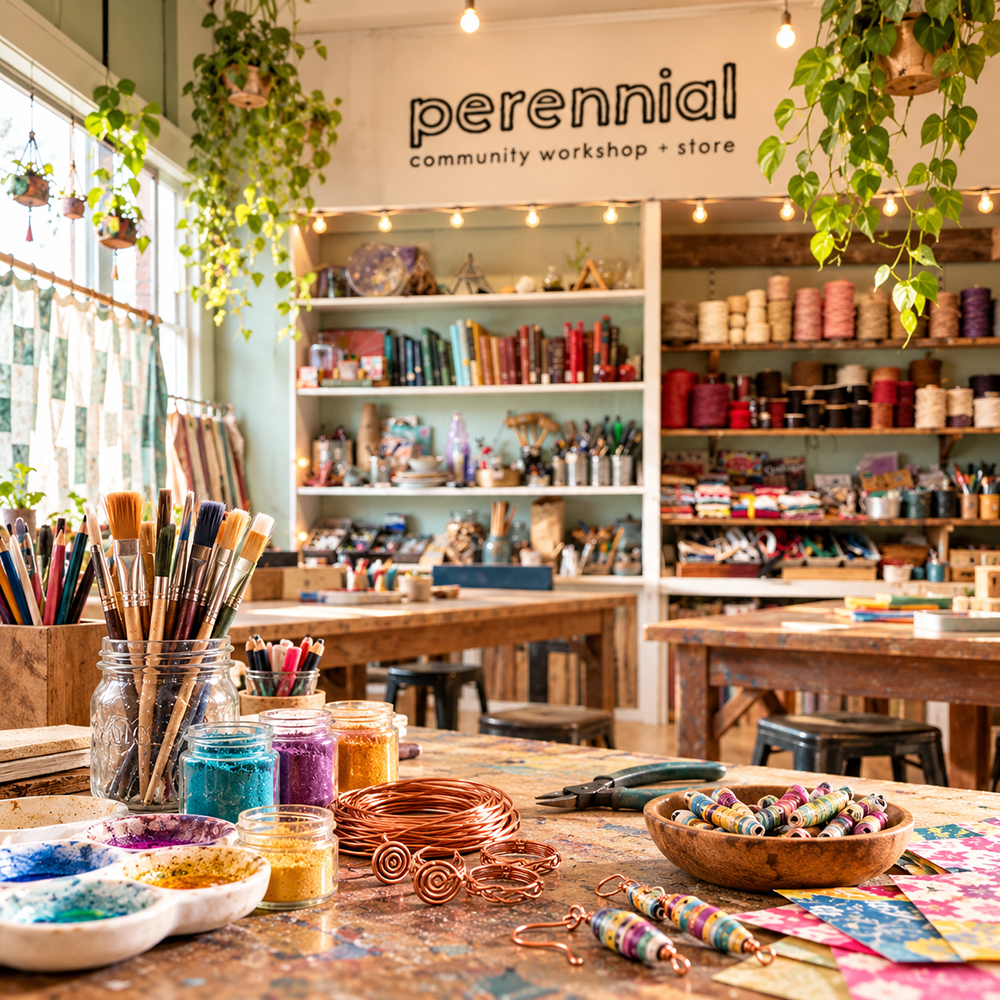
What is Perennial?
Perennial is a nonprofit creative reuse organization located in St. Louis, Missouri.
Their work focuses on sustainability, creativity, education, and giving discarded materials another chance.
Rather than looking at unwanted items and asking: “Should we throw this away?”
Creative reuse asks: “What else could this become?”
It is a simple question, but it completely changes how we interact with the materials around us.
Many traditional recycling processes involve breaking materials down so they can eventually become something new. Creative reuse focuses on taking existing materials and finding creative ways to transform them.
It celebrates imagination.
It invites experimentation.
It encourages people to look closer.
An object does not always lose its value just because it is no longer serving its original purpose.
Through their reuse shop, workshops, classes, and community programs, Perennial helps people develop skills while keeping usable materials from going to waste.
For artists, makers, crafters, DIY enthusiasts, teachers, and curious beginners, it is an incredible resource.
Perennial offers:
- Affordable secondhand creative supplies
- A creative reuse shop
- Classes and workshops
- Opportunities to learn hands-on skills
- Sustainable crafting education
- Community programs
- Inspiration for turning everyday materials into art
 Jessica Carey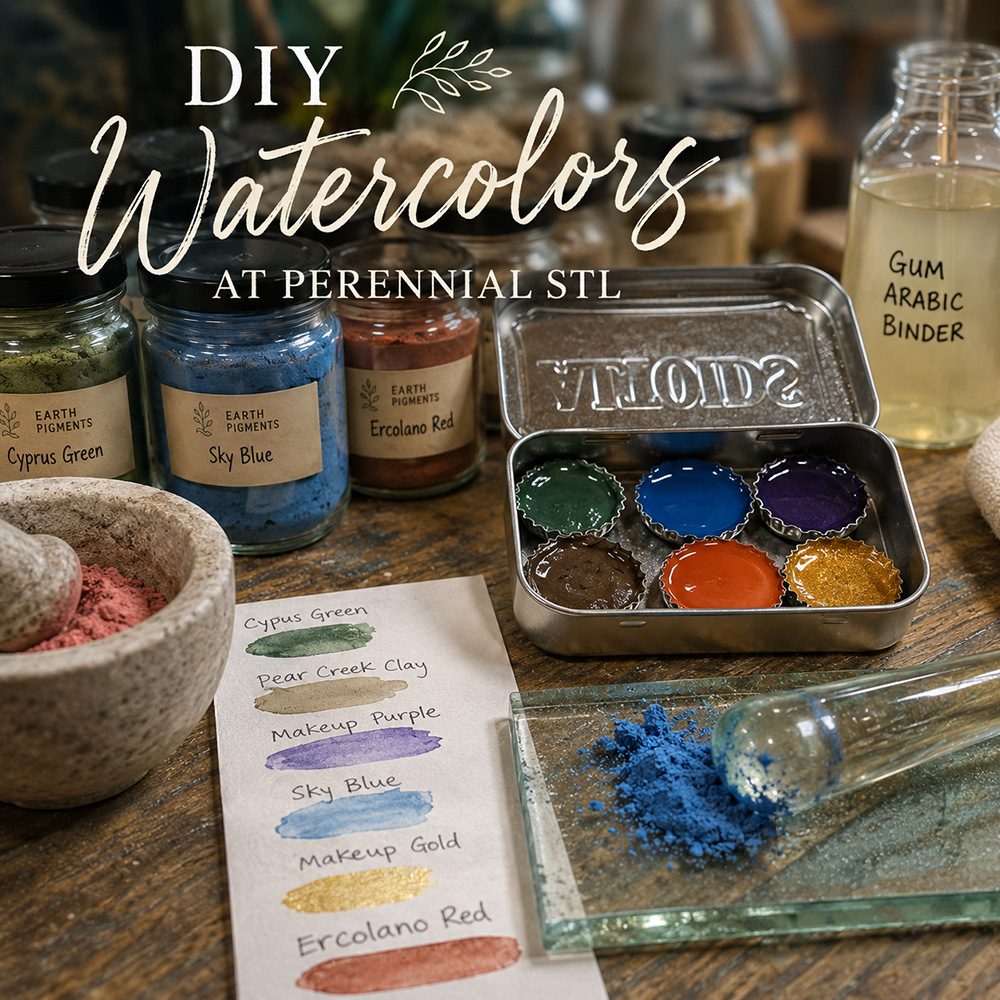
Their reuse shop carries a rotating selection of materials, meaning every visit can be a little different.
Depending on available donations, you may discover:
- Fabric
- Yarn
- Paper
- Frames
- Craft supplies
- Jewelry materials
- Tools
- Woodworking supplies
- Mixed media materials
- Unique odds and ends waiting for a new purpose
It feels a little bit like a creative treasure hunt.
Unlike a traditional art store where everything is neatly packaged and predictable, reuse centers invite curiosity.
You might not walk in knowing exactly what you will find.
Instead, you walk through asking: “What could I create with this?”
And sometimes those unexpected discoveries lead to the most interesting ideas.
 Jessica Carey
Why Creative Reuse Matters for Artists
One of the biggest barriers many people face when exploring creativity is cost.
Art supplies can get expensive quickly.
Trying a new hobby often comes with the pressure of buying all the “right” materials:
The right tools.
The right supplies.
The right equipment.
Before you know it, experimenting with something new can feel overwhelming.
Creative reuse helps remove some of those barriers.
Affordable secondhand materials give people permission to explore.
To test ideas.
To make mistakes.
To learn.
And honestly, mistakes are such an important part of creativity.
When every sheet of paper, every bead, every piece of fabric, or every material feels precious because of the cost, it can become harder to play.
Creative reuse encourages experimentation.
It reminds us that creativity is not about perfection.
It is about curiosity.
It is about problem-solving.
It is about discovery.
Quick Details: Upcycled Copper Rings + Bracelets Workshop
Interested in trying this workshop yourself? Here is a quick overview of the Copper Rings + Bracelets class:
Location:
Perennial
St. Louis, Missouri
Instructor:
Korey Calloway
Length:
Approximately 1.5 hours
Experience level:
Beginner friendly
Materials provided:
Yes! All materials were included.
Materials used:
- Salvaged copper electrical wire
- Beads
- Round-nose pliers
- Needle-nose pliers
- Wire cutters
- Wire strippers
Skills learned:
- Preparing salvaged copper wire
- Basic wire shaping
- Using jewelry tools
- Creating rings and bracelets
- Adding decorative elements
This workshop is a great opportunity to experiment with jewelry making without needing to purchase all the tools and supplies beforehand.
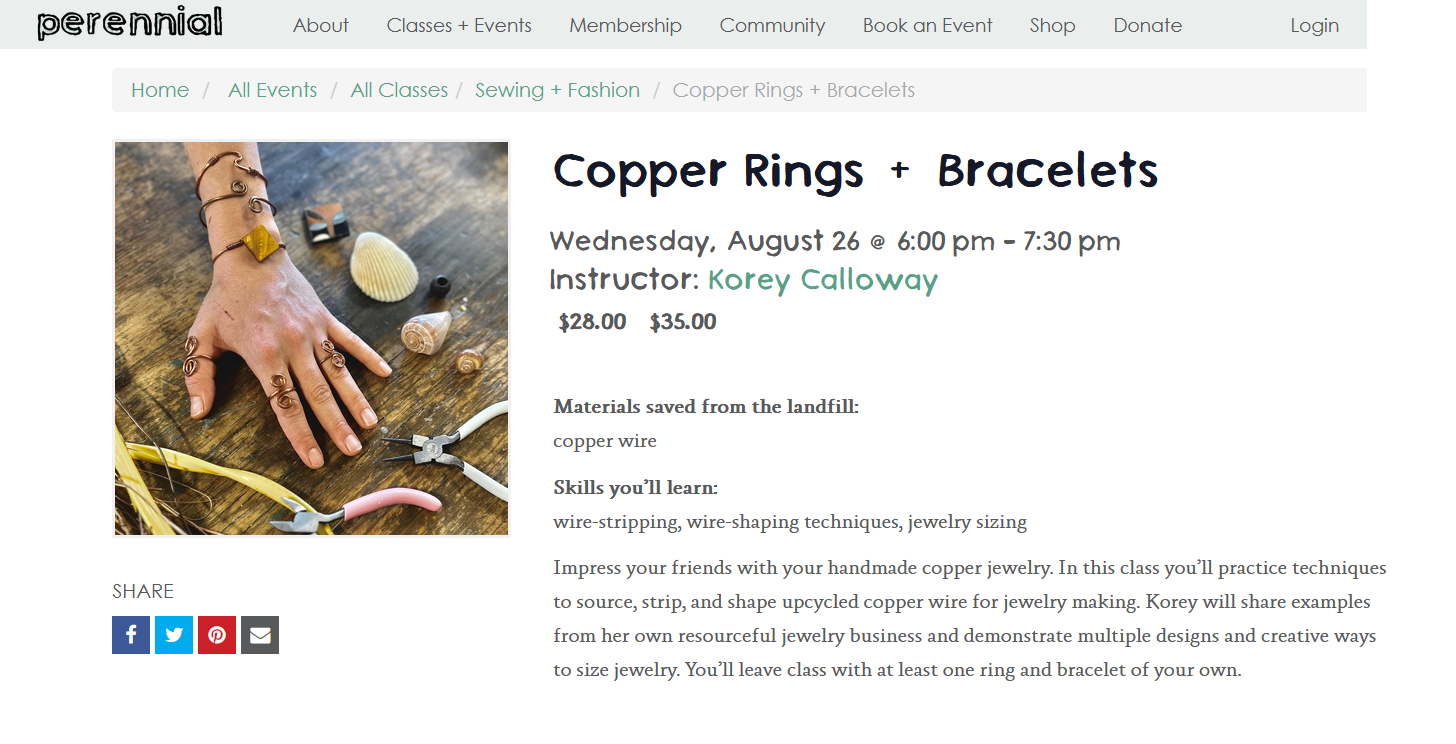
My Upcycled Copper Rings + Bracelets Workshop Experience
One of the classes that caught my attention at Perennial was their Upcycled Copper Rings + Bracelets workshop taught by instructor Korey Calloway.
The idea immediately interested me: taking salvaged copper electrical wire and transforming it into wearable art.
There was something really beautiful about that concept.
Electrical wiring is something many of us never think about.
It exists quietly behind walls, inside electronics, and throughout everyday life.
It is functional.
Practical.
Usually hidden.
But inside that ordinary material is beautiful copper waiting to become something completely different.
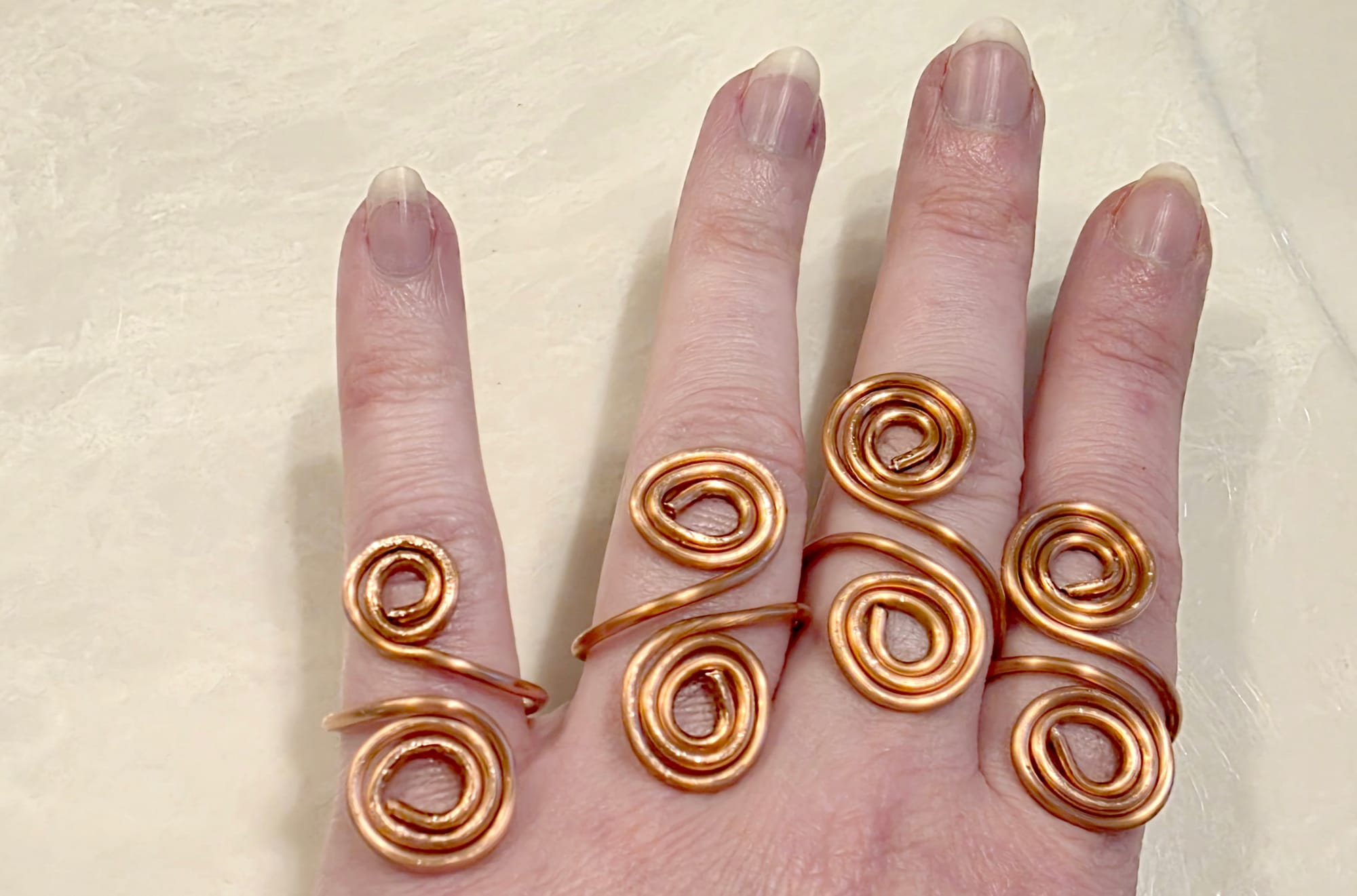
During the workshop, we learned how to take that salvaged wire and turn it into handmade rings and bracelets.
All materials were provided, including:
- Salvaged copper electrical wire
- Beads
- Round-nose pliers
- Needle-nose pliers
- Wire snips
- Wire strippers
One thing I appreciated about the class was that you did not need to arrive already knowing what you were doing.
Sometimes trying a new creative activity can feel intimidating.
You might wonder:
- “What if everyone else already has experience?”
- “What if I mess up?”
- “What if I’m not good at this?”
But spaces like this are designed for learning.
The whole point is exploration.
The Making Process: Turning Electrical Wire Into Jewelry
One of my favorite parts of the workshop was seeing the transformation happen step by step.
We started with salvaged electrical wiring.
At first glance, it looked exactly like what it was originally created to be: a practical material designed for function.
But hidden underneath the outer coating was copper waiting to be uncovered.
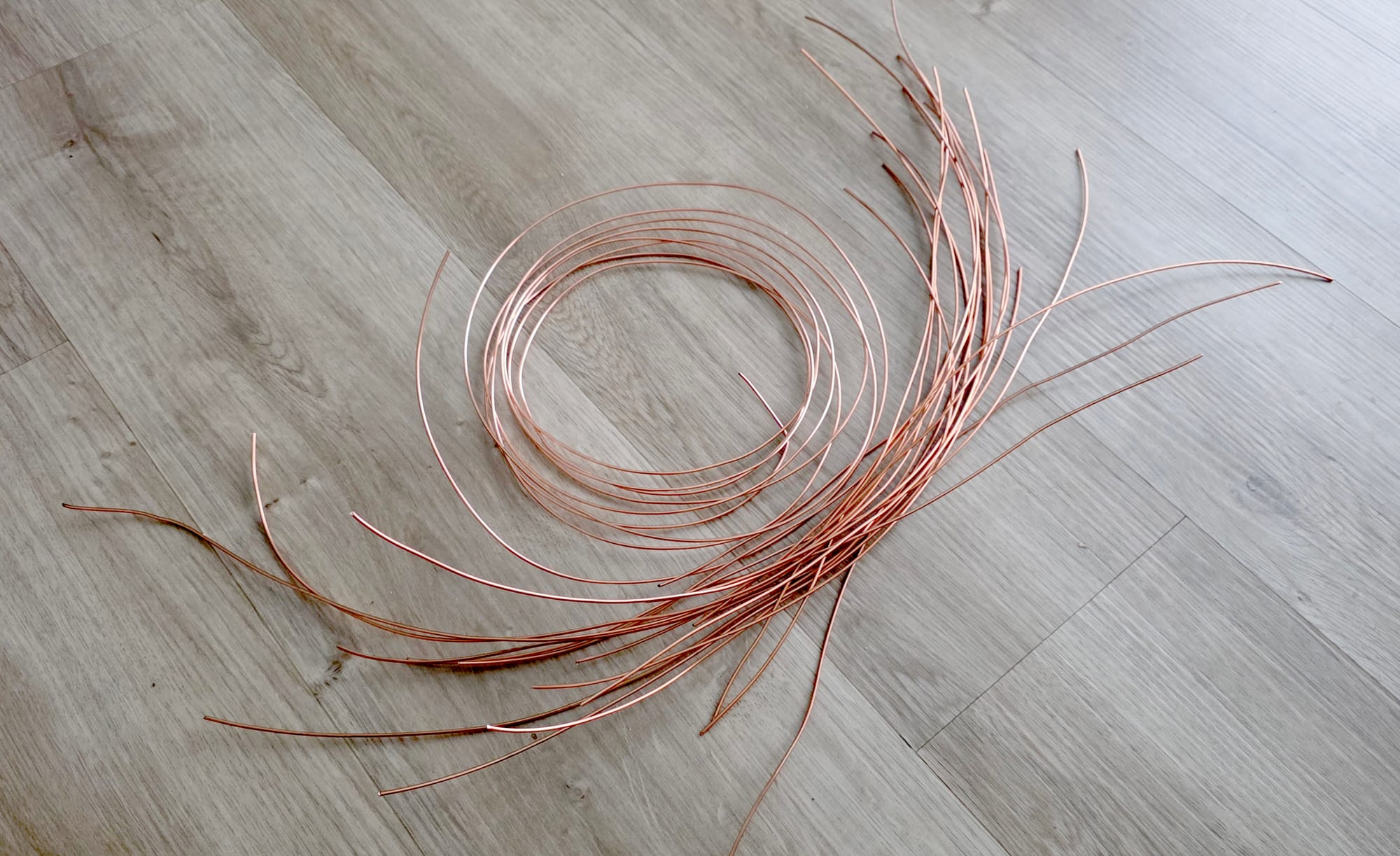
The first step was removing the plastic casing from the electrical wire to reveal the copper inside.
There was something oddly satisfying about that process.
It was almost like revealing the potential that had been there the entire time.
Once the copper was exposed, we used soft scrap fabric, such as felt, to help smooth and work with the wire.
By rubbing the copper with the fabric, the friction creates warmth that helps make the wire easier to maneuver and shape.
From there, we measured and cut our pieces using wire cutters.
The exact length depends on your design, but we used approximately:
- Around 12 inches of wire for bracelets
- Around 6 inches of wire for rings
Then came the experimenting.
Using round-nose and flat pliers, we shaped the copper into wearable pieces.
The round pliers helped create curves, loops, and softer shapes, while the flat pliers helped with gripping and adjusting the wire.
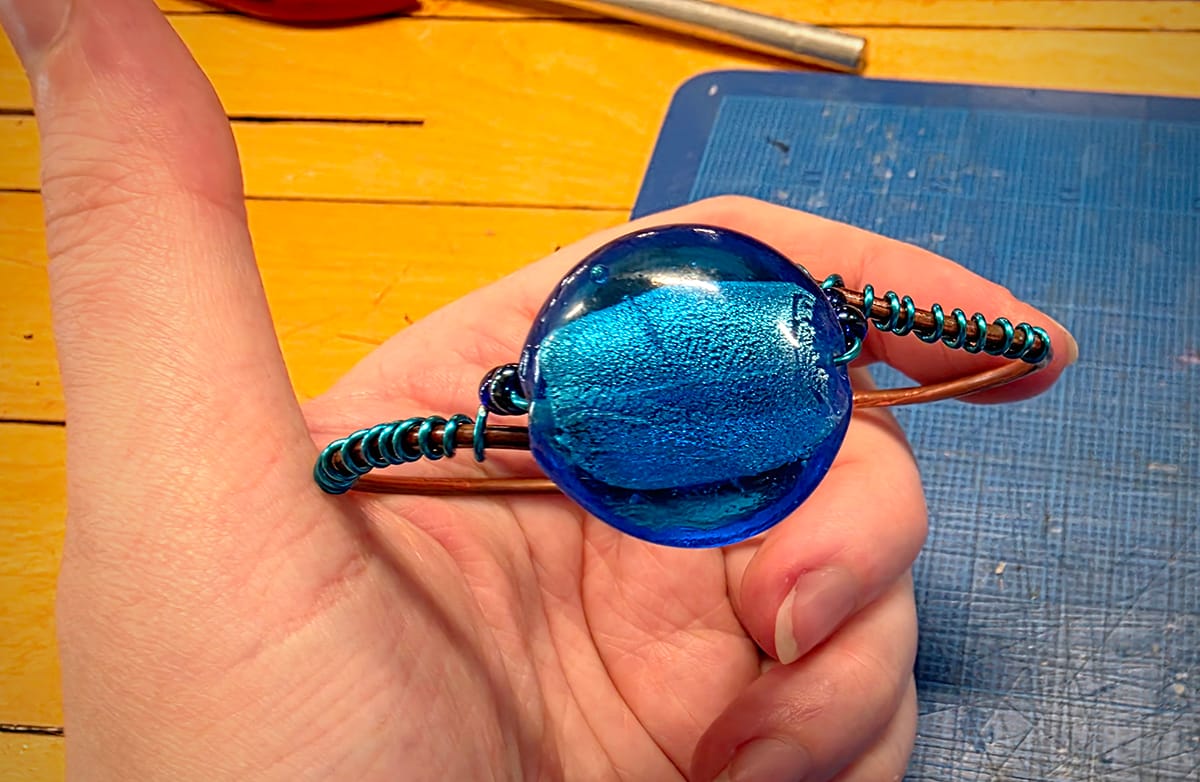
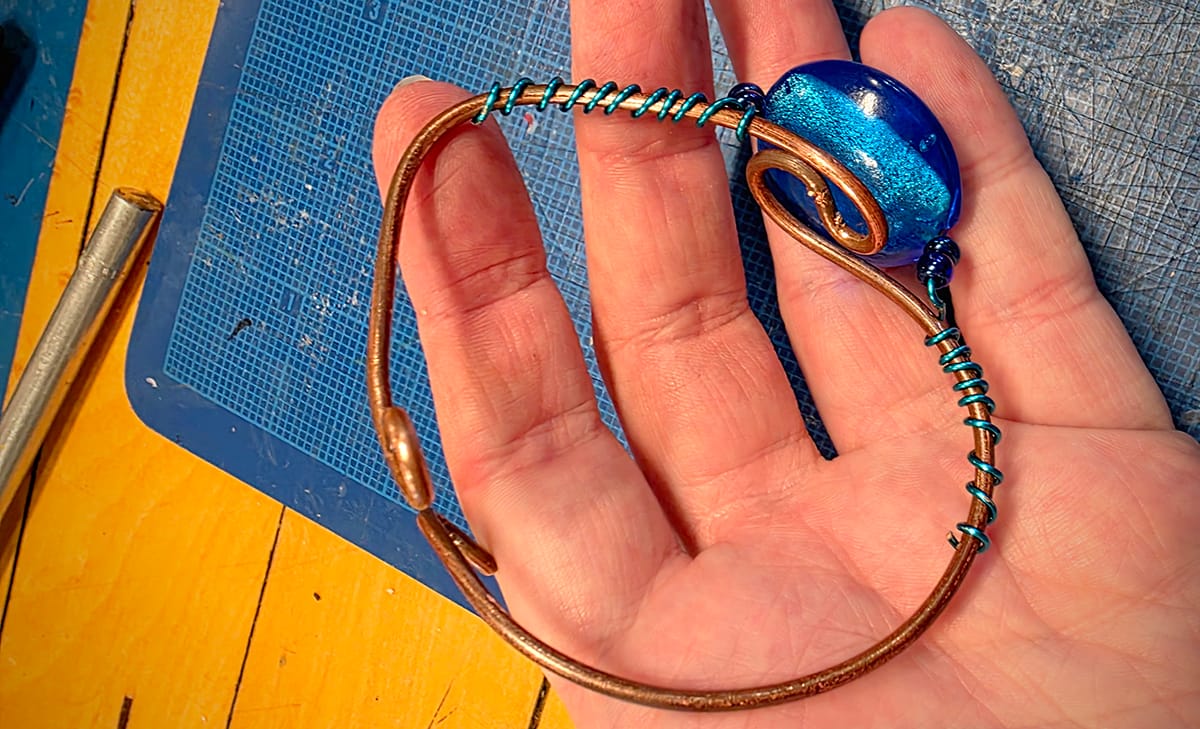
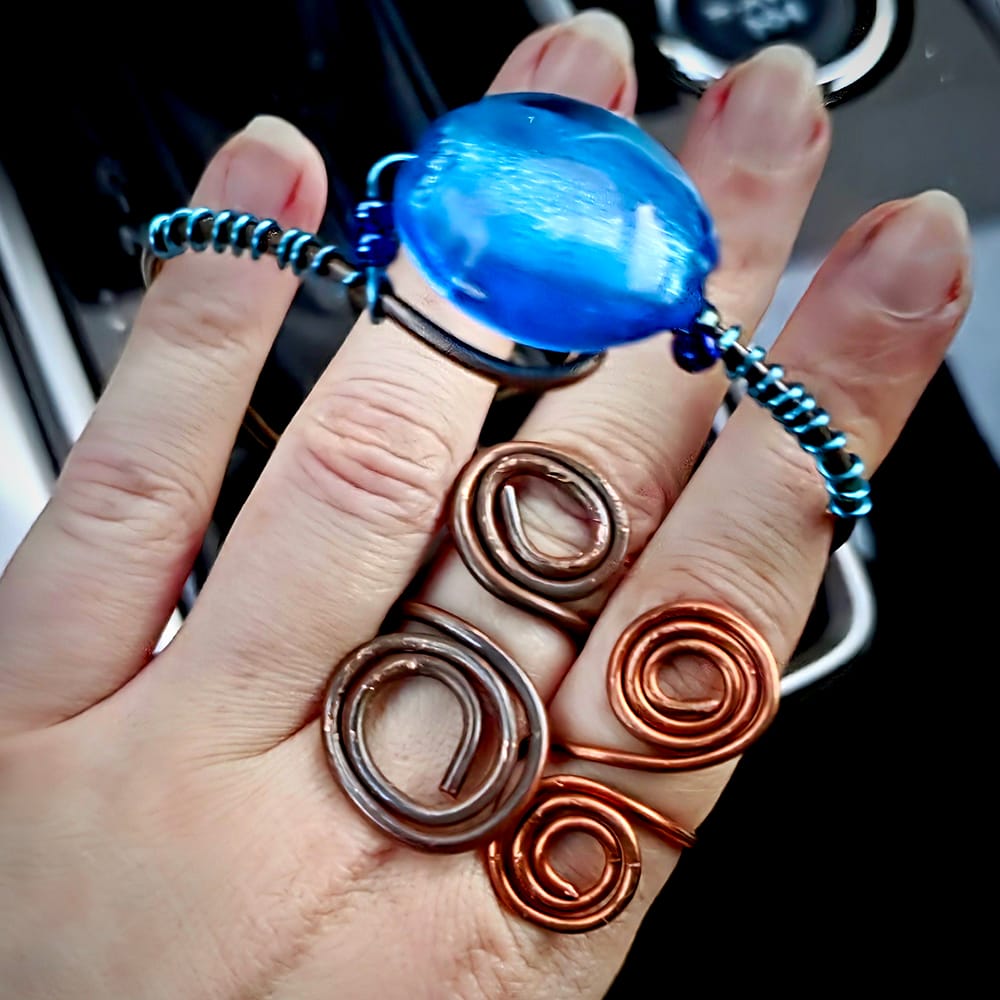
For bracelets, we also explored ways to personalize our designs by adding decorative elements like beads and colored wire accents.
This was where everyone’s creativity really started to show.
The same material could become something simple and minimal.
Or colorful and playful.
Or completely unexpected.
That is one of my favorite things about handmade art:
The material is only the beginning.
The artist decides where it goes next.
Learning Through Experimentation
As we started working with the copper wire, one of my favorite things was seeing how everyone approached the same materials differently.
Everyone started with copper.
Everyone had access to beads and tools.
Everyone learned the same basic techniques.
But every finished piece was completely unique.
That is one of my favorite reminders about creativity:
The same starting point does not mean the same destination.
Each person brings their own choices, ideas, preferences, and perspective into what they create.
During the workshop, we practiced skills like:
- Stripping electrical wire
- Cutting wire safely
- Shaping copper
- Creating loops and curves
- Using jewelry tools
- Adding beads
- Creating wearable designs
There was trial and error.
There was adjusting.
There was experimenting.
And honestly, that is part of what makes handmade art meaningful.
A machine’s goal is usually consistency.
The same shape.
The same size.
The same result every time.
But handmade creations carry little traces of the person who made them.
The tiny variations.
The choices.
The learning process.
The story.
Those differences are not failures.
They are reminders that a real person created something.
Who Would Enjoy This Workshop?
One thing I appreciated about this class was how approachable it felt.
You do not need to already consider yourself a jewelry maker.
You do not need years of art experience.
You do not need to arrive with a perfectly planned idea.
This workshop could be a great fit for someone who:
- Wants to try jewelry making for the first time
- Enjoys hands-on creative activities
- Likes sustainable or eco-friendly projects
- Loves turning unexpected materials into something new
- Wants to explore art without investing in lots of supplies
- Enjoys learning practical creative skills
- Wants a beginner-friendly creative environment
It could also be especially helpful for anyone who feels creatively stuck.
Sometimes trying a completely new material wakes up a different part of your creativity.
If you usually paint, try jewelry.
If you usually draw, try sewing.
If you usually work digitally, try making something with your hands.
Exploring does not mean abandoning your usual creative interests.
It means giving yourself more ways to create.
Continuing After Class: How Do You Find Materials?
One thing I always appreciate about a good creative class is when it does not just give you a finished project.
It gives you a new skill.
The workshop itself was only an hour and a half, but I left with something I could continue exploring afterward.
Which led me to my next question: “Where do I actually find salvaged copper wire?”
When you are in a workshop, the materials are often already prepared for you.
You get to focus on learning.
But continuing at home requires another creative skill:
Resourcefulness.
During the class, I asked Korey where she finds copper wire for her jewelry projects.
She shared that she personally knew an electrician who was able to provide leftover wiring.
Which is an amazing resource.
But I also realized: not everyone knows an electrician.
So I decided to start searching.
And that became its own creative adventure.
 Jessica Carey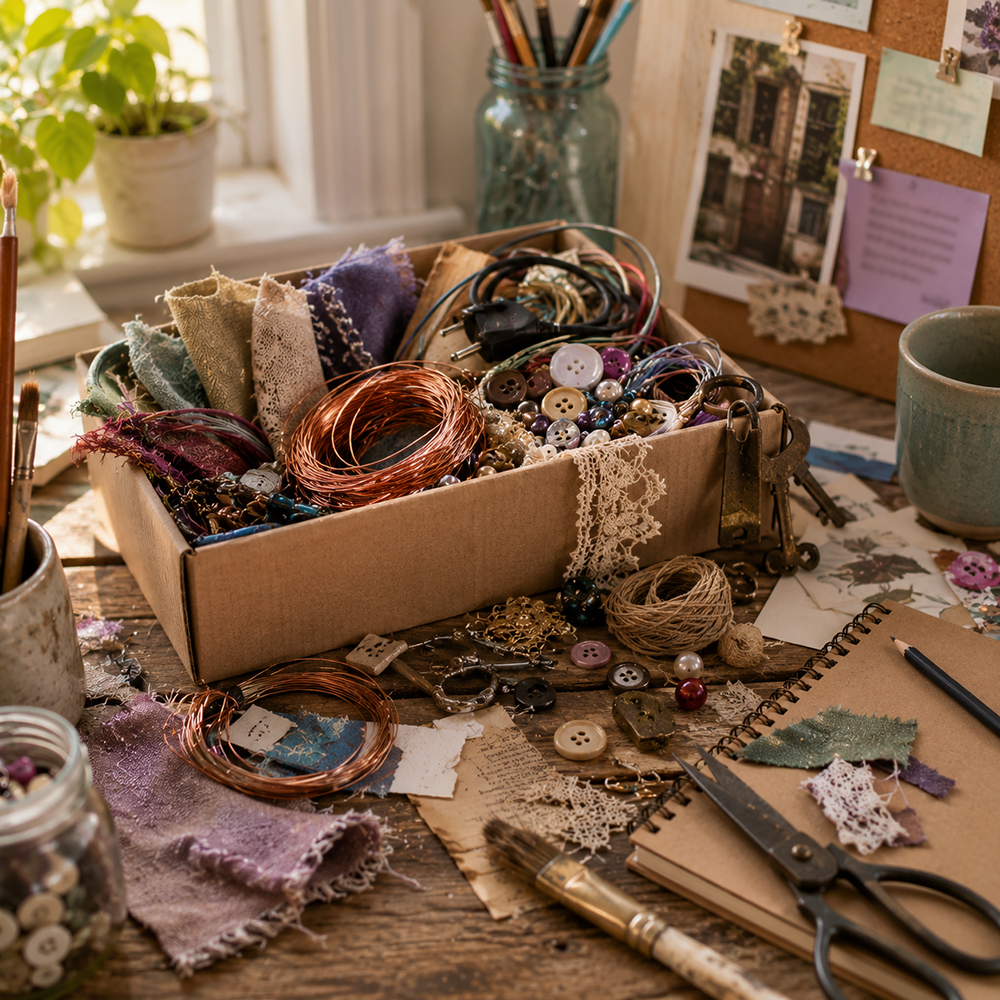
The Creative Treasure Hunt: Finding Supplies
One thing I have learned through exploring art resources is that sometimes opportunities appear because you are willing to ask.
Not every message receives a response.
Not every place has what you need.
Not every door opens.
But sometimes one does.
After the workshop, I started reaching out to different organizations and businesses to see if anyone had scrap electrical wiring available.
I contacted around ten different places.
Most did not respond.
And that is honestly normal.
Finding resources often requires patience, curiosity, and persistence.
But then I connected with Dave at Spectrum Ecycle Solutions.
Spectrum Ecycle Solutions focuses on electronics recycling, which means they work with materials that may otherwise be discarded.
After reaching out and explaining what I was looking for, Dave kindly offered to set aside a free box of spare scrap electronic wiring for me.
That one connection made the entire search worth it.
And it reminded me of something important: community is one of the most valuable creative resources we have.
Sometimes the materials exist.
Sometimes the opportunities exist.
Sometimes people are happy to help.
They just need someone to ask.
Exploring Local Creative Reuse Resources
I also continued my search by visiting Leftovers, Etc., another local creative reuse resource.
While there, I found electronic wiring along with other supplies and materials for around $10.
That is one of my favorite parts about creative reuse spaces.
You never know exactly what treasures you will discover.
Instead of shopping from a predetermined list, you get to explore.
You get to imagine.
You get to look at materials differently.
A random object sitting on a shelf could become part of your next project.
Something overlooked could become something meaningful.
For artists on a budget, students, teachers, beginners, or anyone wanting to experiment without spending a lot of money, places like this can be incredibly helpful.
Creativity becomes less about: “I need everything before I start.”
And more about: “What can I create with what I have?”
Places to Look for Upcycled Art Materials
If you are interested in trying creative reuse projects, there are many places you can explore.
Possible resources include:
Creative reuse centers
Organizations like Perennial and Leftovers, Etc. collect donated materials and make them available for artists, makers, teachers, and community members.
Electronics recycling centers
Depending on their policies and available materials, some electronics recycling organizations may have scrap wiring or components that can be reused creatively.
Architectural salvage and reuse organizations
Places focused on salvaging building materials may sometimes carry unique supplies like hardware, wood, fixtures, or other materials useful for creative projects.
Online community groups
You can also check places like:
- Facebook Marketplace
- Craigslist
- Nextdoor
- Local Buy Nothing groups
Many people have leftover supplies sitting unused.
Local connections
Sometimes simply asking around helps.
Electricians, repair shops, makers, neighbors, or community members may have materials they would otherwise discard.
Always ask permission and follow safety guidelines, but do not underestimate the power of curiosity.
A simple question can sometimes lead somewhere unexpected.
 Jessica Carey
A Quick Note About Working With Salvaged Materials
One important thing to remember with creative reuse is making sure materials are safe and appropriate for your project.
Repurposing materials is exciting, but it is still important to be thoughtful.
When working with salvaged supplies:
- Ask permission before taking materials
- Use trusted sources when possible
- Be mindful when taking apart electronics or unfamiliar objects
- Research materials before using them
- Wear appropriate protective equipment when needed
For copper jewelry specifically, look for clean, usable wiring from safe sources.
Creative reuse is not about grabbing anything and everything.
It is about thoughtfully giving materials another life.
More Creative Reuse Classes at Perennial
One of my favorite parts about discovering creative spaces like Perennial is realizing just how many possibilities exist.
Sometimes trying one class opens the door to another idea.
Learning one skill sparks curiosity about a different material.
Creating one project makes you wonder: “What else could I make?”
If you are interested in taking Korey's copper jewelry class, the next class is held on August 26th, 2026 at Perennial.
Along with the Copper Rings + Bracelets workshop, Perennial offers a variety of creative reuse classes where participants can explore different techniques and materials.
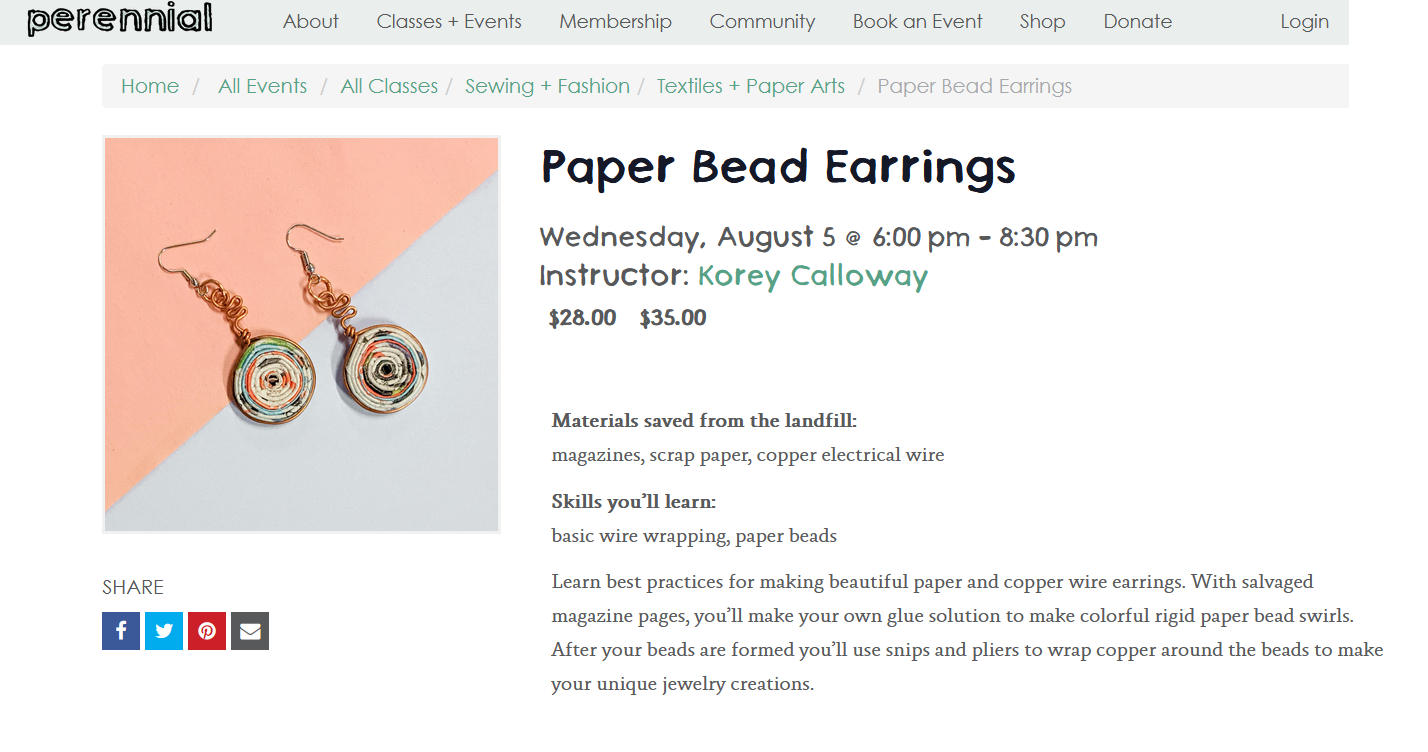
One class that especially caught my attention is Paper Bead Earrings, also taught by Korey Calloway.
In this paper bead workshop, participants transform simple materials like:
- Salvaged magazine pages
- Scrap paper
- Copper electrical wire
into unique handmade earrings.
 Jessica Carey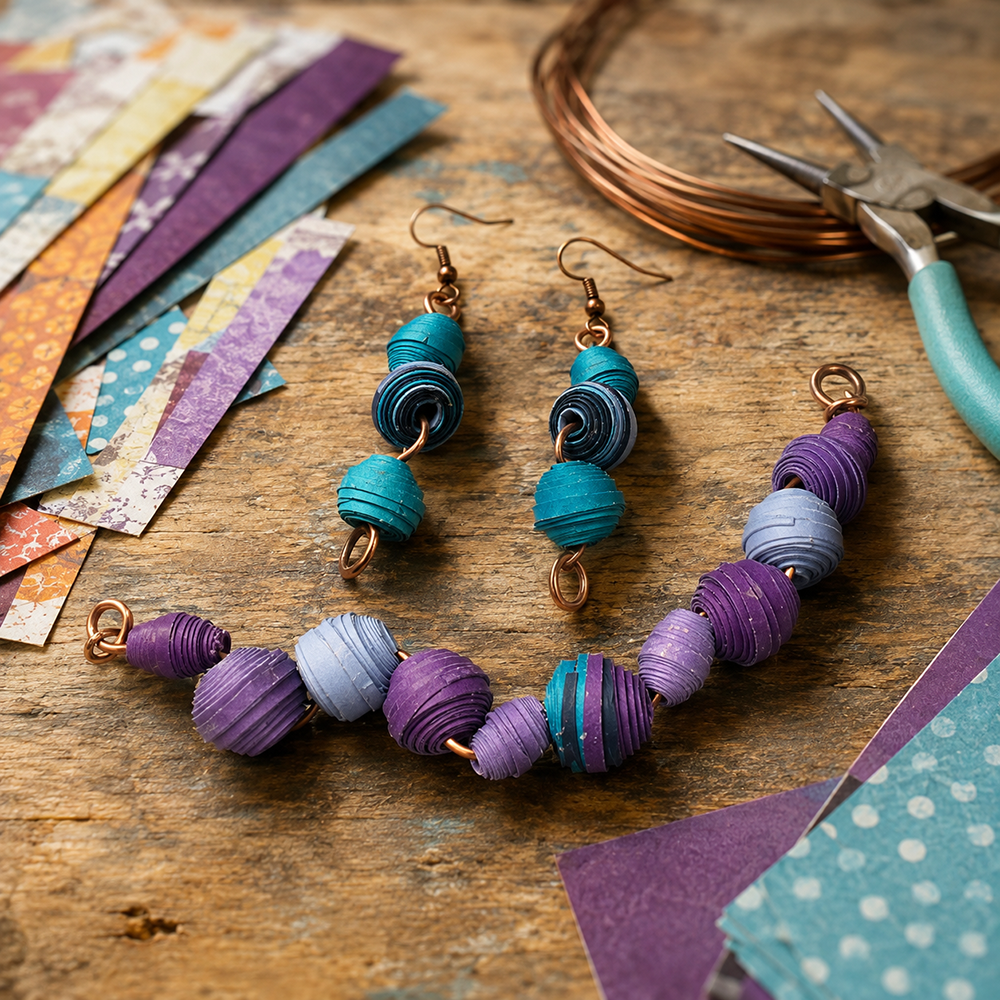
Students learn skills like:
- Creating paper beads
- Making a glue solution
- Basic wire wrapping
- Jewelry techniques
This class will be held next on August 5th, 2026 at Perennial.
I love the idea behind this class because it continues the same message: beautiful things can come from unexpected places.
A magazine page someone finished reading.
A scrap of paper left behind.
A piece of wire no longer needed for its original purpose.
All of these ordinary materials can become something completely new with creativity and imagination.
And that is one of my favorite lessons from creative reuse.
Why Taking Creative Classes Matters
Beyond the finished project, there is something really valuable about giving yourself permission to learn.
As adults, it can sometimes feel intimidating to be a beginner again.
Many people stop trying new creative things because somewhere along the way they started believing:
- “I’m not artistic.”
- “I wouldn’t know where to start.”
- “I’ll probably mess it up.”
- “I’m too old to learn something new.”
But creativity is not about already knowing everything.
Learning is part of creating.
Experimenting is part of creating.
Making mistakes is part of creating.
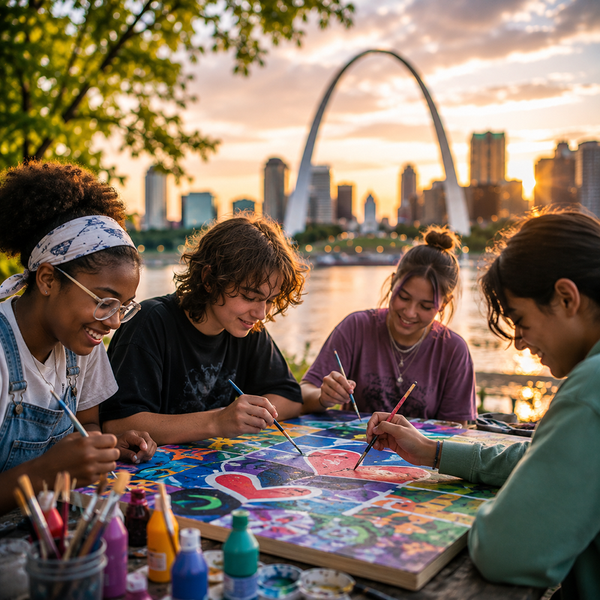
Classes like the ones at Perennial give people a supportive space to explore without needing to have all the answers first.
You can show up curious.
You can learn as you go.
You can discover what interests you.
Sometimes a single workshop becomes more than a project you take home.
Sometimes it becomes the beginning of a new hobby.
A new skill.
A new connection.
A new way of seeing the world.
Finding Possibility Again
When I signed up for a copper jewelry class, I expected to learn how to make rings and bracelets. And I did.
But I also walked away with something bigger.
A reminder: creativity is everywhere.
It exists in materials waiting for a second chance.
It exists in communities willing to share knowledge and resources.
It exists in the simple curiosity of asking: “What could this become?”
A piece of electrical wire can become jewelry.
An old magazine can become beads.
Forgotten supplies can become someone’s next creative project.
Something overlooked can still hold beauty, purpose, and possibility.
And maybe that message reaches beyond art.
Because many of us know what it feels like to go through seasons where we feel stuck, lost, underestimated, or unsure of what comes next.
But transformation is not reserved for perfect conditions.
A flower can grow through a crack in the sidewalk.
A scrap of copper can become something treasured.
A person can rediscover parts of themselves they thought they lost.
Creativity teaches us to look closer.
To imagine.
To believe in possibilities we cannot see yet.
Because sometimes the question that changes everything is not: “What is this right now?”
Sometimes the question is: “What could this become?”
Want even more content about creativity and art?
Be sure to check out all of our creative chronicles!
If you'd like to see examples of my work, you can find some of my art and creations at Redbubble and Gumroad!
Want to check out other St. Louis art spaces and resources?
Check out some of these articles:
-Hidden Gems for St. Louis Artists
-Leftovers and Upcycle Treasure Box
Looking to learn more about my recent journey?
Check out some of these articles:
-Hidden Gems for Autistic & Neurodivergent Adults
-I Think I Might Be Autistic... Now What?
-I Wasn't Broken--I'm Burned Out
 Jessica Carey