
The Parts of Being an Artist Nobody Teaches You
You can spend years learning how to make art without anyone ever teaching you how to build a life around making it.
I have a bachelor's degree in art and a master's degree in art education.
I've spent years making art, teaching art, writing about creativity, experimenting with different materials, and developing creative projects of my own.
And yet, there are entire parts of being a working artist that I've largely had to figure out as I go.
- How do you talk about your work without feeling like you're trying to turn yourself into a sales pitch?
- How do you write an artist statement, biography, or résumé that actually reflects the work you do?
- How do you find the people who might connect with your work?
- How do you price what you create?
- How do you find opportunities, build relationships, apply for funding, manage money, communicate your value, and make plans for something as unpredictable as a creative life?
- And perhaps underneath all of those questions: what does success as an artist actually mean to you?
Because learning how to make art and learning how to sustain an artistic practice aren't quite the same thing.
Art education can teach us about materials, techniques, composition, art history, critique, and creative thinking.
Years of practice can teach us even more.
But artists eventually encounter an entirely different collection of questions that have very little to do with whether we know how to draw, paint, sculpt, perform, write, photograph, design, or make music.
They're questions about how we continue, and many artists are left to figure those things out largely on their own.
 Jessica Carey
Enter Artist INC
That's part of what led me to Artist INC, a professional development program of Mid-America Arts Alliance designed specifically for artists.
I was selected as one of 25 artists participating in the current St. Louis cohort, and as I'm writing this, I'm three weeks into the eight-week program.
So this isn't my final review of Artist INC; I still have five classes left.
There are exercises I haven't completed, subjects we haven't covered, conversations that haven't happened yet, and a final WorkShare presentation waiting for me at the end.
But three weeks has been long enough for me to realize that there's something here worth talking about.
Artist INC describes its purpose as connecting artists with the tools, resources, and opportunities necessary to develop their entrepreneurial skills and strengthen their artistic practices.
The program was founded in 2009 in partnership with the University of Missouri–Kansas City Innovation Center and has since reached thousands of artists across disciplines.
What I've encountered so far, though, feels considerably broader than the word entrepreneurship might initially suggest.
We haven't simply been talking about how to sell more art.
We've been asking why we create, what success means to us, where we're trying to go, who we're trying to reach, and how to communicate what we do in ways that actually sound like us.
Artist INC's eight sessions reflect that broader approach: Your Map, Your Story, Your Public, Your Value, Your Money, Your Plan, Your Presence, and Your WorkShare.
And one of the things that has stood out to me most is that Artist INC doesn't begin by handing everyone the same definition of what a successful artist is supposed to look like.
Instead, one of its guiding principles is self-determined success.
The program explicitly acknowledges that there is no single path to—or definition of—success and encourages artists to identify their own vision before figuring out how to work toward it.
I think that's an important place to begin.
Because before someone can teach you how to build a successful creative life, there's a much more fundamental question that needs answering: successful according to whom?
Learning How to Keep Creating
Making the work matters, but artists don't create in a vacuum.
Creative practices exist inside lives with financial realities, relationships, responsibilities, limited resources, and finite amounts of time and energy.
Artists also need ways to communicate what they do, find opportunities, connect with audiences and collaborators, and navigate systems that rarely come with straightforward roadmaps.
Learning those things doesn't make the art less meaningful; it can help make continuing to create possible.
That's what has made me want to look beyond my own cohort and understand Artist INC more deeply: where it came from, what it teaches, and what might happen when we stop assuming creative people should simply figure everything out alone.
What Is Artist INC?
Artist INC is a professional development program created by artists, for artists.
At its most practical level, the program helps artists develop the knowledge and skills involved in building and sustaining a creative practice—the things that often exist around the artwork itself but can determine whether an artist is able to continue making, sharing, and growing their work.
That includes subjects like communication, goal setting, finances, planning, marketing, professional materials, building relationships, and understanding the value of your work.
But after participating in the program myself, I don't think “business training for artists” fully captures what Artist INC is trying to do.
Because the goal isn't simply to teach artists how to make more money.
It's to help artists become more intentional about the lives and practices they're building.
Built Around the Artist, Not a Formula
One thing I've appreciated so far is that Artist INC doesn't seem interested in producing 25 identical versions of what a “successful artist” is supposed to be.
We're not all making the same kind of work.
We're not at the same point in our creative lives.
We don't have identical goals.
And we certainly don't all need the same things.
Artist INC's own guiding principles acknowledge that there is no single path to success.
Rather than prescribing one model everyone should follow, the program encourages artists to identify what matters to them and build strategies around their individual goals.
That distinction is important.
Success might mean building a full-time studio practice, earning more income, exhibiting, teaching, publishing, performing, securing grants, developing a community project, reaching new audiences—or simply creating a more sustainable structure around work someone is already doing.
The point isn't to squeeze every creative life into the same business plan.
It's to become more intentional about building the creative life that actually makes sense for you.
More Than Information
A lot of information about running a creative practice can technically be found online.
You can search for advice about artist statements, pricing, marketing, budgeting, or grants.
What's harder to find is context: How does this apply to my work? What actually matters for what I'm building? What am I overlooking? Where do I need support?
Artist INC creates a structure for exploring those questions alongside other artists.
It isn't simply giving artists information; it's helping them understand how that information might fit into their own creative lives.
The Organization and History Behind Artist INC
Artist INC didn't emerge on its own.
Behind the program is Mid-America Arts Alliance (M-AAA), a nonprofit regional arts organization founded in 1972.
M-AAA serves Arkansas, Kansas, Missouri, Nebraska, Oklahoma, and Texas, with some programs and partnerships extending beyond those boundaries.
Its work has included grantmaking, professional development, traveling exhibitions, artist services, and community partnerships.
Artist INC began in 2009 through a partnership between M-AAA and the University of Missouri–Kansas City Innovation Center, bringing together support for artists and entrepreneurial development.
The combination makes sense when you consider how much artists already do beyond making things.
We develop ideas, initiate projects, solve problems, find resources, build relationships, adapt when something doesn't work, and create opportunities where none existed.
Artist INC developed professional support around that existing resourcefulness—and, importantly, around the knowledge artists already carry.
Working artists know things because they've lived them.
They've applied for grants, negotiated contracts, built audiences, made mistakes, found opportunities, balanced creative work with other responsibilities, and developed systems that worked for them.
That lived knowledge became central to Artist INC's peer-learning model.
Experience becomes a resource rather than a rulebook.
Since its beginnings in Kansas City, Artist INC has expanded into additional communities and formats, including the eight-session Artist INC Live experience I'm participating in and the shorter Artist INC Express format.
But I think the more interesting story isn't simply that Artist INC grew.
It's the philosophy underneath that growth: artists aren't empty vessels waiting for someone else to explain how creative careers work.
They already carry pieces of the knowledge other artists may need.
Artists Supporting Artists
After three weeks in the program, I'm beginning to understand why that matters.
Other artists understand the strange intersection of creative and practical decisions: putting personal work into the world and then discussing it professionally, pricing something you've made, finding opportunities, explaining work that makes perfect sense inside your own head, and trying to build something sustainable without losing what made you want to create in the first place.
You can learn about those things from books, articles, videos, and experts.
But there's something different about discussing them with people navigating their own versions of the same questions.
Artist Peer Facilitators
That philosophy is reflected in the people leading Artist INC.
Rather than relying solely on conventional instructors, the program uses Artist Peer Facilitators—working artists who guide participants through the curriculum while bringing their own lived professional experience into the room.
A facilitator may have considerably more experience than I do in a particular area.
They may have built a career, navigated opportunities, made mistakes, developed systems, or encountered situations I haven't experienced yet.
But they're still artists.
They're not standing outside creative life and explaining it theoretically.
They're navigating it, too.
That changes the relationship.
The message becomes less: “Here is the correct way to be an artist,” and more: “Here are tools, experiences, questions, and possibilities. Let's figure out what makes sense for the practice you're trying to build.”
That feels much more useful to me.
The Cohort Is Part of the Resource
There are 25 artists in my St. Louis cohort, which means there aren't simply 25 people receiving the same information.
There are 25 different collections of experiences, skills, questions, mistakes, resources, relationships, and creative practices in the room.
The cohort itself becomes part of the resource.
Conversations, exercises, feedback, and small-group work create opportunities for that knowledge to move between people.
Sometimes another person's question becomes useful even when I would never have thought to ask it myself.
That's one of the things I appreciate about learning in community: you aren't limited to the questions already inside your own head.
Artist INC's smaller groups make some of those exchanges more personal, giving us space to discuss goals, receive feedback, and return to conversations over time. Community isn't simply left to chance; it's built into the structure.
That also makes “networking” feel less like asking: what can this person do for me? and more like asking: what can we learn from one another?
That's a very different foundation for building a creative community.
Different Disciplines, Shared Questions
Artist INC is intentionally cross-disciplinary.
There are certainly times when discipline-specific knowledge matters, but artists working in very different forms often encounter remarkably similar questions about audiences, value, opportunities, time, money, communication, and sustainability.
Someone working in another discipline may see a problem differently precisely because they aren't immersed in the assumptions of your field.
Different creative practices can create different ways of thinking.
Peer Support Isn't Peer Prescription
There's another distinction I think matters.
Learning from other artists doesn't mean copying their creative careers.
One person's path isn't automatically a blueprint for someone else.
Artists have different circumstances, capacities, resources, ambitions, and definitions of success.
Something that works beautifully for one person may be completely unrealistic for another.
And that's where Artist INC's emphasis on self-determined success becomes especially important.
Peer learning works best when someone's experience becomes information you can consider—not a command you have to follow.
An artist can say: “This worked for me,” without implying: “Therefore, this is what you should do.”
That's a form of support I wish existed in more places.
Advice can be an offering rather than an obligation.
We can learn from someone's experience without surrendering our own judgment about what fits our lives.
 Jessica Carey
Defining Success for Yourself
What does it mean to be a successful artist?
- Sell your work?
- Make enough money from your art to support yourself?
- Get into galleries?
- Publish a book?
- Win awards?
- Receive grants?
- Build a large audience?
- Become well known?
Those can all be forms of success.
But they aren't the only ones.
And one of the ideas Artist INC establishes early in the program is that there is no single definition of what a successful creative life is supposed to look like.
That sounds simple.
Actually figuring out what success means to you is considerably harder.
Success According to Whom?
We're surrounded by messages about what success is supposed to look like.
More money.
More followers.
More sales.
More recognition.
More accomplishments.
More productivity.
More growth.
And none of those things are inherently bad.
An artist wanting to make more money isn't less sincere.
Wanting recognition doesn't make someone's work less meaningful.
Wanting a larger audience isn't shallow.
Wanting to turn creative work into a full-time career isn't selling out.
But “more” also comes with tradeoffs.
A larger business can mean more administration; more commissions can leave less time for personal work; greater visibility can create more demands on your attention; and additional opportunities can mean more travel, projects, and less time to rest.
An opportunity can look wonderful on paper and still be wrong for the person receiving it.
An opportunity can look wonderful on paper and still be wrong for the person receiving it.
That's why I think there's an important question underneath all the professional skills Artist INC teaches: what is all of this supposed to help you create?
Not just creatively. Personally.
The Life Around the Art Matters, Too
I think artists are sometimes encouraged to imagine our work as though it exists separately from the rest of our lives.
But it doesn't.
The person making the art still needs somewhere to live, relationships, food, rest, healthcare, community, safety, financial stability, joy, and room to experiment, fail, and change their mind.
And different people need different amounts and combinations of those things.
So perhaps a successful artistic life isn't simply one in which the art becomes increasingly successful according to external measurements.
Maybe it's one in which the person and the practice can continue existing together.
That distinction matters to me.
I don't want to build something that looks impressive from the outside while making my actual life impossible to live.
I don't want success to require sacrificing everything that success was supposed to make possible in the first place.
And I don't think sustainability should mean learning how to endure an unsustainable life more efficiently.
A creative practice should have room for the human being inside it.
Starting With Your WHY
Early in Artist INC, we were asked to think about our WHAT, HOW, and WHY: what we create, how we approach it, and underneath both, why it matters.
That last question can be surprisingly difficult.
But identifying it can reveal connections between work that otherwise appears unrelated.
I'll return to what that exercise revealed about my own practice later.
Drawing the Map Before Choosing the Road
The first Artist INC session is called “Your Map,” and its central idea is essentially that you need to know where you're trying to go before you can meaningfully plan how to get there.
The session moves through values, definitions of success, strengths and gaps, long-term thinking, and goal setting.
I like the map metaphor because a map isn't particularly useful without a destination.
You can move very efficiently in completely the wrong direction.
Creative careers can work the same way.
You can become extraordinarily efficient at marketing, producing, applying, networking, earning, and saying yes—and still eventually realize: this isn't the life I wanted.
So, perhaps the first step toward becoming more strategic isn't doing more.
It's deciding what deserves to be done at all.
Goals can help turn that direction into something more concrete, but I think the distinction matters: a goal should serve the life you're trying to build. The life shouldn't exist merely to serve the goal.
What Artists Actually Learn
So what does Artist INC actually teach?
The eight-week program follows a progression that moves from some surprisingly philosophical questions into increasingly practical ones.
The sessions are called: Your Map. Your Story. Your Public. Your Value. Your Money. Your Plan. Your Presence. Your WorkShare.
Taken individually, those titles can sound fairly simple.
Together, though, they form something closer to a map of the different systems surrounding a creative practice.
Because making the work is only one part of being an artist.
There's also figuring out where you're going, understanding why the work matters, communicating it to other people, finding the people you want to reach, valuing what you do, managing money, planning projects, building a professional presence, and eventually standing in front of other people and telling the story of your work.
Artist INC tries to make some of those invisible parts of creative life visible.
What I've Experienced So Far
The first three sessions move from the internal to the external.
Your Map asks artists to examine values, definitions of success, strengths, gaps, and goals.
Your Story turns toward communication and marketing—not merely advertising, but the ways people encounter, understand, access, experience, and support creative work.
Your Public asks artists to think more deliberately about who they're trying to reach and what it's actually like for another person to encounter their work.
Along the way, we've worked on professional materials like artist statements, biographies, résumés, and elevator pitches.
Those can sound like administrative accessories to the “real” work until somebody asks you for one.
Then suddenly you're staring at a blank page trying to summarize years of creative practice in 150 words.
I've found that process surprisingly revealing.
Learning how to communicate your work can become another way of understanding it.
What Comes Next
At the point I'm writing this, I'm only partway through Artist INC.
That's important to say because I don't want to describe sessions I haven't experienced yet as though I have.
The remaining curriculum moves through Your Value, Your Money, Your Plan, Your Presence, and Your WorkShare, taking these questions further into the practical structures surrounding creative work: value, finances, planning, professional presence, and communicating the larger story of a creative practice.
That part is still ahead of me, and so are a lot of the answers.
I don't need to wait until I've mastered every subject to recognize that learning it matters.
The Professional Toolkit Nobody Hands You
Artists are routinely expected to know how to write biographies and statements, price work, understand audiences and marketing, manage money, find opportunities, write proposals, plan projects, maintain a professional presence, and talk confidently about what they do—while somehow continuing to make the work itself.
For many artists, that toolkit gets assembled slowly and unevenly through applications, mistakes, late-night searches, and things other artists happen to tell us.
Artist INC puts many of those scattered pieces into a structure.
Having access to a tool gives you the choice of whether and how to use it.
 Jessica Carey
More Than the Business of Art
Calling Artist INC “business training for artists” isn't exactly wrong, but I think it's incomplete.
The program does address money, marketing, planning, value, and other practical realities.
But underneath those subjects are larger questions about what we're trying to build and what would make our creative practices genuinely sustainable.
Artists already practice many of the qualities associated with entrepreneurship.
We imagine things that don't exist, solve problems, experiment, work within constraints, find resources, adapt, and turn ideas into projects.
What we don't necessarily have is all the professional knowledge surrounding that resourcefulness.
Someone can be extraordinary at making art and still have no idea how to construct a project budget or grant proposal.
These are different skills, and skills can be learned.
Professionalism Doesn't Have to Mean Becoming Someone Else
I think this distinction matters because words like business, marketing, branding, and networking can sometimes make creative people uncomfortable.
They can sound like instructions to become more polished, commercial, strategic, and marketable—and perhaps a little less human or less like yourself.
But learning professional skills doesn't have to mean constructing an artificial professional persona.
Ideally, those skills help you communicate what is already there.
An artist statement shouldn't invent meaning your work doesn't have.
A biography shouldn't transform you into someone more impressive.
Marketing shouldn't require convincing everyone to like what you make.
Networking shouldn't mean collecting people according to how useful they might become.
A plan shouldn't dictate every creative decision for the next ten years.
These things can simply become tools for helping other people understand, access, support, and participate in what you're already trying to create.
The tool should serve the artist.
The artist shouldn't have to reshape their entire life to serve the tool.
Sustainability Is Not the Same as Maximum Productivity
Financial sustainability matters because artists live in the same material world as everyone else.
But a practice can make money and still be personally unsustainable if it requires constant overwork, leaves no room to experiment, or consumes the person maintaining it.
A sustainable practice isn't necessarily the one producing the most.
It's one with conditions that allow the person and the work to continue.
Three Weeks In: What Artist INC Is Already Changing for Me
I'm writing this only three weeks into Artist INC.
That's simultaneously not very long at all—and long enough for me to notice that some things are already shifting.
I haven't finished the program.
I haven't reached the sessions about money, planning, or professional presence yet.
I haven't completed my final WorkShare.
And I'm certainly not emerging from three classes with every question about my creative life magically answered.
What I do have is more language for things I've been trying to understand for a long time.
More clarity about how seemingly separate parts of my work connect.
More concrete professional materials than I had three weeks ago.
New relationships with other artists.
And, perhaps most importantly, a clearer sense that the many things I'm trying to build aren't necessarily as disconnected as they sometimes appear.
Finding the Thread
One of the most useful things Artist INC has asked me to do so far is articulate my WHY, which is surprisingly difficult when you do a lot of different things.
I make art.
I write.
I research and share resources.
I experiment with materials and creative reuse.
I teach.
I'm developing Everyone Creates, a larger project centered on making creativity more accessible.
From the outside—or sometimes even from inside my own head—that can look like an unruly collection of unrelated projects.
Artist INC has pushed me to look underneath the projects.
And underneath them, I keep finding the same thing: I believe creativity belongs to everyone.
I believe people deserve opportunities to make things.
To experiment.
To learn.
To express themselves.
To discover resources.
To connect with other creative people.
To experience the feeling of I made this without first having to prove that they're talented enough, wealthy enough, connected enough, productive enough, or “professional” enough to belong.
Once I identify that as the underlying purpose, the different pieces of my work stop looking quite so scattered.
They're different expressions of the same belief.
That realization hasn't suddenly made my creative life simple.
But it has made it more coherent.
 Jessica Carey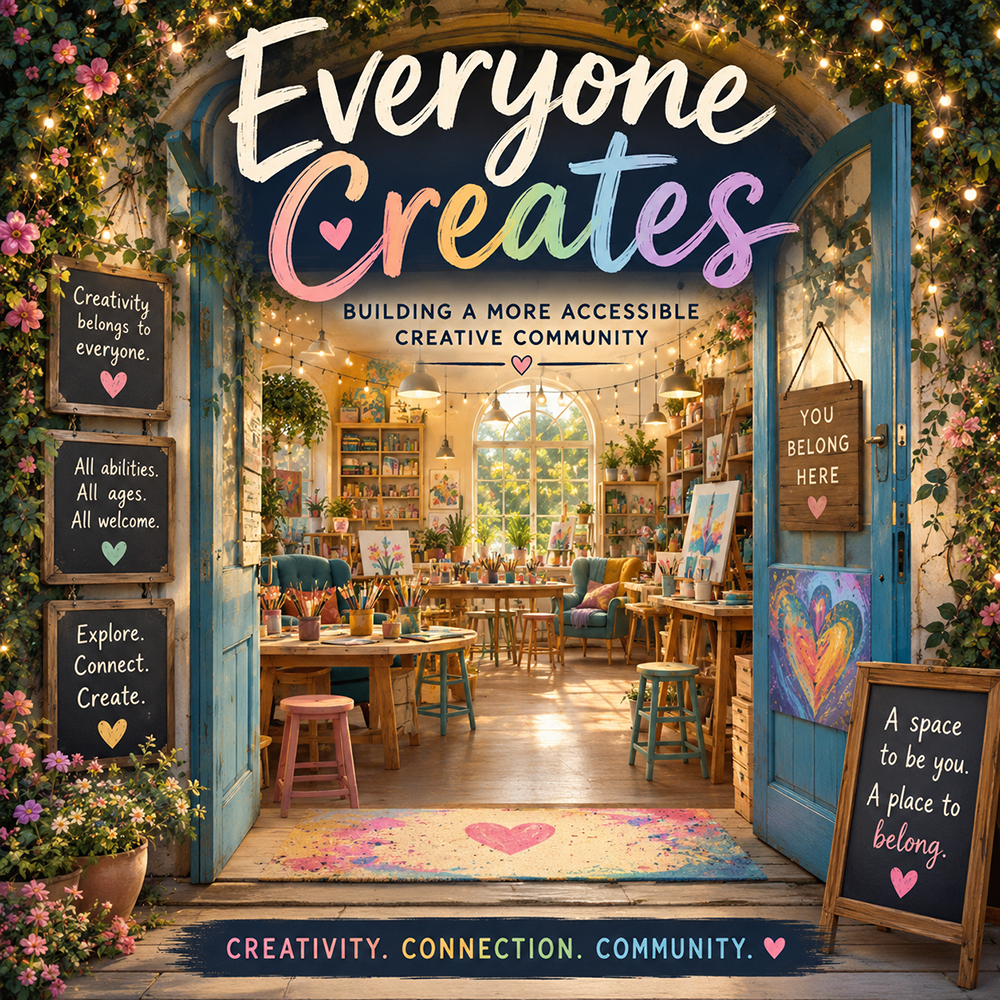
Learning How to Explain What I Already Know
Artist INC has also forced me to practice something I find surprisingly difficult: explaining what I do concisely.
Knowing your work deeply doesn't automatically make it easy to describe.
Sometimes it makes it harder.
When you're inside something every day, you know all the context.
Every project connects to another project.
Every idea has a backstory.
There are qualifications and exceptions and details that feel important.
Then someone asks: “So, what do you do?”
And suddenly you're supposed to turn an entire creative ecosystem into a few sentences.
We've been working on things like elevator pitches, artist statements, biographies, résumés, and ways of communicating our work to different audiences.
Those might sound like relatively mundane professional documents.
Creating them requires deciding what matters most, what belongs, what doesn't, what I want someone to remember, and what I'm actually trying to say.
I've been discovering that clarity isn't the same thing as simplification.
The goal isn't to erase the complexity of my work.
It's to find language that gives someone else a doorway into it.
Seeing What I Already Have
Another useful shift has come from taking inventory.
Professional development can easily begin from a place of deficiency:
- What am I missing?
- What haven't I accomplished?
- What don't I know?
- Why am I not further along?
Artist INC asks us to look at gaps, but it also asks us to look at assets.
- What skills do I already have?
- What experiences?
- What relationships?
- What resources?
- What knowledge?
- What have I already built?
That distinction has mattered.
Because when you're focused on everything you're still trying to accomplish, it can become surprisingly easy to overlook the amount of work you've already done.
Artist INC has also made me inventory what I've already built: Creativity Chronicles, hundreds of pieces of published writing, relationships with artists and creative organizations, years of teaching and research, extensive material experimentation, resource-building, and the resourcefulness I've developed through creating under less-than-ideal circumstances.
There are still significant gaps, but having gaps isn't the same thing as starting from nothing.
Sometimes figuring out your next step requires understanding what you're already standing on.
Turning Dreams Into Something More Concrete
Artist INC has also asked us to think beyond immediate tasks.
Where do I want to be in one year? Three? Five? Ten?
Those questions can feel enormous.
Some of the things I want aren't small.
I want my creative work to become more sustainable, Creativity Chronicles to continue growing into something genuinely useful, to publish books, to develop Everyone Creates into more than an idea, and to build supportive relationships and community around that work.
And I want a life in which creativity can exist alongside stability, connection, rest, and the other things that make a life worth living.
Writing those things down doesn't guarantee they'll happen.
A ten-year goal isn't a prophecy.
But naming a destination changes the kinds of questions you can ask.
Instead of: how am I ever supposed to make all of this happen? the question can become: what is one thing I can do next that moves in that direction?
That's considerably more manageable.
Helpful Doesn't Always Mean Comfortable
I also don't want to write about Artist INC as though every part of professional development automatically feels good.
Some of it stretches me.
Talking about myself quickly is difficult.
Timed activities can be challenging.
Presenting work publicly requires energy and preparation.
There are moments when the amount of information or interaction is a lot to process.
And the final WorkShare is something I'm still working toward rather than something I can confidently report back on from the other side.
I think that nuance belongs here.
Something can be valuable without every component being easy.
Growth doesn't require pretending discomfort doesn't exist.
What has mattered to me is having ways to think about how I can participate, prepare, ask questions, and use the parts of the experience that are helpful rather than measuring success by whether everything feels effortless.
Accessibility doesn't mean removing every challenge.
It means having a meaningful opportunity to engage with the challenge.
Other Artists Change the Experience
And then there are the people.
Three weeks isn't long enough to know exactly which relationships will continue beyond the program.
But it's already different from trying to figure all of this out alone.
I'm meeting artists working in different disciplines and at different points in their careers.
I'm hearing how other people describe their work.
I'm listening to what they're trying to build.
I'm discovering resources I didn't know about.
I'm seeing approaches I wouldn't necessarily have considered.
And sometimes someone else's experience gives me language for something I've been experiencing myself.
That's difficult to reproduce by reading an article or watching a video.
Information can teach you something.
People can expand what you imagine is possible.
I'm Still in the Middle of the Story
Maybe that's the most accurate way I can describe my Artist INC experience right now: I'm in the middle of it.
I don't know what I'll think after week eight, which lessons will prove most useful a year from now, or which relationships and resources will continue beyond the program.
That's part of why I wanted to write about Artist INC now rather than waiting until everything could be neatly summarized from the other side.
Creative development rarely happens that neatly anyway.
Sometimes one conversation, resource, relationship, or question becomes important in ways you couldn't have predicted at the time.
Three weeks into Artist INC, I don't have a tidy before-and-after story.
What I have is something more realistic: a clearer sense of where I've been, what I'm carrying, what I'm trying to build, and some of the tools and people that might help me get there.
For three weeks, I think that's quite a lot.
Artist INC Beyond St. Louis
My experience with Artist INC is happening in St. Louis, but Artist INC isn't a St. Louis-specific program.
What began through a partnership between Mid-America Arts Alliance and the University of Missouri–Kansas City Innovation Center in 2009 has expanded into a broader network of programs serving artists in different communities and disciplines.
That distinction matters because Artist INC isn't simply a workshop that happens to be taught repeatedly in different places.
Its model is designed to become locally rooted.
One of Mid-America Arts Alliance's Artist Services principles is “Centering Local,” based on the idea that artists are best supported by other artists who understand the geography and community in which they're working.
I think that's an important complement to everything else we've discussed about peer learning.
The internet can connect artists to information from almost anywhere.
Creative careers exist somewhere, shaped by local organizations, opportunities, audiences, resources, challenges, and relationships.
Artist INC's emphasis on local artist communities recognizes that geography matters even when professional skills themselves can travel.
Professional development can teach transferable skills while still recognizing that building a creative practice in St. Louis may look different from building one somewhere else.
Different Ways Into Artist INC
Artist INC has also developed more than one format.
Artist INC Live is the full cohort-based experience I'm participating in: an eight-session program that allows participants to work through the curriculum together over time.
There is also Artist INC Express, a condensed version designed to introduce artists to core concepts through a shorter intensive experience.
That broader reach matters because an eight-week program isn't equally accessible or practical for everyone.
Different communities also have different capacities and needs.
The formats may differ, but the larger purpose remains connected to the same idea: giving artists access to professional knowledge, tools, relationships, and resources that can help strengthen their practices.
And according to the 2026 participant workbook, Artist INC programs have reached thousands of artists across disciplines throughout the Mid-America Arts Alliance region and beyond since the program began.
That's a lot of individual creative lives.
Who Is Artist INC For?
When I first encountered Artist INC, I think it would have been easy to assume that a program described as professional development was intended primarily for artists who already had highly established careers.
But professional development isn't a prize you receive once you've proven you're professional enough.
It's one of the ways people develop professionally.
You don't need to have everything figured out before learning how to figure some of it out.
Questions about explaining your work, finding opportunities, pricing, audiences, grants, professional materials, or what you're trying to build aren't signs that someone isn't a “real artist.”
They're normal questions that arise when creative work begins interacting with the rest of the world.
Across Disciplines and Career Paths
Artist INC is also intentionally cross-disciplinary.
Artist isn't shorthand for visual artist: participants may work in visual art, writing, music, performance, film, interdisciplinary or community-based practices, and other creative fields.
Their careers may involve selling work, performing, teaching, publishing, commissions, projects, community organizations, or combinations of several paths.
There isn't one standard creative career, but many of the professional questions overlap even when the work doesn't.
Maybe You Don't Have to Be “Ready”
I think one of the most persistent barriers in creative spaces is the feeling that everyone else somehow knows more than you do.
It can feel as though everyone else already knows the terminology, the opportunities, the grants, the galleries, the people, and all the unwritten rules—and you're standing outside thinking: maybe I'll belong once I know all of that, too.
But how are people supposed to learn the unwritten rules if nobody lets them into the room where they're being discussed?
That's one reason Artist INC's stated commitment to “Dismantling the ‘Cool Kids Table’” stands out to me.
The program acknowledges that entering an established group can feel intimidating and treats inclusivity and welcoming newcomers as part of building a healthier arts community.
That's bigger than making people feel comfortable.
Access to knowledge is itself a form of access.
If professional knowledge travels primarily through private networks, friendships, prestigious institutions, or knowing the right people, artists without those connections begin at a disadvantage that has nothing to do with the quality or potential of their creative work.
Making that knowledge easier to reach doesn't diminish anybody else's accomplishments.
It expands who gets the chance to participate.
Finding Your Way Into the Room
Artist INC won't be the right program for every artist, and availability depends on where programs are currently being offered.
But you don't necessarily need to wait until you feel established enough, know all the terminology, have a perfectly coherent career plan, or have every question answered.
Questions may be part of what brings you into the room.
For artists interested in participating, the best place to start is Artist INC's current program information, since cohorts and application details change over time.
And even for artists who never participate in Artist INC specifically, its philosophy raises a larger question: what would change if professional knowledge, resources, relationships, and support were treated as things artists deserve access to—not secrets they have to earn their way into?
Because artists don't only need opportunities to show what they've already created.
They need infrastructure that helps make whatever comes next possible.
 Jessica Carey
Artists Deserve Infrastructure, Too
We tend to notice art once it exists: the painting on the wall, the book on the shelf, the performance onstage, the song playing through our headphones.
What we don't always see is everything that made its existence possible.
Time. Materials. Knowledge. Space. Money. Relationships. Opportunities. Skills. Access.
Art has infrastructure, even when that infrastructure is invisible.
Sometimes that infrastructure is physical: a studio, tools, materials, or equipment.
Sometimes it's financial: a grant, scholarship, commission, or affordable program.
Sometimes it's informational: professional development, a resource guide, or somebody explaining terminology everyone else seems to assume you understand.
And sometimes it's relational: a mentor, collaborator, cohort, community, or another artist saying, I've dealt with that too. Here's what I learned.
Artist INC operates largely in those last two spaces.
It gives artists information, but it also gives them one another.
And that matters because supporting art and supporting artists aren't exactly the same thing.
If we want vibrant creative communities, we can't only invest in finished artwork. We also have to invest in the conditions that allow people to keep making it.
That doesn't mean professional development can solve every challenge artists face. Housing, healthcare, disability access, affordable workspace, funding, transportation, time, and economic inequality still matter. No eight-week program can fix those things.
But it can be one piece of a healthier creative ecosystem.
I'm still only partway through Artist INC. There are sessions I haven't attended, things I haven't learned yet, people I'm still getting to know, and a WorkShare waiting for me at the end.
Maybe I'll return to this subject after week eight and discover that some of what feels important now looks different from the other side.
I hope I do.
But I don't need to know the ending yet to recognize something valuable in what Artist INC is trying to create.
Artists shouldn't have to prove they can survive without support before they're considered worthy of receiving it.
They shouldn't have to know every unwritten rule before they're allowed into the room.
And they shouldn't have to figure out every part of building a creative life alone.
We spend a lot of time teaching artists how to make things.
Maybe we should spend more time helping create a world in which they can keep making them.
Learning how to make art matters.
Learning how to build a life in which you can keep making it matters, too.
 Jessica Carey
Want even more content about creativity and art?
Be sure to check out all of our creative chronicles!
If you'd like to see examples of my work, you can find some of my art and creations at Redbubble and Gumroad!
Want to check out other art spaces and resources?
Check out some of these articles:
-Hidden Gems for St. Louis Artists
-Leftovers and Upcycle Treasure Box
 Jessica Carey