
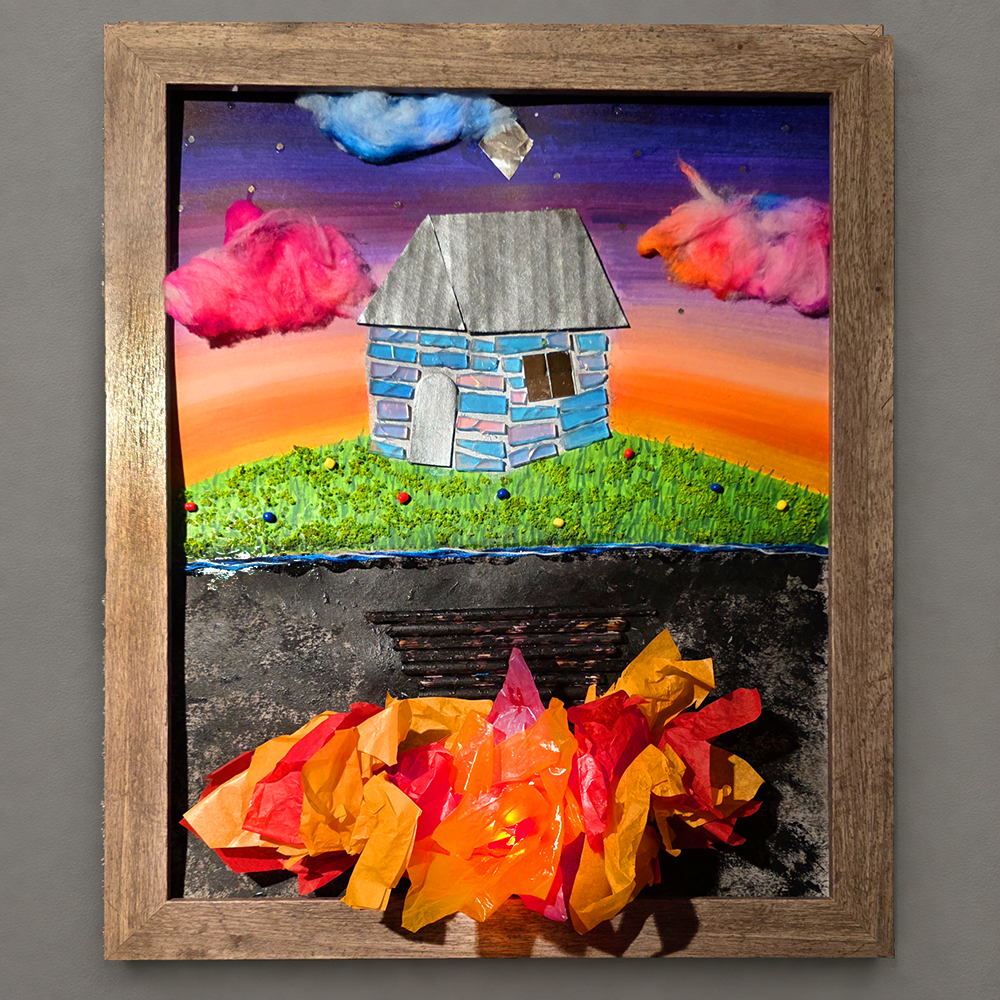
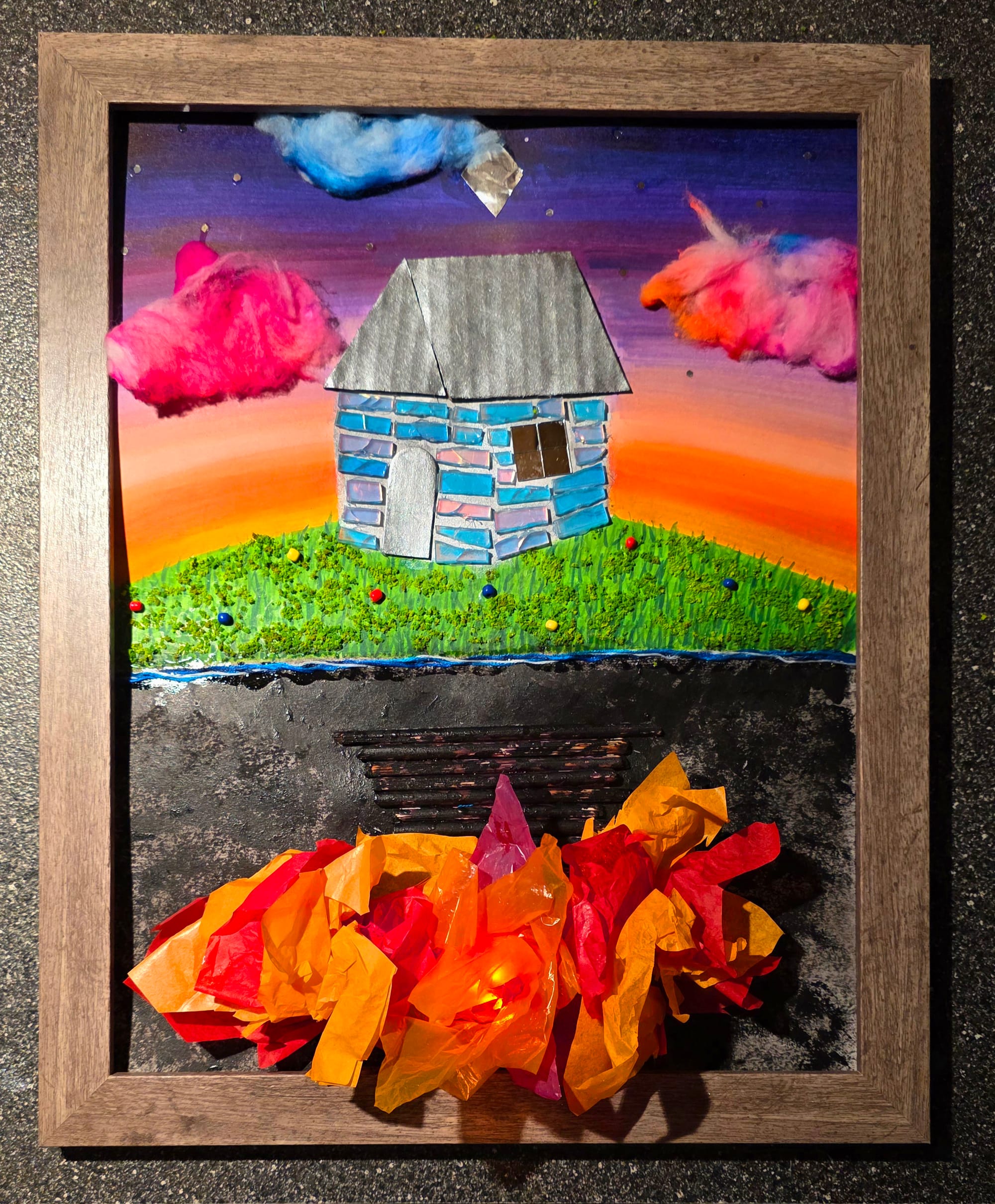
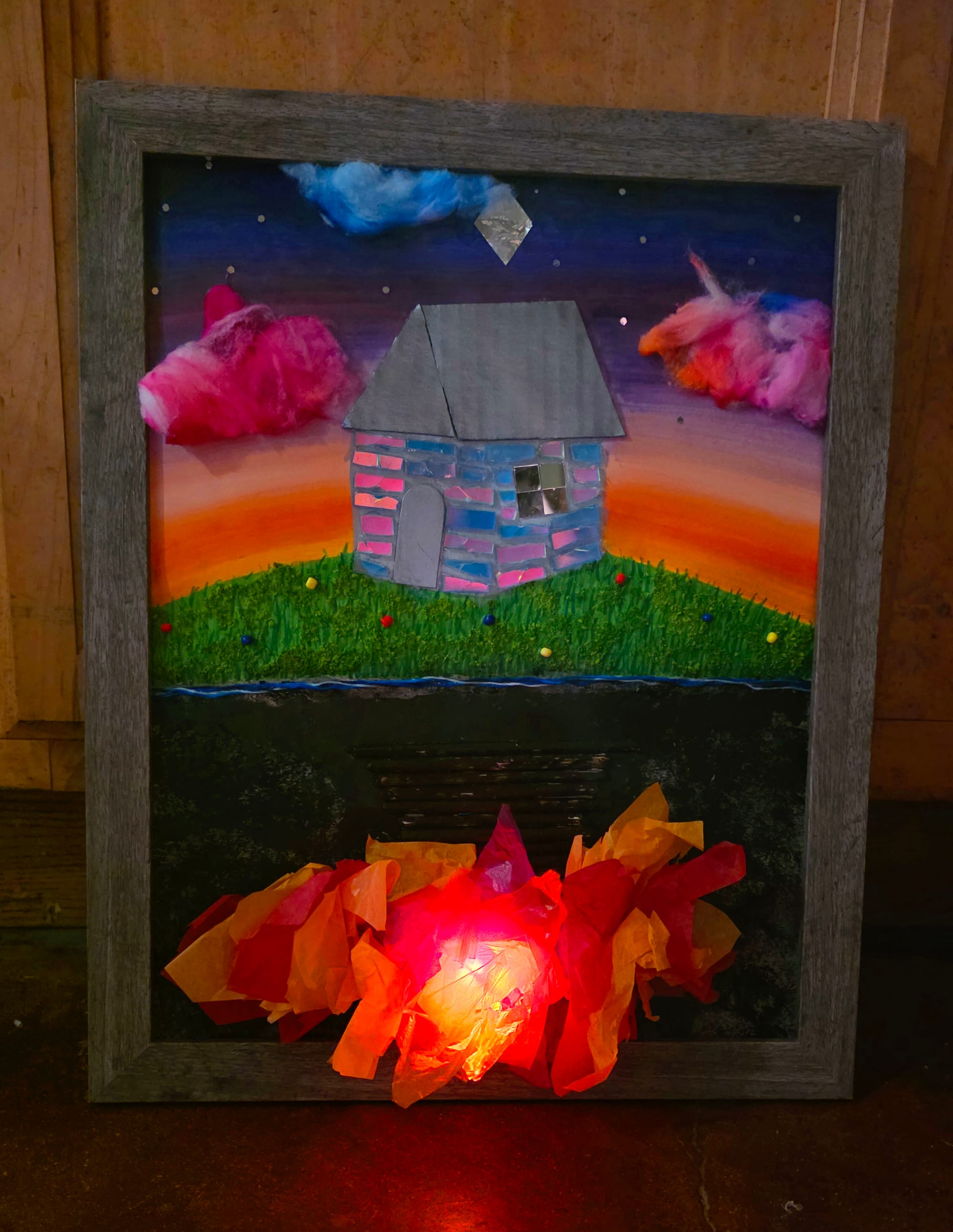
A small house stands beneath a guiding star as the first light of dawn begins spreading across the sky.
Its walls are still being built.
They are imperfect and visibly cracked, but iridescent color and silver travel across their surfaces.
Small signs of life emerge from the surrounding landscape, suggesting that something new has begun—even if it is nowhere near complete.
Beneath the waterline, however, the same house appears as a burned reflection.
Its structure has been reduced to charred wood, fire, ash, and smoke.
What appears above the surface cannot be separated entirely from what remains below it.
They are not two unrelated houses or two entirely separate lives. They are different parts of the same story.
I created Phoenix Rebirth for an exhibition centered on the theme “It’s My Life: It’s Personal. It’s Political. It’s Poetic.”
The title Phoenix Rebirth draws upon the ancient image of a phoenix rising from its own ashes, but I did not include a literal bird within the piece.
Instead, the entire composition becomes the phoenix; the burned reflection holds the ashes of what could not safely continue, while the unfinished house represents the life gradually emerging above them.
This is not a rebirth into someone untouched by fire.
The new life still carries visible cracks, salvaged materials, memory, and evidence of what came before.
Rebirth does not mean returning to an original state; it means becoming capable of building beyond the ending destruction attempted to impose.
The piece reflects what it means to continue building a life after experiences that were profoundly destructive—and to do so without pretending that destruction was necessary, beneficial, or somehow meant to happen.
Stories of resilience are often presented as clean transformations.
Something terrible occurs, the person discovers their strength, and suffering is converted into a triumphant ending.
The ashes disappear beneath the beauty of whatever rose from them.
Real life is rarely that simple.
Leaving an unsafe environment does not immediately create safety.
Recognizing abuse does not erase its consequences.
Freedom may arrive alongside grief, instability, exhaustion, uncertainty, and the loss of people, places, belongings, and identities that once felt inseparable from home.
Sometimes there is no clear moment when destruction ends and rebirth begins; for a while, they exist together.
That is why the burned house remains visible beneath the surface of Phoenix Rebirth.
Erasing it would make the hope above it less truthful.
The life I am building now does not exist because the past was secretly good for me.
It exists because, despite what happened, I have continued searching for whatever could become structure, light, meaning, and shelter.
The silver running through the house does not reward the damage or transform abuse into a blessing.
It represents qualities I have forged in response: discernment, resourcefulness, creative voice, a deeper understanding of healthy love, and the determination to build something different from what I was given.
Even the materials carry that story.
Without access to much of my art-supply collection, I transformed shared supplies and ordinary objects into architecture, atmosphere, fire, reflection, and light.
The piece therefore asks a question larger than whether something beautiful can emerge after pain: how do we create a life from what remains available while refusing to let the people or circumstances that caused the destruction claim credit for what we create afterward?
Phoenix Rebirth does not depict a completed recovery.
The house is unfinished.
The dawn has only begun.
The burned reflection has not disappeared.
But something is being built.
The artwork holds two truths at once: what was done to me was destructive, and it does not get the final say.
The Burned House: When Home Is Not Safe
A house is supposed to represent shelter.
It is where we expect to rest, lower our defenses, keep the things we treasure, and trust that the people inside will care about our well-being.
The idea of home extends beyond walls and a roof; it includes family, belonging, safety, familiarity, and the feeling that there is somewhere in the world we are allowed to exist without constantly proving our worth.
But a house can remain standing while everything the word home is supposed to mean burns away.
When family relationships are shaped by abuse, neglect, manipulation, coercion, scapegoating, or the expectation that one person must continually sacrifice themselves for everyone else, home can become the place where safety is least available.
The language of love and family may remain, but the actions beneath those words tell a different story.
That contradiction can be difficult to acknowledge.
We are often taught that family bonds should survive almost anything—that love means focusing on the good, forgiving repeatedly, remaining loyal, and continuing to offer access no matter how much harm occurs.
The person who names the danger or attempts to leave may be treated as the one destroying the family, even when the family’s own patterns made remaining unbearable.
The burned house beneath the surface of Phoenix Rebirth represents that kind of loss.
It does not represent one bad memory or a single relationship that ended poorly.
It holds the accumulated effects of living where love and harm became tangled together—where belonging came with conditions, where other people’s choices created damage I was expected to absorb, and where protecting myself could be reframed as selfishness or betrayal.
When I eventually left that environment, I did not walk directly from captivity into a completed new life.
Leaving separated me from many of my possessions, including much of the art-supply collection I had built over the years.
It brought housing instability, financial strain, grief, uncertainty, and the challenge of continuing to function while already living with chronic autistic burnout.
But staying would have required me to keep disappearing.
The burned house therefore represents both what was done and what could no longer safely continue.
It holds the grief of realizing that the place and relationships that should have provided shelter could not become safe simply because I loved parts of them or wished they were different.
Sometimes rebuilding does not mean repairing the original house.
Sometimes the foundation itself was shaped by conditions that required us to remain silent, useful, obedient, or small.
Returning to that structure may only return us to the role we had to occupy within it.
A new home must be built from different principles.
- Safety must matter more than appearances.
- Love must include accountability.
- Belonging must not require self-abandonment.
- Care must be allowed to move in more than one direction.
The burned reflection remains in the artwork because leaving does not make the loss unreal.
It also does not mean that nothing within the old life ever mattered. There can be meaningful memories inside a place we cannot safely return to.
We can grieve what was good, what was missing, and what we kept hoping might someday change, but grief does not obligate us to rebuild on the same unsafe foundation.
Sometimes the first step toward creating a home is accepting that we deserve more than a place where we are merely expected to survive.
 Jessica Carey
The Waterline: Where Darkness and Light Meet
The waterline divides Phoenix Rebirth, but it does not create a simple boundary between a dark past and a bright future.
Above it, color begins returning.
The house is under construction, small plants emerge from the ground, and a guiding star remains visible as dawn approaches.
Below it, the same house appears burned and surrounded by smoke, ash, and darkness.
Both exist within the same piece because healing rarely follows a clean progression from suffering into happiness.
We may begin building something new while still grieving what was lost.
We may recognize that leaving was necessary while missing people, places, belongings, or hopes connected to the life we left.
We may experience moments of beauty while continuing to live with exhaustion, uncertainty, and the consequences of what happened.
The waterline represents that space between destruction and rebirth.
It separates the emerging life above from the burned reflection below, but it also connects them.
The lower house is not a discarded version of the upper one.
It remains visible because the life I am building cannot be understood without acknowledging what came before it.
At the same time, the reflection is not the complete truth.
What exists beneath the surface may shape what grows above it, but it does not have exclusive authority over what the future becomes.
The waterline marks the place where survival begins becoming authorship—where I can recognize the story I inherited while beginning to choose what I will build beyond it.
Light plays an important role in that transition.
The area containing the fire is one of the darkest parts of the artwork.
I added a tea light behind the flames so that the fire would actually glow.
Part of my reasoning was playfully literal: if it is fire, it might as well bring light.
That may be my autistic mind showing itself in the creative process, but the literal choice also deepened the metaphor.
Light is easiest to recognize against darkness.
A small flame may barely register in full daylight, but in a darkened space it can reveal shape, texture, distance, and direction. It does not make the darkness disappear, but it changes what becomes visible within it.
The illuminated fire creates an intentional contradiction; fire is the force associated with destruction in the lower half of the piece, yet it is also the artwork’s physical source of light.
That does not mean the destruction was secretly beneficial.
The fire does not become good because it glows, and the harm it represents does not become necessary because I eventually created meaning in response to it.
Instead, the light represents what can emerge when darkness is examined rather than denied.
Experiences of unsafe love and broken belonging forced me to confront questions about relationships, boundaries, accountability, care, and what genuine safety should feel like.
Those questions eventually became part of my writing and creative work.
The illumination belongs to what I have learned, named, and created—not to the people or circumstances that caused the damage.
The fire may have created the darkness within the scene, but it does not control what the light reveals.
It reveals the ruins.
It makes the textures visible.
It draws attention to what happened instead of allowing it to remain hidden.
And because the light can be seen from beyond the burned reflection, it also suggests that destruction is not the only thing present there.
Perhaps that is another reason the piece needed a literal light.
I did not want hope to exist only in the bright colors above the surface; I wanted evidence of it to exist within the darkest part, too.
Sometimes light arrives as rescue, safety, or a clear path forward.
Sometimes it is smaller: the ability to name what happened, recognize what is no longer acceptable, find one usable material, create one honest piece of art, or imagine that another kind of life might exist.
The light does not erase the darkness; it illuminates it—and in doing so, prevents the darkness from becoming the only thing we can see.
The Unfinished House: Rebuilding Is Still a Form of Living
The house above the waterline is not complete.
Its walls are rising, but the structure remains visibly under construction.
It does not yet represent the secure, settled home I ultimately hope to create.
There is still uncertainty surrounding it, and the dawn behind it has only begun.
That incompleteness is intentional.
Stories about survival often focus on the moment someone escapes, leaves, speaks the truth, or chooses a different life.
That decision becomes the triumphant ending—as though recognizing the cage and walking through its open door immediately resolves everything that happened inside it.
In reality, leaving is often the beginning of another difficult chapter.
A person may leave an unsafe environment without having a safe home waiting for them.
They may lose access to possessions, financial stability, familiar routines, community, or relationships.
Their body may continue responding to danger long after the immediate threat has changed.
They may understand intellectually that they are free while still feeling guilt, fear, grief, or the expectation that they will be punished for choosing themselves.
Freedom matters, but it does not automatically create restoration.
 Jessica Carey
When I left my family environment, I chose the possibility of a different life.
I did not step into a completed version of that life.
I entered a period of housing instability, financial strain, continued chronic autistic burnout, and the exhausting work of trying to build safety without many of the resources that would make rebuilding easier.
There have been moments when progress did not look like progress.
It looked like surviving another transition.
Asking someone for help.
Sending another email.
Finding somewhere temporary to stay.
Creating with materials I could access instead of the collection left behind.
Learning that rest is necessary even when the world continues demanding productivity.
Recognizing that choosing differently was worthwhile even when the consequences of that choice remained painful.
The unfinished house honors that stage.
It does not pretend that struggle ends the moment a person leaves what harmed them.
It also refuses the idea that a life must be stable, polished, or complete before it can contain beauty and meaning.
Construction is not failure.
A foundation is not less valuable because the roof has not yet been finished.
A wall does not become meaningless because another still needs to be built.
The absence of a completed home does not erase the courage, labor, resourcefulness, and hope already present in creating one.
The upper house is therefore not a symbol of having arrived; it is a symbol of direction.
Its existence says that I am no longer building according to the rules of the burned house below it.
The new structure can be shaped by principles the old one did not consistently provide: safety, reciprocity, accountability, compassion, freedom, and the belief that my needs are allowed to matter.
I do not yet know exactly what every part of that life will look like.
The uncertainty can be frightening.
A harmful but familiar role still provides a script: remain useful, remain quiet, absorb the pain, keep everyone else comfortable, and call that love.
Building something different requires making choices without a complete blueprint.
But an unfinished future also contains possibility.
There is space for relationships that do not require self-abandonment.
There is space for a home where rest is not treated as failure.
There is space for creativity, community, meaningful work, mutual care, and the family I still hope to create.
There is space to discover who I am beyond the roles I was assigned.
Phoenix Rebirth does not say: everything is better now.
It says: something different is being built.
The house may be incomplete, but it is already evidence that the ruins were not the end of the story.
 Jessica Carey
Cracks, Silver, and the Limits of the “Silver Lining”
The house above the waterline is not smooth or untouched.
Its iridescent tile walls contain visible cracks amidst silver.
This detail was inspired by kintsugi, the Japanese practice of repairing broken pottery with lacquer mixed with powdered metal.
Rather than attempting to make the damage invisible, the repair becomes part of the object’s continuing history.
That idea felt appropriate for Phoenix Rebirth.
Healing does not return us to the person we might have been if nothing painful had happened.
Some experiences permanently change how we understand ourselves, relationships, safety, and the world around us.
Repair cannot make the past untrue, but it can allow life to continue without requiring the cracks to remain hidden.
Still, I wanted to approach this symbolism carefully.
Images of kintsugi and “silver linings” are sometimes used to suggest that suffering improves people—that damage was necessary because something beautiful eventually emerged from it.
Within that interpretation, trauma becomes a disguised gift, and survivors may feel pressured to prove that what happened made them stronger, wiser, kinder, or more successful.
But harm does not become good because someone creates something meaningful afterward.
I can recognize strengths I developed in response to what happened without believing I needed to be harmed in order to possess value.
I can appreciate what I have learned without becoming grateful for the conditions that forced me to learn it.
I can honor the person I became without pretending the person I might have been with greater safety, care, and support was somehow less worthy.
The silver in this piece is therefore not a reward for destruction.
It does not belong to the people who caused the cracks.
It represents what I forged in response: discernment, resourcefulness, empathy, creative voice, stronger boundaries, and a clearer understanding of what love should—and should not—require.
For much of my life, I was taught to focus upon the good in people while minimizing the harm they caused.
I became skilled at understanding other people’s histories, intentions, pain, and limitations, even when they did not offer the same care toward mine.
That understanding sometimes made it harder to recognize when compassion had become self-abandonment.
The questions created by those experiences eventually became part of my work:
- What makes a relationship safe?
- What is the difference between love and control?
- Can we understand why someone behaves harmfully without continuing to accept the harm?
- When does forgiveness become another demand placed upon the injured?
- What does it mean to care for others without disappearing?
Those questions helped shape my writing about healthy relationships, boundaries, accountability, and the possibility of building something better.
The insight is real.
The creative work growing from it is real. But neither makes the original harm necessary.
The silver honors what I made from the questions after they were placed in my hands.
This distinction protects the survivor’s authorship.
If we say suffering automatically creates strength, we give the suffering too much credit.
Many people become resourceful because they were denied adequate resources.
They become independent because dependable help was unavailable.
They learn to read every emotional shift because unpredictability made constant awareness necessary.
These abilities may later become valuable, but they often developed at a tremendous cost.
Survival skills deserve recognition without romanticizing the circumstances that required them.
The silver also does not conceal every crack; it follows their shape.
That matters because healing is not always about restoring the appearance of being untouched.
Sometimes it means becoming less ashamed of the evidence that we have lived through something.
It means allowing repair to be visible and refusing the belief that only an unbroken life can be beautiful.
The house remains imperfect.
Its history remains legible.
But the cracks no longer represent only where the structure was damaged.
They also mark the places where care, truth, creativity, and conscious choice have entered.
I do not believe everything happens for a reason.
I believe that when something painful happens, we may eventually create reasons to continue.
The silver does not tell me why the house was broken; it reflects the light I am choosing to build with now.
Creating with What Was Available
The materials in Phoenix Rebirth were not selected only for how they looked; they were shaped by what I could reach.
When I left the abusive family environments, I also lost access to nearly all of the art-supply collection I had built over many years.
Those materials still existed, but they were no longer available to me.
Creating this piece therefore began with a practical question that closely resembled the larger question behind the artwork: what can I build with what remains available?
I used supplies shared through an open art studio and ordinary materials I could find around me.
Cardboard became the structure of the roof.
Aluminum foil became reflective silver.
A popsicle stick became part of the architecture.
Plastic bags, cotton balls, charred bamboo, iridescent tiles, and other small materials became landscape, smoke, fire, texture, and shelter.
When I did not have silver paint, I mixed silver mica powder with clear glue.
When the fire needed light, I added a tea light.
Each limitation required another act of observation: what does this material already know how to do? What could it become if I stopped seeing it only according to its original purpose?
That question is central to creative reuse.
A plastic bag may be designed to carry groceries, but it can also hold color, movement, translucency, and texture.
Cardboard may be discarded packaging, but it can become a wall, a roof, or the foundation of an imagined home.
Foil can become reflected light.
Cotton can become smoke or clouds.
A damaged, leftover, inexpensive, or overlooked material may contain possibilities that are easy to miss until someone gives it sustained attention.
The process mirrors the meaning of the finished piece.
I was creating an image of rebuilding while actively improvising with what I could access.
The artwork did not merely represent resourcefulness; resourcefulness became the method through which it was made.
That does not mean lacking access to my own supplies was secretly ideal.
There is a tendency to romanticize stories in which someone creates something beautiful from scarcity.
The person’s ingenuity becomes evidence that they never truly needed more support, stability, money, time, space, or materials.
Their ability to adapt is used to make the deprivation appear less serious.
But making do is not the same as having enough.
Resourcefulness can be a genuine strength while also revealing the conditions that made such constant adaptation necessary.
I can feel proud of what I created from cardboard, foil, plastic, and shared supplies while still recognizing that I should not have been separated from my belongings or forced to rebuild without adequate resources.
Both truths can exist together.
Constraint influenced the artwork, but it did not deserve authorship over it; the creativity belongs to the person who looked at what was available and imagined another use.
This is part of what makes creative reuse meaningful to me beyond one art piece.
It asks us to look again at things that have been categorized as scraps, leftovers, or waste.
It challenges the assumption that value disappears when something no longer fulfills its original purpose.
That idea carries an emotional resonance.
People can also become trapped inside narrow definitions of usefulness.
We may be valued for what we provide, how much we endure, how reliably we solve problems, or how little support we appear to require.
When we can no longer perform that expected function, we may fear that our value has disappeared.
But worth is not the same as usefulness.
A material can become something its original design never anticipated; a life can also move beyond the roles other people assigned to it.
 Jessica Carey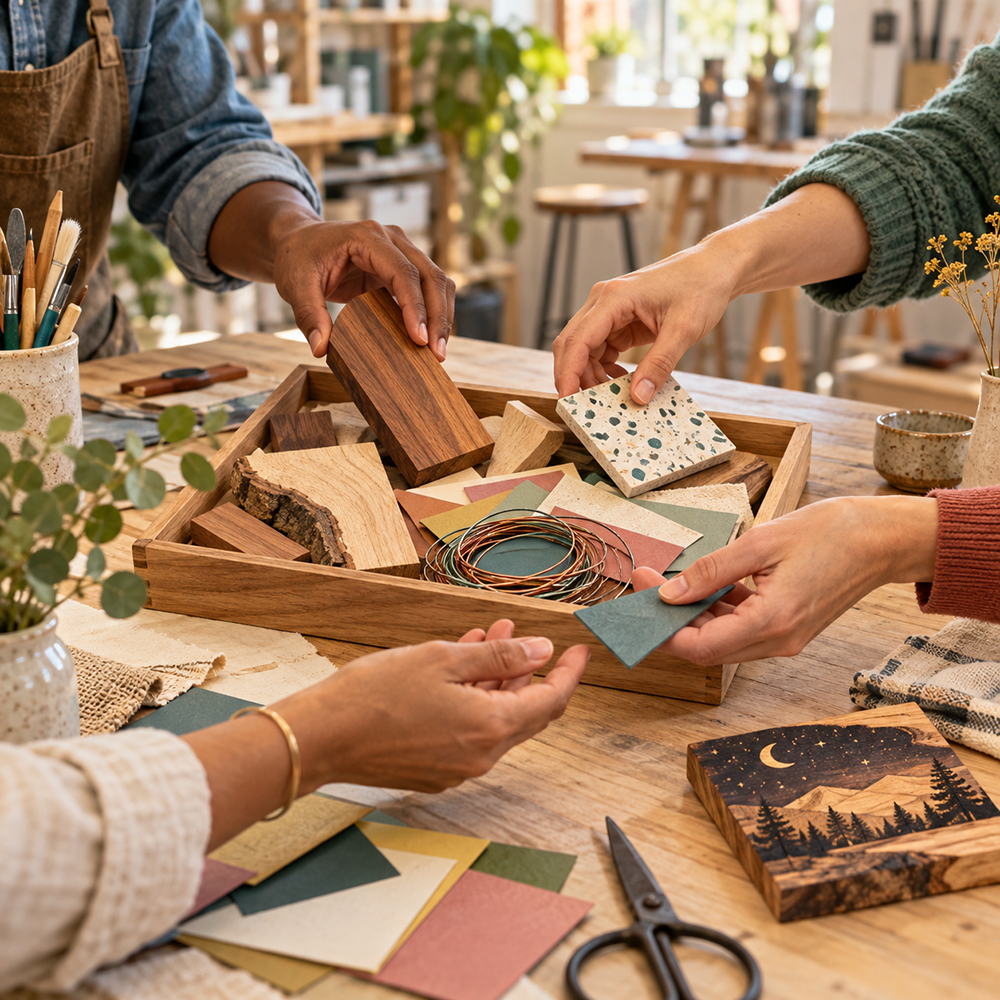
The cardboard in Phoenix Rebirth does not need to pretend it was never a box.
Its history remains part of its surface, but it is no longer limited to what it used to hold; it has become part of a house.
The charred bamboo does not stop being burned; it becomes capable of carrying meaning about destruction, memory, and survival.
The mica and glue do not become literal metal, but together, they still create silver light.
None of these transformations erase what the materials were; they reveal that what something has been is not the only indication of what it can become.
Creating this piece reminded me that art does not always begin with ideal conditions.
Sometimes it begins with attention, experimentation, shared resources, and the willingness to ask what can still be made.
I did not have everything I wanted or deserved to have available, but I had enough to begin.
And beginning with what I could reach became part of the artwork’s truth: even when the perfect tools, conditions, and support are absent, the human impulse to imagine, transform, and build can remain.
 Jessica Carey
Personal, Political, and Poetic
The exhibition invited artists to respond to the theme “It’s My Life: It’s Personal. It’s Political. It’s Poetic.”
At first, those possibilities may sound like separate directions; an artwork might tell an intimate story, make a statement about society, or communicate through beauty and metaphor.
For me, Phoenix Rebirth became all three because personal experiences do not occur outside the systems surrounding them—and art can make those connections visible without reducing them to a single explanation.
The piece is personal because it emerged from my own life.
The burned house represents the harm, neglect, manipulation, and broken belonging I experienced within relationships that were supposed to provide love and safety.
The unfinished house reflects the life I have been trying to build since leaving.
The materials record my present circumstances: limited access to my belongings and supplies, continued housing instability, chronic autistic burnout, and the need to create with whatever I could safely reach.
But the piece is also political—not because it promotes a political party or attempts to offer a policy argument, but because questions of safety, family, disability, housing, resources, and whose suffering society takes seriously are never entirely private.
When harm occurs within a family, people are often encouraged to preserve the appearance of unity rather than protect the person being harmed.
Biological connection may be treated as an endless obligation.
Survivors may be asked to forgive, remain silent, focus on good memories, or offer continued access so that other people do not have to confront the consequences of their behavior.
Leaving is then described as an individual choice while the material cost of leaving is ignored.
- Where will the person live?
- How will they retrieve their belongings (or can they even retrieve them)?
- What happens if disability limits their income or energy?
- Who helps them navigate overloaded systems while they are already exhausted?
- How do they rebuild without the financial, practical, and relational support that families are assumed to provide?
The ability to leave danger depends upon more than courage.
It also depends upon housing, money, transportation, healthcare, accessible services, community support, and people willing to believe what happened.
When those resources are unavailable, the cage may remain closed even when someone recognizes it.
My resourcefulness helped me create this artwork, but resourcefulness should never be used as evidence that adequate support was unnecessary.
The fact that people can improvise shelter, stretch limited resources, navigate impossible systems, or make beauty from scraps does not mean they should continually be expected to survive that way.
A society reveals its values not only through what it celebrates, but through what it asks people to endure alone.
That is part of the political dimension of Phoenix Rebirth.
The piece asks viewers to look beyond the inspirational image of someone rebuilding and consider why so much rebuilding must happen without a stable foundation.
The artwork is also poetic because some truths are difficult to communicate through literal description alone.
A house can represent both a physical dwelling and a sense of self.
Water can become a boundary, a reflection, a memory, or the emotional distance between what others see and what continues beneath the surface.
Fire can destroy while also casting light.
Silver can trace damage without concealing it.
A guiding star can suggest hope without promising certainty.
Dawn can begin before the night has completely ended.
These images allow apparently opposite truths to remain beside one another.
The artwork can hold destruction and creation, darkness and illumination, grief and hope, limitation and imagination, all within the same frame.
That is what poetry often makes possible.
It does not always resolve contradictions; sometimes it gives them a place to coexist.
The personal, political, and poetic elements of Phoenix Rebirth are therefore inseparable.
My personal story exposes broader questions about whose safety matters and what support rebuilding requires.
The materials show both individual ingenuity and the reality of constraint.
The visual metaphors create room for emotional truths that cannot be reduced to a simple message about overcoming adversity.
The piece is personal because I lived it.
It is political because no one’s access to safety exists in isolation.
And it is poetic because the burned house, the unfinished home, the waterline, the silver cracks, and the emerging light can speak where ordinary explanation reaches its limits.
 Jessica Carey
The Guiding Star and the Beginning of Dawn
Above the unfinished house, a star remains visible as dawn begins to enter the sky.
The star does not represent a guarantee that everything will work out exactly as I hope; it does not provide a complete map, remove every obstacle, or reveal how long rebuilding will take.
It represents direction.
When much of life is uncertain, direction can matter more than certainty.
I may not know exactly where I will live, when stability will arrive, how every practical problem will be resolved, or what form the life ahead will eventually take.
But I can still identify the values I want that life to move toward.
Safety.
Kindness.
Mutual care.
Creative freedom.
Relationships in which love does not require control, fear, or self-abandonment.
A home where rest is permitted and support is not something that must be earned through constant usefulness.
A future containing meaningful work, community, family, children, creativity, and the ability to help make the world gentler for other people.
These hopes do not provide a simple route forward; they function more like the star: a point of orientation when the surrounding landscape remains difficult to read.
Sometimes survival narrows life to whatever must happen next.
The next safe place to sleep.
The next bill.
The next application, appointment, email, deadline, or transition.
Long-term dreams can begin to feel distant or even irresponsible when immediate needs remain unresolved.
But direction can survive even when progress is difficult to measure.
The house can remain unfinished while still facing toward the life I want.
The dawn carries a related meaning.
I did not want to portray a bright midday sky, because that would suggest that the darkness had completely passed and the new life was fully established.
That is not where I am.
The light is only beginning.
Dawn is a transitional hour; the world has not yet become fully visible.
Shadows remain, the air still carries the night, and the day ahead is unknown.
But something has undeniably changed; the darkness is no longer complete.
That is closer to the kind of hope I wanted Phoenix Rebirth to hold.
Hope is often described as confidence that a desired outcome will occur.
But when someone has experienced repeated instability, broken trust, or systems that continually fail to provide meaningful support, certainty may not be available.
Hope may need to take a quieter form.
It may be the willingness to send one more message.
To accept help without interpreting need as failure.
To create with the materials currently available.
To keep imagining a safe home before knowing how it will be reached.
To believe that an unfinished life is still worth investing in.
To recognize small signs of growth without demanding that they prove the struggle is over.
The beginnings of color and life above the waterline represent that quieter hope.
They do not cover the ashes below.
They exist beside the evidence of what happened and insist that destruction is not the only process underway.
Something is also taking root.
Something is reflecting light.
Something is being assembled piece by piece.
This matters because hope does not need to deny reality in order to be real.
In fact, hope becomes more trustworthy when it can acknowledge how difficult the present remains.
I do not need to call instability security.
I do not need to describe exhaustion as strength.
I do not need to pretend that temporary shelter is the same as home or that surviving without adequate support means adequate support was unnecessary.
I can tell the truth about where I am and still believe that where I am is not the only place I will ever be.
The guiding star does not tell me that the journey will be easy.
The dawn does not tell me that the night never happened.
They offer something smaller and more honest: orientation, possibility, and evidence that change can begin before the complete future is visible.
The dawn has not fully arrived, but neither is the world entirely dark.
Sometimes hope is simply the decision to keep building toward the light we can already begin to see.
 Jessica Carey
Destruction Does Not Get the Final Say
Phoenix Rebirth is not an image of complete restoration.
The burned house remains beneath the surface, the cracks remain visible, and the new home stands beneath a dawn that has only begun; that incompleteness is part of the truth.
I am still living within the process the artwork represents.
I have left what was unsafe, but I have not yet reached every form of safety and stability I am working toward.
I am still carrying grief, exhaustion, uncertainty, and the practical consequences of rebuilding without the foundation I should have received.
But I am also carrying more than loss.
I am carrying clearer boundaries.
A stronger understanding of what love should feel like.
The creative voice that helped me transform ordinary materials into an image of shelter.
The resourcefulness to begin with what is available.
The willingness to keep imagining a life that does not repeat the conditions from which I came.
These things do not make the destruction worthwhile; they show that destruction was unable to take everything.
The artwork’s two houses therefore need one another.
If I included only the burned reflection, the piece would suggest that what happened was the whole story.
If I included only the colorful house above it, the piece might imply that hope requires hiding the damage or pretending rebuilding is complete.
Together, they offer something more honest.
A life can contain ruins and construction at the same time.
Grief can exist beside possibility.
The past can remain visible without being given permanent authority over the future.
Art cannot restore everything that was lost.
It cannot provide housing, return inaccessible belongings, erase trauma, or make harmful people accountable, but it can create a place where reality is named and reorganized.
It can take experiences that once felt chaotic or unspeakable and give them form, texture, color, boundaries, and light.
Creating Phoenix Rebirth allowed me to decide how the story would be represented.
The fire would be visible, but it would not occupy the entire piece.
The cracks would remain, but they would carry silver.
The house would be unfinished, but it would be rising.
The darkness would exist, but it would contain a literal source of light.
The dawn would not pretend that night never happened; it would simply announce that night was not permanent.
Perhaps this is what rebirth means to me now.
Not returning as someone untouched.
Not transforming suffering into a blessing.
Not arriving instantly at a perfect new life.
Rebirth is the gradual recovery of authorship.
It is the ability to look at what remains and decide what can be carried forward, what must be left behind, and what has never existed before but can now be built.
Phoenix Rebirth holds two truths at once: what was done to me was destructive, and it does not get the final say.
The burned house is part of the story.
The unfinished house is part of the story, too.
And somewhere between the ashes and the approaching dawn, I am still here—gathering what I can reach, following the light I can see, and building.
See Phoenix Rebirth in Person
Phoenix Rebirth was created for “It’s My Life: It’s Personal. It’s Political. It’s Poetic,” an exhibition organized by Marnie’s Creative Outlet and Becky Gunter Photography.
The opening reception will take place at Marnie’s Creative Outlet in Webster Groves, MO on Saturday, October 24, 2026, from 4–7 p.m.
The exhibition will feature personal, political, and poetic artwork created by participating adult and youth artists.
Want even more content about creativity and art?
Be sure to check out all of our creative chronicles!
If you'd like to see examples of my work, you can find some of my art and creations at Redbubble and Gumroad!
Looking to learn more about my recent journey?
Check out some of these articles:
-Hidden Gems for St. Louis Artists
-Hidden Gems for Autistic & Neurodivergent Adults
-Learning What Love Was Supposed to Feel Like
-I Wasn't Broken--I'm Burned Out
-The Difference Between Resting and Giving Up
-What Chronic Autistic Burnout Actually Feels Like
-When You Had to Raise Yourself
 Jessica Carey