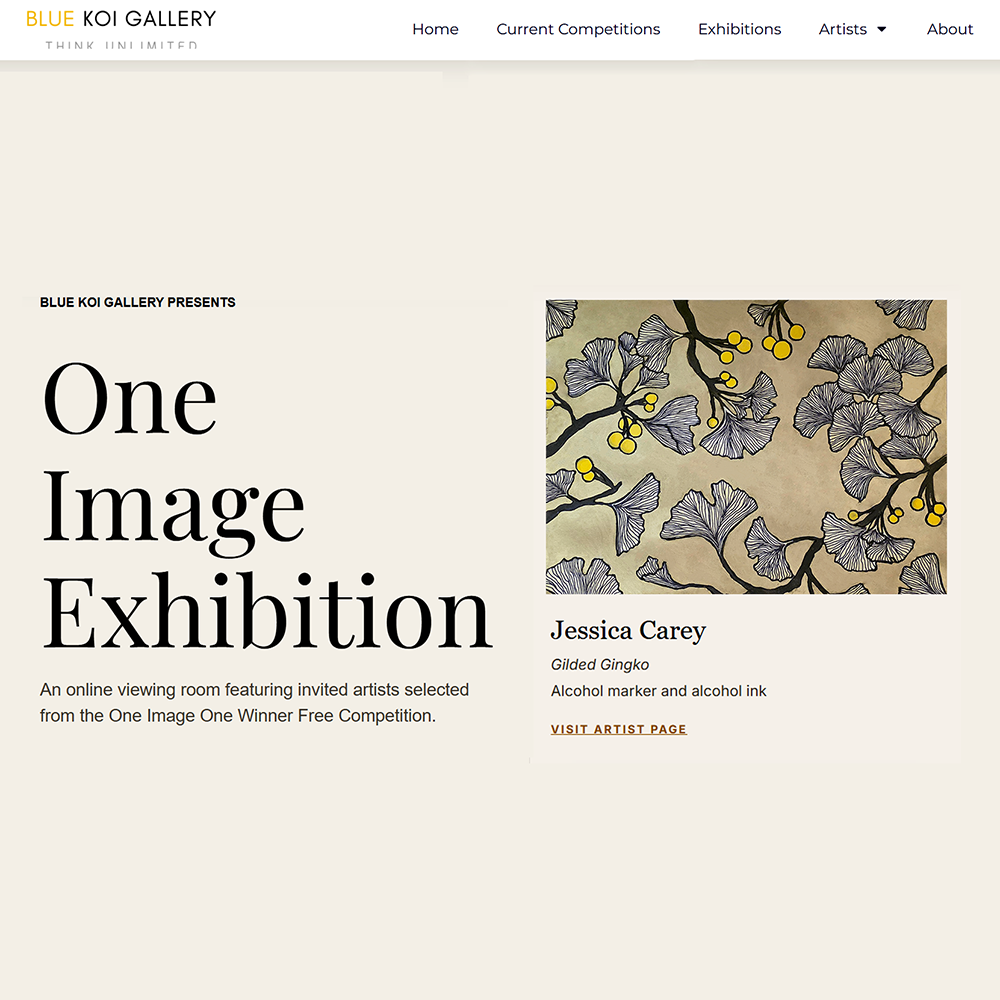
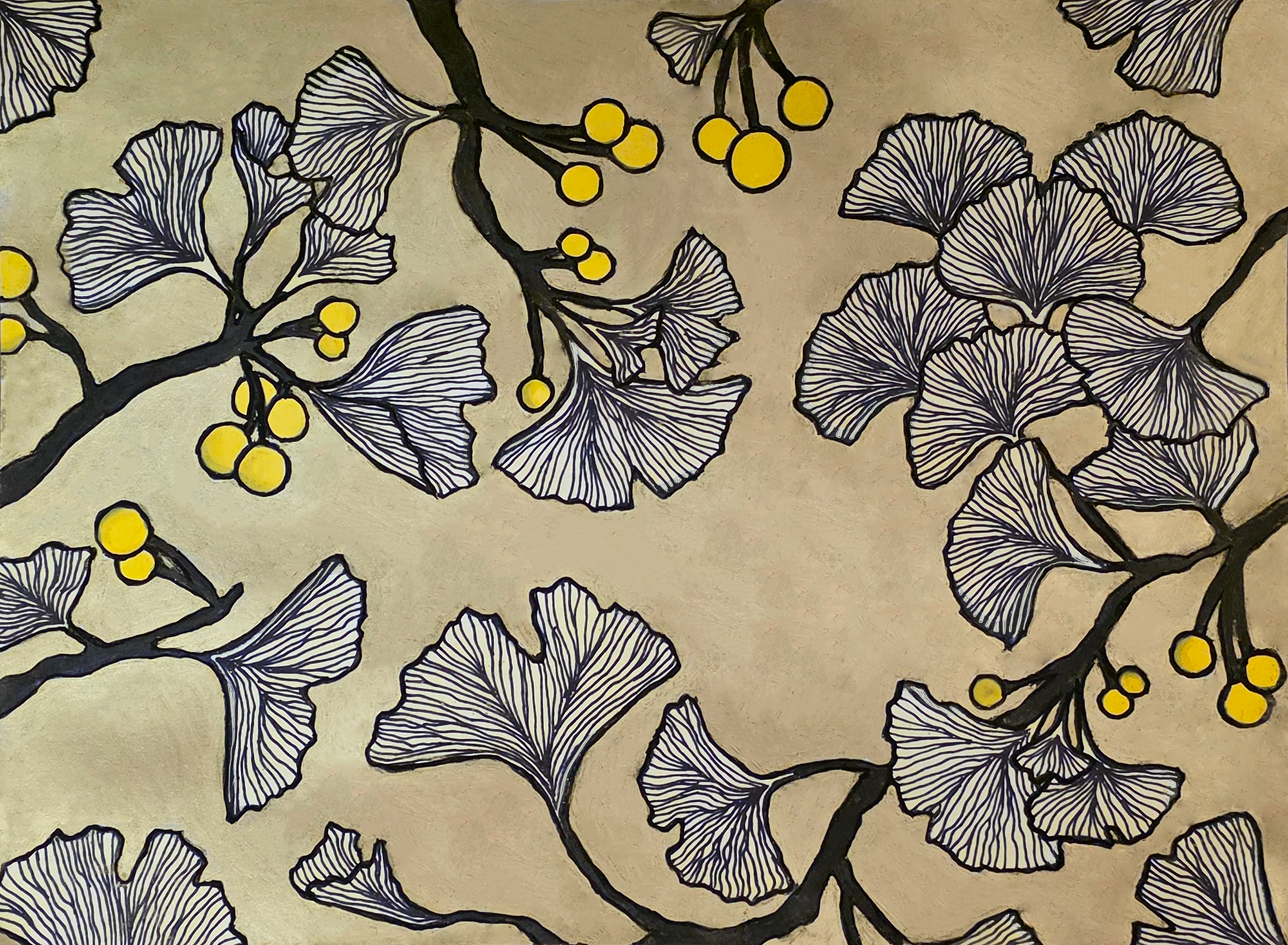
I recently submitted Gilded Ginkgo to Blue Koi Gallery’s One Image One Winner art competition.
The premise was deceptively simple: each artist could submit one original artwork at no cost, and one image would ultimately receive the competition’s primary award.
Choosing only one piece to represent my work was a challenge in itself.
Artists often create across different subjects, materials, styles, and stages of growth.
A single image cannot communicate everything an artist has made or hopes to explore.
Still, it can offer one concentrated glimpse into the way that person sees, thinks, and creates.
More than 550 artworks were submitted to the competition.
Among that large collection of creative voices, Gilded Ginkgo stood out enough to receive an invitation to Blue Koi Gallery’s curated online exhibition.
Blue Koi Gallery chose a limited number of additional works that its reviewers believed deserved further recognition and a professionally presented place within an online exhibition.
That distinction matters to me—artistic recognition does not always arrive as a first-place prize.
Sometimes it arrives as an invitation: someone encountered the work among hundreds of other submissions, paused before it, and decided it deserved to remain part of the conversation.
I am excited that Gilded Ginkgo will now be seen beyond the places where I originally created and shared it.
What began as one artwork made through my own hands will become part of a larger international collection of artistic perspectives—each represented by the single image its creator chose to send forward.
The Story Behind Gilded Ginkgo
Gilded Ginkgo did not begin as a piece created specifically for an exhibition.
It began as an Inktober drawing—one creative response within a challenge built around making art from daily prompts.
The prompt for October 8th was "stinky," but none of the typical stinky things held any appeal; as a result, I did some research on what things are stinky and found that the ginkgo berries smell quite bad.
I love the way ginkgo leaves look, so it seemed like the perfect route.
Using pen and alcohol ink, I developed an arrangement of ginkgo leaves and berries.
Yellow leaves overlap and repeat across the composition and a golden background, punctuated by the rounded berries that inspired the subject.
Dark ink outlines and interior marks give the botanical forms definition, while their repetition allows the drawing to function as both a study of the plant and an ornamental pattern.
The repeated natural forms gradually created something more decorative and expansive than a single botanical study.
When art club saw my finished drawing, several people compared it to hand-drawn wallpaper.
They responded to the repetition, detail, and way the individual leaves worked together to create a larger pattern.
More importantly, they encouraged me to submit it to an art competition.
That encouragement mattered.
Artists spend so much time close to their own work that it can be difficult to evaluate what other people may see within it.
We remember the uncertain beginning, the marks that did not behave as expected, and every decision we reconsidered along the way.
Sometimes another person can recognize strength in a piece before its creator fully understands what they have made.
 Jessica Carey
When the One Image One Winner opportunity appeared, I had to decide which single artwork I wanted to send forward.
One image could never represent every medium I use or every direction my artistic practice may eventually take.
Instead of asking which piece could explain everything about me, I considered which one felt capable of standing on its own.
Gilded Ginkgo had already done that in a small way.
Before it entered any formal review process, it had made people pause, look more closely, and imagine possibilities for it beyond the context in which it was created.
Their reactions helped me see it not merely as another completed drawing, but as a work that might be ready to meet a wider audience.
Choosing it therefore became an act of trust: trust in the piece, trust in the people who saw something meaningful within it, and trust that submitting art does not require certainty that it will be chosen.
It only requires enough willingness to let the work leave the familiar room where it was made.
Now, the same drawing that began as an Inktober experiment will appear in an international online exhibition.
Its journey reminds me that not every meaningful opportunity begins with a grand plan.
Sometimes it begins with ink, a repeated leaf, a room of people saying: “You should submit this,” and the decision to believe them.
How the One Image One Winner Competition Works
Blue Koi Gallery’s One Image One Winner competition was built around a focused premise: one artist, one original artwork, and one opportunity to make a strong impression.
The competition was open to adult artists worldwide and accepted work across a wide range of two-dimensional and three-dimensional visual media, including painting, drawing, photography, digital art, mixed media, sculpture, and textiles.
AI-generated artwork was not accepted, and each submission had to be created and owned by the artist.
There was no fee to enter or to have the artwork considered.
Each artist could submit one image, rather than paying to submit several works or an entire portfolio.
That made the opportunity financially accessible, but it also placed considerable weight on the selection of that single piece.
Blue Koi Gallery stated that submissions would be considered according to four primary areas:
- Artistic voice: how clearly the artwork communicated the artist’s individual point of view
- Originality: the creativity and individuality present within the work
- Visual impact: the strength of its composition, presentation, and emotional presence
- Technical skill: the artist’s execution, control, and understanding of the chosen medium
The competition created two separate paths to recognition.
One artist would be named the official winner and receive the $100 cash award, along with a website feature and promotion.
A limited number of additional artists could be invited to participate in the curated online exhibition.
That second path is how Gilded Ginkgo was selected.
The one-image format made the choice unusually important.
Rather than relying on a larger portfolio to demonstrate range and development, each artist had to choose one work capable of communicating independently—something strong enough to hold attention, convey an artistic voice, and inspire curiosity about what else its creator might make.
More than 550 artists accepted that challenge.
Although only one artwork could receive the primary award, the curated-exhibition component created space for additional pieces that made a meaningful impression during the review.
That distinction reflects something valuable about art itself: artistic strength is rarely limited to one work or one way of seeing.
A competition may require a single winner, but a thoughtfully curated exhibition can recognize that many different images deserve to be encountered.
What the Curated Exhibition Selection Includes
Selection for the curated exhibition means that Gilded Ginkgo will receive a professionally published place within Blue Koi Gallery’s online presentation of artwork chosen from the competition.
The exhibition is not a physical installation, so I will not need to ship the original drawing or travel to another location.
Instead, the artwork will be presented digitally in a clean, gallery-style format alongside other selected pieces.
Its listing will include my name, the artwork’s title and medium, as well as a link allowing interested viewers to continue exploring my work.
Blue Koi Gallery may also highlight the exhibition through its website, email communications, or social-media channels.
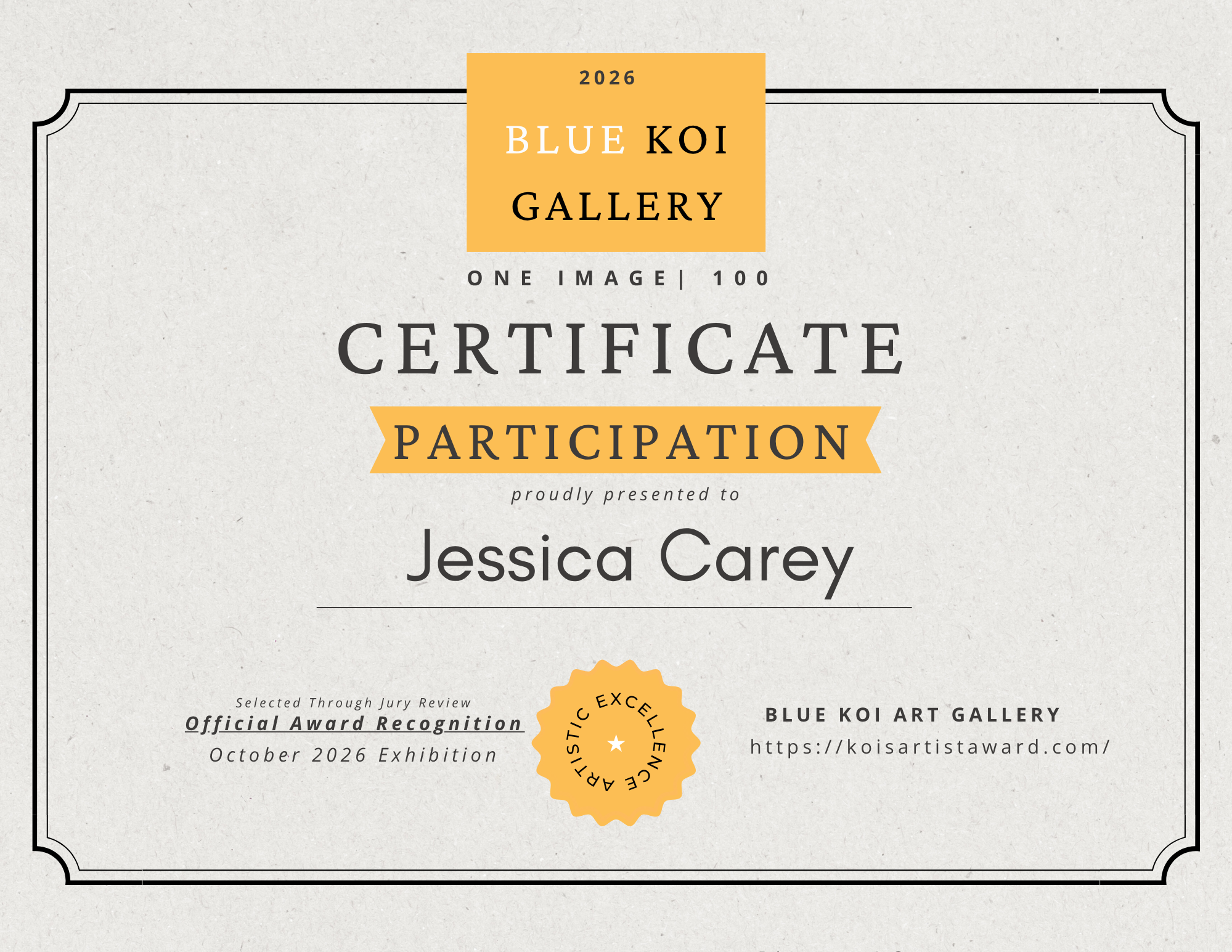
Participating artists are expected to receive a certificate documenting their inclusion, and the exhibition will create a publicly accessible record that can become part of an artist’s portfolio and exhibition history.
Online exhibitions cannot reproduce every quality of encountering an original work in person.
Scale, surface, texture, and the presence of the physical object may be experienced differently through a screen.
At the same time, an online exhibition can cross distances that a physical exhibition cannot.
Artists and viewers do not need to live near the same city, pay for transportation, arrange shipping, or navigate the accessibility barriers of a particular building.
Work created in many different places can share one exhibition space and become available to viewers around the world.
For me, the selection represents recognition beyond the competition’s single cash award. It does not assign Gilded Ginkgo a numerical ranking; it means the piece was reviewed, made an impression, and was invited into a curated presentation.
That invitation gives the artwork an opportunity to travel without the physical drawing ever leaving my hands.
It can reach people who were not present when I made it, who never attended the art club where others first encouraged me to submit it, and who might otherwise have had no reason to encounter my work.
In that sense, the exhibition creates more than another line for my artistic résumé.
It creates a doorway: one through which new viewers can discover Gilded Ginkgo, explore the rest of my creative practice, and perhaps find something within the work that invites them to pause.
About Blue Koi Gallery
Blue Koi Gallery is a global online art platform founded and directed by Ka Koi.
It grew from a desire to promote innovative art and create meaningful conversations around the work artists are producing.
The gallery primarily supports emerging and mid-career visual artists through juried competitions, curated online exhibitions, open calls, artist features, cash awards, and promotional opportunities.
Its calls welcome artists working across many media and styles, with particular attention to expanding visibility for underrepresented creative voices.
Blue Koi Gallery describes its mission as championing artists through access, recognition, and dialogue.
Its online model allows artists from different locations to submit and exhibit work without transporting the original piece.
Although digital presentation cannot reproduce every physical quality of an artwork, it can make exhibitions accessible across geographic boundaries and introduce artists to audiences beyond their existing communities.
The gallery also maintains an online exhibition archive, preserving selected artwork, artist names, award recognition, and curated presentations from previous opportunities.
Artists retain ownership and copyright of their work while allowing the gallery to display and promote submitted images in connection with its competitions and exhibitions.
For viewers, the platform creates a place to encounter contemporary work across painting, drawing, photography, digital art, mixed media, sculpture, textiles, and other visual forms.
For artists, it offers opportunities for their work to move beyond their existing audiences and enter a broader creative conversation.
That combination of access and visibility is part of what made the One Image One Winner opportunity appealing to me.
I could submit Gilded Ginkgo without shipping the original artwork or traveling, while still allowing it to be reviewed and potentially viewed within an international context.
Why This Selection Matters to Me
Submitting art for consideration requires vulnerability.
It means allowing people who do not know the work’s history—or the person who created it—to encounter it entirely on its own.
Among hundreds of submissions, there is no guarantee that any one piece will connect with the reviewers, and neither acceptance nor rejection can determine an artwork’s ultimate value.
That is part of why this invitation feels meaningful.
Gilded Ginkgo was not chosen because the reviewers knew me personally, wanted to encourage me, or understood everything surrounding its creation.
The work had to communicate beyond that context.
Among more than 550 submissions, it made enough of an impression to be invited into the curated exhibition.
This does not mean that one selection can objectively determine the quality of my artwork or predict where my creative practice will lead.
No competition result can carry that much authority.
Art is too varied, subjective, and dependent upon context for a single acceptance or rejection to become a final verdict.
But it can become evidence.
It is evidence that allowing my work to leave familiar spaces can create opportunities.
It is evidence that the encouragement I received at art club was not empty praise.
Other people saw something worth noticing in the drawing, and when I acted upon their encouragement, that work reached another group of viewers who also decided it deserved to be seen.
This selection also becomes part of my developing professional exhibition history.
It gives Gilded Ginkgo a place within a curated international presentation and gives me another reason to continue submitting work even when I cannot know the outcome.
Perhaps that is what this milestone represents most clearly: not arrival, but movement.
It is one artwork, one exhibition, and one step within a much larger creative life.
Yet meaningful paths are often built from steps exactly like this—the decision to submit, the willingness to risk being overlooked, and the unexpected moment when the answer is yes.
How to View Gilded Ginkgo
Blue Koi Gallery’s One Image One Winner curated exhibition is scheduled to open online on October 30, 2026, and viewers will be able to see Gilded Ginkgo presented alongside the work of other artists whose submissions were selected from the competition.
The exhibition will be accessible online, so it can be visited from anywhere without admission, travel, or a scheduled gallery visit.
You can also explore Blue Koi Gallery’s existing shows through its online exhibition archive.
I hope you will take time not only to find Gilded Ginkgo, but also to explore the many different artistic voices presented alongside it.
Each participating artist entered the competition with a single image—one work chosen to represent something about what they notice, value, question, or create.
A curated exhibition is therefore more than a collection of individual accomplishments.
It is a conversation among works that might otherwise never have occupied the same space.
I am grateful that Gilded Ginkgo will become part of that conversation.
What began as an Inktober drawing, supported by the encouragement of people at art club, will now be available to viewers beyond the room where it was first shared.
When the exhibition opens, I hope you will visit, look closely, and perhaps discover an artist or artwork you might never have encountered otherwise.
 Jessica Carey
Want even more content about creativity and art?
Be sure to check out all of our creative chronicles!
If you'd like to see examples of my work, you can find some of my art and creations at Redbubble and Gumroad!
Looking to learn more about my recent journey?
Check out some of these articles:
-Hidden Gems for St. Louis Artists
-Hidden Gems for Autistic & Neurodivergent Adults
-Learning What Love Was Supposed to Feel Like
-I Wasn't Broken--I'm Burned Out
-What Chronic Autistic Burnout Actually Feels Like
-Building a Life from What Remains
 Jessica Carey