
Where Creativity and Reuse Meet
Sometimes you discover a creative space through one experience, and then you keep coming back.
That's what has happened for me with Perennial, a nonprofit creative reuse organization and community workshop in St. Louis.
My first experience there began with something incredibly ordinary: salvaged copper electrical wire.
In a Copper Rings + Bracelets class taught by Korey Calloway, I learned how to take that wire—something originally designed to disappear behind walls and carry electricity—and transform it into rings and bracelets.
Later, I returned for something completely different.
During DIY Watercolors, instructor Tara Pham introduced us to the world of pigments and handmade paint.
We explored where colors actually come from, ground pigments into watercolor binder with glass mullers, and even experimented with unexpected sources of color.
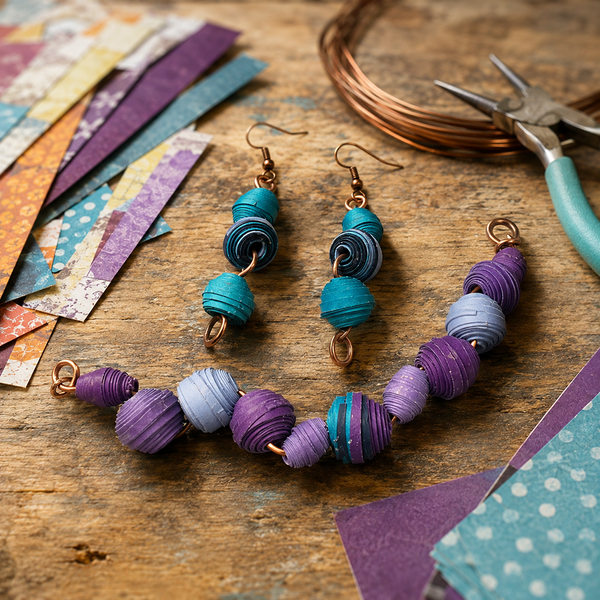
Then came Paper Bead Earrings, another class with Korey.
This time, scraps of cardstock, scrapbook paper, magazine pages, glue, and salvaged copper wire became handmade beads and wearable jewelry.
Three classes.
Three very different creative processes.
And yet, underneath all three was essentially the same question: what else could this become?
That's a question I've found myself returning to again and again while exploring creative reuse.
- What if something doesn't have to stop being useful simply because it has finished serving its original purpose?
- What if the material someone else overlooks becomes exactly what another person needs?
- What if making art doesn't always have to begin with a trip to the store for brand-new supplies?
- And what happens when we start looking at the things around us not only for what they are, but for what they could become?
More Than the Projects I've Made There
After taking my third class at Perennial, I realized something.
I'd written quite a bit about the things I'd learned to make there.
But I hadn't really written about Perennial itself.
And the more time I've spent there, the more I've realized that the individual projects are only pieces of a much larger story.
Perennial isn't simply a place where people can sign up for an interesting craft class.
It's a place built around creative reuse, sustainability, resourcefulness, learning, experimentation, and community—a place where discarded and overlooked materials can become resources rather than waste.
It's also a place where people can learn practical creative skills, access tools and workspace, discover reclaimed materials, connect with other makers, and explore possibilities they may not have known existed.
And for people who want to participate but are struggling financially, Perennial even has scholarship opportunities designed to make some of those experiences more accessible—something I'll explore later in this article.
So rather than focusing on one particular project this time, I want to zoom out.
- What exactly is Perennial?
- Where did it come from?
- What happens inside its St. Louis workshop?
- What can you learn, make, find, and do there?
- And perhaps most importantly: what can a place centered around giving materials another chance teach us about creativity itself?
What Is Perennial?
At its heart, Perennial is a nonprofit community workshop centered around creative reuse.
Located in St. Louis, Perennial brings creativity and sustainability together by helping people learn how to transform discarded, salvaged, and overlooked materials into useful and beautiful things.
Their mission is to build a creative culture of sustainability—one where discarded materials aren't automatically treated as waste, but recognized as resources with possibilities still left inside them.
That philosophy shows up throughout the organization, from the materials people create with to the skills taught in workshops and the resources available within the space.
But to really understand what makes Perennial different, it helps to understand the idea at the center of it all: creative reuse.
What Does “Creative Reuse” Actually Mean?
Creative reuse is sometimes also called upcycling, but the idea is bigger than simply turning an old object into a craft project.
It's a different way of thinking about materials.
We live in a world where it's incredibly easy to think in terms of: Buy. Use. Discard. Replace.
Creative reuse interrupts that cycle with another question: what if we're not finished with this yet?
A discarded piece of wood might become furniture.
A magazine page can become a paper bead.
Salvaged electrical wire can become jewelry.
Fabric scraps can be sewn into something useful.
An old object can be taken apart so that its pieces become materials for something completely different.
The point isn't that everything needs to be saved forever or transformed into art.
It's about recognizing that “no longer useful for its original purpose” and “no longer valuable” aren't necessarily the same thing.
Sometimes an object's first life is simply one of the possibilities contained within it.
Creativity, Sustainability, and Resourcefulness
Perennial's values include creativity, sustainability, resourcefulness, accessibility, and fun, and I think those ideas make much more sense when considered together rather than separately.
Sustainability doesn't have to mean giving something up.
Resourcefulness doesn't have to mean settling for something inferior.
And reuse doesn't have to mean making something that looks or feels like a consolation prize because you didn't have access to brand-new materials.
Creative reuse can instead become an invitation to experiment.
When the material in front of you wasn't necessarily designed for the thing you're trying to make, you have to think differently.
You problem-solve.
You adapt.
You experiment.
You learn what the material can and can't do.
And sometimes you discover possibilities that never would have occurred to you if you'd simply purchased exactly what a set of instructions told you to buy.
I've seen that firsthand in the classes I've taken at Perennial.
Salvaged copper electrical wire wasn't treated as a lesser substitute for jewelry wire.
Paper scraps weren't pretending to be “real” beads.
Unexpected pigments weren't inferior simply because they didn't begin inside a commercially manufactured watercolor pan.
The reused material was part of the creative opportunity.
Expanding the Definition of an Art Supply
That's one of the things I find most compelling about creative reuse.
It expands our understanding of what an art supply can be.
Art stores are wonderful resources, but creativity doesn't begin and end with the things sold in their aisles.
Materials exist everywhere.
Some are sitting unused in closets.
Some are leftover from previous projects.
Some are donated.
Some are salvaged.
Some are headed toward the recycling bin or landfill.
Some aren't traditionally considered “art supplies” at all.
Learning to notice those possibilities can make creativity more sustainable, but it can also make it more accessible.
Because creativity becomes less dependent upon constantly acquiring something new.
Instead of always beginning with: "What do I need to buy?" we can sometimes begin with: "What do I already have—and what could I do with it?"
That shift in perspective is a large part of what makes Perennial interesting to me.
Yes, it's a place where people can learn how to make things.
But underneath those individual projects is something bigger: Perennial teaches people how to see materials differently, and that philosophy didn't appear out of nowhere.
It grew from an artist and educator's own creative-reuse practice—and eventually became an organization dedicated to sharing those skills with the St. Louis community.
 Jessica Carey
How Perennial Began
Every creative space has a beginning, and Perennial's story started with an artist asking many of the same questions that still shape the organization today.
Perennial was founded in 2011 by community artist and educator Jenny Murphy, whose own creative practice involved transforming discarded materials and teaching others how to do the same.
Before there was a dedicated Perennial workshop filled with tools, classes, reclaimed materials, and people learning new skills, there was an idea: what if creative reuse could become a community resource?
Jenny had been developing projects and programs that encouraged people to work with discarded materials, learn practical skills, and reconsider what they might otherwise throw away.
With the help of a grassroots board, that work eventually grew into Perennial.
The goal wasn't simply to teach people how to make crafts from old things.
It was to create opportunities for people to learn how to reuse, repair, create, and become more resourceful—while reducing waste in the process.
And I think that distinction matters.
From an Idea to a Community Workshop
There is a big difference between making something creatively yourself and creating a space where other people have the tools and knowledge to make things, too.
That's part of what makes Perennial's evolution interesting.
An individual creative-reuse practice became something that could be shared.
Instead of one person looking at a discarded material and imagining another possibility, Perennial could teach hundreds—and eventually thousands—of other people how to develop that same kind of resourcefulness.
Someone could learn how to sew.
Someone else could learn woodworking.
Another person might learn to repair something rather than replace it.
Someone could walk into a class having never touched a particular tool before and leave knowing how to use it.
And someone else might simply begin looking at the things they already own a little differently.
Over time, Perennial developed into the nonprofit community workshop that exists in St. Louis today, combining hands-on education with sustainability, creativity, and material reuse.
Building the Space With the Same Philosophy
What I especially like is that creative reuse isn't limited to the projects being taught inside Perennial.
It's woven into the physical space itself.
When Perennial developed its workshop, volunteers helped build out the space using found and reclaimed materials.
There's something wonderfully fitting about that.
If you're creating an organization dedicated to showing people that discarded materials still have value, why shouldn't the workshop itself demonstrate the same principle?
The building becomes part of the lesson.
Instead of creative reuse existing only as an idea written in a mission statement, visitors can encounter it in the materials, tools, projects, and surroundings themselves.
And more than a decade after Perennial began, that original idea continues every time someone walks through the door and learns how to give something another life.
A discarded material becomes a resource.
A practical skill gets passed from one person to another.
Something headed toward the waste stream becomes useful again.
And an idea that began with one artist's creative practice continues through an entire community of people learning, making, experimenting, repairing, and imagining.
That's where Perennial's history becomes particularly interesting to me.
The organization itself grew much like the materials it celebrates: someone recognized possibility and decided it was worth developing.
And today, all of that possibility has a physical home.
Inside Perennial's Creative Reuse Workshop
Understanding Perennial's mission is one thing.
Actually stepping inside the space makes that mission much easier to see.
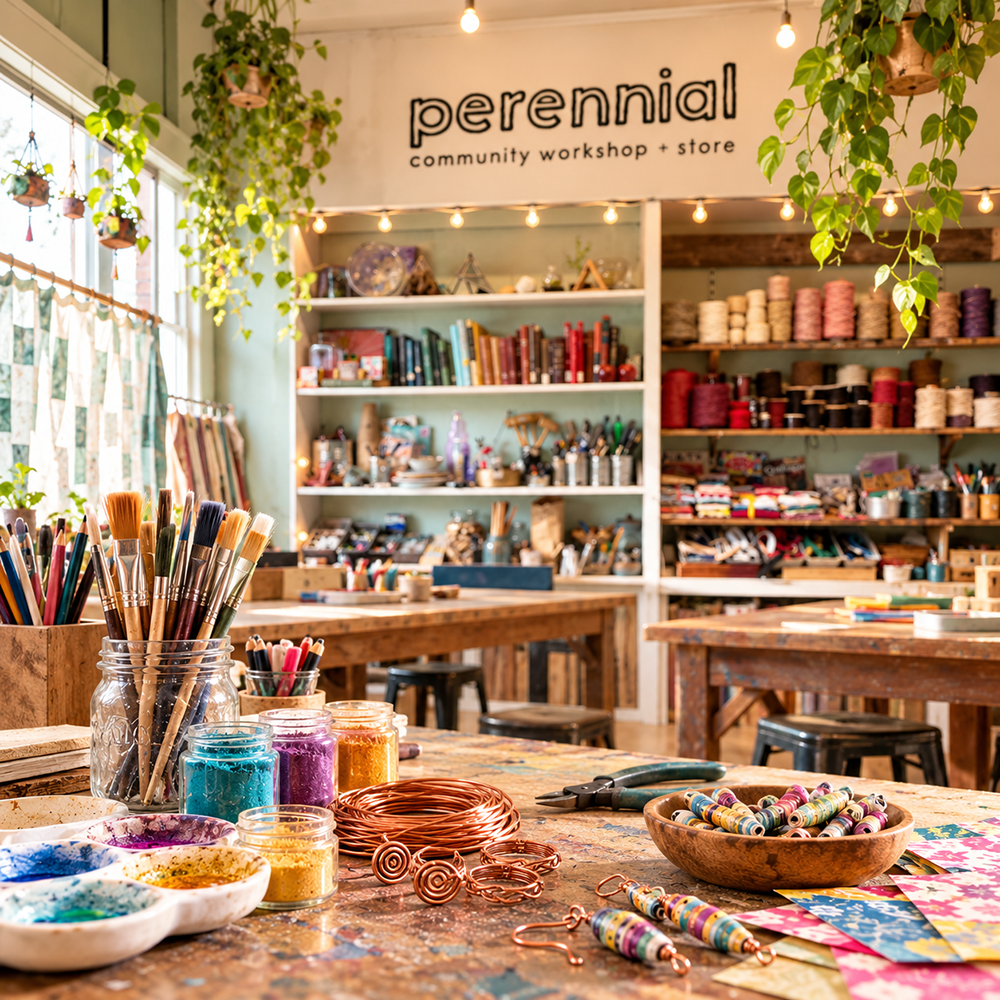
Perennial's home in South St. Louis isn't simply a classroom where people occasionally gather for workshops. It's a working creative space designed for people to learn, experiment, build, repair, and make.
The workshop includes different areas for different kinds of creative work, including a ReUse Studio, a full woodshop, and a small retail area featuring reclaimed materials and creative supplies.
That variety matters because creative reuse can take so many different forms.
One project might involve paper, fabric, beads, or paint.
Another might require drills, saws, clamps, and woodworking equipment.
Someone might be learning to sew.
Someone else might be transforming reclaimed wood.
Another person might be turning magazine pages into jewelry or experimenting with materials they had never considered using artistically before.
Rather than defining creativity as one particular kind of artmaking, the space leaves room for many different ways of working with your hands.
A Space Designed for Making
During the classes I've taken at Perennial, I've spent most of my time gathered around worktables with other participants, surrounded by tools, materials, examples, and works in progress.
And I think there's something valuable about learning in a space where it's obvious that things are actually made there.
It doesn't need to feel pristine or precious.
Materials are handled.
Tools are used.
Experiments happen.
Things get cut apart, rolled, ground, glued, bent, assembled, and transformed.
During my copper jewelry class, the tables became working stations for manipulating salvaged electrical wire with pliers and wire snips.
During DIY Watercolors, the space filled with jars of pigments, glass slabs and mullers, handmade paints, and all the wonderfully messy evidence of people experimenting with color.
And during Paper Bead Earrings, colorful strips of paper, glue, handmade beads, copper wire, and jewelry tools gradually spread across the tables as everyone worked.
The projects were completely different, but the space accommodated all of them.
That's one of the things I find interesting about a community workshop: the room isn't dedicated to one finished outcome.
It's designed around possibility.
Tools Can Be a Form of Access, Too
There's another side of spaces like Perennial that I think is easy to overlook.
Creative access isn't only about whether someone can afford materials.
Sometimes the biggest barrier is the equipment.
There are plenty of things someone might want to learn but can't realistically justify purchasing all the tools for before they even know whether they'll enjoy doing it.
Woodworking is an obvious example.
You might be curious about learning how to build or repair something, but creating a fully equipped woodshop at home requires money, equipment, knowledge, and—perhaps most importantly—physical space.
The same basic problem can happen on a smaller scale with all kinds of creative practices.
Sometimes you don't need to own everything.
You need access to the right thing when you need it—and someone who can teach you how to use it safely.
Community workshops can help fill that gap.
They create opportunities to encounter materials, equipment, and techniques that might otherwise remain inaccessible.
And once you've learned something, you have knowledge you can carry elsewhere.
Perennial feel less like a conventional art studio and more like what its name suggests: a community workshop.
A place where people don't only come to admire finished creative work.
They come to make.
To learn.
To try.
To get their hands dirty.
To use tools they may never have used before.
And to discover what they're capable of doing with materials they might once have overlooked.
Of course, having the space and tools is only part of the equation.
Someone still has to teach you what you can do with them.
And that's where Perennial's classes and workshops come in.
Learning Through Creative Reuse
A workshop full of tools and reclaimed materials contains plenty of possibilities, but possibilities become much easier to explore when someone teaches you where to begin.
That's a major part of what Perennial offers through its classes and workshops.
The subjects vary considerably.
Depending on what's being offered, participants might encounter woodworking, sewing and textiles, book and paper arts, natural dyes, mosaics, stained glass, home repair, jewelry making, tool skills, and all kinds of projects centered around reuse and resourcefulness.
What connects them isn't necessarily a particular artistic medium.
It's the opportunity to learn by doing.
You aren't simply looking at an example of something another person made or hearing someone explain how a tool works.
You're given materials.
You're shown techniques.
And then you get to try them yourself.
That kind of hands-on learning can make unfamiliar creative practices feel much more approachable—especially when you're learning alongside other people who may be trying them for the first time, too.
Three Classes, Three Very Different Transformations
The three classes I've taken at Perennial are a good example of just how broad creative reuse can be.
My first was Copper Rings + Bracelets, taught by Korey Calloway.
We began with salvaged copper electrical wire.
Before that class, I certainly understood that copper wire could theoretically be reused. But sitting at a table with pliers and wire snips and learning how to bend, shape, hammer, twist, and manipulate that wire into something I could actually wear made the idea much more tangible.
By the end of the class, something originally manufactured for an entirely different practical purpose had become rings and bracelets.
And I'd gained skills I could use again.
That last part turned out to matter.
 Jessica Carey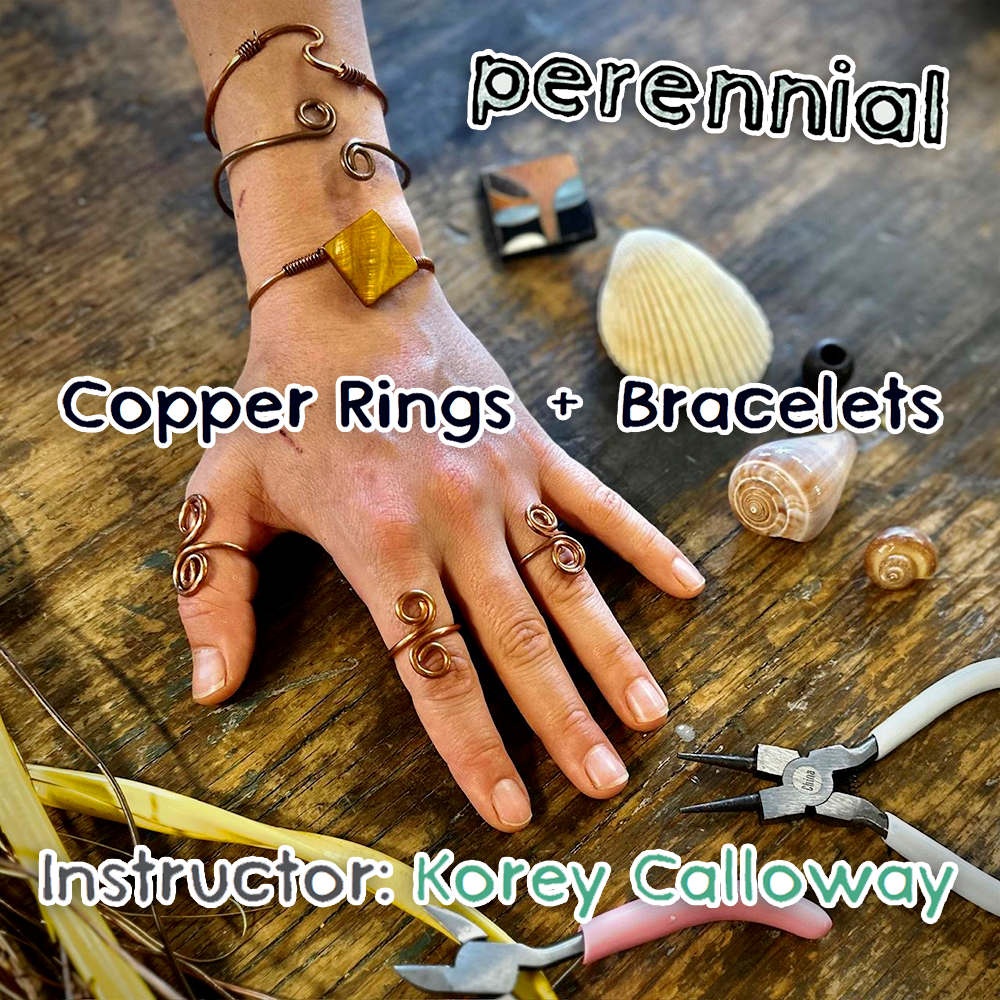
Months later, I returned for Paper Bead Earrings, also taught by Korey.
This time, our primary material was paper—scrapbook paper, cardstock, magazine pages, and other scraps that could be cut and rolled into handmade beads.
But salvaged copper electrical wire returned, too.
Suddenly, some of the jewelry-making skills I'd learned in that first class had another purpose. I wasn't starting completely from scratch. I already knew a little about how the copper behaved and how some of the tools worked.
Meanwhile, the paper-bead technique connected with something I'd first encountered years earlier during student teaching and later experimented with independently.
One class ended up bringing together creative skills I'd learned at entirely different points in my life.
 Jessica Carey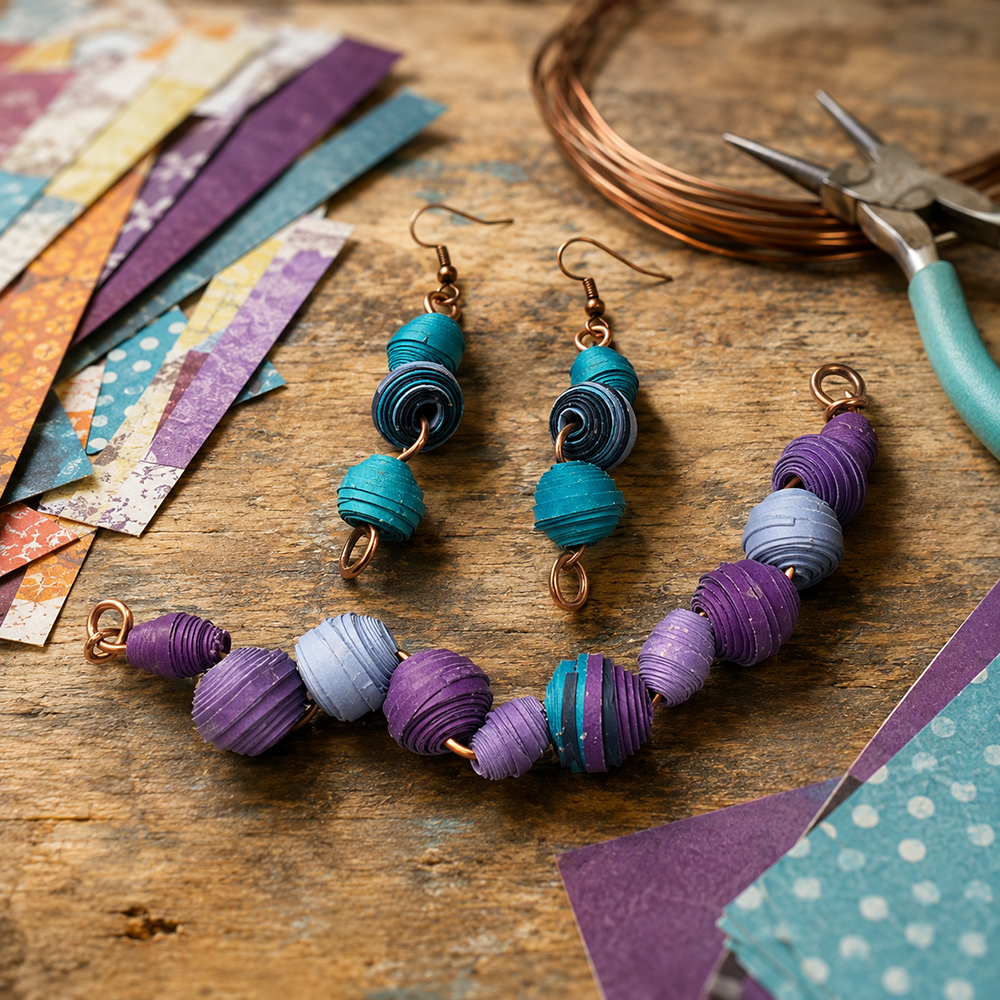
And Then There Was Paint
My DIY Watercolors class, taught by Tara Pham, took me in an entirely different direction.
Instead of transforming a discarded object into something recognizable like jewelry, we explored something much more fundamental: where does color actually come from?
We worked with pigments and watercolor binder, using glass mullers to transform powdered color into usable handmade paint.
That experience expanded my understanding of creative reuse in another direction.
I'd spent years using watercolor paint.
I'd bought watercolor paint.
I'd taught with watercolor paint.
But I'd rarely needed to stop and think about what watercolor actually was.
The class made the art material itself part of the creative process.
And suddenly, creative reuse wasn't only about asking what an old object could become.
It was also about reconsidering where our materials come from in the first place—and how much knowledge can disappear when we're accustomed to buying everything already manufactured, packaged, and ready to use.
 Jessica Carey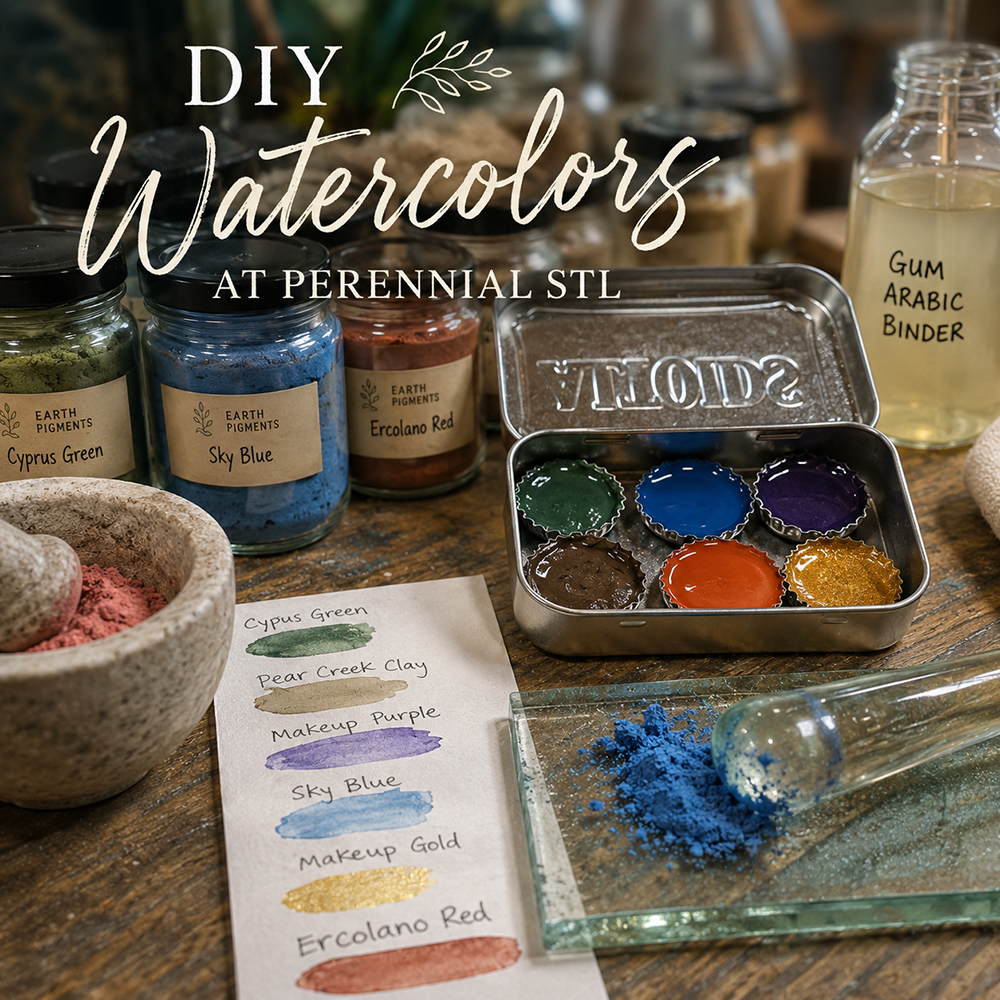
A Class Can Teach More Than One Project
On paper, each class has a fairly straightforward outcome.
Make copper jewelry.
Make watercolor paint.
Make paper-bead earrings.
But what I've carried away from them has been much broader than the finished objects.
I've learned how materials behave, encountered unfamiliar tools and techniques, and gained knowledge that can be adapted and used again.
That's the difference between following instructions for a single project and developing a creative skill.
A finished project may eventually be put away, worn, displayed, gifted, or used. But the knowledge travels with you.
And sometimes you don't realize where that knowledge will lead until much later.
An Invitation to Experiment
Something else I've appreciated in my experiences at Perennial is that the finished example doesn't have to become a rigid destination.
The instructor can demonstrate a technique, explain the tools, help troubleshoot problems, and give you a foundation.
But then there's room for your own decisions.
- Which colors do you choose?
- Which materials catch your attention?
- What happens if you combine things differently?
- What could you do with the technique after class?
That's where learning and experimentation begin to overlap.
And I think that's especially appropriate for a place centered around creative reuse.
After all, creative reuse already asks us to look beyond what something was originally supposed to be.
It makes sense that the learning process can do the same.
A class can begin with one project without having to end there.
And at Perennial, there are ways to continue exploring even after the scheduled class is over.
More Than Classes: A Place to Keep Creating
Taking a class can introduce you to a new skill.
But what happens when the class ends?
Maybe you want to practice what you just learned.
Maybe you have an idea for a completely different project.
Maybe you need access to tools or workspace you don't have at home.
Or maybe you simply want an excuse to sit down and make something alongside other creative people.
That's another part of what makes Perennial interesting.
The organization isn't only structured around individual classes where you arrive, make one project, and leave.
There are opportunities to come back.
Continuing Through Open Studio
Perennial's Open Studio gives people an opportunity to return to the workshop and work more independently.
Open Studio gives people who have already taken a Perennial class an opportunity to return to the workshop and work more independently, with appropriate training required for the tools they plan to use.
I really appreciate the idea behind that progression: learn → practice → experiment → build confidence.
A class can give you the foundation.
But repetition is often where a skill actually begins to feel like your own.
The first time you use an unfamiliar tool, so much of your attention may be devoted simply to remembering what you're supposed to do.
The second time, you understand a little more.
Eventually, you may stop thinking only about how to perform the technique and start wondering what you want to do with it.
That's an important transition.
There's a difference between learning how to reproduce a project and developing enough familiarity with a process to begin creating your own.
And having access to a shared creative workspace can make that experimentation much more realistic—especially when the equipment involved isn't something everyone can reasonably own or keep at home.
Making Alongside Other People
Perennial also offers Craft Club, creating another kind of opportunity to gather around making.
And I think there's value in that, too.
Creativity is often portrayed as something deeply solitary: an artist alone in a studio, quietly working on their own ideas.
Sometimes it is.
But creativity can also happen around a table.
People make things.
Someone asks a question.
Someone else shares an idea.
You notice what the person beside you is working on.
A conversation begins.
You learn about a material you've never tried.
Someone's experiment sparks an idea for something completely unrelated.
Even when everyone is working on their own project, simply being around other people who are making things can change the experience.
I've started noticing this through the classes I've attended at Perennial, too.
You may all begin with the same general materials and instructions, but the results quickly diverge.
People make different choices.
They gravitate toward different colors.
They solve problems differently.
They notice possibilities you didn't.
Community doesn't require everyone to create the same thing.
Sometimes it's simply having a place where different kinds of creativity can exist beside one another.
Finding Materials With Another Life Left in Them
Perennial also gives reclaimed materials a more direct route back into people's hands.
Its retail area offers salvaged and donated materials that can become the starting point for future projects.
That adds another dimension to the creative-reuse cycle.
Someone has something they no longer need.
Instead of automatically becoming waste, that material can potentially make its way to someone else.
And that person might see an entirely different purpose for it.
I love that because creative reuse doesn't always require knowing exactly what you're looking for.
Sometimes inspiration happens in the opposite direction.
Instead of beginning with: "I want to make this, so what do I need to buy?" you can encounter an interesting material and wonder: "What could I make with this?"
Those are two very different ways of approaching creativity.
Neither is inherently better, but the second leaves much more room for surprise.
Becoming Part of the Perennial Community
For people who want to engage more regularly, Perennial also offers memberships that provide additional ways to participate in and support the organization.
Membership isn't necessary for someone to take an individual class, but it can make sense for people who find themselves returning frequently.
Depending on the membership, benefits can include things like discounts on classes and opportunities to use Craft Passes for Open Studio or Craft Club.
And there's something else about the membership system that I want to return to later: access.
Because not everyone who would benefit from creative classes, shared tools, or a supportive making environment can easily afford them.
Perennial has a scholarship opportunity specifically intended to help reduce that financial barrier, including the possibility of receiving either a free year-long Thrifter Membership or a free class.
That's important enough that I don't want to bury it in a passing sentence.
We'll come back to it.
Creativity Needs Somewhere to Go
The more I think about spaces like Perennial, the more I realize how important that continuation can be.
Inspiration is wonderful.
Learning is wonderful.
But people also need places where their creativity can go.
A kitchen table can become a studio.
A bedroom can become a workspace.
A corner of a living room can hold art supplies.
I've created in plenty of imperfect spaces myself.
But there are some things that become dramatically easier when you have access to an environment intentionally designed for making.
A worktable.
Specialized tools.
Room to spread out.
Materials to experiment with.
Other people who understand why you might be excited about a strange piece of discarded wood, an unusual scrap of paper, or a coil of salvaged wire.
And perhaps that's one of the most valuable things a community workshop can offer.
Not simply another project.
A place where creativity is allowed to continue.
 Jessica Carey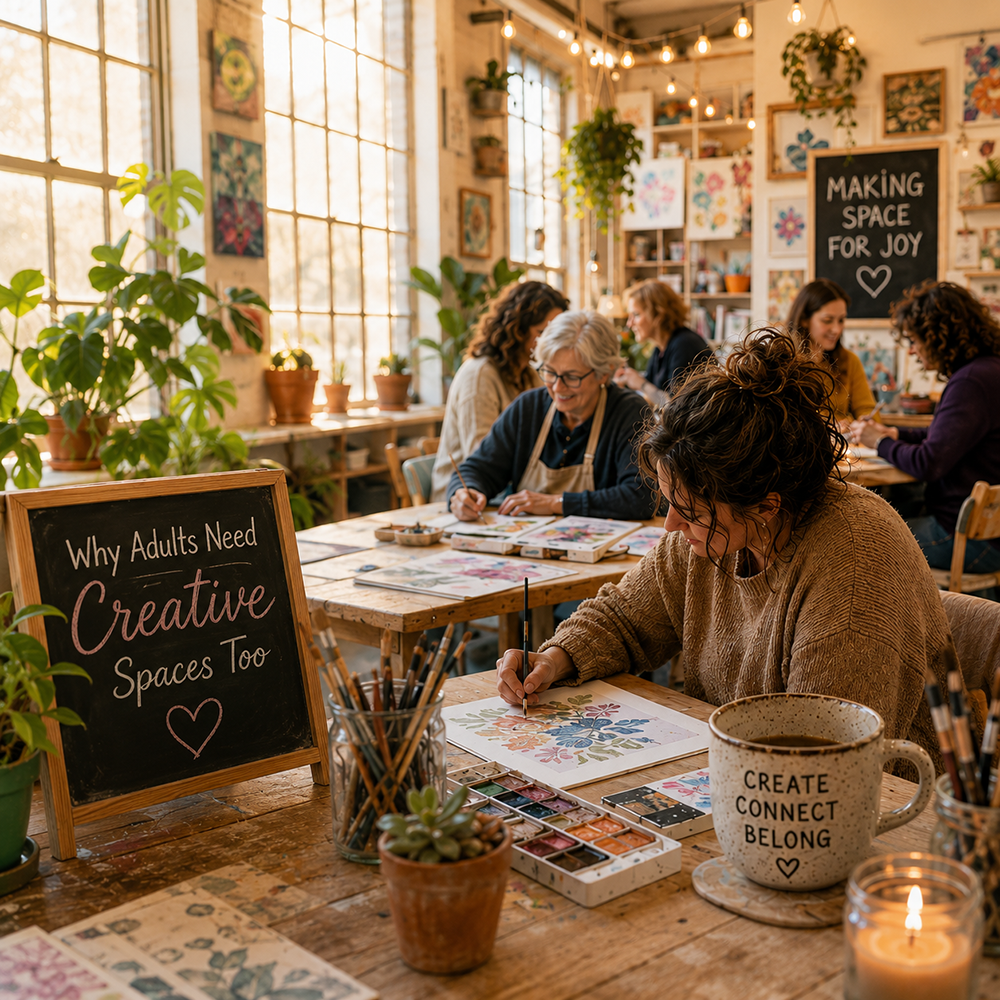
Making Creativity More Accessible
Creative opportunities only matter if people can actually access them.
And unfortunately, creativity can become expensive very quickly.
There are class fees.
Materials.
Tools.
Equipment.
Studio space.
Transportation.
And all the other costs of simply living that determine whether spending money on a creative experience is even possible.
For someone with disposable income, signing up for a $40 or $50 art class might be a relatively easy decision.
For someone experiencing financial hardship, that same amount of money might need to cover groceries, gas, medication, a bill, or some other basic necessity.
That doesn't mean they would benefit from creativity any less.
If anything, periods of instability, isolation, stress, or hardship can make access to something meaningful, restorative, and community-oriented especially valuable.
That's why I was really glad to discover that Perennial offers financial assistance for people who need help accessing its programs.
At the time of writing, scholarship recipients can choose between two forms of support:
- Option 1: A free Thrifter Membership for one year
Valued at $55, the membership includes 20% off classes and two Craft Passes that can be used for Open Studio or Craft Club. - Option 2: One free class valued up to $55
I especially appreciate that there are two options, because different kinds of support make sense for different people.
Someone who wants to try Perennial for the first time might benefit most from having the cost of an entire class covered.
Someone who already knows they would like to participate more regularly might get more long-term value from a year of discounted classes and opportunities to return for Open Studio or Craft Club.
Neither option removes every possible financial barrier.
But it can make the difference between “I can't afford to participate at all” and “Maybe there is a way I can do this.”
And sometimes that opening matters enormously.
 Jessica Carey
Creativity Shouldn't Be Reserved for People Who Can Afford It
This is something I care about far beyond Perennial.
Creativity is often talked about as though it belongs to everyone—and I believe it does.
But if we're serious about that idea, we also have to acknowledge the barriers that determine who actually gets to participate.
Someone can be imaginative without owning expensive supplies.
Someone can be an artist without having a studio.
Someone can be curious about woodworking without owning a garage full of power tools.
Someone can deserve the opportunity to learn something new even when they don't have an extra $55 available for a class.
Financial hardship doesn't make someone less creative.
It simply means they may need a different route to access the same opportunity.
That's why I think programs like this are worth making visible.
People don't always know that assistance exists.
And when money is already tight, it's very easy to see the listed price of something and immediately conclude: "That's not for me."
Sometimes the most helpful thing an organization—or someone writing about it—can do is make sure people know not to stop at the price tag.
There may be another door.
 Jessica Carey
Access Can Take More Than One Form
The scholarship also fits into a larger pattern I've noticed while exploring Perennial.
Accessibility isn't only about reducing a class fee.
Shared tools mean you don't necessarily have to purchase every piece of equipment yourself.
A community workshop means you don't necessarily need your own dedicated studio.
Classes provide instruction for people who don't already know how to use unfamiliar tools or techniques.
Open Studio can provide somewhere to continue practicing once you've learned.
Reclaimed materials can introduce alternatives to constantly purchasing everything new.
And financial assistance can help someone get through the door in the first place.
None of those things individually eliminates every barrier to creativity, but together, they can make creative participation more possible.
And I think that's an important distinction.
Accessibility isn't about assuming everyone needs the same thing.
It's about recognizing that people encounter different barriers—and creating more than one pathway through them.
For someone who can comfortably afford a class, the scholarship information might be something they simply read and move past.
For someone who can't?
It might be the most important information in this entire article.
Why Creative Reuse Matters
It's easy to describe creative reuse in terms of what it keeps out of the trash, and that matters.
When wood, fabric, paper, wire, furniture, and other usable materials are given another purpose instead of being discarded, those materials can remain in use longer.
That impact is measurable, too; Perennial reports that its community diverts more than 20,000 pounds of material from landfills each year through crafting with salvaged materials.
But after spending time at Perennial, I think the value of creative reuse goes beyond simply reducing waste.
It changes the way we look at what we already have.
Because throwing something away often begins with a judgment: this isn't useful anymore.
Creative reuse asks us to question that conclusion.
Maybe it isn't useful for its original purpose anymore, but does that mean it has no value left?
Waste Is Sometimes a Matter of Perspective
A piece of salvaged electrical wire probably doesn't look much like jewelry when you first see it.
Neither does an old magazine.
A leftover piece of wood may not look like the beginning of something beautiful or functional.
A scrap of fabric might seem too small to be useful.
But usefulness isn't always inherent in the object.
Sometimes it depends upon what someone knows how to do with it.
Give the same discarded material to ten different people and they might imagine ten completely different possibilities.
That's where creative reuse becomes especially interesting to me.
It isn't only about saving materials.
It's about developing the ability to recognize possibility.
And that is a creative skill in its own right.
Resourcefulness Is a Creative Skill
There's sometimes an assumption that the ideal creative process begins with having exactly what you need.
The right supplies.
The right tools.
The right workspace.
Enough money.
Enough materials.
Everything conveniently available before you begin.
But creativity has never worked exclusively that way.
People have always made things with what they could access.
Sometimes limitations require us to improvise.
You substitute one material for another.
You figure out how to make something work.
You alter the design.
You combine things that weren't necessarily intended to go together.
You invent a solution because the obvious solution isn't available.
That doesn't mean hardship itself is somehow beneficial or that people should be denied resources because struggling supposedly makes them more creative.
People deserve adequate resources and support.
But resourcefulness can still be a genuine creative strength.
There's a meaningful difference between romanticizing scarcity and recognizing the ingenuity involved in working with what is available.
Creative reuse gives us a place to practice that kind of thinking intentionally.
Instead of seeing limitations only as dead ends, we can sometimes ask: what can I do from here?
Creativity Doesn't Have to Begin With Consumption
There's another idea underneath creative reuse that I've become increasingly interested in:
Making something doesn't always have to begin with buying something.
Creative hobbies can easily become connected with consumption.
There's always another supply.
Another tool.
Another kit.
Another color.
Another product that promises to make creating easier or better.
And sometimes those things really are useful.
There's nothing inherently wrong with buying good art supplies or investing in tools that help you create, but purchasing something new isn't the only possible starting point.
Sometimes creativity can begin with looking around.
- What's already here?
- What's left over?
- What has someone else finished using?
- What could be repaired?
- What could be taken apart?
- What could be combined?
- What could become something completely different?
That shift doesn't eliminate consumption, but it can make our relationship with materials more intentional.
Seeing Value Where It Might Be Overlooked
I think this may be the part of Perennial's philosophy that stays with me most.
Creative reuse asks us to practice seeing value in things that are easy to overlook.
Not because every discarded object secretly needs to become an art project.
And not because we should feel guilty every time we throw something away.
But because discarded doesn't automatically mean worthless.
Sometimes something has another life left in it.
Maybe that's practical: repairing an object so it can continue serving its original purpose.
Maybe it's functional: turning one material into something useful for an entirely different reason.
Maybe it's artistic: transforming something ordinary into something beautiful, strange, expressive, playful, or unexpected.
Or maybe experimenting with it simply teaches you something.
All of those outcomes have value.
That's why I don't think creative reuse is merely an environmental practice.
It's also an exercise in imagination, problem-solving, curiosity, and possibility.
And after three very different classes at Perennial, I've started noticing just how much those lessons can accumulate.
What I've Learned From Three Very Different Classes
When I look at the three classes I've taken at Perennial, they don't immediately seem to have very much in common.
One involved bending and shaping salvaged copper electrical wire.
Another involved pigments, binders, and handmade watercolor paint.
The third involved rolling scraps of paper into beads and combining them with copper wire to create jewelry.
The finished projects certainly don't look alike.
But after experiencing all three, I've realized that I've been learning something much bigger than three separate creative processes.
I've been building a creative vocabulary.
Creative Skills Build on One Another
One of the clearest examples came during my Paper Bead Earrings class.
I'd made paper beads before—first during student teaching years ago and later through my own experimentation.
And only a few months before the paper-bead class, I'd learned some basic copper wireworking and jewelry-making techniques from Korey during her Copper Rings + Bracelets class.
Those experiences had nothing to do with one another when they originally happened.
I certainly wasn't making paper beads years ago because I thought, Someday this will be useful in a jewelry class at Perennial.
And when I learned how to manipulate salvaged copper wire, I didn't know exactly where else those skills might show up.
Then I sat down for Paper Bead Earrings.
Suddenly, two completely separate pieces of creative knowledge belonged together.
The paper-bead experience gave me familiarity with one part of the process.
The copper class gave me familiarity with another.
I wasn't starting from zero.
And I think that's something we sometimes forget when trying something unfamiliar.
Being a beginner at one thing doesn't mean arriving empty-handed.
Everything we've learned creatively can become part of what we bring to the next experience.
Knowledge Travels
That's one reason I think learning creative skills is so valuable.
A project may end.
The knowledge doesn't necessarily end with it.
Learning how a material behaves can help you understand another material later.
Learning how to use a tool can open possibilities in projects you haven't imagined yet.
A mistake can teach you something that prevents another mistake years later.
A technique can sit quietly in the back of your mind until some completely unrelated project suddenly gives you a reason to use it again.
Even the DIY Watercolors class fits into that larger picture.
That class didn't teach me another jewelry-making skill.
Instead, it changed the way I thought about something I'd used for years: paint itself.
Learning more about pigments and binders made me look behind the finished art supply and think about how materials are actually created.
That's knowledge I can carry into painting, teaching, experimenting with natural or unconventional materials, and whatever other creative questions it sparks later.
You don't always know what a skill is for when you first learn it.
Sometimes its usefulness reveals itself much later.
Familiarity Changes the Experience, Too
Something else has gradually changed across my visits to Perennial.
The place itself has become more familiar.
The first time you enter any creative space, you're taking in a lot at once.
- Where do I go?
- Where are the tools?
- How does this work?
- What am I supposed to do?
- Who are these people?
Returning changes some of that.
I began recognizing the space.
Then, when I returned for Paper Bead Earrings, Korey recognized me.
It was a small interaction, but it mattered.
I'd taken her copper jewelry class months earlier, and she was happy to see me again.
This time, I wasn't simply entering a workshop taught by a stranger.
I was returning to learn from someone who had already taught me something.
There's something lovely about that progression.
A place you visit once can eventually become a place you recognize.
An instructor can become a familiar face.
Tools that once felt completely foreign can become things you've handled before.
And instead of every experience existing in isolation, they begin connecting.
You Don't Only Accumulate Projects
I think that's one of the most important things I've realized through these classes.
When we participate in creative communities, we don't only accumulate finished objects.
We accumulate skills.
We accumulate questions.
We accumulate experiences.
We discover materials.
We encounter ideas.
We learn from instructors and from the people working beside us.
We develop confidence in things that once felt unfamiliar.
And sometimes we begin developing relationships with the places and people that make those experiences possible.
My copper rings and bracelets are tangible evidence of one class.
My handmade watercolor paints are evidence of another.
My paper-bead jewelry is evidence of another.
But those objects aren't the entirety of what I brought home.
I also brought home knowledge.
Curiosity.
A greater familiarity with materials and tools.
New things I want to try.
And an expanding sense of what might be possible.
Creativity Is Cumulative
Maybe that's the larger lesson I've been learning.
Creativity is cumulative.
We aren't necessarily starting over every time we try something new.
We're carrying all kinds of things with us—some recent, some learned years ago, some practiced extensively, and some nearly forgotten.
Eventually, those pieces can collide in unexpected ways.
A paper-bead technique from years ago meets copper wireworking learned months ago.
A lesson about pigments changes the way you look at paint you've used for most of your life.
A discarded material you once would have overlooked starts looking like an art supply.
A workshop you've visited before starts feeling familiar.
And the question gradually changes from: "Do I know how to make this?" to: "What do I already know that might help me figure this out?"
I think that's a much more empowering way to approach creativity.
You don't have to know everything.
You don't have to own everything.
You don't have to arrive with every skill you'll eventually need.
You can learn one thing.
Then another.
Then another.
And somewhere along the way, those individual experiences begin connecting into something uniquely yours.
Want to Explore Perennial?
If anything in this article has made you curious about Perennial, there are plenty of ways to explore the organization for yourself.
You don't have to know how to use a woodshop.
You don't have to already consider yourself an artist.
And you certainly don't have to walk through the door knowing exactly what you want to make.
You can simply start with curiosity.
Maybe there's a class on the schedule involving a material you've always wanted to try.
Maybe you want to learn a practical skill.
Maybe you're interested in finding reclaimed materials for a project of your own.
Maybe you'd like to spend more time making things alongside other creative people.
Or maybe, like me, you'll discover one class that sounds interesting—and eventually find yourself coming back for another.
Find a Class That Makes You Curious
Perennial offers a rotating selection of classes and workshops, so rather than listing specific upcoming classes here, I'd recommend checking their current calendar to see what's available.
I think that's part of the fun.
You might go looking for one thing and discover something you'd never considered trying.
That's essentially how creative exploration works: sometimes you follow an existing interest, and sometimes an unfamiliar possibility catches your attention.
And if you've never tried the skill before, don't automatically assume that means the class isn't for you.
One of the purposes of a workshop is to learn.
You don't need to arrive already knowing how to do the thing you're there to be taught.
Explore Beyond the Classroom
Classes are only one entry point.
Depending on what you're interested in and what experience or training you already have, you can also explore opportunities such as Open Studio and Craft Club, browse reclaimed materials, learn more about membership, attend community events, or find other ways to support and participate in Perennial's work.
If you find yourself returning regularly, some of those options may become particularly useful.
And if the price of participating is what makes you hesitate, remember the scholarship opportunity I mentioned earlier.
Don't automatically assume a listed price means the opportunity is out of reach; if financial assistance would make participating possible for you, it's worth looking into the current scholarship options.
Check Before You Go
Because class schedules, programs, hours, prices, scholarship details, and other offerings can change, I recommend checking Perennial's own website for the most current information before making plans.
There you can find current classes, learn more about the workshop and its programs, explore ways to participate, and see what's happening next.
And if you're looking through the class calendar and find yourself thinking: "I've never done anything like that before..." that might not be a reason to keep scrolling.
It might be exactly the reason to try it.
Creativity doesn't require arriving with expertise.
Sometimes it begins with curiosity, a willingness to experiment, and someone willing to show you where to start.
Seeing Possibility Where Others See Waste
After three classes at Perennial, I've brought home quite a few things.
Copper rings and bracelets.
Handmade watercolor paints.
Paper-bead jewelry.
But when I think about what I've actually gained from my experiences there, the finished objects feel like only part of the story.
I've learned new techniques.
I've handled unfamiliar tools.
I've discovered things about materials I'd used for years without really thinking about where they came from.
I've returned to creative processes I'd first encountered nearly a decade ago.
I've watched seemingly unrelated skills unexpectedly connect.
I've met instructors who shared their knowledge with me—and, in one case, returned months later to find a familiar face waiting to teach me something new.
And I've spent more time thinking about a question that reaches far beyond any one class: what else could this become?
Learning to Look Again
Maybe that's what I find most compelling about Perennial.
It teaches people how to make things, certainly.
But underneath the woodworking, sewing, jewelry making, painting, repair, paper arts, and other skills is something even more fundamental: the practice of looking again.
Look again at the scrap of wood.
Look again at the old magazine.
Look again at the electrical wire.
Look again at the leftover fabric.
Look again at the thing you were about to throw away.
Not because everything needs to be kept forever.
Not because every discarded object secretly needs to become art.
And certainly not because people should be expected to make do without the resources they genuinely need.
But because our first assessment of something isn't always the only possible one.
"I don't need this anymore" doesn't necessarily mean "This has no value."
"This isn't what it was originally made for" doesn't necessarily mean "This can't become something else."
Sometimes we simply haven't imagined the next possibility yet.
Creativity as a Way of Seeing
That's why I don't think creative reuse is only about materials.
It's also about imagination.
Resourcefulness.
Curiosity.
Problem-solving.
The willingness to experiment without knowing exactly what will happen.
And the ability to see possibility where it might be easier to see limitation.
Those are useful skills whether you're standing in front of a workbench or nowhere near one.
Creativity has a way of teaching us that there can be more than one answer.
More than one method.
More than one use.
More than one way forward.
Sometimes the material determines the project.
Sometimes the project determines the material.
Sometimes you have exactly what you need.
And sometimes you look at what you do have and begin experimenting from there.
More Than Giving Materials Another Life
Perennial's work is often described through sustainability and keeping usable materials out of the waste stream.
That's important.
But after experiencing the organization for myself, I think there's another kind of transformation happening alongside it.
The material changes.
And so does the person working with it.
Someone who has never used a particular tool learns how.
Someone who didn't think they could make jewelry walks out wearing something they created.
Someone who has always purchased paint discovers what goes into making it.
Someone sees an old magazine and begins imagining beads instead of recycling.
Someone who couldn't afford a creative opportunity discovers that financial assistance might make participation possible.
Someone enters a workshop unsure of what they're doing and leaves knowing something they didn't know a few hours earlier.
Those changes are harder to measure than the amount of material diverted from a landfill.
But they matter.
Because once you've learned how to see possibility, you carry that way of thinking with you.
What Else Could This Become?
I walked into my first Perennial class with salvaged electrical wire in front of me.
It became jewelry.
I came back and worked with pigments.
They became paint.
I returned again to scraps of paper and copper wire.
They became beads, earrings, and new connections between skills I'd learned years apart.
And there are countless other transformations happening within the same space every year.
Wood becomes furniture.
Fabric becomes something useful again.
Broken things get repaired.
Discarded materials become supplies.
Beginners become people who know how to do something they couldn't do before.
And a community workshop becomes a place where people can gather around the shared belief that what already exists may still contain possibilities worth discovering.
I think that's ultimately why Perennial belongs in this Creative Spotlight series.
It's certainly a valuable St. Louis resource for classes, tools, reclaimed materials, workspace, and creative community.
But it's also a place built around an idea I deeply believe in: creativity doesn't always begin with having more.
Sometimes it begins with paying closer attention to what's already in front of us.
A scrap.
A tool.
A material.
An idea.
A skill learned years ago.
Something someone else overlooked.
Something that hasn't found its next purpose yet.
And then asking one deceptively simple question: what else could this become?
Because sometimes giving something another life begins by believing it still has one.
Want even more content about creativity and art?
Be sure to check out all of our creative chronicles!
If you'd like to see examples of my work, you can find some of my art and creations at Redbubble and Gumroad!
Want to check out other art spaces and resources?
Check out some of these articles:
-Leftovers and Upcycle Treasure Box
 Jessica Carey