
For weeks, Phoenix Rebirth existed as a deeply personal object: a small world divided between destruction and rebuilding, darkness and emerging light.
Every material, texture, and symbol carried part of its meaning.
In October 2026, it entered a different kind of life.
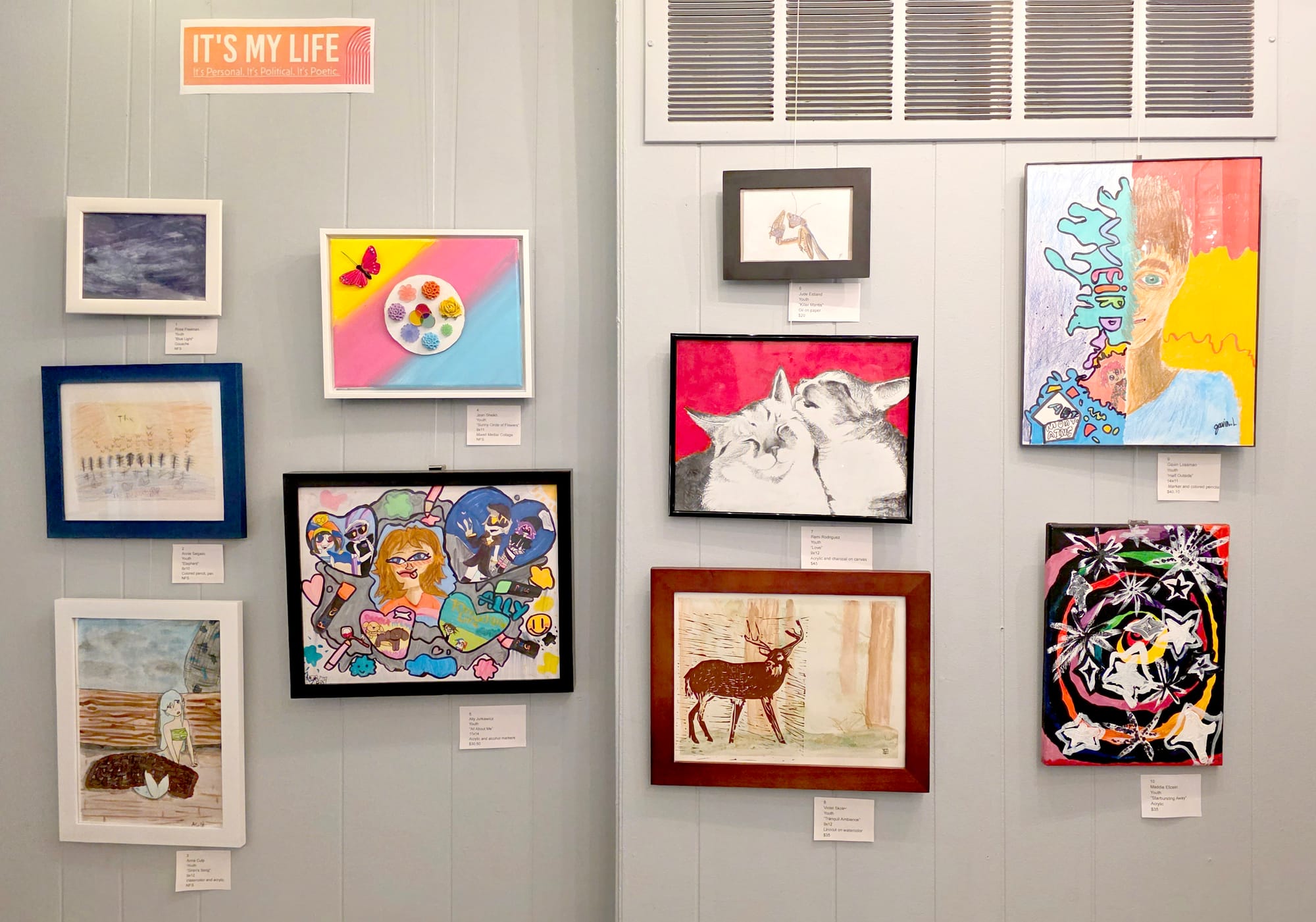
Displayed at Marnie’s Creative Outlet for the opening of It’s My Life: It’s Personal. It’s Political. It’s Poetic. on October 24th, the piece no longer belonged only to the private process of making it.
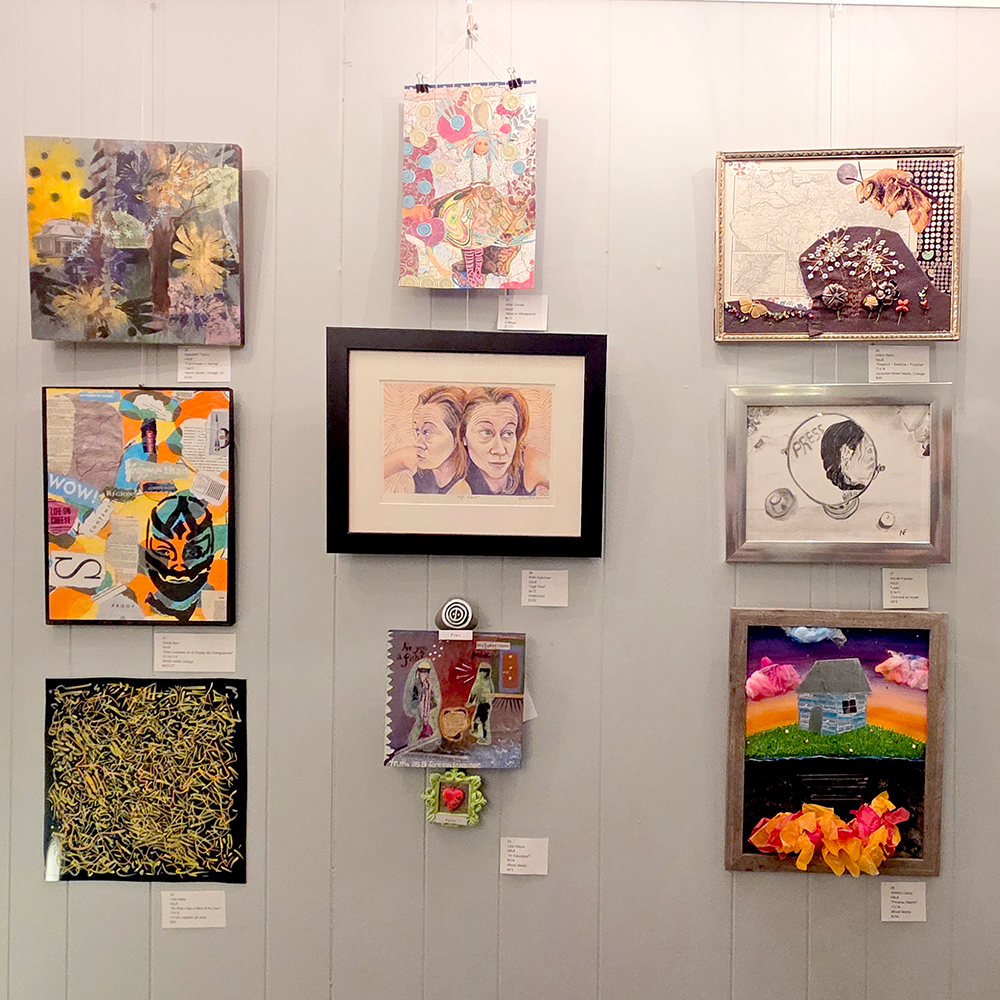
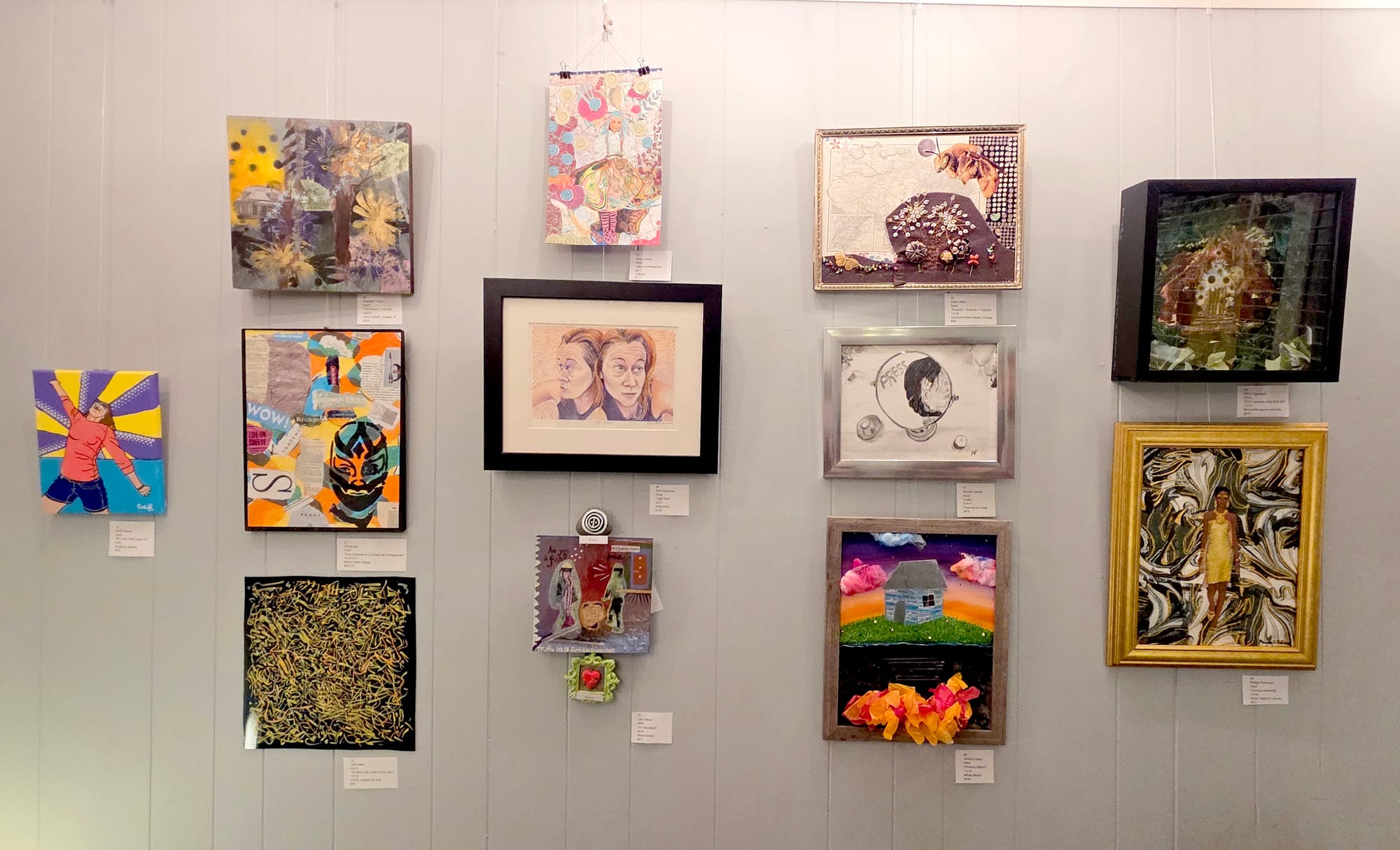
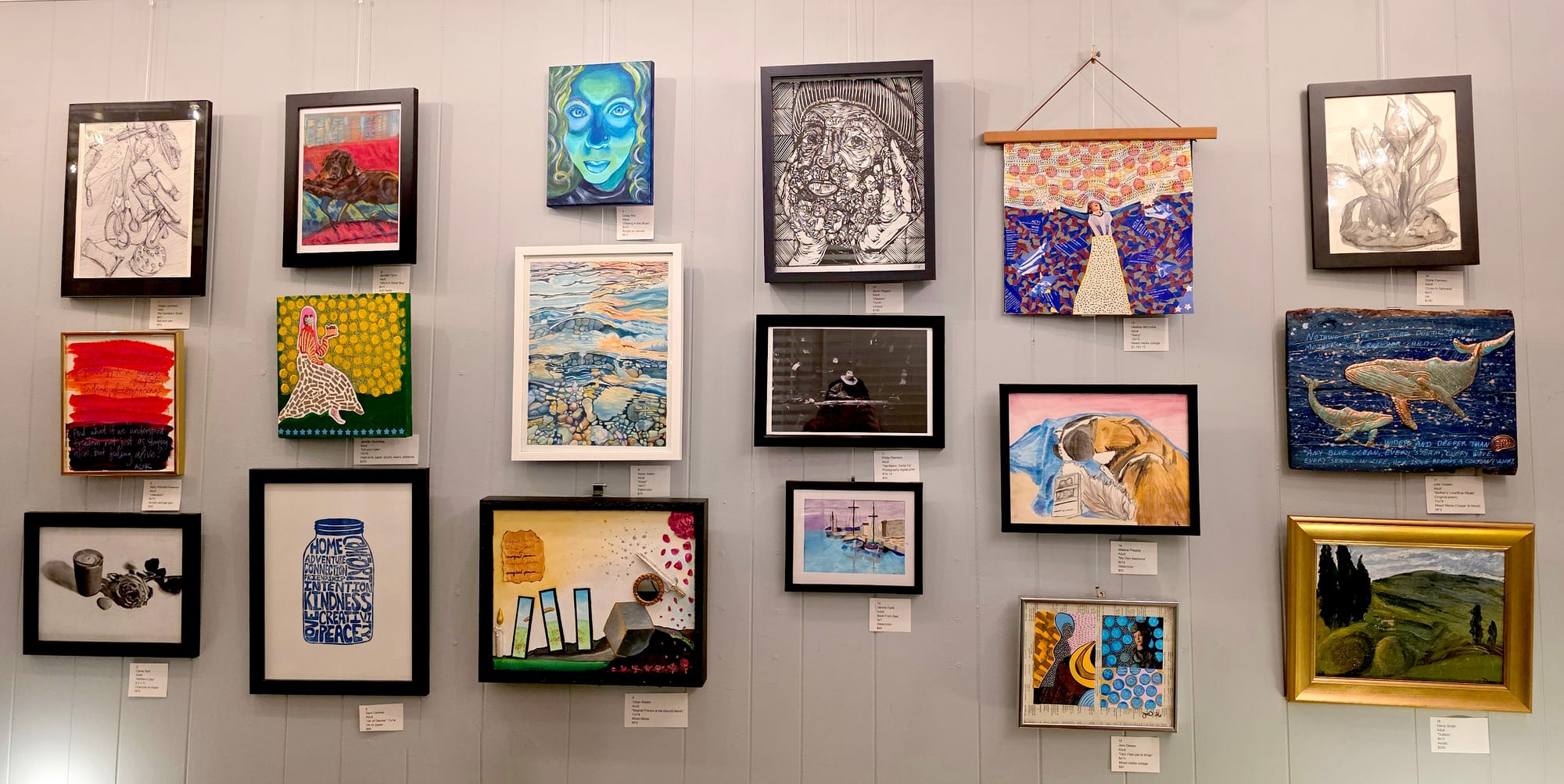
It hung among paintings, drawings, prints, photographs, collages, and mixed-media works created by artists of different ages—each offering another perspective on what it means to live, struggle, question, remember, or hope.
Sharing such a personal artwork can feel vulnerable.
I knew what the burned house, rising water, unfinished home, guiding star, silvered cracks, and emerging dawn meant to me, but I could not know whether those ideas would remain visible once the work left my hands.
An artist statement could provide additional context, but I hoped the artwork would also be capable of communicating before anyone read an explanation.
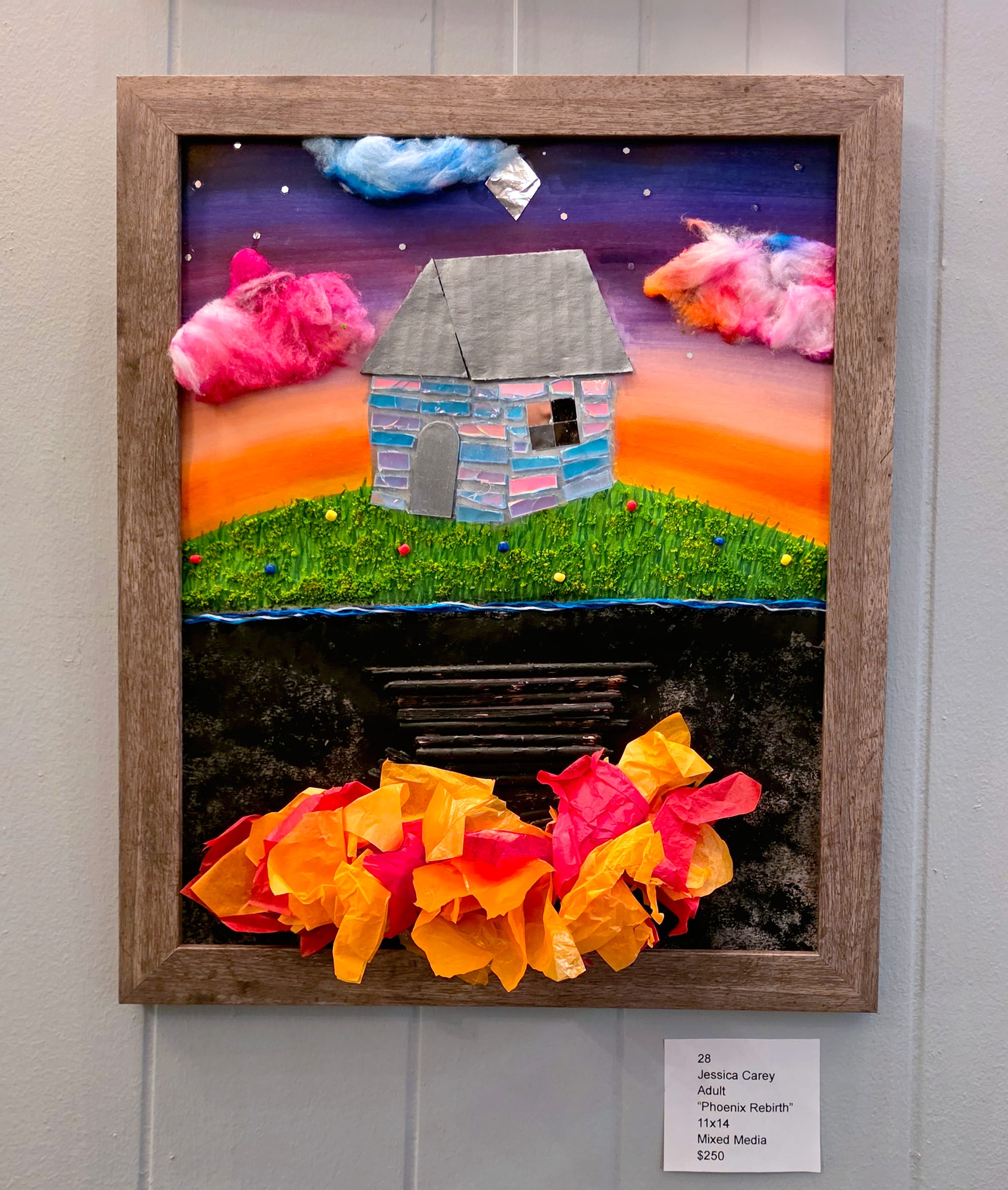
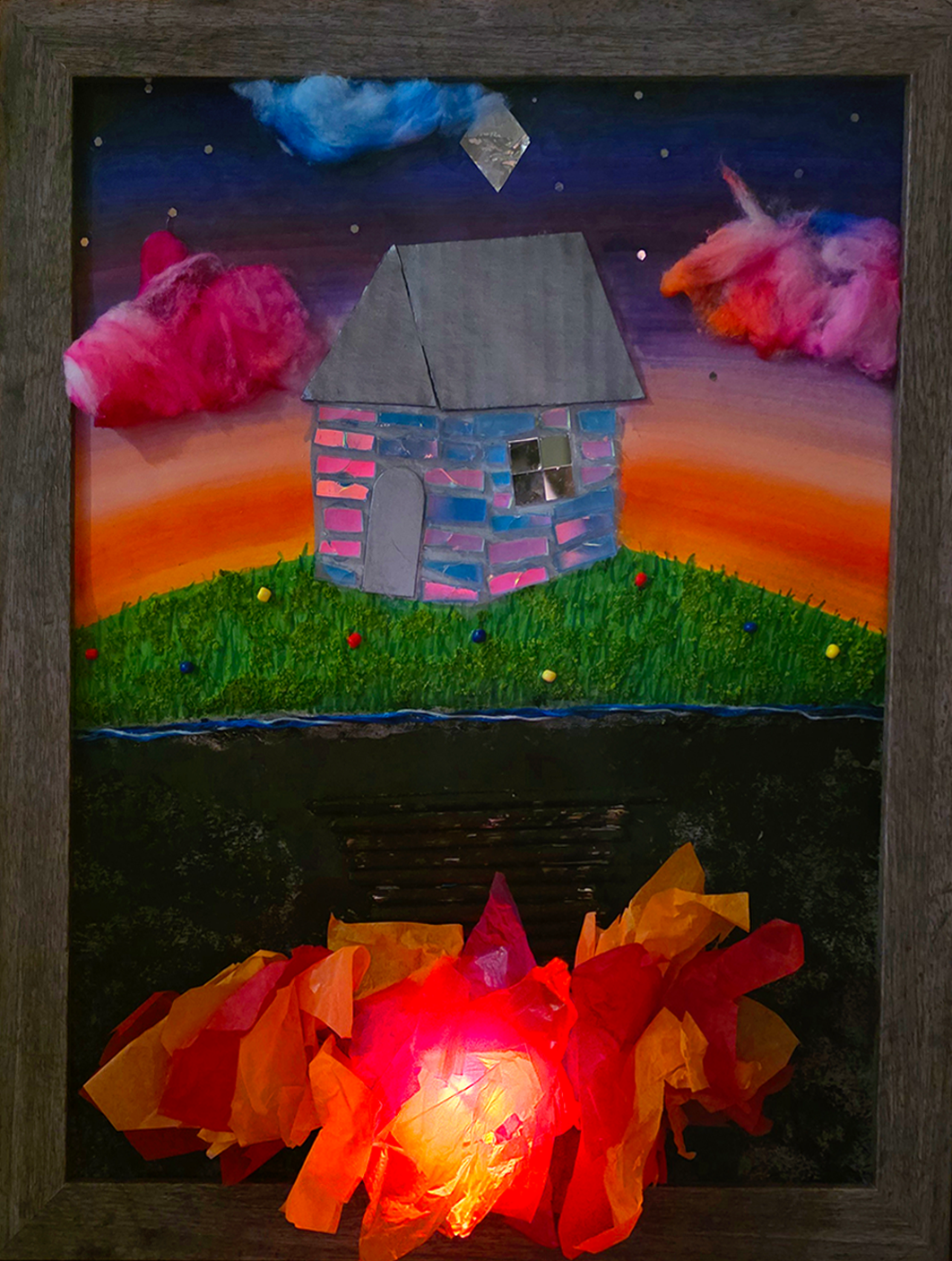
At the opening, I watched people pause before the piece, notice its unconventional materials, and discover that the fire beneath the waterline actually illuminated.
One visitor later told me that she had understood its central themes before reading the artist statement.
Those responses answered a question I had carried into the exhibition: could this deeply personal work communicate beyond the boundaries of my own experience?
Seeing people pause, notice, and respond reminded me that an artwork changes when it enters a shared space.
It does not lose the personal history from which it emerged.
Instead, it gains the possibility of being witnessed, interpreted, and connected to lives beyond the artist’s own.
This is the story of Phoenix Rebirth entering that shared space—and of an exhibition that invited artists of all ages to place something personal, political, or poetic upon the same walls.
 Jessica Carey
An Exhibition About Life as It Is Actually Lived
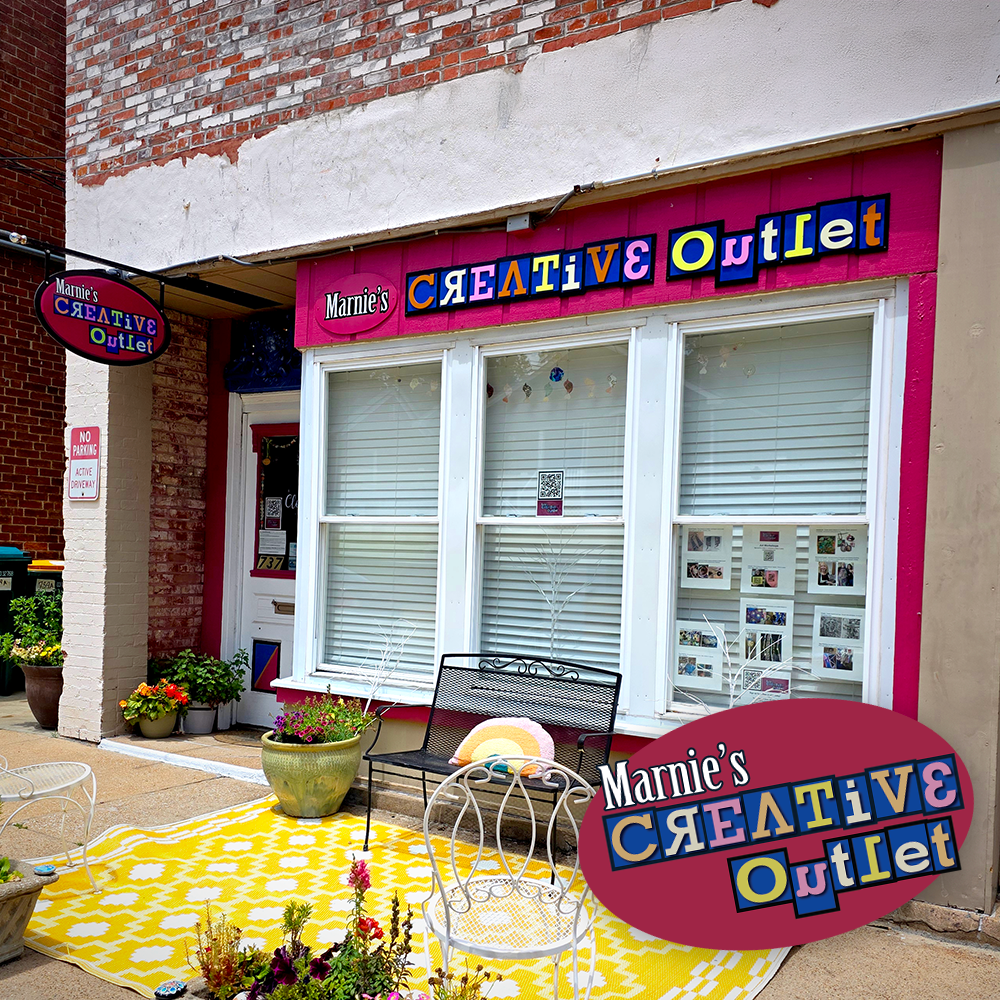
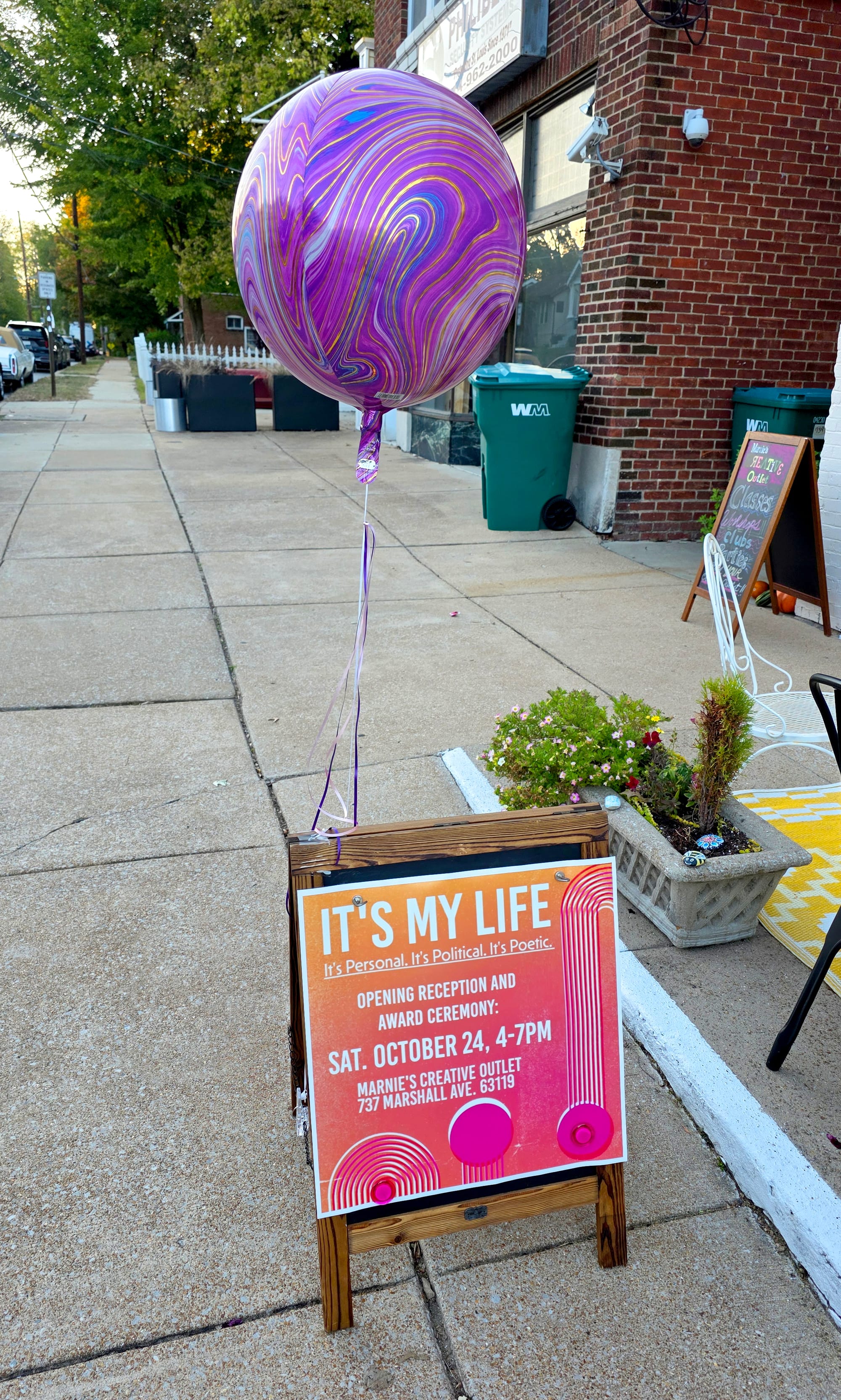
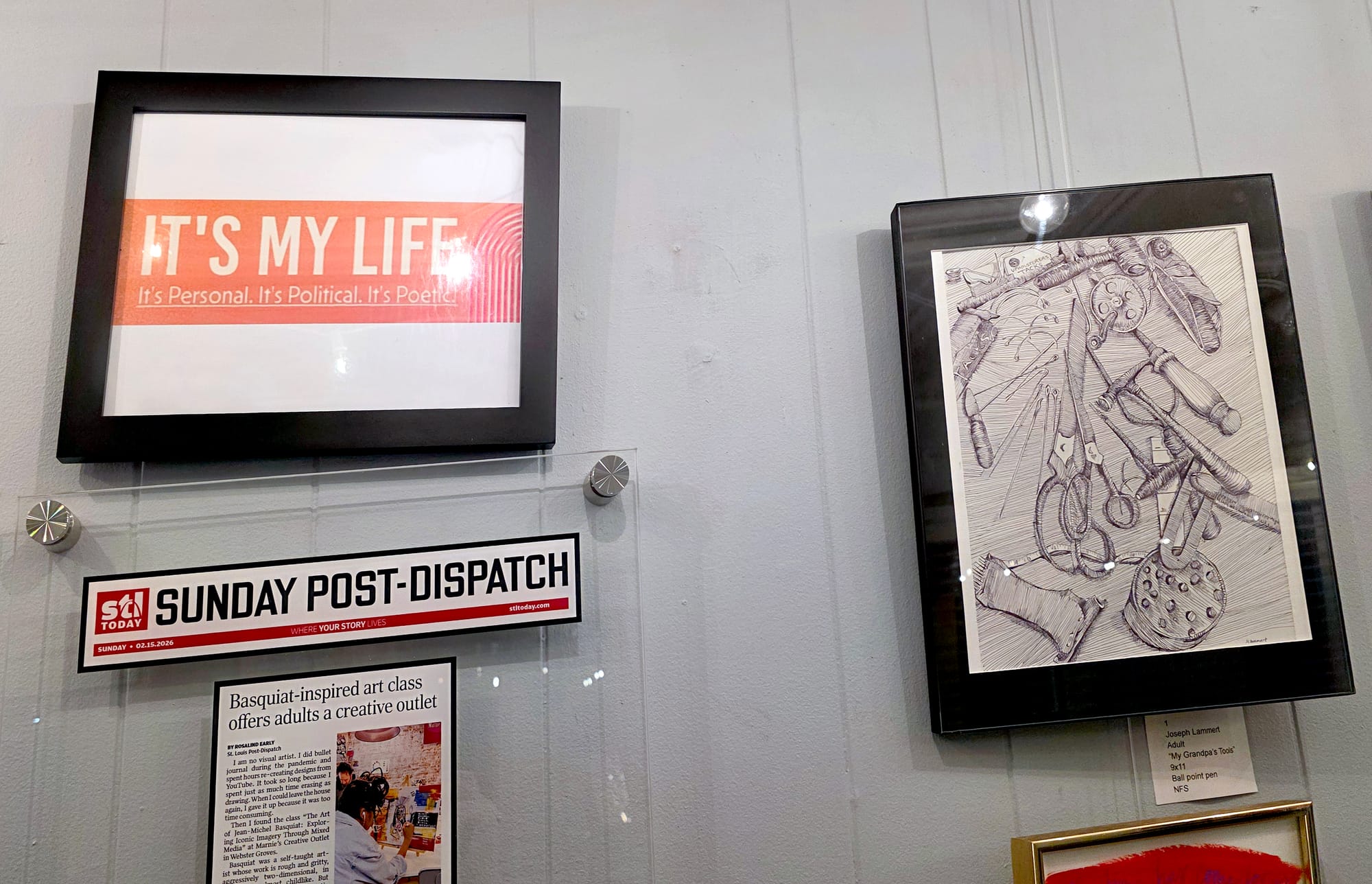
Organized by Marnie’s Creative Outlet and Becky Gunter Photography, It’s My Life: It’s Personal. It’s Political. It’s Poetic. invited artists of all ages to create work rooted in something they genuinely felt, believed, questioned, or experienced.
The call for art was intentionally broad.
A submission could express a personal feeling, respond to the political realities of the world, or celebrate the joy an artist encountered in everyday life.
Each artist could enter one piece measuring 12 × 12 inches, 11 × 14 inches, or smaller, framed or otherwise ready to hang.
Those parameters created physical consistency without requiring emotional or artistic sameness.
The works had to fit within a shared space, but the lives represented within them did not have to fit within a single theme, medium, style, or definition of what meaningful art should look like.
The exhibition’s title also acknowledged that the personal, political, and poetic are not always separate categories.
What happens within one person’s life may be shaped by family systems, cultural expectations, disability, inequality, community, access, safety, or power.
An experience can be deeply intimate while also revealing something about the larger world in which it occurred.
The poetic does not necessarily belong apart from those realities, either.
Art can use color, metaphor, texture, humor, symbolism, or beauty to express truths that would be difficult to contain within a straightforward explanation.
A work can protest, grieve, celebrate, question, or bear witness without needing to resemble a speech or provide every part of its story.
That openness was visible throughout the exhibition.
The walls held paintings, drawings, prints, photography, collage, textiles, and mixed-media pieces.
Some artists worked through recognizable figures, animals, homes, landscapes, and everyday objects.
Others used abstraction, pattern, text, symbolism, or unexpected materials.
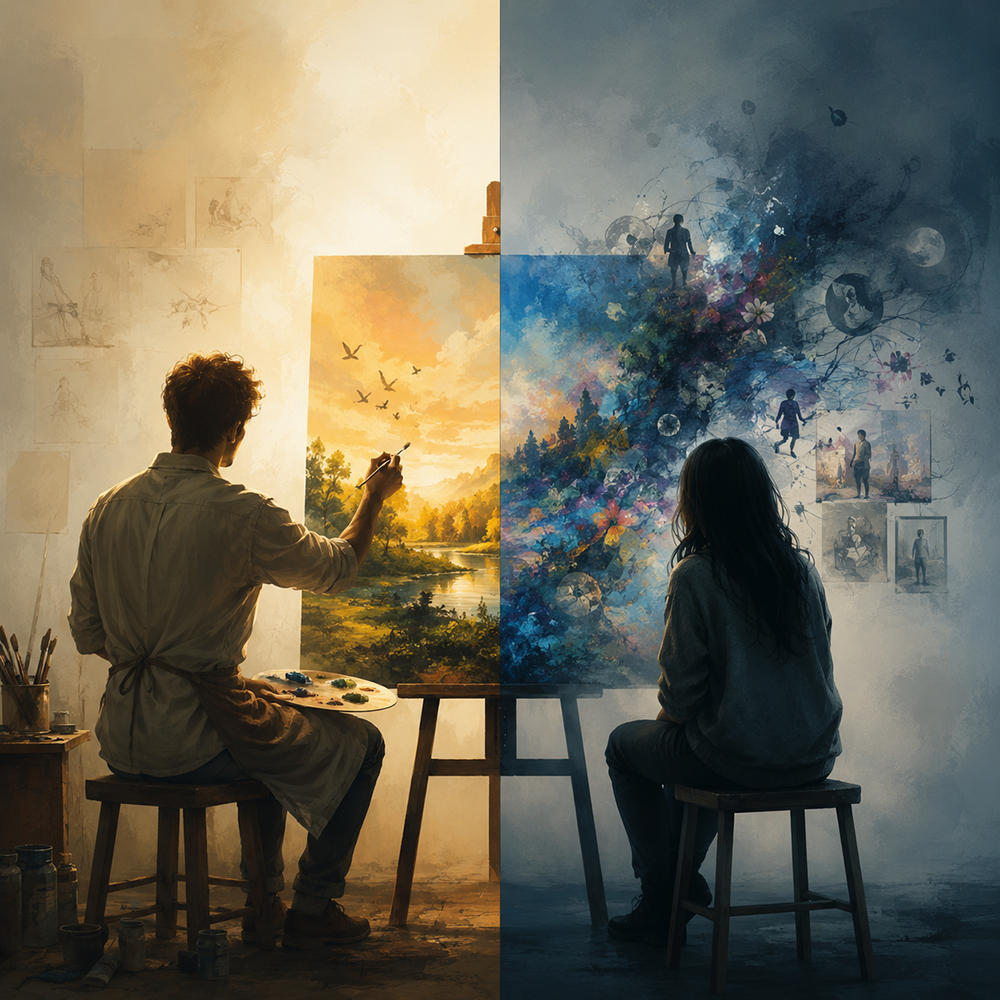
Because the exhibition included both youth and adult artists, its differences extended beyond medium or style.
The walls held perspectives formed at many stages of life without suggesting that age, professional experience, or technical refinement alone determined whether an idea deserved to be presented.
I did not know the complete histories behind the other artworks, and I would not want to impose stories upon them.
Still, the room carried an unmistakable variety of human concerns.
Some pieces felt joyful or playful; others appeared contemplative, defiant, tender, unsettling, mournful, or hopeful.
Seen together, the exhibition felt less like one unified statement than a room filled with distinct voices.
Its cohesion did not come from everyone expressing the same belief.
It came from many people making some part of their inner or outer lives visible.
Within that gathering of perspectives, Phoenix Rebirth found its place—not as the definitive story of survival or rebuilding, but as one personal truth speaking beside many others.
Phoenix Rebirth Finds Its Place
Within the exhibition’s gathering of perspectives, Phoenix Rebirth carried a story of destruction that did not end with destruction.
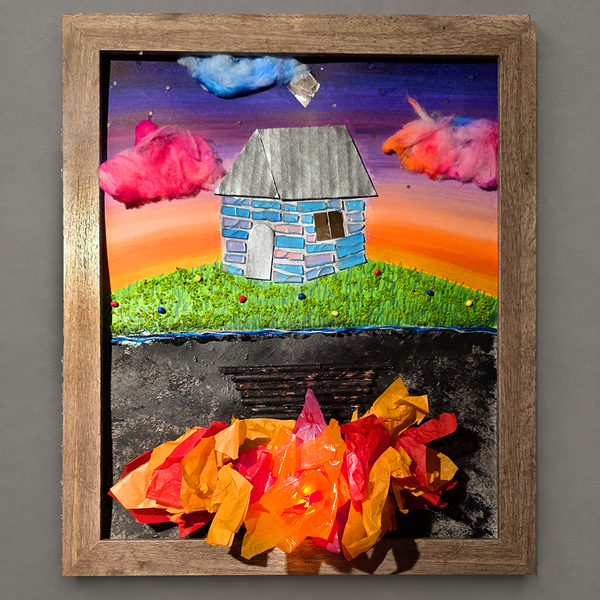
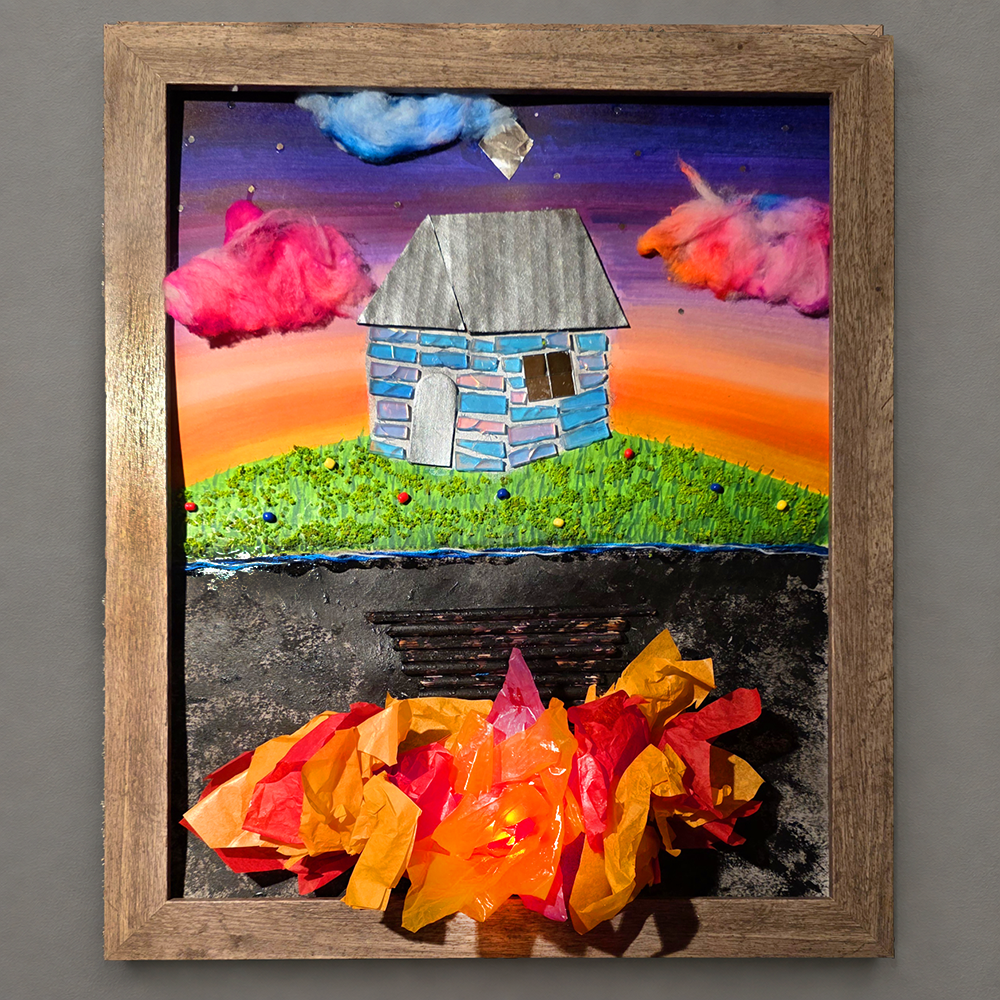
The composition is divided by a waterline.
Below it, a burned reflection of a house sits among charred bamboo, ash, smoke, and illuminated fire.
Above it, another version of the home is still being constructed beneath a guiding star and the first colors of dawn.
Its iridescent walls are imperfect, deliberately cracked, and marked with silver in reference to kintsugi—the practice of repairing broken pottery in a way that allows its history to remain visible.
The piece is personal because it emerged from my experience of living after harm.
The burned reflection represents the consequences of abuse, neglect, unsafe love, broken belonging, and choices made by other people that profoundly affected my life.
The unfinished house above the water does not suggest that everything has already been repaired.
It represents the slower and less certain work of building a safer life from what remains available.
At the same time, the ideas within the piece are not exclusively private.
Abuse, housing instability, disability, inaccessible support systems, and the expectation that harmed people should quietly endure what happened to them are influenced by families, communities, institutions, and cultural beliefs.
Experiences can occur within one home while still revealing something political about whose pain is believed, whose needs receive support, and who is expected to carry the consequences of another person’s behavior.
The work is also poetic in the way it communicates.
It does not reproduce a particular event or offer a literal record of everything that happened.
Instead, fire, water, reflection, darkness, dawn, silver cracks, and an unfinished home create a visual language capable of holding several truths simultaneously.
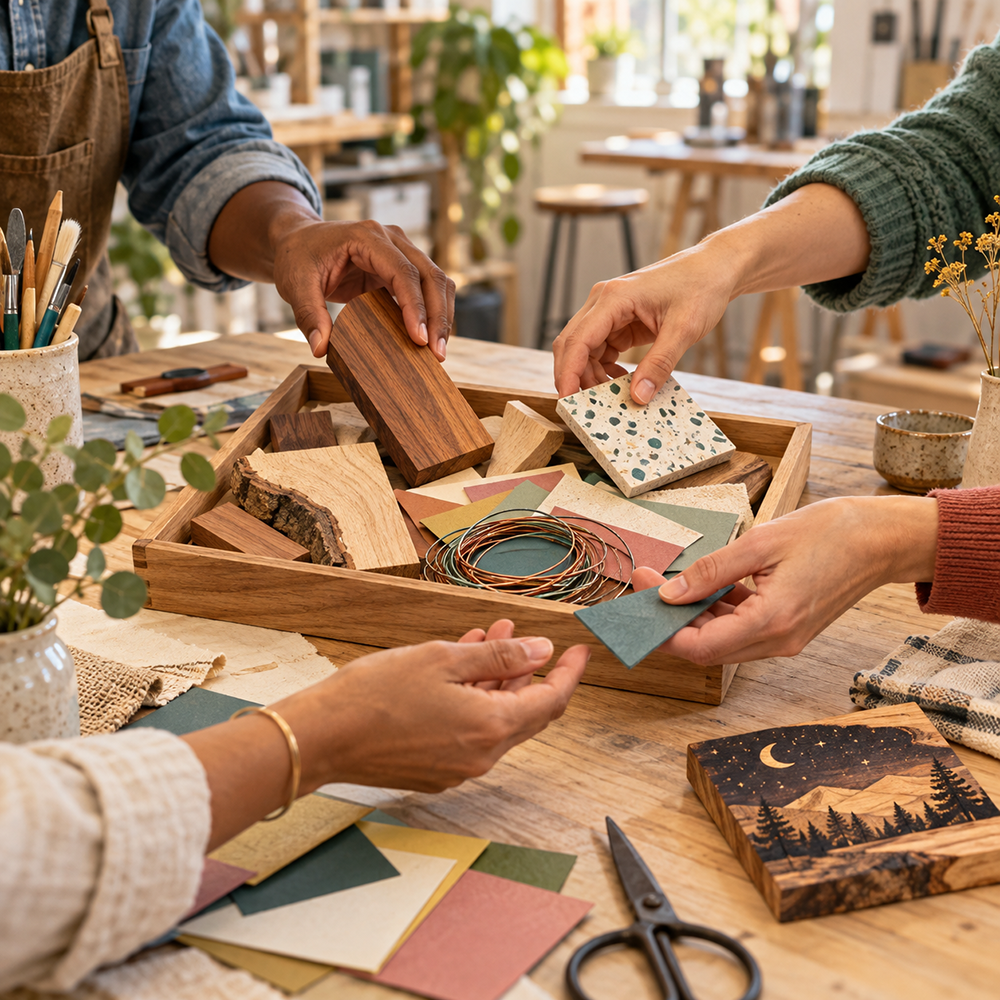
The materials carry part of that language; because I did not have access to much of my own art-supply collection, I created the piece with shared studio supplies and ordinary materials I could obtain: cardboard, aluminum foil, plastic bags, cotton balls, a popsicle stick, charred bamboo, and mica powder mixed with clear glue when silver paint was unavailable.
What might ordinarily be dismissed as scraps became walls, water, clouds, smoke, fire, and shelter.
Even the tea light inside the fire holds more than one meaning.
The fire represents something destructive, but the light within it produces literal illumination in the darkest area of the artwork.
The same place that bears evidence of devastation refuses to remain entirely without light.
In that sense, Phoenix Rebirth belongs naturally within all three parts of the exhibition’s title.
It is personal because it comes from my life.
It is political because no life unfolds separately from the systems, expectations, and power structures surrounding it.
It is poetic because metaphor allowed me to express what a literal account could not fully contain.
Hanging among the other artworks, it did not need to speak for every experience of survival or rebuilding; it only needed to tell its own truth clearly enough to enter the larger conversation.
 Jessica Carey
Seeing the Work in a Public Setting
There is a difference between finishing an artwork and seeing it installed in a public exhibition.
During the creative process, I had encountered Phoenix Rebirth from only a few feet away.
I knew where every material came from, which decisions had changed along the way, and which parts had required improvisation.
I had watched it develop one fragment at a time.
At the opening, however, I could step back and see it as a complete work—framed by the exhibition space and surrounded by art carrying entirely different histories.
In that setting, the piece had to communicate without depending upon my presence.
Most viewers would not know my background before encountering it.
They would see the divided house, the dark reflection, the developing dawn, the silver cracks, and the small light within the fire before they knew what any of those elements meant to me.
That made Gillian’s response especially meaningful.
After looking at the artwork and then reading its accompanying statement, she told me that the concepts had already come through naturally.
She had not needed the written explanation to understand what the work was conveying.
An artist statement can deepen an encounter by revealing context that an image alone cannot provide, but I did not want the written explanation to carry the meaning by itself.
Gillian’s response showed me that the visual choices were already carrying the central tension: something terrible had happened, its effects remained visible, and yet another life was being built above it.
The tea light produced a more immediate kind of connection.
Visitors were excited when they realized that the fire actually lit up.
That discovery introduced an element of surprise and invited people to examine the piece more closely.
It also allowed one of its central metaphors to become physically present: light was not merely painted or represented within the darkness—it was actively shining through it.
The illumination did not remove the burned house or transform the lower half of the piece into something cheerful.
Instead, it made both realities visible at once. The darkness remained dark, but it was no longer empty of light.
Seeing other people respond reminded me that viewers do not need access to every detail of an artist’s life to recognize emotional truth.
Their interpretations may not duplicate the artist’s exact thoughts, nor should they have to.
Art creates a meeting place between what the creator placed within the work and what another person is able to perceive through their own experiences.
This allows a personal artwork to become communal without becoming a spectacle.
The work can invite recognition and conversation while the artist retains the right to privacy, complexity, and ownership of their own story.
Viewers are offered an honest point of connection—not unrestricted access to every wound that made the artwork possible.
Phoenix Rebirth remained my story, but it was no longer confined to my private understanding of it.
By allowing the piece to be exhibited, I also allowed it to communicate for itself—and discovered that it could.
Why Local, All-Ages Exhibitions Matter
Local exhibitions can offer something essential: an approachable place for people to recognize themselves as artists and encounter creativity within their own community.
At Marnie’s Creative Outlet, artists could bring one ready-to-hang piece, see it presented with care, invite people they knew, meet other creators, and experience their work as part of a genuine exhibition.
The opening reception—with refreshments, conversations, an awards ceremony, and visitors moving among the displays—turned the artwork into a community event rather than a collection of isolated objects.
Including both youth and adult categories made that invitation even more meaningful.
Young artists were not treated as people whose creativity would only become significant someday.
Their work was framed, labeled, judged, and displayed alongside art made by adults.
At the same time, adults did not need to possess a particular professional title or follow one approved artistic path before participating.
The resulting variety reflected something I believe deeply: creativity does not belong exclusively to the most experienced, formally trained, financially resourced, or publicly recognized people.
It belongs to children experimenting with how to express an idea, adults returning to art after years away, established artists refining a long-developed practice, and people who may still be learning to call themselves artists at all.
All-ages exhibitions also allow these groups to learn from one another.
Younger artists bring directness, invention, and freedom from some of the rules adults learn to impose upon themselves.
Adult artists bring histories, skills, questions, and perspectives shaped across longer stretches of life.
Neither contribution has to diminish the other.
An exhibition about life should contain that kind of difference.
Human lives do not all arrive at the same stage, follow the same path, or speak through the same visual language.
By making room for artists across ages, media, and experience levels, It’s My Life allowed its diversity to become part of the meaning of the show.
Spaces like this do more than display finished artwork; they help build a culture in which creating, sharing, and being witnessed are possibilities available to more people.
For some participants, the exhibition may have been one event within an established artistic career.
For others, it may have been the first time they saw their work hanging publicly.
Both experiences deserve a place on the wall.
 Jessica Carey

What the Opening Represented to Me
Participating in the exhibition mattered to me for reasons that extended beyond having another place to display my artwork.
I created Phoenix Rebirth during a period when much of my life was still unsettled.
I did not have access to most of my personal art-supply collection, a dedicated studio, or the stability that artists are often imagined to need before producing meaningful work.
I created from within the rebuilding rather than waiting until I had reached the other side of it.
That reality shaped both the imagery and the physical construction of the piece.
Shared studio materials, repurposed objects, and improvised substitutes did not merely allow me to finish the artwork; they became part of what it was saying.
The work demonstrated its own central idea through the way it was made: what remained available could still become structure, beauty, shelter, and light.
Completing the piece was one act of persistence. Submitting it was another.
The work contained experiences that were painful and personal, and entering it into a judged exhibition meant accepting that other people might not understand it, connect with it, or find it artistically successful.
I could control the care with which I created it, but I could not control what would happen once it entered the room.
At the opening, I saw that vulnerability met with curiosity rather than dismissal.
People gave the work the careful attention I had hoped it could invite.
Their responses confirmed that its visual language could carry the central ideas even before the artist statement provided fuller context.
That did not erase the circumstances from which Phoenix Rebirth emerged.
Recognition does not retroactively make harm worthwhile, and a successful artwork is not compensation for what made its creation necessary.
What the opening offered was something different: evidence that destruction had not taken away my ability to make meaning, communicate clearly, or contribute something of value.
The house within Phoenix Rebirth is still under construction, and in many ways, so is my life.
Seeing it displayed did not mean that the rebuilding was finished; it meant that something created during that unfinished process had already become worthy of being witnessed.
The opening therefore represented more than the public presentation of one mixed-media piece.
It was a moment in which survival became creative expression, private meaning became shared communication, and the resources I still possessed became visible alongside everything I had lost.
It was not proof that I had arrived at some final destination.
It was proof that I was still building—and that what I was building could already hold light.
 Jessica Carey
The Light Was Meant to Be Seen
When I placed a tea light inside the fire of Phoenix Rebirth, the decision began with a rather literal thought: if I was going to create fire, it might as well actually glow.
Yet that small light came to express something larger than a realistic effect.
It shines from the burned reflection rather than from the brighter world above the waterline.
It does not wait for the darkness to disappear before becoming visible.
In fact, the darkness is what allows its presence to be seen most clearly.
Around it, the walls carried many other expressions of life: joyful, painful, political, humorous, uncertain, imaginative, and hopeful.
Each artist had chosen one piece through which to make something visible.
Together, those works reminded me that art does not require everyone to share the same experience.
It asks only that we make room to encounter one another’s truths.
Phoenix Rebirth still contains the burned house.
It still acknowledges what was destructive, what was lost, and what cannot simply be made unhappened.
Publicly displaying it did not transform that history into something good or make the harm necessary for the sake of creating art.
What changed was that the destruction no longer had sole possession of the story.
Above the ashes, a home is being built.
Above the darkness, dawn has begun. Within the fire, something still produces light.
At the exhibition, other people could see those realities existing together—not as evidence that rebuilding is easy or complete, but as evidence that devastation does not have to receive the final word.
Phoenix Rebirth began as an attempt to give physical form to that truth.
At It’s My Life: It’s Personal. It’s Political. It’s Poetic., it became part of a larger gathering of people doing the same: transforming pieces of their lived experience into something another person could witness.
The light was made within the darkness—but it was meant to be seen beyond it.
 Jessica Carey
Read the Story Behind Phoenix Rebirth
 Jessica Carey
This article reflects on seeing Phoenix Rebirth displayed publicly as part of It’s My Life: It’s Personal. It’s Political. It’s Poetic. To learn more about the experiences, symbolism, unconventional materials, and creative decisions behind the artwork, read the full story of how Phoenix Rebirth was created.
It’s My Life: It’s Personal. It’s Political. It’s Poetic. was organized by Marnie’s Creative Outlet and Becky Gunter Photography. The opening reception and awards ceremony took place on October 24, 2026, at Marnie’s Creative Outlet in Webster Groves, Missouri.
Want even more content about creativity and art?
Be sure to check out all of our creative chronicles!
If you'd like to see examples of my work, you can find some of my art and creations at Redbubble and Gumroad!
Looking to learn more about my recent journey?
Check out some of these articles:
-Hidden Gems for St. Louis Artists
-Hidden Gems for Autistic & Neurodivergent Adults
-Learning What Love Was Supposed to Feel Like
-I Wasn't Broken--I'm Burned Out
-What Chronic Autistic Burnout Actually Feels Like
-Building a Life from What Remains
 Jessica Carey