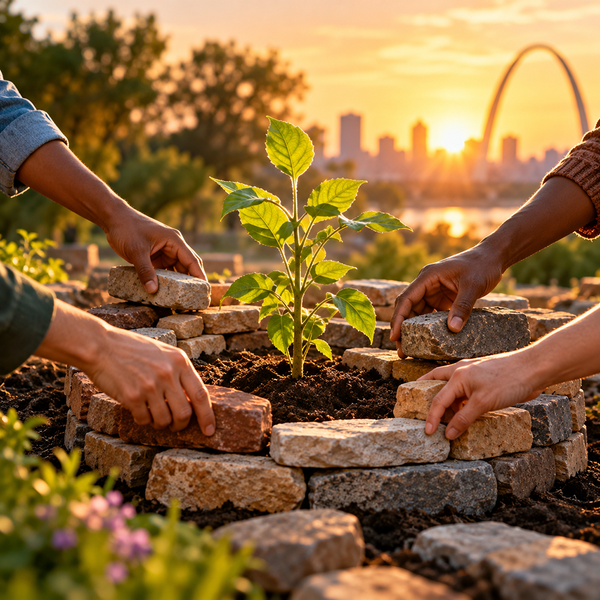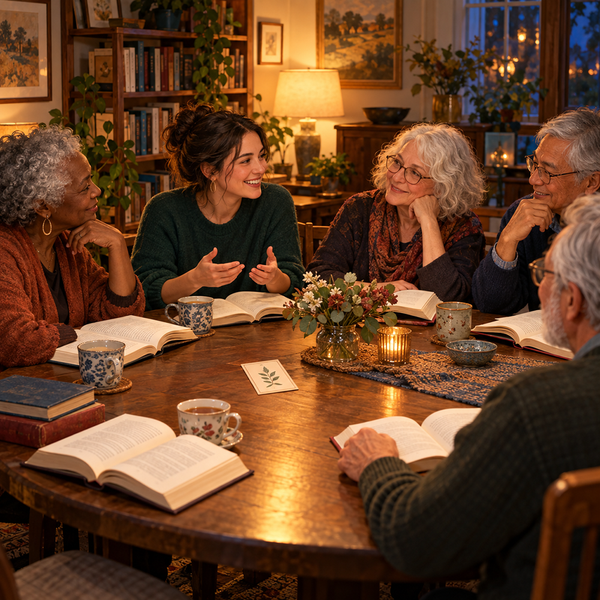

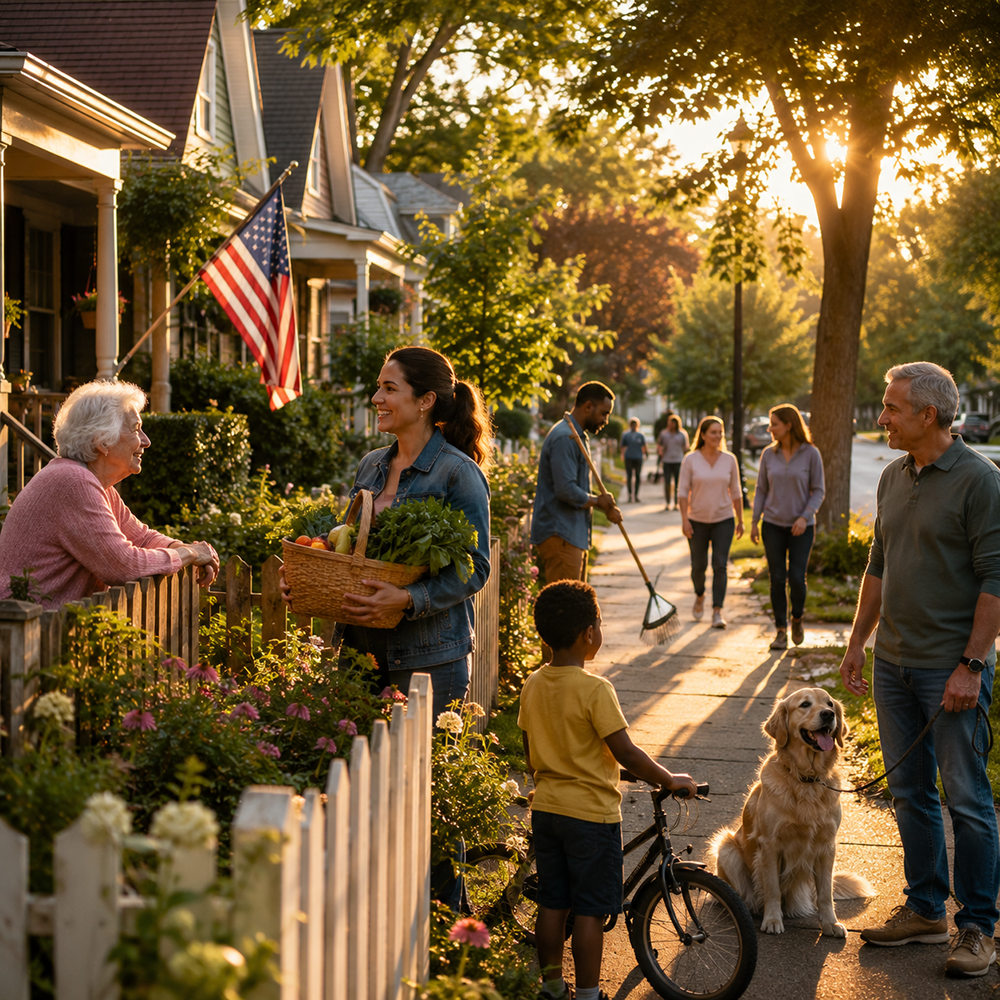
Most of us know what a neighbor is in the simplest sense.
Someone who lives nearby.
Perhaps across the street.
Next door.
Down the hall.
Around the corner.
Yet if someone asked us what makes a good neighbor, our answers would likely become much more interesting.
Some might talk about quiet streets.
Others about borrowing a ladder.
Sharing vegetables from a garden.
Watching one another's homes while someone is away.
Checking in after a storm.
Helping shovel a driveway.
Bringing over a meal when life becomes difficult.
Stories occasionally emerge of neighbors whose actions are driven more by suspicion, prejudice, fear, or the desire to control than by genuine care for the people around them.
These tragedies remind us that simply living near someone does not automatically make us good neighbors.
Neighborliness is not defined by proximity but by the choices we make toward the people whose lives intersect with our own.
Many people remember hearing stories about neighborhoods where doors were rarely locked, children played together until sunset, and asking to borrow a cup of sugar was an ordinary part of life.
Whether those memories perfectly reflect reality or not, they point toward something people continue longing for.
Not simply proximity.
But community.
Today, many people can live beside one another for years without ever learning each other's names.
We pass one another on sidewalks.
Park beside one another.
Hear one another through apartment walls.
Yet remain complete strangers.
The result is often not hostility.
It is something quieter.
Disconnection.
And perhaps that raises important questions:
- What if being a good neighbor has never been primarily about geography?
- What if it is about the kind of environment we help create wherever our lives intersect with the lives of others?
Perhaps being a neighbor is less about where someone lives...
And more about how we choose to respond to the people whose paths cross our own.
 Jessica Carey
A Good Neighbor Notices
One of the simplest qualities of a good neighbor is also one of the easiest to overlook.
They notice.
They notice the elderly man who hasn't collected his newspaper in several days.
The family welcoming a new baby home.
The teenager struggling to carry groceries.
The child riding a bicycle for the first time.
The neighbor whose porch light has stayed off for weeks after losing someone they love.
The person who seems unusually quiet.
The new family moving into the neighborhood.
Most opportunities to care for another person begin long before we offer help.
They begin with paying attention.
In many ways, this is what transforms a collection of houses into a community.
People stop becoming anonymous.
They become human beings with names.
Stories.
Dreams.
Struggles.
Celebrations.
Healthy neighborliness begins with this simple shift.
Instead of asking: "Who's that person?"
It begins wondering: "I wonder how they're doing."
Curiosity opens the door to compassion.
Not every observation requires action.
Sometimes respecting another person's privacy is the most loving response.
Healthy neighbors understand that care does not mean constant involvement.
People need space.
Boundaries.
Quiet.
Independence.
Neighborliness is not about inserting ourselves into every situation.
It is about remaining aware enough that when genuine opportunities to care arise, we are able to recognize them.
Sometimes noticing leads to a smile across the fence.
Learning someone's name.
Welcoming a new neighbor with a simple hello.
Other times it leads to something more tangible.
Helping carry heavy bags.
Bringing over a meal during a difficult season.
Offering to watch a pet while someone is away.
Checking in after a storm.
Holding the door open.
Returning a package delivered to the wrong house.
Offering a cup of sugar—or borrowing one.
These moments are rarely dramatic.
In fact, they often seem too ordinary to matter.
Yet they quietly communicate something profoundly important:
- "You are not invisible."
- "Someone sees you."
- "You matter here."
Those messages can become powerful antidotes to the loneliness so many people quietly carry.
There is another kind of noticing that healthy neighbors practice as well.
They notice strengths.
Not just needs.
They celebrate the teenager who graduates.
Congratulate the neighbor who planted a beautiful garden.
Encourage the child who proudly shows off a sidewalk chalk masterpiece.
Thank the person who spends Saturday morning picking up litter at the local park.
Healthy communities are strengthened not only by helping people through hardship but also by recognizing and celebrating the good that already exists among them.
Perhaps this is because every person longs to know they are more than another face passing by.
To be noticed is, in many ways, to be reminded that our presence matters.
Perhaps that is why genuine neighborliness begins not with grand acts of service...
But with the simple willingness to truly see the people whose lives quietly intersect with our own.
 Jessica Carey
Small Acts Build Strong Communities
When people imagine changing the world, they often picture something extraordinary:
- A major movement
- A groundbreaking invention
- A famous speech
Yet healthy communities are usually built much more quietly.
One conversation at a time.
One favor at a time.
One act of kindness at a time.
Neighborliness rarely asks us to do everything; it simply asks us to do the next loving thing that is within our ability.
Sometimes that looks remarkably ordinary:
- Returning a package delivered to the wrong address
- Holding the door for someone carrying heavy bags
- Helping a neighbor shovel snow after a storm
- Watering someone's plants while they're away
- Bringing over a meal after a new baby is born or during a season of illness
- Offering to lend a ladder, a garden tool, or—yes—a cup of sugar
- Checking in after a storm to make sure everyone is safe
- Welcoming a new family to the neighborhood with a simple introduction
These moments may seem insignificant.
Yet they communicate something deeply important: "Your well-being matters to me."
That message has the power to slowly transform the atmosphere of a neighborhood.
Trust grows.
People begin recognizing one another's names.
Older neighbors feel less isolated.
Newcomers begin feeling that they belong.
Children learn that adults around them care about their safety.
For many children, neighbors become some of the first examples of community beyond their own family.
A wave from across the street.
Someone who remembers their name.
A trusted adult who cheers them on.
These simple interactions quietly teach children whether the world beyond their front door is something to fear or a place where kindness can be found.
Little by little, strangers become familiar faces.
And familiar faces gradually become people who know they can rely on one another.
This kind of care is not about keeping score.
Healthy neighbors do not help because they expect every kindness to be repaid.
Nor do they quietly keep a record of favors owed.
They help because communities flourish when people freely care for one another.
Sometimes we will be the one offering help.
At other times, we will be the one who needs it.
Healthy communities make room for both.
Healthy communities are built not only by people who know how to give, but also by people who are willing to receive kindness with gratitude.
Accepting a meal after surgery, saying yes when someone offers to help shovel the driveway, or allowing a neighbor to carry a heavy box reminds us that community is something we create together.
Sometimes receiving help is just as important as offering it because it gives others the opportunity to practice generosity as well.
There is also wisdom in recognizing that different people have different gifts to offer.
Not everyone can lift heavy furniture.
Not everyone has extra money to give.
Not everyone has abundant free time.
Yet almost everyone has something meaningful to contribute:
- A listening ear
- A warm smile
- A ride to an appointment
- A homegrown tomato from the garden
- A few minutes spent checking in with someone who has been lonely
- Encouragement during a difficult season
Communities become richer when people share what they are able rather than comparing what they cannot offer.
These ordinary acts also create something larger than immediate help.
They create trust.
Over time, people begin to believe: "If life becomes difficult, I won't have to face it entirely alone."
That confidence cannot be bought.
It cannot be legislated.
It grows through repeated experiences of people showing one another quiet, dependable care.
Perhaps this is why so many people remember neighborhoods where borrowing a cup of sugar was never really about the sugar.
It was about relationship.
It was a simple reminder that asking for help was not a burden.
It was part of belonging to a community where people looked after one another.
Perhaps that is still possible today.
Not because every neighborhood will become perfect.
But because every small act of kindness becomes another thread woven into the fabric of a healthier community.
And over time, those threads become something strong enough to hold people through both ordinary days and extraordinary hardships.
 Jessica Carey
Good Neighbors Create Safety, Not Suspicion
One of the greatest gifts a neighborhood can offer is a sense of safety.
Not only physical safety.
Emotional safety.
Relational safety.
The quiet confidence that we are surrounded by people who care about one another's well-being.
Healthy communities do not eliminate every danger.
No community can.
Instead, they create environments where people increasingly know: "If something goes wrong, we will help one another."
That kind of safety grows through trust.
And trust grows through countless ordinary interactions:
- Learning someone's name
- Smiling as you pass
- Offering help during difficult seasons
- Respecting one another's homes, boundaries, and privacy
- Looking out for one another without constantly looking at one another with suspicion
There is an important difference between being attentive and being suspicious.
Attentiveness asks: "Is someone okay?"
Suspicion asks: "What are they doing wrong?"
Attentiveness seeks understanding.
Suspicion often searches for evidence that fear was justified.
Healthy neighborliness begins from a posture of goodwill.
It recognizes that most people are simply trying to live their lives, care for those they love, and contribute to their communities in the ways they know how.
Of course, genuine dangers do exist.
There are times when reporting dangerous behavior, calling emergency services, or protecting vulnerable people is absolutely the right thing to do.
Being a good neighbor does not mean ignoring situations that place people at risk.
Wisdom and discernment remain essential.
The difference lies in what motivates our response.
Healthy neighbors act because they want to protect people.
Not because they enjoy policing them.
Not because they assume the worst.
Not because they want to control how everyone else lives.
Love asks: "How can I help keep this community safe?"
Fear often asks: "How do I protect myself from everyone around me?"
Those questions produce very different neighborhoods.
One builds connection.
The other slowly builds isolation.
 Jessica Carey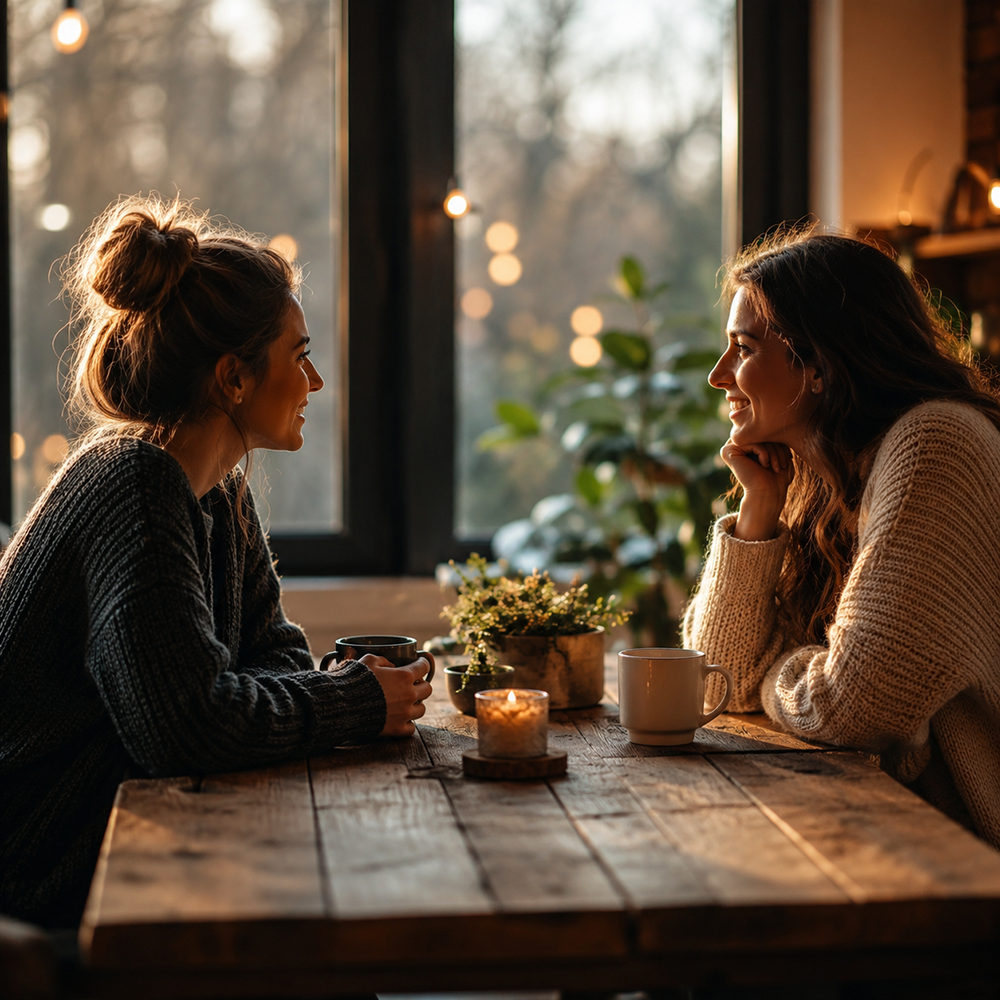
Healthy communities also recognize that safety is something everyone helps create together.
It is reflected in how we drive through residential streets.
How we care for shared spaces.
How we respect quiet hours while still making room for children to laugh and play.
How we respond when disagreements arise.
How we welcome newcomers.
How we speak about people who are different from us.
Every one of these ordinary choices contributes to the emotional climate of a neighborhood.
Little by little, people begin learning what kind of place they live in:
- Is this a place where people look out for one another?
- Or merely look at one another?
- Is this a place where mistakes are met with conversation whenever possible?
- Or where assumptions quickly replace understanding?
Healthy neighbors cannot remove every conflict or every concern.
But they can help create an atmosphere where people feel less alone, less fearful, and more willing to trust.
Perhaps that is one of the quietest forms of safety.
Not simply knowing that danger is absent.
But knowing that if difficulty comes, people will respond with wisdom, compassion, and a genuine desire to protect one another's humanity.
Because true safety is not created by suspicion alone.
It is created when vigilance is guided by care, and when care is rooted in the recognition that every person shares the same fundamental dignity.
 Jessica Carey
Good Neighbors Care for the Common Good
Healthy neighborhoods are built upon a simple but powerful realization.
We do not live only beside one another.
We live with one another.
Even when our lives are busy and our interactions are brief, our choices quietly shape the environment everyone shares.
The way we care for our property affects the people who walk past it.
The way we drive through neighborhood streets affects the children playing nearby.
The way we use shared spaces influences whether others feel welcomed or excluded.
The way we speak to one another shapes whether people experience the neighborhood as a place of trust or tension.
In ways both large and small, we are continually helping create the world our neighbors wake up to each day.
Healthy neighborliness recognizes this shared responsibility.
It asks not only: "What is most convenient for me?"
But also: "How will my choices affect the people around me?"
This shift does not require us to stop having our own needs or preferences.
Rather, it invites us to remember that our lives are interconnected.
A thriving community is not built by people who never disagree.
It is built by people who recognize that everyone shares an interest in creating a place where life can flourish.
Sometimes caring for the common good means making small sacrifices for one another:
- Driving a little more slowly on streets where children play
- Cleaning up after our pets
- Keeping shared spaces clean
- Respecting quiet hours while also recognizing that laughter, conversation, and children at play are signs of a living community—not inconveniences to eliminate
- Welcoming newcomers rather than treating them as outsiders
- Supporting local schools, libraries, parks, and community organizations that enrich everyone's lives
- Looking after shared spaces because they belong, in some way, to all of us
These choices may seem ordinary.
Yet they communicate important truths:
- "This place matters."
- "The people here matter."
- "We belong to something larger than ourselves."
Libraries remind us that communities flourish when knowledge, creativity, and opportunity are shared rather than hoarded.
They are more than buildings filled with books.
They become gathering places where neighbors of different ages, backgrounds, and experiences learn, create, and grow alongside one another.
Healthy communities resemble thriving ecosystems.
Every person contributes something different.
Some offer shade.
Some offer beauty.
Some protect.
Some teach.
Some simply remind others they are not alone.
Flourishing comes not from everyone becoming the same but from many different gifts working together.
Healthy communities also recognize that every person contributes differently:
- Some volunteer their time.
- Others mentor young people.
- Some organize neighborhood gatherings.
- Others quietly check on elderly neighbors after storms.
- Some plant flowers that brighten a shared sidewalk.
- Others pick up litter without expecting recognition.
- Still others simply greet people warmly each morning, creating a culture where strangers gradually become familiar faces.
No single act creates a thriving community.
It is the combination of many different acts of care, offered by many different people, that slowly transforms a neighborhood into a place of belonging.
Perhaps this is one of the most beautiful aspects of neighborliness.
It reminds us that we are not merely consumers of the places where we live.
We are caretakers.
Each of us leaves fingerprints on the emotional atmosphere of our communities through the way we speak, the way we respond, the way we care, and the way we choose to treat one another.
The question is not whether we are shaping our neighborhoods because we are.
The deeper question is: what kind of neighborhood is our presence helping to create?
Because communities do not become healthier by accident.
They become healthier whenever ordinary people repeatedly choose to contribute to the common good.
 Jessica Carey
Boundaries Make Better Neighbors
Being a good neighbor does not mean always saying yes.
It does not mean being available at every moment.
It does not mean sacrificing your own well-being in an attempt to meet everyone's needs.
Healthy communities are built upon generosity.
They are also built upon respect.
Respect for one another's homes.
Time.
Privacy.
Differences.
Responsibilities.
And personal boundaries.
This balance is what allows kindness to remain sustainable.
Imagine a neighborhood where everyone felt entitled to enter one another's homes without asking.
To borrow belongings without permission.
To interrupt at any hour of the day.
To expect constant availability.
Even if these actions were done in the name of friendliness, they would gradually erode trust rather than strengthen it.
Genuine neighborliness recognizes that every person has a life beyond the front door.
Families to care for.
Work to complete.
Health to manage.
Personal struggles others may never fully see.
Rest is not selfish.
Privacy is not rejection.
Sometimes the kindest response we can offer is simply honoring another person's need for space.
Healthy boundaries also protect generosity from becoming resentment.
When people continually give beyond what they are able, kindness can slowly become exhaustion.
Resentment begins replacing joy.
What was once freely offered begins feeling like an obligation.
Healthy neighbors understand that care cannot be sustained if it consistently ignores human limits.
This is why healthy communities make room for both giving and receiving:
- Sometimes we are able to offer help.
- Sometimes we need to decline because our own responsibilities require attention.
- Sometimes we are the ones asking for support.
There is dignity in all three.
Respecting boundaries also means recognizing that people express neighborliness in different ways.
One neighbor may enjoy long conversations over the backyard fence.
Another may be quieter but faithfully clear sidewalks after every snowfall.
One family may host neighborhood gatherings.
Another may quietly check on elderly residents each week without drawing attention to themselves.
There is no single personality that defines a good neighbor.
Kindness has many expressions.
What matters is not how outgoing someone appears.
It is whether their presence contributes to a community where people are treated with dignity and respect.
Healthy boundaries also make room for healthy differences.
Neighbors will not always share the same opinions.
The same traditions.
The same lifestyles.
The same cultures.
The same schedules.
The same interests.
Community does not require everyone to become alike.
It asks something much simpler:
- Can we disagree without dehumanizing one another?
- Can we respect differences without allowing those differences to become barriers to basic kindness?
- Can we recognize that another person's dignity does not depend upon how similar they are to us?
Curiosity asks questions that fear has already answered.
There three different approaches people can take toward neighbors.
The first is withdrawal:
- "Leave me alone."
- "Your life has nothing to do with mine."
The second is over-involvement:
- "I should always be available."
- "I should fix everyone's problems."
Neither extreme creates healthy community.
Healthy neighborliness lives in the middle.
It says:
- "I care about you."
- "I respect you."
- "I'll help when I reasonably can."
- "I'll also respect your privacy, my own limits, and the fact that neither of us is responsible for living the other's life."
Perhaps this is one of the quiet gifts of boundaries.
They remind us that genuine love does not require constant access.
Nor does respect require complete agreement.
Healthy neighborliness grows when people freely choose kindness rather than feeling pressured into it.
Because communities flourish not when everyone lives the same life...
But when each person is given room to live their own life while contributing, in their own way, to the well-being of those around them.
 Jessica Carey
Neighborliness Extends Beyond Familiar Faces
One of the greatest tests of neighborliness is not how we treat the people who are easiest to love; it is how we respond to people who are different from us.
Every community is made up of individuals with different stories.
Different cultures.
Different ages.
Different personalities.
Different beliefs.
Different abilities.
Different ways of experiencing the world.
Healthy communities do not require everyone to become the same.
Instead, they learn how to live together with curiosity, respect, and goodwill.
This begins with a simple but profound recognition.
Every person we encounter is far more than our first impression of them:
- The neighbor whose yard looks untidy may be caring for a loved one with a serious illness.
- The teenager who seems withdrawn may be carrying burdens invisible to everyone else.
- The elderly man who rarely leaves his home may be grieving the loss of a lifelong partner.
- The family that recently moved into the neighborhood may be wondering if they will ever truly belong.
We rarely know the full story another person is carrying.
Remembering this does not require us to ignore harmful behavior or abandon wisdom; it simply invites humility.
Healthy neighbors resist the temptation to reduce people to assumptions, labels, stereotypes, or a single difficult interaction.
Instead, they remain open to the possibility that there is more to every person than first meets the eye.
This posture changes the atmosphere of a community.
Instead of asking: "How are they different from me?"
Healthy neighborliness begins asking: "What might we have in common?"
We all hope someone notices when we're struggling.
We all long to feel safe.
We all want to know that our lives matter.
We all experience joy.
Fear.
Loss.
Hope.
Love.
Those shared experiences remind us that beneath our differences, our humanity is deeply connected.
This does not mean we will always agree.
Healthy communities are not built upon uniformity.
They are built upon the conviction that another person's dignity does not disappear simply because they think differently, worship differently, vote differently, look differently, or live differently than we do.
Respect is not agreement.
Compassion is not endorsement.
Kindness is not the absence of conviction.
Healthy neighborliness allows people to hold deeply held beliefs while continuing to treat one another with dignity, honesty, and care.
Perhaps this is one of the greatest gifts we can offer the places where we live.
To become the kind of people who refuse to let fear, prejudice, or indifference have the final word.
To greet before we judge.
To listen before we assume.
To learn before we label.
To remember that every stranger is a human being whose life carries joys, wounds, dreams, and struggles we may never fully see.
Perhaps that is what it truly means to love our neighbors.
Not that we know everything about them.
But that we choose to recognize their humanity before allowing our differences to define the relationship.
Because communities flourish whenever people become known first as neighbors...
And only second as everything else.
 Jessica Carey
Communities Celebrate Together
Healthy neighborhoods do more than respond to crises.
They celebrate ordinary life together:
- Children riding bicycles
- Gardens blooming in spring
- Front porch conversations on cool evenings
- Block parties
- Holiday decorations
- Farmers' markets
- Community festivals
- A neighbor excited to share tomatoes from their garden
These moments remind us that community is not simply about solving problems.
It is about sharing life.
Joy, like kindness, grows when it is shared.
 Jessica Carey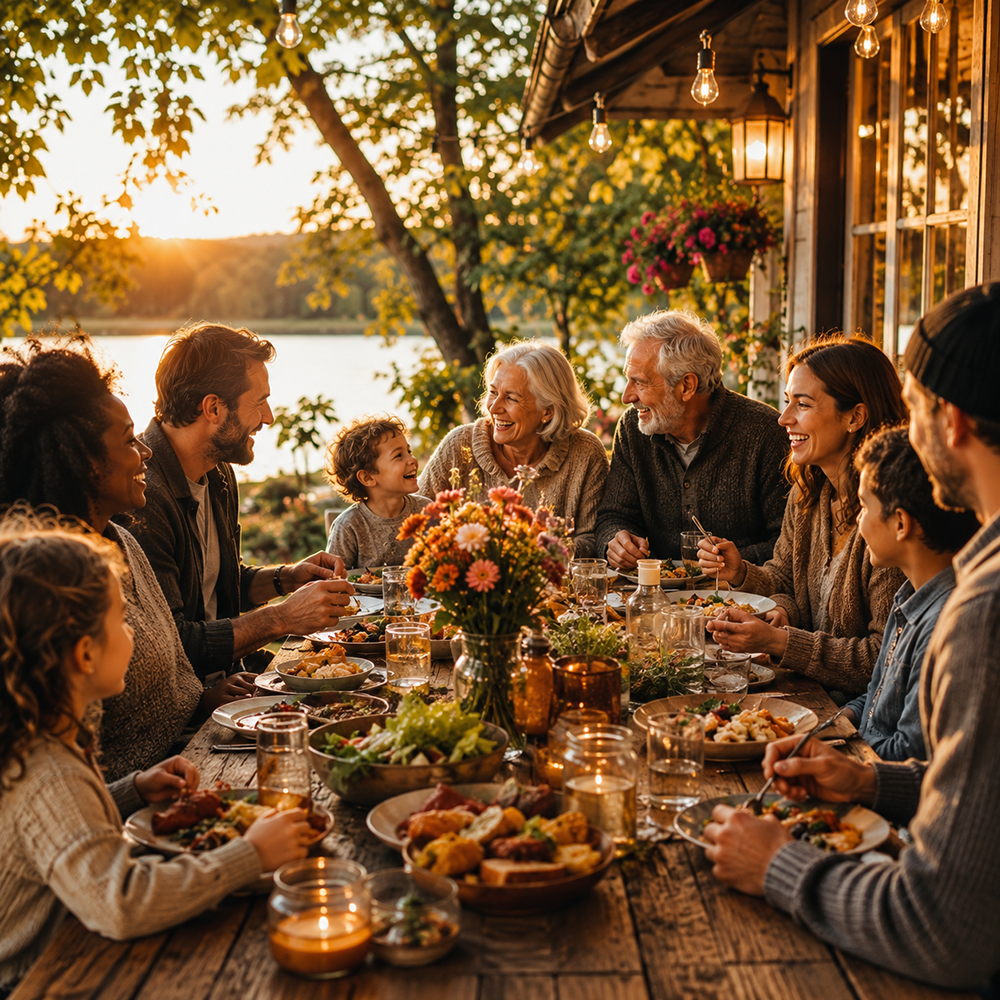
Every Community Is Built One Neighbor at a Time
Perhaps one of the most hopeful truths about neighborliness is that it has never depended on having the perfect neighborhood.
It begins with ordinary people making ordinary choices.
Choosing to notice
Choosing to learn someone's name.
Choosing kindness over indifference.
Curiosity over assumption.
Respect over entitlement.
Care over convenience.
Communities become healthier whenever people begin believing they belong to one another rather than merely living beside one another.
Every lasting community begins the same way.
With strangers.
No one begins life knowing the people next door.
Communities grow because strangers gradually become familiar faces, familiar faces become trusted neighbors, and trusted neighbors become people who quietly help carry one another through life.
Throughout this reflection, we've explored a simple but transformative idea.
A neighbor is more than someone who happens to live nearby.
A neighbor is another human being whose life intersects with our own.
That understanding changes the way we see the places we live.
Neighborhoods become more than collections of houses.
Apartment buildings become more than shared walls.
Streets become more than places we drive through.
They become communities filled with people whose joys, struggles, hopes, and lives matter.
Healthy neighborliness does not ask us to become responsible for everyone.
Nor does it ask us to abandon healthy boundaries or ignore genuine dangers.
Instead, it invites something both simpler and more profound.
To recognize that every interaction leaves a small imprint on the emotional atmosphere we all share:
- A smile
- A conversation
- A helping hand
- A respectful disagreement
- A meal delivered during a difficult season
- A child greeted by name
- A newcomer welcomed instead of ignored
 Jessica Carey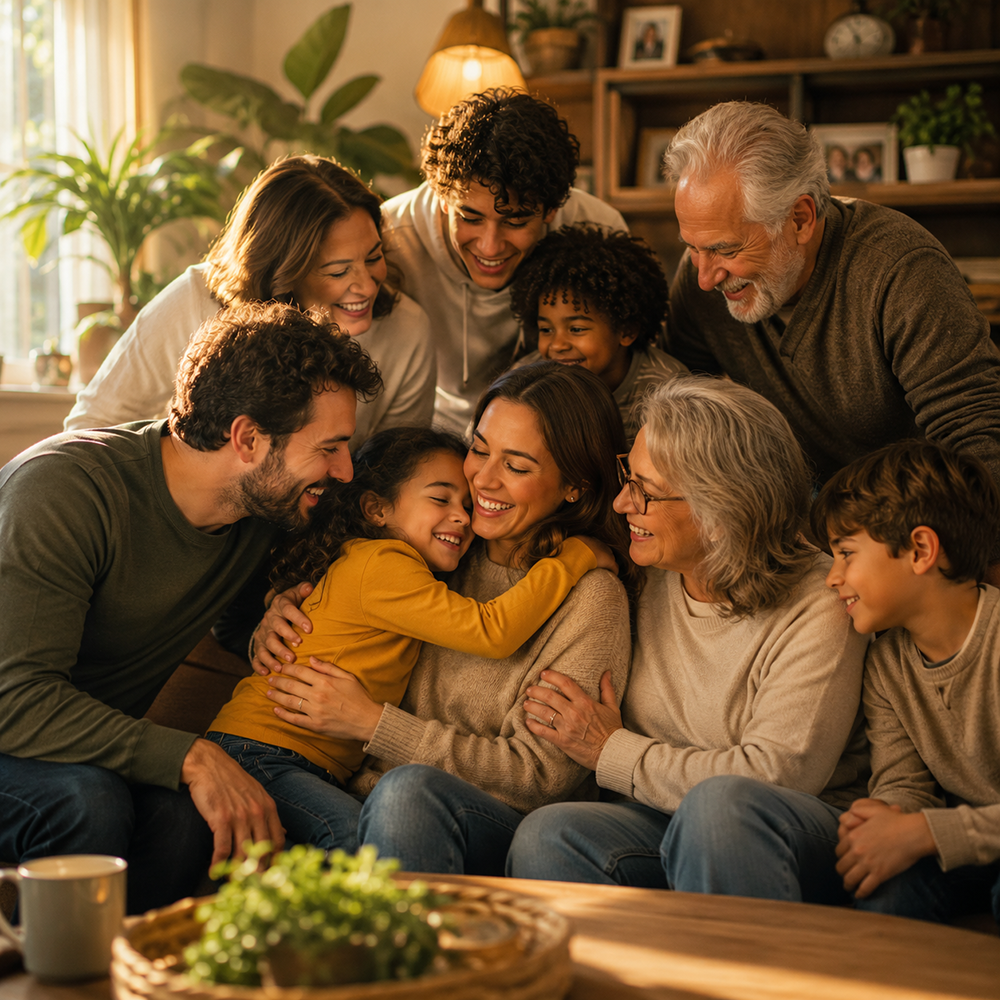
None of these moments seem extraordinary by themselves.
Yet together, they quietly shape whether a community becomes a place where people merely live...
Or a place where people truly belong.
Perhaps that is why communities are never built all at once.
They are built conversation by conversation.
Act of kindness by act of kindness.
Relationship by relationship.
One ordinary day at a time.
Communities are rarely transformed by a single extraordinary act.
More often, they are shaped by ordinary kindness practiced consistently over time.
Every community we've ever admired was once built by ordinary people making ordinary choices.
This also means that neighborliness is not something reserved for people with outgoing personalities.
Or endless free time.
Or extraordinary resources.
Every one of us has opportunities to contribute:
- Sometimes through practical help.
- Sometimes through encouragement.
- Sometimes through protecting shared spaces.
- Sometimes through simply treating another person with dignity and respect.
No contribution is too small when it helps another person feel seen.
Perhaps that is one of the quiet miracles of being a good neighbor.
We often imagine that changing a community requires grand solutions.
Yet communities are most often transformed through ordinary people who consistently practice extraordinary care.
People who choose to greet rather than ignore.
To listen rather than assume.
To protect rather than exploit.
To contribute rather than merely consume.
To leave every place a little kinder than they found it.
Perhaps that is what neighborliness has always been.
Not simply living beside one another.
But helping one another live well.
Communities are not defined by the streets we share; they are defined by the humanity we share.
Because in the end, being a good neighbor is not about the distance between our homes.
It is about the posture of our hearts.
It is choosing to recognize that every person whose path crosses ours carries a life of immeasurable worth.
It is asking:
- "How can my presence make this place feel a little more like home?"
- "Who helped make the world feel like home for me?"
- "How can I become that person for someone else?"
Because every thriving community begins the same way.
With ordinary people choosing, day after day, to become good neighbors.
We may never know how far a single act of neighborliness travels.
A smile may become encouragement.
Encouragement may become hope.
Hope may become courage.
Courage may become kindness offered to someone else.
In this way, even the smallest acts of care ripple outward in ways we may never fully see.
That is one of the quiet miracles of being a good neighbor.
 Jessica Carey
Want even more content about creativity and art?
Be sure to check out all of our creative chronicles!
If you'd like to see examples of my work, you can find some of my art and creations at Redbubble and Gumroad!
Looking to learn more about my recent journey?
Check some of these articles:
-The Difference Between Resting and Giving Up
-Hidden Gems for St. Louis Artists
-Hidden Gems for Autistic & Neurodivergent Adults
-I Think I Might Be Autistic... Now What?
 Jessica Carey