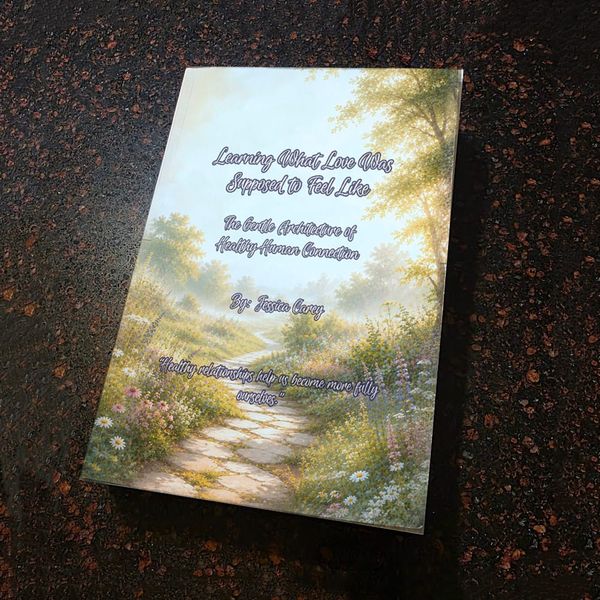


Many of the choices we make in relationships look similar on the surface.
Checking in with someone.
Setting boundaries.
Offering help.
Asking difficult questions.
Protecting ourselves.
Holding someone accountable.
Any one of these actions can arise from love.
Or from fear.
That is what makes relationships so complicated.
The same behavior can be motivated by entirely different hearts.
Fear is not something to be ashamed of.
It is one of the oldest parts of being human.
Fear helps us survive.
It notices danger.
Protects us from harm.
Encourages caution when something feels uncertain.
Without fear, we would walk into traffic without looking.
Touch hot stoves.
Ignore genuine threats.
Fear has an important place in our lives.
The problem is not that fear exists.
The problem begins when fear quietly becomes the foundation upon which we build our relationships.
Because fear asks very different questions than love does.
Fear asks:
- "How do I make sure I don't lose this?"
- "How do I protect myself?"
- "How do I stay in control?"
- "How do I prevent being hurt?"
Love asks something entirely different:
- "How do we help one another flourish?"
- "How do we grow together?"
- "How do we create safety?"
- "How do we understand one another more deeply?"
Notice that love does not ignore safety.
It simply creates safety differently.
Fear often tries to create safety through control.
Love creates safety through trust.
Fear often seeks certainty.
Love seeks understanding.
Fear builds cages.
Love grows roots.
One confines.
The other nurtures.
Perhaps this is why so many unhealthy relationship patterns look like love at first.
Control can look like protection.
Possessiveness can look like devotion.
Surveillance can look like trust.
Rescuing can look like helping.
Silence can look like peace.
Yet beneath each of these is often the same quiet question: "What am I afraid of?"
That question is not meant to condemn us.
It is meant to invite curiosity.
Because when we understand what fear is protecting...
We often discover what love has been inviting us to build instead.
Perhaps that is what healthy relationships are really about.
Not eliminating fear.
But learning to let love become the wiser guide.
 Jessica Carey
Fear Tries to Create Safety Through Control
At the heart of many unhealthy relationship patterns is a simple longing.
The longing to feel safe.
To know that we matter.
To believe we won't be abandoned.
To trust that what we love won't suddenly disappear.
These longings are deeply human.
Every one of us carries them.
When fear enters those places, it naturally begins looking for ways to protect us.
It asks:
- "How do I make sure this doesn't fall apart?"
- "How do I prevent being hurt?"
- "How do I make sure they don't leave?"
- "How do I stay safe?"
These questions are not signs that something is wrong with us.
They are signs that something inside us feels vulnerable.
Sometimes fear isn't only a thought.
It is a nervous system remembering experiences that once required protection.
Fear is trying to protect what it believes is precious.
The difficulty is not that fear wants safety.
The difficulty is the methods fear often chooses.
Fear frequently tries to create safety through control:
- If I can control another person's choices... maybe they won't leave.
- If I can monitor everything... maybe nothing bad will happen.
- If I can avoid every difficult conversation... maybe the relationship will survive.
- If I can keep everyone happy... maybe no one will reject me.
At first, these strategies can feel reassuring.
Control often creates the illusion of certainty.
But certainty and safety are not the same thing.
A relationship may appear calm while fear quietly governs every interaction.
People stop speaking honestly.
Needs remain unspoken.
Mistakes become frightening.
Disagreement feels dangerous.
Connection slowly gives way to performance.
Ironically, the very strategies meant to protect the relationship often begin weakening it.
Not because the desire for safety was wrong.
But because fear attempted to create safety by limiting freedom rather than nurturing trust.
Love seeks safety differently.
Love does not ignore fear.
It listens to it.
It asks what fear is trying to protect.
Then it gently responds with wisdom instead of panic.
Rather than asking: "How do I control this person?"
Love asks: "How do we build a relationship where honesty is safe?"
Rather than asking: "How do I guarantee I'll never be hurt?"
Love asks: "How do we become people who can face hurt with honesty, repair, and compassion?"
Fear searches for guarantees.
Love builds resilience.
Fear tries to eliminate uncertainty.
Love learns how to remain present even when certainty is impossible.
That does not mean love is fearless.
It means love refuses to let fear become the architect of the relationship.
Because genuine safety cannot be forced into existence through control.
It grows through trust.
Respect.
Honesty.
Accountability.
Kindness.
Repair.
And the quiet confidence that healthy relationships are not held together by cages.
They are held together by roots.
Roots that grow stronger because they are freely chosen.
Not because they are tightly controlled.
Perhaps that is one of the greatest invitations fear offers us.
Not to ignore it.
But to ask: "What kind of safety am I trying to create?"
And then to wonder whether love might know a healthier way.
 Jessica Carey
When Fear Disguises Itself as Love
Fear is rarely obvious.
It does not usually announce itself by saying: "I am afraid."
Instead, it quietly puts on the clothes of love.
It says:
- "I'm only trying to protect you."
- "I just don't want anything bad to happen."
- "I worry because I care."
- "I'm only doing this because I love you."
Sometimes those words are completely true.
Love does protect.
Love does care.
Love does notice when something feels unsafe.
The challenge is that fear can produce many of the same outward behaviors as love.
The difference lies beneath the surface.
Imagine two people asking the same question: "Where are you?"
One asks because they genuinely want to know if you're safe after a difficult drive home.
The other asks because they need to monitor your every movement to quiet their own anxiety.
The words are identical.
The motivation is not.
Or imagine two parents setting boundaries for a child.
One does so with the goal of helping the child grow in wisdom, responsibility, and confidence.
The other does so because uncertainty feels unbearable and control seems like the only way to feel secure.
From the outside, both may appear strict.
Yet one is nurturing maturity.
The other is trying to soothe fear.
This is why looking only at behavior is rarely enough.
Healthy relationships invite us to ask a deeper question: "What is motivating this?"
- Is this action creating more freedom?
- More trust?
- More honesty?
- More mutual flourishing?
- Or is it quietly shrinking another person's world in order to make fear feel safer?
Fear often believes that if it can tighten its grip...
Watch more closely...
Say yes to everything...
Or never allow conflict...
Then love will be protected.
Yet love rarely grows under those conditions.
- Love needs room to breathe
- Room to speak honestly
- Room to choose freely
- Room to make mistakes, repair them, and grow
Without that freedom, relationships often become performances rather than places of genuine connection.
 Jessica Carey
People begin saying what feels safest instead of what is true.
They hide struggles instead of asking for help.
They comply instead of contributing.
They remain close physically while becoming increasingly distant emotionally.
Ironically, fear's attempts to preserve connection often weaken the very intimacy it longs to protect.
Love offers another way.
Instead of asking: "How do I keep everything under control?"
Love asks: "How do we create the kind of relationship where trust can grow?"
Instead of seeking certainty through control, love seeks security through honesty.
Instead of demanding closeness, it nurtures belonging.
Instead of holding tightly out of fear, it creates the conditions where people freely choose to remain.
Perhaps that is one of the quietest truths about love.
Love does not become stronger by tightening its grip.
It becomes stronger by deepening its roots.
Because relationships flourish not when fear succeeds in controlling every outcome...
But when love creates enough safety for truth, freedom, responsibility, and trust to grow together.
 Jessica Carey
The Worlds Love and Fear Create
Every relationship creates an environment.
Whether we realize it or not, the ways we speak, respond, repair, encourage, and protect one another gradually shape the emotional climate we live within.
Some environments invite people to breathe more deeply.
Others quietly teach people to hold their breath.
This is one of the most significant differences between love and fear.
They do not simply inspire different actions.
They cultivate different worlds.
When fear becomes the foundation of a relationship, people often begin organizing their lives around self-protection.
They become careful about what they say.
They hide mistakes.
They avoid difficult conversations.
They monitor another person's moods before expressing their own needs.
They begin asking: "What do I need to do to keep things from getting worse?"
Over time, honesty gives way to performance.
Authenticity gives way to self-protection.
The relationship may appear peaceful from the outside.
Yet beneath the surface, everyone is working hard simply to avoid upsetting the system.
Love creates a very different environment.
Love certainly does not eliminate difficulty.
People still disagree.
They still make mistakes.
They still disappoint one another.
But the atmosphere itself is different.
Instead of asking: "How do I avoid making a mistake?"
People begin asking: "How do we repair when mistakes happen?"
Instead of fearing honesty, they begin trusting that truth will be met with curiosity rather than humiliation.
Instead of hiding weakness, they discover that vulnerability is welcomed rather than weaponized.
Instead of earning belonging through perfect performance, they experience belonging that makes growth possible.
Notice what has changed.
Not the absence of conflict.
Not the absence of pain.
But the presence of safety.
Fear often creates relationships where people survive.
Love creates relationships where people flourish.
That flourishing does not come from controlling every outcome.
It grows from repeatedly choosing honesty over pretending.
Curiosity over assumption.
Repair over blame.
Freedom over control.
Responsibility over fear.
Little by little, those choices become the climate of the relationship itself.
Perhaps this is why healthy relationships often feel so different before we can explain why.
Our nervous systems notice the environment long before our minds find the words.
We recognize what it feels like to exhale.
To stop performing.
To stop anticipating danger in every disagreement.
To know that we can be honest without immediately risking rejection.
That is one of love's quietest gifts.
It creates an environment where people no longer have to spend all their energy protecting themselves.
They can begin using that energy to grow.
Perhaps that is the deepest difference between fear and love.
Fear asks: "How do I survive?"
Love gently asks: "How do we help one another come fully alive?"
The answers to those questions slowly shape the world every relationship becomes.
 Jessica Carey
When Fear Counterfeits Love
One of the reasons fear can be so difficult to recognize is because it rarely presents itself as something obviously harmful.
Instead, it often imitates love.
It borrows love's language.
Love's gestures.
Even love's intentions.
From the outside, the two can look remarkably similar.
Yet beneath the surface, they are growing entirely different kinds of relationships.
Fear says: "If I can control this, I'll finally feel safe."
Love says: "If we build trust, we can face uncertainty together."
Fear says: "If I never disagree, we'll keep the peace."
Love says: "Honest conversations make genuine peace possible."
Fear says: "If I rescue you from every struggle, you'll know I care."
Love says: "I'll walk beside you while believing you are capable of growing."
Fear says: "If I watch everything you do, nothing bad will happen."
Love says: "Trust grows through honesty, consistency, and freedom—not constant surveillance."
Fear says: "If I never let you leave, I'll never lose you."
Love says: "Love is meaningful precisely because it is freely given."
Fear says: "If I make you feel ashamed, maybe you'll finally change."
Love says: "Accountability invites growth because it speaks to our capacity to become better, not our worth as human beings."
 Jessica Carey
Notice something important.
In every case, fear and love are trying to protect something valuable.
Connection.
Belonging.
Safety.
Growth.
The difference is not what they desire.
The difference is how they try to achieve it.
Fear often believes that enough control will create security.
Love knows that genuine security cannot be forced.
It must be cultivated.
Trust cannot be demanded.
It is built.
Belonging cannot be coerced.
It is offered.
Respect cannot be controlled.
It is practiced.
Love cannot be owned.
It is chosen.
This is why fear's counterfeits eventually begin to crack.
Control may create compliance.
But it cannot create trust.
Silence may create temporary calm.
But it cannot create peace.
Rescuing may create dependence.
But it cannot create resilience.
Possession may create proximity.
But it cannot create intimacy.
Shame may create outward obedience.
But it rarely creates lasting transformation.
Love works differently.
It creates the conditions where healthy qualities can take root naturally.
Not because people are forced into them.
But because they feel safe enough to choose them.
Perhaps this is one of the most freeing truths about healthy relationships.
We do not have to ask only: "What am I doing?"
We can also ask: "What is inspiring this action?"
- Is it fear trying to protect itself?
- Or is it love seeking the flourishing of everyone involved?
The answer to that question quietly shapes every relationship we build.
Because fear and love may sometimes look alike from a distance.
But over time, they always grow different kinds of fruit.
 Jessica Carey
Fear Watches. Love Trusts.
Few things reveal the difference between fear and love more clearly than the way they approach trust.
Fear longs for certainty.
Love learns to live with uncertainty.
That does not mean love ignores wisdom.
Nor does it pretend that betrayal never happens.
Rather, love understands that trust cannot be manufactured through constant monitoring.
Fear often believes that if it gathers enough information...
Checks enough messages...
Asks enough questions...
Keeps close enough watch...
Then nothing painful will happen.
Control begins to feel like protection.
Surveillance begins to feel like care.
Yet underneath these behaviors is often a quiet hope: "If I can see everything, perhaps I can prevent being hurt."
That hope is deeply understandable.
Most of us know what it feels like to fear losing someone we love.
To fear being deceived.
To fear being abandoned.
Fear tries to soothe those wounds by searching for certainty.
But certainty is something relationships can rarely promise.
Healthy trust grows differently.
It is not blind.
It pays attention.
It notices patterns.
It welcomes honesty.
It responds wisely when trust is broken.
Yet it also understands something fear often forgets.
No amount of watching can create genuine trust.
Trust grows when people repeatedly choose honesty.
When their actions align with their words.
When accountability follows mistakes.
When repair is pursued after harm.
These are the roots from which trust grows.
Not surveillance.
Not suspicion.
Not constant proof.
Ironically, fear's attempts to guarantee trust often begin eroding it.
Relationships become investigations rather than conversations.
People begin feeling monitored instead of known.
Performance quietly replaces authenticity.
Instead of asking: "How can I prove I'm trustworthy?"
People begin wondering: "Will anything I do ever be enough?"
Love offers another path.
It recognizes that trust always involves some degree of vulnerability.
To trust another person is not to guarantee that we will never be hurt.
It is to gradually choose openness because someone has demonstrated themselves to be worthy of it.
And when trust is broken, love does not ask us to ignore reality.
It invites us to respond with wisdom.
Sometimes trust is rebuilt through accountability, consistency, and repair.
Sometimes healthy boundaries become necessary while trust slowly grows again.
Sometimes relationships change because trust has been repeatedly violated.
Love makes room for all of these possibilities.
Because love is not committed to pretending everything is fine.
It is committed to reality.
Fear searches endlessly for certainty.
Love seeks something deeper.
Not the impossible promise that nothing painful will ever happen...
But the confidence that honesty, integrity, and genuine repair create relationships strong enough to weather uncertainty together.
Perhaps that is the deepest invitation of trust.
Not to stop seeing clearly.
But to stop believing that control can give us what only character can create.
Because trust is never built by watching another person more closely.
It is built when two people continually choose to become trustworthy.
 Jessica Carey
Fear Rescues. Love Empowers.
When fear sees someone struggling, its first instinct is often to make the struggle disappear.
It rushes toward immediate relief.
It wants the pain to stop.
The uncertainty to end.
The discomfort to pass.
That impulse comes from a caring heart.
Watching someone we love suffer can be incredibly painful.
Sometimes stepping in is exactly the right thing to do.
When someone is in crisis...
When circumstances overwhelm their capacity...
When they genuinely cannot carry a burden alone...
Love gladly shares the weight.
We were never meant to face every hardship by ourselves.
Yet not every struggle is the same.
Some difficulties cannot be removed without also removing the opportunity to grow through them.
Fear often struggles to make that distinction.
It asks: "How do I make this easier right now?"
Love asks: "What will help this person become stronger over time?"
Those questions sometimes lead to different responses.
Fear may solve every problem before another person has the opportunity to wrestle with it.
Love offers encouragement while allowing responsibility to remain where it belongs.
Fear often mistakes relief for healing.
Love understands that healing sometimes asks us to walk through difficult places rather than around them.
This is why healthy love is willing to do something fear finds incredibly difficult.
It believes in another person's capacity.
It says: "I'll help you."
Not: "I'll become you."
It says: "I'll walk beside you."
Not: "I'll carry your life for you."
It says: "I believe you can grow."
Not: "I don't think you can handle this."
Perhaps that is one of the deepest gifts healthy love offers.
It does not measure care by how indispensable it becomes.
It measures care by how much another person is gradually empowered to stand with greater wisdom, confidence, and resilience.
Fear often asks: "How do I rescue this person?"
Love gently asks: "How do I help this person discover the strength that is already beginning to grow within them?"
One creates dependence.
The other cultivates confidence.
One removes every obstacle it can.
The other remains faithfully present while believing that growth is possible.
Because healthy love does not merely seek to make today easier.
It hopes to help another person become increasingly capable of facing tomorrow.
 Jessica Carey
Fear Holds On. Love Lets People Grow.
One of fear's greatest temptations is believing that love is proven by how tightly we hold on.
If we can just keep someone close...
Prevent them from changing...
Protect them from every mistake...
Convince them to stay...
Then perhaps everything will be okay.
At first, this can feel like devotion.
Commitment.
Even loyalty.
Yet beneath the surface, fear is often asking:
- "What if I lose them?"
- "What if they change?"
- "What if they no longer need me?"
- "What if they choose a different path?"
These questions are deeply human.
Every meaningful relationship carries the possibility of loss.
We cannot love without also becoming vulnerable.
Fear responds to that vulnerability by tightening its grip.
Love responds differently.
Love recognizes that every person is growing.
Changing.
Learning.
Healing.
Making mistakes.
Beginning again.
Because of that, love does not seek to preserve people exactly as they are.
It hopes for their flourishing—even when that growth is unexpected.
Sometimes growth brings people closer.
Sometimes it changes the way a relationship looks.
Children become adults.
Friends move away.
Partners discover new dreams.
People recover from unhealthy patterns.
They become more confident.
More independent.
More fully themselves.
Fear often experiences these changes as threats.
Love learns to see them as part of life.
This does not mean growth is always easy.
Sometimes another person's growth challenges our expectations.
Sometimes it asks us to release roles we have grown comfortable with.
Sometimes it invites us to celebrate strengths that mean we are needed differently than before.
Those moments can stir grief.
And that grief deserves compassion.
Yet love asks a gentle question:
- "Am I trying to preserve this relationship exactly as it has always been?"
- "Or am I helping create the conditions where both of us can continue becoming healthier people?"
Healthy love is not afraid of growth simply because growth brings change.
It understands that relationships, like living things, are meant to develop.
A tree that never changes never becomes strong.
A child who is never allowed to mature never becomes an adult.
A friendship that never adapts eventually becomes fragile.
Growth is not the enemy of love.
It is one of love's greatest hopes.
This is why healthy love celebrates another person's increasing confidence, wisdom, and freedom.
It delights when they begin making healthier choices.
It encourages them to discover gifts they did not know they possessed.
It rejoices when they become more fully themselves.
Not because it no longer wants the relationship.
But because genuine love has never sought ownership.
It has always sought flourishing.
Perhaps this is one of the quietest differences between fear and love.
Fear asks: "How do I keep this exactly as it is?"
Love asks: "How do I help what is good continue to grow?"
One clings to what already exists.
The other makes room for what is still becoming.
Because healthy love does not measure its success by how tightly it can hold another person.
It measures its success by whether both people are becoming freer, wiser, more compassionate, and more fully alive.
Sometimes that journey draws people closer together.
Sometimes it changes the shape of the relationship.
But love remains committed to the same hope.
Not possession.
Flourishing.
Because love has never been about keeping people small enough to hold onto.
It has always been about helping one another become everything we are capable of becoming.
 Jessica Carey
Fear Builds Walls. Love Builds Boundaries.
At first glance, walls and boundaries can look remarkably similar.
Both create limits.
Both involve saying no.
Both acknowledge that not every behavior should be welcomed.
Yet beneath the surface, they are motivated by very different hopes.
Walls are often built from fear.
Boundaries are often built from love.
Fear says:
- "I've been hurt before."
- "No one gets close again."
- "If I keep enough distance, I'll never have to experience that pain another time."
Walls promise protection through isolation.
They close every door because opening even one feels too risky.
Sometimes that response is deeply understandable.
When someone has experienced betrayal, abuse, manipulation, or repeated harm, creating distance may feel like the only way to survive.
Those walls often begin as acts of self-protection.
They deserve compassion, not judgment.
Yet walls were never meant to become permanent homes.
They keep danger out.
But they can also keep healing, trust, and healthy connection from entering.
Boundaries are different.
Boundaries do not say: "No one is welcome."
They say: "Healthy relationship is welcome."
They create clarity rather than isolation.
They communicate expectations instead of assumptions.
They protect dignity rather than punishing mistakes.
Healthy boundaries are not built because we expect everyone to hurt us.
They are built because love flourishes where respect, honesty, and responsibility are able to grow.
A garden fence is a helpful picture.
The fence is not there because the gardener hates people.
It is there because something beautiful is growing.
The purpose is not exclusion for its own sake.
It is protection for the sake of flourishing.
Relationships are much the same.
Healthy boundaries do not exist because love has failed.
They exist because love is valuable enough to protect.
Fear often believes that safety comes from keeping everyone at a distance.
Love creates safety by learning who can be trusted with increasing closeness.
That process takes time.
It requires discernment.
Consistency.
Repair.
Mutual respect.
Some people gradually earn deeper trust because their actions repeatedly demonstrate care and integrity.
Others may show, through repeated choices, that greater distance is the healthiest response.
Boundaries make room for both realities.
They allow relationships to grow naturally rather than forcing closeness that has not yet been supported by trust.
Perhaps this is one of the greatest gifts boundaries offer.
They remind us that love and wisdom belong together.
We do not have to choose between caring for another person and caring for ourselves.
Healthy love seeks the flourishing of everyone involved.
That includes protecting our own dignity as well as theirs.
Fear often asks: "How do I make sure no one can ever hurt me again?"
Love gently asks: "How do I create relationships where honesty, respect, and trust have room to grow?"
Those questions lead to very different lives.
One builds walls that become increasingly difficult to leave.
The other builds gates that open thoughtfully, wisely, and with hope.
Because the healthiest relationships are not those without boundaries.
They are the ones where boundaries quietly create the safety that allows genuine intimacy to take root.
Love is not the absence of limits.
Sometimes love is the wisdom to know which doors should remain open...
Which ones should open slowly...
And which ones should remain closed until genuine change makes trust possible.
 Jessica Carey
Fear Uses Shame. Love Invites Accountability.
When relationships are guided by fear, mistakes often become threats.
A mistake feels like evidence that someone is failing.
A disagreement feels like rejection.
A weakness feels like something to hide.
In that environment, shame quietly begins to take root.
Shame hopes that if people feel badly enough about themselves, they will finally change.
It whispers:
- "You should be embarrassed."
- "What's wrong with you?"
- "You'll never get this right."
- "If you were a better person, this wouldn't have happened."
At first, shame can seem effective.
People may become quieter.
More compliant.
More careful.
But compliance is not the same as growth.
Fear often mistakes silence for transformation.
Yet shame rarely teaches people how to become healthier.
Instead, it often teaches them to become better at hiding.
To pretend.
To perform.
To avoid vulnerability because being seen feels dangerous.
Ironically, the very thing meant to produce change often creates the conditions where change becomes more difficult.
Love approaches mistakes differently.
Love does not pretend harm never happened.
It does not lower healthy expectations.
It does not excuse behavior that causes pain.
Instead, love invites accountability.
Accountability begins with a different belief: "You are capable of growth."
Because of that belief, accountability speaks honestly.
It names harm without attacking dignity.
It addresses behavior without condemning identity.
It asks:
- "What happened?"
- "Who was affected?"
- "How can this be repaired?"
- "What can we learn moving forward?"
Notice what accountability is doing.
It is not trying to make someone feel worthless.
It is trying to help someone become wiser.
That difference changes everything.
Fear says: "If you feel bad enough about yourself, maybe you'll finally change."
Love says: "Because I believe in your capacity to grow, I'm willing to tell you the truth."
Truth spoken with compassion becomes an invitation rather than a weapon.
It creates space for ownership instead of defensiveness.
For repair instead of denial.
For humility instead of humiliation.
This is why healthy accountability can feel deeply respectful.
It refuses to reduce people to their worst moment.
It acknowledges both realities at the same time.
A person can make choices that cause real harm.
And that same person can still possess the capacity to learn, repair, and become someone different.
Healthy love refuses to deny either truth.
Perhaps this is one of the most beautiful differences between fear and love.
Fear is preoccupied with proving who someone is.
Love is interested in who someone is becoming.
That does not mean change is guaranteed.
People always retain the freedom to continue harmful patterns.
But accountability leaves the door open for transformation.
Not by ignoring reality.
Not by minimizing harm.
But by believing that honest truth, paired with compassion and responsibility, creates the kind of environment where genuine growth becomes possible.
Because healthy love is not afraid of truth.
It trusts that truth, when held with grace and wisdom, is one of the greatest gifts we can offer one another.
Not to shame.
But to help one another become more fully alive.
 Jessica Carey
Fear Seeks Peace Through Silence. Love Seeks Peace Through Truth.
When fear becomes the foundation of a relationship, silence can begin to feel like safety.
- If no one mentions the problem... perhaps it will go away.
- If no one disagrees... perhaps the relationship will survive.
- If everyone keeps smiling... perhaps nothing is really wrong.
Imagine a family where everyone knows not to mention a certain topic.
The room becomes quiet whenever it comes up.
On the surface, everyone is getting along.
Underneath, everyone is carrying the same unspoken tension.
The silence feels peaceful.
But no one is actually at peace.
Fear often believes that avoiding discomfort will preserve connection.
For a little while, it may even appear to work.
Arguments become less frequent.
Conversations stay pleasant.
Everyone learns which topics should never be mentioned.
The relationship seems calm.
Yet beneath that calm, something important begins to disappear.
Honesty.
Needs remain unspoken.
Hurt remains unresolved.
Questions go unasked.
Patterns continue unchallenged.
Little by little, peace becomes something people perform rather than something they experience.
This is one of fear's greatest illusions.
It confuses the absence of conflict with the presence of peace.
Love understands something different.
Love knows that peace is not created by pretending reality does not exist.
It is created by making reality safe to face together.
That does not mean every conversation is easy.
Some truths are painful.
Some disagreements are uncomfortable.
Some patterns require tremendous courage to name.
Love does not seek those conversations because it enjoys conflict.
It seeks them because relationships cannot heal what they refuse to acknowledge.
This is why healthy love values honesty over appearance.
It would rather experience temporary discomfort than build a lifetime upon pretending.
Notice how different the questions become.
Fear asks: "How do I keep this conversation from happening?"
Love asks: "How do we have this conversation in a way that protects one another's dignity?"
Fear asks: "How do I avoid upsetting anyone?"
Love asks: "How do we tell the truth with kindness?"
Fear asks: "How do I make this tension disappear?"
Love asks: "What is this tension trying to teach us?"
Those questions lead to very different relationships.
One slowly teaches people that honesty is dangerous.
The other teaches that truth and love can exist together.
This does not mean every conversation ends with agreement.
Healthy people will sometimes see situations differently.
They will disappoint one another.
They will make mistakes.
What matters is not that conflict never occurs.
What matters is whether the relationship is strong enough to remain honest when conflict does arise.
That kind of peace is quieter than avoidance.
It is steadier than pretending.
It grows each time people choose curiosity over defensiveness.
Listening over winning.
Repair over blame.
Truth over performance.
Perhaps this is one of the deepest gifts love offers.
Not a relationship without difficult conversations.
But a relationship where difficult conversations no longer have to threaten belonging.
Because genuine peace is not built by hiding reality.
It is built by facing reality together with honesty, compassion, courage, and hope.
That kind of peace does not ask us to become smaller.
It invites all of us to become truer.
 Jessica Carey
Fear Tries to Own. Love Freely Chooses.
Perhaps one of fear's greatest temptations is to confuse closeness with possession.
When we deeply value someone, it is natural to hope they remain part of our lives.
We cherish shared memories.
We celebrate the trust that has been built.
We hope the relationship continues to grow.
These desires are not the problem.
The problem begins when fear quietly whispers:
- "If I lose this person, I'll lose part of myself."
- "I need them to stay."
- "I need them to choose me."
- "I can't let them leave."
Little by little, the relationship can begin shifting.
Instead of asking how both people can flourish, fear becomes preoccupied with keeping the relationship exactly as it is.
That shift is subtle.
It rarely sounds like ownership.
Instead, it often disguises itself as devotion:
- "If you really loved me..."
- "After everything I've done for you..."
- "You owe me."
- "You can't leave."
- "You belong with me."
These words usually arise from fear rather than love.
Fear fears loss.
Fear fears rejection.
Fear fears loneliness.
Those fears deserve compassion.
Yet compassion does not require us to confuse possession with love.
Love cannot be demanded.
It cannot be guilted into existence.
It cannot be controlled into becoming genuine.
Its beauty lies precisely in the fact that it is freely given.
 Jessica Carey
Think about the people whose love has meant the most to you.
- Was it meaningful because they had no choice?
- Or because, again and again, they chose to show up with kindness, honesty, and care?
Choice is what gives love its beauty.
- Without freedom, love becomes obligation.
- Without freedom, loyalty becomes captivity.
- Without freedom, kindness becomes compliance.
- Without freedom, relationships slowly lose the very qualities that made them life-giving in the first place.
Healthy love understands this.
It never stops appreciating another person's presence.
But it also refuses to treat that presence as something it owns.
Instead, it asks: "How do we keep becoming people who freely choose this relationship?"
That question changes everything.
Rather than trying to control another person's decisions, healthy love invests in the qualities that make relationships worth choosing.
Trust.
Respect.
Honesty.
Repair.
Kindness.
Shared growth.
These are the roots that help relationships endure.
Not because someone has been pressured to stay.
But because both people continue discovering that the relationship is a place where they can flourish.
Perhaps this is one of love's quietest acts of courage.
It releases the illusion that another person's heart can ever be controlled.
It understands that every meaningful relationship involves freedom.
That freedom carries risk.
People may disappoint us.
They may change.
Sometimes relationships end despite our deepest hopes.
Love grieves those realities.
But it refuses to replace freedom with possession in an attempt to avoid pain.
Because genuine love has never been about owning another person's life.
It has always been about honoring the gift of sharing part of the journey together.
Fear asks: "How do I make sure you stay?"
Love gently asks: "How do we continue creating a relationship that both of us are grateful to choose?"
One question tries to secure love by holding tighter.
The other nurtures love by helping it remain freely given.
Because the deepest beauty of love is not that it can be possessed.
It is that it continues to be chosen.
 Jessica Carey
Love Is Not the Absence of Fear
After exploring the many ways fear can imitate love, it would be easy to reach the wrong conclusion.
We might begin believing that healthy people never feel afraid.
That love somehow replaces fear altogether.
But that is not how human beings work.
Every one of us knows fear.
We fear losing people we cherish.
We fear rejection.
Failure.
Grief.
Being misunderstood.
Being hurt again.
Fear is part of being human.
It reminds us that something matters deeply to us.
The goal is not to eliminate fear.
The goal is to understand it—and then gently choose who will guide our next step.
Fear often notices something important.
It tells us:
- "This relationship matters."
- "You've been hurt before."
- "Something feels uncertain."
Those observations are not the problem.
The problem begins when fear starts making promises it cannot keep.
It promises that control will eliminate uncertainty.
That silence will preserve peace.
That shame will create change.
That possession will guarantee love.
That walls will ensure safety.
Again and again, fear reaches for certainty.
Yet certainty has never been something relationships can fully offer.
Love listens to fear without surrendering to it.
It acknowledges the vulnerability.
The uncertainty.
The possibility of disappointment.
Then it chooses a different response.
- Instead of controlling, it practices trust
- Instead of hiding, it speaks honestly
- Instead of possessing, it keeps choosing
- Instead of shaming, it invites accountability
- Instead of building cages, it cultivates belonging
Notice what has changed.
Not the absence of fear.
The presence of wisdom.
Healthy love does not pretend fear isn't there.
It simply refuses to let fear become the architect of the relationship.
This is why courage plays such an important role in healthy connection.
Courage is not the absence of fear.
It is love choosing the next step even while fear is still speaking.
- Sometimes courage sounds like telling the truth.
- Sometimes it sounds like apologizing.
- Sometimes it sounds like setting a boundary, asking for help, forgiving wisely, or remaining present during a difficult conversation.
Fear may still be there.
Courage simply refuses to let it make every decision.
Courage is not fearlessness.
It is the willingness to keep choosing honesty when fear urges us to hide.
To keep choosing trust when fear wants complete certainty.
To keep choosing boundaries when fear whispers that guilt should decide.
To keep choosing compassion when fear demands control.
Every healthy relationship contains these moments.
Moments when fear quietly says: "Protect yourself."
And love gently replies: "Let's protect what helps both of us flourish."
Perhaps this is the deepest invitation love offers us.
Not to stop being afraid.
But to become people who are no longer led by fear alone.
People who listen carefully to what fear is trying to protect...
Then respond with wisdom, honesty, courage, and compassion instead.
Because fear may tell us what feels threatened.
But love helps us decide what kind of relationship we want to build.
And that choice, made over and over again in countless ordinary moments, slowly becomes the world we create together.
Love is remarkably patient with growth.
It understands that people rarely change overnight.
It celebrates small steps.
It welcomes repair.
It leaves room for learning.
It believes people are more than their worst moment.
Love is strong enough to tell difficult truths because it never loses sight of another person's dignity.
 Jessica Carey
A Gentle Invitation to Notice
None of us responds from love all the time.
None of us responds from fear all the time either.
Every day contains moments where both voices quietly speak.
Before an important conversation...
After an argument...
When someone disappoints us...
When we fear losing someone...
When we feel misunderstood...
We all arrive at small crossroads.
Fear whispers one path.
Love quietly offers another.
Perhaps the invitation is not to judge ourselves whenever fear appears.
It is simply to become curious.
- What is fear trying to protect?
- What would love build instead?
Those questions may become some of the gentlest companions we carry through our relationships.
Choosing the Voice That Guides Us
Throughout this article, we've explored two very different ways of relating to ourselves and one another.
Fear asks: "How do I protect myself?"
Love asks: "How do we help everyone flourish?"
Those questions shape far more than individual moments.
They gradually shape the kind of relationships we build.
The kind of families we create.
The kind of communities we become.
The kind of people we are growing into.
Along the way, we discovered that fear often reaches for strategies that promise safety but cannot ultimately provide it.
Control instead of trust.
Surveillance instead of confidence.
Rescuing instead of strengthening.
Walls instead of healthy boundaries.
Shame instead of accountability.
Silence instead of genuine peace.
Possession instead of freely chosen love.
None of these responses begin because people are incapable of love.
They often begin because something precious feels threatened.
Fear is trying to protect what matters.
That deserves compassion.
Yet compassion also invites wisdom.
Because fear is an excellent messenger, yet it is a poor architect.
It can alert us that something feels uncertain.
Something feels vulnerable.
Something feels deeply important.
But it cannot, by itself, build the kind of relationships our hearts long for.
That work belongs to love.
Love listens to fear without becoming ruled by it.
It chooses trust when control feels easier.
Truth when silence feels safer.
Boundaries when guilt feels persuasive.
Accountability when shame feels tempting.
Freedom when possession feels reassuring.
Again and again, love gently asks: "What will help all of us flourish?"
Not simply: "What is kindness?"
Or: "What is trust?"
Or: "What is forgiveness?"
But: "What kind of world are we creating together?"
Every choice we make strengthens something.
Every conversation nourishes something.
Every response waters something.
We rarely notice a garden changing in a single day, and relationships are much the same.
We are always cultivating a relationship.
The question is what kind of relationship we are helping grow.
One rooted in fear...
Or one rooted in love.
We cannot force a tree to grow by pulling harder on its branches.
We care for its roots, and relationships are much the same.
This is not a decision we make only once.
It is a practice.
A quiet returning.
Again and again.
Sometimes fear will speak first.
Sometimes loudly.
Sometimes convincingly.
It will tell us to tighten our grip.
Hide our hearts.
Avoid the conversation.
Control the outcome.
Protect ourselves at all costs.
Those moments do not mean we have failed.
They simply invite another question: "Now that fear has spoken... what would love have me do?"
- Sometimes love will comfort
- Sometimes it will tell the truth
- Sometimes it will establish a boundary
- Sometimes it will forgive
- Sometimes it will wait
- Sometimes it will let go
- Sometimes it will remain
Love is not predictable because every situation is different.
Yet its direction remains remarkably consistent.
It seeks not control, but trust.
Not appearance, but honesty.
Not ownership, but freedom.
Not performance, but belonging.
Not mere survival, but flourishing.
Perhaps that is the deepest difference between fear and love.
Fear asks us to build a life that protects us from being hurt.
Love invites us to build a life where people can become more fully alive.
That invitation does not require us to stop being afraid.
It simply asks us to let wisdom, compassion, and courage become stronger than fear.
Because fear may speak first.
But love does not have to surrender the final word.
And every time we choose love's wiser path, we quietly help create the kind of world where trust can deepen, peace can grow, relationships can heal, and people are free to become more fully themselves.
Perhaps that is what healthy connection has always been inviting us to discover.
Every relationship becomes an environment.
Day by day...
Word by word...
Choice by choice...
We are deciding what kind of world another person experiences when they are with us.
Will it become a place where fear quietly teaches people to hide?
Or a place where love gently invites people to grow?
That choice is never made once.
It is made a thousand ordinary moments at a time.
And perhaps that is how healthy connection has always been built.
 Jessica Carey
Want even more content about creativity and art?
Be sure to check out all of our creative chronicles!
If you'd like to see examples of my work, you can find some of my art and creations at Redbubble and Gumroad!
Looking to learn more about my recent journey?
Check some of these articles:
-The Difference Between Resting and Giving Up
-Hidden Gems for St. Louis Artists
-Hidden Gems for Autistic & Neurodivergent Adults
-I Think I Might Be Autistic... Now What?
 Jessica Carey