
There is something especially satisfying about taking materials that might otherwise be overlooked — scraps of paper, old magazine pages, leftover cardstock, salvaged electrical wire — and discovering that they can become something entirely different.
This time, they became jewelry.
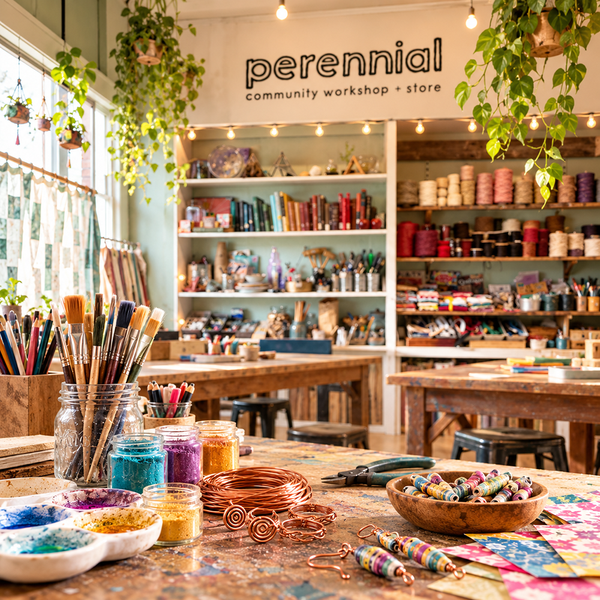
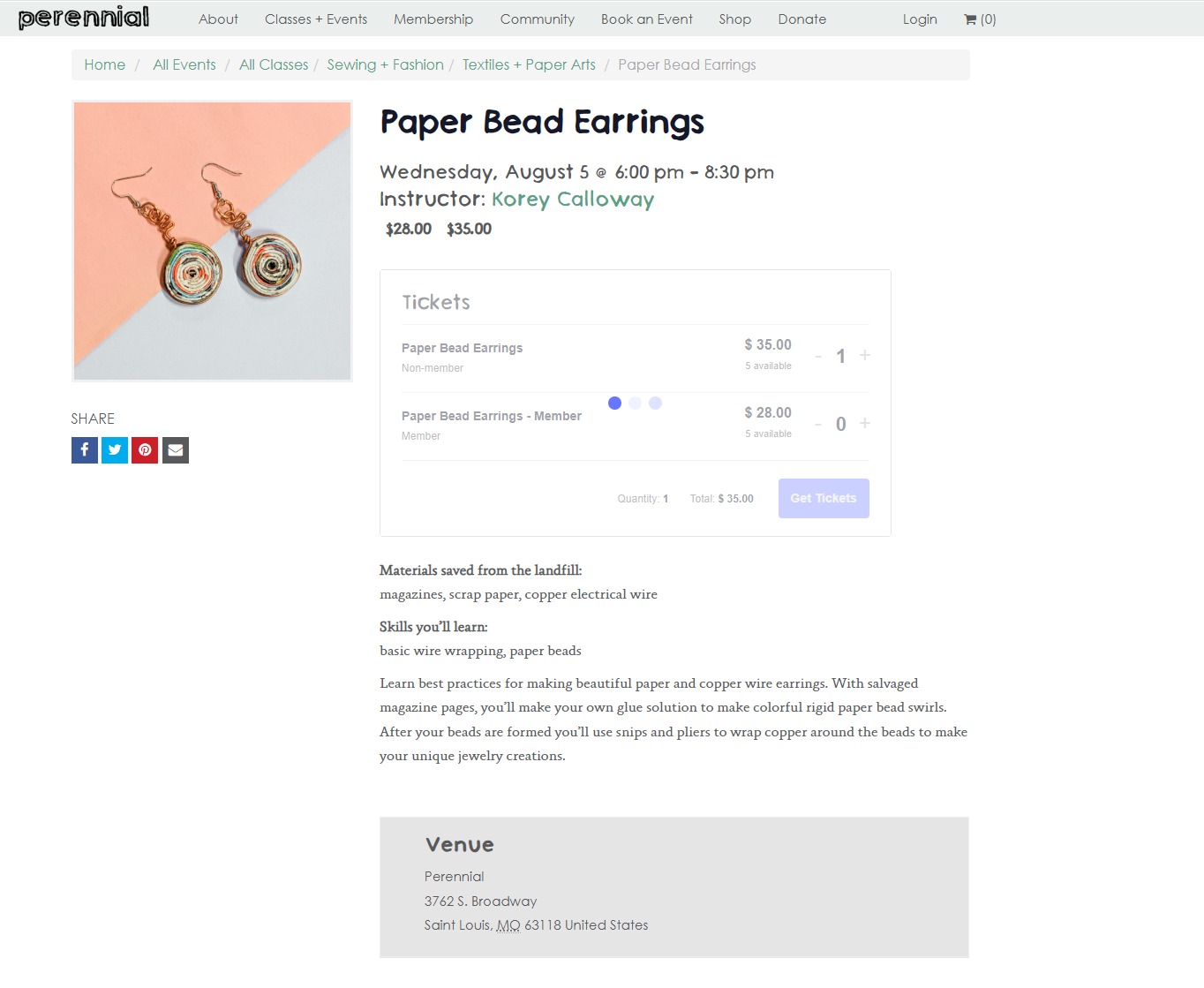
I recently returned to Perennial, a nonprofit creative reuse organization in St. Louis, for another hands-on class: Paper Bead Earrings, taught by artist and instructor Korey Calloway.
If Korey's name sounds familiar, there's a reason.
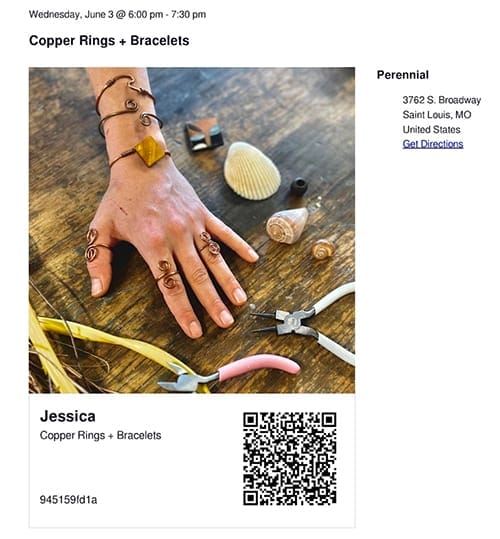
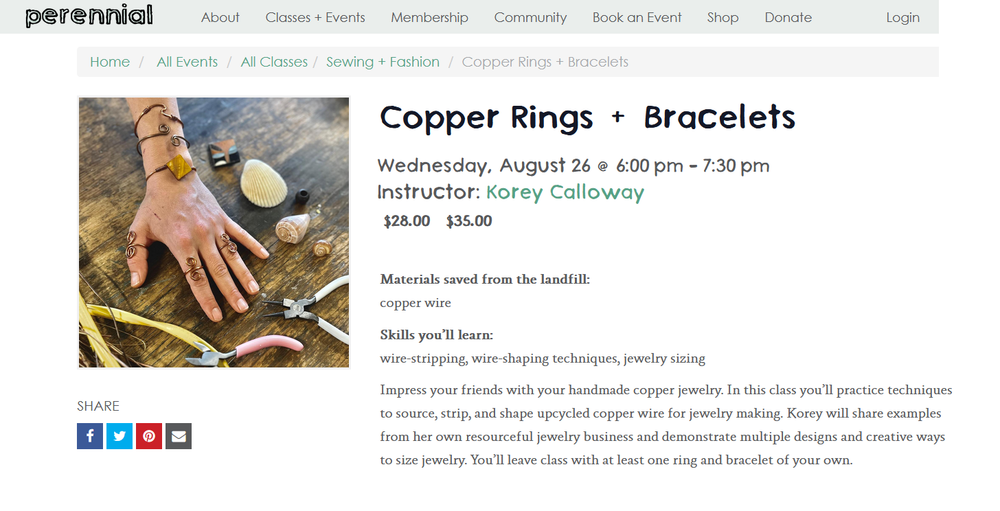
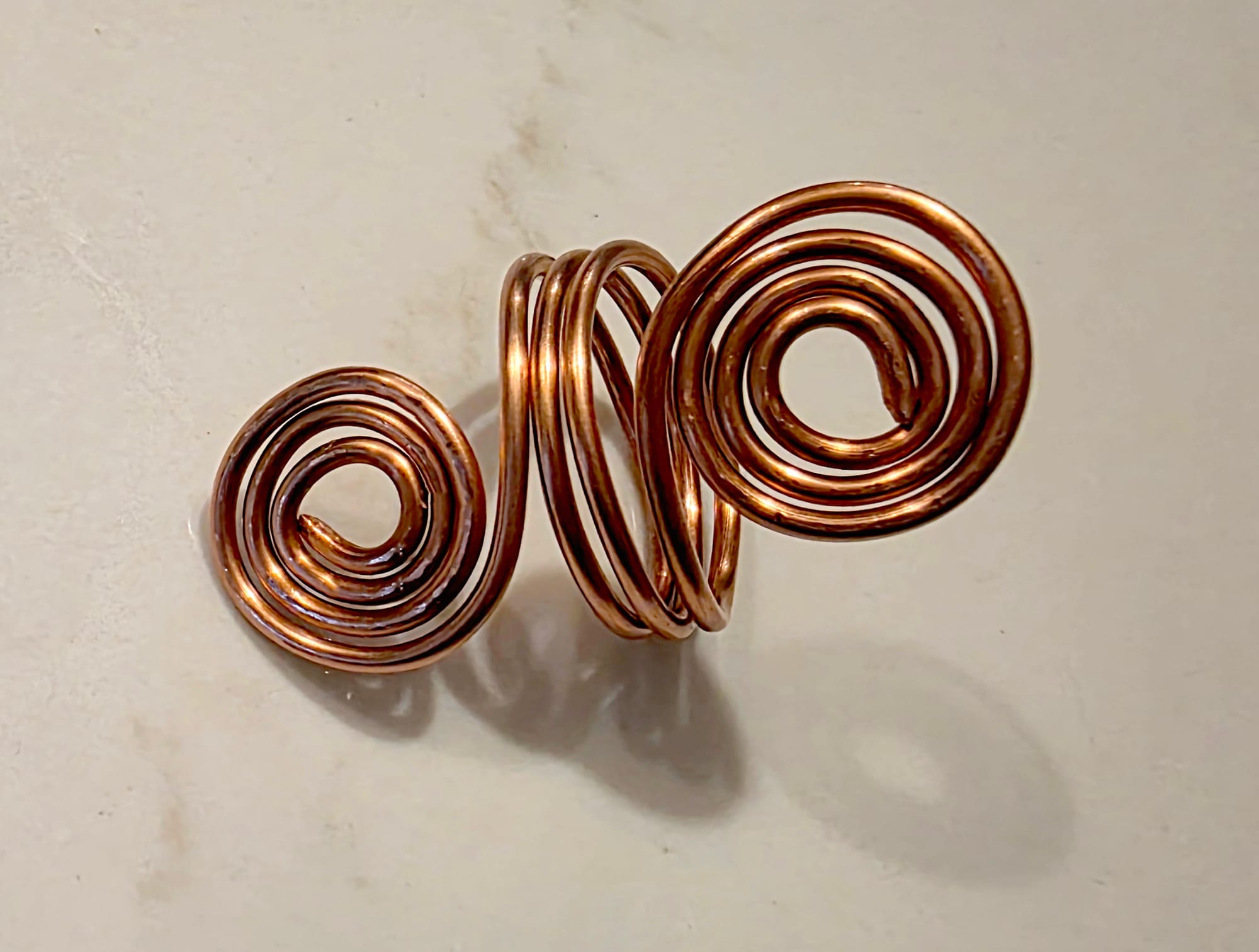
Back in June, I took her Copper Rings + Bracelets class, where we learned how to transform salvaged copper electrical wire into wearable jewelry.
That experience ended up giving me a bit of a head start this time around because copper wire — along with some of the same jewelry tools and techniques — made another appearance.
Korey recognized me when I arrived and was happy to see me again, which made returning for another class feel especially welcoming.
There is something lovely about going back to a creative space and beginning to recognize the people there — and having them recognize you, too.
A class can be about learning a new skill, but experiences like this remind me that creative spaces can also slowly become places of familiarity and community.
The premise of the evening was wonderfully simple: turn paper into beads, then turn those beads into wearable art.
We had all kinds of paper to work with — cardstock, scrapbook paper, magazine pages, and other colorful scraps.
By cutting, rolling, layering, and gluing them in different ways, something completely ordinary began taking on shape and dimension.
Add salvaged copper wire, a few jewelry tools, and a little imagination, and those scraps could become earrings, necklaces, and potentially much more.
And while this wasn't actually my first encounter with paper beads, the class introduced me to techniques and possibilities I hadn't explored before.
That's one of my favorite things about creative reuse: the materials may be ordinary, but the possibilities rarely are.
A scrap of paper doesn't have to remain a scrap of paper.
Sometimes, it might just be a bead waiting to happen.
 Jessica Carey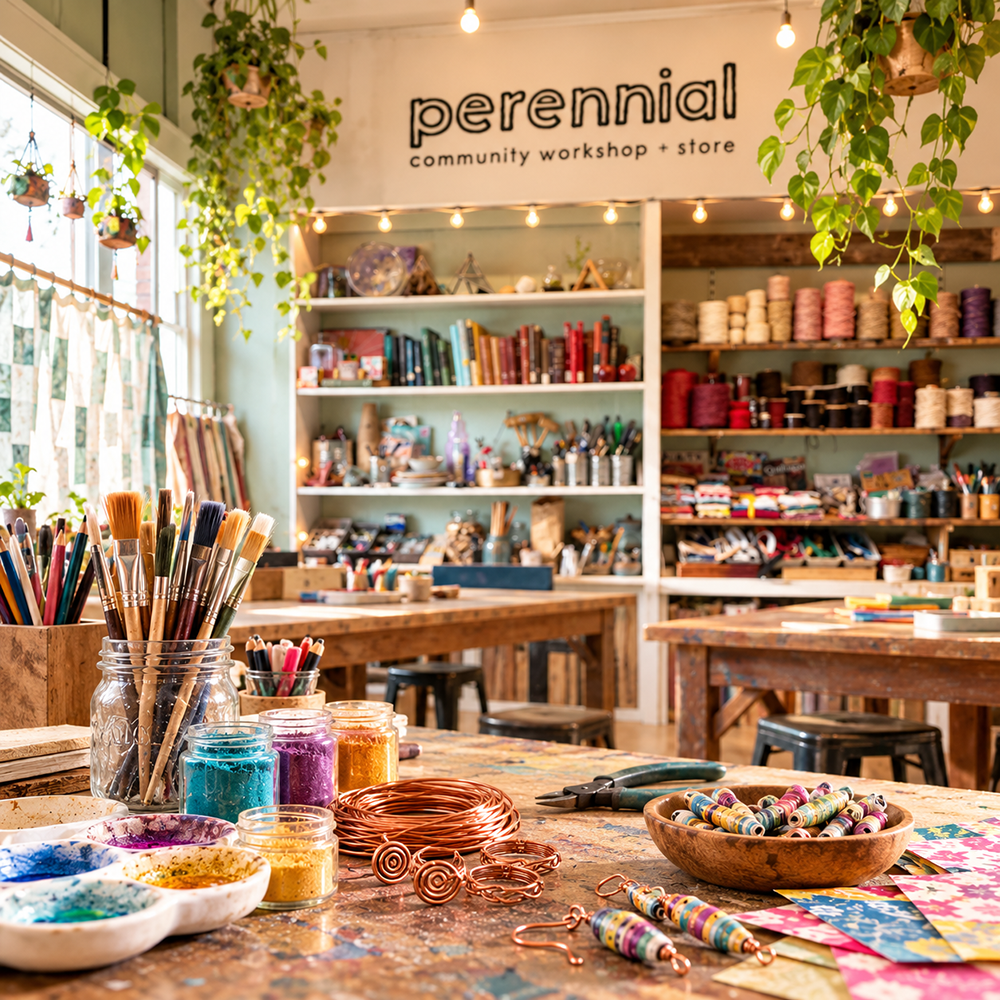
Returning to an Old Creative Technique
Paper beads actually weren't new to me when I walked into this class.
My first experience making them goes all the way back to the 2015–2016 school year, when I encountered the technique during my student teaching.
Years later, after the pandemic, I found myself experimenting with them again on my own.
That second round of exploration became almost like a little creative experiment: what happens if I make the paper itself part of the design?
Instead of relying only on paper that already had interesting colors or patterns, I began creating my own.
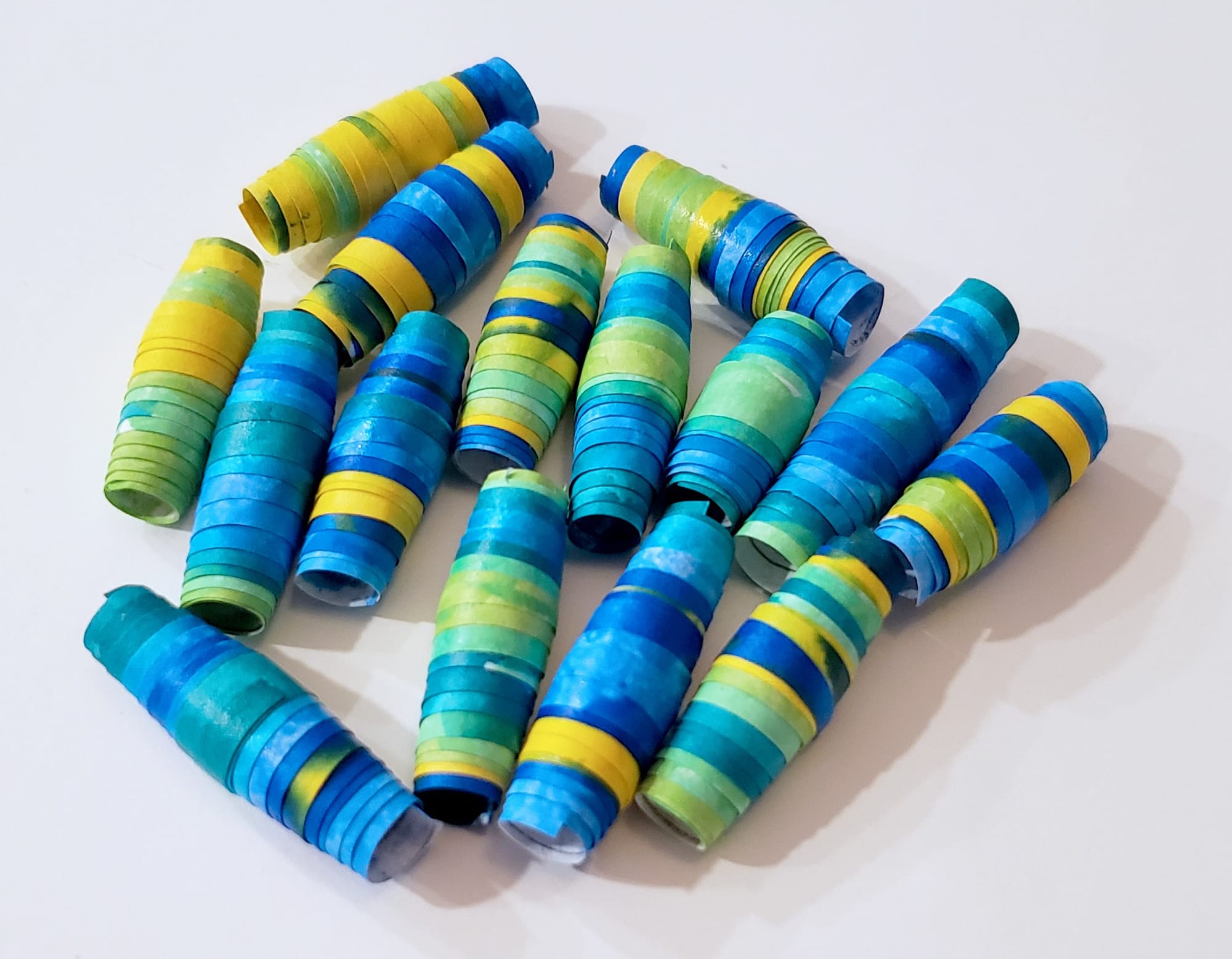
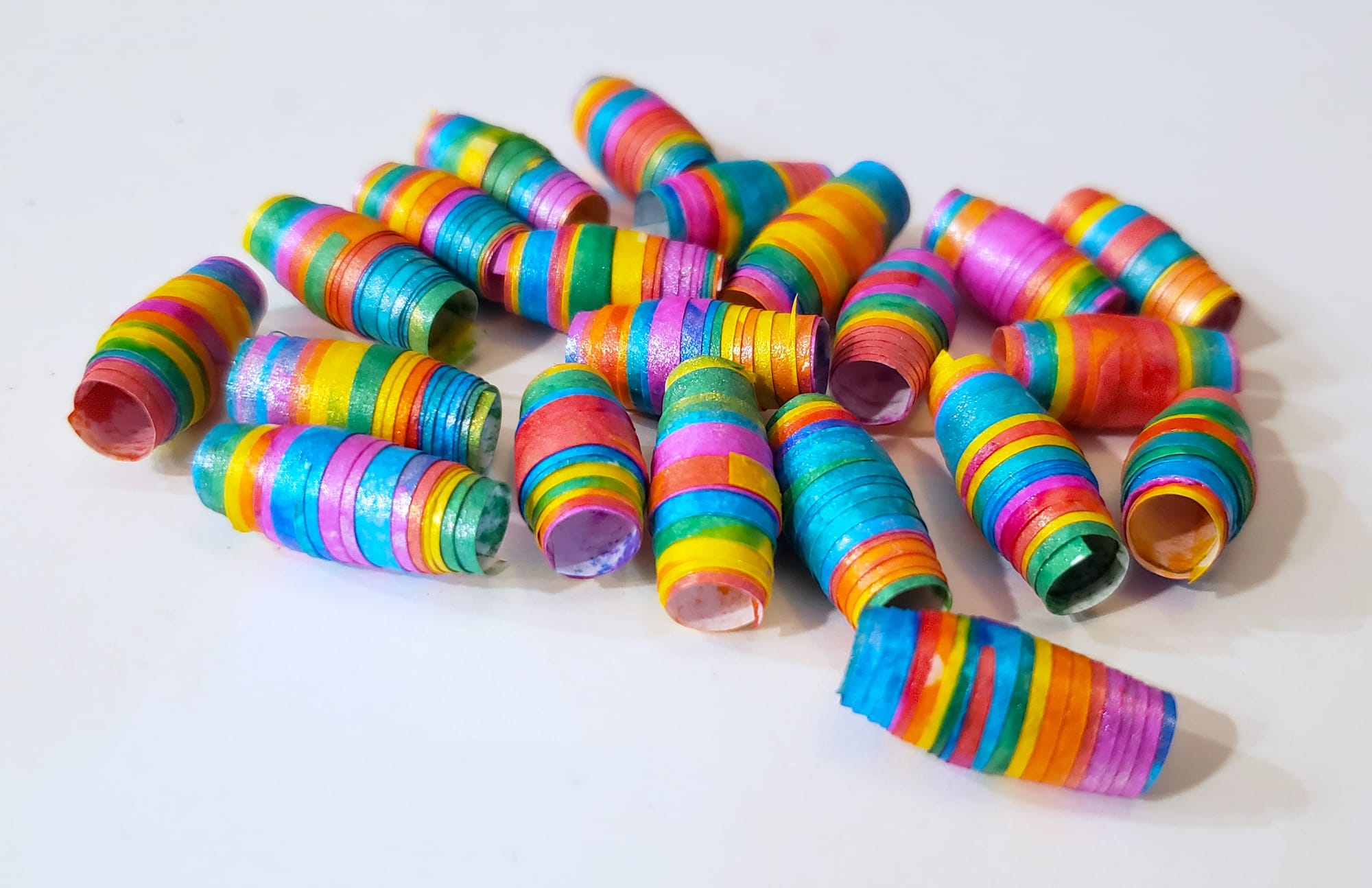
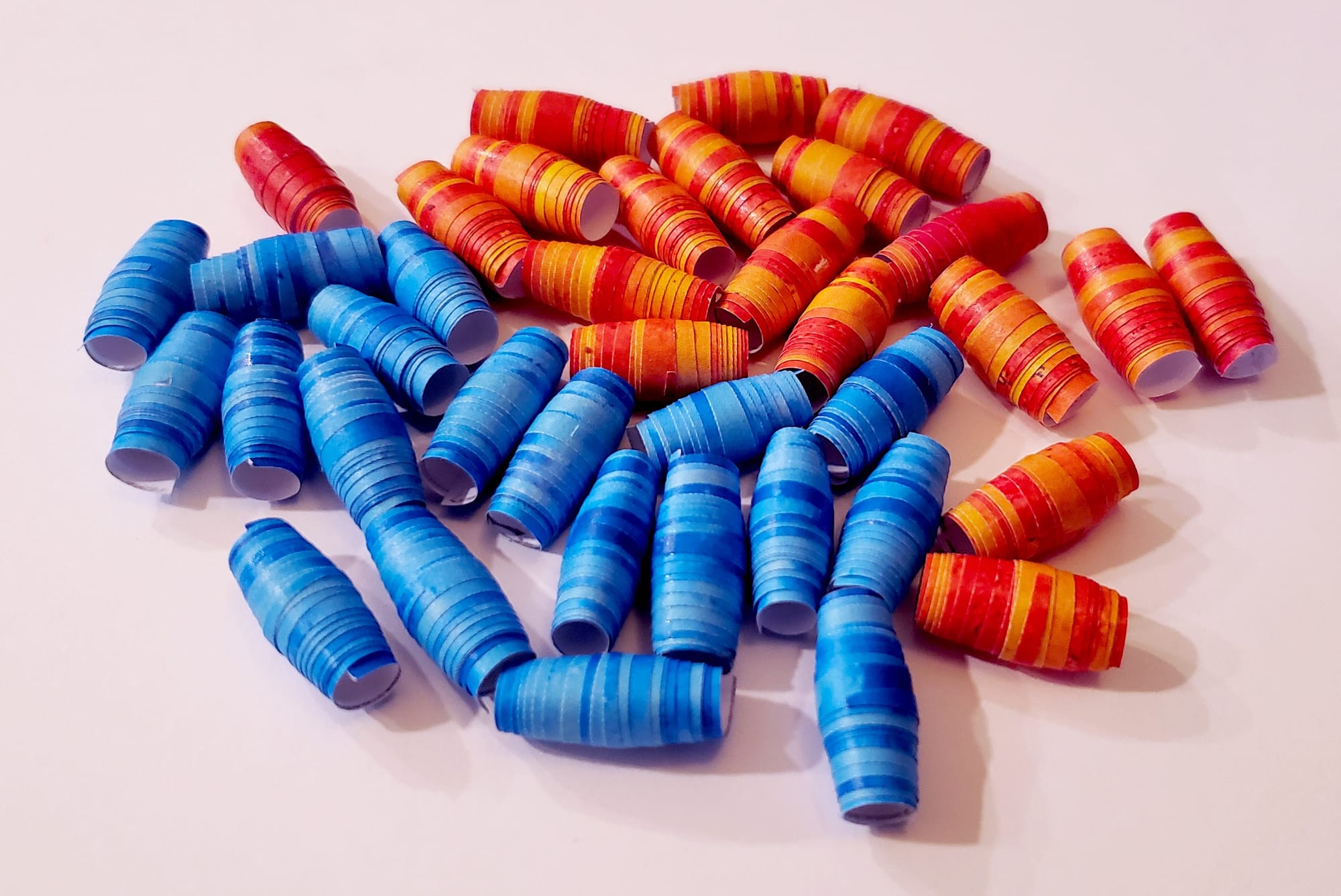
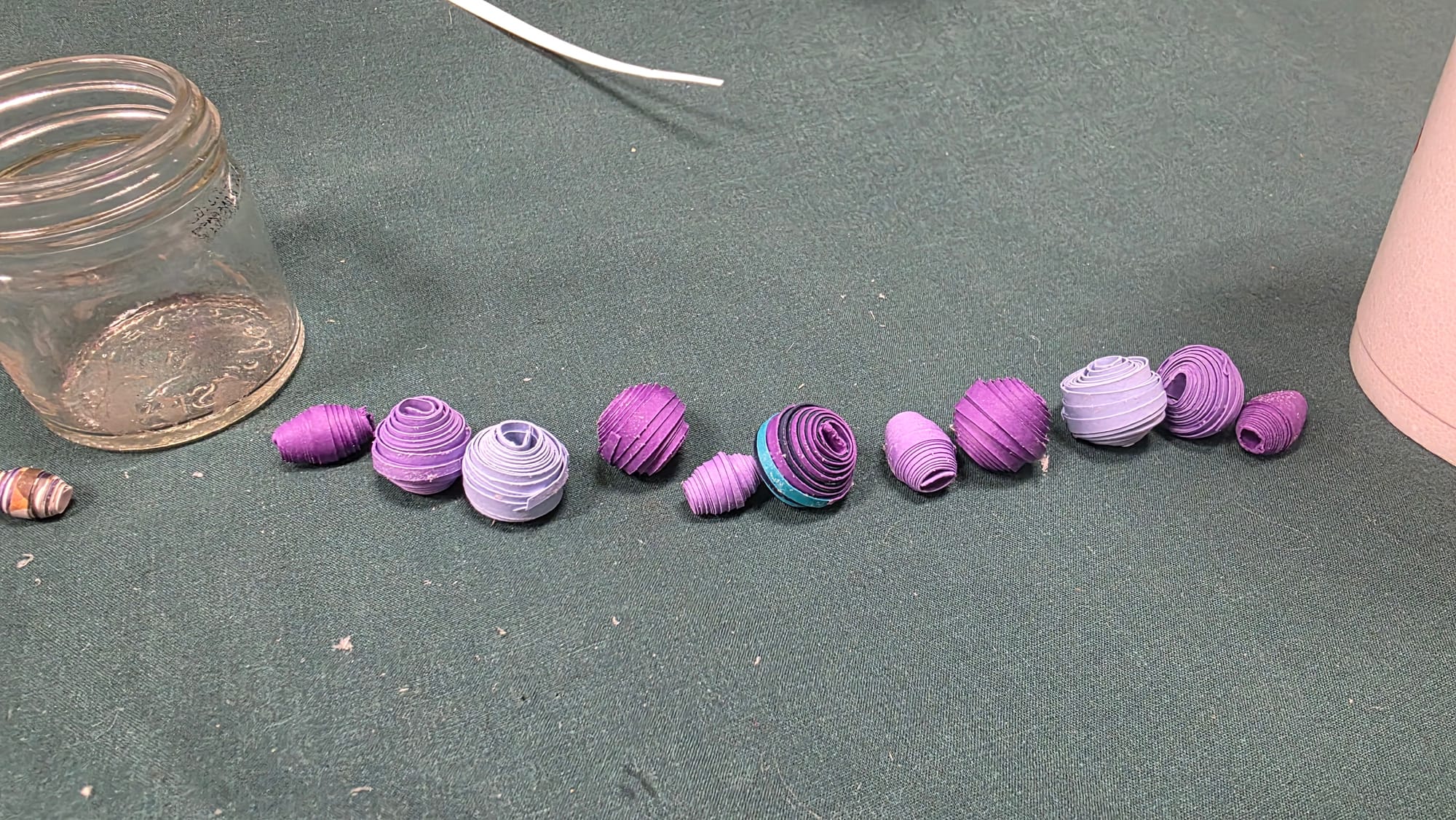
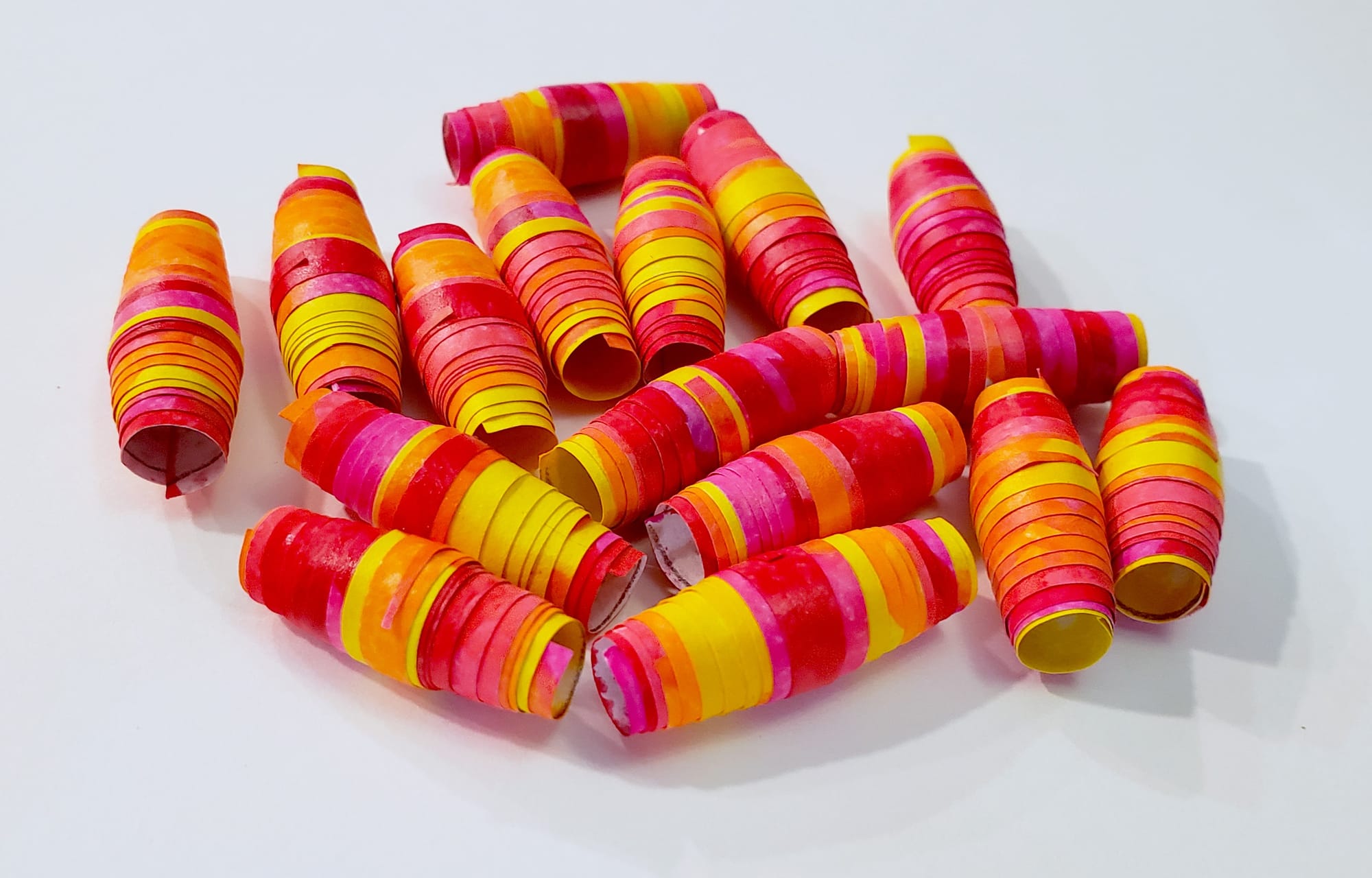
I played with dot markers and other art materials, covering sheets of paper with different combinations of colors and designs before cutting them into long strips and rolling them into beads.
And that was part of the fun — you don't entirely know what a flat design is going to become until you roll it.
Colors that seemed separate on the page suddenly became stripes.
Patterns wrapped around themselves.
The width and shape of the paper changed the silhouette of the finished bead.
Even relatively simple marks could produce surprisingly intricate results once everything was wound together.
I experimented with different color palettes, too: bright rainbow combinations, fiery reds and oranges, and cooler blues, greens, and yellows.
Each sheet of decorated paper produced its own collection of tiny, one-of-a-kind objects.
So, when I saw Paper Bead Earrings on Perennial's class schedule, the technique itself was familiar.
But the possibilities Korey introduced were not.
I'd made paper beads before, but I hadn't really explored what could happen after the bead was finished.
This class took something I'd previously enjoyed as an art-making experiment and carried it one step further: turning those handmade beads into actual pieces of jewelry.
And because I'd already worked with Korey on salvaged copper jewelry earlier this summer, I was walking into the class with two seemingly separate bits of previous experience — paper bead making and copper wirework — that were suddenly about to meet.
That made this class feel less like starting completely from scratch and more like discovering a new way to build upon skills I'd picked up at entirely different points in my creative life.
From Scraps of Paper to Handmade Beads
One of the things I continue to appreciate about Perennial's classes is how they encourage you to look at ordinary materials differently.
For this class, our raw material was about as ordinary as it gets: paper.
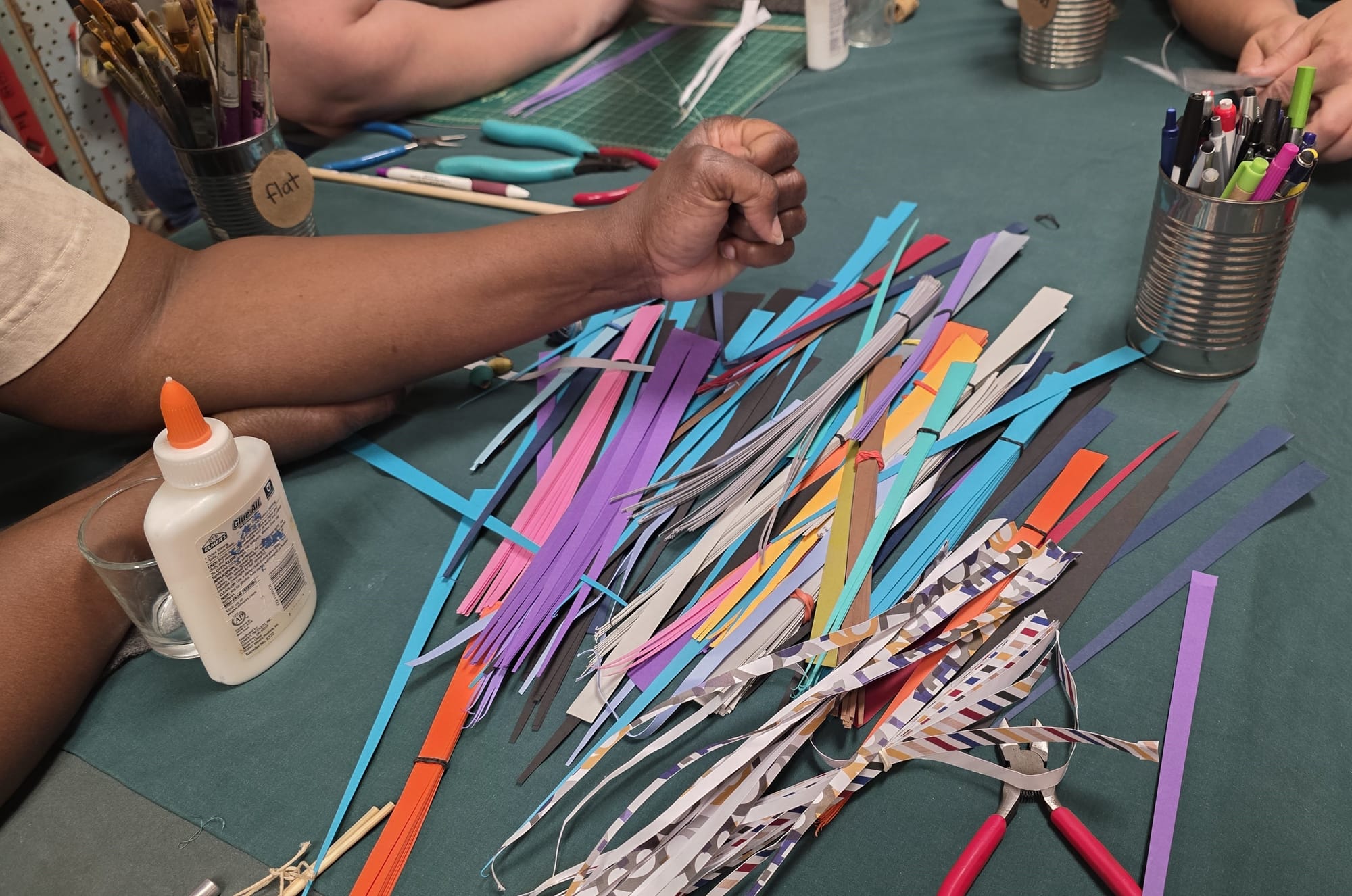
There were pieces of cardstock, scrapbook paper, magazine pages, and other colorful scraps spread across the table.
Materials that could easily end up forgotten in a drawer or tossed into a recycling bin suddenly had another possibility.
They could become jewelry.
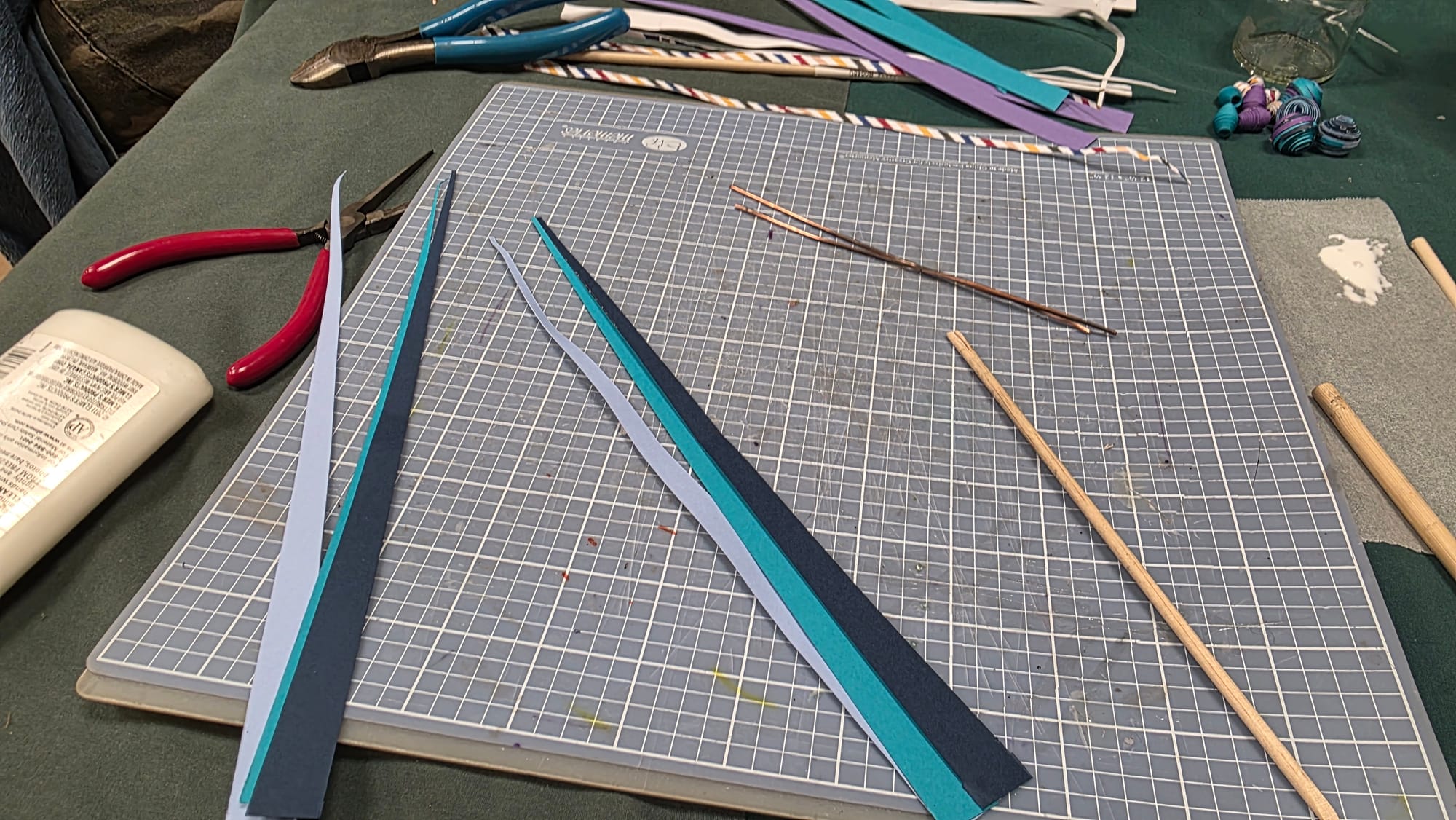
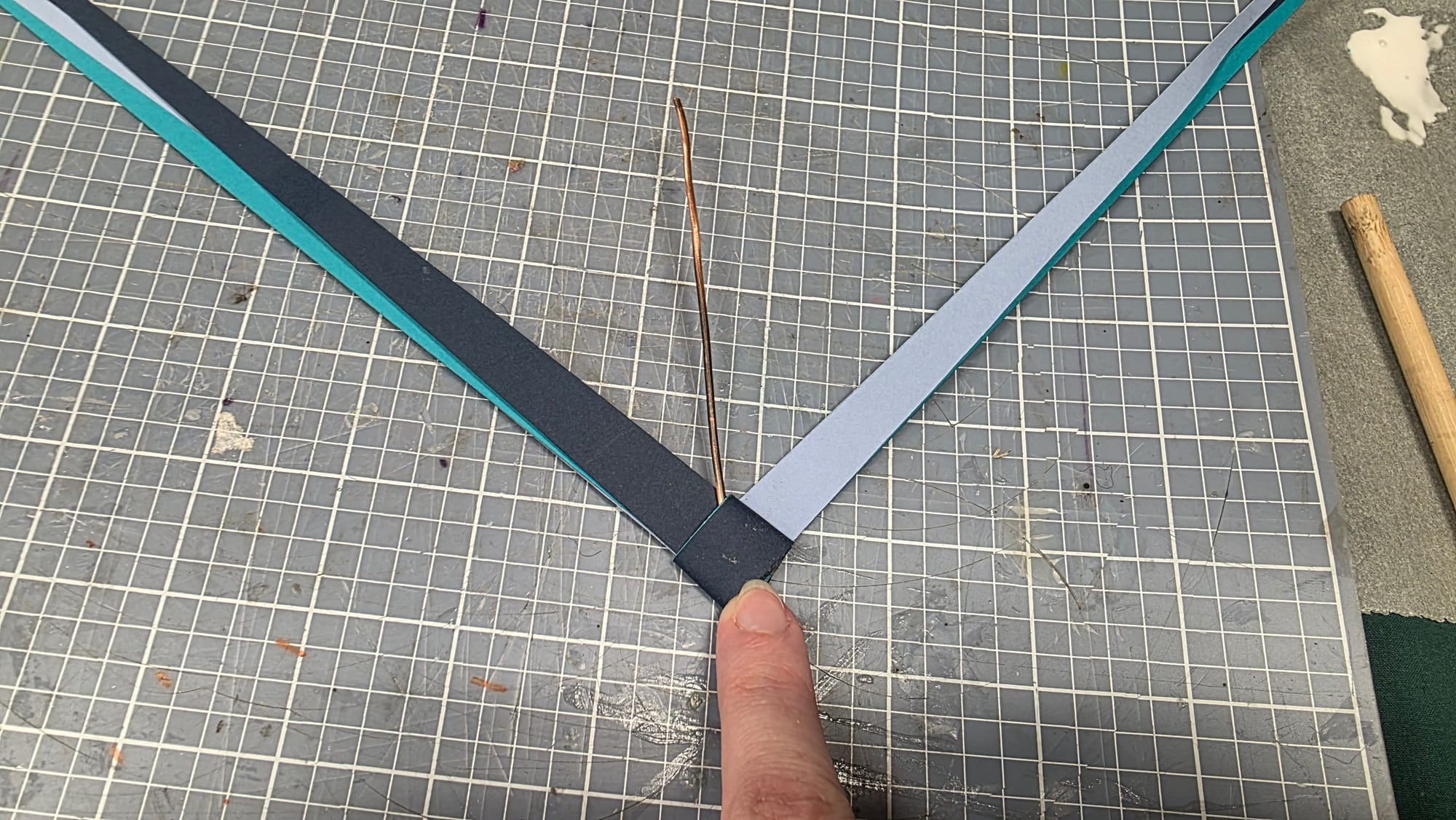
The basic process behind a traditional paper bead is surprisingly simple.
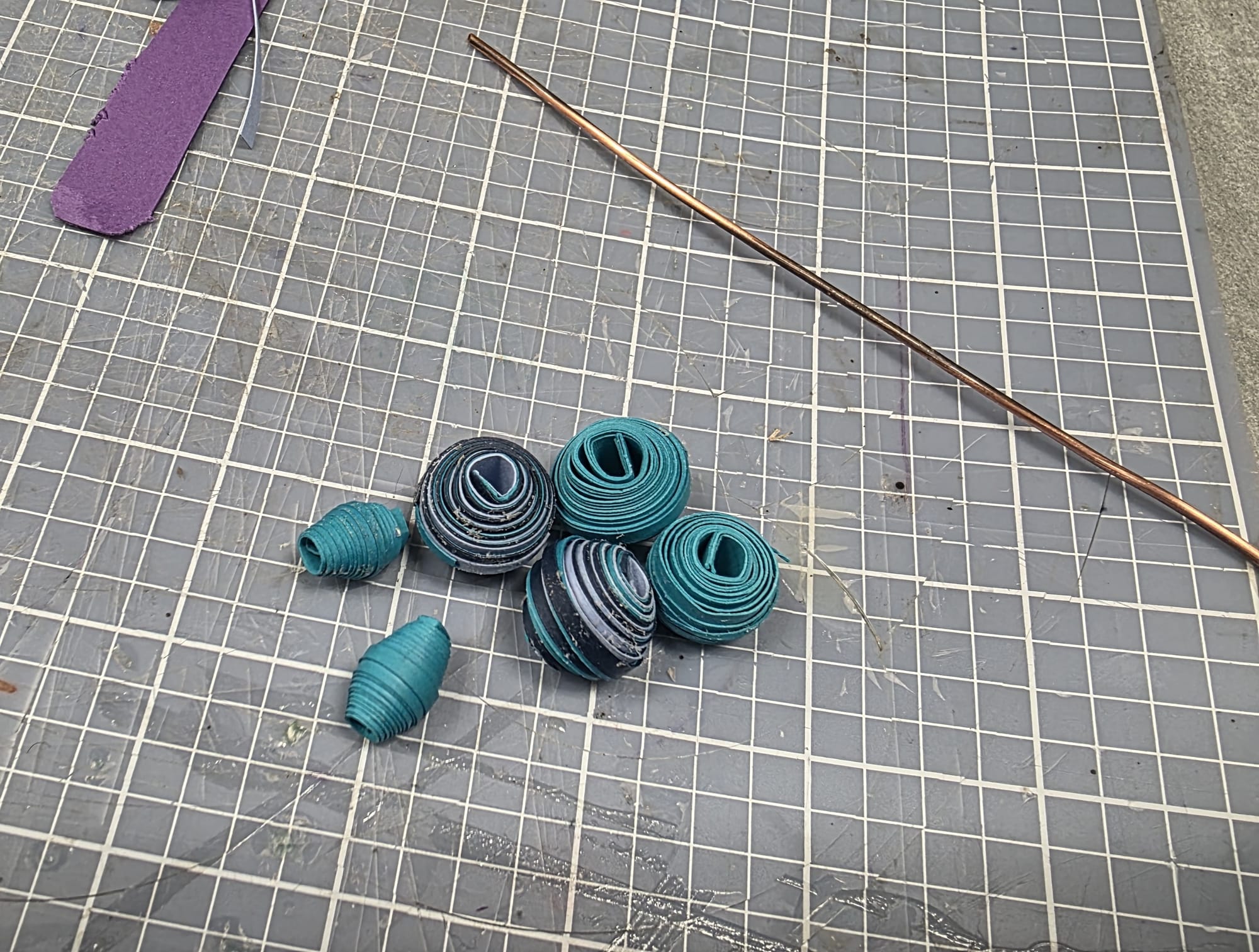
You cut paper into long strips, add glue, and carefully roll the strip around a thin form.
As the paper wraps around itself, layer after layer builds upon the last until that flat strip becomes a three-dimensional bead.
But "simple" certainly doesn't mean there is only one way to do it.
Different papers create different results.
So do different colors, patterns, strip widths, and shapes.
A piece of a magazine might reveal unexpected bits of color as it wraps around itself, while decorative scrapbook paper can create an entirely different effect.
Even the same basic technique can produce beads that look nothing alike.
And that's part of what makes paper beads so much fun; you don't necessarily know exactly what you're going to get until you roll the paper.
Korey showed us different approaches and encouraged us to experiment rather than worrying about making everything perfectly uniform.
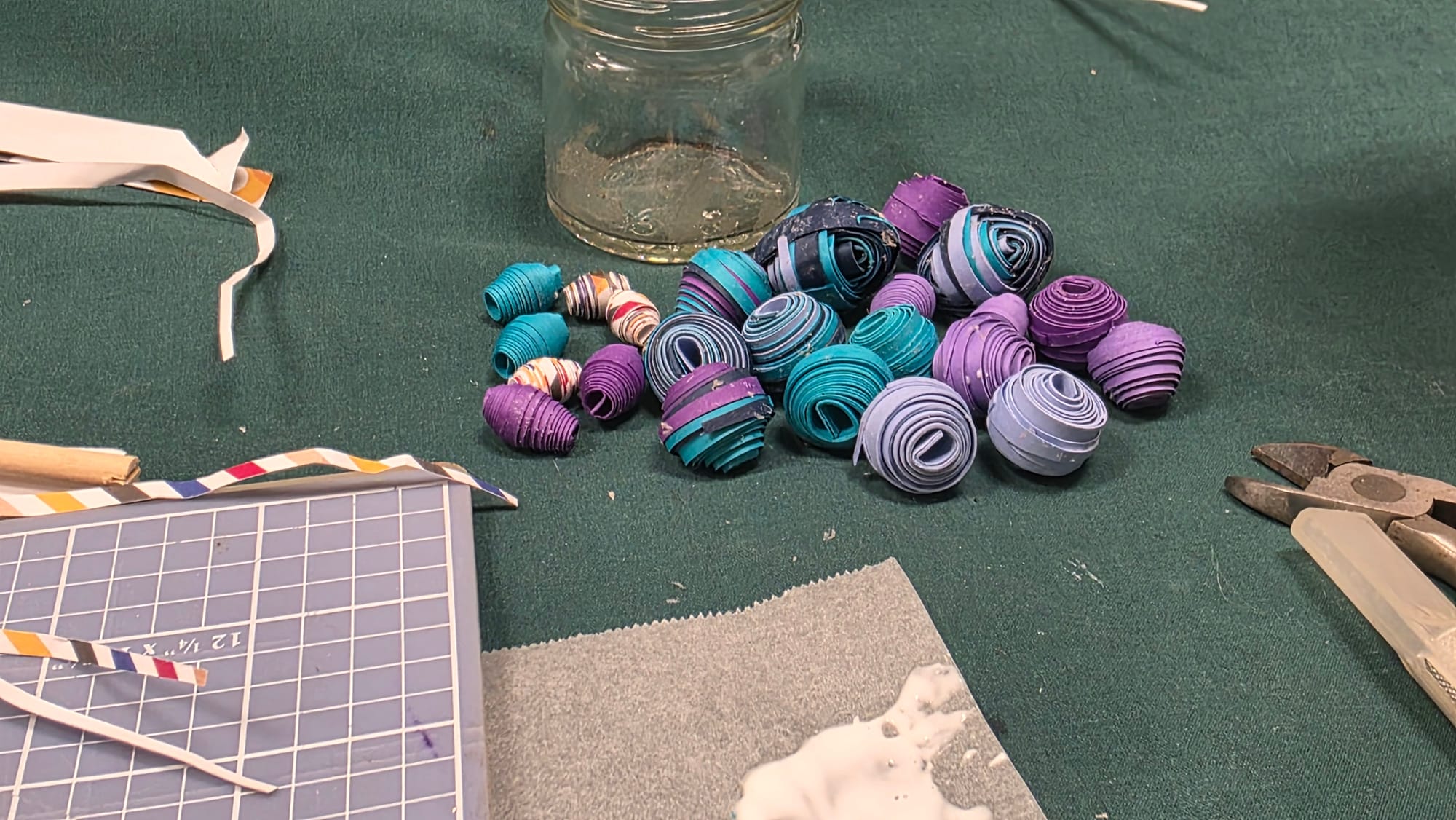
Around the table, scraps slowly transformed into beads of different sizes, shapes, colors, and personalities.
She also introduced us to another technique I hadn't used before: pillow beads.
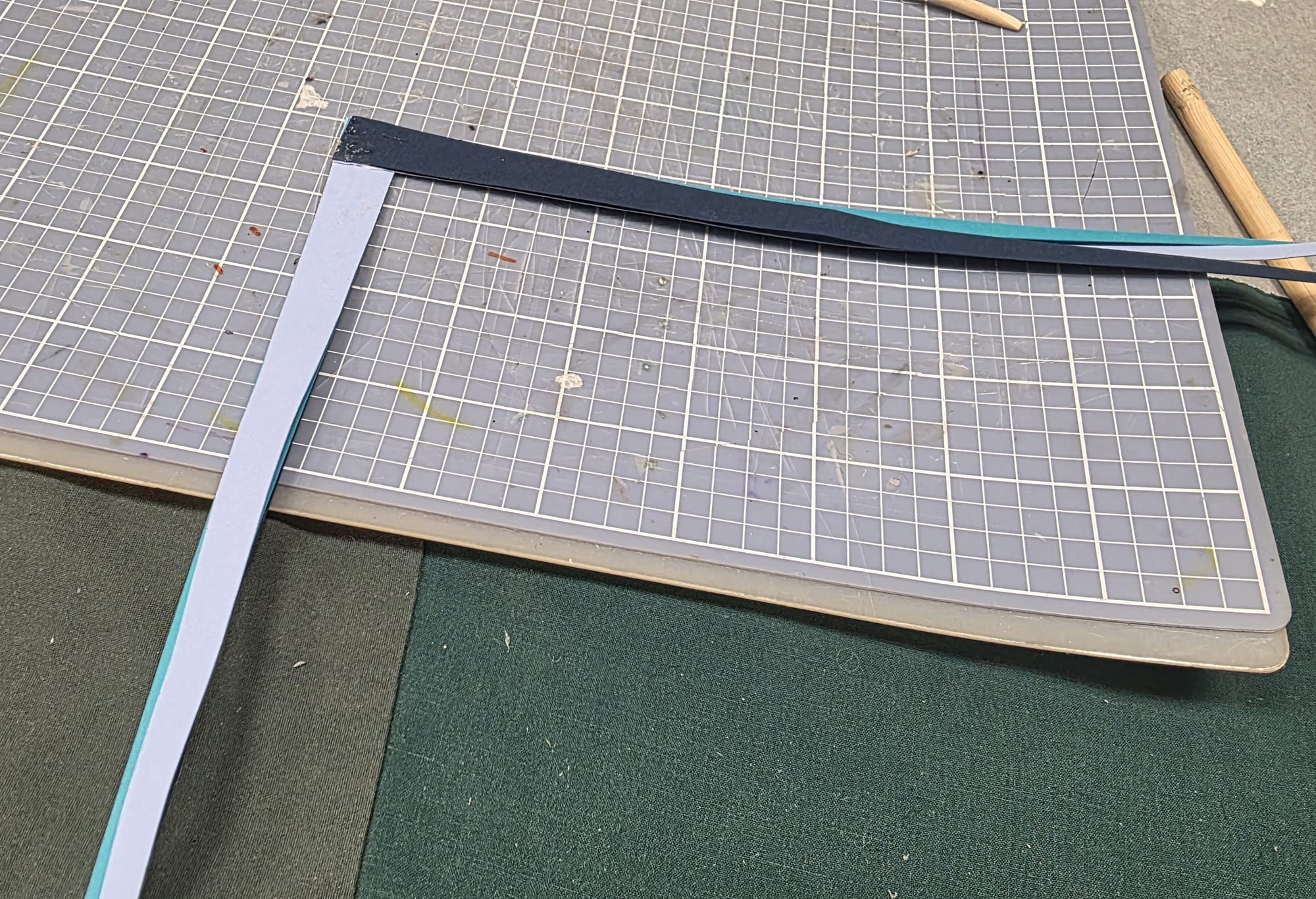
Instead of rolling a long strip around a form, these begin with paper arranged in an "L" shape.
The paper is repeatedly folded over itself, building up layer upon layer until it becomes a thicker, dimensional bead.
It was a great reminder that even within something as specific as "paper bead making," there isn't just one method to learn.
There are directions to explore.
And perhaps my favorite part is that the material itself doesn't need to be precious.
An interesting magazine page.
A leftover strip of cardstock.
A piece of scrapbook paper from another project.
The scraps become the raw material for whatever you imagine next.
As everyone began experimenting, the table gradually filled with colorful paper strips, tiny rolled beads, copper wire, glue, and works in progress.
It was fun seeing how differently people approached the same basic materials.
One person might gravitate toward bright scrapbook paper while someone else discovered an interesting section of a magazine page.
Even before we began assembling the jewelry, everyone's collection of beads was already starting to look different.
The Glue Matters More Than You Might Think
When you're making jewelry out of paper, one question naturally comes to mind: how durable can it really be?
Apparently, much more durable than you might expect.
One of the most useful things Korey emphasized during class was the importance of choosing the right kind of glue.
While ordinary school glue might seem like the obvious choice for a paper craft, she specifically recommended using Elmer's Glue-All instead.
Glue-All helps hold the rolled layers together while also helping to seal and strengthen the finished bead.
Since these aren't necessarily meant to remain little paper experiments sitting safely on a table — they're being turned into jewelry that can actually be worn — durability matters.
And then Korey told us something that made me rethink just how sturdy paper jewelry could potentially become.
She explained that wood glue can make paper beads tough, and she knew this from experience.
At one point, some of her own paper bead earrings had been lost outside in the rain.
As if surviving the weather weren't enough of a test, she later accidentally ran them over with her car.
And the beads survived.
There was something both funny and genuinely impressive about hearing that while sitting at a table surrounded by little strips of paper.
It also challenged the assumption that "made from paper" automatically means fragile or temporary.
Once paper has been tightly rolled, layered, glued, and properly sealed, it becomes something quite different from the flimsy sheet it started as.
That opens up even more possibilities for experimenting at home.
Different papers can create different appearances, but different adhesives and finishes can affect the strength, longevity, and feel of the finished beads, too.
It's another example of something I love about classes like these: sometimes the most valuable lesson isn't a complicated technique.
Sometimes it's a seemingly tiny piece of practical knowledge — like learning that the type of glue you reach for actually matters.
And sometimes it's discovering that a discarded piece of paper can become jewelry sturdy enough to have a much longer life than anyone might expect.
From Paper Beads to Wearable Art
Making the beads was only half the adventure.
Once we had a collection of tiny paper creations, it was time to figure out what they could become.
For our earrings, we returned to a material I'd become quite familiar with during my previous class with Korey: salvaged copper electrical wire.
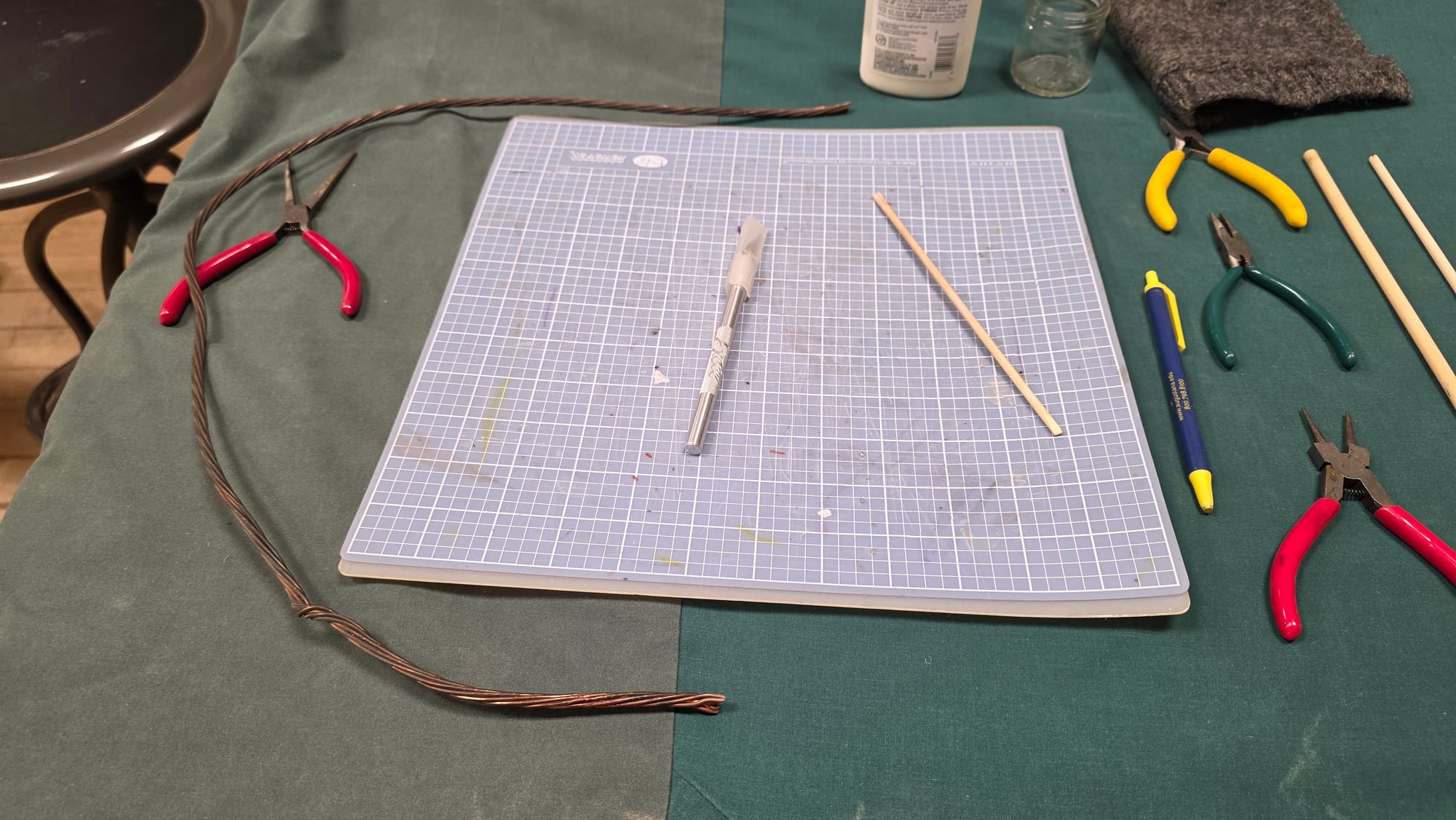
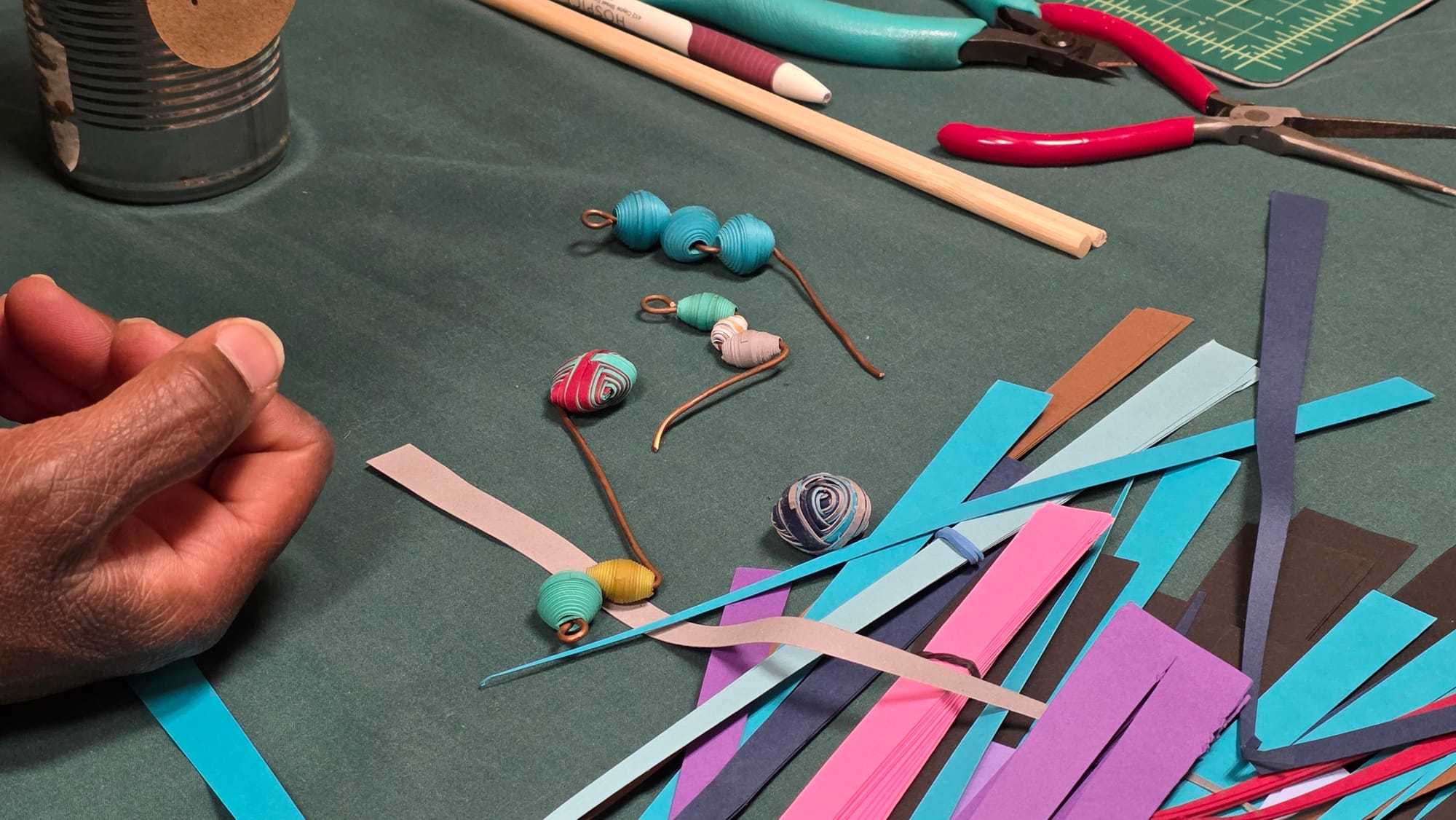
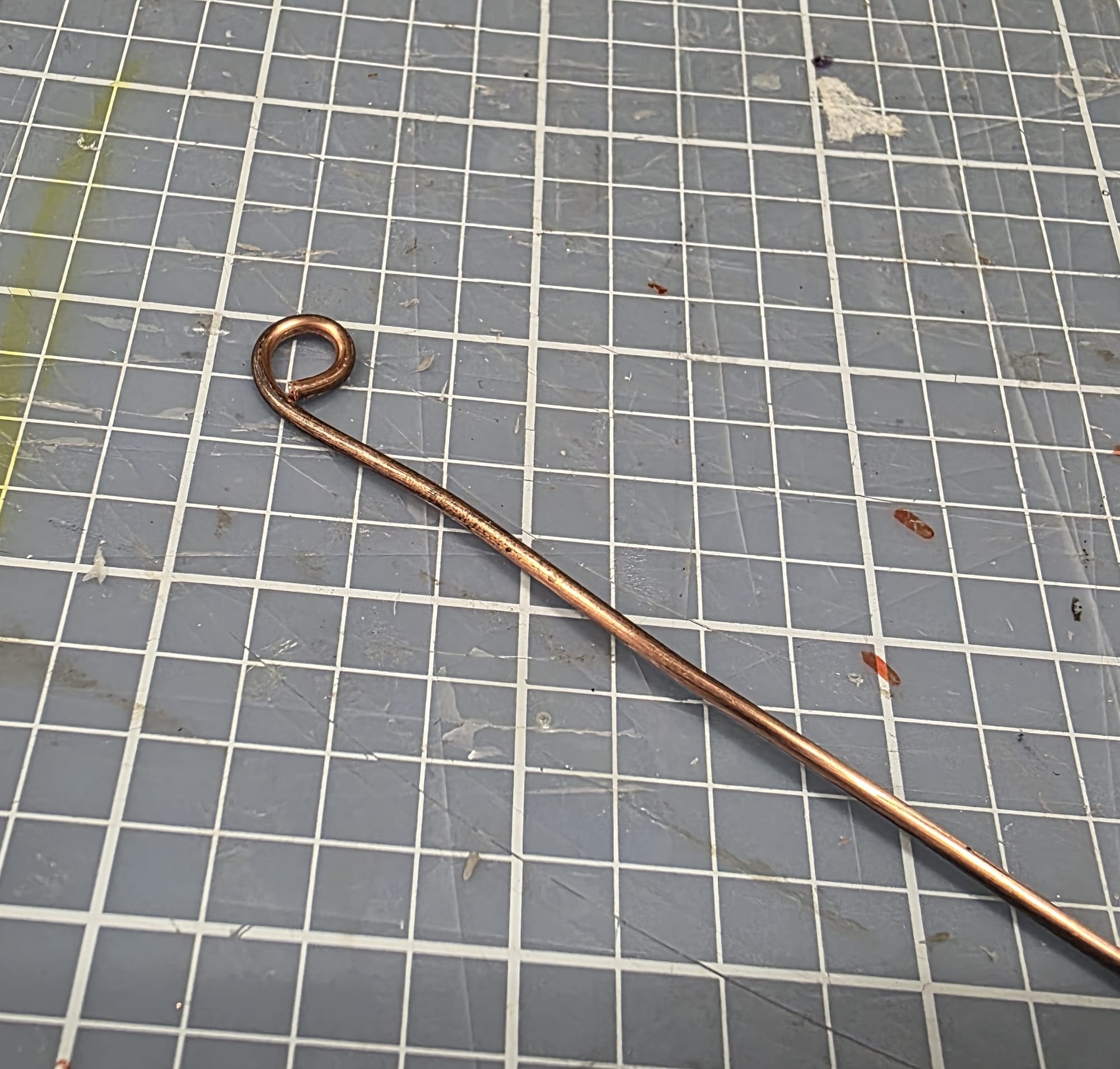
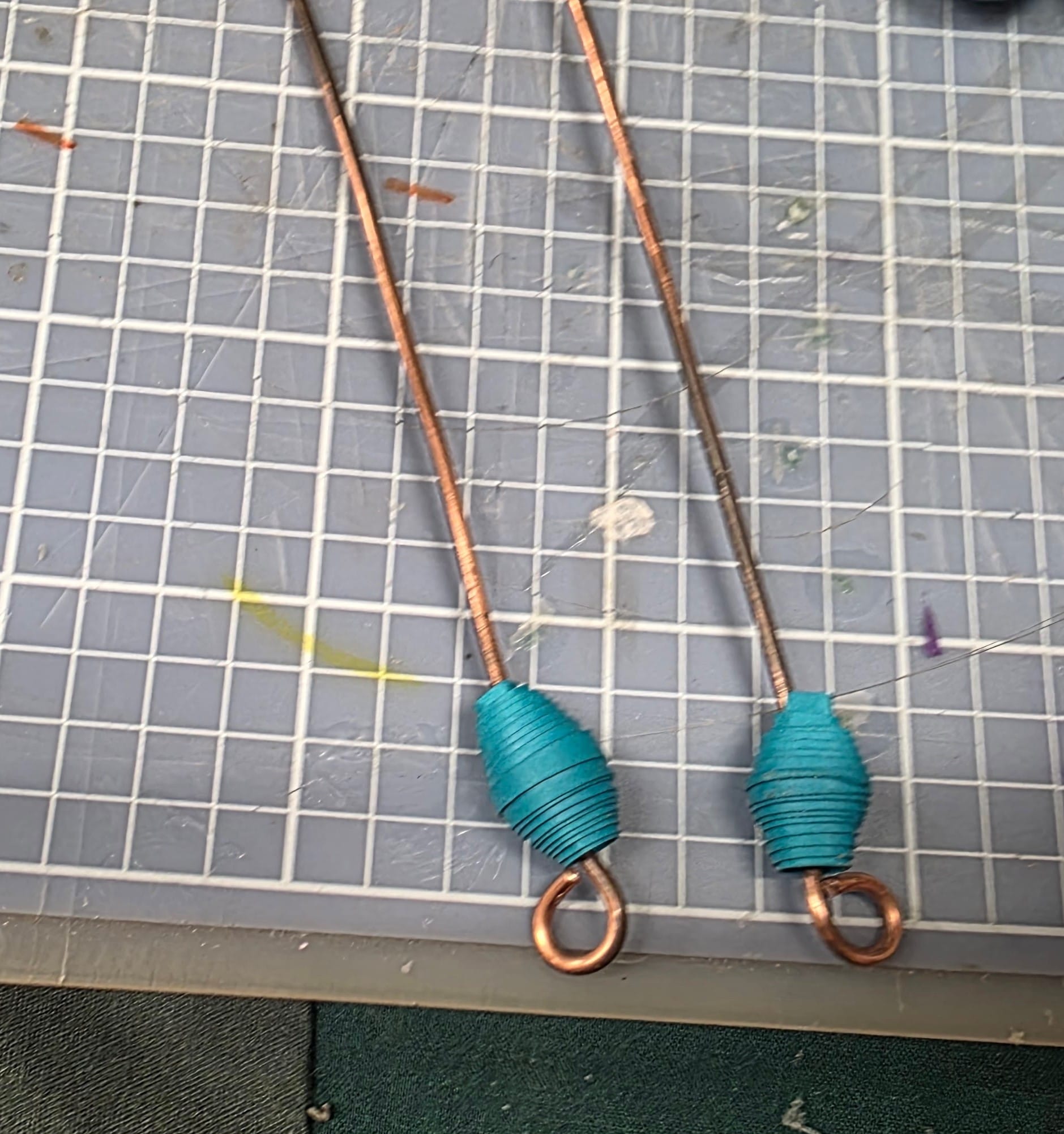
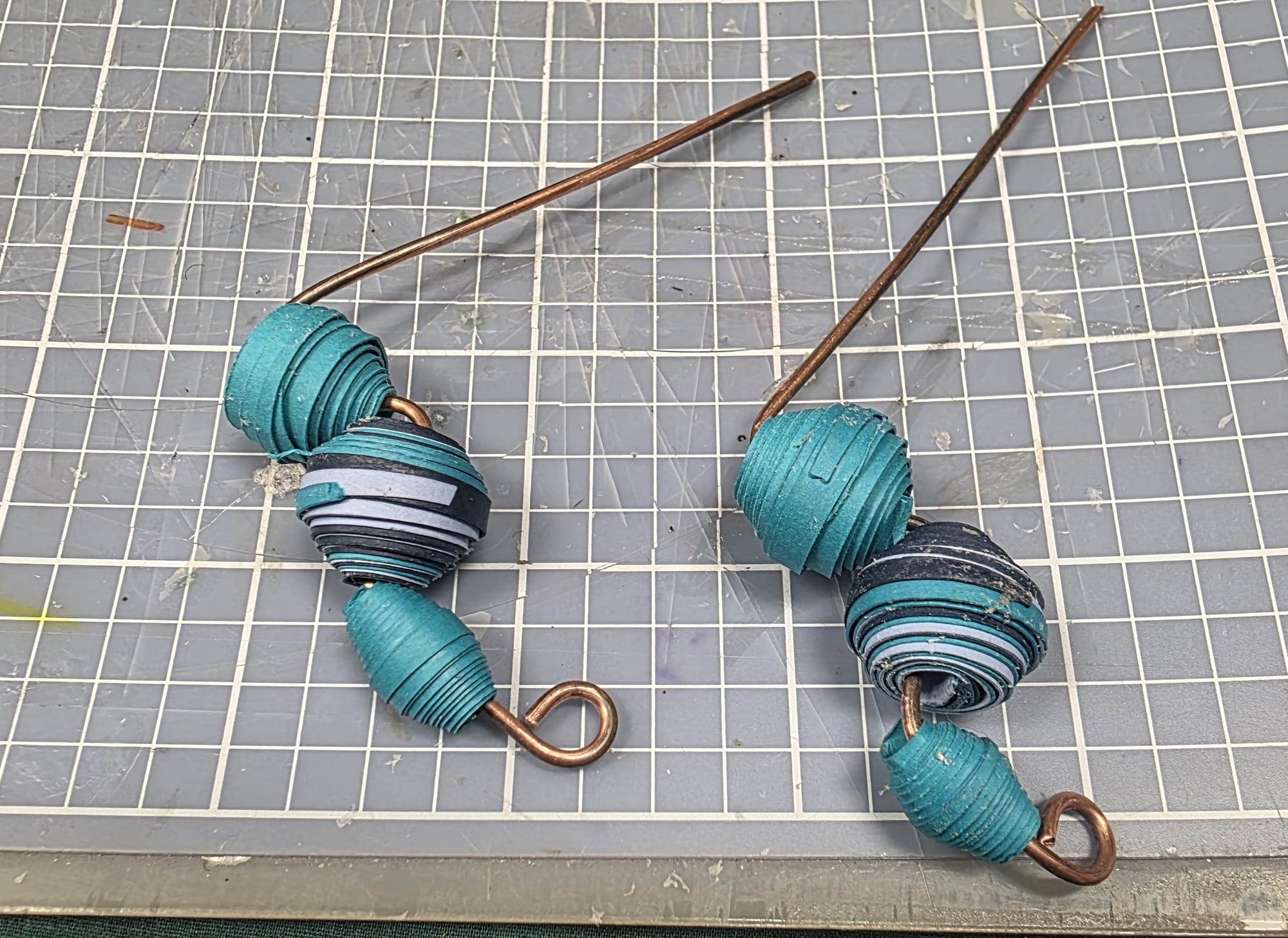
We used round-nose pliers, needle-nose pliers, and wire snips to shape the copper into the components needed to turn our beads into earrings.
Because I'd already worked with these tools and learned some basic wire-wrapping techniques in Korey's Copper Rings + Bracelets class back in June, this part felt surprisingly familiar.
I wasn't starting from zero.
I already understood a little about how the copper behaved, how to manipulate it with the jewelry tools, and how loops and connections could be formed from what began as an ordinary piece of electrical wire.
That gave me a bit of a leg up — but it also showed me something I really love about learning creative skills:
They build on one another.
The techniques from one project don't necessarily stay confined to that project.
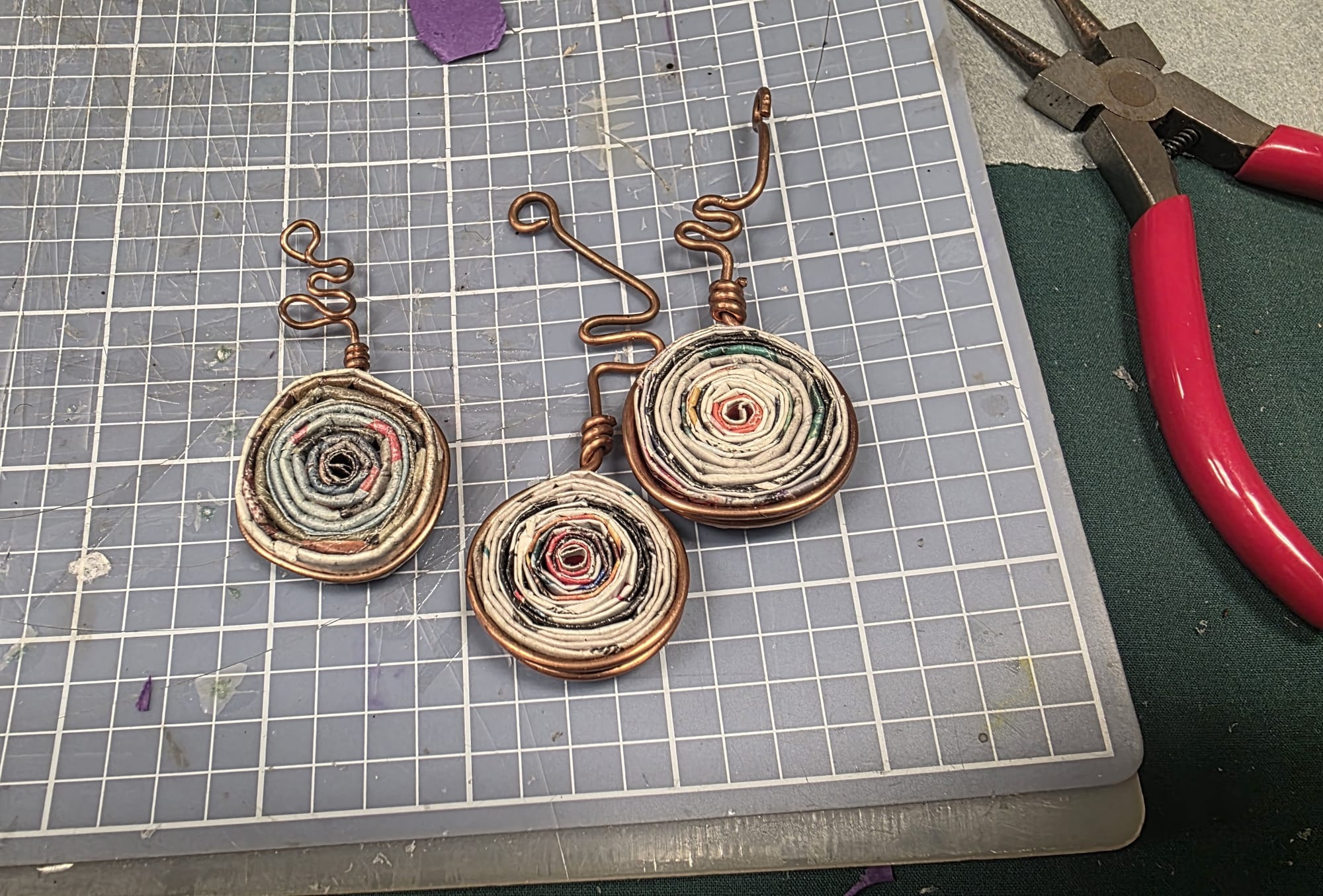
Copper wire that I'd previously learned to turn into rings and bracelets could now become hooks and connections for paper bead earrings.
Meanwhile, a paper-making technique I'd first encountered years ago could suddenly intersect with the wireworking skills I'd learned only a couple of months earlier.
Korey showed us several different ways we could assemble our earrings, giving us room to play with the number, size, shape, and arrangement of the beads.
One thing I appreciate about Korey's teaching style is that she doesn't make the project feel limited to one predetermined outcome.
She demonstrates techniques and possibilities, but leaves plenty of room for participants to experiment and decide what they want their own pieces to become.
Korey can be very much go with the flow and embraces exploration, experimentation, and listening to curiosity.
And the possibilities didn't stop with earrings.
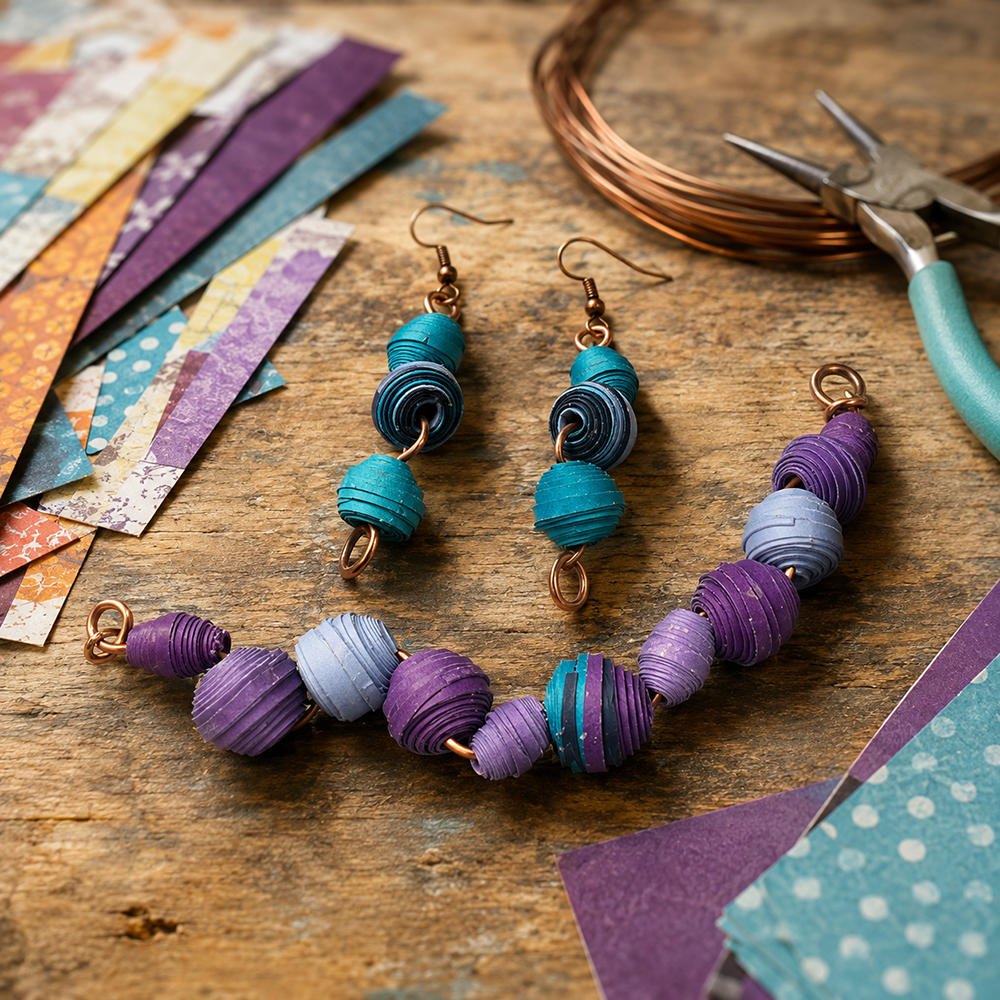
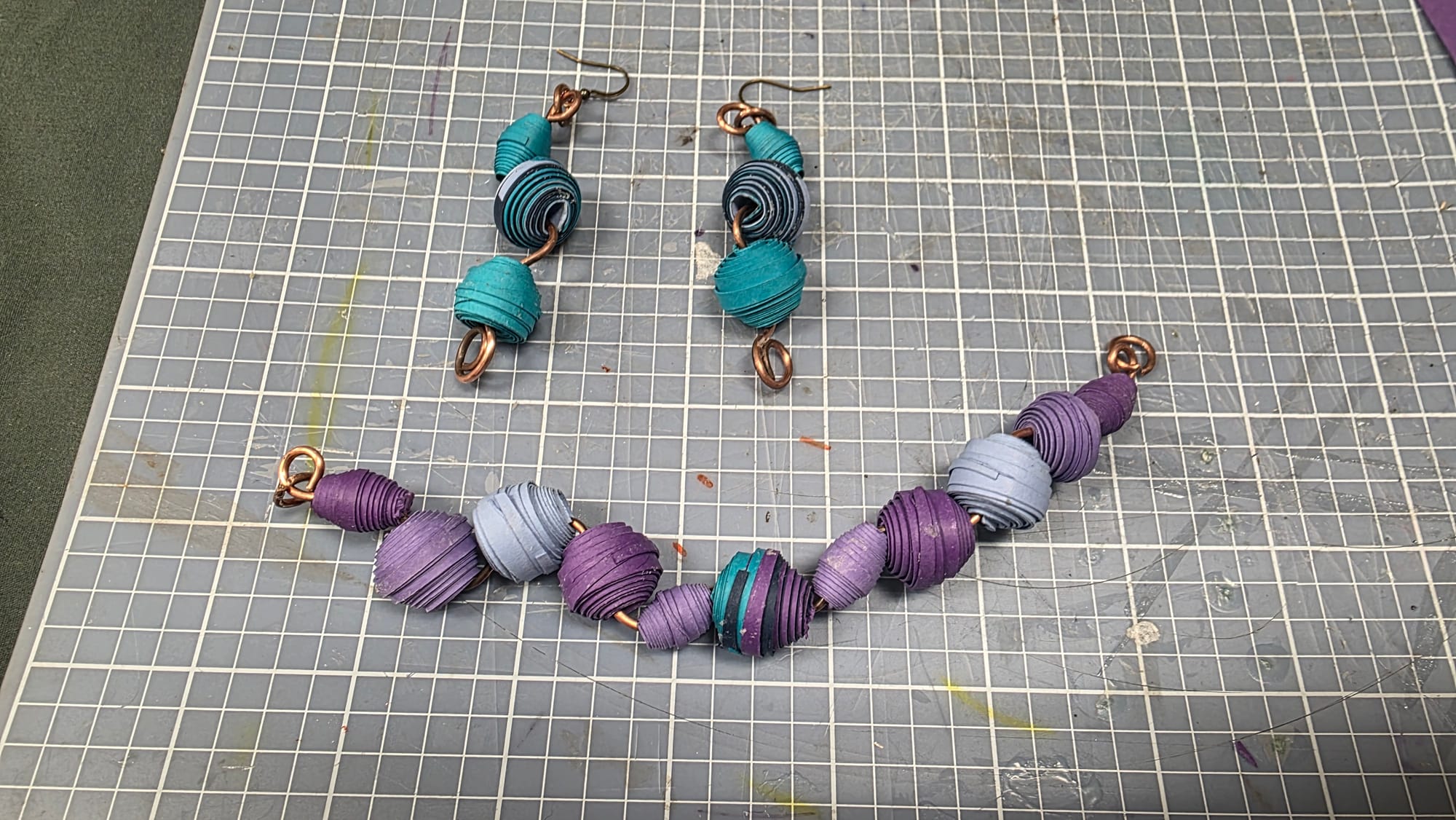
She also demonstrated how the same paper beads could be connected to create a necklace, which immediately made the project feel much bigger than the title of the class might suggest.
Once you understand how to make the beads and how to connect them, you're no longer limited to recreating one particular pair of earrings.
You have the beginnings of an entire jewelry-making vocabulary.
Earrings could be long and dangling or relatively simple.
Beads could be matched carefully or intentionally mismatched.
Different colors and patterns could be combined.
Smaller beads could sit beside larger ones.
Copper could become part of the visual design rather than merely something holding everything together.
And, of course, those same techniques could potentially extend into necklaces, bracelets, pendants, keychains, ornaments, or whatever else someone imagines.
That's when a class becomes more than learning how to make one thing.
You leave knowing how to make one thing — but also beginning to see all the other things it could become.
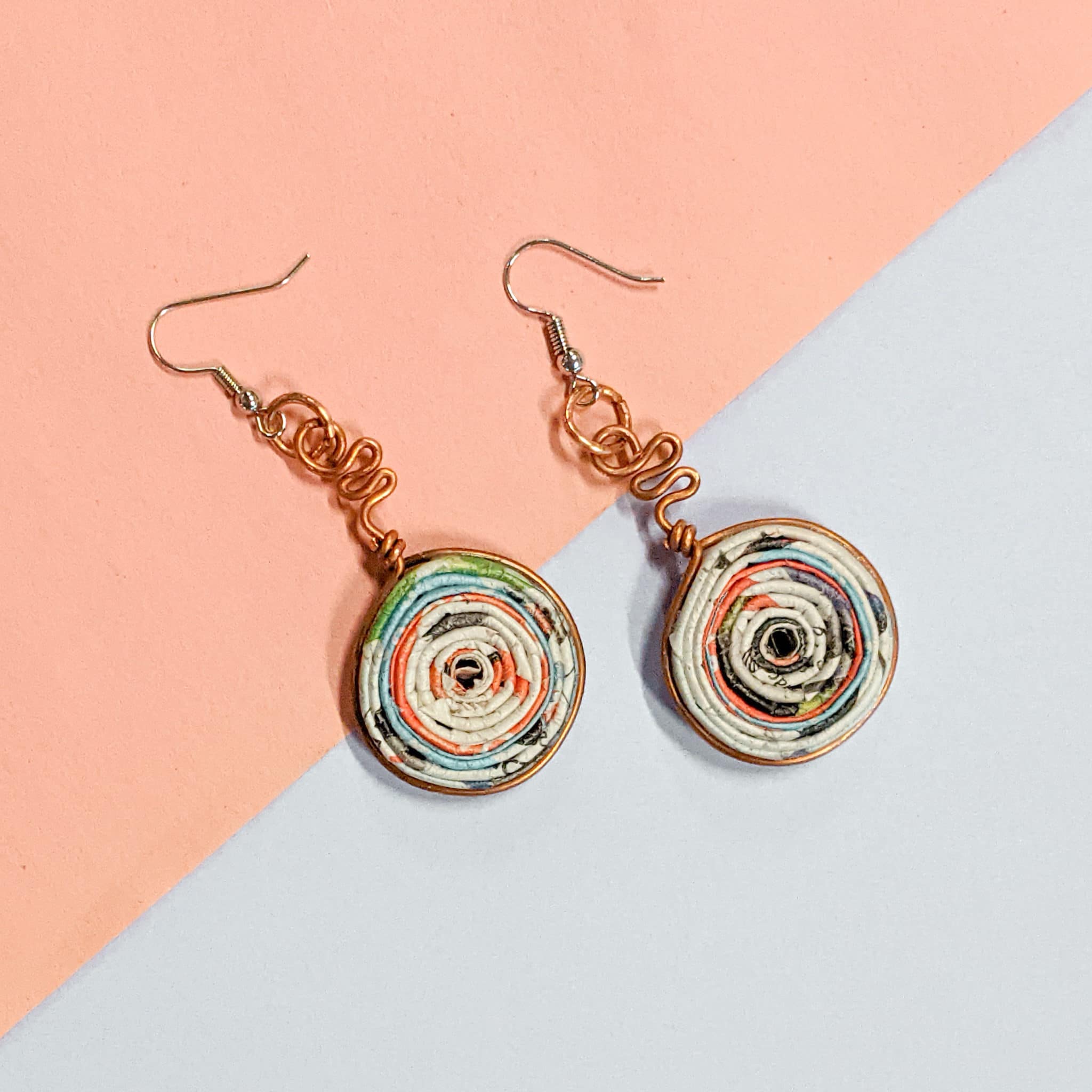
By the end of class, I had created several jewelry pieces of my own, experimenting with different combinations of the paper beads I'd made, making a set of earrings and a necklace.
I loved seeing them finally assembled because the individual beads that had looked like little experiments scattered across the table suddenly felt completely different once they were hanging from copper wire as finished jewelry.
 Jessica Carey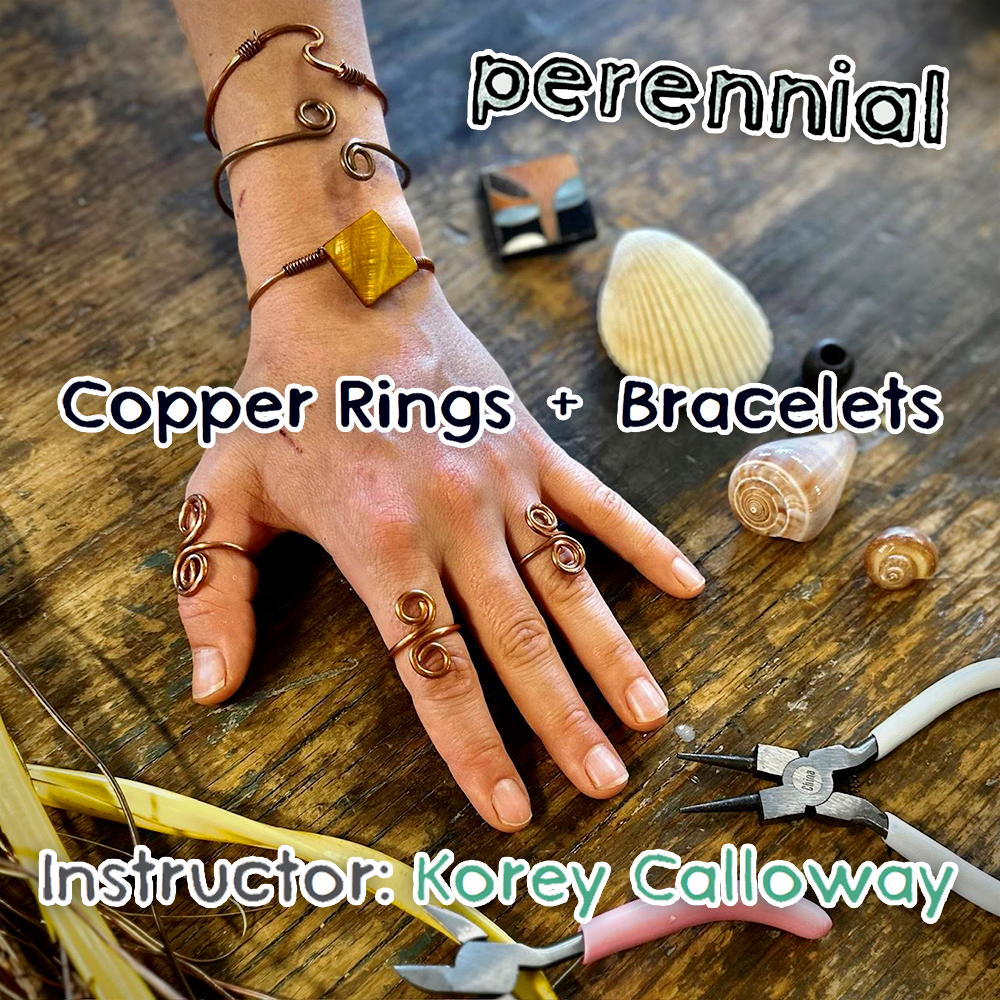
So Much Possibility in a Scrap of Paper
One of my favorite things about paper beads is just how open-ended they are.
The basic materials can be incredibly simple.
Paper.
Glue.
Something to roll the paper around.
And yet those few materials can produce an almost endless variety of results.
A colorful magazine page can become a striped bead.
A piece of scrapbook paper can become something intricate and decorative.
Leftover cardstock can find a purpose instead of ending up in the recycling bin.
And you don't even need to begin with patterned paper.
When I experimented with paper beads on my own years ago, part of the fun was making the paper itself.
I used dot markers and other art materials to create colorful designs across otherwise ordinary sheets of paper, then cut those designs into strips and rolled them into beads.
That added another layer of experimentation.
You weren't simply choosing a paper because you liked how it looked.
You could create the colors and marks yourself—and then discover what happened when that flat artwork was cut apart and wrapped around itself.
The finished bead didn't necessarily look anything like the original sheet.
Dots became stripes.
Separate colors overlapped.
Patterns disappeared in some places and unexpectedly emerged in others.
The process contained an element of surprise.
And I think that's part of what makes paper beads so approachable: there isn't one "correct" outcome.
You can deliberately coordinate colors.
You can use whatever paper happens to be available.
You can make matching beads or embrace the differences.
You can create something bold and colorful, subtle and earthy, carefully planned, or completely experimental.
Even scraps left over from other creative projects can become the starting point for something new.
Creative Reuse as an Invitation
That sense of possibility fits beautifully with what Perennial does.
Creative reuse isn't simply about finding ways to avoid throwing things away.
It's about learning to see materials differently.
A magazine isn't only something to read.
Scrapbook paper isn't useless because the remaining piece is too small for the project it originally came from.
Electrical wire isn't limited to whatever practical purpose it was manufactured for.
When we start asking: "What else could this become?"
the definition of an art supply gets much bigger.
And importantly, creativity can become more accessible, too.
You don't always need an expensive collection of specialty beads to experiment with jewelry making.
Sometimes the material you need is already sitting in a recycling pile, tucked inside a craft drawer, or left over from something else.
That doesn't mean the resulting artwork is somehow "less than."
The paper beads we created weren't substitutes for "real" beads.
They were real beads.
They simply carried a different story.
A story about resourcefulness.
Experimentation.
Transformation.
And seeing value in something that could easily have been overlooked.
That's what I continue to enjoy about Perennial's classes.
They don't just give discarded and leftover materials another life.
They give us practice seeing possibility.
And once you start developing that habit, it's surprisingly difficult to stop looking around and wondering: "What could I make with that?"
Continuing the Experiment at Home
One of the best things about learning to make paper beads is that it doesn't require an elaborate studio setup to continue experimenting.
In fact, you may already have some of the most important materials sitting around your home.
Old magazines.
Leftover scrapbook paper.
Cardstock scraps.
Interesting printed papers.
Even paper you've decorated yourself.
Once you understand the basic process, almost any suitable piece of paper becomes something worth looking at twice.
Instead of asking: "Do I need this scrap anymore?"
You might start asking: "Would this make an interesting bead?"
Perennial's follow-up resources offered several suggestions for finding materials locally and affordably, including Perennial itself, St. Louis Art Supply, Artmart, Schaefer's Hobby Shop, Habitat for Humanity ReStore, and the Goodwill Outlet on Market.
They also suggested checking free listings on Craigslist, Nextdoor, and Facebook Marketplace.
I especially appreciate that many of those suggestions don't begin with "Go buy a brand-new craft kit."
They begin with looking for what already exists.
That is very much in keeping with Perennial's approach to creative reuse.
If you want to turn your beads into jewelry, the tool list becomes slightly more specialized.
During class, we worked with round-nose pliers, needle-nose pliers, wire snips, Elmer's Glue-All, and medium-gauge salvaged copper electrical wire in addition to our paper.
But even then, the underlying idea remains refreshingly simple: start with what you have, learn what you need, and build from there.
You don't need every possible jewelry-making tool before you're allowed to experiment with paper beads.
You can begin with paper.
Make a few beads.
See what happens.
And then decide where you want the process to take you.
 Jessica Carey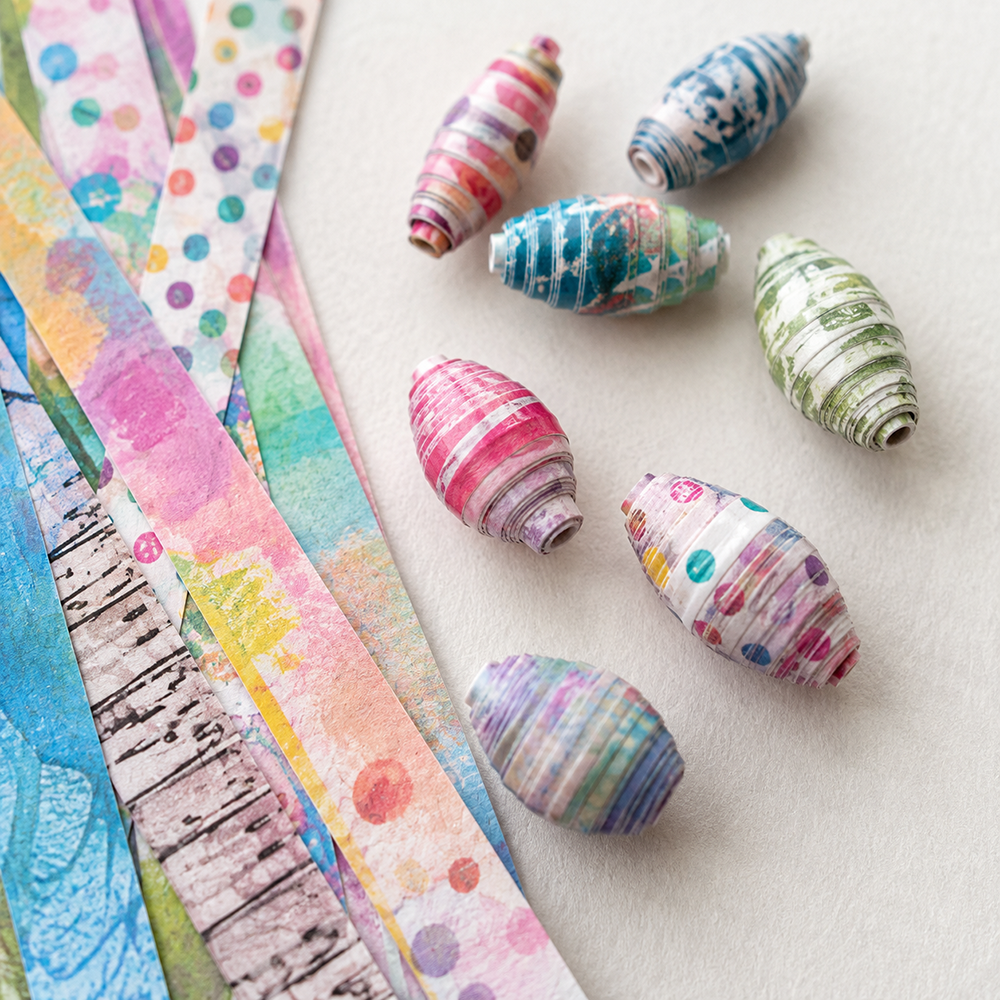
Learning Beyond the Class
Perennial also sent us home with resources for continuing our exploration, including Playing with Books: The Art of Upcycling, Deconstructing, and Reimagining the Book by Jason Thompson.
And, as with the DIY Watercolors class, the learning doesn't necessarily have to end when the workshop does.
Perennial offers Open Studio time for people who want to practice skills or work on their own projects, as well as Craft Club gatherings centered around sustainability, creativity, and connecting with other makers.
Participants can also become members to support Perennial's nonprofit work while receiving discounts on future classes.
I really appreciate that approach.
A class can introduce you to a technique.
But then you get to decide what happens next.
Maybe you make another pair of earrings.
Maybe you experiment with handmade paper designs.
Maybe you try the pillow-bead technique again.
Maybe you make enough beads for a necklace.
Or maybe the next project takes the technique somewhere Korey never demonstrated at all.
Because ultimately, a good creative class doesn't only teach you how to reproduce the instructor's example.
It gives you enough knowledge to start asking your own questions.
And sometimes the most exciting one is simply: "Okay... what else can I do with this?"
 Jessica Carey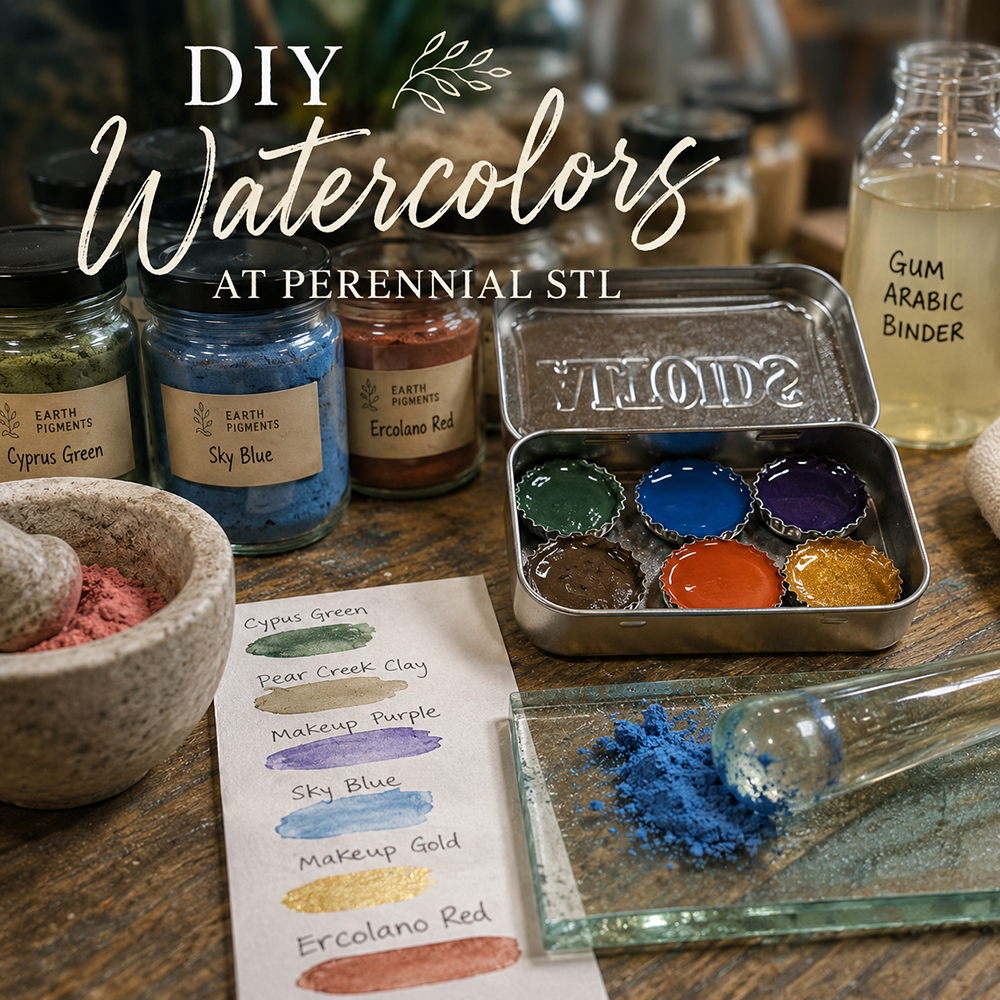
Creativity Builds on Itself
When I signed up for Paper Bead Earrings at Perennial, I knew I wasn't walking into the class completely unfamiliar with what we would be doing.
I'd made paper beads before.
I'd worked with salvaged copper wire before.
I'd used some of the jewelry tools before.
But I'd never brought all of those things together quite like this.
And somewhere between rolling scraps of paper into beads and shaping copper wire into jewelry, I found myself thinking about how interesting creative learning really is.
We don't always know when something we learn will become useful again.
My first experience with paper beads happened during student teaching in the 2015–2016 school year.
Years later, I returned to them on my own, experimenting with dot markers and other art materials to design papers specifically to see what would happen when I cut and rolled them.
Then, this June, Korey taught me how to work with salvaged copper electrical wire during Perennial's Copper Rings + Bracelets class.
None of those experiences happened because I knew they would eventually intersect.
But eventually, they did.
At Paper Bead Earrings, an art technique from nearly a decade ago met a jewelry-making skill I'd learned only a couple of months earlier.
And suddenly, both could become something new.
Nothing We Learn Creatively Is Wasted
I think that's one of the things I love most about creativity.
Skills accumulate.
Ideas cross-pollinate.
Materials find their way into completely different projects.
Something you experimented with years ago might suddenly solve a problem you're working on today.
A technique learned in one class might become the foundation for another.
And sometimes two completely separate creative experiences eventually collide and make you think: "Wait... I know how to do this."
There's a confidence that comes with that realization.
You aren't starting over every time you try something new.
You're carrying everything you've already learned with you.
That doesn't mean you won't be a beginner again.
There will always be unfamiliar tools, new techniques, mistakes, questions, and things that don't quite work the first time.
But being a beginner doesn't mean arriving empty-handed.
Every creative experience gives us something to carry forward.
Another Class, Even More Possibilities
It was also genuinely nice returning to another class taught by Korey.
She recognized me and was happy to see me again, and this time I got to build upon some of the skills she'd already taught me rather than meeting those tools for the first time.
That's one of the unexpected things I've come to appreciate about returning to creative spaces like Perennial.
You don't just accumulate projects.
You begin accumulating relationships, skills, confidence, ideas, and experiences.
One class leads to another.
An instructor becomes a familiar face.
A strange tool becomes something you recognize.
A material you once didn't know how to use becomes something you can approach with a little more confidence.
And your understanding of what you can create keeps expanding.
I walked into Korey's first class with pieces of salvaged copper wire and learned that they could become jewelry.
I walked into this one with scraps of paper and learned that they could become jewelry, too.
Maybe that's the lesson underneath both experiences: creativity doesn't necessarily require extraordinary materials.
Sometimes it requires learning to see the extraordinary possibilities hiding inside ordinary ones.
A piece of electrical wire.
A magazine page.
A scrap of cardstock.
A little glue.
Things that might easily be overlooked suddenly become colorful beads, earrings, necklaces, rings, or something nobody in the class has even thought of yet.
And perhaps that's why I keep enjoying Perennial's classes so much.
I don't simply leave knowing how to make another project.
I leave looking at the materials around me and wondering: "What else could this become?"
And really, isn't that where creativity begins?
Want even more content about creativity and art?
Be sure to check out all of our creative chronicles!
If you'd like to see examples of my work, you can find some of my art and creations at Redbubble and Gumroad!
Want to check out other art spaces and resources?
Check out some of these articles:
-Hidden Gems for St. Louis Artists
-Leftovers and Upcycle Treasure Box
 Jessica Carey