
Content note: This article discusses childhood trauma, emotional and physical abuse, grief, suicide, family rejection, and self-neglect. It also contains major spoilers for the complete story of Fruits Basket.
I was first introduced to the original Fruits Basket anime when I was in sixth grade.
At the time, I did not have the language to explain everything that made the story feel so meaningful to me.
I knew that I loved its humor, its characters, and the strange but charming premise of people transforming into animals from the Chinese zodiac.
I loved the warmth that Tohru brought into the Sohma household and the gradual feeling that these lonely characters were becoming something like a family.
But even beneath the comedy and sweetness of the original anime, there was always something deeper.
The Sohmas were not merely quirky people with an inconvenient magical secret; nearly every member of the family carried some form of pain.
They were grieving, isolated, rejected, controlled, frightened, or ashamed.
Some became angry.
Some withdrew.
Some apologized for existing.
Some performed happiness.
Some tried to make themselves useful enough to be kept.
Even when I could not yet name those patterns as trauma responses, I could feel that these characters were hurting—and that their pain mattered.
As I grew older and encountered the complete story, particularly through the 2019 adaptation, I began to understand more fully what Fruits Basket had been exploring all along.
Underneath the pastel colors, romantic misunderstandings, and adorable animal transformations is a story about what happens when bonds become chains.
It explores the damage created by emotional abuse, neglect, scapegoating, abandonment, coercive control, grief, and the roles children are forced to carry long before they are old enough to understand them.
It is also a story about what can happen afterward.
Almost every major character has been shaped by something painful.
Yuki has been taught that he is worthless without the person controlling him.
Kyo has been treated as a monster and blamed for tragedies he did not cause.
Tohru has learned to hide grief and neglect her own needs beneath kindness, usefulness, and a reassuring smile.
Akito is so terrified of abandonment that she attempts to turn love into something no one is allowed to leave.
Their trauma affects how they see themselves, how they relate to other people, and what kind of future they believe they are permitted to have.
But Fruits Basket does not treat trauma as destiny.
That does not mean the characters simply decide to leave the past behind.
Love does not instantly undo years of fear and shame, and recognizing a harmful pattern does not make it easy to stop repeating.
They misunderstand themselves and one another, retreat into familiar defenses, resist help, and struggle to imagine identities beyond the ones their families assigned to them.
Change becomes possible through truth, connection, safety, accountability, and choice.
As the characters experience relationships that do not depend upon obedience, perfection, usefulness, or fear, they begin questioning the roles they inherited and imagining futures the Sohma system taught them they could never have.
Fruits Basket is therefore not only about breaking a supernatural curse; it is about breaking inherited cycles—and discovering that the past can shape a person without receiving permanent authority over who they become.
A Curse That Is Really a Family System
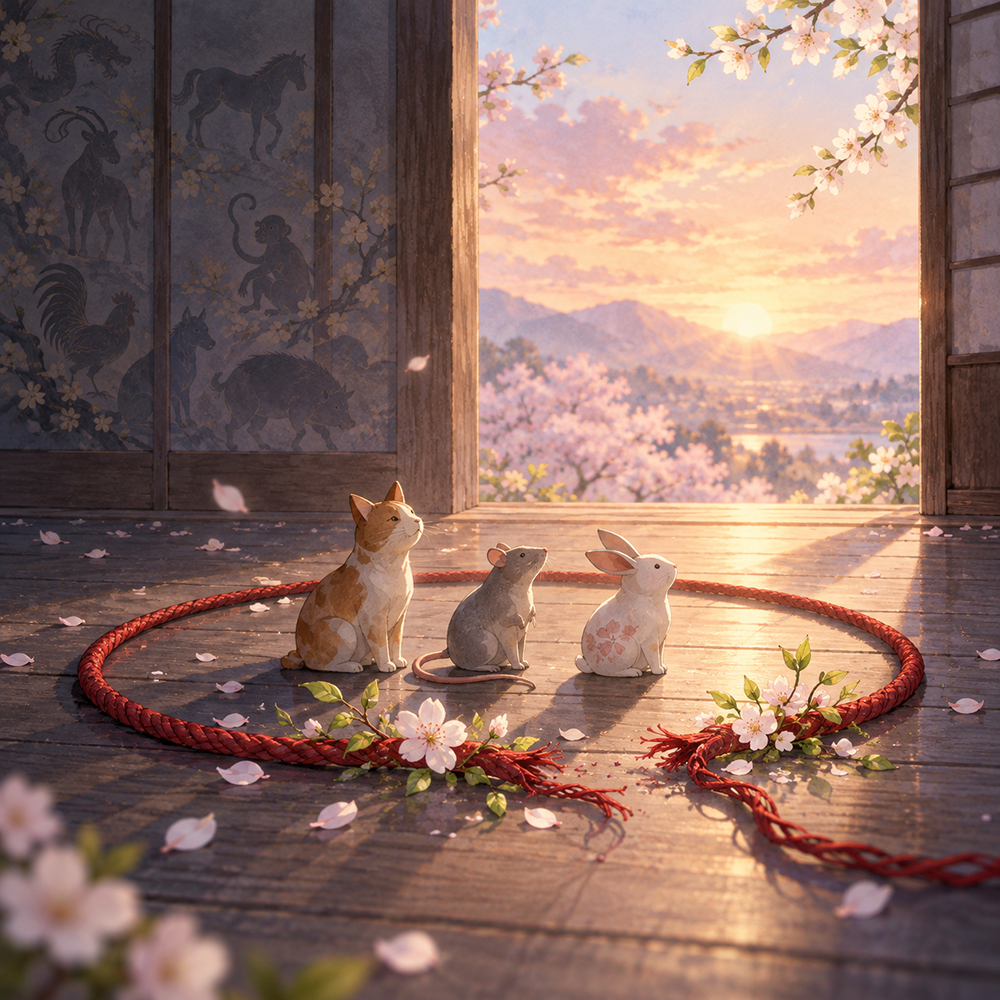
The zodiac curse initially appears to be the Sohma family’s strangest secret: certain family members transform into animals from the Chinese zodiac when embraced by someone of another sex.
It creates many of the story’s funniest and most endearing moments, particularly as Tohru becomes acquainted with each member of the zodiac.
But the transformations are only the most visible part of the curse.
The deeper curse is a bond connecting the zodiac members to Akito, who occupies the role of God.
It is not merely an emotional attachment or a family tradition they can choose to reject.
The bond exists within them as something ancient and instinctive.
Even when they recognize Akito’s cruelty, they feel compelled to return, obey, and seek approval.
They may fear Akito, resent Akito, or understand that Akito is harming them—and still feel unable to leave.
Although the curse is supernatural, the family system surrounding it is painfully recognizable.
The Sohmas are born into roles they did not choose.
Those roles influence how they are treated, where they are allowed to live, which relationships they may pursue, and what kind of future they are expected to accept.
Their individual needs matter less than preserving the family’s structure.
Akito is taught that the zodiac members exist to remain eternally connected to God.
The zodiac members are taught that this bond is sacred and unbreakable. Kyo, as the Cat, is taught that exclusion, humiliation, and eventual confinement are simply his rightful place within the story.
The system presents these arrangements as inevitable.
That is how many harmful family systems maintain themselves.
Their rules may not be written down or spoken directly, but everyone gradually learns which roles they are expected to play.
One person becomes the authority whose emotions determine the atmosphere of the entire family.
Another becomes the favorite or the symbol of family success. Someone becomes responsible for keeping the peace.
Someone learns to disappear. Someone is treated as fragile, difficult, selfish, or unstable.
Someone else becomes the scapegoat—the person blamed for conflicts the family does not want to examine honestly.
I recognize that role because, in many ways, I became the scapegoat within my own family.
When I reacted to mistreatment, the reaction could become the problem.
When I named something harmful, the focus could shift toward my tone, sensitivity, memory, or supposed lack of gratitude.
The question was no longer what happened to her?
It became why is she causing conflict by talking about it?
This created an impossible position.
I was expected to absorb the family’s behavior quietly, but any visible evidence that it affected me could be used as proof that I was difficult, unstable, selfish, or responsible for the tension around me.
The system produced the pain and then treated my pain as the disruption.
Like the Cat within the Sohma family, the scapegoat can become the person onto whom everyone else places what they do not want to examine.
Blaming one person allows the family to preserve its preferred image without confronting the patterns harming everyone inside it.
Once these roles have been assigned, every new event is interpreted through them.
Kyo is not treated as a child who deserves protection.
He is treated as the Cat: the rejected outsider whose existence gives the rest of the family someone to look down upon.
Yuki is not treated as a child with needs, fears, and preferences.
As the Rat, he becomes valuable to his mother and desirable to Akito, but that supposed importance does not allow him to belong to himself.
Even Akito is born into a predetermined identity.
She is raised to believe that she is God and that the zodiac members are destined to love her forever.
Her role grants her enormous power, but it also leaves her incapable of understanding love as something freely given.
If the bond disappears, she does not know who she is or why anyone would choose to stay.
These roles do not affect everyone equally, nor do they erase personal responsibility.
Akito possesses power that the others do not, and she repeatedly chooses to use that power to control and harm them.
But the system injures everyone within it by replacing authentic relationships with prescribed ones.
It teaches them that love means obedience.
It teaches them that belonging must be earned through submission.
It teaches them that maintaining the bond is more important than protecting the people inside it.
It teaches them that leaving is betrayal, even when staying is destroying them.
This is why the word bond carries such complicated meaning throughout Fruits Basket.
Bonds can offer comfort, continuity, and belonging.
They can connect people across years of change.
But a bond that cannot be questioned, refused, or left is not the same as a freely chosen relationship; a connection can be called sacred and still function like a cage.
The Sohmas’ supernatural bond also reflects how abusive family systems can continue across generations.
Most of the current members did not create the structure surrounding the zodiac.
They inherited it.
Older generations preserve its traditions, conceal its harm, and prepare younger members to accept the same rules.
What has existed for a long time begins to feel natural, even when it is profoundly damaging.
No single person has to invent every part of the abuse for the system to continue.
It survives whenever people protect the family’s image, remain silent about what happens within it, blame the most vulnerable person, or insist that tradition matters more than safety.
This is why leaving such a system is rarely as simple as recognizing that it is harmful.
Questioning it can mean questioning one’s family, identity, memories, obligations, and even the right to trust one’s own perception.
The familiar may be painful, but life outside it is unknown.
The zodiac members are not only afraid of Akito; many are afraid of what the loss of the bond might mean.
- Who are they without the animal spirit that has shaped their bodies and relationships since birth?
- Where do they belong if they no longer belong to God?
- What remains when the connection that has caused so much suffering is also one of the only forms of belonging they have ever known?
The curse therefore represents more than abuse alone.
It represents the terrifying mixture of love, fear, loyalty, identity, grief, and obligation that can make harmful relationships so difficult to leave.
From outside the Sohma family, the injustice appears obvious.
From inside it, the characters have spent their lives being taught that this is simply how the world works.
To break the curse, they must do more than escape one person.
They must begin questioning the entire story they inherited about love, family, belonging, and who they are allowed to become.
 Jessica Carey
When “Family” Becomes a Cage
Perhaps this is one reason Fruits Basket has remained so important to me since I was young.
My own family did not share the Sohmas’ supernatural curse, and the circumstances are not identical, but I recognize what it means for the title of family to become more important than the well-being of the people inside it.
In my family, being related to someone was often treated as a reason they should continue receiving love, loyalty, forgiveness, and access—regardless of how they behaved.
Abuse, neglect, manipulation, gaslighting, coercion, scapegoating, and other forms of mistreatment were not necessarily treated as reasons to reconsider a relationship.
Instead, I was encouraged to focus on the good and minimize the harm.
I was told that loving family meant “loving all the good and ignoring all the bad.”
It meant waking up every day and consciously choosing to love them, no matter what.
On the surface, that language can sound noble. Most people contain both good and difficult qualities.
Healthy relationships require patience, empathy, repair, and the ability to accept imperfection.
No one should be discarded for making an ordinary mistake or for being a complicated human being.
But there is a profound difference between accepting imperfection and being expected to accept abuse.
When “family” becomes a reason that certain people never have to face meaningful consequences, love stops functioning as mutual care.
It becomes a rule imposed upon the people being harmed.
The injured person is expected to forgive, understand, remain available, and remember every good moment.
Meanwhile, the person causing the harm is not required to become safer.
The family bond becomes sacred, but the person being harmed does not.
Even attempts to name what happened may be treated as the real betrayal.
The problem becomes the person who spoke, objected, remembered, or finally established a boundary—not the behavior that made those boundaries necessary. Denial, blame-shifting, gaslighting, scapegoating, and DARVO can all help preserve the family’s preferred story: nothing truly terrible happened, and if it did, the injured person caused it, misunderstood it, deserved it, or is now behaving cruelly by refusing to move on.
That is its own kind of curse.
It teaches people to distrust their perception.
It asks them to measure their goodness by how much pain they can absorb without disrupting the family.
It turns love into endurance and boundaries into evidence of disloyalty.
It can also make leaving extraordinarily difficult.
Walking away from harm may feel like violating everything a person has been taught about love, gratitude, forgiveness, and duty.
Even when the relationship is unsafe, the person leaving may still carry grief, guilt, attachment, and memories of what was good.
Good memories do not make the harm imaginary, and loving someone does not make their treatment acceptable.
We can understand why a person behaves as they do without continuing to provide them with access.
Refusing to participate in an abusive pattern is not the same as failing to love.
This is what the Sohma curse captures so powerfully.
The zodiac members’ connections are real.
Their shared history is real.
Some of their affection is real. But the bond has also been used to demand obedience, silence, and endless tolerance of harm.
The story does not ask them to prove their goodness by remaining inside the cage.
Instead, it slowly allows them to discover that a relationship held together by coercion is not made healthy simply because it is called family.
Love without freedom, accountability, or safety can become another name for captivity.
Watching the Sohmas question their inherited roles may have resonated with me long before I consciously understood why.
Somewhere beneath the magical transformations and family secrets was a truth I needed: a bond can be real and still be harmful.
A person can love parts of what they came from and still recognize that they cannot safely remain within it.
Breaking the bond does not mean the past never mattered; sometimes it means finally accepting that you matter, too.
Eventually, recognizing the cage was not enough. I had to leave it.
In September 2025, I fled the family environment that had shaped nearly my entire life.
I did not leave because I had stopped caring or because every memory had suddenly become bad.
I left because love, history, and biological connection didn't make the environment safe.
There was no stable new life waiting on the other side.
Leaving separated me from many of my belongings and began a long period of housing instability, financial strain, grief, uncertainty, and continued chronic autistic burnout.
Freedom did not immediately feel peaceful.
In many ways, it felt frightening, disorienting, and extraordinarily expensive.
But remaining would have required me to continue disappearing.
I could not heal while participating in the same system that required me to deny what was happening.
Choosing differently did not instantly repair my life, but it gave repair somewhere to begin.
That experience helps me understand why the zodiac members grieve when the curse breaks.
A cage can be familiar.
It can contain history, attachment, meaningful memories, and people we once desperately wanted to love us differently.
Walking out does not erase any of that.
Sometimes it simply means accepting that uncertainty outside the cage offers more possibility than certainty inside it.
 Jessica Carey
Trauma Does Not Look the Same in Everyone
Although the Sohmas are connected by the same curse, they do not respond to their experiences in the same way.
Some become quiet.
Some become angry.
Some try to disappear.
Some become relentlessly cheerful.
Some apologize for everything, while others attempt to control everyone around them.
Even characters who have experienced similar forms of rejection develop very different ways of surviving it.
This is part of what makes Fruits Basket feel so human.
Stories about trauma can sometimes reduce survivors to a narrow collection of recognizable symptoms.
A traumatized character may be portrayed as visibly fragile, perpetually sad, or obviously haunted by the past, but pain does not always announce itself so clearly.
Sometimes trauma looks like Yuki’s carefully controlled politeness.
To the people at school, Yuki appears composed, intelligent, gracious, and almost impossibly perfect.
He is admired so intensely that his classmates place him on a pedestal.
Yet that admiration does not make him feel known.
Beneath the princely image is someone who has learned to conceal his emotions, doubt his own worth, and remain distant from other people.
Sometimes trauma looks like Kyo’s anger.
He lashes out, rejects kindness, and directs his pain toward Yuki.
His behavior can make him appear hostile and difficult long before the audience understands the shame, grief, manipulation, and rejection beneath it.
Anger gives him somewhere to put feelings that might otherwise destroy him—but it also harms his relationships and prevents him from facing what he is truly afraid of.
Sometimes trauma looks like Rin’s refusal to trust.
Her intensity can appear harsh, secretive, or self-destructive.
She pushes away people who care about her and attempts to carry impossible burdens alone.
Her determination partly comes from love, but it is also shaped by the belief that closeness makes people vulnerable and that depending on someone may place them in danger.
Sometimes trauma looks like Hatori’s resignation.
After losing the relationship and future he wanted, he does not outwardly rebel against the system.
He continues functioning within it, treating injuries, keeping secrets, and quietly absorbing the pain around him.
His calmness does not mean the harm had little effect.
It may mean he has learned not to expect anything different.
Sometimes trauma looks like Shigure’s calculated manipulation.
Unlike characters who withdraw, submit, or openly rebel, Shigure learns how to work within the family system while quietly pursuing his own desired outcome.
He understands the people around him well enough to move them toward breaking the curse, but his insight does not always become compassion.
He may treat other people’s emotions as pieces on a board, demonstrating that resisting an abusive system does not automatically make every method of resistance healthy.
Sometimes it looks like Ritsu apologizing for taking up space.
Sometimes it looks like Momiji smiling while carrying the pain of being rejected by his mother.
Sometimes it looks like Tohru taking care of everyone except herself.
These characters remind us that a survival response can easily be mistaken for a personality.
Someone may be called angry without anyone asking what taught them to remain ready for a fight.
Another may be praised for independence when they have actually learned that help will not come.
kKindness may conceal a belief that usefulness is the price of love, while apparent calm may reflect the knowledge that displaying pain is unsafe.
These responses once served a purpose:
- Anger can create distance from people who might cause harm.
- Perfection can reduce the risk of criticism.
- Withdrawal can prevent further rejection.
- Constant helpfulness can make abandonment feel less likely.
- Apologizing can calm unpredictable people.
- Emotional numbness can allow someone to continue functioning through circumstances that would otherwise feel unbearable.
What protects a person in one environment, however, may begin harming them in another.
A defense that protects someone in one environment may limit them in another.
Kyo’s anger, Yuki’s composure, Tohru’s selflessness, and Rin’s fierce independence all help them survive—but eventually prevent them from recognizing or accepting safer forms of connection.
Healing therefore does not require the characters to condemn the versions of themselves that survived.
It asks them to recognize that they may no longer need every defense in every relationship.
That process is neither immediate nor graceful.
People do not abandon lifelong coping mechanisms simply because a kinder person appears.
Safety may be offered many times before it begins to feel believable.
Affection may initially feel suspicious.
Vulnerability can feel more dangerous than loneliness because loneliness, at least, is familiar.
Fruits Basket allows its characters to move unevenly through that process.
They make progress and retreat.
They misunderstand care.
They repeat behaviors they know are hurting them.
They may intellectually recognize that a situation has changed while their bodies and emotions continue responding as though the original danger is still present.
The series also recognizes an essential distinction: understanding the source of someone’s behavior does not mean pretending that the behavior causes no harm.
Kyo’s history helps explain why he redirects his pain toward Yuki, but it does not make Yuki responsible for receiving that anger.
Tohru’s fear of abandonment explains why she neglects herself, but it does not make that self-neglect healthy.
Akito’s upbringing and terror of being left help us understand her desperation, but they do not excuse her manipulation, cruelty, or violence.
Trauma can explain behavior without erasing accountability.
This is especially important because traumatized people are sometimes treated as though they belong to one of two categories: perfectly sympathetic survivors who never hurt anyone, or harmful people whose pain no longer deserves recognition. Fruits Basket allows for something more complicated.
A person can be deeply wounded and still cause wounds.
A coping mechanism can be understandable and still need to change.
Someone can deserve compassion without being entitled to unlimited access, obedience, or forgiveness.
And two people can endure related forms of harm without becoming the same person.
The Sohma curse connects these characters, but it does not determine a single response. Each person carries the family’s pain differently.
Their eventual healing must therefore take different forms as well.
For Yuki, that journey begins with learning that he is more than the identities other people have constructed around him.
Yuki: When Other People Define Who You Are
Yuki Sohma appears to have everything Kyo wants.
As the Rat, Yuki holds an honored place within the zodiac.
At school, he is intelligent, attractive, graceful, and admired so intensely that other students refer to him as a prince.
He seems composed in situations where Kyo becomes flustered or angry.
From the outside, Yuki appears accepted everywhere he goes.
But admiration is not the same as belonging.
The students who idealize Yuki do not necessarily know him.
They admire a distant image—beautiful, polite, accomplished, and seemingly untouched by ordinary insecurity.
The more perfect that image becomes, the less room Yuki has to exist as an imperfect person within it.
He is surrounded by attention and profoundly lonely.
That contradiction began long before his classmates decided he was a prince.
As a child, Yuki was valued for what his zodiac position could provide rather than loved for who he was.
His mother treated his closeness to Akito as an opportunity to improve the family’s social standing.
When Yuki attempted to express that he was suffering, his needs were dismissed.
The adults responsible for protecting him either failed to recognize his distress or chose the benefits of the arrangement over their child.
Akito then taught Yuki what that abandonment supposedly meant.
Isolated from other children and denied reliable support, Yuki was repeatedly told that no one wanted him, that he had no value outside his bond with Akito, and that the world beyond that room would reject him.
Those messages did not remain external insults; over time, they became part of how Yuki understood himself.
This is one of the most damaging effects of emotional abuse: the abuser’s voice can eventually become difficult to distinguish from one’s own.
Even after Yuki leaves Akito’s immediate control, he continues carrying that voice inside him.
Physical distance does not automatically restore the identity that coercion distorted.
He remains anxious, guarded, and unsure how to approach other people as an equal.
His princely persona offers some protection.
If he is calm enough, polite enough, capable enough, and difficult enough to criticize, perhaps no one will discover the frightened person underneath.
But the mask also reinforces his isolation.
Other people respond to the performance while Yuki remains convinced that the person behind it would not be accepted.
He becomes admired without feeling lovable.
I recognize part of myself in that divide between the person other people see and the person living underneath.
I was not treated like a school prince, but I became known through another kind of idealized role: the intelligent, capable, responsible person who could keep functioning no matter what life demanded.
I earned strong grades, completed both a bachelor’s and master’s degree, worked multiple jobs, cared for other people, volunteered, solved problems, and continually found ways to keep going.
From the outside, that competence could look like evidence that I was fine; it was not.
People could admire what I accomplished without understanding the fear, sensory overwhelm, exhaustion, masking, trauma, and constant internal calculation required to accomplish it.
They knew what I could produce and which role I could perform.
They did not necessarily know what it cost me—or who I was when I was not being useful, successful, or reassuring.
Like Yuki, I learned that being favorably perceived is not the same as being known.
A polished exterior can create its own kind of loneliness.
The more convincingly I performed competence, the less likely anyone was to recognize that I needed help; my success became evidence against my suffering.
Learning that I am autistic has helped me understand why maintaining that acceptable version of myself required so much energy.
Healing has involved something similar to what I see in Yuki: not becoming more impressive, but learning that I am allowed to be a whole person instead of an endlessly composed one.
I can be intelligent and disabled, capable and overwhelmed, articulate in writing and unable to process another demand.
I can be accomplished and still need care.
I do not have to remain the idealized version other people constructed in order for my life to have value.
The admiration without being loved is partly why his resentment toward Kyo is so complicated.
Kyo sees Yuki’s status, popularity, and place within the zodiac and assumes that Yuki possesses everything he lacks.
Yuki looks at Kyo and sees a person who can argue, react, form ordinary relationships, and express emotion without first transforming it into something elegant.
Kyo may be rejected by the Sohma system, but he seems more capable of entering the world beyond it.
Each envies what the other appears to possess.
Kyo longs for Yuki’s acceptance. Yuki longs for Kyo’s freedom.
Neither initially understands the private suffering beneath the other’s life.
Their rivalry allows both of them to direct their pain sideways instead of confronting the system that created it.
Tohru begins changing something in Yuki because she relates to him differently.
She does not worship Prince Yuki, use the Rat for status, or demand that he fulfill an assigned role. She offers warmth without requiring perfection.
Around her, he begins experiencing the kind of gentle attention and reassurance he had been denied as a child.
At first, Yuki struggles to understand what that attachment means.
The story appears to be constructing a familiar romantic triangle between Yuki, Tohru, and Kyo, but Yuki eventually recognizes that what he sought from Tohru was not primarily romantic love.
He experienced her as the nurturing presence he had always needed.
That realization is important because Fruits Basket does not force every profound connection into romance.
Tohru’s importance to Yuki is not diminished because he does not become her romantic partner.
She gives him an experience of emotional safety that helps him begin rebuilding his relationship with himself.
But Tohru cannot be the entirety of Yuki’s world.
If his healing consisted only of transferring his emotional dependence from Akito to Tohru, he would remain defined by another person.
The new relationship would be kinder, but Yuki still would not have learned how to belong to himself.
His growth therefore takes him outward.
Joining the student council places Yuki among people who do not automatically treat him as a prince.
Kakeru challenges, irritates, teases, and occasionally misunderstands him.
Instead of carefully maintaining the distant image everyone expects, Yuki begins reacting more honestly.
He becomes frustrated, jokes, makes mistakes, asserts himself, and begins participating in life rather than observing it from behind a polished surface.
These interactions may appear smaller than the dramatic confrontations surrounding the zodiac curse, but they are essential to his healing.
Yuki is learning how to be ordinary.
He does not need to be worshipped, needed, or flawlessly composed in order to remain connected to other people.
A disagreement does not necessarily mean abandonment.
Imperfection does not automatically make him worthless.
He can contribute to a group without making its acceptance the sole foundation of his identity.
His relationship with Machi develops from this more grounded place.
Machi is not captivated by the Prince Yuki image.
She sees the suffocating loneliness beneath perfection because she also knows what it means to be shaped by impossible expectations.
Yuki, in turn, learns to notice her carefully—not as someone he must rescue, but as an individual whose silences, preferences, fears, and small acts of courage deserve recognition.
Their relationship grows through being seen accurately.
That is different from idealization. It is also different from control.
Akito’s version of connection requires Yuki to remain small, dependent, and certain that no one else could want him.
The school’s idealization requires him to remain graceful and unreachable.
His healthier relationships make space for him to change.
Yuki’s reconciliation with parts of his past is similarly gradual.
He cannot recover the childhood he should have received.
His mother does not suddenly become the parent he needed, and his brother Ayame cannot erase the ways he once failed to protect him.
But Yuki begins making choices about what those relationships will become rather than waiting for others to define them for him.
He acknowledges what hurt him without allowing that hurt to become the entirety of his identity.
Yuki’s healing is therefore not a transformation into someone stronger, more talented, or more impressive.
Other people already believed he was all of those things.
His healing is the freedom to become less perfect.
He can be awkward, angry, playful, uncertain, vulnerable, and still worthy of connection.
He can recognize both his strengths and his limitations without viewing either as proof that Akito was right about him.
He can allow people to know him instead of merely admiring him.
For someone whose identity was constructed through other people’s expectations, becoming an ordinary, complicated person is an extraordinary form of liberation.
Yuki does not need to discover that he was secretly the prince everyone imagined.
He needs to discover that he never had to be a prince in order to matter.
Kyo: The Child Chosen to Carry Everyone Else’s Shame
If Yuki is placed on a pedestal, Kyo is placed beneath everyone else.
As the Cat, he is excluded before anyone has the opportunity to know him.
The original zodiac story establishes the Cat as the outsider who was deceived, rejected, and denied a place at the banquet.
Within the Sohma family, that story becomes more than folklore.
It creates a role that each successive Cat is expected to inhabit.
Kyo is not simply a child who happens to possess a different zodiac spirit; he is treated as something shameful.
His true form is considered grotesque.
His existence is discussed as though it were a misfortune for everyone around him.
He grows up knowing that the previous Cat was confined and that the same fate has already been prepared for him.
His future appears decided before he is old enough to imagine one for himself.
The Sohma family needs the Cat to remain beneath them.
If one person can be designated as monstrous, everyone else can feel comparatively normal.
If the Cat can be blamed for rejection, suffering, and disorder, the family does not have to examine the cruelty of the system itself.
Kyo becomes a container for shame that does not actually belong to him.
That dynamic intensifies after his mother dies by suicide.
Kyo’s father blames him for her death, treating his child as the cause rather than confronting the fear, abuse, social pressure, and despair surrounding her life.
Akito reinforces the same narrative: Kyo is told that his nature is twisted, his existence destroys other people, and those who suffer around him do so because he is a monster.
A child repeatedly given that message may eventually stop asking whether it is true.
Kyo internalizes the belief that something is fundamentally wrong with him.
He does not merely think he has made mistakes.
He believes that his existence is itself a mistake—that harm follows him because of what he is.
This is one of the cruelest effects of scapegoating.
It takes pain produced by an entire family system and concentrates it inside one person.
The scapegoat is then expected to carry both the original harm and the blame for reacting to it.
Kyo’s role as the family scapegoat is another part of Fruits Basket that feels painfully familiar.
Within my own family, I often became the person onto whom unresolved problems could be placed.
When I named mistreatment, established a boundary, or reacted to something harmful, the focus could shift away from what had happened and onto my response.
My distress became evidence that I was difficult.
My attempts to protect myself could be reframed as cruelty, selfishness, disloyalty, or an attack upon the family.
The system could harm me and then blame me for no longer being able to absorb the harm quietly.
Over time, I internalized the belief that perhaps I really was the problem.
If I could become more understanding, more useful, less sensitive, less exhausted, or better at communicating, perhaps the family would finally become safe.
I kept searching for the version of myself who could prevent other people from mistreating me, but that person did not exist.
Like Kyo, I was carrying responsibility for choices and patterns much larger than myself.
This does not mean I have never made mistakes or hurt anyone.
Being scapegoated does not make a person infallible, but healthy accountability requires distinguishing between what genuinely belongs to us and what other people placed upon us because they did not want to carry it themselves.
Leaving my family required me to begin making that distinction.
I can examine my behavior without accepting the claim that my existence caused the dysfunction around me.
I can acknowledge imperfect reactions without pretending those reactions appeared in a vacuum.
I can take responsibility for my choices without accepting responsibility for other people’s abuse, neglect, manipulation, or refusal to change.
Kyo’s story speaks to the part of me that was taught to confuse shame with accountability.
Shame says: everything becomes harmful because something is fundamentally wrong with you.
Accountability says: you are human. You can examine what belongs to you, make repairs where necessary, and refuse what never belonged to you at all.
That difference makes a future possible.
Kyo’s anger grows from that environment of being the scapegoat.
He is quick to fight, easily embarrassed, and often unable to communicate what he feels.
He lashes out before someone can get close enough to reject him.
He runs when his emotions become too overwhelming.
His hostility creates distance, and distance offers temporary protection.
Anger also gives him something more manageable than grief.
It is easier for Kyo to believe that defeating Yuki will solve his life than to face the possibility that the system was never fair.
If Yuki is the reason Kyo is rejected, then beating Yuki might finally make him acceptable.
If the Rat is the enemy, Kyo does not have to confront the fact that the people responsible for protecting him chose to mistreat him.
Akito exploits that hope by offering him a false path toward freedom: if Kyo can defeat Yuki, perhaps he can avoid confinement and finally be accepted as a true member of the zodiac.
Kyo’s rivalry therefore becomes more than ordinary jealousy; in his mind, he is fighting for the right to have a future.
But Yuki was never the person who took that future from him.
Like Kyo, Yuki is another child responding to a role the Sohma family forced upon him.
Kyo envies Yuki’s status and apparent acceptance, while Yuki envies Kyo’s emotional freedom and ability to form relationships outside Akito’s control. Each initially sees only what the other appears to possess.
The rivalry allows them to avoid recognizing how profoundly they resemble one another.
Both have been isolated.
Both have been taught to hate themselves.
Both believe the other received the life they were denied.
And both direct their pain toward someone who did not create it.
Understanding this does not mean Kyo bears no responsibility for how he treats Yuki.
His trauma explains the anger, but Yuki does not deserve to become its target.
Part of Kyo’s growth is learning to separate what was done to him from what he does in response.
Before he can do that, however, he needs evidence that the family’s story about him is not the only possible truth.
Kazuma provides some of that evidence.
Although Kazuma initially takes Kyo in partly because of guilt over how he treated his own grandfather, who was the previous Cat, their relationship grows into genuine parental love.
Kazuma feeds him, trains him, remains beside him, and allows Kyo to experience care that is not dependent upon defeating Yuki or proving that he is worthy.
Kazuma does not pretend the true form does not exist; he wants Kyo to discover that being seen is survivable.
His decision to remove Kyo’s prayer-bead bracelet in front of Tohru is painful and ethically complicated.
He forces Kyo into an exposure that Kyo did not choose, risking both his trust and his most important relationship.
Kazuma believes Kyo will remain trapped by shame unless someone encounters the part of him he has been taught to hide.
When Tohru first sees Kyo’s true form, she is frightened, and she runs.
That detail matters.
Her acceptance is not powerful because she responds with effortless perfection; it is powerful because fear is not the end of her response.
She recognizes that Kyo has fled while believing his deepest fear has been confirmed, and she chooses to follow him.
Tohru does not tell him that the form is secretly beautiful or that his pain is imaginary.
She acknowledges her fear while refusing the conclusion that fear makes him unworthy of care.
For perhaps the first time, the part of Kyo most associated with rejection is fully visible—and someone returns.
That moment does not cure him.
Kyo continues carrying shame, guilt, and the expectation that happiness will eventually be taken away.
He accepts Tohru’s kindness while believing he has no right to return her love.
The closer they become, the more frightened he becomes of what she would think if she knew about his connection to her mother’s death.
Kyo witnessed the accident that killed Kyoko.
He might have been able to pull her away from the approaching vehicle, but doing so in front of other people could have revealed the zodiac secret by causing him to transform.
In a moment of terror and hesitation, he did not reach for her.
He then interprets Kyoko’s final words as condemnation.
That event attaches itself to every message Kyo has already received about himself: people die because of him; he fails everyone who loves him; he does not deserve a future; getting close to Tohru is another form of harm.
His guilt contains a real and painful question about the choice he made in that moment, but it also expands far beyond responsibility into total self-condemnation.
Kyo does not believe he made one frightened human decision with devastating consequences.
He believes the event reveals what he has always been told he is: a monster.
This is why accepting Tohru’s love is so difficult; love threatens the punishment he believes he deserves.
If he allows himself to be happy, he must question the identity constructed from years of blame.
Eventually, Kyo can no longer continue hiding behind anger, rivalry, or self-hatred. He tells Tohru the truth.
When she still expresses her love for him, he initially rejects it—not because he feels nothing, but because being loved contradicts everything he believes about himself.
His healing requires more than receiving acceptance; it requires choosing not to run from it.
Kyo begins taking responsibility for what belongs to him without continuing to carry what does not.
He can regret that he did not reach for Kyoko without accepting that he caused her death.
He can acknowledge that he unfairly directed his anger toward Yuki without accepting the Sohma family’s claim that he deserves lifelong confinement.
He can grieve his mother without accepting his father’s accusation that his birth destroyed her.
He can recognize the ways he has hurt people without treating his entire existence as harm.
This distinction is essential.
This is the distinction Kyo must eventually make: accountability allows a person to acknowledge specific choices and choose differently, while shame treats the person’s entire existence as the offense.
The Sohma family taught Kyo shame; healing makes genuine accountability possible.
That change becomes visible when Kyo finally confronts his biological father; instead of absorbing his father’s rage as proof of his own guilt, he begins to recognize the fear and avoidance beneath it.
His father has spent years placing responsibility on Kyo rather than facing his own treatment of Kyo’s mother or the complexity of her suffering.
Kyo refuses to continue carrying that version of the story.
He also begins to see Yuki as another person rather than a symbol of everything he was denied.
Their relationship does not become gentle or sentimental overnight, but it becomes more honest.
Kyo no longer needs Yuki to be the villain of his life because he is finally facing the true sources of his pain.
Most importantly, he begins planning for a future even before he knows exactly what freedom will look like.
The boy who assumed he would be imprisoned decides that he wants to live, love, work, travel, and continue growing.
He stops treating hope as something reserved for other people.
Tohru’s love matters deeply, but she does not single-handedly rescue him.
Kazuma’s care, Kyo’s relationships, painful confrontations, honest accountability, and his own repeated choices all contribute to his transformation.
Other people show him that another story is possible.
Kyo must decide to live inside it.
His arc does not suggest that enough love can erase trauma.
It suggests that being accepted may help someone question the shame they were taught—and that, with time, they may begin choosing a life beyond it.
Kyo cannot change what happened to him, recover the childhood he deserved, or undo the losses he carries, but he can refuse the cage waiting for him.
He can take responsibility for his choices without accepting responsibility for an entire family’s cruelty, stop treating survival as the most he deserves, and choose a future the Sohmas had already decided he would never have.
Tohru: When Self-Neglect Looks Like Kindness
Tohru is introduced as the person who brings warmth into the Sohma household.
She cooks, cleans, listens, encourages, remembers what matters to people, and responds to suffering with compassion rather than judgment.
Her presence helps the zodiac members feel safe enough to reveal parts of themselves they have kept hidden.
Again and again, her kindness changes the emotional direction of a scene.
It would be easy to interpret Tohru as simply, naturally selfless—the emotionally healthy outsider whose goodness begins repairing a damaged family.
But Tohru is not outside the story’s exploration of trauma.
She is one of its clearest examples.
Her kindness is genuine.
She truly cares about other people, and the series never suggests that every loving thing she does is secretly manipulative or false.
But some of the behaviors that appear most admirable in her are also connected to grief, parentification, abandonment, and a deeply rooted fear of becoming a burden.
Tohru does not merely enjoy helping people.
She has learned to associate usefulness with safety.
That pattern begins in childhood.
After the death of her father, Katsuya, Tohru watches her mother become consumed by grief.
Kyoko had already experienced rejection, loneliness, and instability before meeting him.
Katsuya became the person who saw and accepted her when she had little sense of a future.
Losing him did not only mean losing her husband; it threatened the life and identity she had built with him.
During the most severe period of Kyoko’s grief, Tohru is left emotionally alone.
She is a child who has lost her father and is also terrified of losing her mother; rather than having space to express her own grief, she begins searching for a way to bring Kyoko back to her.
Tohru remembers relatives saying that she does not resemble her father.
She becomes afraid that Kyoko will follow Katsuya into death and leave her behind.
In response, she begins imitating her father’s unusually polite way of speaking—as though becoming more like him might make her visible enough for her mother to remain.
Her formal speech, one of her most recognizable characteristics, is therefore connected to something much deeper than simple politeness.
It began as an attempt to preserve attachment.
The child Tohru learns a devastating lesson: perhaps people remain when she becomes what they need.
Even after Kyoko returns emotionally and becomes a loving, devoted mother, the survival pattern does not simply disappear.
Tohru continues trying to be easy to love.
She works hard, maintains the household, offers reassurance, and minimizes her own needs.
She becomes the dependable one.
That role is often praised.
People may call someone like Tohru mature, thoughtful, resilient, or wise beyond their years.
What is less often acknowledged is why a child needed to become so capable in the first place.
Sometimes apparent maturity is the visible result of needs that had nowhere safe to go.
After Kyoko dies, Tohru’s tendency toward self-neglect becomes impossible to miss—although the people around her do not immediately recognize it.
When her grandfather’s home is temporarily unavailable, Tohru considers asking her closest friends for help. She knows Uotani and Hanajima love her.
The audience has every reason to believe they would rather help than discover she was suffering alone.
But Tohru does not give them the opportunity.
She decides that their lives and family circumstances are already too complicated; rather than risk inconveniencing anyone, she lives alone in a tent.
This is not healthy independence.
Tohru is a grieving, unhoused teenager working, attending school, and attempting to care for herself in the woods.
Yet she treats asking for shelter as though it would be the more unreasonable choice.
Her calculation reveals how little space she believes her needs should occupy.
From the outside, self-neglect can resemble generosity.
The person appears undemanding, considerate, and remarkably capable.
They anticipate what everyone else needs and rarely request anything in return.
Because they continue functioning, other people may assume they are fine.
But having no visible needs is not the same as being safe, supported, or whole.
Tohru’s first New Year without her mother makes this especially clear.
She encourages Yuki, Kyo, and Shigure to attend the Sohma gathering without her.
She smiles and reassures them that she will be all right.
She focuses on what they are expected to do and refuses to make her grief into anyone else’s problem.
Once they leave, the smile collapses.
Tohru is left alone with her mother’s photograph, mourning privately because she has convinced everyone else that she does not need them.
Yuki and Kyo’s decision to return is meaningful precisely because they do not come back with a solution.
They cannot restore Kyoko or remove Tohru’s grief.
They return so she will not have to enter the new year alone.
For once, someone looks beyond the reassuring performance.
They recognize that the person who always takes care of others may also need someone to come back for her.
That moment captures one of the gentlest forms of care in Fruits Basket: not fixing someone’s pain, demanding that they explain it, or insisting that they become cheerful again—simply noticing and staying.
Tohru offers this kind of presence to many people, yet accepting it for herself is far more difficult.
Her habit of self-abandonment affects more than practical decisions; it shapes what she allows herself to want.
For much of the story, Tohru organizes her emotional world around her mother’s memory.
Kyoko is not only the person she loved most; preserving that love becomes part of Tohru’s identity.
She carries her photograph everywhere.
She speaks to her, thinks about her, and uses that bond as an anchor after losing the person who made home feel possible.
The attachment is loving, but it is also tied to fear.
Tohru worries that moving forward might mean leaving her mother behind.
If someone else becomes the most important person in her life, she fears that she is betraying Kyoko or diminishing what they shared.
Her growing love for Kyo forces her to confront this conflict.
Wanting a future with him means admitting that she wants something for herself.
It means accepting that her life is continuing beyond the relationship that once defined it.
It also means acknowledging emotions she cannot transform into service for someone else.
Tohru can cook for people, comfort them, and help carry their pain, but saying I want this is much more frightening.
Her breakdown near the end of the story is therefore not evidence that her kindness has failed; it is evidence that the parts of herself she has suppressed can no longer remain invisible.
She is grieving.
She is afraid.
She is angry with herself.
She wants Kyo.
She does not know how to reconcile love for the person she lost with love for the person still in front of her.
For perhaps the first time, the girl who always knows how to respond to everyone else does not know how to make her own feelings neat, helpful, or reassuring.
This is an important turning point because healing cannot require Tohru to remain endlessly pleasant.
Her growth is not about becoming kinder. She is already extraordinarily kind.
It is about learning that kindness does not require her disappearance.
She can care for other people without treating her own needs as dangerous.
She can love her mother without freezing her life at the moment of loss.
She can support Kyo without being responsible for repairing every wound he carries.
She can want companionship, express pain, accept help, and take up emotional space.
She can be loved for more than what she provides.
This also complicates the idea that Tohru saves the Sohmas.
She undoubtedly changes their lives, but the relationships are not entirely one-directional.
The Sohmas gradually begin noticing her, protecting her, returning for her, and challenging the belief that she must earn belonging through constant care.
She offers them a different experience of love.
They begin offering one back.
That reciprocity matters; a relationship in which Tohru endlessly gives while everyone else receives would only recreate the pattern she needs to heal.
The healthier relationships within the story become places where care can eventually move in both directions.
Tohru’s kindness is one of her greatest strengths.
Her self-erasure is not.
The distinction can be difficult to see because both may result in the same outward action.
She may cook a meal because she enjoys caring for someone—or because she is afraid she has no value unless she is useful.
She may reassure a friend because she wants to support them—or because telling the truth about her own feelings seems too dangerous.
Often, both motives may exist at once.
Healing does not require Tohru to become less loving; it allows her love to include one more person: herself.
That may be why she resonates so deeply with people who learned early to be the good child, the helpful one, the easy one, or the strong one.
Her story recognizes both the beauty within that compassion and the hidden cost of believing that care must always flow away from us.
Tohru spends much of Fruits Basket helping other people believe they are worthy of love beyond what happened to them.
Eventually, she must begin believing the same thing about herself.
 Jessica Carey
Why I Have Always Been “Such a Tohru”
Long before I understood all the psychology beneath Tohru’s behavior, I recognized myself in her.
I have referred to myself as “such a Tohru” plenty of times over the years.
Part of that identification comes from her kindness, empathy, and desire to believe there is something worth understanding in other people.
But as I have grown older—and gained language for autism, trauma, parentification, masking, and self-neglect—I have also begun to recognize the more painful similarities.
Our histories are not identical; I do not want to collapse the differences between a fictional character’s story and my own life or pretend that every event has a direct real-world equivalent.
But the emotional patterns feel familiar.
Like Tohru, I learned early to pay close attention to what other people needed.
I learned to be helpful, responsible, accommodating, and understanding.
I became accustomed to carrying things that should not have belonged to a child and to measuring my value through what I could do for other people.
I learned that being good meant requiring very little.
That being loving meant enduring.
That other people’s feelings, struggles, intentions, and limitations should be carefully considered—even when mine were not given the same consideration.
This can create a person who appears unusually capable from the outside.
They may work hard, anticipate problems, care for other people, and continue functioning in circumstances that should never have been theirs to manage alone.
Others may call them strong.
What they do not always see is that the strength developed because not being strong did not feel like a safe option.
That is part of what I see in Tohru.
tHer decision to live in a tent rather than risk burdening the people who love her reflects a painfully familiar logic: other people already have enough to deal with; I should find a way to manage this without becoming one more problem.
I recognize that logic.
During periods of housing instability and overwhelming need, I have often found myself worrying about the inconvenience my circumstances might create for other people.
Even when I was struggling to remain safe and functional, part of me continued monitoring whether I was asking for too much, staying too long, needing too much support, or failing to make myself sufficiently useful in return.
When someone has learned that their needs are a burden, even survival can begin to feel like an imposition.
Tohru also has an extraordinary ability to find explanations for other people’s behavior.
She notices their pain.
She imagines what they may have experienced and offers compassion even when they are difficult, distant, or unkind.
That capacity is beautiful.
It can also become dangerous when understanding someone is confused with accepting everything they do.
For much of my life, I was encouraged to focus on the good in my family and overlook the harm.
I could see other people’s wounds, histories, and limitations so clearly that it became difficult to give equal weight to what their behavior was doing to me.
Compassion moved outward while accountability—and often blame—turned inward.
I thought that if I could understand someone well enough, respond kindly enough, explain myself clearly enough, or love consistently enough, perhaps the relationship would become safe.
Tohru’s story helps reveal why that hope can be so persistent.
She repeatedly encounters people whose defenses soften in response to being treated with kindness.
Within the story, her compassion genuinely does make a difference.
But even Fruits Basket eventually shows that kindness cannot require endless self-abandonment.
Tohru has to develop a relationship with her own wants, limits, grief, and anger.
She cannot remain only the person who understands everyone else.
She must also become someone willing to recognize when she is hurting.
My identification with Tohru has taken on another dimension since learning that I am autistic.
Tohru is not canonically identified as autistic, and I am not suggesting that there is one definitive diagnosis hidden within the story.
Her behavior can be understood through grief, trauma, personality, cultural expectations, and the specific circumstances of her childhood.
Still, she gives me what I can only describe as autistic vibes.
There is something familiar in her highly formal way of speaking, her earnestness, her unusual trains of thought, and the way she sometimes approaches social interactions through learned rules and deliberate politeness.
She can be literal, miss what others consider obvious, and understand people deeply while still appearing socially unconventional.
She often seems to process situations differently from those around her, yet her difference is expressed through gentleness rather than the emotionally detached stereotype so often assigned to autistic characters.
Most of all, I recognize the effort beneath her presentation.
Many late-diagnosed autistic people—particularly those socialized to be agreeable, helpful, and emotionally attentive—learn to survive through masking.
We may study what other people expect, develop scripts, monitor our behavior, and become exceptionally aware of the emotional atmosphere around us.
If trauma is added to that, the pressure to remain pleasant and useful can become even stronger.
Other people may see empathy, competence, and composure without seeing how consciously those qualities are being maintained—or how exhausted the person has become.
Tohru’s constant politeness can be interpreted through the childhood story that produced it.
But that explanation does not prevent autistic viewers from recognizing something of themselves in the way she seems to have constructed a socially acceptable self from careful observation, practiced language, and an intense desire not to cause discomfort.
Her empathy also matters to me.
Autistic people are frequently stereotyped as lacking empathy.
My own experience has often involved feeling other people’s emotions and circumstances so intensely that I struggled to separate compassion from responsibility.
Tohru’s problem is not that she fails to care; it is that her care for everyone else can become so expansive that she disappears inside it.
I know what that feels like.
Perhaps this is why I connected with her before I possessed any of this language; sometimes we recognize ourselves in a story before we understand what we are recognizing.
As a child, I may have primarily seen a kind girl who kept going and gradually found people who loved her.
As an adult, I see someone whose kindness was both a genuine part of her character and one of the ways she survived.
I see someone who learned to smile through pain, make herself useful, and avoid burdening others.
I see someone who needed to discover that receiving care did not make her selfish and that having needs did not make her unlovable.
I also see why her story offered hope.
Tohru does not have to become hard in order to heal.
She does not have to abandon empathy, tenderness, or the part of herself that looks for light in other people.
Her growth does not require her to become less like Tohru.
It requires her to stop excluding herself from the compassion she gives so freely.
That is a lesson I am still learning.
- Being kind does not mean allowing others to harm me.
- Understanding someone does not require me to deny what happened.
- Needing help does not make me a burden.
- Protecting myself does not erase the love I once felt.
- The ability to survive without adequate care does not mean I should have been expected to do so.
Perhaps being “such a Tohru” does not have to mean endlessly carrying everyone else while smiling.
Perhaps it can also mean learning, slowly and imperfectly, that I am one of the people worthy of being protected, understood, and cared for.
 Jessica Carey
Tohru and Akito: The Same Fear, Two Different Paths
At first, Tohru and Akito appear to be complete opposites.
Tohru is gentle, humble, and consistently attentive to other people’s emotions.
Akito is volatile, possessive, and willing to cause harm to maintain control.
Tohru enters the Sohmas’ lives and helps them move toward freedom.
Akito represents the bond from which they are attempting to become free.
But beneath those differences is a similar foundational fear.
Both Tohru and Akito are terrified of abandonment.
That does not make their behavior morally equivalent.
It does not erase the enormous difference in power between them or lessen Akito’s responsibility for the harm she causes.
Instead, their parallel wounds allow Fruits Basket to explore how similar fears can lead people down radically different paths.
Tohru responds to the possibility of abandonment by making herself easy to keep.
Akito responds by making it impossible to leave.
Tohru attempts to become indispensable through care.
She cooks, cleans, listens, comforts, and minimizes her needs.
She tries to ensure that her presence never creates too much difficulty for anyone else.
If she is useful enough, agreeable enough, and loving enough, perhaps people will continue choosing her.
Akito does not trust choice.
She relies on the zodiac bond, family authority, fear, shame, isolation, and violence.
If the people around her cannot freely leave, she never has to discover whether they would freely stay.
Both strategies emerge from the belief that love is not secure.
Neither Tohru nor Akito fully trusts that another person could see who she is—including the frightened, grieving, needy, imperfect parts—and continue loving her without being compelled.
But where Tohru responds by erasing herself, Akito erases everyone else.
Akito’s fear did not appear without a history.
Before her birth, Akito’s parents were already trapped in a destructive relationship shaped by jealousy and possession.
Her mother, Ren, viewed even her own child as a rival for Akira’s attention.
Akito was assigned the role of God before she could understand what it meant and was raised as a boy because Ren refused to accept another girl competing for love and status.
Akira, meanwhile, assured Akito that she was special and that the zodiac bonds proved she had been born to be loved.
After his death, those assurances become the foundation upon which Akito attempts to build her entire identity.
She has been taught that the zodiac members will remain with her forever.
Not because of how she treats them.
Not because they continually choose the relationship.
Because the bond guarantees it.
For a child being rejected by her mother and grieving her father, that promise may initially feel like safety, but it also prevents Akito from learning how mutual love actually works.
She does not need to respect the zodiac members’ autonomy, repair harm, tolerate disagreement, or accept that relationships change.
Their continued attachment is presented as something she is owed.
The bond becomes her evidence that she is lovable.
As it begins weakening, Akito does not merely fear losing individual relationships; she feels her entire understanding of herself collapsing.
If the zodiac members can leave, then perhaps Ren was right.
Perhaps the promise was false.
Perhaps Akira’s love did not make her eternally special.
Perhaps, without the role of God, there is no reason anyone would remain.
That fear helps us understand the desperation behind her behavior.
It does not justify what she chooses to do with it.
Akito repeatedly responds to another person’s independence as though it were an attack.
When someone falls in love, develops an identity beyond the zodiac, or begins imagining a life outside the estate, Akito attempts to punish the movement toward freedom.
Hatori is permanently injured after asking for permission to marry Kana.
Rin is pushed from a window and later confined.
Yuki is isolated and taught that he is worthless.
Kyo is reminded that he is a monster destined for imprisonment.
Kureno is stabbed when his separation becomes undeniable.
Momiji is struck when he refuses to abandon Tohru for Akito’s sake.
These are not merely expressions of pain.
They are acts of abuse.
Akito’s trauma deserves recognition because understanding how abusive patterns develop can help expose the system that sustains them, but an explanation becomes dangerous when it is used to transfer responsibility away from the person causing harm.
Many characters in Fruits Basket have endured rejection, manipulation, grief, and fear; they do not all respond by attempting to control other people.
That is where Tohru’s role as Akito’s foil becomes especially meaningful.
Tohru also responds to abandonment fear by attempting to influence whether people stay—but her strategy is self-erasure rather than overt control. Instead of saying, You are not permitted to leave me, her behavior says, I will become so easy to keep that perhaps you will not want to leave.
Both strategies begin with the belief that love is insecure.
Tohru sacrifices her own needs to preserve connection; Akito sacrifices other people’s autonomy.
One is primarily destructive to the self, while the other becomes abusive toward everyone within its reach.
The contrast reveals something important about trauma and choice.
People do not choose their original wounds.
They do not choose the family system into which they are born or the survival responses their minds first develop.
But as those responses begin affecting other people, choice and responsibility still matter.
A wound can shape a person without controlling every decision they make forever.
By the time Tohru and Akito face one another near the end of the story, both are confronting the collapse of the attachment structures that have defined them.
Tohru is struggling with the belief that choosing a future with Kyo means betraying her mother.
Akito is struggling with the reality that the zodiac bond is breaking and the people she believed would remain forever may build lives without her.
Both are being forced to accept that love changes.
People grow.
Relationships take new forms.
Someone can remain meaningful without remaining the center of another person’s life.
Tohru moves toward this truth painfully but gradually.
She learns that loving Kyo does not erase Kyoko.
She can carry her mother’s memory while allowing her life to continue.
Love does not need to remain frozen to remain real.
Akito initially responds by tightening her grip because if change means loss, she will attempt to stop change itself.
But coercion cannot preserve the relationship she wants; it can only preserve physical proximity, silence, or submission.
The harder Akito tries to prevent abandonment, the more she gives people reasons to leave.
Her encounter with Tohru introduces another possibility.
Tohru does not approach Akito because the abuse was acceptable.
She recognizes the terror beneath Akito’s behavior and offers a connection that is not created by the curse.
For the first time, Akito is confronted with the possibility of a relationship that cannot be guaranteed by her role as God.
That offer is powerful because Akito must decide how to respond.
A freely offered hand is fundamentally different from a supernatural bond; it can be refused, and it can also be lost if it is treated carelessly.
Accepting voluntary connection requires Akito to begin relinquishing the control upon which her previous relationships depended.
Tohru’s response is consistent with her character, but it should not be interpreted as the one morally correct response to abuse.
Not every person Akito harmed wants friendship with her.
Not every person forgives her.
Not every relationship can or should be restored.
Tohru can offer what she chooses to offer.
The others retain the right to choose differently.
The story’s compassion toward Akito is most meaningful when it is not confused with absolution.
She is not beyond humanity because she became abusive.
She is also not released from responsibility because she was harmed first.
Her history explains why abandonment terrifies her.
Her choices reveal what she does with that terror.
Tohru and Akito show us two people carrying a similar fear in opposite directions.
One attempts to become impossible to reject by asking for almost nothing.
The other attempts to become impossible to reject by allowing others almost nothing.
Neither can build a truly mutual relationship while fear is making every decision.
Tohru must learn that she does not have to disappear for people to stay.
Akito must learn that if people are not free to leave, their presence cannot prove that they have chosen to love her.
The difference between a bond and a cage is not simply whether people remain.
It is whether they are allowed to choose.
 Jessica Carey
Compassion Is Not the Same as Excusing Harm
One of the most difficult questions raised by Fruits Basket is what should happen after harm has been recognized.
- Can someone who has caused profound suffering change?
- Does understanding their history make forgiveness necessary?
- If a person begins taking responsibility, are the people they harmed required to welcome them back?
The story offers no single response because there should not be one.
Tohru responds to Akito with compassion.
Even after witnessing Akito’s cruelty and being threatened herself, she recognizes the terror and loneliness beneath Akito’s behavior.
She reaches toward the person hidden beneath the role of God and offers the possibility of a different kind of relationship.
That choice reflects who Tohru is.
It does not create an obligation for everyone else.
The zodiac members have each experienced Akito differently.
Some were isolated, humiliated, controlled, assaulted, threatened, or prevented from pursuing relationships of their own.
Their injuries are not interchangeable, and neither are their responses.
Some may eventually speak to Akito again.
Some may accept an apology without desiring closeness.
Some may move forward without offering forgiveness. Some may need permanent distance.
Rin’s response is particularly important.
While other characters begin adapting to the end of the curse, Rin cannot simply set aside what Akito did.
She cannot understand how the others appear able to move forward so quickly.
Akito’s suffering does not feel more important to her than the suffering Akito caused.
Rin does not immediately transform her pain into compassion for the person who abused her.
The story does not make her cruel for that.
This protects Fruits Basket from one of the most damaging messages stories about forgiveness can send: that the kindest or most healed survivor is the one who offers an abuser emotional comfort, restored access, or freedom from consequences.
A survivor’s goodness is not measured by how warmly they respond to the person who harmed them.
Forgiveness, reconciliation, and renewed access are separate decisions.
Forgiveness—if a survivor finds the concept useful—may be an internal process that does not restore the relationship.
Reconciliation requires mutual participation, accountability, and repair.
Access concerns whether the person who caused harm is permitted back into someone’s life and under what conditions.
A survivor may understand without forgiving, forgive without reconciling, or recognize genuine change while still maintaining permanent distance.
Distance does not necessarily mean hatred.
Sometimes it means safety.
This distinction matters because abusive family systems often use compassion as a tool for preventing accountability.
The injured person is encouraged to consider what the other person endured, remember their good qualities, recognize that no one is perfect, and understand that family relationships are complicated.
All of those statements may contain truth.
They can also be used to avoid the more important question: has this relationship become safe?
Understanding why someone causes harm does not undo the harm.
Recognizing that they are wounded does not require volunteering to be wounded again.
Believing in their humanity does not require offering them unlimited access to yours.
Fruits Basket extends humanity to Akito without pretending that humanity equals innocence.
Her childhood, her mother’s treatment, her father’s promises, and the role imposed upon her all help explain how she developed such a desperate relationship with control.
But Akito still made choices.
She used her authority to isolate, threaten, injure, and manipulate people who had less power.
She punished autonomy because it frightened her.
She treated other people’s lives as extensions of her emotional needs.
Her pain is real, and so is the pain she caused.
Holding both truths is not a failure of compassion; it is a more honest form of it.
Genuine accountability requires more than feeling terrible once consequences arrive.
It means naming what happened without redirecting blame, accepting that other people may never view the relationship the same way again, and respecting the boundaries they establish.
It also means changing behavior without making forgiveness the reward one expects to receive.
Akito’s decision to release the zodiac members from her claim over them matters because it begins relinquishing the role that allowed her to possess them, but it cannot return the childhoods, relationships, safety, or years that were lost.
Her willingness to change does not determine how quickly anyone else must heal.
Accountability does not guarantee restoration.
That may be one of its most difficult requirements.
If a person changes only on the condition that everyone acknowledges, forgives, or returns, control has not truly been surrendered.
Change must include accepting that other people remain free to make decisions based on what they experienced.
This is also why Tohru’s offered friendship should be understood as a personal choice rather than a universal model.
Tohru sees a lonely, frightened person and reaches out; that response is consistent with her deep empathy and her instinct to search for the pain beneath someone’s behavior.
Her compassion may become part of what helps Akito imagine a different way of relating to people.
But another survivor would not be wrong to walk away.
Rin is not less healed because she cannot respond like Tohru.
Yuki is not required to rebuild intimacy with the person who isolated him.
Kyo does not owe closeness to the family that prepared a cage for him.
Hatori’s quietness should not be mistaken for an absence of injury.
Momiji’s ability to move forward does not erase the losses he carries.
Each person has the right to decide what healing and safety require.
Depending upon the harm, accountability, and safety involved, a relationship may be repaired, substantially limited, or ended.
And sometimes the most loving decision a person can make for themselves is to stop participating in a pattern that requires them to be harmed in order for someone else to feel secure.
Compassion remains valuable; without it, people can become flattened into the worst things they have done, and the possibility of meaningful change can disappear.
But compassion without boundaries can become another demand placed upon the injured.
The goal is not to choose between understanding and accountability.
It is to refuse the belief that one must cancel the other.
We can understand how someone became harmful and still say that the harm was unacceptable.
We can hope that they change without remaining close enough to be part of that process.
We can recognize their humanity without sacrificing our own, and we can choose safety without turning that choice into cruelty.
Fruits Basket does not offer one required path after trauma.
Tohru reaches out.
Rin remains angry.
Others move forward in ways that are quieter, more distant, or unresolved.
Their different responses remind us that healing is not a performance of moral purity.
Sometimes healing looks like forgiveness.
Sometimes it looks like a boundary.
Sometimes it looks like building a life in which the person who harmed us is no longer allowed to decide what love, family, or goodness must require.
 Jessica Carey
Tohru Does Not Save Everyone—Connection Makes Change Possible
Because Tohru’s arrival marks the beginning of so much change within the Sohma family, it can be tempting to describe her as the person who saves everyone.
Her kindness softens defenses. Her presence disrupts the family’s isolation.
Characters reveal things to her that they have never felt safe telling anyone else.
She recognizes humanity in people who have been reduced to zodiac roles, family expectations, or the worst moments of their lives.
But saying that Tohru saves the Sohmas oversimplifies both her role and their healing—and places a dangerous amount of responsibility upon one person.
Tohru cannot return Yuki’s childhood, remove Kyo’s shame, undo Akito’s abuse, restore Hatori’s relationship with Kana, or make Rin feel safe through kindness alone.
What she offers is a different relational experience: she listens without immediately judging, remains curious where others expect rejection, and responds to vulnerability with care rather than exploitation.
For people who learned that being known leads to humiliation, punishment, or abandonment, she becomes evidence that not every relationship must resemble the ones that hurt them.
That does not make her a cure; it makes her a catalyst.
A catalyst creates conditions in which change becomes more possible, but it cannot determine what someone will do with that possibility; each character still has to confront their own beliefs, choices, defenses, and fears.
Tohru can tell Kyo that she accepts him, but she cannot make him believe he deserves a future.
She can offer Yuki warmth, but she cannot build an identity for him.
She can reach toward Akito, but she cannot complete the work of accountability on Akito’s behalf.
Other people can open a door, but they cannot force someone to walk through it.
This distinction is important beyond Fruits Basket.
Survivors are sometimes told that the right partner, friend, mentor, or therapist will finally repair everything another person damaged.
Conversely, caring people may believe that if they are patient enough, loving enough, or understanding enough, they can rescue someone who is suffering.
Support can be life-changing.
But love is not the same as treatment, and care is not control over another person’s healing.
No relationship can guarantee that someone will change.
No amount of kindness can make another person face what they are unwilling to acknowledge.
And no individual should be required to sacrifice their own well-being in order to prove that they did everything possible to save someone else.
Fruits Basket becomes more meaningful when its healing is understood not as one extraordinary girl repairing an entire family, but as the gradual creation of a wider network of care.
Kazuma’s relationship with Kyo is one of the clearest examples.
He gives Kyo a home, teaches him, remains committed to him, and becomes the father Kyo should have had from the beginning.
Tohru’s acceptance matters, but it does not arrive in an emotional vacuum.
Kazuma has already spent years showing Kyo that at least one person will continue choosing him.
Uotani and Hanajima provide that foundation for Tohru.
They know that her smile does not always tell the complete truth.
They protect her, challenge people who mistreat her, and offer a form of chosen family outside biological obligation.
Even when Tohru struggles to ask for help, their love provides evidence that she does not have to earn every relationship through usefulness.
Yuki’s healing expands through the student council.
Tohru gives him an early experience of safety, but Kakeru, Machi, and the others help him develop a life in which he can participate more freely.
Through those relationships, he learns to disagree, joke, lead, fail, notice other people, and reveal more of himself.
Rin’s survival depends upon more than her determination.
Haru’s care matters, as does the intervention of people who recognize that she is in danger.
Her story illustrates both the importance of connection and the limitations of trying to protect someone entirely by pushing them away.
Momiji, despite his own pain, repeatedly offers emotional insight and courage to others.
He does not become compassionate because he has avoided suffering.
His kindness grows alongside grief that the people around him do not always see.
Even the complicated relationship between Yuki and Kyo eventually changes.
They do not become one another’s therapists or suddenly erase years of rivalry.
But as each begins confronting his own pain, he becomes less dependent upon treating the other as an enemy.
Healing spreads through these small changes.
One person experiences acceptance and becomes more capable of noticing someone else.
Someone who has been supported begins offering support.
A person who learns that disagreement does not always lead to abandonment becomes more willing to speak honestly.
Someone who has been treated as an individual begins seeing individuality in others.
The new relationships do not erase the old wounds; they challenge the beliefs those wounds created.
This is why consistency matters throughout the story because a single dramatic declaration may be emotionally powerful, but many of the characters change through ordinary repetition.
Someone returns.
Someone listens again.
Someone remembers what matters.
Someone offers food, shelter, humor, patience, or companionship.
Someone remains present after seeing an imperfect part of another person.
Gradually, the possibility of safety becomes more believable.
That process is not linear.
A person may receive years of care and still panic when a relationship changes.
They may understand intellectually that they are loved while emotionally expecting rejection.
They may move forward and then retreat into an old defense when something activates the original fear.
Safe connection does not instantly replace what trauma taught; it offers new experiences from which another understanding can slowly be built.
The relationships in Fruits Basket are also most healing when care becomes reciprocal.
Tohru begins by giving far more than she receives.
She cooks, cleans, encourages, and carries other people’s pain while concealing her own.
If that pattern continued unchanged, the new household would still depend upon her self-erasure.
But Yuki and Kyo begin paying attention.
They return for her on New Year’s Eve.
They worry about her safety.
They notice when her smile does not match what she feels.
Her friends remain fiercely present.
Kyo eventually becomes someone with whom Tohru can imagine expressing not only care but desire, grief, fear, and a future she wants for herself.
The relationship becomes meaningful not because Tohru endlessly saves him, but because both of them are gradually asked to stop running from being known.
This reciprocity separates healthy support from rescue.
Rescue places one person above the other: the stable person fixes the broken one, the giver remains strong, and the receiver becomes a project.
Mutual care allows both people to possess needs, limitations, strengths, and choices.
No one is reduced to only the helper or only the helped.
Tohru changes the Sohmas.
They also change her.
They give her relationships beyond the loss around which she has organized her life.
They challenge her belief that her pain should remain hidden.
They offer places where she can belong without being connected by blood or supernatural obligation.
I have begun experiencing smaller versions of this in my own life.
Leaving my family did not suddenly provide me with one perfect person capable of repairing everything that had happened.
Healing has come through many different people offering different forms of care: a therapist who believed the seriousness of what I experienced, friends who listened, professionals who recognized needs others dismissed, creative communities that welcomed me, and people who offered practical help without requiring me to become smaller in return.
None of them could erase the past or solve every part of my current situation.
But each safe interaction provided another piece of evidence that the world outside my family’s version of reality contained other possibilities.
Care did not always have to come with control.
Support did not always require surrendering my voice. Being understood did not have to mean being managed.
No single person rescued me, but people have helped me remember that I am not required to rebuild entirely alone.
Together, the characters begin creating something the zodiac bond could never provide: connection that is meaningful precisely because it can be chosen.
That may be the deeper healing force within Fruits Basket.
Not perfect love.
Not one endlessly compassionate person.
Not the fantasy that another human being can remove everything painful from us.
Healing becomes possible through many experiences of being seen, believed, supported, challenged, protected, and allowed to choose.
Other people cannot walk the entire path for us, but they can make the path less lonely.
They can reflect possibilities we could not yet imagine for ourselves.
Love does not do another person’s healing for them.
But love can help create a world in which healing no longer feels impossible.
And as the Sohmas begin experiencing relationships built through freedom rather than obligation, the supposedly eternal curse starts to lose its hold.
 Jessica Carey
Breaking the Curse Means Choosing an Unwritten Future
For much of Fruits Basket, breaking the curse appears to be the answer to everything.
If the bond disappears, the zodiac members will no longer transform.
They will no longer feel instinctively compelled toward Akito.
Kyo will no longer carry the Cat’s true form or the fate of eventual confinement.
Each person will finally be free to live outside the roles assigned at birth.
But when the curse begins breaking, the characters do not experience only relief.
They cry.
That response reveals how complicated freedom can be.
The zodiac bond has caused enormous suffering, but it is also ancient, intimate, and woven into each character’s sense of self.
They have never known life without the animal spirits.
The bond connects them to a story that began long before their births and gives them a place—however painful—within something larger than themselves.
Losing it means losing the cage.
It also means losing what was familiar inside the cage.
This is one of the most psychologically truthful parts of the story.
Harmful relationships and family systems are rarely sustained by pain alone.
They may also contain affection, identity, history, tradition, shared language, meaningful memories, and a sense of belonging.
A person can know that a bond is hurting them and still grieve when it ends.
Grief does not mean leaving was wrong.
It means something mattered, even if it could not safely continue.
The original bond between God and the zodiac animals was created from a desire to preserve connection forever.
God could not bear the thought that their gathering would end, so the banquet became a promise that they would remain together across lifetimes.
The Cat recognized what the others did not: forcing something to last forever does not preserve its life; it prevents it from changing.
A bond that can never end also denies the people inside it the freedom to grow, separate, form new relationships, and become someone beyond the original promise.
The zodiac curse is born from the refusal to accept impermanence.
By the time the story begins, the joyful banquet has decayed into obligation.
The original meaning has been forgotten, but the bond continues demanding loyalty.
What may once have represented connection now preserves a hierarchy in which God possesses and the zodiac obeys.
The curse demonstrates that even something created from love can become harmful when it refuses to allow change.
This is also why the curse does not break through one spectacular victory.
There is no final battle in which the correct person defeats Akito and releases everyone else.
The bonds begin dissolving individually, sometimes without an obvious external cause.
Kureno’s breaks long before the main story. Momiji and Hiro are later released at different moments.
Eventually, the remaining bonds disappear as the entire structure reaches its end.
The story never reduces this process to a formula.
The characters do not earn freedom by healing perfectly.
Tohru does not locate a magical solution. Kyo does not win his freedom by defeating Yuki.
The curse is already weakening, partly because a bond built to deny change cannot remain unchanged forever.
Still, the characters’ choices matter profoundly.
They may not control the precise moment the supernatural bond disappears, but they must decide how to live when it no longer tells them who they are.
Kureno remains with Akito even after his curse breaks because freedom from the supernatural bond does not automatically free him from guilt, obligation, or emotional responsibility.
He feels Akito’s terror and chooses to stay, believing that leaving would destroy her.
His story demonstrates that the external cage can open while the internal one remains.
Momiji responds differently.
When his curse breaks, he experiences both freedom and devastating loneliness.
The bond is gone, but the family he wanted has not been restored.
His mother still does not remember him as her son.
His younger sister remains separated from the truth of their relationship.
Liberation does not return what he lost.
Yet Momiji chooses to continue toward a future.
He allows himself to grieve without treating grief as proof that he should return to captivity; he accepts that freedom may initially feel emptier than the bond—and still recognizes that an unwritten life contains possibilities the curse never offered.
This distinction matters.
Freedom does not always feel immediately safe.
A predetermined role can be painful while still offering certainty.
If someone has spent their life being the caretaker, scapegoat, peacemaker, golden child, difficult one, responsible one, or family disappointment, losing that role can create a frightening question: who am I now?
Without the role, there is no script.
There may also be no guarantee of belonging.
The zodiac members must begin forming identities that are not based upon which animal possesses them, how close they are to Akito, or what place they occupy inside the Sohma hierarchy.
Each character must confront the identity waiting beneath the assigned role: Yuki beyond the Rat and the prince, Kyo beyond the rejected Cat, Hatori beyond duty and resignation, Rin beyond the expectation that freedom requires forgiveness, and Akito beyond the identity of God.
Momiji must continue growing even though liberation cannot restore the family and childhood he deserved.
For Akito, the curse breaking is especially terrifying because her power and her sense of worth have been fused together.
She has interpreted the zodiac bond as proof that she is eternally loved.
When it disappears, she must face the difference between being needed, being obeyed, and being freely chosen.
She can no longer rely upon destiny to hold people close.
That loss makes authentic relationship possible for the first time.
Tohru’s journey parallels this transformation even though she is not part of the zodiac.
She, too, has organized her identity around a bond she is terrified of changing; her love for her mother is real and irreplaceable, but she fears that continuing forward will mean abandoning Kyoko.
Tohru must learn that releasing a frozen form of the bond does not erase the relationship.
Kyoko can remain part of her life without remaining the only center around which that life is allowed to grow.
Memory can travel with her into the future rather than requiring her to remain emotionally suspended in the past.
This is the difference between carrying love and being confined by it.
Kyo’s future becomes the clearest rejection of the destiny assigned to him.
The family has already written his ending: he will lose his freedom and spend the rest of his life confined.
He has lived beneath that expectation for so long that imagining adulthood becomes an act of resistance.
When Kyo chooses to leave the Sohma environment, continue his training, and build a life with Tohru, he is doing more than beginning a romantic future.
He is claiming time.
He is acting as though his life will continue.
He is making plans in defiance of everyone who taught him that he had no right to possess a future at all.
Tohru chooses to go with him, but she is not simply following someone else’s story.
She is also stepping beyond the life organized entirely around her mother’s absence and other people’s needs.
She allows herself to want a future and participate in choosing it.
Their departure does not mean their trauma has disappeared.
Kyo will still carry memories of rejection, guilt, and loss.
Tohru will still grieve her mother and unlearn years of self-neglect.
Freedom does not transform them into people who were never harmed.
It gives them room to become more than what happened.
That may be the deepest meaning of the curse breaking.
Trauma often creates the feeling that the ending has already been written.
The abandoned person will always be left.
The scapegoat will always be blamed.
The child who was never protected will always be unsafe.
The person trained to serve others will never be allowed to need.
The family role will follow them everywhere.
Fruits Basket does not deny how powerfully those expectations shape a life; it also refuses to treat them as prophecy.
An unwritten future is frightening because it contains no guarantees.
The characters may make mistakes.
They may grieve what they lost, repeat old patterns, or discover that freedom feels unfamiliar.
But uncertainty also contains possibility.
Once the curse no longer defines them, the zodiac members are not handed perfect lives.
They are given something both smaller and more profound: the right to find out who they might become.
Breaking the curse does not mean becoming untouched by the past; it means the past is no longer permitted to write the entire future.
What Fruits Basket Understands About Healing
Fruits Basket does not present healing as a moment when the past disappears.
The characters do not reach the end of the story and become people to whom nothing terrible happened.
Their histories remain part of them.
They still carry grief, memories, habits, fears, and relationships that cannot be restored to what they should have been.
What changes is their relationship to those experiences.
They begin discovering that what happened to them does not have to determine every belief they hold about themselves, every relationship they enter, or every choice they make next.
That process is slow.
Yuki does not receive kindness once and immediately become confident.
Kyo does not experience acceptance and instantly release years of shame.
Tohru does not recognize her self-neglect and suddenly become comfortable expressing every need.
Rin does not become safe simply because the curse ends.
Akito does not undo a lifetime of abusive behavior by deciding that the zodiac members are free.
Healing unfolds through accumulated moments.
A boundary is recognized.
A painful truth is spoken.
Someone accepts help.
Someone notices an old pattern and chooses differently.
Someone discovers that conflict does not always end in abandonment.
Someone grieves the relationship they deserved instead of continuing to chase it from a person unable or unwilling to provide it.
Someone begins planning for a future they once assumed they would never have.
These changes may appear small compared with the supernatural curse, but they are what give the curse’s eventual ending emotional meaning.
Healing Expands What Is Possible
Fruits Basket understands that healing is neither linear nor created through isolated willpower.
A person may recognize that they are safe and still expect punishment.
They may desire closeness and retreat when it arrives.
An old defense can remain emotionally convincing long after it has stopped being necessary.
The story therefore does not treat survival strategies as character defects.
Yuki’s distance, Kyo’s anger, Tohru’s usefulness, and Rin’s refusal to depend upon others all developed for reasons.
Healing asks them neither to hate those defenses nor to remain governed by them forever.
A response that made survival possible in one environment may prevent connection in another.
Relationships help challenge what trauma taught them, but love cannot complete anyone else’s healing.
Being believed, protected, welcomed, and consistently cared for can provide new evidence about what relationships are capable of becoming.
Still, each person must decide what to do with that evidence.
No survivor has failed because love did not immediately heal them, and no caring person is responsible for sacrificing themselves to rescue another.
Healing also does not require forgetting, forgiving, or restoring every relationship.
Tohru can love Kyoko while continuing to live.
Momiji can grieve his family while moving toward a future without them.
Rin can maintain anger and distance without becoming less worthy of healing.
Understanding another person’s history does not grant that person unlimited access.
What healing gradually restores is choice.
Trauma narrows the characters’ imagined futures.
It tells Kyo that he will be confined, Yuki that he must remain behind a perfect mask, Tohru that she must be useful and undemanding, Rin that dependence is dangerous, and Akito that control is the only protection against abandonment.
Healing does not guarantee a painless future; it makes more futures imaginable.
Kyo can leave. Yuki can become known. Tohru can need. Rin can establish boundaries. Momiji can grieve and continue growing. Akito can attempt to become someone other than God.
Choice does not mean that people are responsible for having been traumatized or that determination alone can overcome it.
Healing requires safety, time, resources, support, and opportunities that are not equally available to everyone.
But as those conditions begin to exist, the characters become less confined to the roles that once kept them alive.
They can finally ask: what do I want my life to become now?
That is the hope Fruits Basket offers—not a life in which the past never happened, but one in which the past is no longer the only source of instruction.
The Past Is Part of Us, but It Is Not All of Us
When I first encountered Fruits Basket in sixth grade, I could not have explained why it mattered so much to me.
I did not have language for parentification, masking, coercive control, scapegoating, self-abandonment, trauma responses, or abusive family systems.
I only knew that these characters were wounded without being treated as hopeless; their pain affected them deeply, but the story continued looking for the person beneath it.
Perhaps I recognized parts of myself before I understood what I was recognizing.
Tohru may be the character in whom I most immediately recognize myself, but she is not the only one.
I recognize her determination to remain kind and useful while believing her own needs should occupy as little space as possible.
I recognize Yuki’s experience of being admired for a carefully maintained version of himself while remaining unknown beneath it.
I recognize Kyo’s struggle to separate genuine accountability from shame imposed by a family that needed someone to blame.
Different parts of their stories reflect different ways I learned to survive—and different parts of what I am now attempting to unlearn.
Learning that I am autistic gave my connection with Tohru another layer.
What once looked like uncomplicated sweetness began revealing exhaustion, practiced politeness, fear of burdening others, and an identity built partly through caring for everyone nearby.
Her kindness was genuine, but it was also one of the ways she survived.
What matters is that Tohru does not have to become cold in order to heal.
She learns that compassion without self-compassion is incomplete and that she can remain loving while becoming visible.
That distinction matters to me.
In a family system where being family was treated as a reason to excuse mistreatment, boundaries could feel like failures of love.
Recognizing abuse could feel like betrayal.
Protecting myself could feel selfish because I had been taught to measure goodness by how much understanding, forgiveness, and endurance I could offer.
Fruits Basket presents another possibility.
Kyo does not betray his family by refusing the cage prepared for him.
Yuki is not ungrateful for building an identity beyond what Akito and his mother wanted from him.
Rin is not unhealed because she cannot offer easy forgiveness.
Tohru does not stop loving her mother when she chooses to continue living.
A relationship can matter and still need to change.
A bond can be real and still be harmful.
Leaving the cage does not mean that nothing inside it was meaningful; it means that whatever good existed there was not enough to make captivity safe.
This is part of why Fruits Basket remains so relevant.
Many people are examining the roles they were assigned within families and relationships.
They are discovering that understanding another person’s wounds does not require becoming the place where those wounds are repeatedly acted out.
They are grieving relationships that contained both love and harm while attempting to build lives beyond stories that once seemed permanent.
Fruits Basket does not offer a simple promise that everything will work out once someone becomes brave enough to choose healing.
Its characters need relationships, opportunities, time, truth, and forms of safety they could not create entirely alone.
Some losses cannot be restored. Some apologies cannot return what was taken.
Freedom arrives with grief because even painful identities can be frightening to release.
But the story refuses to confuse difficulty with impossibility.
Again and again, someone encounters a person who challenges what trauma taught them.
Someone who was told they were monstrous is treated as human.
Someone who was admired but never known is finally seen.
Someone who believed they must always provide care experiences another person returning for them.
Someone who thought control was the only way to keep a relationship is offered a connection that must be freely chosen.
Those moments do not erase the past.
They create evidence that the past was not the whole truth.
This is perhaps the form of hope I have always found in Fruits Basket. It does not insist that darkness was secretly light or that suffering happened for a good reason.
It acknowledges what people can do to one another: the manipulation, neglect, rejection, violence, and shame that can alter the course of a life.
At the same time, it continues looking for the light that harm could not entirely destroy.
People can hurt us.
People can also believe us, return for us, sit beside us, offer us shelter, help us name what happened, and show us forms of care we did not know existed.
They cannot heal everything for us, but they can help us discover that the world is larger than the one that harmed us.
Ultimately, Fruits Basket is not powerful because every character receives a perfect ending; it is powerful because people who believed their stories were already over begin imagining what might come next.
Kyo was told that his future would end inside a locked room.
Yuki was taught that he could not exist beyond Akito’s definition of him.
Tohru believed that moving forward might mean abandoning the person she loved most.
The zodiac members inherited a bond that presented itself as eternal.
And still, something changed: the curse broke.
Not because the past became unimportant.
Not because love erased every wound.
Not because everyone forgave in the same way.
It broke because even something described as eternal could reach an ending—and because the people once defined by that bond could begin choosing what to build after it.
Perhaps that is what I needed from the story in sixth grade, even before I knew how to say it.
Perhaps it is still what I need from it now.
The past shapes us. It leaves marks. It teaches us how to survive, and sometimes we carry those lessons long after the danger has changed.
Healing may require grief, support, boundaries, accountability, and choices we never should have been forced to make.
But what happened to us is not the only truth about who we are.
The roles we were assigned are not the limits of what we can become.
And breaking the curse does not mean becoming someone untouched by the past.
It means realizing that the past is no longer the only voice allowed to tell us who we are—or what kind of future we deserve.
Want even more content about creativity and art?
Be sure to check out all of our creative chronicles!
If you'd like to see examples of my work, you can find some of my art and creations at Redbubble and Gumroad!
Looking to learn more about my recent journey?
Check out some of these articles:
-Hidden Gems for St. Louis Artists
-Hidden Gems for Autistic & Neurodivergent Adults
-Learning What Love Was Supposed to Feel Like
-The Difference Between Resting and Giving Up
-What Chronic Autistic Burnout Actually Feels Like
 Jessica Carey