
A Box That Looked Suspiciously Like Makeup
Sometimes you know exactly what an art supply is supposed to do.
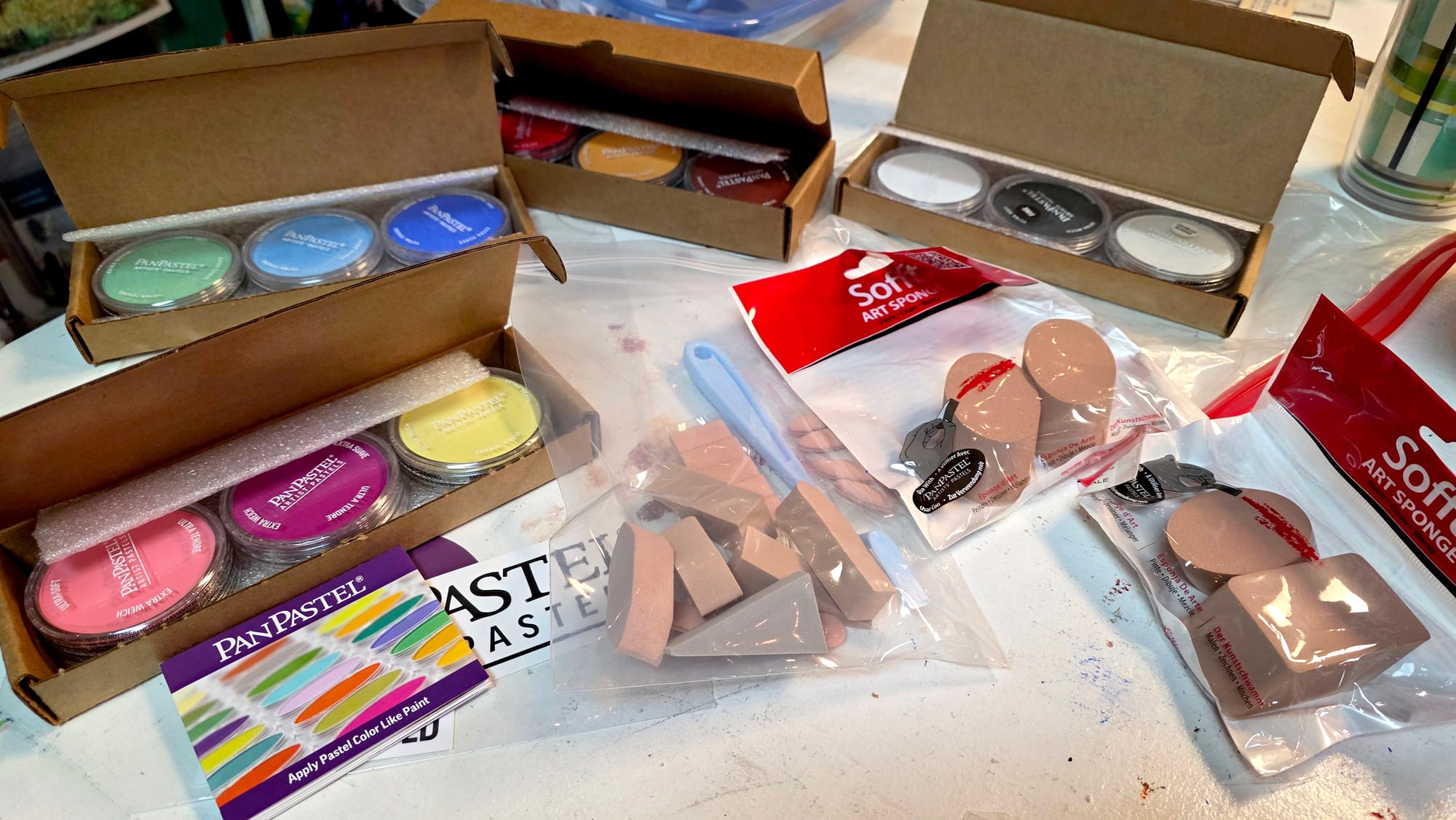
And sometimes you put a collection of little round pans, sponges and oddly shaped applicators on an Art Club table and somebody asks if you brought eyeshadow.
Honestly? I could see it.
When I brought a collection of PanPastel colors and Sofft Tools to Art Club, several people immediately gathered around to see what I had.
The little pans of brightly colored pigment really do look a bit like oversized makeup, especially when they're surrounded by bags of sponges and applicators.
But these weren't eyeshadows.
They were soft pastels.
And, until that day, I had never actually used them before.
I'd used traditional soft pastel sticks, so pastel itself wasn't new to me; PanPastel is different.
Instead of holding a pastel stick in your hand and drawing directly onto the surface, the color comes in shallow pans and can be picked up with sponges and other tools.
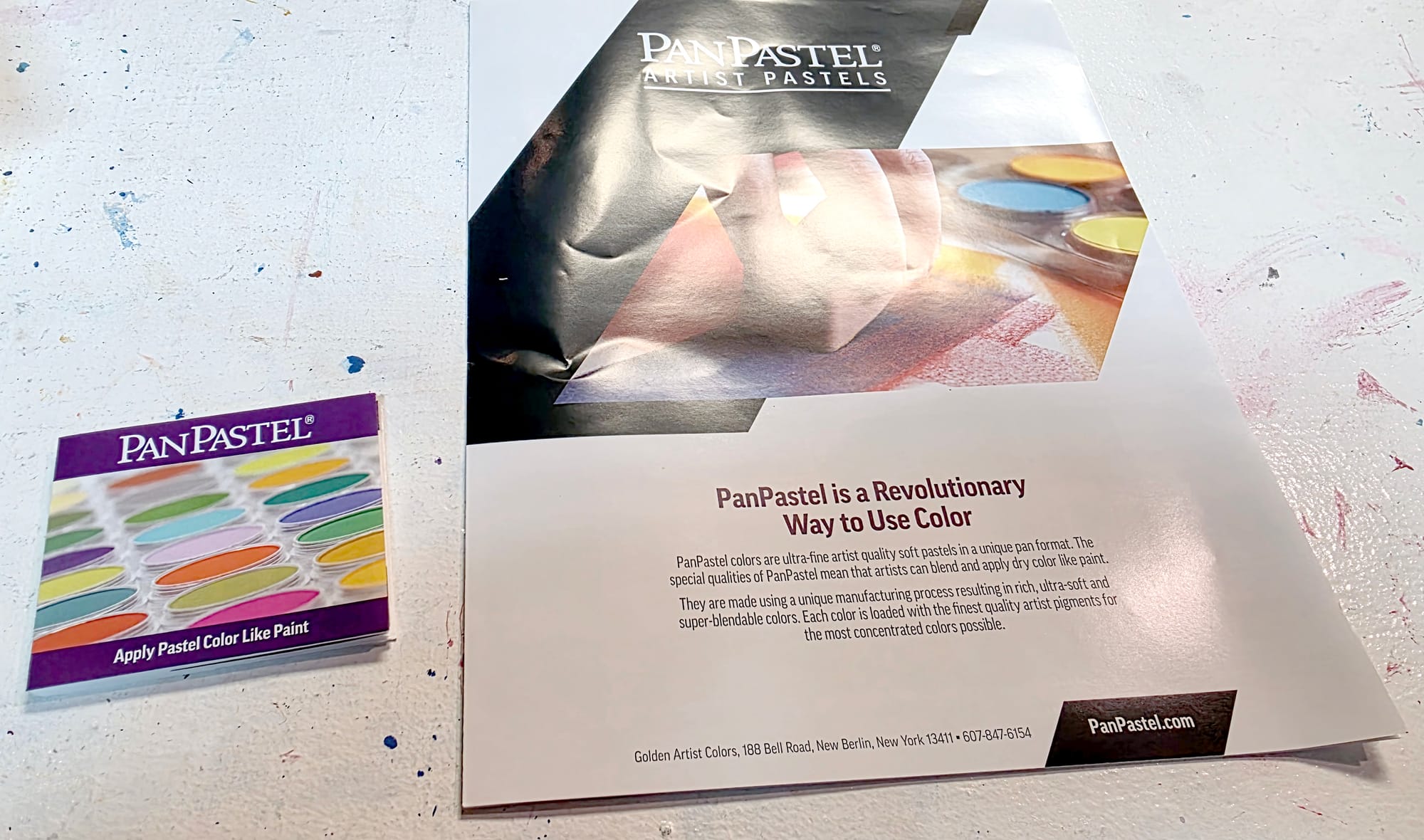
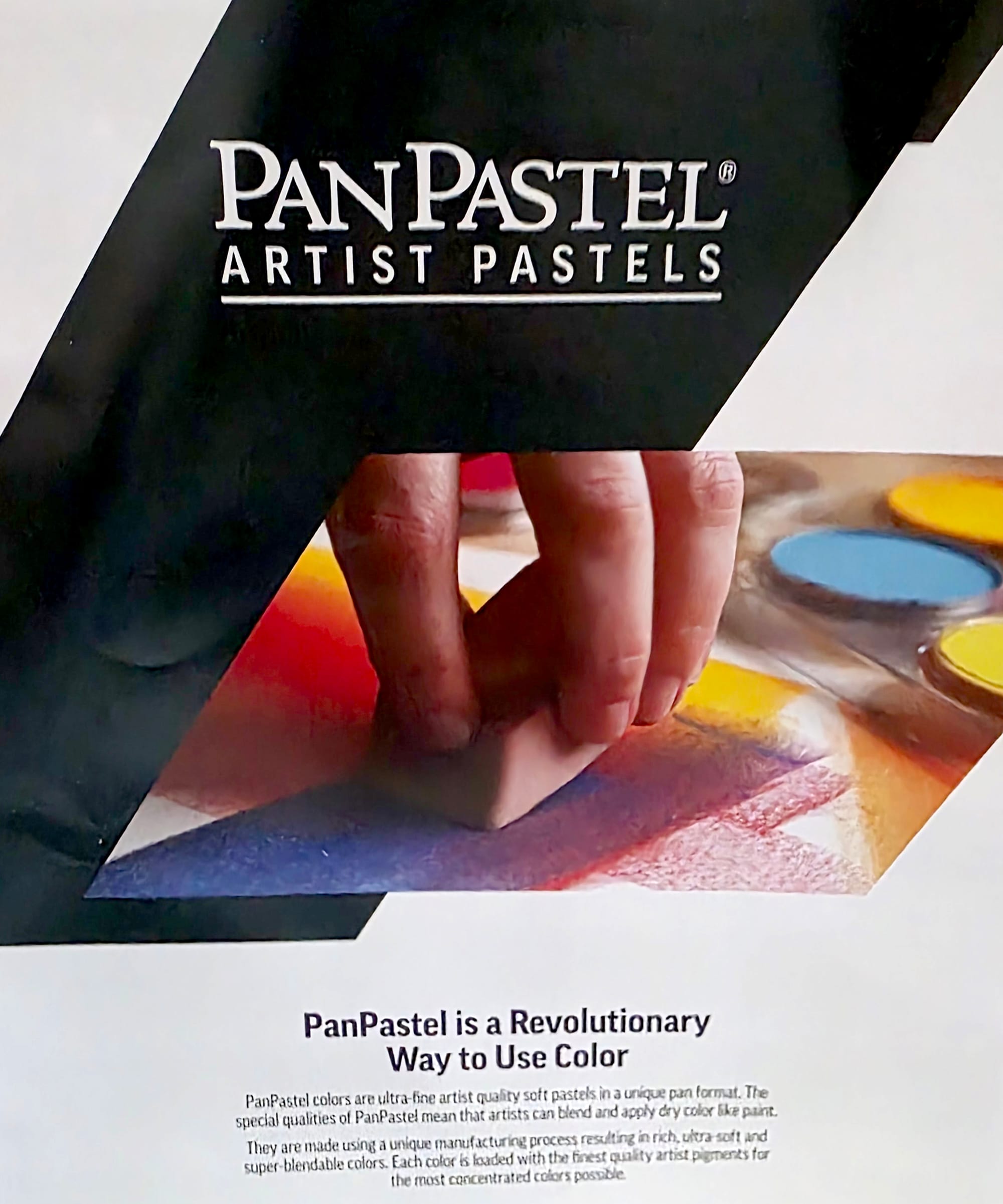
The information PanPastel sent with the supplies described the experience as applying pastel color like paint.
That immediately made me curious: how do you paint with something that's completely dry?
Apparently, I wasn't the only one wondering.
Our Art Club host was shocked when she realized what I'd brought; she told me she'd always wanted to try PanPastel—and was even more surprised when I explained that PanPastel had generously sent the supplies to me to experiment with.
Another artist wanted to know how pastels were different from crayons.
Someone else began talking about the sidewalk chalk art she'd been creating for years.
Before we'd really made anything, one unfamiliar material had already started an entire conversation.
Then we opened everything up.
There were colors to test.
Sponges in different shapes and sizes.
Little applicators and tools I didn't completely understand yet.
Different ways to pick up the pigment, move it around and make marks.
Nobody needed to know exactly what we were doing.
We could just try things.
And once I put PanPastel to paper for the first time, I understood what that little booklet meant.
It really does feel like painting.
Just without the paint.
And that wasn't the only thing that surprised me.
So, What Exactly Is PanPastel?
Before I started experimenting, I needed to understand what I actually had in front of me.
PanPastel is soft pastel color packaged in little round pans rather than traditional sticks.
You pick up the color with sponges and other applicators, then apply it to a surface in a way that feels surprisingly similar to painting.
No water.
No wet paint.
Just dry color.
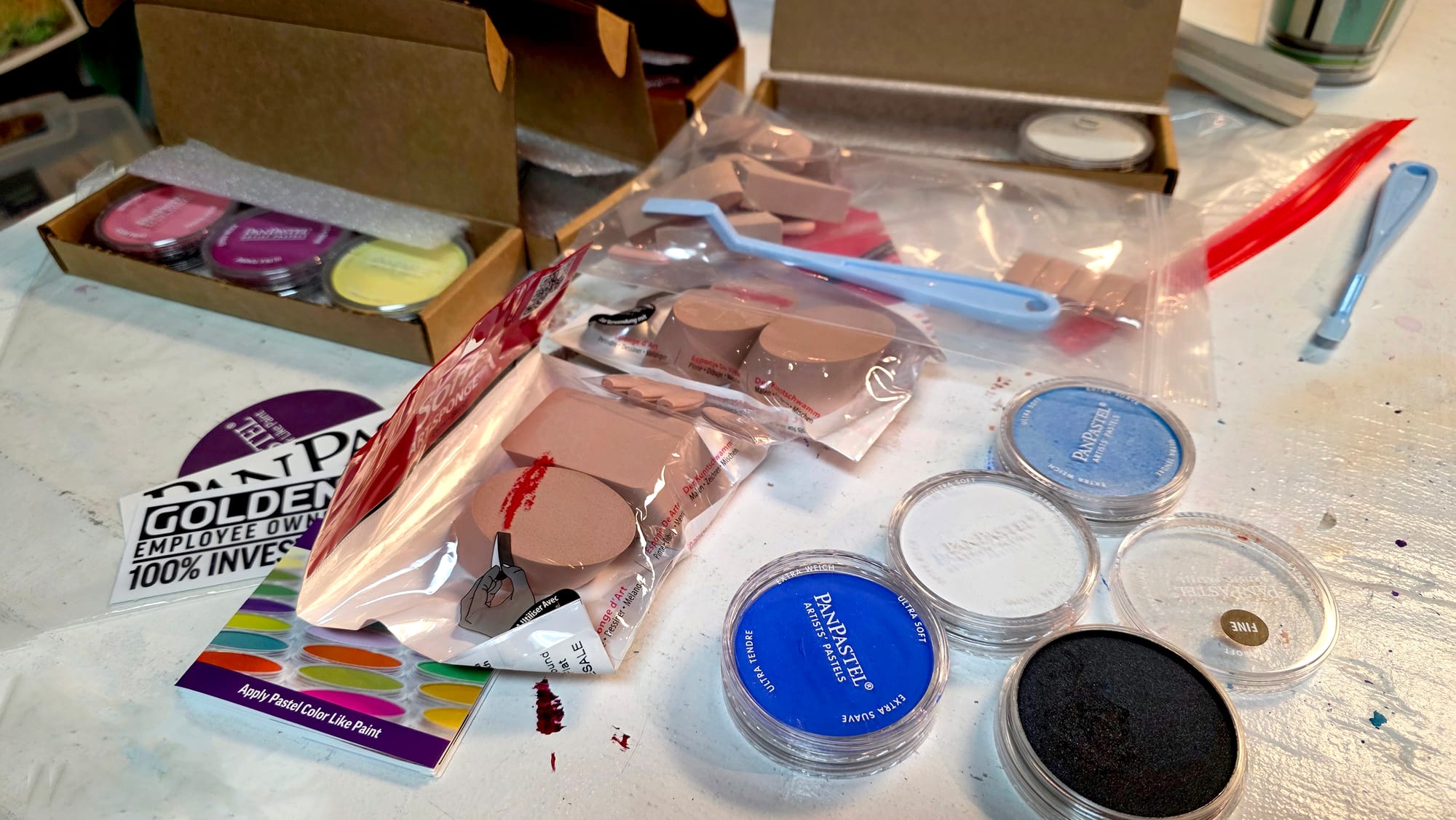
Along with the pastels themselves, I received an assortment of Sofft Tools designed for applying and manipulating the pigment. There were sponge bars in different shapes, small applicators for details, and little covers that fit over plastic knife-shaped tools.
Some could make broad areas of color. Others could create smaller marks, lines, edges, and details.
And there were a lot of things to play with.
Disclosure: PanPastel generously provided the pastels and Sofft Tools featured in this experiment at no cost. This article is not sponsored, and all experiences and opinions are my own.
A Very Generous Box of Experiments
PanPastel sent me around a dozen colors to explore, along with an assortment of Sofft sponges, applicators, tools, and information about different ways the materials can be used.
Which was incredibly generous.
A huge thank-you to Jonie and the PanPastel team for sending all of these goodies for me to experiment with.
What made the gift especially meaningful wasn't simply receiving art supplies.
It was being able to bring them into Art Club, spread everything across the table, and invite other people to experiment with me.
Our host finally got to try a material she'd been wanting to use.
Other artists could pick up an applicator and make a few marks without needing to buy an entire set first.
And I got to watch people with completely different artistic backgrounds approach the same unfamiliar materials in completely different ways.
That's one of my favorite things about the Materials Lab.
I can experiment by myself—and often do—but something changes when you put an unfamiliar material in the middle of a table full of artists.
 Jessica Carey
Materials Lab Notes
Material: PanPastel Artists' Pastels
Tools: Sofft sponges, knives and covers, and smaller applicators
Previous experience: Soft pastel sticks, but no previous experience with PanPastel
Setting: Art Club
Starting question: What does it actually mean to “paint” with dry pastel?
Status: Very much still experimenting
I didn't have a finished artwork planned.
I wasn't trying to master a new medium in one evening.
For the first experiment, I really only needed to know one thing: what happens when I start making marks?
First Experiment: Just Make Marks
The first thing I made with PanPastel wasn't really an artwork.
It was more like a page full of questions.
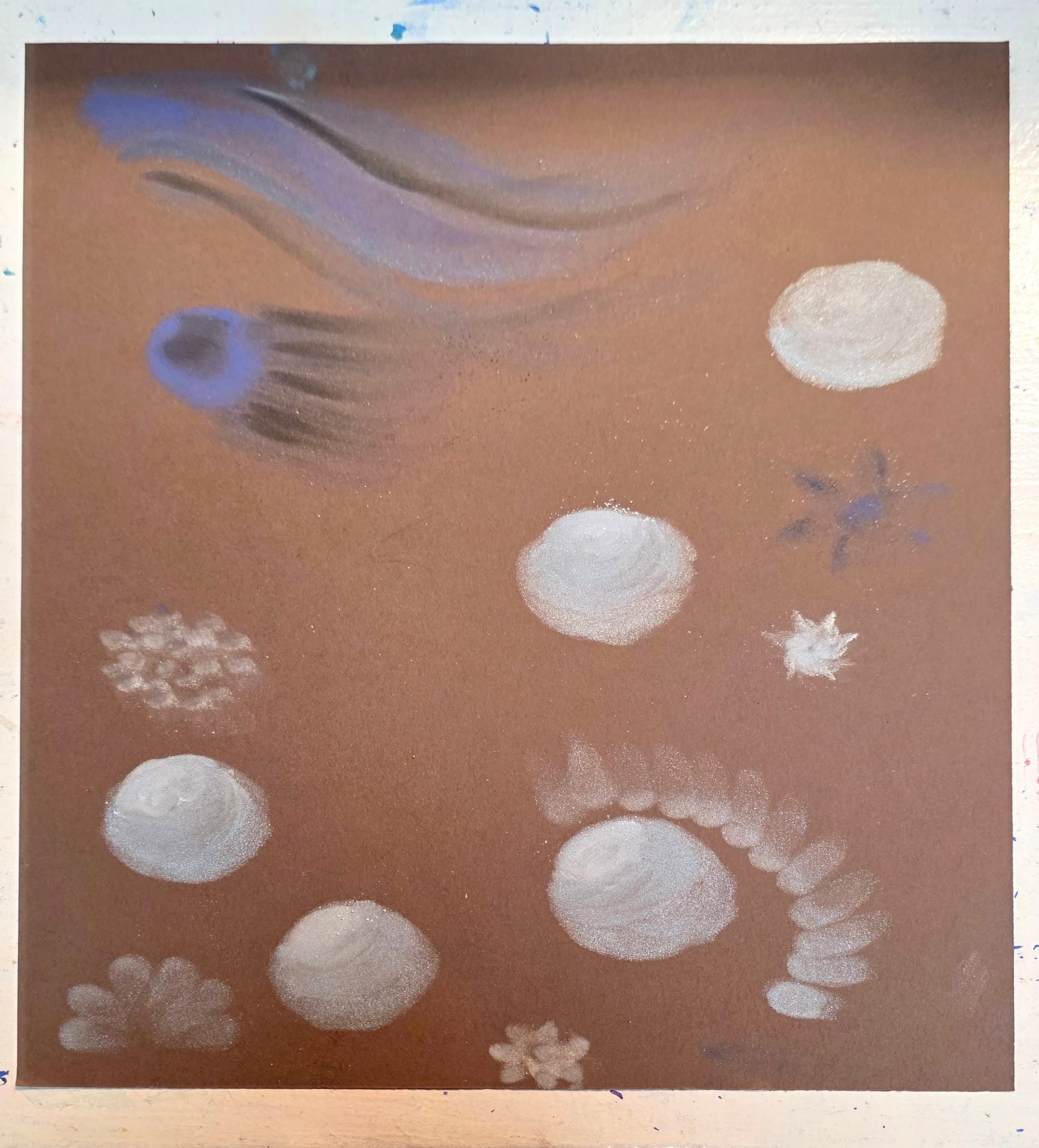
My art club started with a sheet of brown paper, picked up some of the different applicators, and began making marks.
Circles. Lines. Little flower-like shapes. Soft patches of color. Repeated marks. A few things that didn't particularly resemble anything at all.
I wasn't trying to make something beautiful.
I was trying to figure out what the material could do.
- How much color would an applicator pick up?
- How easily could I move it across the paper?
- What happened if I went over the same area again?
- Could I make a hard edge? A soft one?
- What kinds of marks would the different sponge shapes create?
And almost immediately, I understood why PanPastel describes the experience as applying pastel color like paint.
Painting Without the Paint
The pigment moved across the paper remarkably easily.
Instead of drawing with a pastel stick, I could pick up color with an applicator and sweep it across the surface.
I could make broad areas of color, soften edges, layer one mark over another, or use smaller tools for more controlled shapes.
It felt less like drawing with a pastel and more like having a palette of dry paint sitting in front of me.
Except there was no water cup.
No wet brush.
No paint drying on the palette while I figured out what I wanted to do next.
Just pigment, a surface, and a collection of tools that made me want to keep asking: okay, what happens if I try this one?
That's one of the things I love about experimenting with an unfamiliar material; there's a brief period when you don't have established habits yet.
You don't know which tool is your favorite.
You don't know which technique is “yours.”
You haven't decided what you're good or bad at.
You're just discovering.
From Little Marks to Something Bigger
Eventually, I wanted to see what would happen if I stopped making isolated test marks and actually covered a larger area.
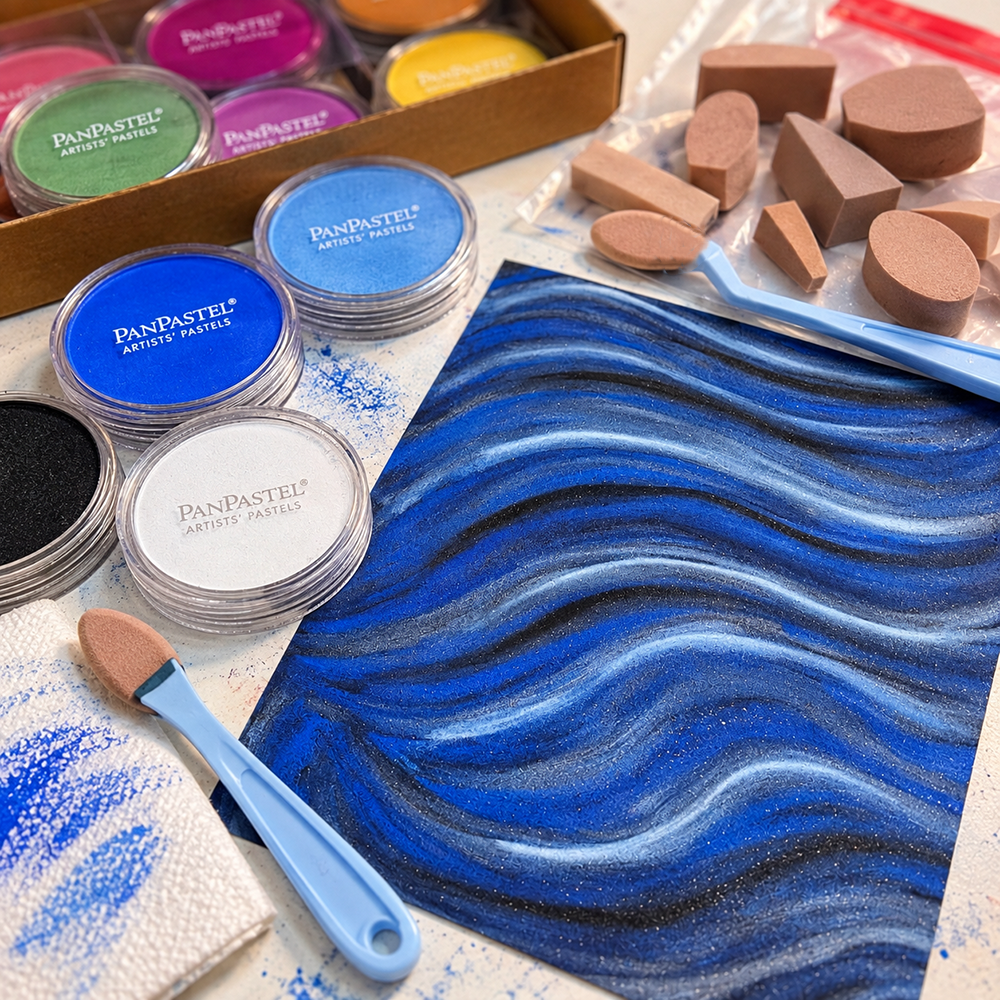
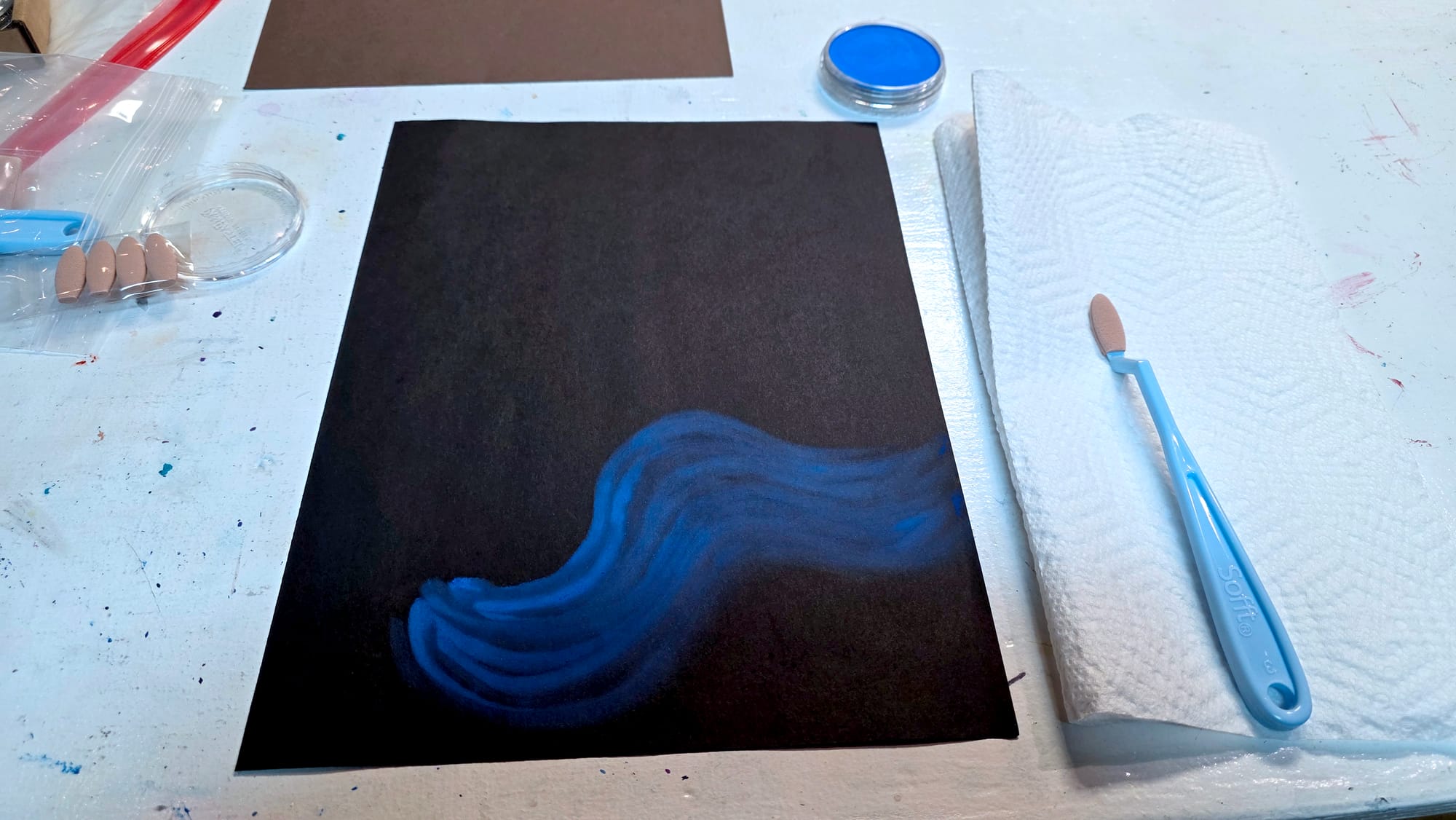
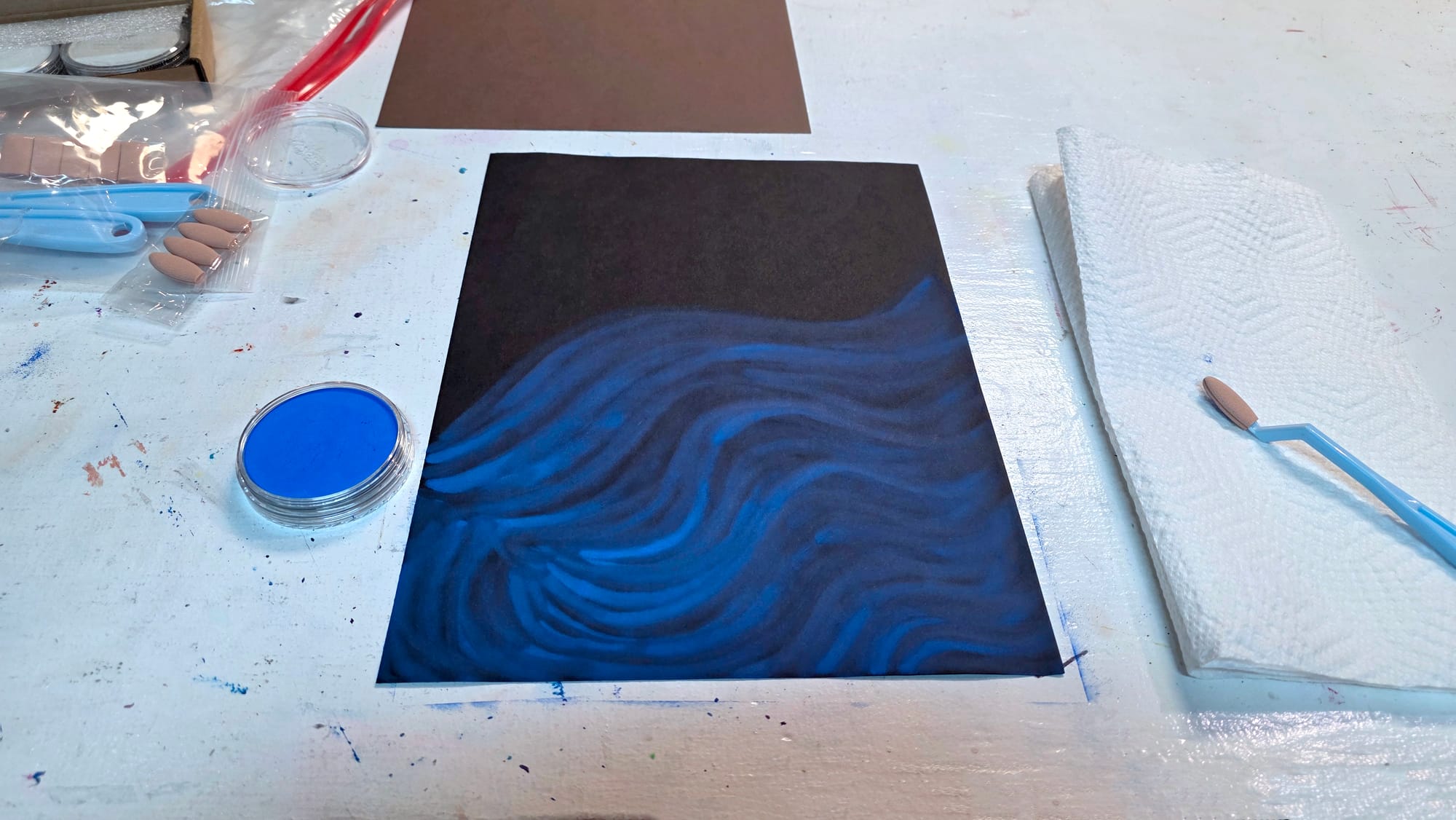
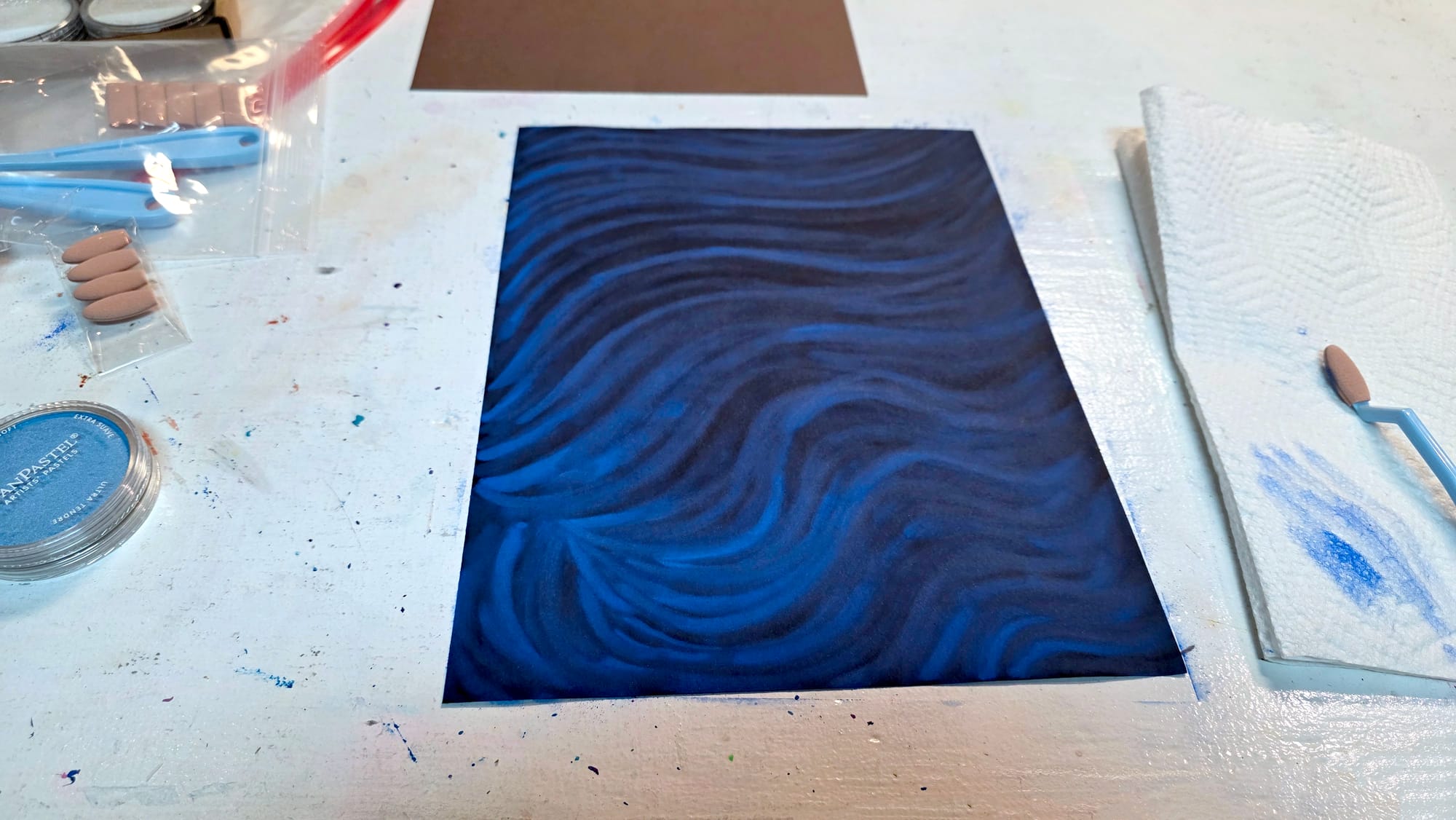
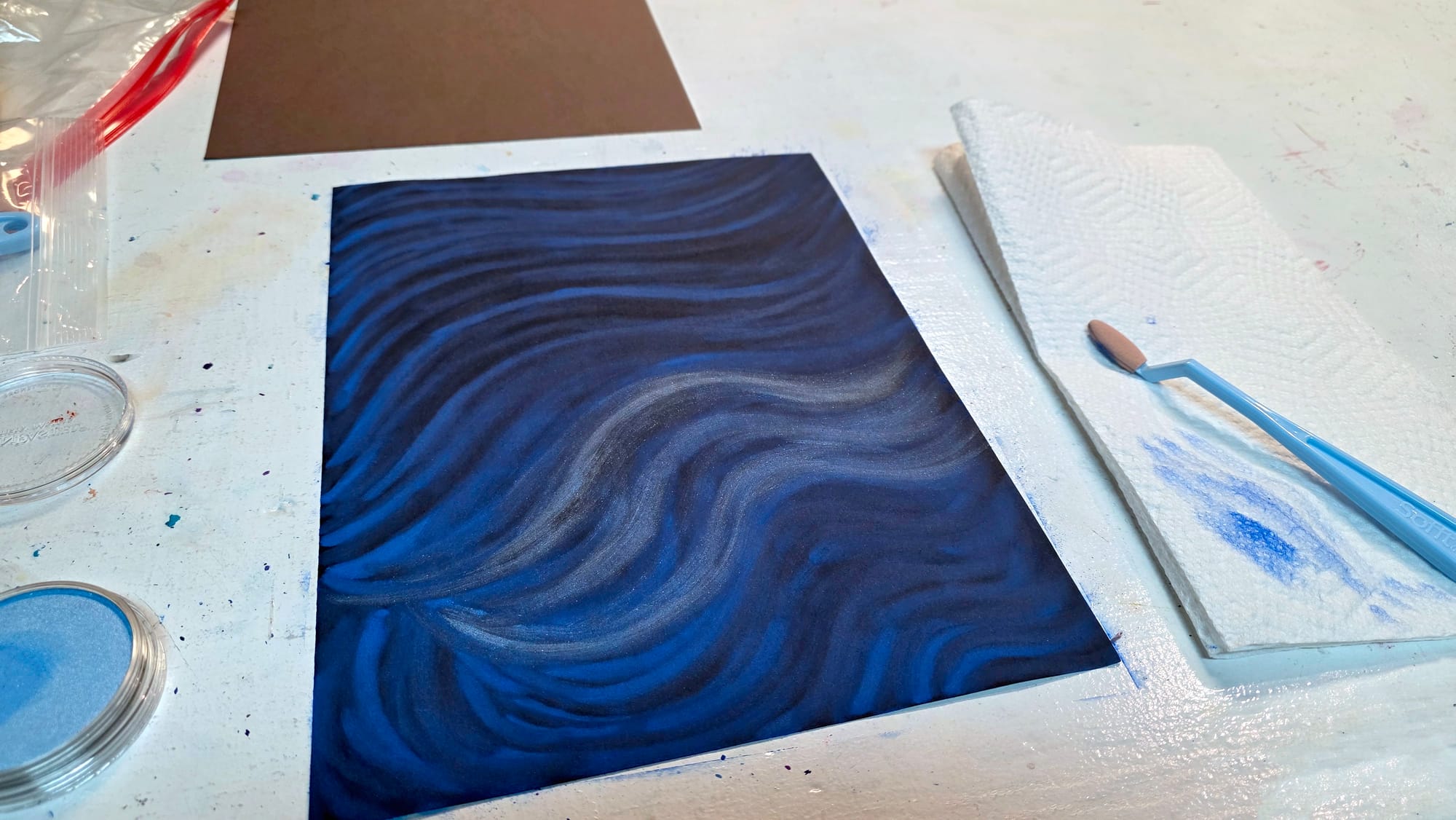
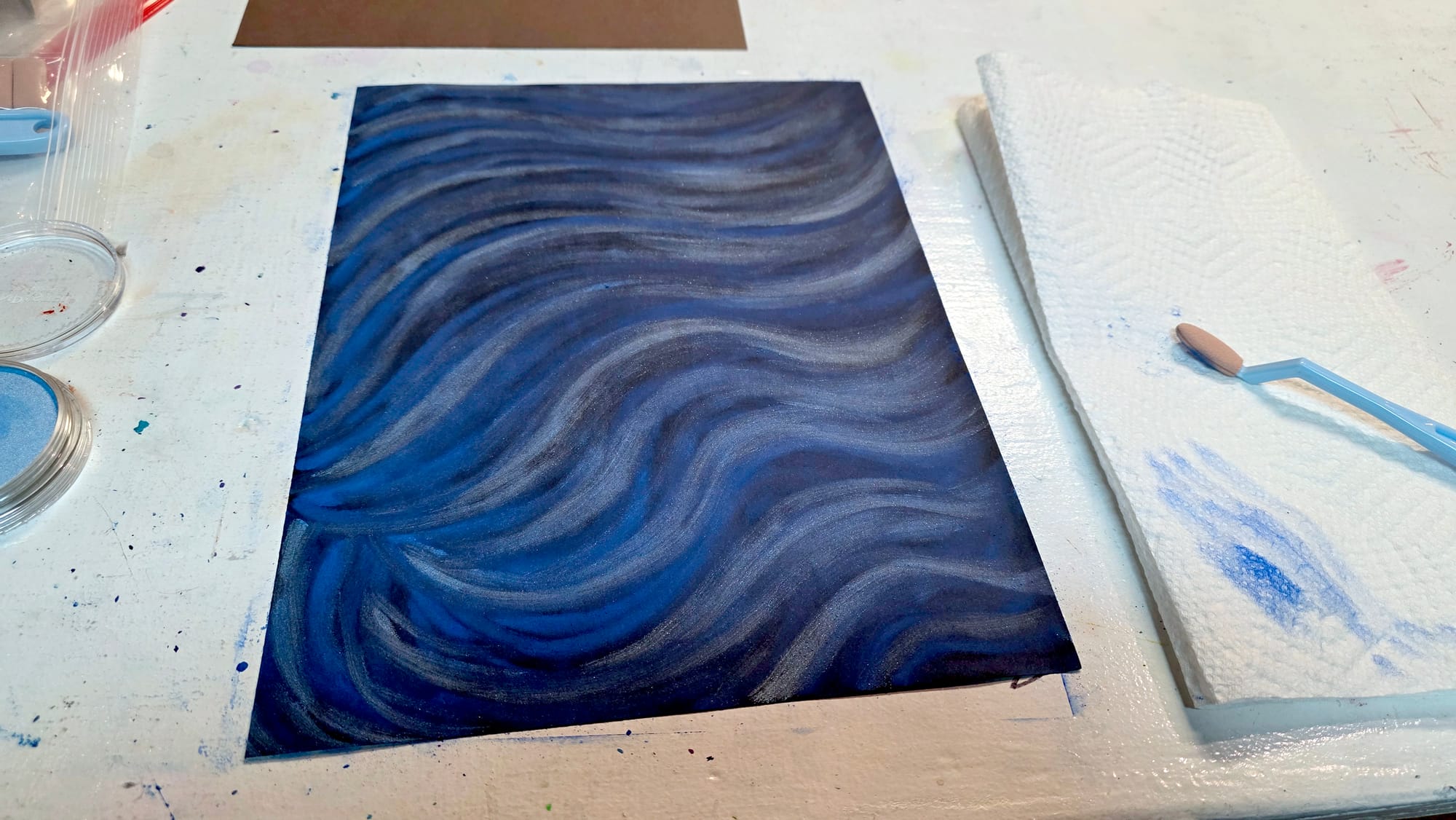
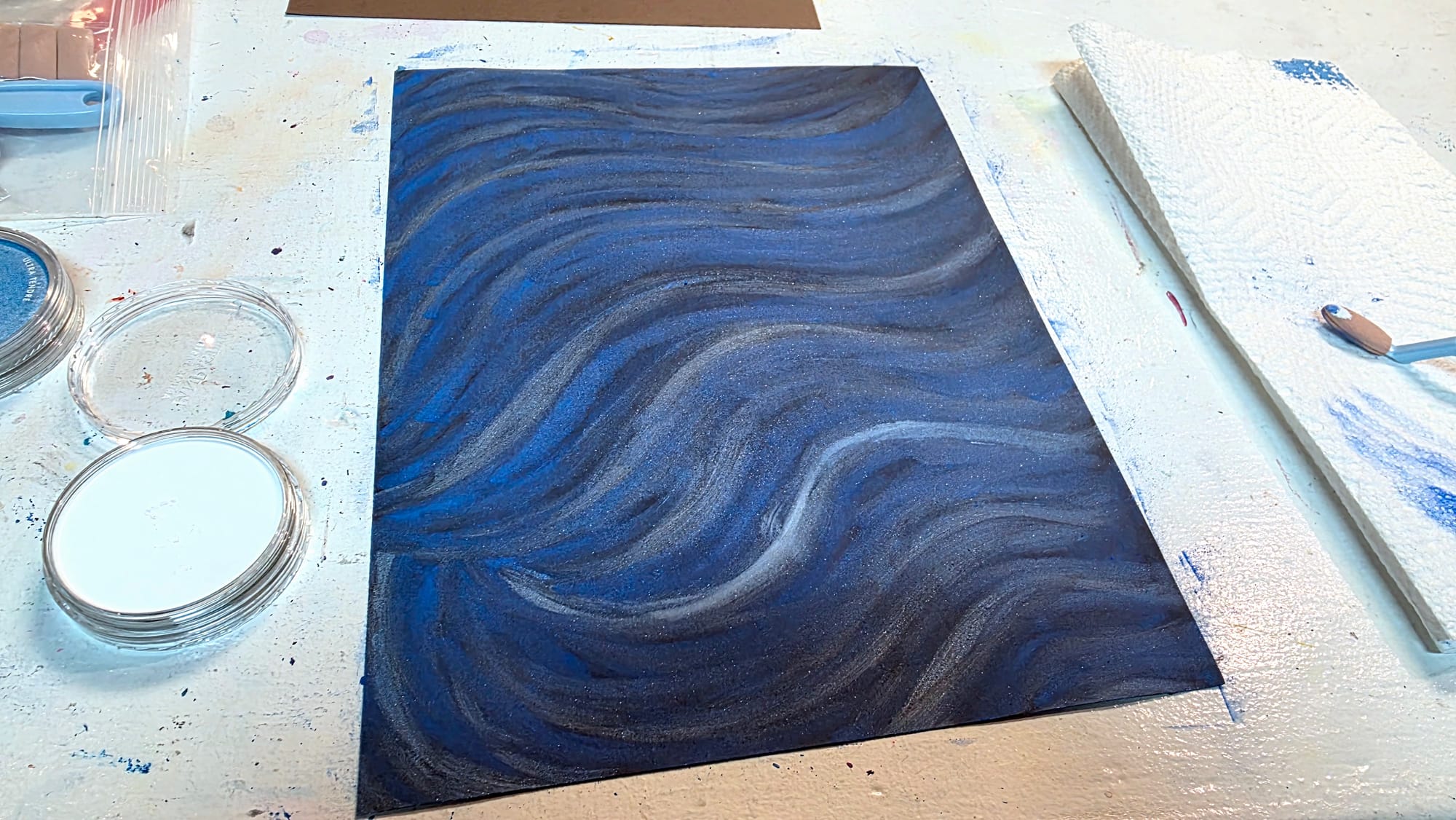
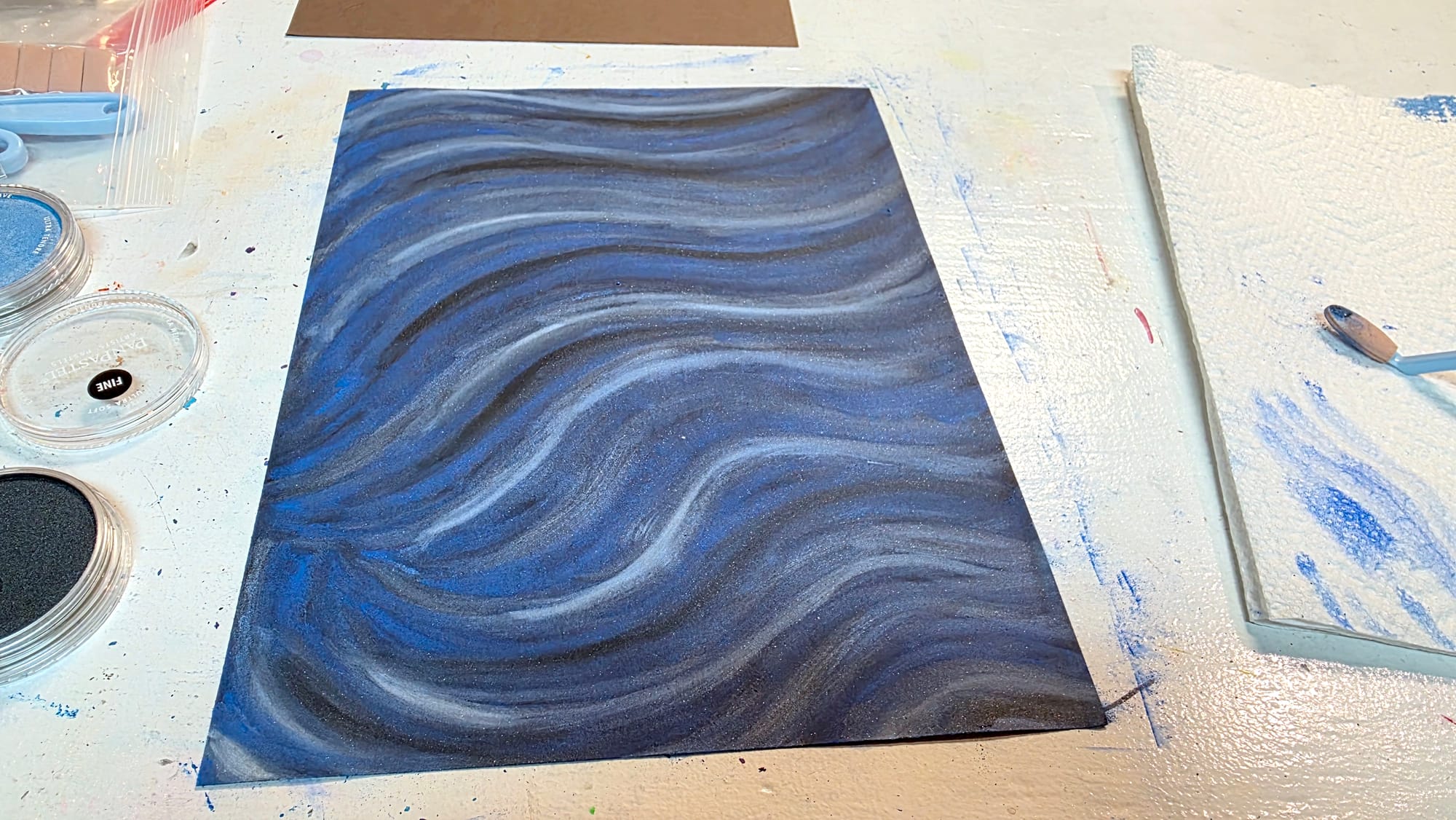
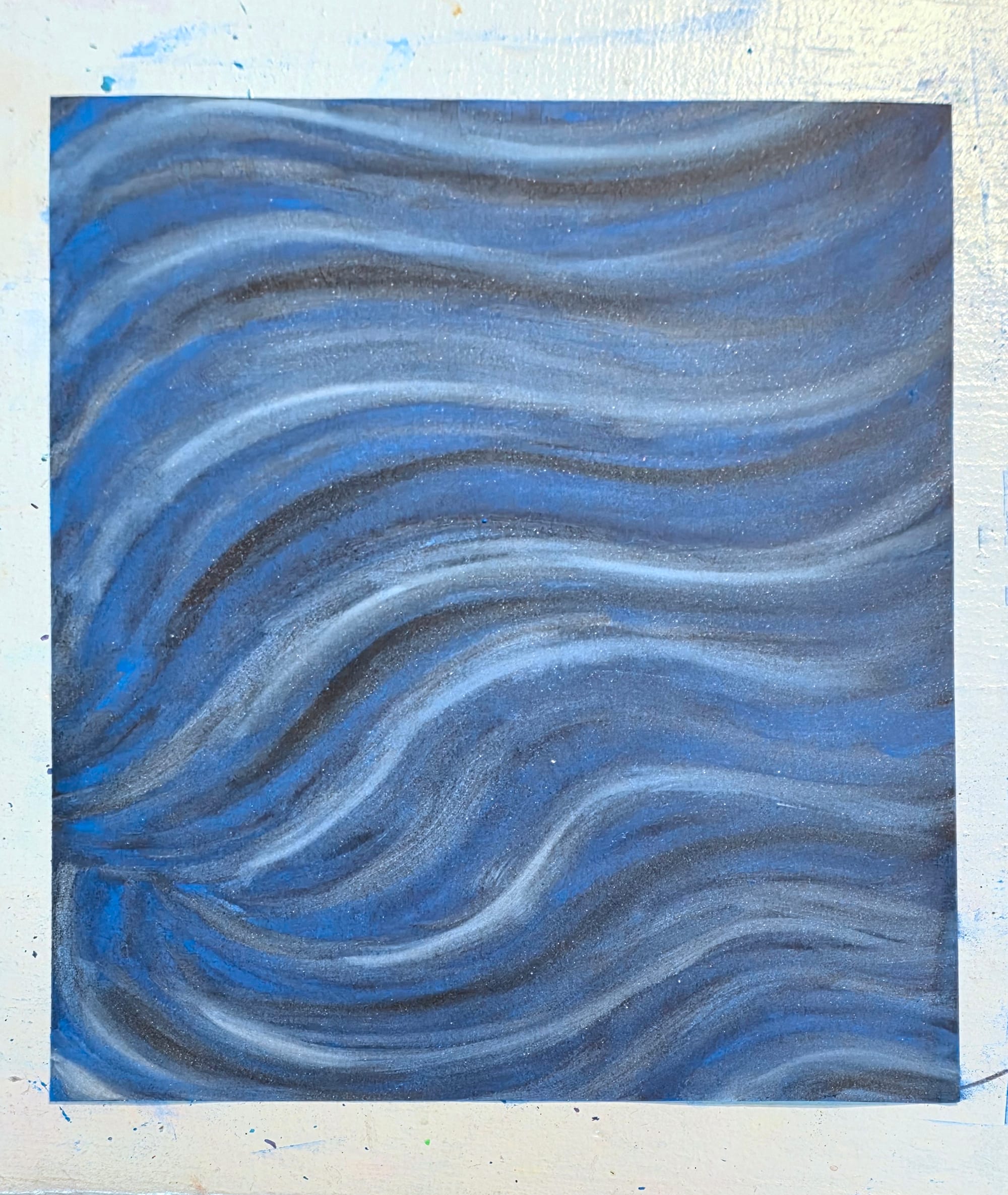
I started working with blues, black, white, and other cool tones, building sweeping bands of color across the paper.
I layered them.
Blended them.
Pulled lighter colors through darker areas and darker colors through lighter ones.
The little experimental marks from earlier started turning into long, flowing lines that moved across the page almost like waves.
And that's when PanPastel really clicked for me.
I wasn't thinking very much about pastel technique anymore.
I was thinking about color.
Movement.
Layers.
Where I wanted something lighter.
Where I wanted more depth.
How one band could flow into another.
In other words, I was thinking remarkably similarly to the way I think when I'm painting.
Except everything was still completely dry.
And the more I played with it, the more I wanted to keep going.
An Unexpected Sensory Discovery
There was another difference I noticed almost immediately, and it had very little to do with what the finished marks looked like: my hands were clean.
I'm autistic, and that matters more than it might sound.
I've worked with traditional soft pastels before, and I genuinely like them.
They're vibrant, blendable, and capable of creating beautiful effects.
But there's one part of the experience that can be incredibly uncomfortable for me: the pastel getting all over my hands.
Soft pastel can be dusty and messy.
Pigment transfers onto your fingers as you work, especially if you're someone who likes blending and manipulating materials directly.
For some artists, that may not be particularly bothersome.
For my sensory system, it can be a nightmare.
And sensory discomfort doesn't magically stop mattering just because I'm enjoying the artwork I'm making.
Sometimes a material can be creatively exciting while the physical experience of using it makes me want to stop.
The Tool Can Change the Experience
That's why the PanPastel applicators surprised me so much.
I could still blend.
I could still move pigment around.
I could still layer colors, soften edges, make broad sweeping marks, and play with the material.
But I didn't have to use my fingers to do it.
The Sofft sponges and applicators created a little bit of distance between my skin and the pastel itself—and for me, that small difference made the experience dramatically more comfortable.
I wasn't constantly thinking about pigment on my fingers or resisting the urge to stop what I was doing and clean my hands.
I could just make art.
That doesn't mean PanPastel will automatically be sensory-friendly for every autistic or neurodivergent artist.
Sensory experiences are incredibly individual, and someone else may respond completely differently to the texture of the sponges, the pastel itself, or another part of the process.
But for my sensory system?
This worked. Really, really well.
Accessibility Can Be Surprisingly Small
I think there's something worth noticing here beyond PanPastel itself.
Sometimes accessibility isn't about changing what someone is capable of doing.
It's about changing the amount of discomfort they have to tolerate in order to do it.
I can use traditional soft pastels.
I've done it before.
But being capable of tolerating an uncomfortable sensory experience isn't the same thing as that experience being accessible or sustainable for me.
Give me a different way to interact with essentially the same kind of material, though, and suddenly some of that friction disappears.
The art didn't become easier because somebody lowered the creative expectations; the tool simply fit me better.
And that's something I hadn't expected to discover when I opened a box of pastels.
When Everyone Starts Experimenting
One of my favorite things about bringing new materials to Art Club is that I don't get to control what happens next.
I can put something on the table with one set of questions in my head, and somebody else will immediately see something completely different.
That's exactly what happened with the PanPastels.
Once everyone realized the colorful little pans weren't eyeshadow, people started picking up the applicators and trying them for themselves.
There wasn't a formal demonstration or a particular project everyone was supposed to make.
We were simply exploring.
And almost immediately, the questions started.
One person wanted to understand the difference between pastels and crayons.
Another member, who has been making sidewalk chalk art for years, started talking about her experiences working with chalk outdoors.
Our host, meanwhile, finally got to try a material she'd wanted to experiment with for a long time.
Everyone came to the table with different experiences.
And that meant everyone noticed different things.
One Material, Lots of Questions
I think that's one of the most valuable things about experimenting alongside other artists.
If I had stayed home and tested the PanPastels by myself, I still would have learned plenty.
I probably would have experimented with blending, different applicators, layering colors, and the sensory experience.
But I might not have started thinking about crayons.
Or sidewalk chalk.
Or what someone accustomed to making enormous drawings on rough concrete might notice about a pastel designed primarily for much smaller surfaces.
Those questions appeared because somebody else was there.
That's what collaborative experimentation can do.
You don't necessarily need everyone in the room to have expertise in the material you're testing.
Sometimes it's more interesting when they don't.
Someone brings experience with painting.
Someone brings drawing.
Someone brings sidewalk chalk.
Someone has never touched a pastel before.
Someone asks the question that everybody else assumed they already knew the answer to.
Put all of those perspectives around the same table, and suddenly you're not conducting one experiment anymore.
You're conducting several.
Pastels, Crayons, and Another Question
The question about crayons stuck with me because it's a perfectly reasonable one.
From the outside, a pastel stick and a crayon can look pretty similar.
You hold both in your hand.
Both deposit color when you drag them across a surface.
Depending on the kind of pastel we're talking about, even the words we use for these materials can get confusing.
But they don't necessarily behave the same way.
And rather than turning Art Club into an impromptu chemistry lecture, I think the more interesting question for the Materials Lab is what those differences mean when you're actually making something.
- How does a crayon move across paper compared with a traditional soft pastel?
- How does a traditional pastel stick compare with color applied from a PanPastel?
- What blends easily?
- What creates a hard line?
- What creates a soft field of color?
- What happens when you layer them?
- And what happens if you start combining them?
I hadn't arrived at Art Club planning to compare any of those things.
Now I want to.
And Then Someone Mentioned Sidewalk Chalk…
That conversation created another question I definitely hadn't arrived with: could you use PanPastel for sidewalk art?
I don't know, and that's precisely why the question interests me.
A sidewalk is dramatically different from the paper I'd been experimenting on.
It's rough, porous, exposed to weather, and generally much less forgiving than an art surface.
There's also the matter of the applicators.
The Sofft Tools worked beautifully gliding across paper, but dragging one repeatedly across rough concrete sounds like an excellent way to find out how quickly I can destroy it.
I'm curious, but I'm just not sacrifice-all-my-nice-applicators-to-the-sidewalk curious.
At least not yet.
A small concrete paver or another rough test surface, though?
That sounds like an experiment.
And suddenly, one afternoon of playing with pastel had produced an entirely new collection of questions.
Okay, But What Else Can We Put It On?
So far, my experiments had been happening on paper.
And PanPastel worked beautifully there.
But once I realized how easily I could pick up the color, spread it across a surface, blend it, layer it, and manipulate it with different tools, the Materials Lab part of my brain started doing what it usually does: what else can I put this on?
Different kinds of paper seem like an obvious place to start.
Smooth paper and heavily textured paper might interact with the pigment completely differently.
Dark surfaces could change the way lighter colors appear.
Canvas introduces another texture altogether.
And then there are the less obvious possibilities.
Wood. Tile. Found objects. Mixed-media pieces.
Maybe even some of the flooring samples currently waiting for me after another Materials Lab experiment.
I don't know which of those will work.
That's what makes me want to try them.
 Jessica Carey
What Happens When Materials Lab Experiments Collide?
I've been thinking more and more about what happens when materials from different experiments start meeting each other.
A flooring sample doesn't have to remain the flooring experiment.
A PanPastel doesn't have to remain the pastel experiment.
- What happens if I use PanPastel on one of the wood-look flooring panels Michael's Flooring gave me?
- Could pastel become part of a collage?
- Could I combine it with polymer clay?
- What happens alongside acrylic paint, colored pencil, ink, or some other material already sitting in my art supplies?
I don't know yet.
But the more experiments I do, the less interested I am in keeping materials inside neat little categories.
That's part of what the Materials Lab is becoming for me.
It's not only: what can this material do?
It's also: what happens when this material meets that one?
 Jessica Carey
And Then There's the Question of Permanence
Of course, getting pigment onto an unusual surface is only part of the experiment.
I'd also want to know whether it actually stays there.
Pastel can remain vulnerable to rubbing and smudging, which raises another set of questions.
- Would some surfaces hold the pigment better than others?
- Would a finished piece need a fixative?
- What would applying a fixative do to the color or texture?
- Could certain surfaces simply be terrible candidates for PanPastel?
Again: I don't know yet.
And I'd rather say “I don't know” than pretend every interesting idea is automatically a successful technique.
Some experiments might work beautifully.
Some might need adjusting.
Some might fail spectacularly.
But a failed experiment still tells me something about the material.
Well...Now I Want All the Colors
There is, unfortunately, one problem with this experiment.
PanPastel sent me around a dozen colors to try, which was incredibly generous—and more than enough to start experimenting.
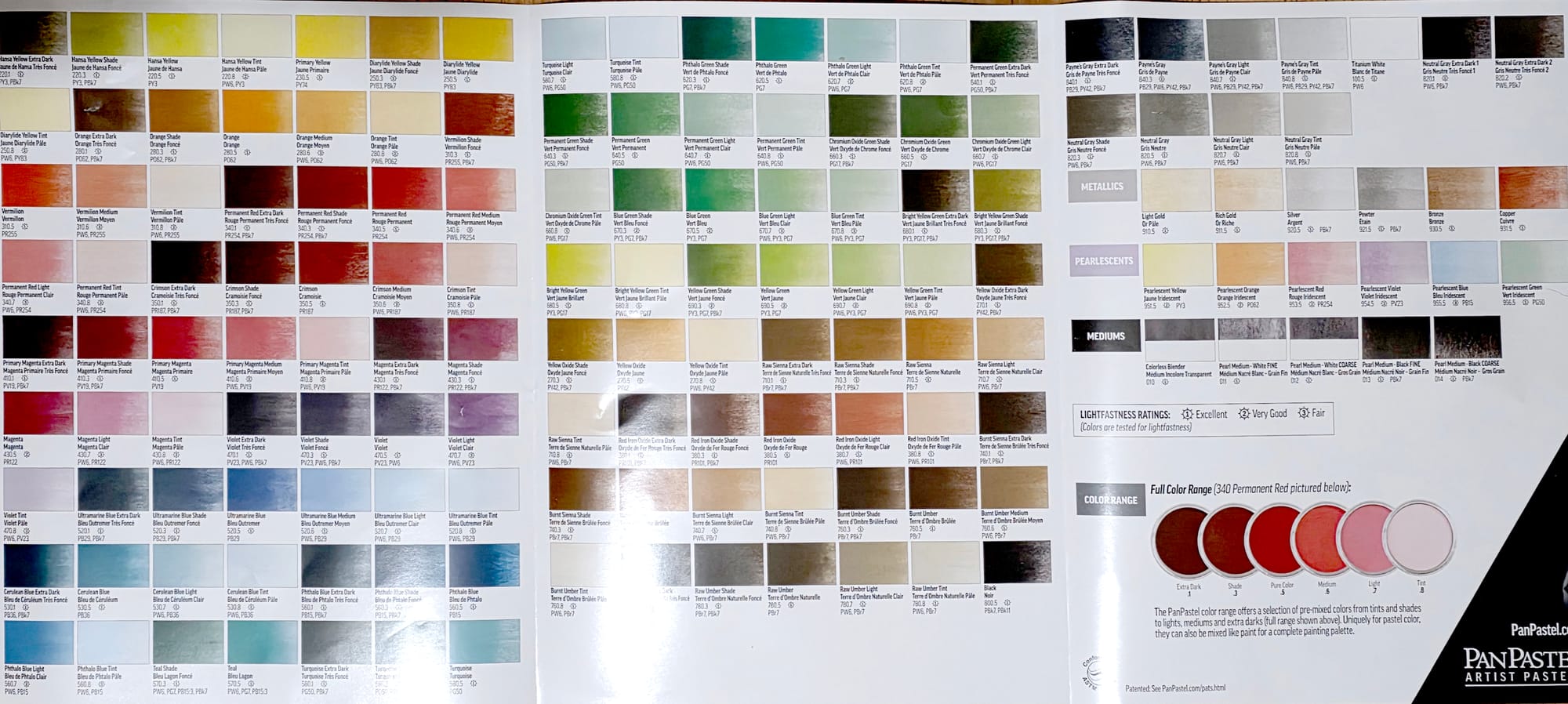
Then I unfolded the color chart they included in the package.
Oh, there are so many more colors.
Suddenly, the little collection I'd been happily experimenting with was surrounded by possibilities I hadn't even considered yet.
More blues. More greens. More purples. Warm colors. Cool colors. Tints and shades. Metallics.
Colors I could imagine blending together before I'd even touched them.
This feels dangerous.
Not because I need every possible color in order to make something interesting.
If anything, experimenting with a limited palette can lead to discoveries you might not make when every option is available.
But now that I know how PanPastel feels to work with—and how much I enjoyed it—I'm extremely curious about what I could do with a larger range.
So yes, when I eventually have the funds, I would very much like to try more colors.
Possibly a lot more colors.
For research purposes, obviously.
Sometimes Trying Something Is Enough
There's something else I appreciate about how this particular experiment happened.
Not everyone at Art Club needed to buy a PanPastel set to find out whether they enjoyed using one.
Our host had wanted to try them for a while.
Then one afternoon, there they were.
She could pick up an applicator, try the pigment herself, and actually experience the material instead of trying to decide from photographs, videos, or descriptions whether it might be worth buying someday.
The same was true for everyone else at the table.
Somebody could make a few marks.
Try a different color.
Ask a question.
Decide they loved it.
Decide it wasn't really their thing.
Or simply satisfy their curiosity and move on.
I think there's something quietly important about that.
Art materials can be expensive, especially when you're curious about something you've never used before.
Buying an entire set just to discover whether you even enjoy the experience isn't always realistic.
But materials can be shared.
A box of supplies can sit in the middle of a table.
One person's opportunity to experiment can become several people's opportunity to experiment.
And nobody has to become an expert for the experience to matter.
Sometimes getting to say: “I've always wondered what that's like” and then actually finding out is enough.
 Jessica Carey
Sometimes the Material Isn't the New Part
Before this experiment, pastels weren't unfamiliar to me.
I'd used soft pastel sticks before; I knew they could create rich color, soft blends, bold marks, and beautiful effects.
What I hadn't experienced was pastel like this.
Putting the same general kind of material into a pan and applying it with sponges and tools changed my relationship with it more than I expected.
I wasn't holding a stick and drawing.
I was picking up color.
Sweeping it across a surface.
Blending one area into another.
Layering.
Softening.
Building.
It felt like painting, even though nothing was wet.
And because I wasn't constantly getting pastel pigment all over my fingers, I could enjoy that process without one of the sensory experiences that can make traditional soft pastels difficult for me.
The pastel hadn't stopped being pastel; the way I could interact with it had changed.
Sometimes the Tool Is Part of the Material
I think that's something I can easily overlook when thinking about art supplies.
We tend to focus on the material itself: paint, clay, pastel, charcoal, paper.
But how we interact with that material matters, too.
A brush changes what paint can do.
A carving tool changes what clay can do.
A sponge changes what pastel can do.
And sometimes a different tool doesn't just change the marks we make.
It changes the experience of making them.
That can affect comfort. Control. Curiosity. Accessibility.
It can make someone want to keep experimenting with a material they might otherwise put down.
For me, the Sofft Tools weren't simply accessories sitting beside the “real” art supply.
They were part of what made PanPastel feel so different.
The Best Experiments Create More Questions
I started this experiment knowing very little about PanPastel.
Now I know that I love the way the pigment moves across paper.
I know that the applicators make the experience much more comfortable for my particular sensory needs.
I know that different tools invite different kinds of marks.
And I know that putting unfamiliar supplies in the middle of an Art Club table is a very effective way to generate far more questions than I started with.
- What happens on textured paper?
- Wood?
- Canvas?
- One of those flooring samples sitting in my growing collection of strange art materials?
- What happens when PanPastel meets other media?
- Do different applicators completely change the result?
- And, yes, what happens when I eventually get my hands on some of those other colors?
I don't know yet.
That's not an unfinished experiment.
That's an experiment doing exactly what I hoped it would do.
It made me curious.
What Else Can PanPastel Do?
Maybe that's where I'll leave this one for now.
Not with a verdict.
Not with a list of everything PanPastel can and can't do.
Just with a table covered in colorful pans, sponge applicators, experimental marks, a wavy blue drawing I hadn't planned to make, and a growing list of things I want to try next.
Jonie and PanPastel gave me the materials to begin experimenting (and shared that PanPastels are a favorite for Taxidermy Clubs, which was an interesting tidbit).
Art Club gave me more people to experiment alongside.
And the materials gave all of us questions.
There are still surfaces to test, colors to explore, tools to play with, and combinations I haven't thought of yet.
So this particular Materials Lab experiment isn't finished.
It's just reached my favorite stage: the part where one question turns into twenty more.
And somewhere in those questions is the next experiment.
Want even more content about creativity and art?
Be sure to check out all of our creative chronicles!
If you'd like to see examples of my work, you can find some of my art and creations at Redbubble and Gumroad!
Looking to learn more about my recent journey?
Check out some of these articles:
-Hidden Gems for St. Louis Artists
-Hidden Gems for Autistic & Neurodivergent Adults
-Learning What Love Was Supposed to Feel Like
-I Wasn't Broken--I'm Burned Out
-The Difference Between Resting and Giving Up
-What Chronic Autistic Burnout Actually Feels Like
-When You Had to Raise Yourself
 Jessica Carey