
A Collection of Possibilities
Sometimes, creative possibilities come from the things other people no longer need.
A leftover piece of wood. An oddly shaped offcut. A small block that isn't quite the right size for its original purpose.
To one person, these might simply be scraps.
But to someone else? They might be the beginning of something wonderful.
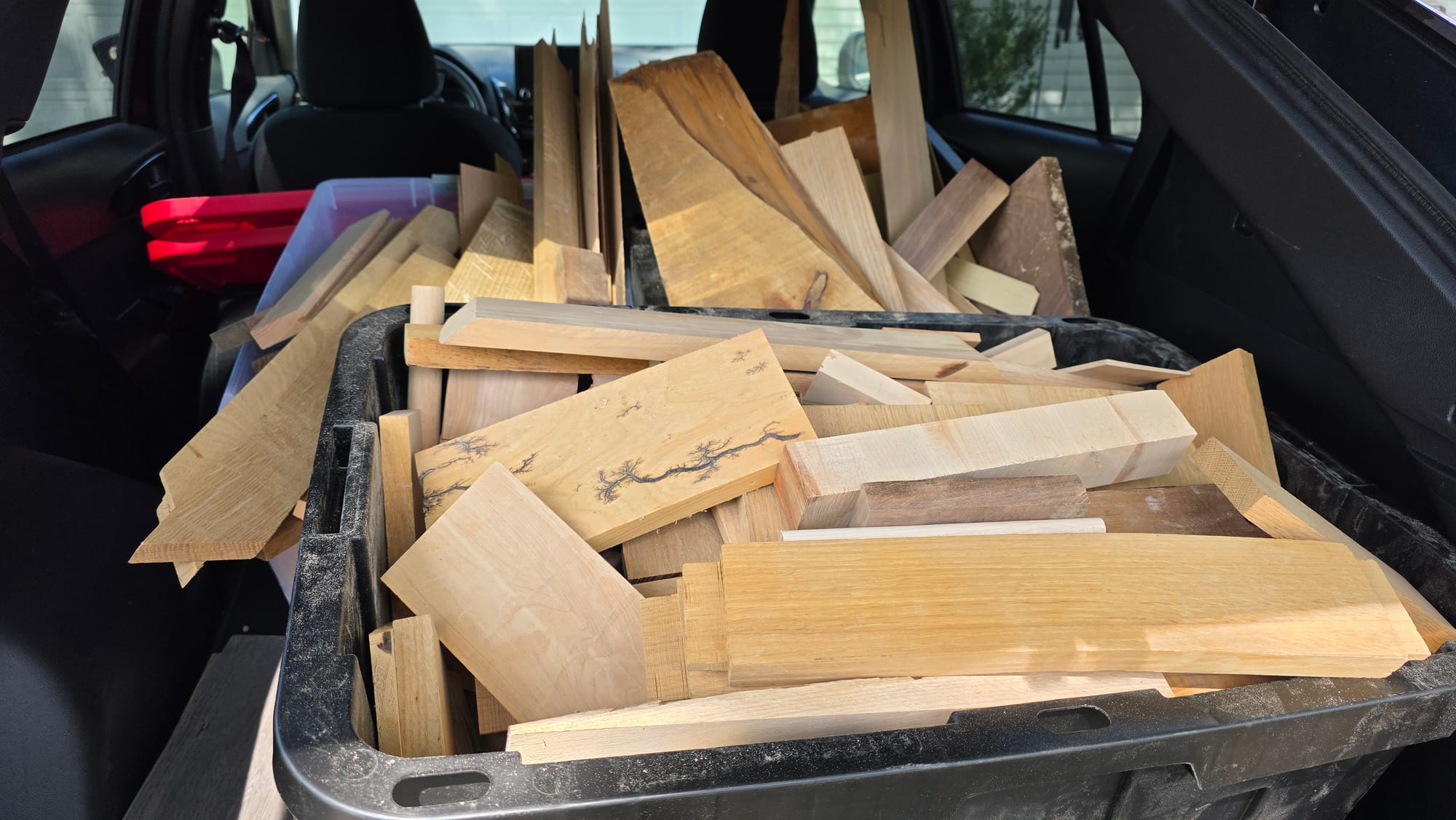
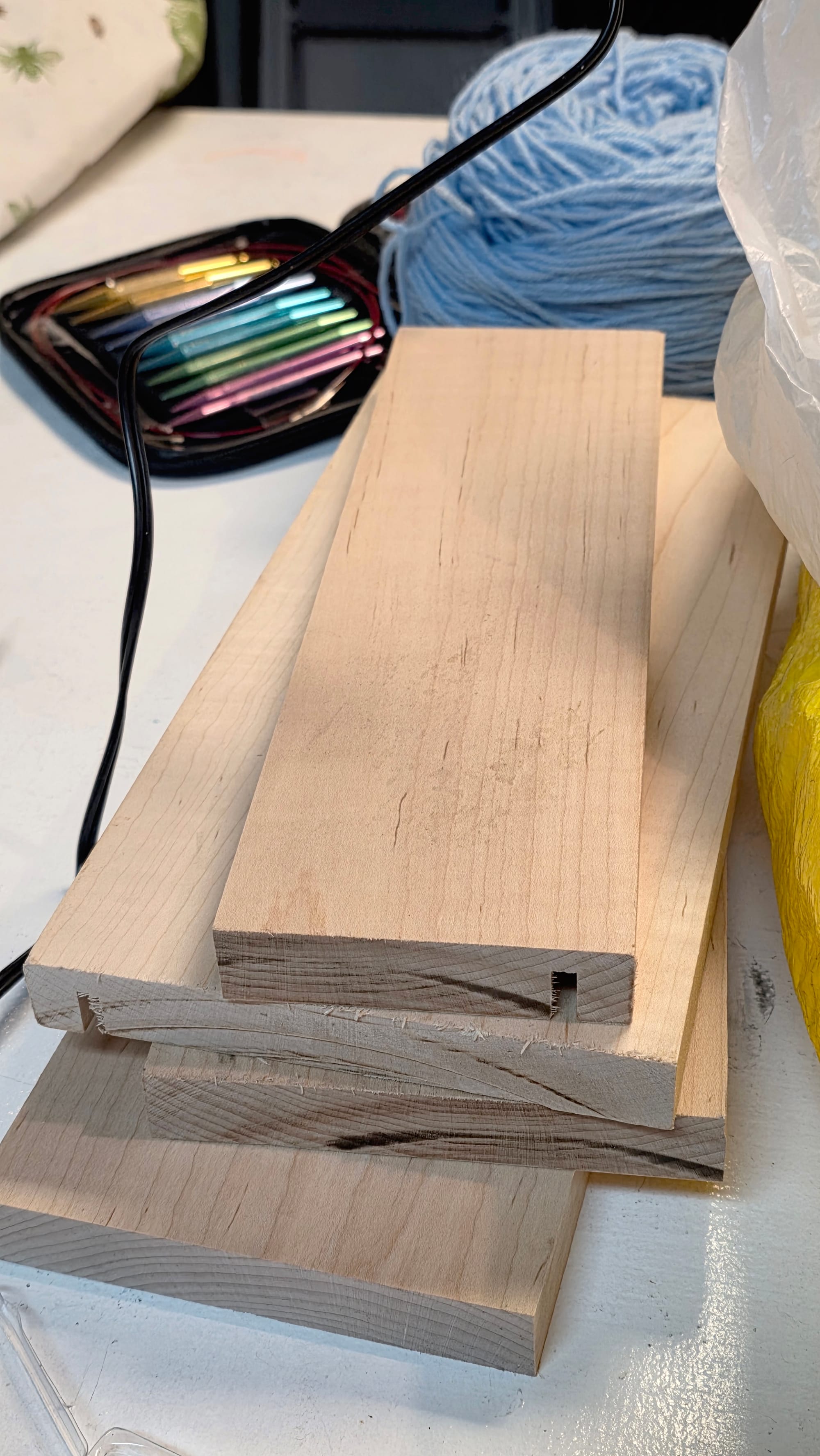
Recently, I connected with Seth from MuniMo Woodworking and Design, who generously provided me with a collection of hardwood offcuts from his woodworking projects.

And when I say a collection, I mean quite a collection!
There were boards, blocks, narrow strips, triangular pieces, and all sorts of different shapes and sizes.
Some had beautiful, distinctive grain patterns.
Others were small enough to fit in the palm of my hand.
Each piece had its own characteristics—and, potentially, its own creative possibilities.
I didn't have a specific project planned for every piece.
In fact, that was part of the appeal.
I've always enjoyed experimenting with materials, trying unfamiliar techniques, and finding creative uses for things that might otherwise be overlooked.
Having access to all these different pieces of hardwood meant I could explore without needing to purchase perfectly sized boards for every idea.
And one of the first things I wanted to try? Wood burning.
I'd never done it before, but suddenly I had an assortment of surfaces to practice on.
If something didn't turn out the way I imagined, that was okay.
I could learn from it and try again.
But the wood didn't all stay with me.
As I began experimenting, I also started sharing pieces with other artists and makers, and what fascinated me was how differently everyone imagined using them.
Where I saw a surface for wood burning, someone else saw a bookbinding tool, a sculpture base, or the beginnings of an entirely different project.
What started as an opportunity to learn a new technique became something bigger: an experiment in what happens when useful materials are shared.
So, what can hardwood scraps become—not just in one person's hands, but in many?
Materials Lab Notes
Material: Assorted hardwood offcuts and woodworking scraps
Source: Generously provided by Seth at MuniMo Woodworking and Design
Experiments so far: First-time wood burning (pyrography), paint-marker illustrations on wood, and sharing hardwood offcuts with other artists and makers
Future possibilities: Combining wood burning with color, sculpture bases, miniature scenes, mixed-media projects, and additional woodworking techniques
Setting: Independent experiments, art club, and creative projects throughout the community
Experience level: First-time wood burning, alongside existing experience with drawing, painting, and mixed-media art
Status: Experiment ongoing
 Jessica Carey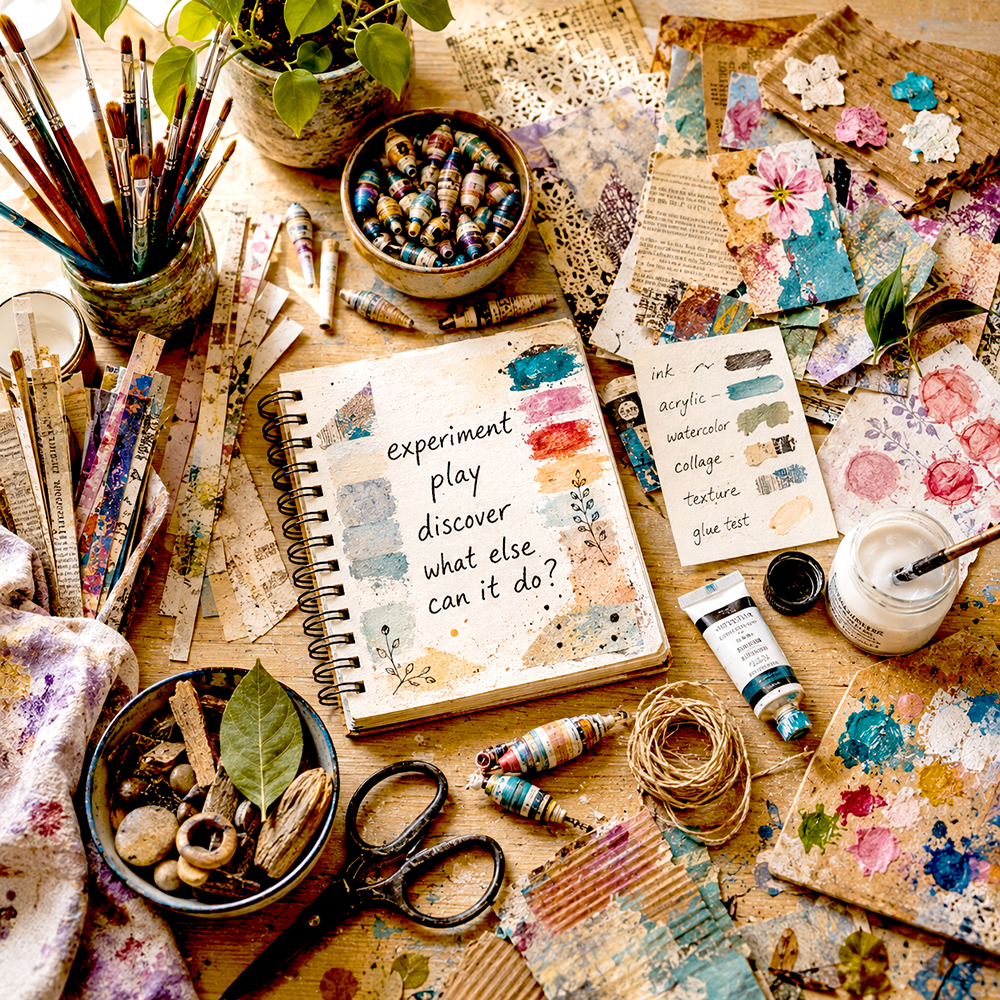
What I'm Working With
Seth's collection included boards, blocks, narrow strips, triangular offcuts, and pieces with different grain patterns and thicknesses.
Some offered relatively flat surfaces for drawing or wood burning.
Others had shapes that suggested three-dimensional projects, decorative objects, or sculpture bases.
Rather than planning a specific project for every piece, I decided to experiment with what the different shapes and surfaces might offer.
My first experiments involved wood burning and paint markers, but I also began sharing pieces with other artists and makers to see what possibilities they might discover.
Experiment #1: Trying Wood Burning for the First Time
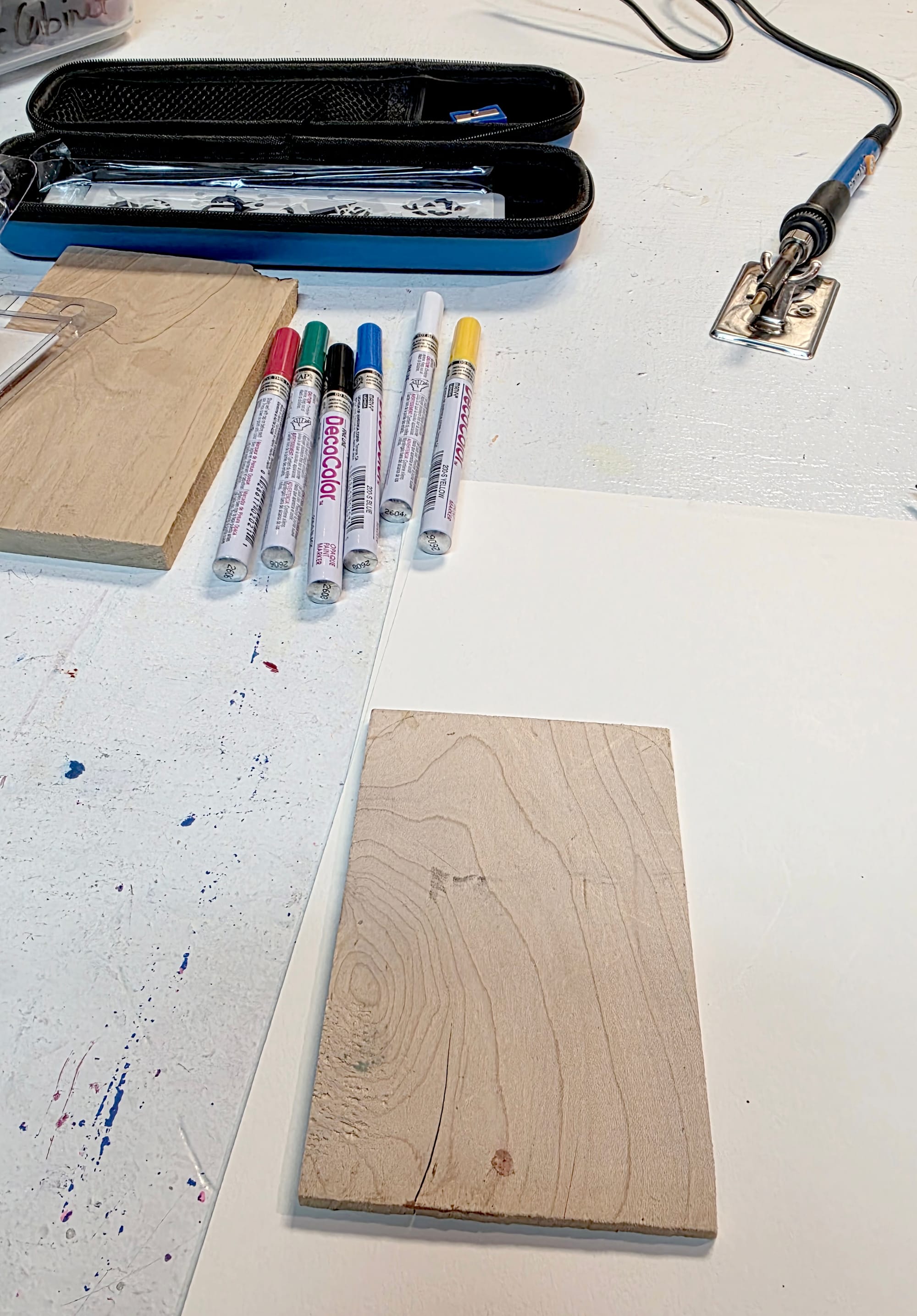
One of the first things I wanted to try with the hardwood offcuts was something I'd never done before: wood burning!
Also known as pyrography, wood burning involves using a heated tool to create marks and designs on wood.
Instead of applying ink or paint to the surface, you're using heat to leave a permanent mark.
It's a technique I'd been curious about, but curiosity and actually trying something are two different things.
Having an assortment of free hardwood pieces finally gave me the opportunity to experiment without worrying so much about wasting expensive materials.
And that's something I really appreciate about creative reuse.
Sometimes having materials available is what makes trying something new feel possible in the first place.
Learning to Draw With Heat
I'm accustomed to drawing with pencils, pens, markers, and other familiar tools, but drawing with a heated metal tip?
That's a different experience.
I began experimenting with simple marks, lines, shapes, and patterns, getting a feel for how the tool interacted with the wood.
Unlike drawing on paper, wood has its own grain, density, and texture; the surface isn't necessarily uniform, and the marks you make can vary depending on how the heated tip moves across it.
That meant paying attention not only to the design I wanted to create, but also to the material itself.
- How easily could I make a smooth line?
- What happened when I moved the tool more slowly?
- Could I create different line weights or textures?
- How much control did I have when working on smaller pieces?
I wasn't trying to master the technique in one sitting.
I was trying to discover what it could do.
A quick note about wood-burning safety: Because pyrography involves high temperatures and can produce smoke and fumes, it's important to work in a well-ventilated space, use a heat-safe surface, and follow the tool manufacturer's instructions. Not all scrap wood is suitable for burning, especially pieces with unknown treatments, coatings, adhesives, or finishes. When experimenting with reclaimed wood, it's worth confirming that the material is safe for this technique before getting started.
What I Noticed Along the Way
One of the first things I noticed while experimenting with wood burning was that not all the wood responded the same way.
Some pieces were easier to burn than others, even though I was using the same basic technique.
That was interesting because it reminded me that the surface itself plays an important role in how a material behaves.
Different pieces of hardwood can have different characteristics, and those differences can affect the experience of working with them.
I also discovered that the wood-burning tips themselves made a difference.
Some were easier for me to use than others, depending on what I was trying to create; my favorite is probably the universal tip, as it is the most versatile.
And then I got to experience another variable: using a different wood-burning tool altogether.
My friend's mom had borrowed my wood-burning tool, so when I went to art club, I borrowed Marnie's instead, and I noticed a difference.
Marnie's tool didn't get as hot as mine, which made it a bit more difficult for me to work with.
It was an interesting reminder that even when you're using the same technique, changing the equipment can change the experience.
I still had fun, though!
And that's something I appreciate about experimenting. I'm not just learning how to create different designs. I'm also discovering how the materials, tools, and techniques interact with one another.
Sometimes a change in the results isn't necessarily about what you're doing differently; it might be about what you're working with.
And every experiment gives me another opportunity to figure that out.
From Practice Marks to Little Works of Art
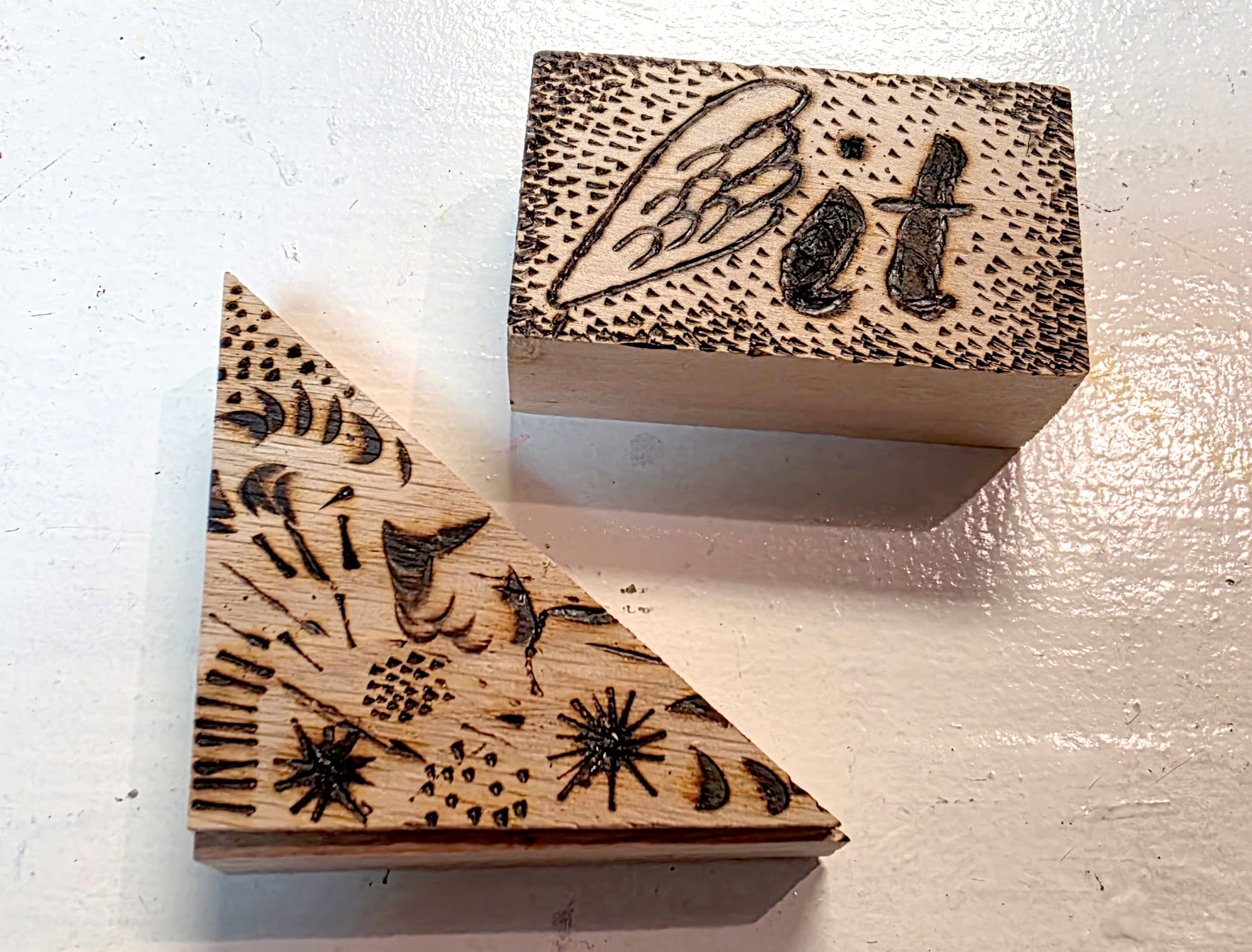
As I experimented, I started moving beyond simple marks and into more recognizable designs.
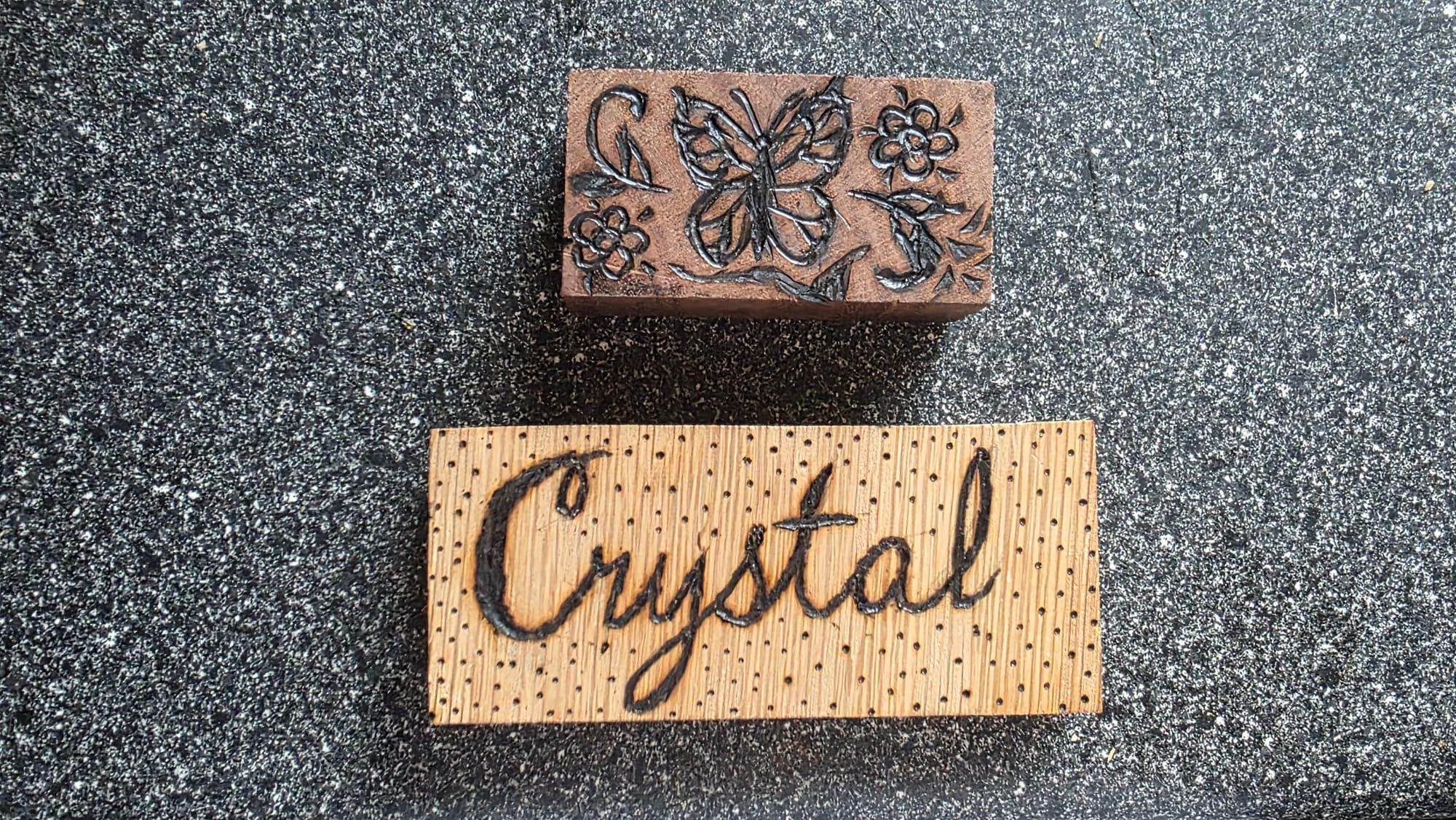
I played with botanical patterns, flowers, butterflies, decorative shapes, and lettering.
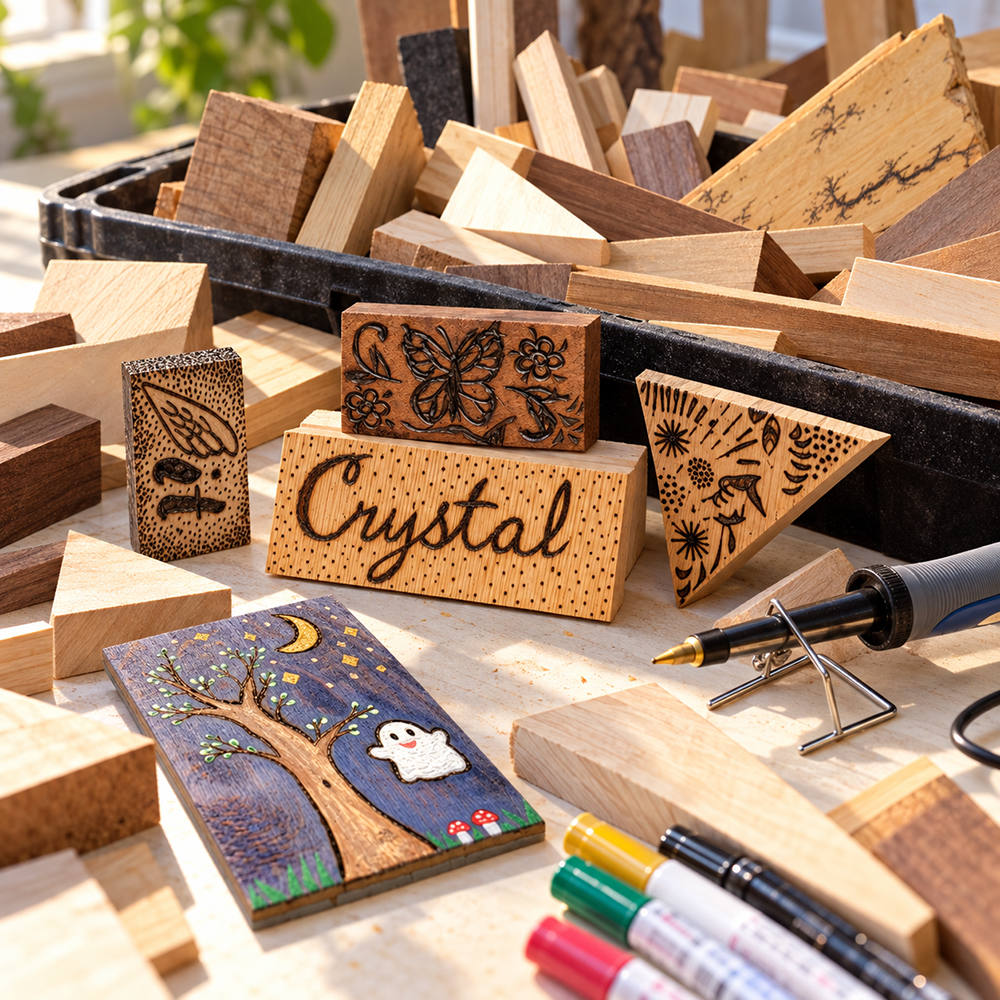
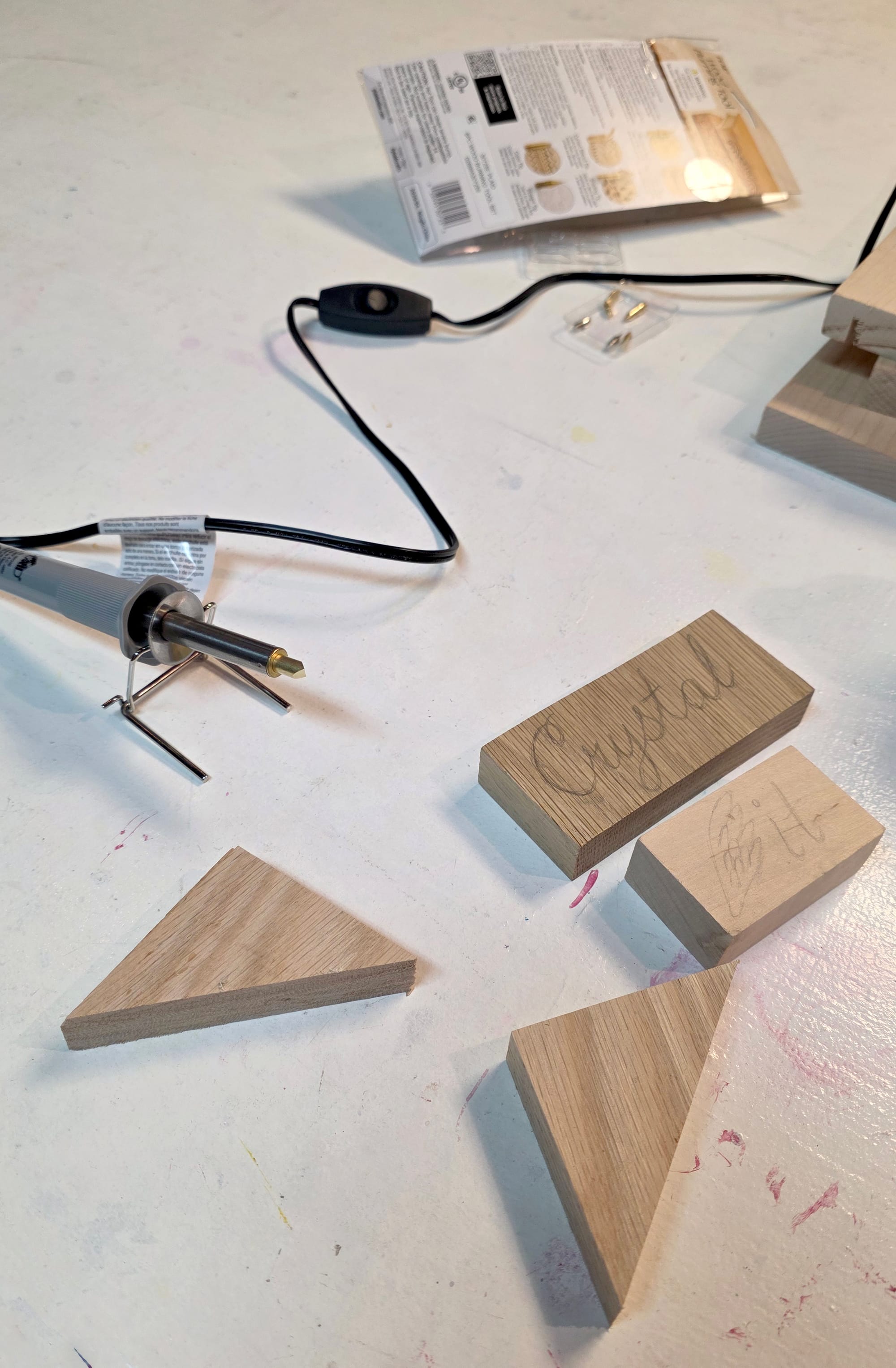
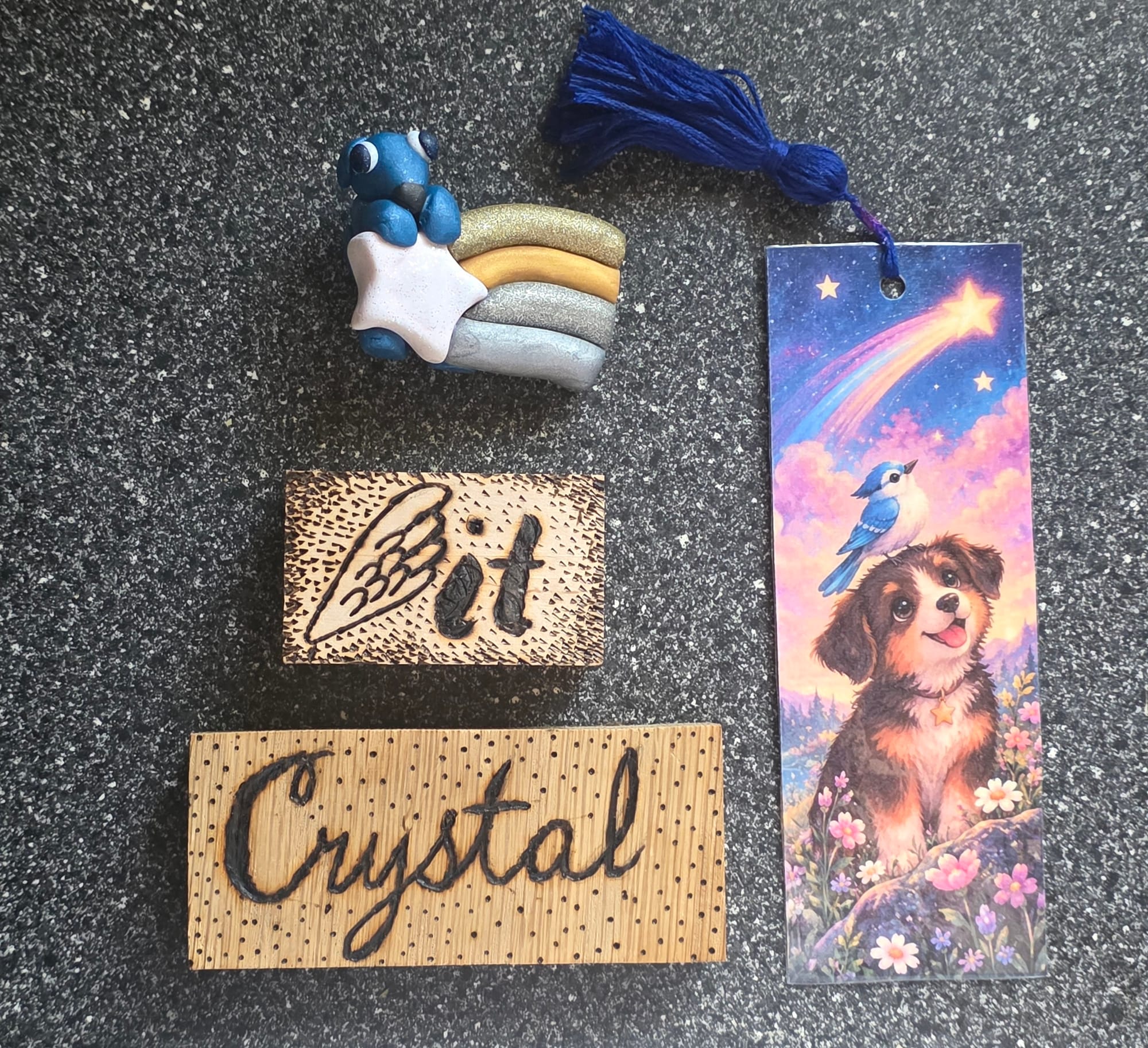
One small rectangular piece became a personalized gift featuring the name Crystal.
Another experiment involved a butterfly surrounded by little flowers and leaves.
I also explored how different shapes of wood could influence the artwork itself.
A rectangular block offers one kind of composition.
A triangle offers another.
And a piece with interesting natural grain might suggest an entirely different direction.
Rather than treating the wood as a blank surface that needed to accommodate whatever I wanted to draw, I began thinking about how the material's existing characteristics could become part of the design.
That's something I enjoy about working with found and reclaimed materials.
Sometimes the material contributes ideas of its own.
The Little Triangle That Found a Home
One of my experiments was a small triangular piece of hardwood.
It wasn't a grand project; it was an opportunity to practice creating marks and patterns on an unfamiliar surface.
But when I created it at art club, Marnie—the art club host—really liked it.
So, I gave it to her, and now she has it on display at Marnie's Creative Outlet!
I love that.
Something that began as a practice piece, made from a woodworking offcut while I was learning a new technique, became something another person genuinely appreciated and wanted to keep.
It didn't need to be an elaborate, perfectly planned artwork to have value.
It simply needed to connect with someone.
And that experience reminded me of something I think is easy to overlook when we're learning a new creative skill:
An experiment doesn't have to be perfect to become meaningful.
An Unexpected New Possibility
Trying wood burning has opened up an entirely new direction for my creative practice.
I'm already thinking about other designs, personalized gifts, small decorative pieces, and ways to combine wood burning with materials I enjoy using.
- What happens if I add color?
- Can I combine burned outlines with paint markers?
- Could the wood grain become part of a landscape, a tree, or another illustration?
- How might different shapes and sizes of wood influence what I create?
- And what other possibilities might emerge as I become more comfortable with the tool?
I don't have all the answers yet, but that's what makes this exciting.
I started with a collection of hardwood scraps and a technique I'd never tried before.
Now I have new skills to explore, gifts to create, and plenty of ideas for what to try next.
And I've barely begun discovering what these little pieces of wood can become.
The Experiment Didn't Stop With Me
One of the most exciting things about receiving all those hardwood offcuts wasn't just figuring out what I could make with them.
It was discovering what other people could make, too.
Because as much as I enjoy collecting interesting materials and imagining their possibilities, I also love sharing them.
And when I started offering pieces of wood to other creative people, something wonderful happened.
The possibilities multiplied.
Different Artists, Different Ideas
I brought some of the hardwood offcuts to art club, where other members immediately began imagining how they might use them.
And their ideas weren't necessarily anything like mine!
While I'd been experimenting with wood burning and creating little illustrations, some members saw opportunities to make bookbinding equipment.
Others were interested in using the wood as bases for sculptures, including projects they could work on with children.
Same collection of wood.
Completely different creative directions.
That's one of the things I love about being around other artists and makers.
Everyone brings different experiences, interests, skills, and ways of seeing the world.
Something that might look like a potential drawing surface to me could look like a useful tool or structural component to someone else.
Neither interpretation is more creative than the other.
They're simply different possibilities waiting to be explored.
Finding the Right Materials for the Right Artist
I also shared some of the wood with a fellow artist I met through Artist INC.
Her artistic practice involves drawing and painting directly on wood, so when I mentioned having a collection of hardwood offcuts available, she was excited about the opportunity to use some.
I loved being able to make that connection.
Here were materials that Seth had generously shared with me, and here was another artist whose existing creative practice made those materials especially useful.
I didn't need to invent a project for her.
I didn't need to tell her what the wood should become.
I simply had something she could use, and I was happy to share it.
Sometimes supporting another artist doesn't require an elaborate collaboration or a big financial contribution.
Sometimes it's as simple as recognizing that you have access to something someone else could genuinely benefit from and making that connection.
One Idea Inspires Another
Another portion of the wood went to a friend and their mother.
And what I particularly loved about that experience was how the materials sparked curiosity beyond the projects they might make immediately.
They started talking about wanting to take woodworking classes, explore wood burning, and create a fairy garden for their yard.
Suddenly, a collection of leftover hardwood wasn't just a supply of materials.
It was an invitation to learn something new.
To try an unfamiliar technique.
To imagine a project they might not otherwise have considered.
And potentially to spend time creating something together.
I don't know exactly what they'll end up making, and that's part of the fun.
Their ideas belong to them.
But I love knowing that sharing a few pieces of wood helped inspire those possibilities.
More Than One Creative Life
Not every idea has become a finished project yet; some are still possibilities.
But I think that matters, too.
The value of a material isn't limited to what someone has already made with it.
Sometimes its value is also in what it allows someone to imagine, attempt, or learn.
One person's leftover material can become another person's opportunity.
And when useful materials continue circulating, those opportunities can keep growing.
A Gatherer, Not a Hoarder
A friend recently told me something that made me smile.
They said I'm an excellent gatherer, rather than a hoarder.
And the more I've thought about it, the more I've come to appreciate that distinction.
I do have a tendency to notice things other people might overlook.
An unusual piece of wood. Leftover art supplies. Discontinued samples. Materials that are perfectly usable but no longer needed for their original purpose.
Where someone else might see scraps or clutter, I often see possibilities.
- Could this become something?
- Could I experiment with it?
- Could someone else use it?
Sometimes I know exactly what I'd like to try; other times, I have absolutely no idea.
But I enjoy discovering what's possible.
Finding Things Is Only Part of It
What I particularly appreciated about my friend's observation was that they recognized something important: I don't want to collect materials just for the sake of having them; I want them to be useful.
Sometimes that means experimenting with them myself.
Sometimes it means saving something for a project I haven't figured out yet.
And sometimes it means realizing that another person might have a much better use for a particular material than I do.
That's when sharing becomes part of the creative process.
I don't have to personally transform every piece of wood into a finished artwork for it to have value.
I can recognize its potential, connect it with someone who might appreciate it, and let them decide what happens next.
And I love that.
Creativity Doesn't Have to Begin With a Purchase
Another thing I've been thinking about throughout these Materials Lab experiments is how often creative projects are presented as something that begins with buying supplies.
Find a tutorial.
Make a shopping list.
Purchase the materials.
Follow the instructions.
There's nothing inherently wrong with that approach, but it isn't the only way to create.
Sometimes the process can begin with looking around and asking:
- What do I already have access to?
- What is someone else no longer using?
- What could I make with what's available?
Working with donated and leftover materials has encouraged me to think more flexibly about what an art supply can be.
A hardwood offcut doesn't have to remain a woodworking scrap.
It might become a drawing surface, a sculpture base, a handmade tool, or a thoughtful gift.
And sometimes the limitations of an unusual material can encourage ideas that wouldn't have occurred to us if we'd started with a perfectly prepared, store-bought surface.
 Jessica Carey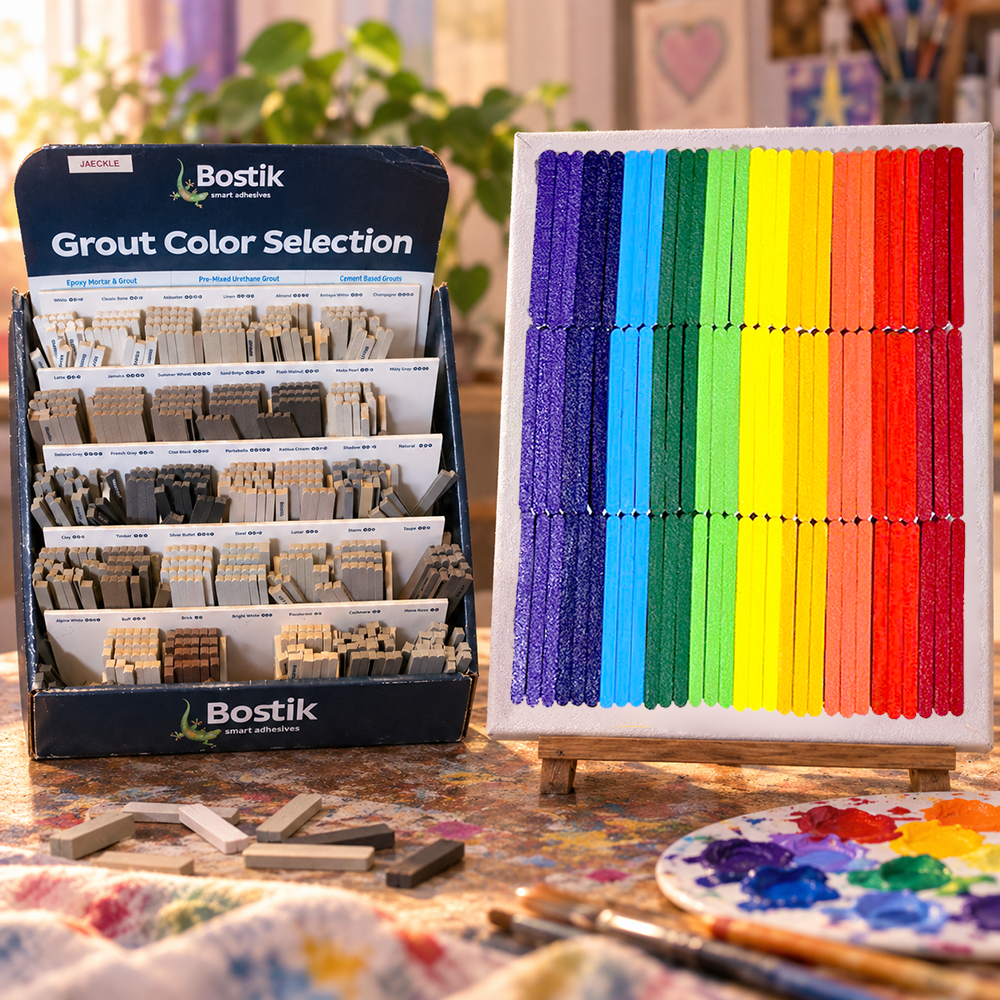
 Jessica Carey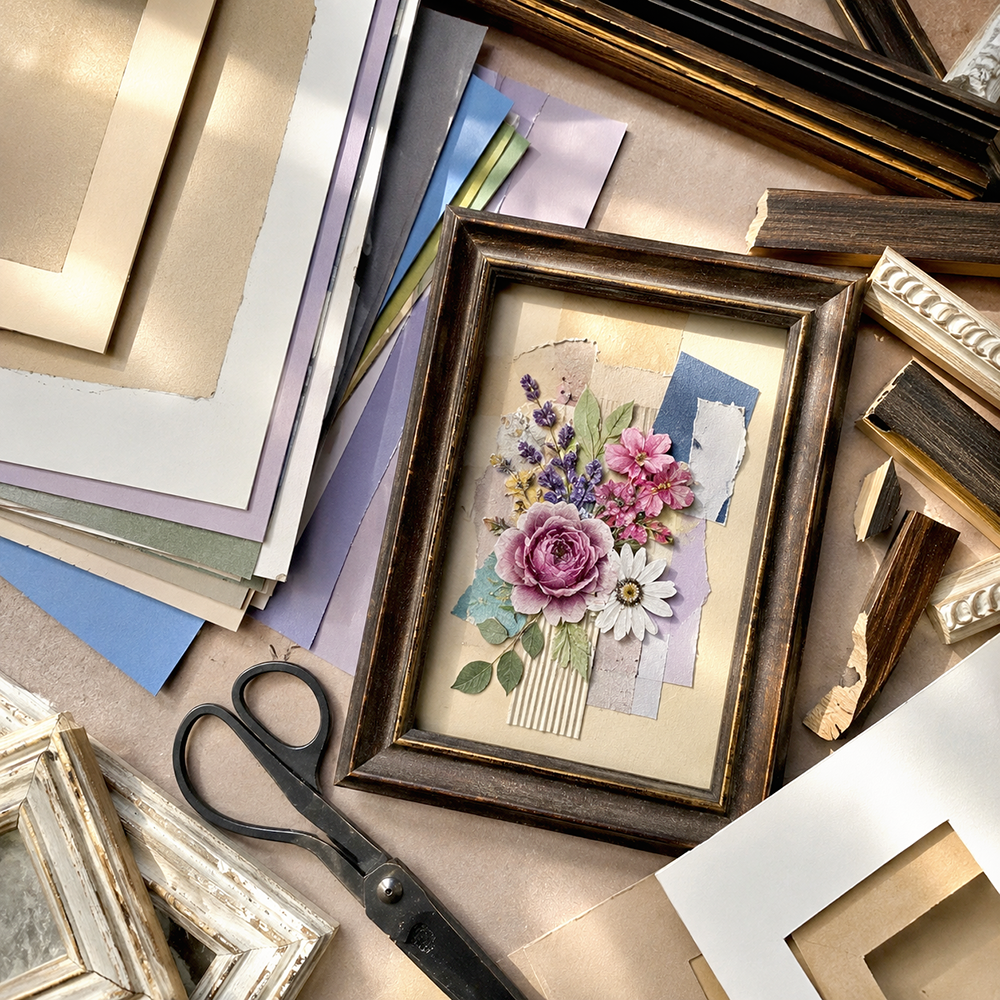
Sharing Makes the Possibilities Bigger
Of course, not every material needs to be saved, and collecting more than we can reasonably use or manage isn't always helpful.
But I think there's something wonderful about finding ways to keep useful materials circulating.
Especially when access to art supplies, equipment, and creative opportunities can be limited by cost.
Sharing doesn't magically remove every barrier to creativity, but it can make a difference.
Someone gets to experiment without purchasing an entire package of supplies.
Someone discovers a material they hadn't considered using before.
Someone finds exactly the odd little piece they needed for a project.
Someone else becomes curious enough to try a new technique.
And sometimes those opportunities lead to more connections, more learning, and more sharing.
That's what I find so exciting.
The possibilities don't have to end with the person who first receives the materials.
They can keep growing.
Making Room for Possibility
I don't think being a gatherer means I have to find a use for absolutely everything, and I certainly don't need to keep every interesting material that comes my way.
Sometimes the most useful thing I can do is pass something along.
Because the goal isn't to accumulate the biggest collection of supplies.
It's to help those supplies become something:
- An artwork
- A tool
- A gift
- A new skill
- A shared experience
- Or even just the beginning of an idea someone hadn't considered before
And perhaps that's what I like most about my friend's description.
Being a gatherer isn't only about what I find. It's about what I help make possible.
What Else Can Hardwood Do?
After experimenting with wood burning and seeing how other people have approached these hardwood offcuts, I've found myself wondering: what else could I do with them?
Because while wood burning was one of the first techniques I wanted to explore, it certainly isn't the only possibility.
And with so many different shapes, sizes, and surfaces to work with, there's plenty of room for more experimentation!
Adding a Little Color
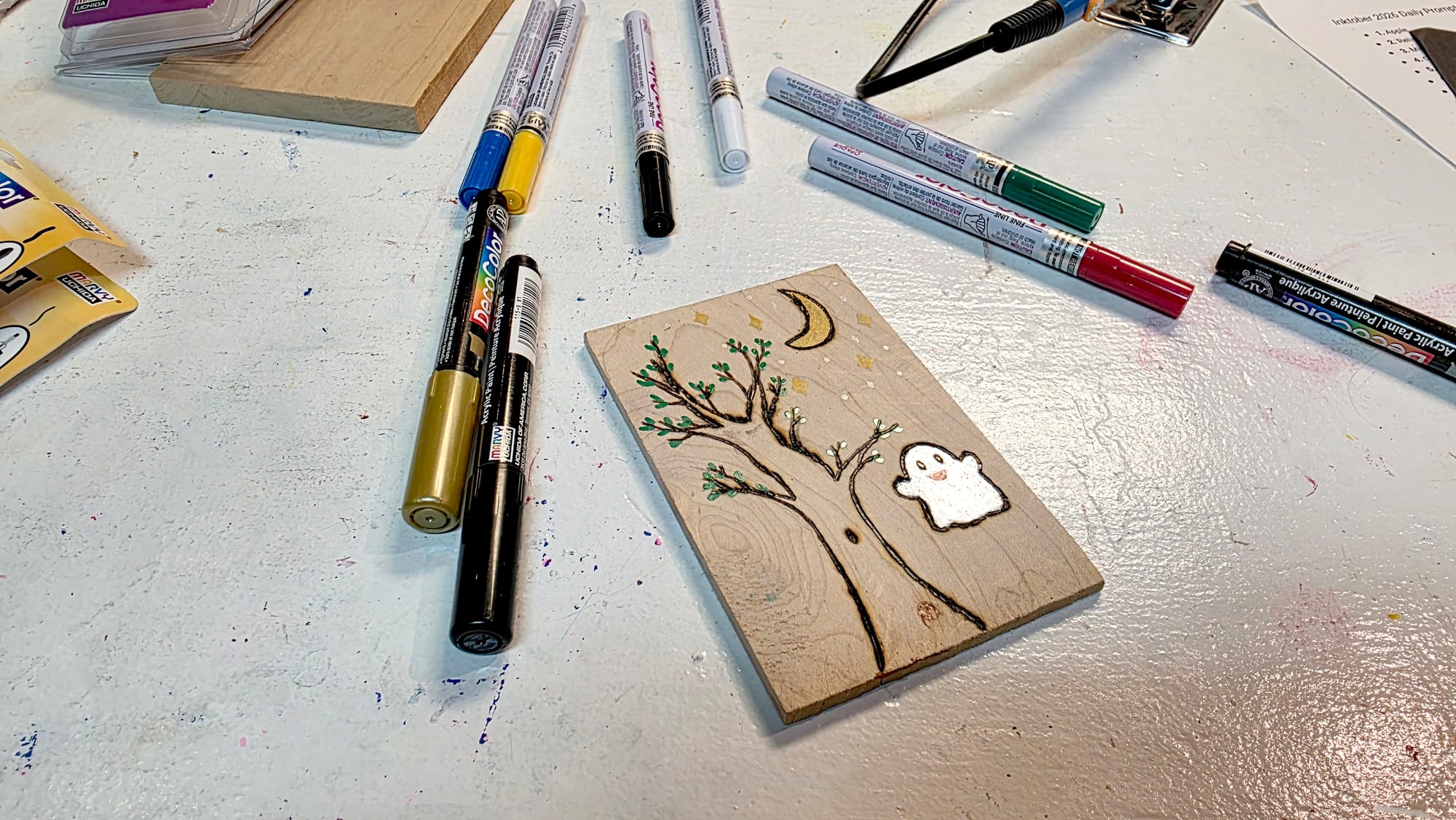
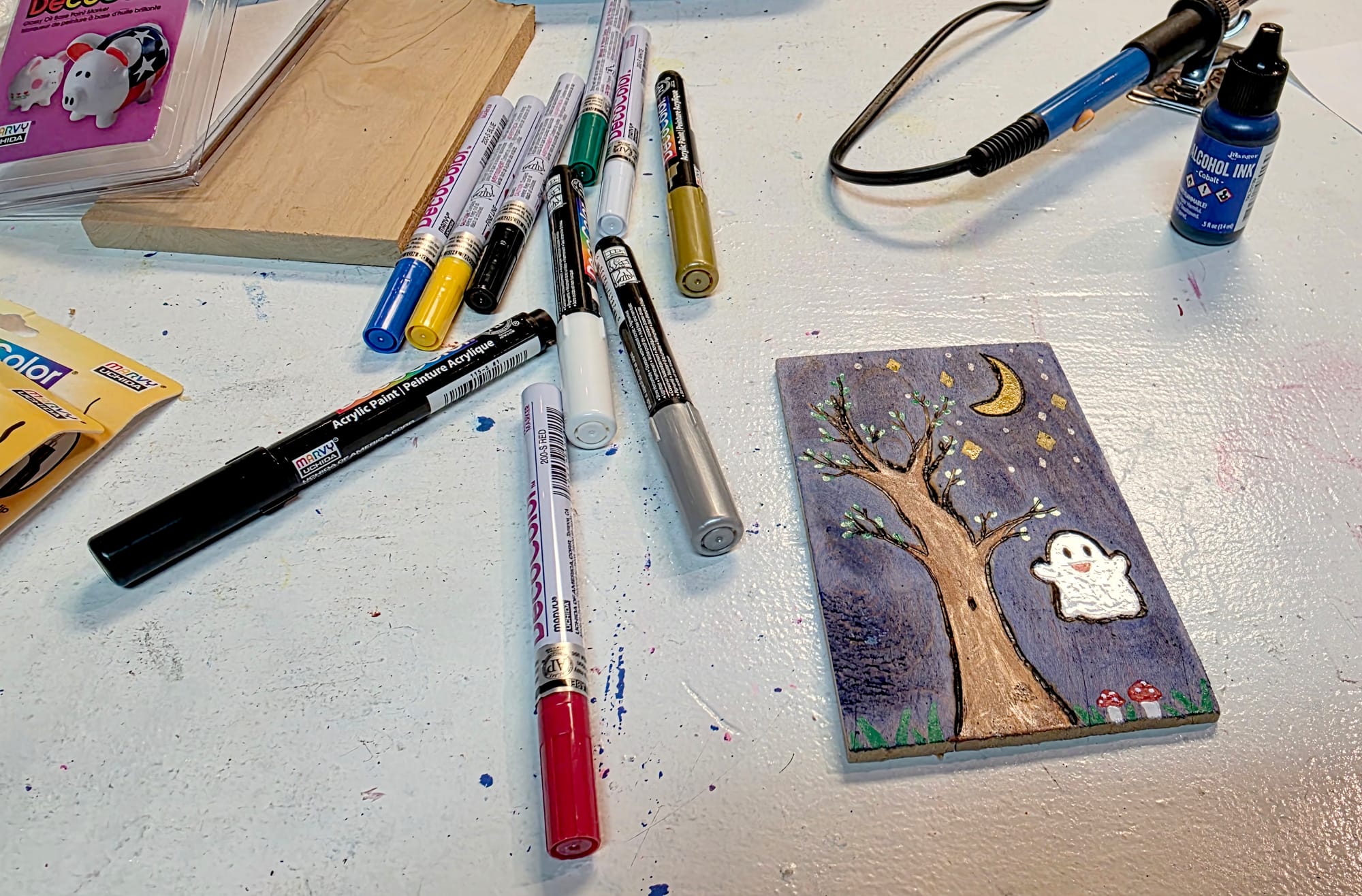
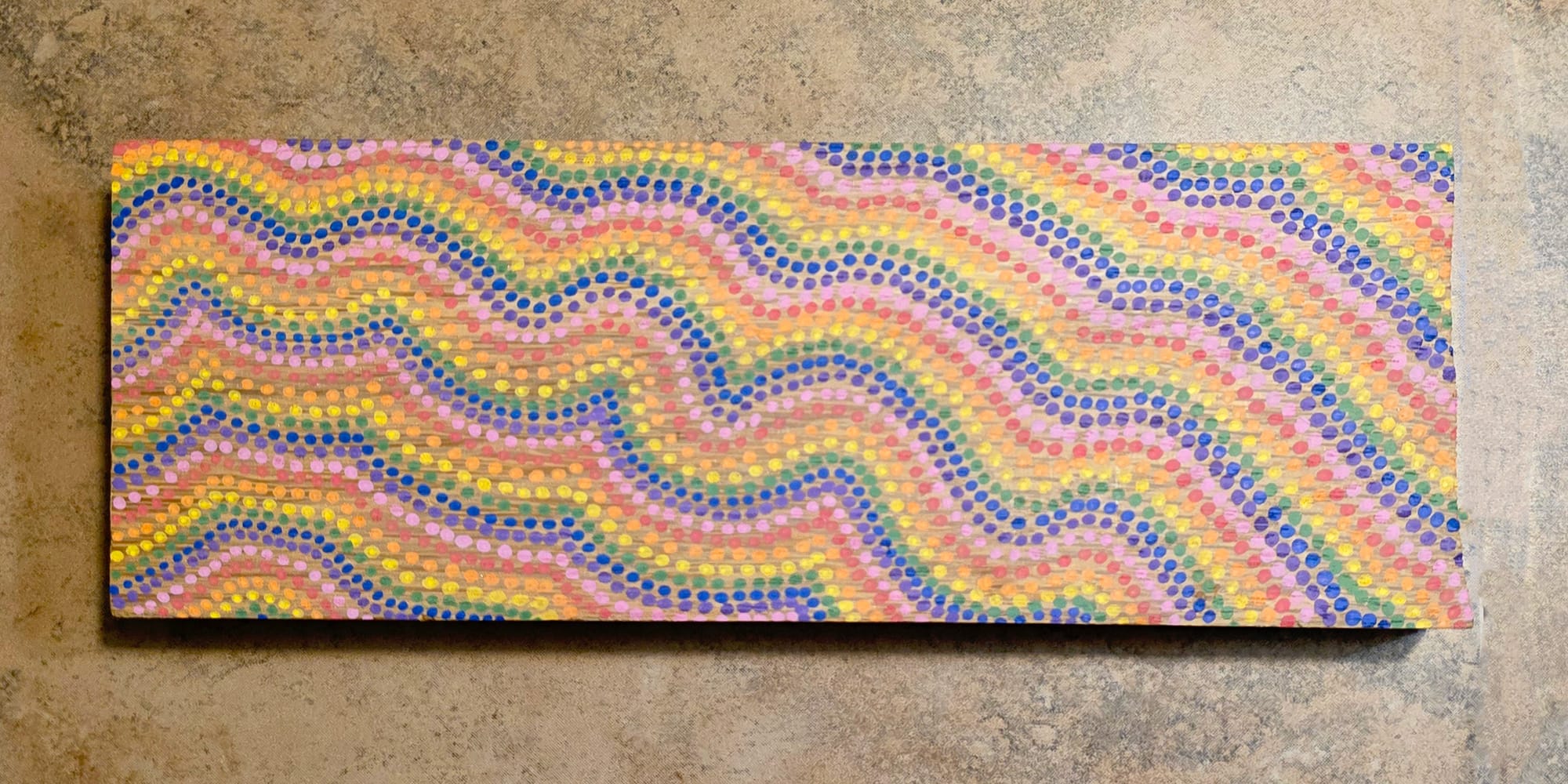
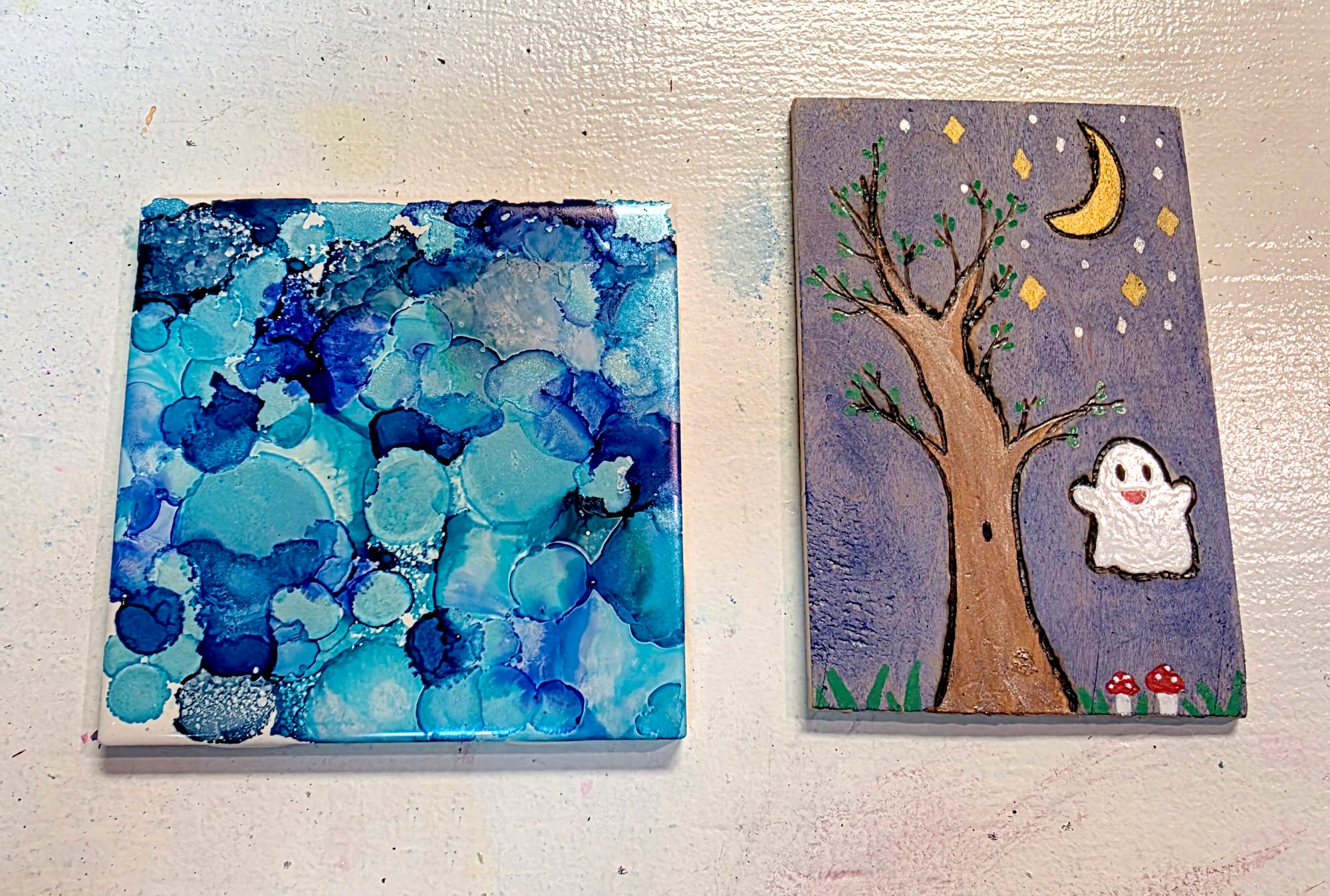
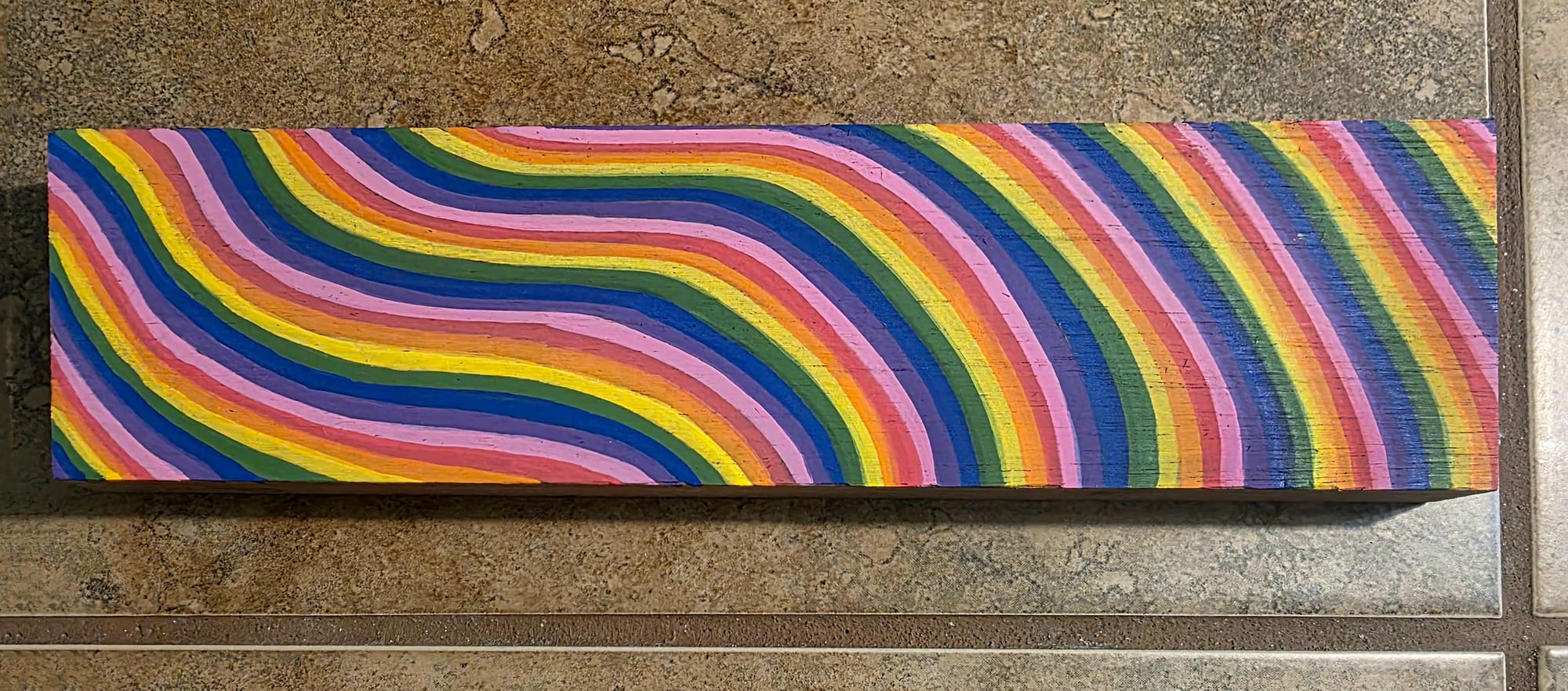
One direction I've already started exploring is using paint markers to create colorful illustrations on some of the hardwood offcuts.
Thanks to Lawrence at Marvy Uchida, I've had the opportunity to experiment with an assortment of markers on different surfaces, including the wood Seth provided.
I'm also curious about combining those colorful illustrations with wood burning, using the burned marks and added color together in a single design.
I love the idea of combining the natural warmth and texture of wood with colorful illustrations.
Wood burning creates marks through heat, while paint markers add color directly to the surface.
They offer different possibilities, and I'm curious about how they might complement one another.
- Could I use wood burning to create an outline and fill certain areas with color?
- What happens when I leave some of the natural wood exposed?
- How might the wood grain influence the colors or designs I choose?
I've already enjoyed making little illustrations on wood, and I'm interested in exploring more ways to combine techniques.
There's something especially appealing about letting the wood remain recognizable as wood rather than completely covering its surface.
Although, of course, sometimes covering it might lead to an interesting result, too!
That's the fun of experimenting; I don't have to decide there's only one right way to use a material.
Letting the Shape Suggest the Project
Another thing I've enjoyed about these offcuts is that they aren't all standard rectangles.
There are triangles, blocks, strips, and other unusual shapes.
And those shapes can become part of the creative challenge.
A small triangular piece might inspire a decorative design that wouldn't work quite the same way on a rectangular board.
A narrow strip could lend itself to lettering, a border pattern, or a small illustration.
A thicker block might become something that stands on its own rather than an artwork meant to hang on a wall.
I find myself looking at the pieces and wondering what their shapes might suggest.
Instead of starting with a design and finding wood to fit it, I can start with the wood and see where it leads.
What if the material helps determine the artwork?
Beyond a Drawing Surface
Of course, hardwood doesn't have to be something I draw or paint on.
Although most of my experiments so far have involved decorating the surfaces of the wood, I'm also interested in exploring how these offcuts might become part of three-dimensional projects.
Some of the pieces might work as bases for small sculptures. Others could become components in mixed-media artwork, decorative objects, or handmade gifts.
I'm particularly interested in how wood might interact with other materials I enjoy experimenting with.
- Could I combine it with polymer clay?
- What about wire, beads, or other found materials?
- Could a piece of wood become the foundation for a tiny scene or a miniature world?
- And what might happen if I combined several offcuts rather than working with each piece individually?
I don't have finished answers to all those questions.
But I have materials to explore, and that's a wonderful place to begin.
 Jessica Carey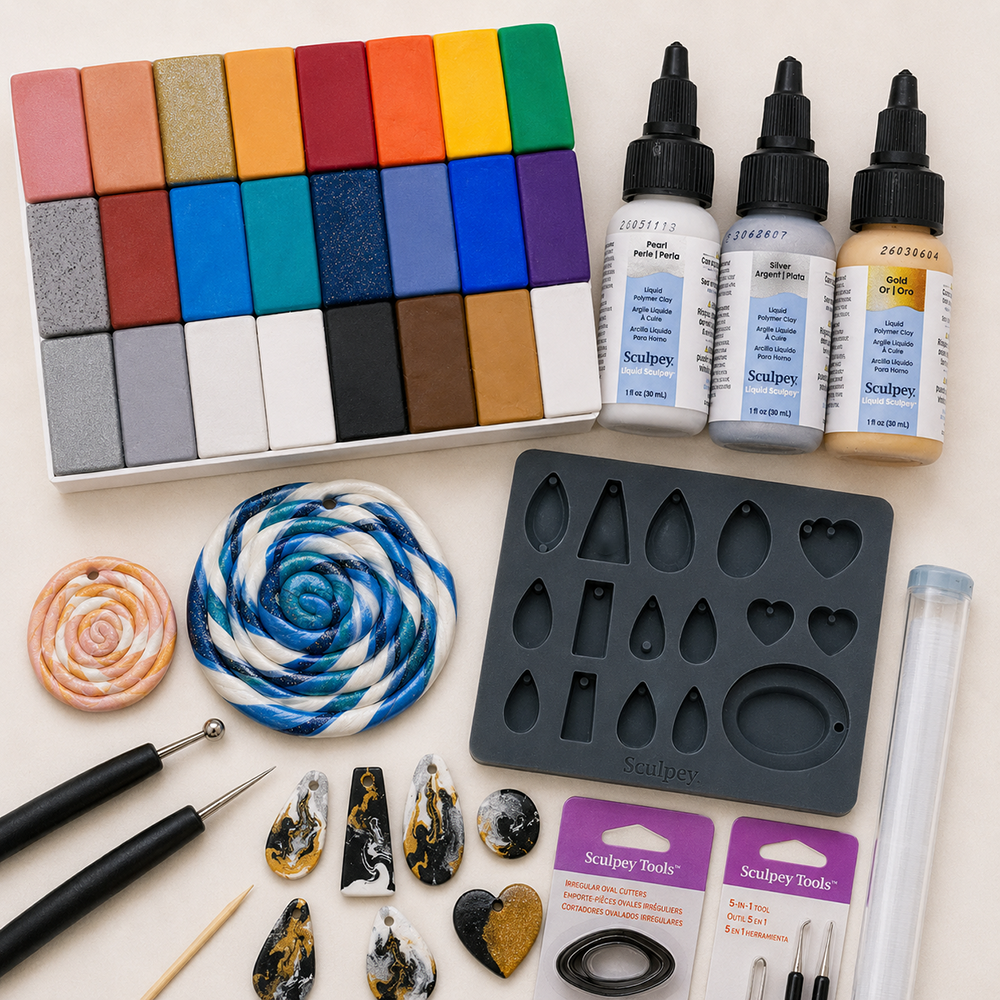
Following the Curiosity
One thing I've learned from experimenting with unconventional materials is that I don't always need to know exactly where a project is going.
Sometimes I begin with a specific idea.
Sometimes I begin with a technique I want to learn.
And sometimes I simply pick up an interesting material and wonder what I could do with it.
Not every experiment will become a finished artwork.
Some might remain practice pieces.
Some might teach me what doesn't work particularly well.
Others might lead to something completely unexpected.
And that's okay.
An experiment can be worthwhile even when the result isn't something I'd planned to make.
I think that's part of what makes working with these hardwood offcuts so enjoyable.
They give me room to play, learn, make mistakes, discover new techniques, and follow ideas as they develop.
And because Seth shared such a wonderful assortment of pieces, those opportunities aren't limited to a single project or even a single artist.
There's still more to try.
More to learn.
More to share.
And plenty more to discover.
So, what else can hardwood scraps become?
I don't know everything yet, but I'm excited to keep finding out.
 Jessica Carey
A Thank-You to Seth and MuniMo Woodworking and Design
Before wrapping up this Materials Lab, I want to extend a heartfelt thank-you to Seth at MuniMo Woodworking and Design.
By sharing hardwood offcuts from his woodworking projects, Seth gave me the opportunity to explore a technique I'd never tried before, but his generosity also reached beyond my own experiments, providing materials and inspiration for other artists, makers, and curious beginners.
And that's what makes this experience especially meaningful to me.
One act of generosity can make room for many different acts of creativity.
The wood may have been leftover from one project, but that didn't mean its creative possibilities were exhausted.
The Ripple Effect of Generosity
This experience has also reminded me how much potential can be hiding in materials that are no longer needed for their original purpose.
Something that isn't particularly useful to one person anymore might be exactly what someone else needs to begin creating.
- It might be a woodworking offcut
- A discontinued tile sample
- A leftover piece of matboard
- An assortment of art supplies that have been sitting unused
The material itself might seem small or ordinary.
But in the right hands, it can become an opportunity to learn, experiment, create, or connect with someone.
And when people are willing to share those resources, the impact can reach further than the original exchange.
Still Becoming
I certainly haven't finished exploring everything these hardwood offcuts can do.
There are more designs I'd like to try, more techniques I'm curious about, and more ways I hope to combine wood with other materials.
And I'm looking forward to seeing what the people I've shared the wood with decide to create, too.
Some of those projects may turn into finished artworks.
Others might become learning experiences, handmade tools, gifts, or entirely unexpected discoveries.
That's part of what makes this so exciting.
The materials haven't reached the end of their story.
In many ways, they're just getting started.
So thank you again, Seth, for sharing your woodworking offcuts and helping make all these experiments and connections possible.
Your generosity has already traveled further than the original collection of wood.
And I think that's a beautiful reminder that something doesn't have to be new to become the beginning of something wonderful.
Sometimes it just needs someone willing to see its potential and someone willing to share it.
This Materials Lab experiment is ongoing! I'll continue exploring different techniques and creative possibilities with these hardwood offcuts, and I'm excited to see what else they—and the people working with them—might become.
Have you ever created something from leftover wood or another unexpected material? I'd love to hear what you made, what you discovered, or what you'd like to try!
Want even more content about creativity and art?
Be sure to check out all of our creative chronicles!
If you'd like to see examples of my work, you can find some of my art and creations at Redbubble and Gumroad!
Looking to learn more about my recent journey?
Check out some of these articles:
-Hidden Gems for St. Louis Artists
-Hidden Gems for Autistic & Neurodivergent Adults
-Learning What Love Was Supposed to Feel Like
-I Wasn't Broken--I'm Burned Out
-What Chronic Autistic Burnout Actually Feels Like
-Building a Life from What Remains
 Jessica Carey