
It Started With a Question
Some art supplies come from art stores.
Others apparently come from flooring stores.
Lately, I've been experimenting with a simple question: what materials are businesses throwing away that artists could use instead?
Stores and other businesses regularly end up with scraps, offcuts, discontinued samples, old displays, packaging, and other materials that are no longer useful for their original purpose.
They may not look like traditional art supplies, but that doesn't necessarily mean they're finished being useful.
So I've started asking.
That's how I recently ended up at Michael's Flooring, asking whether they had any old samples, scraps, or other materials they were planning to throw away that I might be able to repurpose for art.
They did; Jen was ecstatic to have the old materials get repurposed instead of ending up in a landfill.
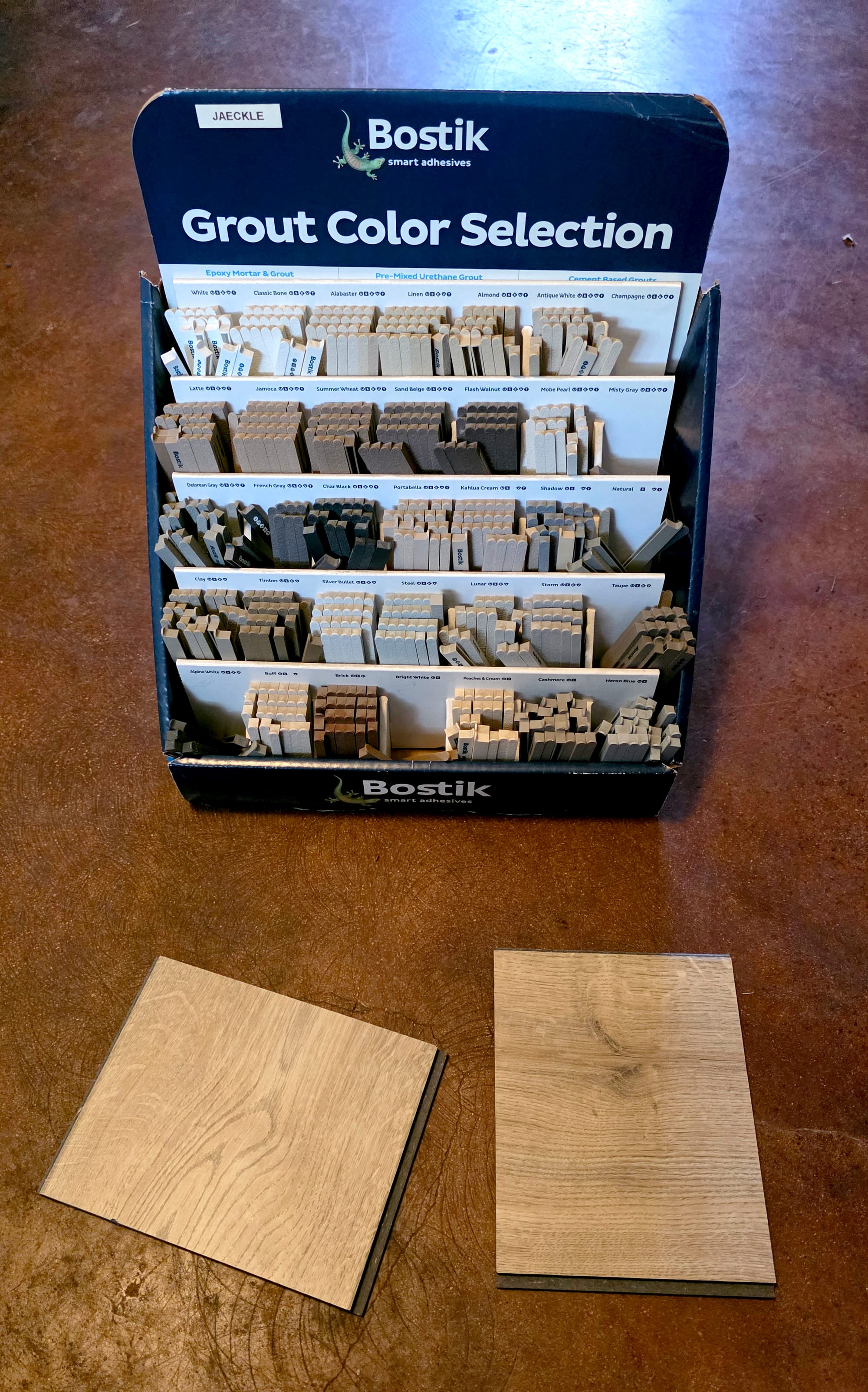
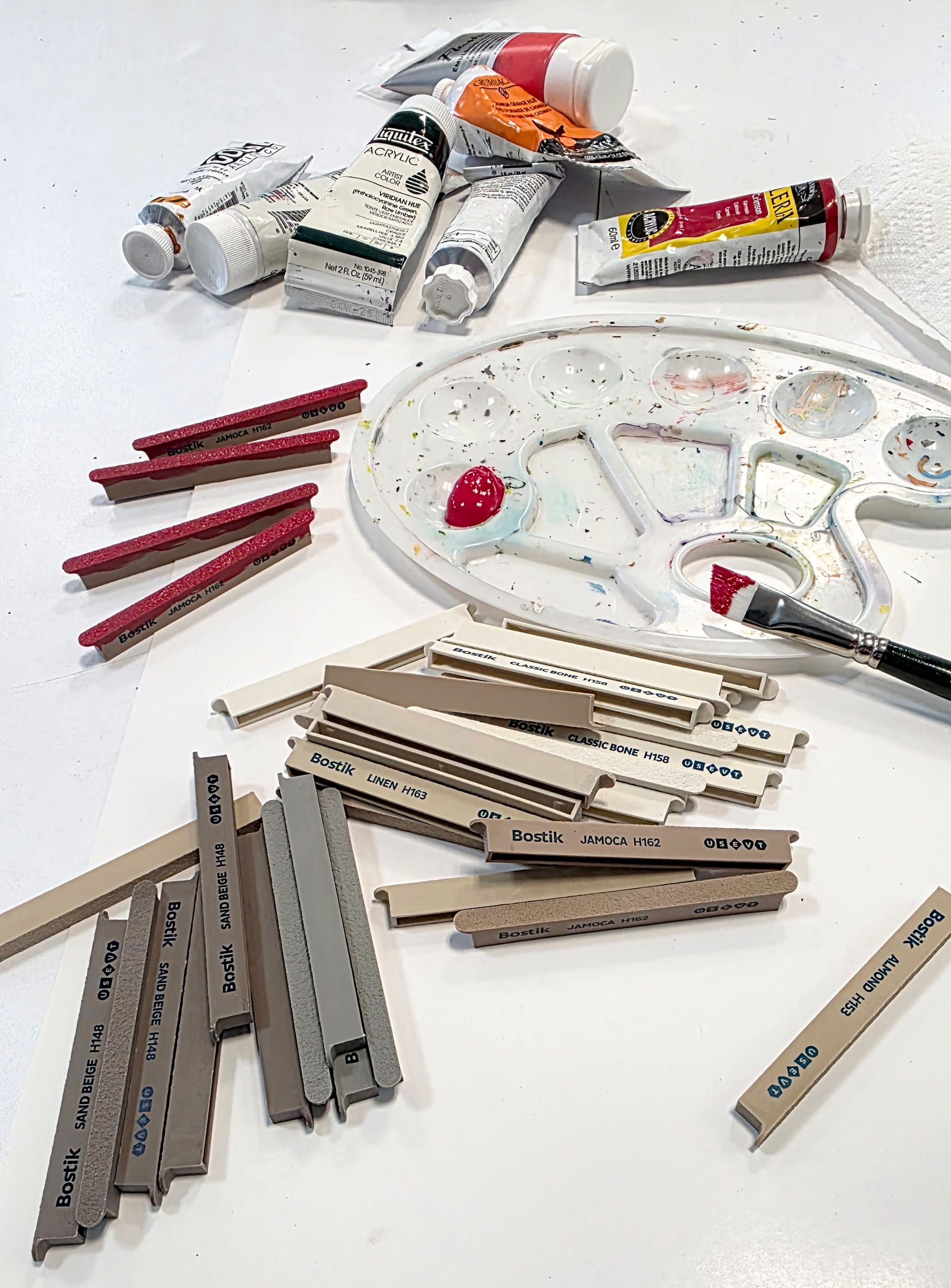
Among the materials I received was an old Bostik grout color display filled with dozens of little sample sticks in shades of beige, gray, white, brown, and black.
They were designed to do one very specific job: help someone choose a grout color.
But looking at all those little uniform pieces, I couldn't help thinking about a different question: what else can they do?
 Jessica Carey
When a Grout Sample Stops Being a Grout Sample
I brought some of the samples with me to Artists First and started experimenting.
The original colors were useful for flooring customers, but I wondered what would happen if I changed them.
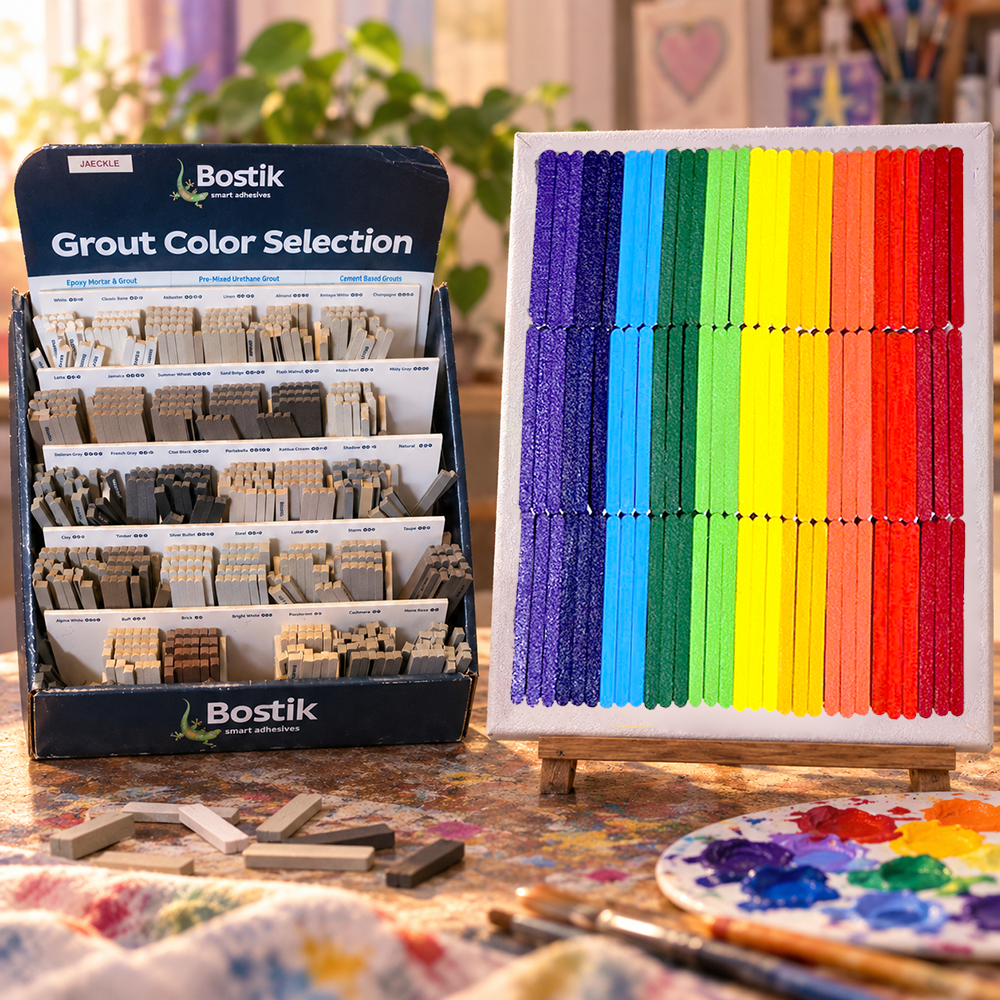
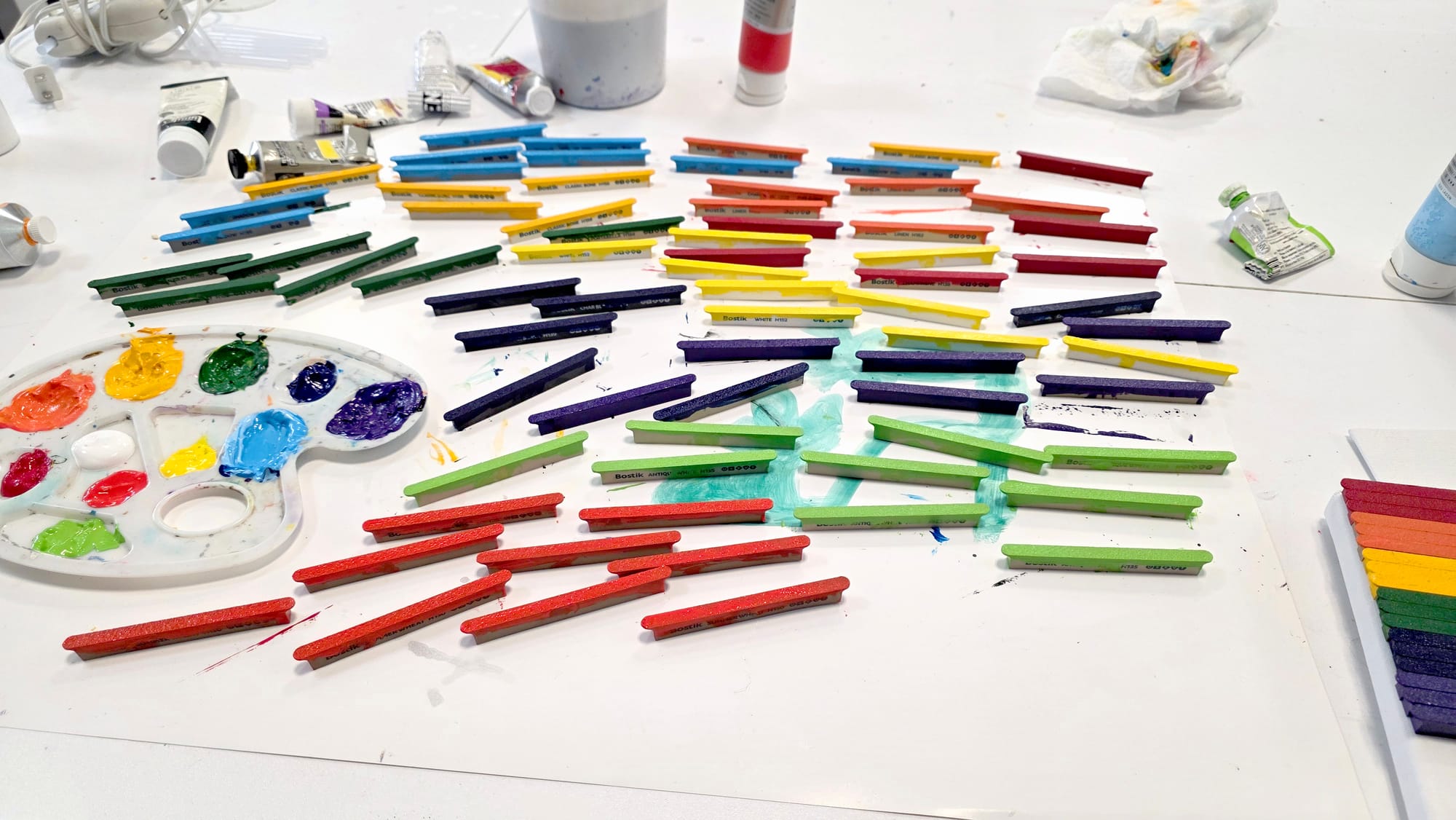
I pulled out acrylic paints and started covering the textured surfaces in bright reds, oranges, yellows, greens, blues, and purples.
And something interesting happened.
The more I painted, the less they looked like grout samples.
They started looking like tiny building blocks. Mosaic pieces. Lines of color. Pieces of a pattern that hadn't been assembled yet.
There wasn't an elaborate plan behind it. I was simply testing the material and seeing what happened.
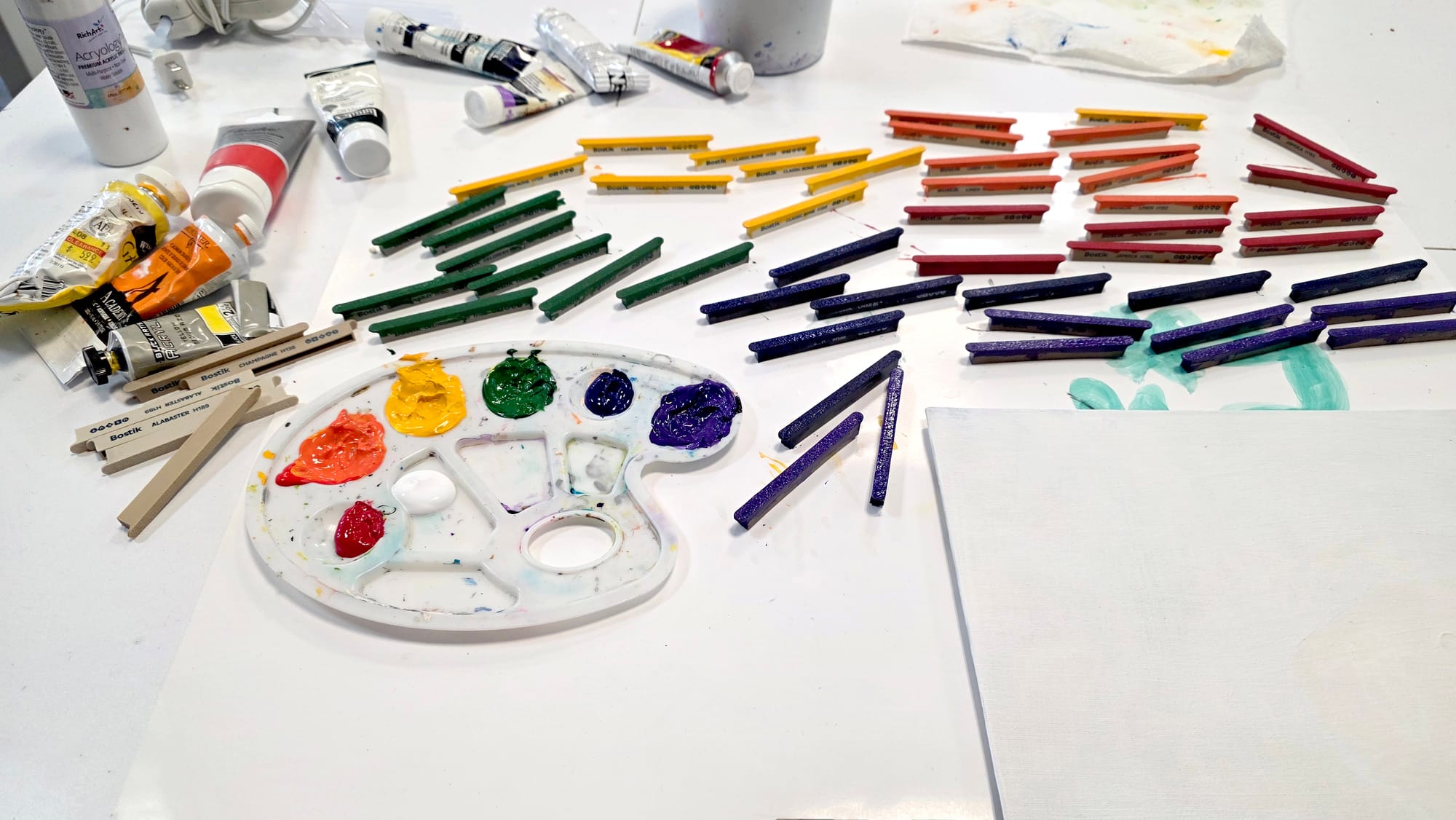
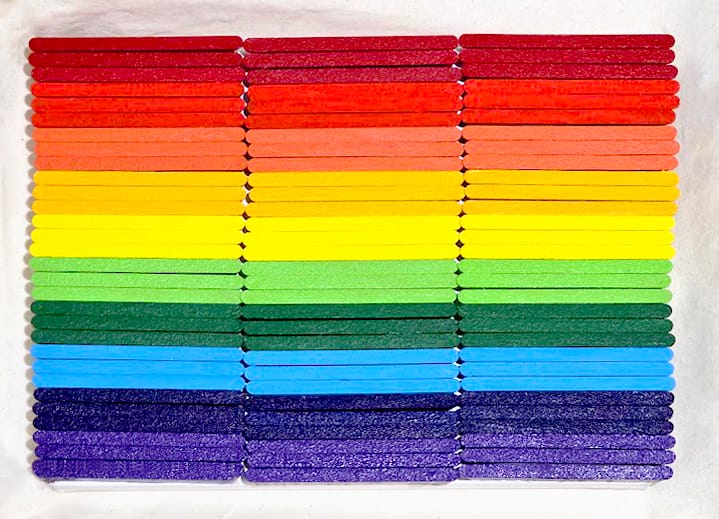
Eventually, I had enough painted pieces spread across the table to create an entire rainbow.
And that was when the experiment started becoming an artwork.
From Experiment to Artwork
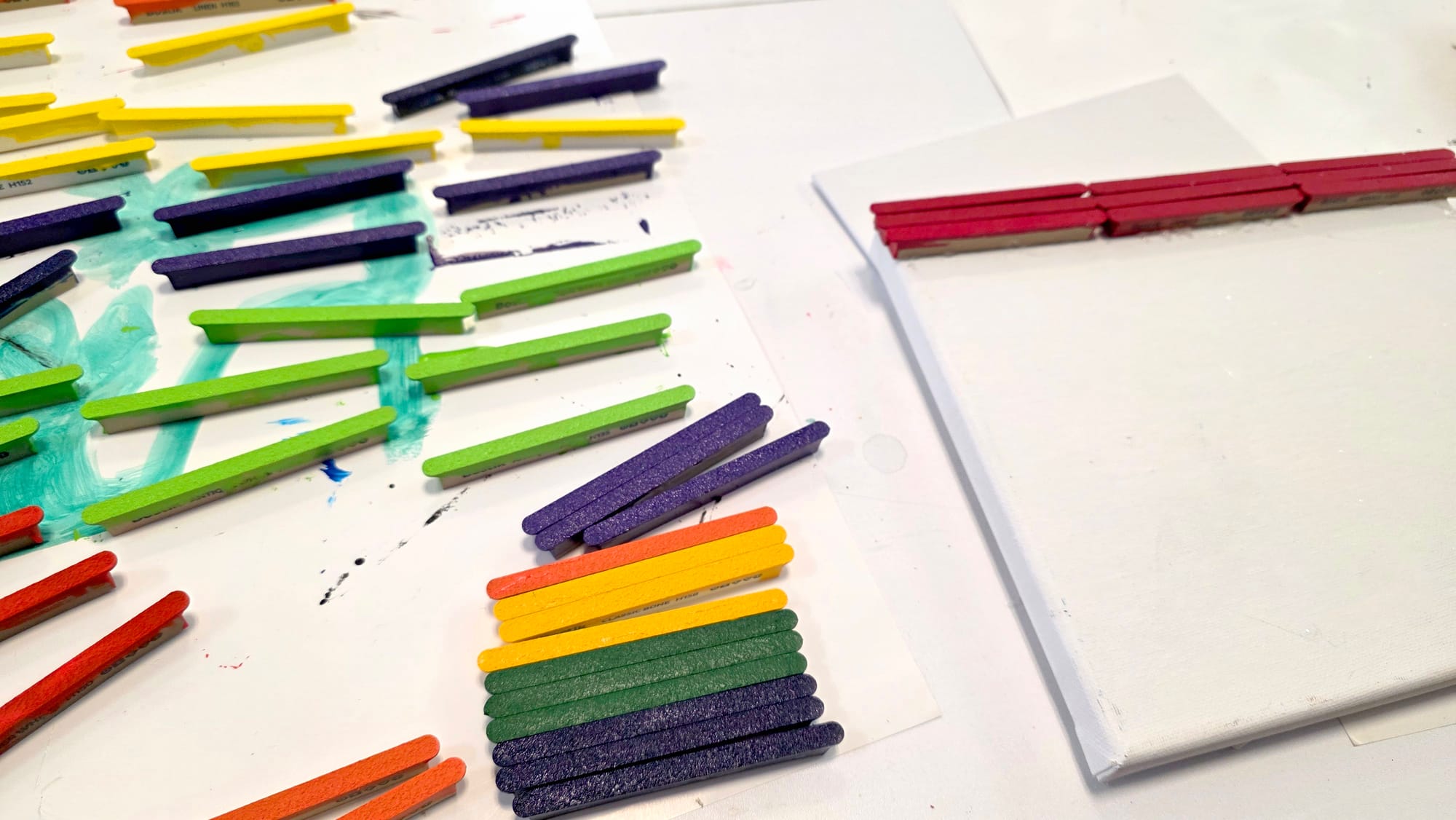
Once I had a table full of painted samples, I started arranging them by color.
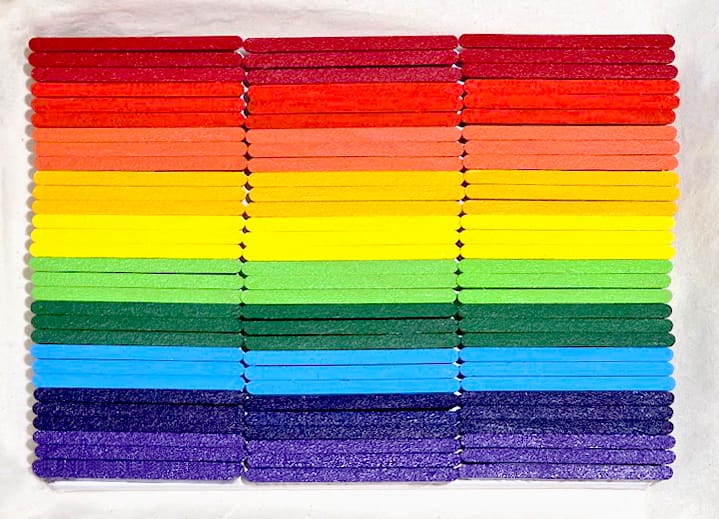
Red faded into orange. Orange became yellow, then green, blue, and purple.
I moved pieces around, adjusted the shades, and tried different arrangements until the individual sticks started working together as one larger field of color.
Eventually, I decided to attach them to a canvas.
One by one, I hot glued the samples into place, building rows of color across the surface; something that had started as a discarded flooring display was becoming a rainbow collage.
And apparently, I wasn't the only one who thought the transformation was interesting.
The staff at Artists First were surprised when they learned where the materials had come from.
First, there was the fact that I'd simply asked a flooring store whether they had anything they were going to throw away—and gotten the materials for free.
But I think the grout samples themselves were even more surprising.
They hadn't looked at them and seen art supplies.
Honestly, neither had the manufacturer.
These little pieces had been designed to help someone decide what color grout belonged between their tiles; that was their job.
Until it wasn't.
Once I painted them, arranged them, and started building with them, their original purpose became almost irrelevant.
They were just material.
An Unexpected Trip to a Dolly Parton Exhibit
While I was working, the Artists First staff told me I should enter the finished piece in their upcoming Dolly Parton tribute exhibition.
At first, I didn't quite understand the connection.
Then they reminded me of Dolly Parton's Coat of Many Colors.
Suddenly, a little experiment with discarded flooring samples had another layer to it.
I hadn't set out to make a piece inspired by Dolly Parton; I hadn't even started with a finished artwork in mind.
I had started with a box of things someone no longer needed and the question: “What else can they do?”
Now those discarded samples had become a colorful artwork—and that artwork was going to have an opportunity to hang in an exhibition.
There's something I love about that progression.
The materials didn't need to be expensive; they didn't need to come from an art-supply store, and they didn't even need to begin their lives as art materials.
They just needed someone willing to imagine another possibility.

“Wait… You Can Just Ask?”
One of the most interesting parts of this experiment wasn't actually the grout samples.
It was watching other people's reactions to them.
When I explained to people at Artists First that Michael's Flooring had given me the samples for free because they were materials the store no longer needed, there was genuine surprise.
Then there was the fact that I was painting grout samples and turning them into art.
That seemed to surprise people even more.
And I understand why; when most of us think about getting art supplies, there's a pretty familiar process:
- We decide what we want to make.
- We figure out what supplies it requires.
- Then we go somewhere that sells art or craft supplies and buy them.
There's nothing wrong with that; I love traditional art materials, too.
But it isn't the only way to find something to make art with.
I saw the same realization happen when I mentioned some of my creative-reuse experiments to another artist in my Artist INC cohort.
She was surprised that I had thought to contact businesses and ask whether they had scraps or unwanted materials I could use for art.
And then came that wonderful shift from: “You did what?” to something much closer to: wait, I could do that, too.
Maybe We Need Permission to See Things Differently
I've been thinking about that reaction.
As artists, we're constantly encouraged to be creative with what we make, but sometimes we're much less creative about what we're allowed to make it from.
A tile belongs on a wall or floor.
A grout sample belongs in a showroom.
A matboard offcut is waste from a frame shop.
A little piece of wood is a construction scrap.
Until somebody asks a different question.
- What if the tile becomes part of a mosaic?
- What if the grout sample becomes a piece of a collage?
- What if the matboard becomes a surface for drawing, painting, bookmaking, or sculpture?
- What if the wood becomes something nobody has thought of yet?
The point isn't that every discarded object secretly needs to become art. Sometimes a scrap really is just a scrap.
But we don't necessarily know that until we look at it.
 Jessica Carey
Free Materials Can Also Mean Freedom to Experiment
There's another reason I've become interested in materials businesses don't need anymore: experimentation is much easier when ruining something isn't expensive.
Art supplies can be costly.
When you're working with something precious—or something you had to stretch your budget to afford—it can be surprisingly difficult to give yourself permission to experiment.
- What if I mess it up?
- What if the idea doesn't work?
- What if I waste it?
A material that was already headed toward disposal changes that equation.
I could paint a grout sample just to find out whether acrylic paint would stick to it.
I could glue it.
Arrange it.
Paint over it.
Try something strange.
And if the experiment failed?
I hadn't destroyed a precious art supply.
I had learned something from a material that might otherwise have been thrown away.
That doesn't make discarded materials worthless.
In some ways, it makes them extraordinarily useful for learning.
Creative Reuse Is Contagious
That's why the reactions from other artists have stayed with me.
Maybe the most valuable thing about sharing these experiments isn't convincing everyone to make artwork out of grout samples.
It's showing that the question can be asked in the first place.
You can look beyond the art-supply aisle.
You can ask a business what happens to its old samples.
You can notice the weird little thing headed toward the trash.
You can pick something up and have absolutely no idea what you're going to make with it yet.
And you can ask: what else can it do?
Then the Materials Found Me
The grout samples weren't the end of this experiment.
But this time, I wasn't the one who asked.
After my first visit to Michael's Flooring, Jen Rhodes—the person who had helped me with the original batch of materials—remembered what I was doing with them.
Later, she texted me.
Another Michael's Flooring location had old samples and materials they were getting rid of; they needed to free up space, and she thought I might be able to use some of it for art.
Suddenly, something had changed.
My first experience began because I asked a business whether something headed toward disposal might have another use.
The second opportunity came looking for me.
Creative Reuse Can Be Mutually Helpful
I think that's an important part of this story.
When I first started reaching out to businesses about unwanted materials, I thought primarily about what artists might be able to rescue and reuse.
But creative reuse doesn't necessarily have to be a one-sided request for free supplies.
Businesses sometimes have old displays, discontinued samples, offcuts, scraps, or other materials taking up valuable space; eventually, someone has to decide what happens to all of it.
If a business is able and willing to give those materials away, connecting them with someone who can actually use them can help both sides.
They clear out materials they no longer need.
I get unusual materials to experiment with.
And at least some things that might otherwise become waste get another chance to be useful.
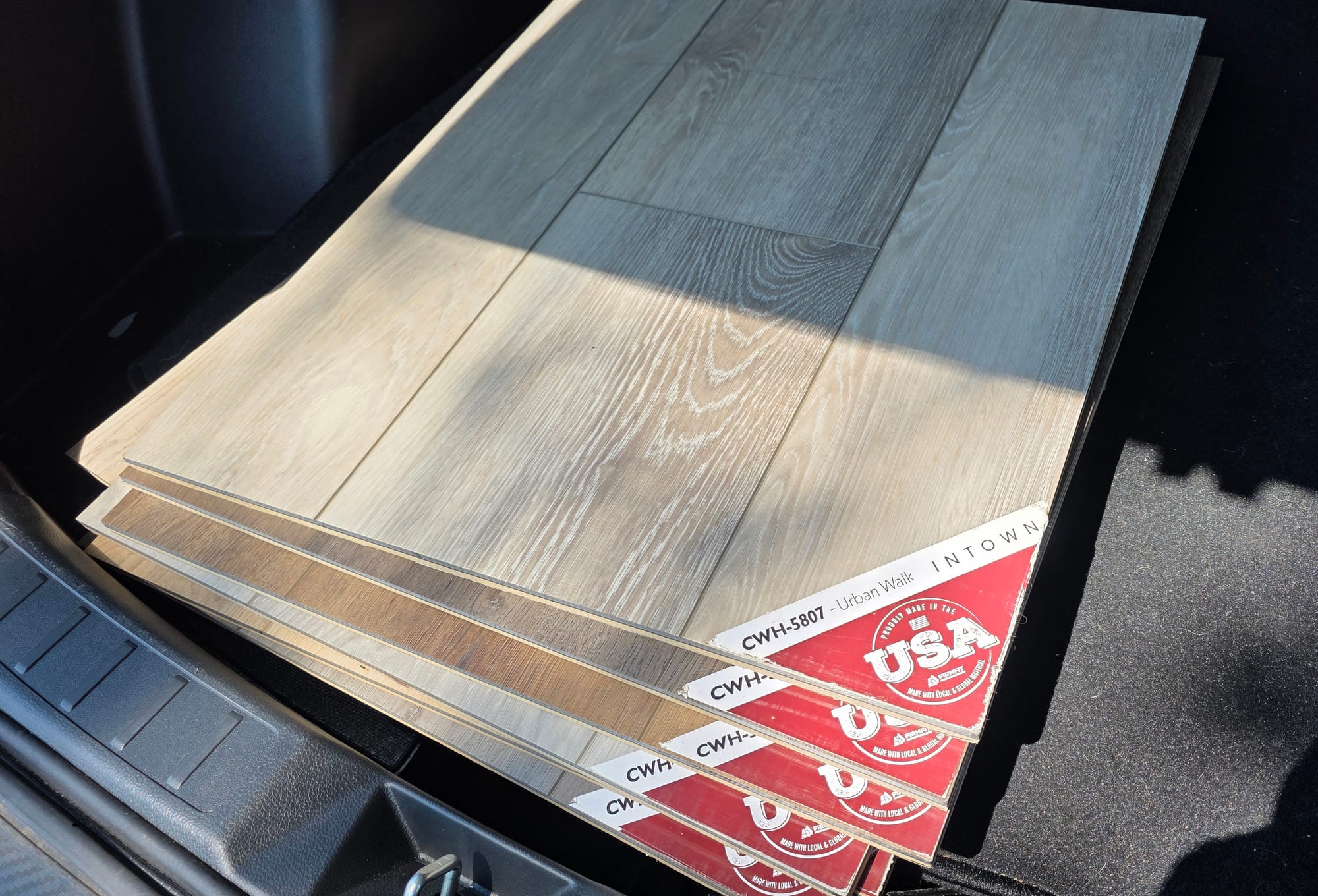
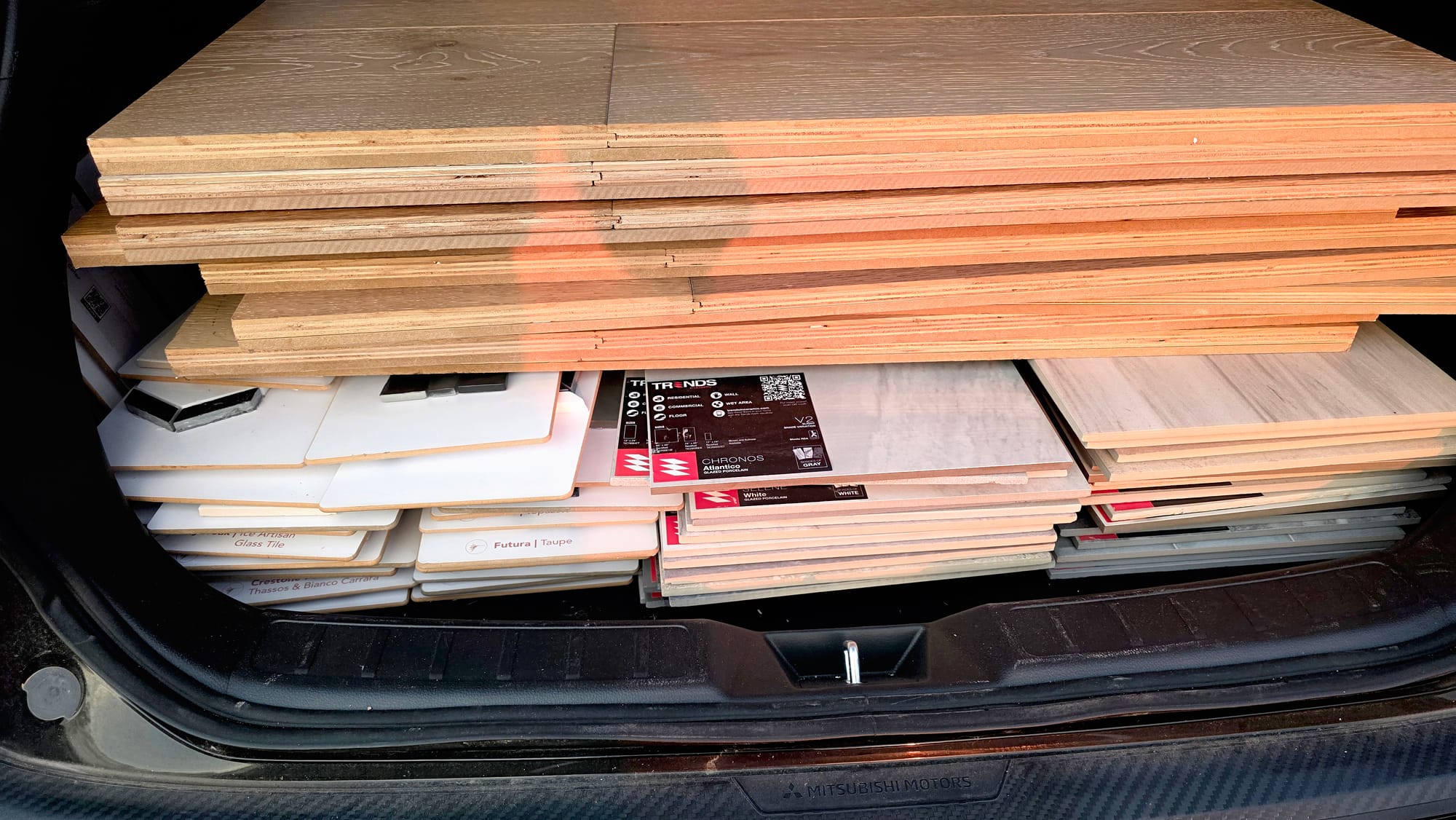
In this case, that meant another trip to Michael's Flooring—and a considerably fuller car.
This time there were large wood-look flooring panels, tile samples, stone-like slabs, and assorted sample boards in different sizes, colors, textures, and materials.
Some of them were so substantial that calling them “scraps” almost seemed strange.
They weren't necessarily useless.
They were simply no longer useful there.
 Jessica Carey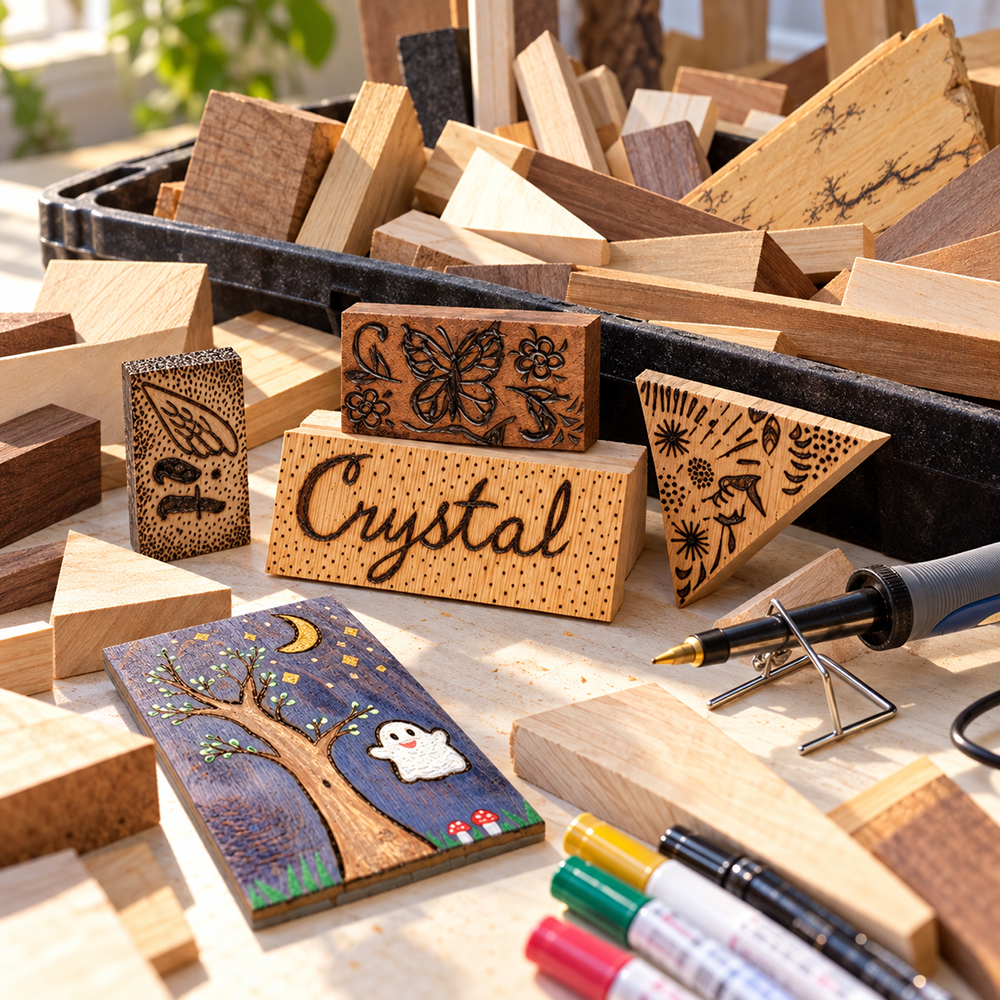
From Asking to Building a Connection
Maybe that's another lesson hidden inside this experiment.
Asking can do more than get you materials once.
It can let someone know: if you have something like this again, I might be able to use it.
I didn't need to repeatedly contact Jen asking whether anything else had become available.
She already knew I was interested in creative reuse.
When another opportunity appeared, she knew someone who might genuinely appreciate the materials.
And because I'd actually started experimenting with what she'd given me, there was now a story attached to those materials, too.
The grout samples hadn't simply moved from a flooring store into another storage pile.
They were being used.
They had been painted in bright colors, arranged across a canvas, and transformed into an artwork that was now headed for an exhibition.
That's a pretty remarkable second life for something that had outlived its original purpose.
I Still Don't Know What the New Materials Will Become
Now I have another collection of materials waiting for experiments.
The tile samples immediately make me wonder about mosaics.
The large flooring panels could potentially become surfaces for painting or mixed-media work.
The stone-like pieces introduce completely different textures and possibilities.
But I don't want to decide what everything has to become before I've had a chance to explore it.
After all, I didn't look at a grout-color display and think: obviously, this will become a rainbow collage for a Dolly Parton exhibition.
That happened because I started playing.
The material came first.
The experiment came second.
The artwork came later.
So, for now, the new materials don't need project instructions.
They need questions.
- What can I paint?
- What can I cut or rearrange?
- What can I combine?
- What happens when a flooring material leaves the floor entirely?
And, as always: what else can it do?
 Jessica Carey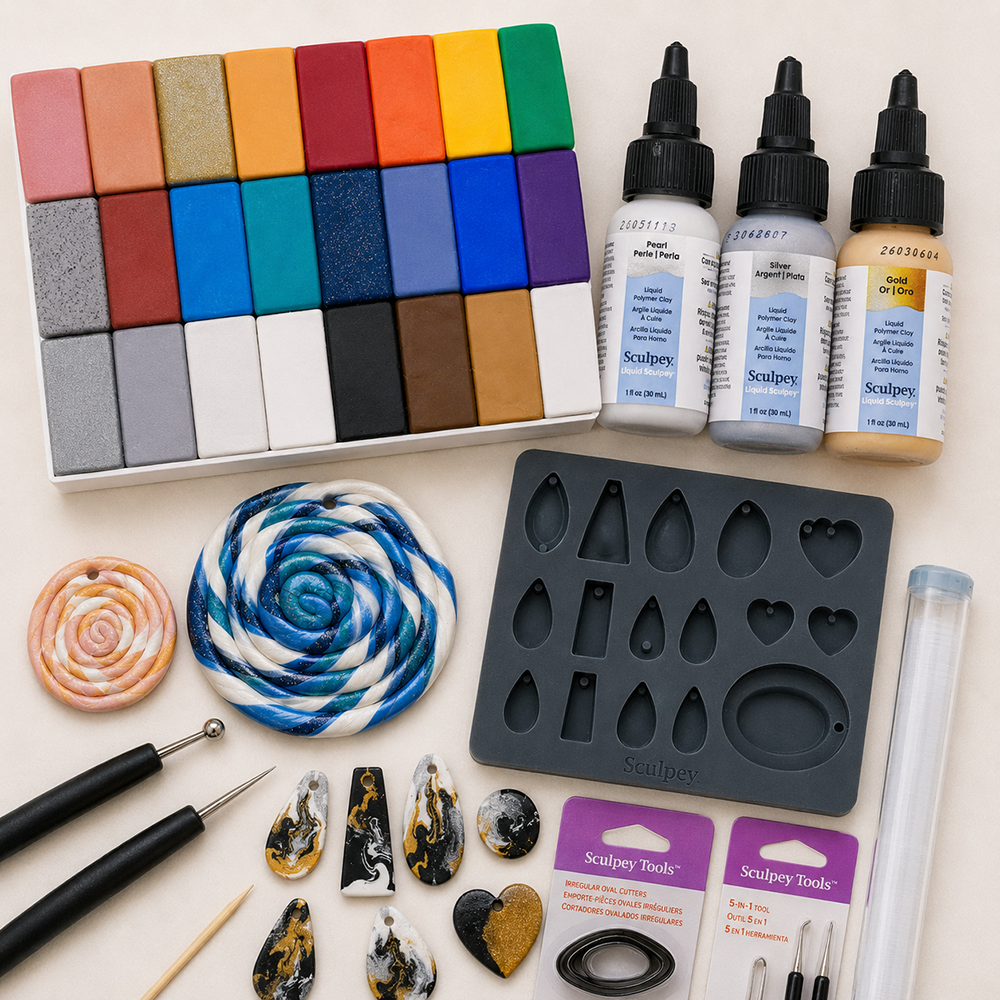
You Can Ask, Too
If you're reading this and thinking: I never would have thought to ask a flooring store for art supplies, you're definitely not alone.
That's been one of the most common reactions I've encountered while experimenting with creative reuse.
But here's the thing: you don't necessarily need to ask a business for art supplies.
Ask about what they don't need anymore.
A flooring store may not have a box labeled "Free Art Materials."
What it might have is an outdated sample display, discontinued tile samples, flooring pieces, or other materials taking up space.
A frame shop might have matboard offcuts.
A woodworker might have small pieces of lumber.
A printer or sign shop might have paper, vinyl, or other offcuts.
An upholstery shop might have fabric remnants.
None of those materials have to begin as art supplies to become useful to an artist.
Start With What Would Otherwise Go to Waste
There's an important distinction here.
I'm not walking into businesses expecting them to give me merchandise they could otherwise sell.
I'm interested in materials they don't need anymore—things that might be discarded, recycled, sit unused indefinitely, or otherwise have reached the end of their usefulness to that particular business.
That makes the question much simpler: do you have any clean scraps, discontinued samples, old displays, offcuts, or other materials you're getting rid of that an artist might be able to reuse?
Sometimes the answer will be no, and that's okay.
A business may not generate usable scraps; it may already have a recycling or donation system.
Company policies might prevent employees from giving materials away.
Or they simply may not have anything available when you ask.
A no doesn't mean asking was inappropriate.
It just means there isn't a match this time.
 Jessica Carey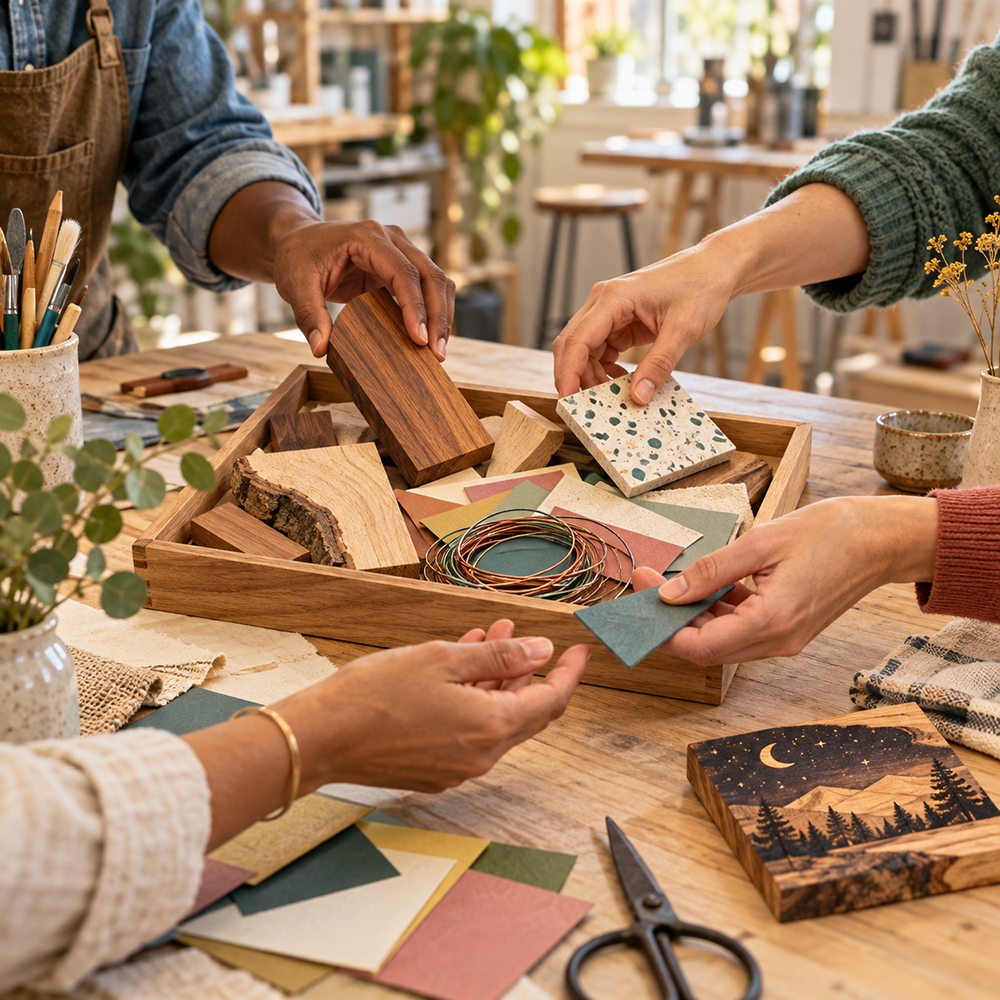
You Don't Need a Perfect Plan First
You also don't necessarily need to approach a business with a finished project proposal.
I didn't contact Michael's Flooring because I desperately needed grout samples to complete the rainbow grout-sample artwork I'd already designed.
There was no such artwork.
I was asking a broader question: is there something here that could have another life?
That leaves room for discovery.
Of course, it's still important to be realistic.
Don't take an enormous quantity of something simply because it's free if you have nowhere to store it or no reasonable possibility of using it.
Creative reuse isn't particularly helpful if we're just moving waste from a business's storage room into our own.
But you don't have to know the final destination of every individual piece, either.
Curiosity is allowed to come before certainty.
A Simple Way to Ask
Your message doesn't need to be elaborate.
Something like this is enough:
Hi! I'm a local artist who enjoys experimenting with creative reuse. I wanted to ask whether you ever have clean scraps, discontinued samples, offcuts, old displays, or other materials that you're getting rid of that might be usable for art. I'd love to repurpose some rather than see them go to waste if you have anything appropriate. No worries at all if you don't—thank you for considering it!
You can adapt that depending on the business and what kinds of materials you're interested in.
And then let them decide.
Don't take materials without permission.
Don't pressure someone after a no.
Don't expect employees to work around company policies.
Be willing to pick things up when you say you will.
And if someone helps you, kindness and gratitude go a long way.
Don't Forget to Show Them What Happened
There's one more part of this that I think is easy to overlook: if you make something, consider showing the people who helped you.
Businesses may be accustomed to seeing old samples as clutter they need to clear out.
They don't necessarily get to see what happens next.
There's something wonderful about being able to come back and say: remember those strange little things you gave me? Look what they became!
It closes the loop.
And sometimes, as my experience with Michael's Flooring showed me, maintaining that connection can lead somewhere unexpected.
Someone might remember you the next time materials become available.
Someone else at the business might start setting interesting scraps aside.
Or maybe nothing else ever comes from it—and that's okay, too.
Something still avoided the waste stream.
An artist got something unusual to experiment with.
And an object that had reached the end of one life got the chance to begin another.
No Longer Needed Doesn't Mean Useless
One thing this experiment keeps reminding me is that “no longer needed” and “useless” aren't necessarily the same thing.
The grout samples had done the job they were designed to do.
At some point, they helped customers look at different colors and imagine what those colors might look like between their tiles.
Eventually, the display wasn't needed anymore.
From the perspective of its original purpose, its story was finished.
Except it wasn't.
Those same little samples could hold acrylic paint.
They could be arranged.
They could be glued to canvas.
They could create texture and dimension.
Put enough of them together, and they could become a rainbow.
And eventually, something that started as an unwanted flooring-store display could become an artwork headed for an exhibition.
Nothing about the physical material suddenly became more valuable when I brought it into an art studio.
What changed was the way I looked at it.
Usefulness Depends on the Question
We tend to describe objects according to the jobs they were designed to perform.
A grout sample shows grout colors.
A tile covers a surface.
A piece of flooring belongs on a floor.
A matboard scrap is what's left after something else gets cut.
But those descriptions tell us where the material came from.
They don't necessarily tell us everything the material can do.
That's one reason I've become so interested in experimenting with materials outside traditional art supplies.
Instead of beginning with: what am I supposed to make with this?
I can ask: what properties does this have?
- Is it rigid?
- Flexible?
- Textured?
- Transparent?
- Paintable?
- Cuttable?
- Stackable?
- Reflective?
Can I punch holes in it?
Wrap something around it?
Glue something to it?
Break it apart?
Combine it with another material?
Suddenly, I'm not looking at a grout sample anymore.
I'm looking at a small, textured, dimensional object that accepts paint.
That's a completely different starting point.
 Jessica Carey
Not Everything Needs to Be Saved
Of course, creative reuse doesn't mean every scrap needs to become an art project.
Some materials aren't safe to work with.
Some can't practically be reused.
Some are genuinely waste.
And accumulating enormous amounts of material without ever using it doesn't solve much of anything.
The goal isn't to rescue every object from every trash can.
It's to become a little more curious before deciding that an object's usefulness is over.
Sometimes the answer really will be: there's nothing I can do with this.
But sometimes it might be: wait a minute.
The Material Didn't Change. The Question Did.
That's ultimately what happened with the grout samples.
They were the same objects when they were sitting in a flooring store as they were when I carried them into an art studio.
Then I painted one.
And another.
And another.
I started arranging them by color.
Eventually, dozens of tiny pieces that had once existed to help someone choose grout became something completely different.
The material didn't need to know what it was becoming.
Neither did I, at first.
I just needed to be curious enough to experiment.
And perhaps that's the part of creative reuse I find most exciting.
Sometimes possibility isn't hiding inside a new material we've never seen before.
Sometimes it's hiding inside something ordinary that we've already decided we understand.
 Jessica Carey
A Special Thank-You
Before wrapping up this experiment, I want to give a warm thank-you to Jen Rhodes and Michael's Flooring for making it possible.
It meant a lot that Jen was genuinely excited to see materials that were no longer needed find another life through art—and even more that she remembered what I was doing and reached out when another location had materials they needed to clear out.
That kind of connection is exactly what makes creative reuse possible: someone has a material they no longer need, someone else sees possibility in it, and instead of becoming waste, it gets another chance to become something.
Thank you for giving me a whole lot of new things to ask: “What else can it do?”
What Else Can It Do?
The rainbow collage may be finished, but the experiment isn't.
Somewhere along the way, a discarded grout display became a pile of brightly painted pieces.
Those pieces became a rainbow.
That rainbow became an artwork.
And now, unexpectedly, that artwork is headed for an exhibition.
Meanwhile, I have an entirely new collection of flooring samples waiting for me.
There are tiles that might become mosaics.
Large flooring panels that might become surfaces for painting or mixed-media work.
Stone-like pieces whose possibilities I haven't figured out yet.
And probably ideas I can't predict from looking at any of them right now.
That's part of the fun.
The Materials Lab isn't about proving that every discarded object has some brilliant secret purpose; it's about giving ourselves permission to investigate before assuming we already know what something can be.
So maybe the next time you encounter an odd scrap, an obsolete sample, an offcut, a leftover piece, or something else that's reached the end of its original job, don't immediately ask: what is this supposed to be used for?
Try asking:
- What does it do?
- What could I try?
- What else can it do?
You might discover that the answer is nothing.
You might make an absolutely terrible experiment.
You might learn something useful and never make a finished artwork at all.
Or you might paint a bunch of old grout samples on a random afternoon and somehow end up with a piece for a Dolly Parton exhibition.
I certainly didn't see that one coming.
But that's what experiments are for.
Your Turn to Experiment
The next time you encounter an offcut, outdated sample, leftover piece, strange bit of packaging, or other material that's no longer needed, you don't have to immediately know what to make from it.
Start smaller.
Look at it.
Touch it, if it's safe to handle.
Notice what it's made from.
Notice its texture, weight, shape, flexibility, transparency, edges, and surface.
Then forget, for a moment, what it was supposed to be.
Ask what it could be.
Maybe the answer is nothing.
Maybe you'll try something and it won't work.
Or maybe you'll end up painting dozens of grout samples in every color of the rainbow and somehow find yourself entering them in a Dolly Parton exhibition.
There's really only one way to find out.
What else can it do?
 Jessica Carey
Want even more content about creativity and art?
Be sure to check out all of our creative chronicles!
If you'd like to see examples of my work, you can find some of my art and creations at Redbubble and Gumroad!
Looking to learn more about my recent journey?
Check out some of these articles:
-Hidden Gems for St. Louis Artists
-Hidden Gems for Autistic & Neurodivergent Adults
-I Wasn't Broken--I'm Burned Out
-The Difference Between Resting and Giving Up
-What Chronic Autistic Burnout Actually Feels Like
 Jessica Carey