Before someone ever calls themselves an artist, they may already be making things.
A child drags a finger through condensation on a window.
Someone doodles in the margin of a notebook.
We arrange stones.
Hum melodies that didn't exist a moment ago.
Decorate the things we own.
Move furniture around until a room somehow feels right.
Fold paper.
Stack blocks.
Tell stories.
Tie ribbons around things that didn't need ribbons.
Take something apart and put it back together differently.
We find a surface.
We leave a mark.
We find a material.
We change it.
We encounter something that already exists and wonder, sometimes without even putting the thought into words: what else could this become?
Something Wasn't Here Before
There is something quietly remarkable about making.
At first, there is only a piece of paper.
A lump of clay.
A length of yarn.
A piece of wood.
A collection of sounds.
An empty room.
A blank document.
Then a human being interacts with it.
They move something.
Add something.
Remove something.
Combine things that weren't together before.
And afterward, the world is slightly different.
Maybe only slightly.
Maybe temporarily.
Maybe the thing will be thrown away tomorrow.
Maybe nobody besides its maker will ever care about it.
But for a moment there is this strange little fact: something wasn't here before; now it is, and I had something to do with that.
Not Everything We Make Needs a Purpose
We make useful things, of course.
Shelter.
Clothing.
Tools.
Containers.
Furniture.
Things designed to solve problems and meet needs.
But usefulness doesn't explain all of it.
Because humans have an interesting habit of doing more than what is strictly necessary.
We don't merely make a container.
We decorate it.
We don't simply construct a building.
We think about how it looks.
We turn food into shapes.
Add patterns to clothing.
Arrange objects on shelves.
Choose colors.
Invent characters.
Sing when silence would function perfectly well.
We make things nobody asked for.
Things nobody needs.
Things that may never earn money, solve a problem, teach a lesson, or accomplish anything measurable.
And still, we make them.
 Jessica Carey
Sometimes the Impulse Comes Before the Explanation
Ask someone why they made something and perhaps they'll have an answer:
- I wanted to remember this.
- I made it for someone I love.
- I needed somewhere to put what I was feeling.
- I wanted to see if I could do it.
- I thought it would be beautiful.
- I was bored.
- It seemed fun.
And sometimes: I don't know. I just wanted to.
Maybe we don't always need to translate that impulse into something more impressive.
Sometimes the desire to make seems to arrive before we understand why.
Our hands begin before we've written the artist statement.
We pick up the pencil.
Move the object.
Touch the material.
Try the idea.
Make the mark.
And only afterward might we wonder what drew us toward it.
Why Do We Make Things?
There are plenty of practical answers to that question.
We make because we need things.
Because creativity can support well-being.
Because people build careers from what they create.
Because making can teach skills, solve problems, preserve traditions, or communicate ideas.
All of those things can be true.
But there's another question underneath them that interests me more: why are humans so drawn to making in the first place?
- Why do we leave marks?
- Why do we transform materials?
- Why do we take things that exist inside us—ideas, stories, feelings, images, sounds—and give them forms outside ourselves?
- Why do we decorate things that would function perfectly well without decoration?
- Why do we make things for one another?
- Why, even when nobody is grading us, paying us, asking us, or sometimes even watching us, do we still create?
I don't think there's one answer.
Maybe that's what makes the question so interesting.
Perhaps we make to communicate.
To remember.
To play.
To connect.
To explore.
To transform.
To leave some small evidence of an encounter between ourselves and the world.
Or perhaps sometimes the impulse is simpler than any explanation we could give it.
Something is in front of us.
Something could be done with it.
And some deeply human part of us thinks: I want to make something.
 Jessica Carey
We Leave Marks
Give a child a crayon and a blank piece of paper, and something often happens almost immediately.
A line.
A scribble.
A circle that may or may not have been intended to be a circle.
The child looks at it.
Makes another.
And another.
Soon the empty page isn't empty anymore.
Something happened between the hand, the crayon, and the paper.
A mark appeared.
I Did That
There is something wonderfully simple about recognizing a mark as your own.
Drag a finger through wet sand and a line follows you.
Press your hand into clay and your palm remains after you lift it away.
Move a pencil across paper and the movement of your hand becomes visible.
Maybe that's part of the fascination.
An action that would otherwise disappear leaves something behind.
I moved my hand like this.
And now there is evidence of the movement.
I touched this.
And now the material carries the shape of that touch.
I was here.
Not necessarily as some grand declaration of importance.
Sometimes it's much smaller than that.
More like: I did that.
We Mark the Things Around Us
And we don't only make marks on surfaces intended for art.
We doodle in margins.
Draw little faces on sticky notes.
Write names in condensation.
Arrange magnets on refrigerators.
Put stickers on water bottles.
Customize phone backgrounds.
Decorate notebooks that would work perfectly well undecorated.
Some people cover belongings in color and pattern.
Others make one tiny alteration that nobody else would even notice.
A plain object becomes: mine.
Not simply because we own it, but because we've interacted with it.
We've left some trace of preference, personality, humor, memory, or touch.
The object now carries a small encounter between itself and a person.
Some Marks Disappear
Not everything we make is meant to last.
A drawing in sand disappears beneath the tide.
A chalk picture washes away in the rain.
A pattern traced into condensation vanishes as the glass dries.
A carefully decorated cake gets eaten.
A snow sculpture melts.
Someone spends an hour arranging objects only to take them apart afterward.
The disappearance doesn't mean making them was pointless.
Maybe that's worth remembering.
We sometimes talk about creating as though the goal is to leave something behind—to make something permanent enough to outlive us.
And sometimes it is.
But making isn't always an attempt at immortality.
Sometimes it's simply an encounter.
A person was here.
A material was here.
For a little while, they interacted.
Something happened.
And then it passed.
A Mark Doesn't Have to Be Important
Maybe that's part of what makes this impulse so interesting.
The mark doesn't necessarily need an audience.
It doesn't need to be beautiful.
It doesn't need to be preserved.
It doesn't need to become valuable.
It doesn't even need to be particularly good.
A doodle drawn absentmindedly during a conversation may never mean anything more than the movement of a pen across paper.
But someone still made it.
For a few seconds, a blank space presented a possibility.
And a human being responded by changing it.
Perhaps that's one of the smallest forms making can take.
Not: look at the important thing I have created.
But simply: there was nothing here; my hand moved, and now there is a mark.
And sometimes, before stories or symbolism or usefulness enter the picture, that seems to be enough.
We Transform What We Find
A piece of clay is already something.
So is a length of yarn.
A fallen branch.
A sheet of paper.
A cardboard box.
A handful of flour.
A collection of sounds.
A room full of furniture.
And yet humans have an interesting tendency to encounter what already exists and wonder: what else could this become?
Clay becomes a bowl.
Yarn becomes a scarf.
Wood becomes a table.
Flour becomes bread.
Paper becomes a crane.
Sounds become a song.
A cardboard box becomes a castle, a robot, a house, a spaceship—or whatever else a child decides it is that afternoon.
We don't only live among materials.
We transform them.
We See Possibility in Things
There is something quietly creative about looking at one thing and imagining another.
A scrap of fabric might become part of a quilt.
An empty jar might become a vase.
A broken piece of jewelry might become part of something new.
Someone finds an oddly shaped piece of driftwood and immediately knows exactly where it should go.
Someone else looks at it and sees firewood.
Another person simply sees a stick.
None of those responses is necessarily wrong.
But making often begins with that little shift: this is what it is.
Followed by: but it could also be...
The material hasn't changed yet.
The first transformation happens in imagination.
Creativity Doesn't Always Call Itself Art
We sometimes make creativity unnecessarily small by reserving it for activities officially recognized as creative.
Painting.
Drawing.
Sculpture.
Music.
Writing.
Dance.
Those certainly belong.
But the impulse to transform and arrange appears in much more ordinary places.
Someone braids another person's hair.
Decorates a birthday cake.
Arranges flowers on a table.
Patches a torn pair of jeans in a way that makes the repair visible and beautiful.
Chooses how photographs hang on a wall.
Builds a blanket fort.
Wraps a gift.
Plants flowers according to color.
Sets a table for people they love.
Rearranges a room until it feels different to inhabit.
None of those things has to be called art for creativity to be happening.
Maybe making is bigger than the categories we've built around it.
 Jessica Carey
Sometimes Function Isn't Enough
Humans also have an amusing habit of adding things that aren't strictly necessary.
A bowl only needs to hold something.
And yet we glaze it blue.
A sweater only needs to keep someone warm.
And yet we choose a pattern.
A cake only needs to be edible.
And then somebody spends an hour piping tiny flowers across it.
A building can provide shelter without ornament.
A chair can function without being beautiful.
A notebook doesn't care what its cover looks like.
But we do.
We add pattern.
Texture.
Color.
Shape.
Personality.
Tiny details someone might never consciously notice.
Function answers: does it work?
Making sometimes asks another question: yes—but what else could it be?
Our Hands Learn What Materials Can Do
Of course, transformation isn't unlimited.
Materials answer back.
Clay collapses when pushed too far.
Wood has grain.
Paper tears.
Yarn tangles.
Paint runs.
Fabric stretches.
Ingredients behave differently when heated.
Sometimes the thing we imagined simply doesn't work.
And then something interesting happens.
We adjust.
Try again.
Change the plan.
Follow what the material is doing.
Discover a possibility we hadn't considered.
Making becomes less like imposing an idea onto something and more like a conversation between: what I want to do and what this material will let me do.
Sometimes the material even gives us a better idea.
The World Is Full of Could Be
Perhaps that's one of the strange gifts of making.
It lets us encounter the world not only as a collection of finished things, but as a collection of possibilities.
This could be folded.
That could be painted.
Those could be combined.
This could be moved over there.
That broken thing might be repaired.
This scrap might belong somewhere else.
- What happens if I turn it upside down?
- What happens if I make it smaller?
- What happens if I use it differently?
- What happens if I try?
Not every possibility becomes something wonderful.
Some become spectacular failures.
Some become strange little accidents.
Some get taken apart and used for something else.
But before any of that can happen, someone has to imagine that what exists doesn't have to remain exactly as it is.
Maybe that's part of why we make.
We encounter a world already full of things.
And instead of only asking: what is this?
Some part of us also asks: what could it become?
We Make Inner Things Outer
Some things exist without having a physical form.
A memory.
An idea.
A feeling.
A melody you hear only in your head.
A character nobody else has met.
A place that doesn't exist.
A story that hasn't been told.
They can feel extraordinarily real to us.
And yet nobody else can see them.
Then we make something.
The melody becomes sound.
The character becomes a drawing.
The memory becomes a photograph, poem, quilt, painting, or story.
The imagined place becomes a miniature world built from cardboard.
Something that existed only within one person has crossed a strange boundary.
Now some part of it exists outside them.
Sometimes We Make What We Can't Quite Say
Language is remarkable.
But sometimes words don't seem to fit.
Someone might know exactly what they're feeling and still struggle to explain it.
Or perhaps they don't know what they're feeling at all.
There is simply something there.
A heaviness.
An excitement.
A question.
A memory that keeps returning.
An image they can't stop imagining.
So maybe they paint.
Write.
Sing.
Dance.
Sew.
Build.
Photograph.
Arrange.
Not necessarily because they have a message they want someone else to decode.
Sometimes making gives something intangible somewhere to go.
A feeling becomes color.
A memory becomes an object.
A thought becomes a sentence.
An imagined sound enters the air.
We don't necessarily solve what was inside us by making it.
But now we can encounter it in another form.
Sometimes Making Is How We Find Out
We often imagine creativity beginning with certainty: I know exactly what I want to make.
And sometimes it does.
But sometimes we begin with almost nothing.
A color we keep reaching for.
A sentence that appeared in our head.
A shape we want to draw again.
A melody we keep humming.
A material we feel drawn toward without knowing what we're going to do with it.
So we follow it.
One mark leads to another.
One sentence creates the next.
One choice changes what becomes possible afterward.
And eventually we may step back and realize: oh, there you are.
Maybe we recognize something we hadn't known how to name.
Maybe we don't.
The finished thing may remain mysterious even to the person who made it.
But perhaps making doesn't always happen because we've already understood something.
Sometimes making is one of the ways we meet what we don't understand yet.
 Jessica Carey
We Can Show Someone Something They Could Never Otherwise See
There is something almost impossible about trying to fully share an inner experience.
Nobody can enter another person's memory exactly as they experienced it.
Nobody can hear an imagined melody until its creator gives it sound.
Nobody can see the landscape inside someone else's mind.
Nobody can experience another person's love, grief, wonder, fear, nostalgia, humor, or imagination exactly as they do.
There will always be distance between inner worlds.
And yet humans keep building bridges across it.
- Here.
- Listen to this.
- Read this.
- Look at what I made.
- This is a little bit of what it was like for me.
The thing we make can never transfer an experience perfectly.
But it can offer someone else a glimpse.
And perhaps that glimpse is enough to make the distance between two inner worlds feel slightly smaller.
Not Everything Inside Us Needs an Audience
But making inner things outer isn't always about being understood by someone else.
Sometimes nobody sees the sketchbook.
The song is sung alone.
The story stays in a document.
The strange little object lives on a shelf.
The journal is closed.
The photograph is never posted.
The thing still exists.
And perhaps that matters.
Because making doesn't always need to say: I want you to see this.
Sometimes it says: I needed to see this.
There is something different about an idea once it has words.
Something different about an imagined image once it has lines.
Something different about a memory once we've given it a form we can hold.
The audience can simply be the person who made it.
We Give Form to What Has None
Maybe this is one of the stranger things humans do.
We take something invisible and give it edges.
Something silent and give it sound.
Something fleeting and give it a place to remain.
Something imagined and allow it, however imperfectly, to enter the physical world.
Not everything we make begins inside us, of course.
Sometimes we're simply responding to materials, solving a practical problem, playing, or following curiosity.
But sometimes there is something within us that seems to ask for a form.
We may not know why.
We may not know what it means.
We may not even know what we're making until it's already there.
But for a little while, something that could only be experienced from inside one human being becomes something another person—or perhaps simply its maker—can encounter.
Maybe we make because sometimes having something inside us isn't quite the same as giving it somewhere to exist.
We Make Because Making Feels Good
Sometimes making feels good.
That may not sound like a particularly profound explanation.
Maybe it doesn't need to.
There is pleasure in pressing a thumb into soft clay.
In watching watercolor spread across wet paper.
In pulling yarn through a loop and watching row after row slowly become fabric.
In cutting along a line.
Folding paper into a crisp edge.
Sanding something rough until it becomes smooth.
Mixing colors just to see what appears.
Arranging pieces until suddenly they fit.
Sometimes the pleasure isn't in what the thing means.
It's in what our hands are doing.
Our Hands Like to Be Involved
Making is often physical in ways we don't think much about.
Push.
Pull.
Twist.
Fold.
Cut.
Smooth.
Stack.
Stitch.
Shape.
Arrange.
Repeat.
We interact with materials and receive immediate responses from them.
Push into clay and it moves.
Pull yarn and a loop tightens.
Drag a brush and color follows.
Strike a key and a sound appears.
Move one piece and the whole arrangement changes.
There is something satisfying about that exchange: I do something, and something happens.
And then we respond to what happened.
Making can become a rhythm between ourselves and whatever is in front of us.
Repetition Can Be Its Own Kind of Pleasure
Not every creative moment needs constant novelty.
Sometimes we want to do the same thing again.
And again.
And again.
Another stitch.
Another bead.
Another brushstroke.
Another folded piece.
Another line.
Another row.
The repetition may eventually create something larger, but sometimes the individual motion itself is part of what keeps us there.
There can be comfort in knowing what comes next.
There can also be a quiet satisfaction in watching small actions accumulate.
One stitch doesn't look like much.
Neither does one mark.
But then there are twenty.
A hundred.
A thousand.
And eventually you realize: oh, this is becoming something.
Making Gives Us Little Problems to Solve
Of course, making doesn't always feel peaceful.
Sometimes the yarn tangles.
The clay collapses.
The paint does something deeply unhelpful.
The pieces refuse to fit.
The recipe behaves as though it has developed a personal grievance against you.
The thing you imagined and the thing sitting in front of you appear to have absolutely nothing in common.
And strangely, that can be part of the appeal, too.
- What if I try this?
- Can I fix that?
- What happens if I turn it around?
- Could this mistake become something else?
Making gives us small problems with materials we can physically engage.
Sometimes we solve them.
Sometimes we don't.
Sometimes the failed solution creates a much more interesting problem.
And sometimes what was supposed to be one thing becomes a surprisingly good something else.
There can be pleasure not only in succeeding, but in figuring things out as we go.
Sometimes We Make Because It's Fun
Adults can become strangely uncomfortable with this explanation.
Children don't seem to have quite the same problem.
Why did you paint that?
Because I wanted to.
Why is the dog purple?
Because I made it purple.
Why did you glue that thing there?
Because.
There is a freedom in creating before we learn that every activity is apparently supposed to become productive.
We don't necessarily need to improve.
Monetize it.
Master it.
Post it.
Finish it.
Turn it into a side hustle.
Or produce something impressive enough to justify the time we spent.
Sometimes we can make because making is an enjoyable way to spend part of a life.
That's enough.
Sometimes Our Hands Know Before We Do
Perhaps that's why the impulse to make can be difficult to explain.
Our minds want reasons.
But sometimes our hands have already begun.
We pick up the interesting rock.
Touch the fabric.
Straighten the objects.
Twist the wire.
Open the sketchbook.
Reach for the yarn.
Maybe there is a deeper reason.
Maybe we'll discover one later.
Or maybe the material simply invited interaction and something in us answered.
- Touch this.
- Move this.
- Try this.
- See what happens.
We do.
Something changes.
We respond.
And for a little while, that exchange is satisfying enough that we want to keep going.
Maybe some making begins with meaning.
Some with necessity.
Some with an idea that won't leave us alone.
But sometimes the answer to “Why did you make that?” can remain wonderfully uncomplicated: because making it felt good.
We Make With and For One Another
Some of the things we make are never really ours alone.
A child draws a picture and immediately runs to give it to someone.
A friend makes another friend a birthday card.
Someone knits a scarf for a person they love.
A family prepares a meal together.
People decorate a room for a celebration.
Someone learns a recipe that has passed through generations of hands.
We make things for people.
We make things beside people.
We learn how to make things from people.
And sometimes making becomes one of the ways we reach toward one another.
I Made This for You
There is something particular about receiving something another person made.
Not necessarily because the object is technically impressive.
Not because it would have been expensive to buy.
But because somewhere in its creation was a thought: you.
Someone chose the color you like.
Remembered something you said.
Spent an afternoon stitching, painting, baking, building, writing, folding, carving, or arranging.
The thing carries evidence of attention.
Even something very small can say: I thought about you when you weren't here.
Perhaps that's why handmade gifts can feel so different from other objects.
They aren't only things.
They contain time someone chose to spend.
Come Make This With Me
But making doesn't always result in an object passed from one person to another.
Sometimes the making itself is what we share.
People gather around tables.
Paint beside each other.
Cook together.
Sing together.
Quilt together.
Build together.
Make decorations for something that hasn't happened yet.
Someone reaches for the scissors.
Someone else asks for the glue.
One person knows how to do something another doesn't.
Someone makes a mistake.
Someone laughs.
Someone says: wait—how did you do that?
And for a while, people who might otherwise have little reason to interact are occupied by the same thing.
The object matters.
But so does everything happening around it.
 Jessica Carey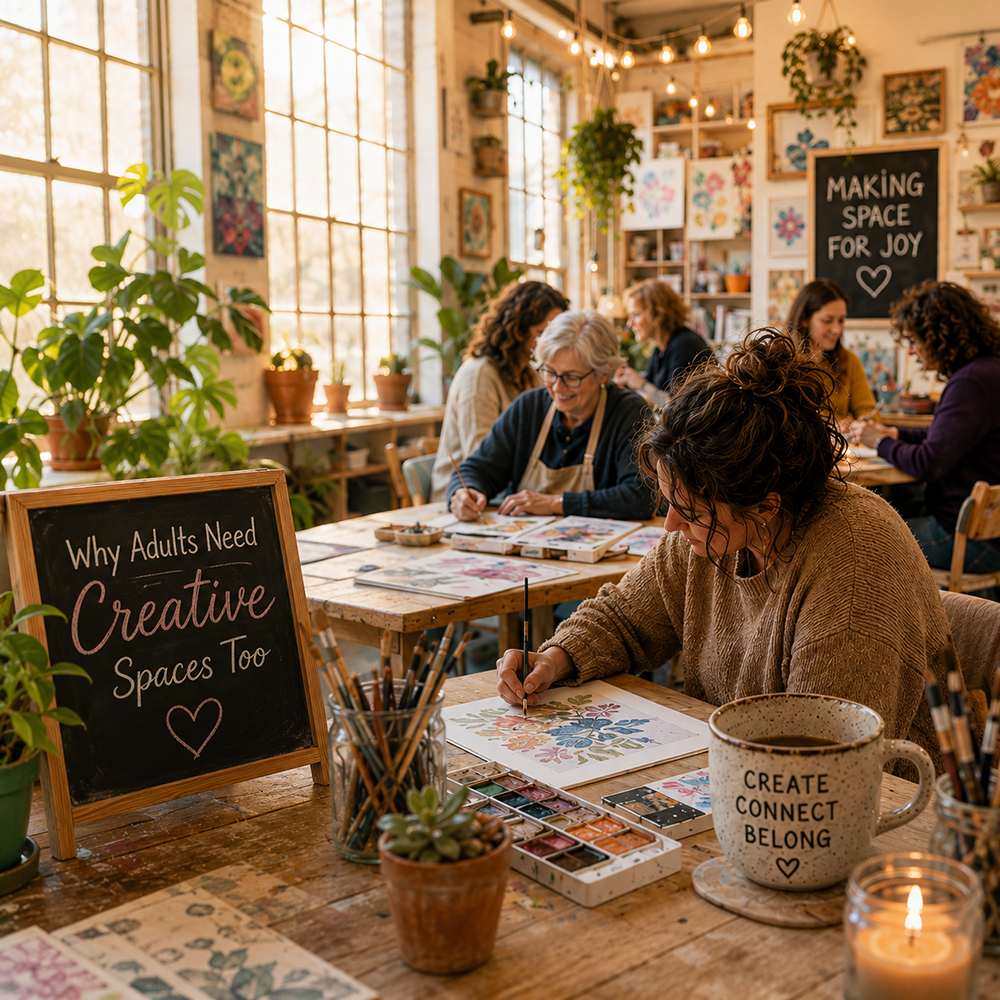
Let Me Show You
Almost nothing we know how to make appeared from nowhere.
Someone showed someone.
Who showed someone else.
Who changed it.
Adapted it.
Improved it.
Forgot part of it.
Invented another part.
Passed it along again.
A grandparent teaches a child a recipe.
A friend shows another friend how to knit.
An artist demonstrates a technique.
A craftsperson teaches an apprentice.
A child shows another child the very important correct procedure for constructing the particular kind of paper creature they invented five minutes ago.
Knowledge moves through hands.
- Hold it like this.
- Try pulling this part tighter.
- Watch what happens when you do this.
- Here—you try.
Making becomes something we inherit from one another.
And something we alter before passing along.
What We Make Carries Other People With It
Even when we make alone, we may not really be making alone.
The technique came from somewhere.
The tool was designed by someone.
The pattern may have been taught to us.
The story structure has ancestors.
The song carries sounds we've heard before.
The materials were grown, produced, gathered, manufactured, sold, or given to us by other hands.
We borrow.
Learn.
Adapt.
Combine.
Respond.
Sometimes knowingly.
Sometimes without realizing how many other people helped make our own making possible.
Perhaps that's one reason the idea of the completely isolated creative genius has always been a little strange.
A person may make something entirely by themselves.
But they still make it inside a human world.
We Make Things to Hold What Matters
Some things are also made because ordinary life occasionally seems to need a physical form for what we care about.
We make birthday cakes.
Wedding decorations.
Baby blankets.
Costumes.
Holiday ornaments.
Memorials.
Photo albums.
Handwritten cards.
Objects that mark beginnings.
Objects that mark endings.
Objects that say:
- This happened.
- You matter.
- We remembered.
- We're celebrating.
- We miss you.
- We're glad you're here.
The object doesn't create the relationship.
But sometimes it gives the relationship somewhere to land.
Something we feel toward another person becomes something we can bake, stitch, write, build, arrange, wrap, hold, give, or keep.
Making Can Be a Way of Reaching Toward Someone
Maybe that's why some of the simplest phrases surrounding creativity feel so deeply human:
- Look what I made.
- I made this for you.
- Come make this with me.
- Let me show you how.
- Will you show me?
Each one reaches across the space between people.
One offers something.
One invites someone closer.
One passes knowledge forward.
One admits there is something another person knows that we don't.
And perhaps that is another reason we keep making.
Not everything we create is intended for another person. Not everything needs to be shared.
But again and again, humans have taken materials, sounds, words, food, movement, images, and ideas and used them to reach toward one another.
Sometimes we make because there is another human being on the other side of the making.
And something in us wants to say: here, this is for you.
And Then There Is Something That Wasn’t There Before
So, why do we make things?
Maybe we make because we want to communicate.
Because we want to remember.
Because something inside us needs somewhere outside us to exist.
Because we see possibility in what is already here.
Because our hands enjoy touching, moving, shaping, arranging, and transforming.
Because we're curious.
Because we're bored.
Because we're playing.
Because we love someone.
Because another person taught us how.
Because we want to pass something along.
Because something could exist that doesn't exist yet.
Or maybe sometimes there isn't a reason we could neatly explain.
We Don't Have to Solve the Mystery
There is a temptation, especially when talking about creativity, to turn making into something we can justify.
We make because it's good for us.
Because it develops skills.
Because it builds community.
Because it helps us communicate.
Because it preserves culture.
Because it can become a career.
Because it produces something useful.
Those things can all be true.
But perhaps asking “Why do we make things?” doesn't have to end with a practical defense of why making is worthwhile.
Maybe making doesn't need one.
Because underneath all those explanations is something much simpler.
Human beings encounter things.
And then we interact with them.
We Answer What We Encounter
A blank page becomes marked.
A piece of clay changes beneath someone's hands.
A length of yarn becomes something it wasn't before.
A collection of sounds becomes a melody.
An empty room becomes arranged.
A memory becomes a story.
An idea becomes an object.
A feeling becomes color.
Something one person knows becomes something another person can learn.
The world offers us materials, experiences, sensations, problems, people, memories, spaces, sounds, and possibilities.
And again and again, humans seem to answer: what if I did something with this?
Not always because we need to.
Sometimes simply because we can.
The Smallest Act of Making Still Changes Something
Most things we make will never hang in museums.
They won't become historically important.
Nobody will write about them.
Some won't even survive the week.
The chalk washes away.
The cake gets eaten.
The flowers wilt.
The blanket fort comes down.
The doodle gets recycled.
The melody is hummed once and forgotten.
But permanence isn't the only measure of whether something happened.
For some amount of time, however brief, a human being encountered part of the world and changed it.
And perhaps the world changed them a little too.
There was an interaction.
A response.
A tiny before and after.
This was like this.
Then I touched it.
Now it is like this.
Maybe Making Is a Kind of Conversation
Perhaps that's one way to think about making.
Not as humans standing apart from the world and producing things into it, but as an ongoing conversation with what we encounter.
A material offers possibilities.
We try something.
The material responds.
We respond again.
Another person shows us something.
We learn it.
We change it.
We pass it along.
Something inside us asks for a form.
We give it one.
Something outside us catches our attention.
We move closer.
Making happens somewhere in that exchange.
Between what is and what could be.
Between the world as we encounter it and whatever we choose to do next.
There. I Made Something.
Maybe there is no single answer to why we make.
Maybe there shouldn't be.
Sometimes we pick up the pencil, tie the knot, shape the clay, move the furniture, hum the melody, arrange the stones, tell the story, or make the mark without entirely knowing why.
Then we look at what wasn't there before.
There, I made something.
We spend so much time asking what our creations are worth, whether they're good enough, what they mean, whether anyone wants them, or whether making them was productive.
But beneath all of those questions is something much older and simpler.
A human being encounters a world already full of things—and feels the impulse to add something.
Maybe we make because being human has never only been about experiencing the world.
We've always wanted to answer it.
Want even more content about creativity and art?
Be sure to check out all of our creative chronicles!
If you'd like to see examples of my work, you can find some of my art and creations at Redbubble and Gumroad!
Looking to learn more about my recent journey?
Check out some of these articles:
-Hidden Gems for St. Louis Artists
-Hidden Gems for Autistic & Neurodivergent Adults
-Learning What Love Was Supposed to Feel Like
-I Wasn't Broken--I'm Burned Out
-The Difference Between Resting and Giving Up
 Jessica Carey