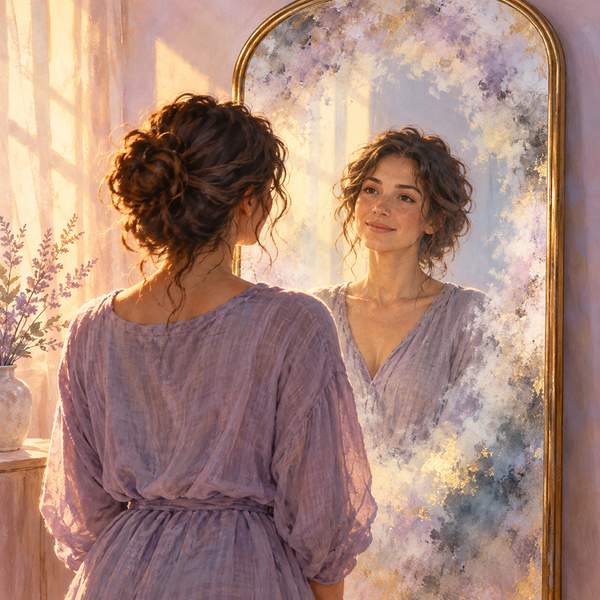


You can look at something without really seeing it.
Just as you can hear someone's words without truly listening to them.
You can sit beside another person without being genuinely present with them.
You can walk the same street hundreds of times without noticing the flowers growing through a crack in the sidewalk, the faded lettering above an old storefront, the way afternoon light changes the color of a building, or the tree you've passed so many times that it has become little more than part of the background.
Your eyes were open.
The information was there.
But attention and awareness are something different.
Looking Is Not the Same as Seeing
We often use looking and seeing almost interchangeably.
And in everyday language, that's perfectly understandable. But as concepts, I think there is an important distinction between them.
Looking can be as simple as directing our eyes toward something.
Seeing asks more of us.
It asks us to notice.
To stay.
To pay attention long enough for the thing in front of us to become more than the quick idea our minds have assigned to it.
A tree stops being simply tree.
It becomes rough bark interrupted by old scars.
Branches reaching unevenly toward light.
Tiny gaps of sky between leaves.
Greens that aren't actually one green at all.
Roots disrupting the sidewalk.
A dead branch beside new growth.
Nothing about the tree changed.
We did.
We stayed long enough to notice what had been there all along.
Art Has a Way of Revealing How Little We See
One of the fascinating things about making art is how quickly it can expose the difference between knowing what something is and actually observing what it looks like.
Ask someone to draw an eye from memory, and they may draw a familiar symbol: an almond-shaped outline, a circle in the middle, a few eyelashes.
We know what an eye looks like.
Or at least we think we do.
But sit in front of an actual person and try to draw their particular eye, and suddenly there is much more to notice.
The whites aren't necessarily white.
The iris isn't one flat color.
The eyelids have thickness.
The eyelashes don't form a neat row of identical lines.
Light changes everything.
The eye sits within bone, skin, shadow, wrinkles, texture, and form.
Now you're no longer drawing the symbol your mind stores for eye.
You're trying to see this eye.
The same thing happens with almost anything we try to draw, paint, photograph, sculpt, or otherwise study closely.
A hand is no longer just five fingers attached to a palm.
A face isn't a collection of standard features.
A building isn't simply windows inside a rectangle.
A shadow isn't always gray.
A cloud isn't necessarily white.
A tree isn't a brown trunk topped by a green blob.
The closer we pay attention, the less generic the world becomes.
Sometimes We See What We Expect Instead of What Is There
Our minds need shortcuts.
We couldn't possibly examine every object, sound, person, texture, movement, and sensation around us with complete attention every moment of every day.
So we recognize.
Categorize.
Predict.
Fill in gaps.
Chair.
Car.
Tree.
House.
Person.
We know enough to move on.
Most of the time, that's incredibly useful.
But there is a tradeoff.
Once we think we know what something is, we may stop being curious about what it actually is.
And that is where art can interrupt us.
Drawing can make us notice that the object we've looked at every day isn't shaped quite the way we thought.
Photography can make us notice light we'd normally walk past.
Painting can reveal colors hidden inside something we'd casually call brown.
Writing can make an ordinary moment worth examining.
Making can ask us to linger where we normally would have moved on.
Art doesn't necessarily give us a different world to look at.
Sometimes it simply teaches us to look at this one differently.
And perhaps that is one of creativity's quieter gifts.
Not only learning how to make something.
But learning how to notice what was already there.
 Jessica Carey
We Often See What We Think Is There
One of the strangest things about seeing is that we don't approach the world with completely empty minds.
We bring memories.
Expectations.
Assumptions.
Categories.
Past experiences.
Ideas about what things are supposed to look like.
That helps us make sense of an incredibly complicated world. But it can also mean that sometimes we aren't responding entirely to what is in front of us.
We're responding to what we think is there.
Familiarity Can Make Things Disappear
Think about a room you spend a lot of time in.
- Without looking around, could you describe everything on the walls?
- Where every object sits?
- Exactly what color the floor is?
- The shape of every piece of furniture?
You may have looked at those things thousands of times.
But familiarity has a funny way of making details disappear.
Once our minds decide, I know this place, we don't necessarily need to examine it closely anymore.
The same thing can happen on the route we take to work, in our neighborhood, with objects we use every day, and even with people we see regularly.
We stop discovering and start recognizing.
Recognition says: “I know what that is.”
Seeing asks: “But what is actually here?”
Labels Are Useful—Until They Become the Whole Picture
There is nothing inherently wrong with categories.
We need words like tree, building, chair, and person to communicate and navigate the world.
But a label can become a stopping point.
Once something has a name, we can feel as though we understand it.
- It's a weed.
- It's an old building.
- It's just a cup.
- It's just a kid's drawing.
But look longer.
The weed may have tiny purple flowers.
The old building may contain layers of architecture from different periods.
The cup may have a worn place where someone's thumb rests every morning.
The child's drawing may contain an entire story that isn't obvious until someone asks about it.
The category isn't necessarily wrong.
It's simply incomplete.
And perhaps one of the habits creativity can cultivate is the willingness to remain curious after we've already named something.
We Can Do This to People, Too
This is where looking versus seeing becomes about much more than visual observation.
We categorize people remarkably quickly.
- Shy
- Loud
- Difficult
- Successful
- Awkward
- Lazy
- Talented
- Strange
Sometimes those descriptions contain pieces of truth.
But a piece of truth can become a distortion when we mistake it for the whole person.
Once we think we know who someone is, we may begin filtering everything they do through that expectation.
Someone we've labeled quiet speaks passionately, and it surprises us.
Someone we've labeled difficult expresses a need, and we interpret it as another problem.
Someone we've labeled talented struggles, and we don't notice how much help they need.
Someone we've labeled fine tells us they aren't, and we hear the words without allowing them to change what we've already decided.
At that point, we may be looking directly at a person while interacting mostly with our idea of them.
Seeing someone asks something harder of us.
It asks us to leave room for the possibility that we don't already know everything.
Attention Requires Curiosity
Maybe genuine seeing begins with a small amount of uncertainty.
Instead of: I know what this is.
There is: What am I missing?
Instead of: I know what they mean.
There is: Could you tell me more?
Instead of: I've seen this a hundred times.
There is: What haven't I noticed before?
That doesn't mean endlessly analyzing everything around us.
Nobody has the capacity to pay profound attention to every detail of every moment.
It simply means recognizing that familiarity is not the same thing as complete understanding.
There is almost always more to notice.
Sometimes Seeing Means Letting Ourselves Be Wrong
Perhaps this is one of the hardest parts.
If genuine attention gives us new information, sometimes that information contradicts what we thought we knew.
The tree isn't shaped the way we remembered.
The shadow isn't the color we expected.
The person isn't who we assumed.
The situation is more complicated than the story we'd already constructed about it.
Seeing requires enough openness to say: “I thought I understood this. Maybe I didn't.”
Artists encounter this constantly.
You begin drawing what you think you see.
Then you look again.
The angle is different.
The proportion is wrong.
The negative space reveals something your first glance missed.
So you adjust.
Look again.
Adjust again.
Not because observing carefully guarantees perfect understanding, but because you're allowing what is actually in front of you to challenge what you expected to find.
That's useful far beyond art.
Because sometimes paying attention isn't about finding confirmation for what we already know.
Sometimes it's about noticing enough to realize that the world—or the person in front of us—is more complicated than the version we carried into the room.
 Jessica Carey
Art Teaches Us to Notice
One of the beautiful things about making art is that it can change the way we encounter the world after we put the materials down.
Learn photography, and you may begin noticing light.
Learn to draw, and you may begin noticing shape and proportion.
Paint, and suddenly colors become more complicated.
Work with textiles, and you may notice patterns, fibers, seams, textures, and construction.
Write, and you may begin collecting tiny moments—a strange sentence overheard in a coffee shop, the way someone pauses before answering a question, the particular feeling of a quiet room after everyone leaves.
Art doesn't necessarily give us better eyes.
It gives our attention somewhere new to go.
Different Practices Ask Us to Notice Different Things
Every creative medium has its own way of asking: “Did you see that?”
A photographer might notice the reflection in a window that everyone else walks past.
A painter might see violet inside a shadow someone else simply calls gray.
A sculptor might notice weight, volume, balance, and the way a form occupies space.
A fiber artist might notice how fabric falls, how stitches create structure, or how different textures interact.
A musician may hear rhythms hidden inside ordinary sounds.
A writer may notice gestures, contradictions, pauses, patterns of speech, and tiny human interactions.
None of these people necessarily has access to a more correct version of reality.
They've simply practiced paying attention to particular parts of it.
And the longer we practice noticing something, the easier it can become to find it everywhere.
Art Can Make the Ordinary Strange Again
There is a peculiar challenge in truly seeing familiar things.
The first time we encounter something unusual, our attention naturally wakes up.
But repetition dulls novelty.
The extraordinary becomes ordinary.
The ordinary becomes background.
Art can reverse that process.
Place an everyday object in front of someone and ask them to draw it for twenty minutes.
A shoe.
A spoon.
A houseplant.
A coffee mug.
Suddenly an object barely worth noticing becomes an entire landscape of lines, reflections, shadows, dents, textures, curves, and imperfections.
The object hasn't become more interesting.
We have become more interested.
There is an important difference.
 Jessica Carey
Attention Can Be Practiced
We sometimes talk about being observant as though it is simply a personality trait.
Some people notice things.
Others don't.
But creative practice suggests that attention can also be developed.
You can practice looking for negative space.
Practice noticing color.
Practice listening for rhythm.
Practice recognizing texture.
Practice observing how bodies move.
Practice noticing the difference between what you assume something looks like and what is actually in front of you.
That doesn't mean we should move through life scrutinizing everything.
Constant attention would be exhausting.
The goal isn't to notice everything.
It's to become capable of noticing more intentionally.
The World Becomes More Detailed When We Become Curious
Perhaps that's why creative practice can make familiar environments feel different.
Once you become interested in light, light is everywhere.
Once you become interested in texture, an old wall isn't merely an old wall.
Once you become interested in color, green stops being one color.
Once you become interested in human expression, a conversation contains much more than words.
Once you become interested in stories, ordinary people stop looking like background characters.
The world hasn't suddenly acquired more detail.
The detail was already there.
We're simply learning how to meet it.
And maybe that's one of the quietest lessons art can teach us:
Seeing isn't always about searching for something extraordinary.
Sometimes it's about giving ordinary things enough attention that we finally realize they were never ordinary to begin with.
Different Minds Notice Different Worlds
Two people can stand in exactly the same place and experience surprisingly different versions of it.
One notices the humming fluorescent light.
Another never consciously registers it.
One immediately sees that a picture frame is slightly crooked.
Another notices the expression on the person standing beneath it.
Someone notices patterns.
Someone notices movement.
Someone notices sounds.
Someone notices tiny inconsistencies.
Someone notices the emotional atmosphere of the room.
Someone notices something nobody else seems to have registered at all.
Same room.
Same moment.
Different worlds of attention.
 Jessica Carey
What We Notice Is Not Universal
I was reminded of this recently through conversations with a new autistic friend.
We found ourselves talking about ideas like looking versus seeing, hearing versus listening, and the difference between simply occupying the same physical space as another person and being genuinely present with them.
It made me think about how differently people can move through the world.
As an autistic person, I've often been aware of things that seem insignificant or invisible to other people—details, patterns, inconsistencies, subtleties, or connections that make me stop and wonder: how did nobody else notice that?
But the reverse can also happen.
Someone else may immediately register something that wasn't where my attention went.
That distinction matters.
Because different perception doesn't necessarily mean one person is paying attention and another isn't.
Sometimes they're paying attention to different things.
Neurodivergence Can Make Differences in Attention Especially Visible
Many neurodivergent people describe experiences involving intense focus, sensory sensitivity, pattern recognition, strong attention to particular details, or becoming deeply absorbed in subjects that interest them.
That can make the difference between looking and seeing feel particularly noticeable.
A detail someone else dismisses as insignificant may feel impossible to ignore.
A contradiction may stand out immediately.
A change in someone's wording, behavior, tone, environment, or routine may be striking.
An interest that another person engages with casually may become something a neurodivergent person explores with extraordinary depth.
But neurodivergent people aren't one perceptual type.
An autistic person can notice microscopic details while overlooking something another person considers obvious.
Someone with ADHD may notice an enormous amount of information while struggling to direct attention toward the thing they're supposed to be focusing on.
Sensory sensitivity can make certain details intensely present—and sometimes make filtering the world necessary simply to function within it.
So, I don't think the lesson is: neurodivergent people notice; neurotypical people don't.
It's something more interesting: there is no single way to notice a world.
Depth Can Look Different From the Outside
There is another layer to this that I think matters.
Sometimes what appears to be lack of attention may actually be a difference in how attention is expressed.
One person shows listening through eye contact and frequent verbal responses.
Another listens more effectively while looking away.
Someone asks lots of questions.
Someone becomes quiet because they're processing what was said.
Someone responds immediately.
Someone needs time before they know what they think.
Someone remembers the emotional heart of a conversation.
Someone remembers the exact sentence spoken three months ago.
That doesn't mean sincerity never varies. Of course it does.
People can half-listen.
They can be distracted.
They can wait for their turn to speak instead of trying to understand.
They can move through relationships superficially.
They can also care deeply.
But we should be careful about assuming we can measure another person's depth entirely by whether their attention looks like ours.
Sometimes two people care and show it differently.
And sometimes, yes, one person really isn't paying attention.
Learning to tell the difference requires more seeing, not less.
Other People Can Show Us What We Missed
Perhaps one of the gifts of being around minds unlike our own is discovering how incomplete our individual attention actually is.
Imagine several artists standing before the same landscape.
One becomes fascinated by the clouds.
Another paints the architecture.
Someone photographs the shadows.
Someone sketches the people.
Someone notices a discarded object near the curb.
Someone becomes interested in the weeds growing through concrete.
Someone writes about the sounds rather than drawing anything at all.
None of them captured the landscape in its entirety.
Each captured a relationship with it.
And when we encounter what someone else noticed, something wonderful can happen: we get to see something we didn't see ourselves.
That's part of what art gives us.
A painting can say: look where I looked.
A photograph can say: I noticed this.
A poem can say: stay here with me for a moment.
A story can invite us inside a perspective we could never completely inhabit on our own.
Seeing Deeply Doesn't Mean Seeing Everything
Maybe this is the humility underneath attention.
No matter how observant we are, we miss things.
Our experiences shape what stands out.
Our interests shape what we pursue.
Our senses have limits.
Our brains filter.
Our expectations interfere.
Our attention wanders.
And another person may notice exactly what escaped us.
So perhaps seeing isn't about becoming the person who notices everything.
No one does.
It's about remaining curious enough to recognize: there may be more here than what I noticed.
And sometimes another person's way of seeing—especially when it differs dramatically from our own—can help us find it.
Seeing People Is Different From Looking at Them
Perhaps the greatest difference between looking and seeing appears when what we're looking at is another human being.
You can know what someone looks like without knowing them.
You can know their name.
Their job.
Their age.
Their interests.
The things they usually order.
The stories they've told before.
You can spend enormous amounts of time physically near them.
And still not necessarily see them.
Because knowing information about someone isn't the same thing as paying attention to who they are.
Hearing Isn't the Same as Listening
Most of us have probably experienced the strange loneliness of talking to someone who technically heard every word we said but wasn't really listening.
Maybe they were preparing their response while we were still speaking.
Maybe they immediately changed the subject.
Maybe they offered advice for a problem we weren't describing.
Maybe they remembered the words but missed what mattered underneath them.
Or perhaps we explained something clearly, only to realize later that the other person had filtered everything through assumptions they already held about us.
The sound reached them.
The meaning didn't.
Listening requires something more than functioning ears.
It requires attention.
Curiosity.
The willingness to let another person's words actually affect our understanding of them.
Otherwise, we aren't really listening to discover who someone is.
We're listening for evidence that confirms who we've already decided they are.
Presence Is More Than Proximity
The same is true of being physically present.
Two people can sit beside one another while being worlds apart.
Someone can be in the room but absorbed in their phone.
Someone can nod at all the expected moments while their mind is somewhere else.
Someone can spend years around another person without becoming deeply curious about their inner world.
And conversely, sometimes a short conversation can contain extraordinary presence.
Someone remembers the small detail.
Asks the thoughtful follow-up question.
Notices when your expression changes.
Lets silence exist instead of rushing to fill it.
Responds to what you actually said rather than what they expected you to say.
You feel the difference.
Not necessarily because they performed all the socially expected signals of attentiveness perfectly.
But because somehow you know: they were here with me.
To See Someone Is to Allow Them to Surprise You
Perhaps one of the deepest forms of attention is allowing another person to remain more complicated than our understanding of them.
People change.
Contradict themselves.
Discover things about themselves.
Have needs we didn't expect.
React differently than they did five years ago.
Contain parts of themselves we haven't encountered yet.
If we decide that knowing someone means possessing a finished definition of them, we may stop seeing the actual person.
We begin interacting with an archive.
- You've always been like this.
- That's just who you are.
- I know you.
But genuine knowing may require something much less certain: “I know you—and I am still getting to know you.”
That leaves room for another person to exist beyond our expectations.
Attention Is a Form of Care—but It Isn't Mind Reading
There is something deeply caring about noticing another person.
Remembering what matters to them.
Learning how they communicate.
Recognizing when something seems different.
Listening when they tell us what they need.
But seeing someone doesn't mean we should magically know everything without being told.
We will misunderstand.
Miss cues.
Forget things.
Interpret something incorrectly.
Different people communicate differently, and what looks obvious to one person may be completely invisible to another.
That's why genuine attention needs communication, not assumption.
Instead of: I know what you're feeling.
We can ask: How are you feeling?
Instead of: You clearly meant this.
We can ask: Is this what you meant?
Instead of expecting someone to prove that we know them well by correctly guessing every need, we can remain curious.
Seeing another person isn't about becoming an expert who no longer needs their input.
It's about valuing their input enough to keep listening.
Being Seen Is Different From Being Observed
There is also an important distinction between being seen and merely being watched.
Someone can notice everything you do and still not understand you.
They can scrutinize.
Monitor.
Analyze.
Judge.
Collect details.
That isn't necessarily connection.
Being genuinely seen contains something observation alone doesn't: recognition of personhood.
You aren't merely a collection of behaviors to interpret.
You aren't a problem to solve.
You aren't a role someone expects you to perform.
You aren't an idea living inside somebody else's head.
You're a person with an inner world they cannot fully access unless you choose to share it.
Seeing respects that mystery.
Maybe Connection Begins With “Tell Me More”
There is something remarkably simple at the heart of all this.
Curiosity.
Not interrogation.
Not analysis.
Not trying to uncover everything about another person.
Just the willingness to communicate: there is more to you than what I currently understand, and I'm interested in knowing it.
- Tell me more.
- What was that like for you?
- What do you mean by that?
- What am I missing?
- Is there something you wish I understood?
Those questions do something assumptions cannot.
They make room for the other person to participate in being known.
And perhaps that's one of the most meaningful differences between looking at someone and truly seeing them.
Looking can tell us: there you are.
Seeing says: you are here—and I am paying attention.
 Jessica Carey
The World Changes When We Pay Attention
There is an interesting paradox in all of this.
When we begin paying closer attention, the world can seem to change.
Colors become more complicated.
Familiar places become more detailed.
Ordinary objects become interesting.
People become harder to summarize.
Conversations contain things we might previously have missed.
But most of the time, the world itself didn't suddenly become richer.
We became more available to its richness.
Attention Doesn't Create the Detail
The tiny flowers were already growing through the sidewalk.
The afternoon light was already moving across the wall.
The old building already had layers of peeling paint.
The bird was already singing somewhere above us.
The person across the table already had an inner world we couldn't completely see.
Attention didn't create any of those things.
It simply allowed us to encounter more of what was there.
That's part of what makes genuine seeing so humbling.
We begin to realize how much can exist beyond the boundaries of our awareness.
Ordinary Doesn't Mean Empty
We often imagine that wonder requires something extraordinary.
A dramatic landscape.
A once-in-a-lifetime experience.
A masterpiece in a museum.
A person with an incredible story.
Something we've never encountered before.
But familiarity doesn't make something empty.
Look closely at almost anything and complexity begins appearing.
A leaf contains veins, scars, edges, gradients, tiny imperfections.
An old table carries scratches from years of use.
A neighborhood contains traces of people who lived there before us.
A familiar face changes constantly through expression, age, emotion, light, and experience.
Even objects we consider mundane can become fascinating when we stop treating familiarity as proof that there is nothing left to discover.
Perhaps the opposite of ordinary isn't extraordinary.
Perhaps sometimes it is simply: unnoticed.
Attention Is Not the Same as Constant Vigilance
There is an important distinction here, too.
Paying attention doesn't mean we should attempt to notice everything, all the time.
That would be impossible.
And exhausting.
Human minds filter information for a reason.
We need to rest.
Zone out.
Move through familiar routines without examining every detail.
Sometimes a tree really does just need to be tree while we're trying to get somewhere.
Seeing isn't a demand to live in permanent hyper-awareness.
It's an invitation to become more intentional about where we place our attention when it matters.
When we're making something.
When someone is trusting us with something important.
When we're somewhere beautiful.
When our assumptions are being challenged.
When something familiar deserves another look.
Attention Is a Kind of Relationship
Maybe that's ultimately what connects art, seeing, listening, and presence.
Attention creates relationship.
When we draw an object, we spend time with it.
When we photograph a place, we decide what deserves our focus.
When we listen deeply to someone, we temporarily allow their experience to matter more than whatever response we were preparing.
When we notice something everyone else walked past, we form a tiny relationship with that moment.
We say, in some quiet way: I noticed you.
That doesn't mean attention is always profound.
Sometimes we notice something silly.
Sometimes we stare at an interesting crack in a wall.
Sometimes we become fascinated by the texture of tree bark.
Sometimes we realize the clouds look ridiculous.
Sometimes we discover that an object we've owned for five years has a detail we've somehow never noticed.
That's part of it too.
Seeing doesn't have to turn every moment into a revelation.
It simply asks us to occasionally stop moving through the world as though everything familiar has already told us everything it has to say.
The World Was Already There
Maybe art doesn't teach us to find beauty everywhere.
Maybe that's too neat.
Some things aren't beautiful.
Some moments aren't profound.
Some people won't become understandable simply because we pay closer attention.
Seeing doesn't guarantee that we'll like what we find.
What it offers is something simpler: a more honest encounter with what is actually there.
Not the symbol.
Not the category.
Not the assumption.
Not merely what we expected to find.
Something closer to the thing itself.
And perhaps that's why learning to see can change our experience of living.
The world doesn't necessarily become different.
We become more present for the world we're already in.
 Jessica Carey
What Have You Stopped Seeing?
Maybe the things most worth seeing aren't always hidden.
Sometimes they're simply familiar.
The tree outside the window.
The building we pass every morning.
The object we've owned for years.
The person we've known so long that we think we already know everything there is to know.
The world can become background surprisingly quickly.
We look without noticing.
Hear without listening.
Stand beside someone without really being present.
Recognize without remaining curious.
Not because we're necessarily uncaring.
Sometimes we're tired.
Distracted.
Overwhelmed.
Rushing.
Thinking about what comes next.
Sometimes our minds simply do what minds are remarkably good at doing: take something complicated, recognize it as familiar, and decide we already know enough to move on.
But every once in a while, we can look again.
Look at Something You Think You Already Know
Choose something ordinary.
Not a masterpiece.
Not a spectacular landscape.
Not something you've never seen before.
Something familiar.
A mug.
Your hand.
A tree.
A shoe.
A building you pass constantly.
Someone's face—when they're comfortable being observed.
Stay with it slightly longer than you normally would.
What shape is it actually?
Where does the light fall?
What colors are there that you wouldn't normally name?
What is worn, uneven, asymmetrical, changing?
What did your mind simplify?
You don't even have to draw it.
Just notice.
Because sometimes the difference between looking and seeing is nothing more dramatic than staying a little longer.
And Then Try It With People
Perhaps this matters even more.
Think about someone you know.
Not the role they occupy in your life.
Not the category you've placed them in.
Not who they were five years ago.
Not who you expect them to be.
Them.
What have they been interested in lately?
What makes them light up?
What have they been trying to tell you?
What has changed?
What questions haven't you asked because you assumed you already knew the answers?
When they speak, are you listening to understand—or listening for the moment when you can respond?
When you're together, are you actually together?
There is no perfect way to see another person.
We will misunderstand one another.
Miss things.
Make assumptions.
Get distracted.
And nobody owes us unlimited access to their inner world simply because we're curious.
But perhaps genuine connection asks us to remain open to the possibility that there is always more to another person than the version of them we carry in our heads.
What Have You Stopped Seeing?
Maybe there's something in your life you've looked at so many times that you no longer really see it.
Maybe it's an object.
A place.
A person.
A part of yourself.
Maybe you think you already know what it is.
Maybe you do.
But perhaps there is still something there you haven't noticed.
Art can teach us to slow down enough to find those things.
Not because artists possess some magical ability to see what everyone else cannot.
But because creative practice can remind us to remain curious.
To notice the shadow instead of assuming it's gray.
To look at the tree instead of drawing the symbol for tree.
To listen to what someone actually said instead of what we expected them to say.
To let another person's perspective reveal something our own attention missed.
To allow familiarity to become interesting again.
The world is full of things we have already looked at.
That doesn't mean we've finished seeing them.
Maybe that's the invitation.
Look again.
Listen again.
Ask again.
Stay a little longer.
Because looking tells us something is there.
Seeing asks us to be present enough to notice it.
Want even more content about creativity and art?
Be sure to check out all of our creative chronicles!
If you'd like to see examples of my work, you can find some of my art and creations at Redbubble and Gumroad!
Looking to learn more about my recent journey?
Check out some of these articles:
-Hidden Gems for St. Louis Artists
-Hidden Gems for Autistic & Neurodivergent Adults
-Learning What Love Was Supposed to Feel Like
-I Wasn't Broken--I'm Burned Out
-The Difference Between Resting and Giving Up
 Jessica Carey