
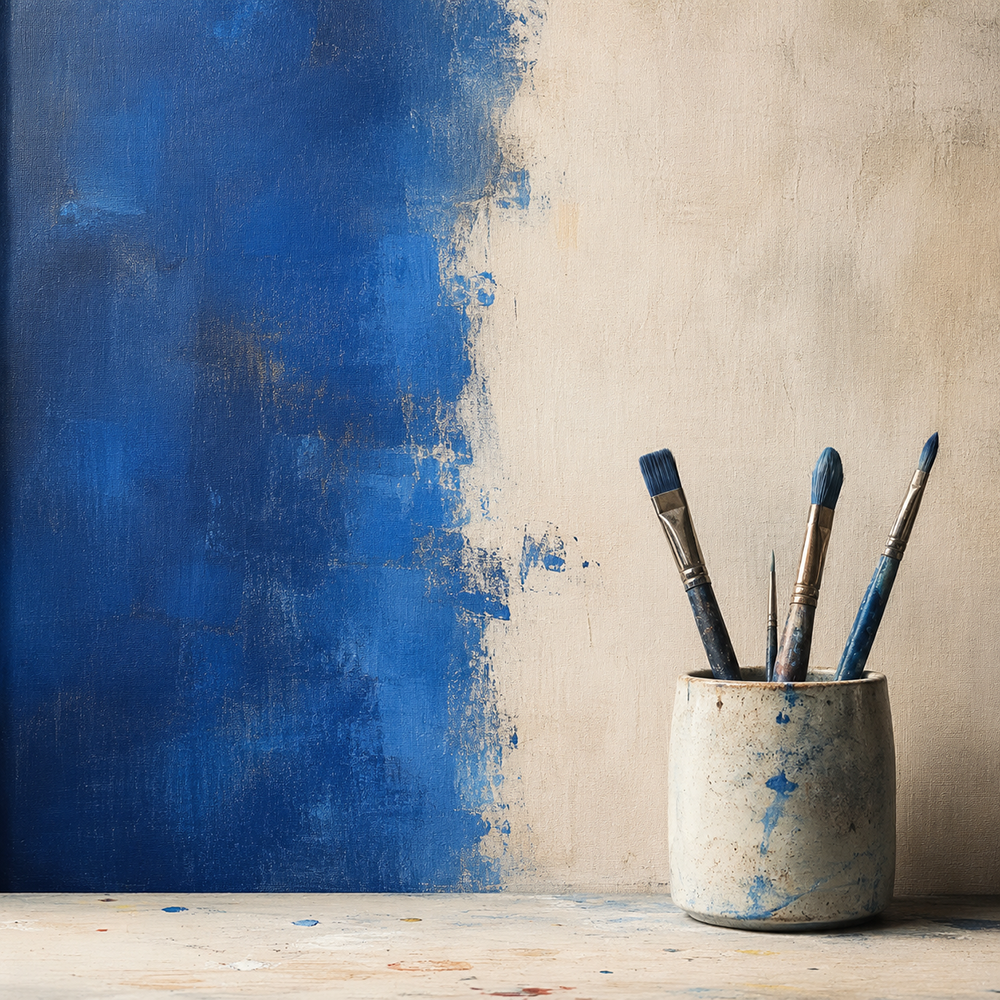
Stand in front of a work of art long enough and someone may eventually ask: “But what does it mean?”
It's a reasonable question.
Maybe the colors symbolize something.
Maybe the objects were carefully chosen.
Maybe there's a political message hidden beneath the surface.
Maybe the artist is exploring grief, identity, memory, injustice, love, belonging, or something else that can't easily be put into ordinary language.
Sometimes there really is an answer.
Sometimes there are several.
And sometimes the artist might shrug and say: “I just really liked the blue.”
We Expect Art to Explain Itself
There can be a strange pressure surrounding art to make it mean something.
Not simply to exist.
Not simply to be interesting.
Not simply to be beautiful, strange, playful, unsettling, satisfying, or fun to make.
It needs a concept.
A message.
Symbolism.
An artist statement explaining what we're supposed to understand.
This isn't necessarily a bad thing.
Art can communicate extraordinarily complex ideas, and learning the story or intention behind a work can completely change how we experience it.
But somewhere along the way, “What does this mean?” can stop being an invitation to curiosity and start sounding almost like a demand: “Why does this deserve to exist?”
And I'm not sure art always owes us that answer.
Maybe the Question Is Bigger Than Meaning
An artist might make something because they need to say something.
But they might also make something because they were curious.
Because they became fascinated by a color, texture, material, or shape.
Because the process was interesting.
Because the idea made them laugh.
Because they thought it would look beautiful.
Or simply: because I wanted to make it.
Are those lesser reasons to create?
No, they aren't.
Meaning Isn't the Same Thing as a Message
Maybe part of the problem is that we sometimes treat meaning and message as though they're interchangeable.
A message tends to point somewhere: I want to say this.
But meaning can be stranger than that.
Meaning can be intentional.
It can emerge accidentally.
It can develop while the artist is working.
It can appear years later.
It can belong partly to the viewer.
It can change depending on who encounters the work and when.
And something can affect us deeply even when we couldn't explain exactly what it is saying.
A piece of music can move us without giving us an argument.
A color can remind us of somewhere we haven't thought about in years.
A pattern can simply feel satisfying to look at.
An abstract painting can hold our attention even when we have absolutely no idea what we're “supposed” to see.
Maybe art doesn't always communicate like a sentence.
Sometimes it creates an experience.
What If There Isn't a Hidden Answer?
Sometimes there may not be a secret meaning waiting for us to solve.
The blue might not symbolize sadness.
The flower might not represent mortality.
The repeated circles might not be commentary on the cyclical nature of existence.
Maybe the artist liked circles.
And discovering that doesn't make the artwork suddenly emptier.
Art can contain ideas without being a puzzle.
It can communicate without having one correct interpretation.
It can invite thought without delivering a lesson.
So perhaps instead of assuming every artwork contains some hidden intellectual treasure we need to uncover, we can begin somewhere more open:
- What am I noticing?
- What does this bring up for me?
- What was the artist curious about?
- What might this mean?
Meaning can be a wonderful part of art.
But does art need a message to justify its existence?
No, art doesn't need a message in order to justify its existence.
 Jessica Carey
Sometimes the Artist Really Is Saying Something
Of course, sometimes the blue does mean something.
Sometimes every color, object, material, gesture, word, and compositional choice has been made with extraordinary intention.
Artists have used their work to mourn.
Protest.
Remember.
Celebrate.
Question.
Document.
Preserve stories.
Challenge power.
Explore identity.
Express experiences that ordinary language struggles to contain.
Art can communicate things that matter enormously.
So, the answer to “Does art need to mean something?” shouldn't become: “Meaning doesn't matter.”
It does.
Sometimes understanding what an artist was trying to communicate can completely transform the way we experience their work.
Context Can Change What We See
Imagine encountering a portrait without knowing anything about it.
Perhaps you notice the colors.
The expression.
The clothing.
The way the figure has been positioned.
You may like it. You may dislike it. You may feel something you can't quite explain.
Then you learn who the person is.
When it was painted.
What was happening in the artist's life.
What was happening in the world around them.
Why a particular object appears in the background.
Suddenly details that seemed decorative may carry historical, political, cultural, or deeply personal significance.
The artwork hasn't changed.
But your relationship with it has.
Context gives you another way of seeing.
That doesn't mean you were wrong to respond to the work before you knew its story.
It means there was more available to discover.
Symbols Can Carry Entire Worlds
Artists can also use symbols because symbols allow enormous ideas to occupy very small spaces.
A flower can represent something beyond a flower.
A particular color can carry cultural, religious, political, or personal associations.
An empty chair can suggest absence.
A repeated object can become memory.
A familiar image can be altered until it asks us to reconsider what we thought it represented.
But symbolism isn't a universal codebook.
The same color can mean different things across cultures, time periods, communities, artists, and even individual works.
Red might suggest danger.
Love.
Anger.
Celebration.
Blood.
Power.
Or perhaps nothing symbolic whatsoever.
Which is why looking for meaning can be interesting, but assuming we already know the meaning can become another way of not really seeing.
Sometimes understanding requires context.
Sometimes it requires listening to the artist.
Sometimes the most accurate answer is: we don't know.
 Jessica Carey
Art Can Say What Ordinary Language Cannot
There is also a reason someone might choose to make art instead of simply writing down: “Here is the message I would like to communicate.”
Art doesn't always work like an essay.
A painting can hold contradiction without resolving it.
Music can create an emotional experience that would be difficult to translate into sentences.
Dance can communicate through bodies, space, rhythm, tension, and movement.
A sculpture can make an idea physically present.
A poem can leave something deliberately unfinished or ambiguous.
Sometimes the meaning isn't hiding behind the artwork waiting to be translated.
The artwork itself is the way the meaning exists.
Asking an artist to reduce it to a neat explanation can occasionally be a little like asking: “Yes, but what would this song be if it weren't music?”
Maybe something would be lost in the translation.
Looking for Meaning Can Be Part of the Experience
So there is nothing wrong with asking:
- Why did the artist choose this?
- What was happening when this was made?
- Does this image have a particular significance?
- What might the artist be exploring?
Those questions can lead us deeper into a work.
They can teach us history.
Introduce us to experiences beyond our own.
Reveal things we initially overlooked.
Help us recognize deliberate choices.
And sometimes they allow us to hear something an artist very much wanted someone to hear.
The problem isn't asking what art means.
The problem is assuming art must provide a sufficiently profound answer before it earns our attention.
Because sometimes an artist is trying desperately to tell us something.
And sometimes?
They really did just like the blue.
Both are allowed.
 Jessica Carey
Sometimes “I Liked the Blue” Is Enough
Imagine asking an artist why they chose blue.
Maybe they'll tell you it represents grief.
Or memory.
Or distance.
Or spirituality.
Or the ocean they grew up beside.
Maybe they'll tell you about the historical significance of the pigment, the cultural associations of the color, or the way blue functions symbolically throughout their body of work.
Or maybe they'll say: “I liked the blue.”
And somehow, that answer can feel almost suspiciously simple.
Surely there must be more to it.
But what if there isn't?
What if the blue is there because the artist loved the way it looked?
Why wouldn't that be enough?
Curiosity Is a Reason to Make Something
Not every creative process begins with an idea that can be translated into words.
Sometimes it begins with: what happens if I do this?
- What happens if I mix these colors?
- What happens if I stitch these materials together?
- What happens if I make this enormous?
- What happens if I make it ridiculously tiny?
- What happens if I photograph the same object every day for a month?
- What happens if I cover the whole surface?
- What happens if I leave most of it empty?
- What happens if I use a material I'm not “supposed” to use this way?
That isn't necessarily an artist trying to communicate a message.
It's an artist investigating a possibility.
And sometimes the answer is: that didn't work.
Sometimes it's: that's interesting.
Sometimes: I have absolutely no idea what I made, but I kind of love it.
Curiosity doesn't need to know where it's going before it begins.
That's part of what makes it curiosity.
Sometimes Art Is About the Experience of Making It
There are creative choices that make much more sense through the hands than through language.
The satisfaction of smoothing clay.
The rhythm of knitting.
The resistance of carving into a material.
The unpredictability of watercolor spreading through wet paper.
The sound of charcoal moving across a textured surface.
The strange pleasure of peeling dried glue from your fingers.
The moment two colors mix into one you didn't expect.
Sometimes the artist isn't working toward a profound statement.
They're having an experience with a material.
Making can be sensory.
Physical.
Playful.
Repetitive.
Messy.
Calming.
Frustrating.
Surprising.
Fun.
The artwork at the end may matter.
But sometimes what mattered most happened while someone's hands were busy making it.
Beauty Doesn't Need an Excuse
There can also be a strange hesitation around saying: “I wanted to make something beautiful.”
As though beauty by itself is somehow intellectually insufficient.
But humans have decorated things for an extraordinarily long time.
We add patterns to functional objects.
Arrange colors.
Decorate clothing.
Carve surfaces.
Plant gardens.
Design spaces.
Choose objects because looking at them gives us pleasure.
There doesn't always need to be a hidden argument underneath that impulse.
Sometimes someone makes something beautiful because beauty delighted them enough to make more of it.
Of course, beauty itself is complicated and subjective. What one person finds breathtaking, another may find boring, ugly, excessive, or confusing.
But that doesn't make aesthetic pleasure meaningless.
Enjoying how something looks is an experience.
And experience is part of what art can offer.
Art Is Allowed to Be Silly
Art can also exist because somebody thought something was funny.
That's it.
A ridiculous drawing.
An absurd sculpture.
A tiny hat placed on something that absolutely does not need a hat.
A deliberately terrible portrait of a friend.
A ceramic creature with an expression that makes you laugh every time you see it.
Not satire.
Not social commentary.
Not a profound investigation of the human condition.
Just: this amused me, so I made it.
There can be tremendous freedom in allowing creativity to be unserious.
Play doesn't become more legitimate when we attach an impressive explanation to it.
Sometimes joy is the entire point.
Sometimes there isn't even a point.
Maybe we were simply playing.
“Because I Wanted To” Is an Artistic Reason
An artist doesn't have to reverse-engineer a profound explanation afterward to make their work sound more important than it felt while they were making it.
Sometimes “I don't know. I wanted to see what would happen,” is honest.
Sometimes “It was fun,” is honest.
Sometimes “I thought it looked beautiful,” is honest.
And sometimes “I liked the blue,” really is the whole answer.
None of those reasons is inferior to making art about something deeply personal, political, historical, spiritual, or emotional.
They're simply different reasons humans create.
We don't have to turn a simple creative impulse into something complicated before we're willing to believe it mattered.
 Jessica Carey
Meaning Can Appear After the Art Exists
We often imagine artistic meaning happening in a particular order.
First, the artist has something to say.
Then they make an artwork that expresses it.
Then the viewer looks at the artwork and tries to figure out what the artist meant.
Sometimes that's exactly what happens.
But creativity can be much messier than that.
Sometimes the artist doesn't know what something means until after they've made it.
Making Can Reveal Something You Didn't Know You Were Saying
Creative work doesn't always begin with a fully formed idea.
An artist might start with a color.
A shape.
A photograph.
A sentence.
A material.
An image they can't stop thinking about.
They follow it without entirely knowing why.
Then something begins to emerge.
Maybe they notice the same shape appearing repeatedly.
Maybe a character they've written behaves in a way they didn't anticipate.
Maybe they step back from a painting and suddenly recognize an emotion they hadn't consciously intended to put there.
Maybe someone asks about the work and, while trying to answer, the artist realizes: oh, maybe that's what this is about.
That doesn't mean there was secretly a perfect message buried in their subconscious from the beginning.
It simply means that creating can be a way of discovering, not only communicating.
Sometimes we make something because we already know what we want to say.
Sometimes making is how we find out.
Time Can Change What Something Means
Meaning can also arrive later.
Imagine finding a drawing you made ten years ago.
At the time, perhaps it was nothing particularly important.
You were experimenting.
Passing time.
Trying a new material.
Drawing something because you liked it.
But now the artwork belongs to a particular period of your life.
You remember where you were when you made it.
Who you knew.
What you cared about.
What you didn't know yet.
The object hasn't physically changed.
But you have.
And because you've changed, your relationship with it has changed too.
Something that once meant very little may become precious.
Something that once felt profound may no longer feel important.
Something you disliked may become one of your favorite things because it preserves evidence of who you were while you were learning.
Meaning isn't always fixed at the moment of creation.
Sometimes life keeps writing onto the things we've made.
Viewers Bring Their Own Lives With Them
The artist isn't the only person capable of finding meaning after the work exists.
Viewers do it too.
Someone sees a painting and thinks of their childhood home.
Another person feels unsettled by it.
Someone else finds it comforting.
A song becomes connected to a relationship.
A photograph reminds someone of a place the photographer has never visited.
A poem seems to describe an experience its writer never had.
None of those responses necessarily tells us what the artist intended.
But they're still real experiences happening between a person and a work of art.
We don't encounter art as blank slates.
We bring memories.
Associations.
Cultures.
Losses.
Relationships.
Beliefs.
Experiences.
Entire lives.
So, two people can stand before exactly the same artwork and find very different things there.
Unintended Doesn't Mean Meaningless
This raises an interesting possibility.
Can an artwork contain something its creator didn't consciously intend?
It can—although we should be careful about what we mean by contain.
Maybe an artist repeatedly uses imagery connected to home without realizing how important that theme has become to them.
Maybe their choice of materials carries cultural associations they weren't consciously thinking about.
Maybe a viewer notices a pattern the artist never deliberately planned.
Maybe circumstances change and an older artwork takes on a completely different significance.
That doesn't mean every interpretation becomes an objective fact about the artist.
But it does mean intention isn't the only place meaning can come from.
Art exists in relationship with people.
And relationships create possibilities the creator cannot completely control.
Sometimes Meaning Is Something We Build With Art
Perhaps meaning isn't always an object hidden inside an artwork waiting to be uncovered.
Sometimes it's something that happens between the artwork and the people who encounter it.
That makes the question “What does this mean?” considerably more interesting.
Sometimes there is an intentional message.
Sometimes there isn't.
Sometimes meaning emerges during creation.
Sometimes it arrives much later.
Sometimes someone else finds something we never expected them to find.
And sometimes an artwork that began with nothing more profound than “I liked the blue” can eventually mean far more than the artist ever planned.
Meaning doesn't always have to come before the art.
Sometimes the art comes first—and meaning catches up later.
The Artist Doesn't Own Every Interpretation—but Neither Does the Viewer
Once an artwork leaves the artist's hands and enters the world, something interesting happens.
Other people encounter it.
And they bring themselves with them.
Their memories.
Experiences.
Cultures.
Relationships.
Beliefs.
Associations.
Someone may stand in front of an artwork and feel something the artist never expected.
They may notice a connection the artist never consciously intended.
They may find comfort in something the artist experienced as painful.
They may see sadness where the artist felt hope.
Does that mean the viewer is wrong?
Not necessarily.
But it also doesn't mean the viewer gets to decide what the artist meant.
“This Means Something to Me” Is Different From “This Is What the Artist Meant”
Imagine an artist paints a room filled with yellow light.
A viewer might look at it and think of their grandmother's kitchen.
Another might associate yellow with happiness.
Someone else might find the color strangely unsettling.
All of those experiences can be genuine.
But then imagine the artist explains: “I used yellow because it reminded me of my childhood home.”
A viewer can still have their own relationship with the yellow.
They can say: “It reminds me of my grandmother.”
What becomes more questionable is saying: “No. The yellow actually represents jealousy.”
Those are two different kinds of claims.
One says: “This is what I experience in the artwork.”
The other says: “I know what was happening inside the artist better than the artist does.”
Interpretation can be expansive without becoming ownership of someone else's intentions.
The Artist Can't Completely Control What Happens Next
At the same time, artists don't necessarily get to dictate every experience someone has with their work.
An artist might say: “That's not what I meant.”
Fair enough.
But the viewer might truthfully respond: “It is still what I experienced.”
Both can exist.
The artist has particular authority over their own intention:
- This is what I was thinking.
- This is why I made this choice.
- This is what I hoped to communicate.
The viewer has authority over their own experience:
- This reminded me of something.
- This made me uncomfortable.
- This made me feel hopeful.
- This is what I noticed.
Neither person needs to erase the other.
Art can hold the space between them.
Context Still Matters
This distinction becomes especially important when art comes from experiences, communities, histories, or cultures outside our own.
Personal response matters.
But sometimes understanding a work asks us to learn something.
- Who made it?
- When?
- Where?
- Under what circumstances?
- Are there symbols or traditions here that have meanings I don't know?
- Has the artist spoken about the work?
- What might I be missing because I'm encountering it from outside that context?
There is a difference between bringing ourselves to art and making the artwork entirely about ourselves.
Sometimes seeing more requires listening.
Art Can Hold More Than One Truth
Perhaps we don't need to choose between: “Only the artist gets to decide what the artwork means.”
And: “The artist's intention doesn't matter; meaning belongs entirely to the viewer.”
Both seem too narrow.
An artist can say: “This is what I meant.”
A viewer can say: “This is what I found.”
Those answers might overlap.
They might not.
And sometimes the distance between them is where the most interesting conversation begins.
Sharing art means allowing it to encounter lives beyond the one that created it. Other people may find things the artist never planned.
But encountering someone else's work also asks something of the viewer: curiosity without possession.
We can find our own meaning while still leaving room to listen when the person who created the work tells us what it meant to them.
The Pressure to Explain Can Change the Art
There is a difference between asking an artist about their work because we're curious and asking because we expect them to justify it.
- Why did you make this?
- What does it represent?
- What's the concept?
- What are you trying to communicate?
- Why did you choose this color?
- What does this symbolize?
Those can be wonderful questions.
They can help an artist recognize connections they hadn't consciously noticed.
They can open conversations.
They can help viewers understand choices that aren't immediately apparent.
But ask them often enough—or in the wrong context—and another message can begin hiding underneath them: surely you had a sufficiently important reason for making this.
Sometimes the Explanation Comes Afterward
Anyone who has had to write an artist statement, participate in a critique, explain a school project, submit work to an exhibition, or apply for an artistic opportunity may recognize the pressure.
You made something.
Now explain what it means.
And sometimes you know.
The ideas were there from the beginning.
But sometimes the creative process was intuitive.
You followed a color.
A material.
A feeling.
An interesting problem.
Something you couldn't quite name.
Then someone asks what it all symbolizes, and suddenly: “I wanted to see what would happen” doesn't feel sophisticated enough.
So, there can be a temptation to work backward.
The blue becomes sadness.
The circles become cycles of life.
The torn paper becomes fragmentation of identity.
Maybe those interpretations genuinely emerge upon reflection.
But sometimes we're simply trying to produce an explanation that sounds important enough to justify the artwork.
Artist Statements Can Be Useful Without Becoming Confessions
This doesn't mean artist statements are bad.
A thoughtful artist statement can give viewers context they couldn't possibly know otherwise.
It can explain a process.
Introduce a question.
Describe a material choice.
Place work within a larger body of ideas.
Tell us something about what the artist was exploring.
But an artist statement doesn't have to decode every inch of the work.
And it doesn't have to become a confession in which the artist exposes every private experience that influenced what they made.
Sometimes an artist may deliberately leave something ambiguous.
Sometimes they may not know exactly why a particular image keeps appearing.
Sometimes the meaning may be personal enough that they don't want to explain it publicly.
And sometimes there simply isn't an elaborate story behind the choice.
Not explaining everything doesn't mean there is nothing there.
“I Don't Know Yet” Is an Answer
Maybe one of the most honest things an artist can sometimes say is: “I don't know.”
Or: “I'm still figuring that out.”
Creative work doesn't always arrive after understanding.
As we've already explored, sometimes making is part of how understanding happens.
So expecting artists to immediately provide a perfectly organized explanation can ask them to pretend they've reached the end of a process they're still inside.
Perhaps the work is asking a question rather than answering one.
Perhaps the artist is exploring something they can't name yet.
Perhaps they'll understand it differently five years from now.
Or perhaps there genuinely isn't anything more complicated to uncover.
Uncertainty isn't necessarily a failure of artistic thought.
Sometimes uncertainty is where the art began.
Explanation Can Also Narrow an Experience
There is another interesting consequence of explaining art too completely.
Sometimes an explanation can make us stop looking.
Imagine encountering an unfamiliar artwork and wondering about it.
You notice something.
Form an interpretation.
Change your mind.
Notice something else.
Then you read a label that tells you exactly what the work means.
Suddenly it can be tempting to think: oh, that's the answer.
And stop wondering.
Context can deepen an artwork.
But explanation can sometimes narrow one, too.
Maybe there is value in leaving a little room between: “Here's what I was exploring.”
And “Here's exactly what you must experience.”
The artist can offer a doorway without deciding where every viewer must stand once they walk through it.
Art Doesn't Have to Defend Its Right to Exist
Maybe that's the larger problem with demanding meaning from every artwork.
The question quietly shifts from: “What might be happening here?”
To: “Convince me this was worth making.”
But creativity doesn't need to stand before a jury.
An artwork can carry an enormous political message.
It can hold grief someone couldn't put into words.
It can preserve a history.
Challenge an injustice.
Ask a difficult question.
Or explore nothing more complicated than what happens when orange sits beside pink.
Those possibilities don't have to compete.
Profundity isn't the admission price for creativity.
Artists are allowed to know exactly what they're saying.
They're allowed to discover it while they work.
They're allowed to understand it years later.
They're allowed to keep some of it private.
They're allowed to leave questions unanswered.
And they're allowed to say: “There really isn't anything deeper. I just liked making it.”
Art can invite explanation.
It shouldn't always have to survive an interrogation.
Maybe Meaning Isn't Something Art Has to Prove
So, does art need to mean something?
Not necessarily.
At least, not in the way we sometimes mean when we ask the question.
Art doesn't need a hidden message.
It doesn't need symbolism waiting to be decoded.
It doesn't need an artist statement capable of transforming every creative decision into an intellectual argument.
It doesn't need to teach us something.
Change society.
Reveal a profound truth.
Explain the human condition.
Sometimes art does those things.
Sometimes magnificently.
But those possibilities don't create an entrance requirement.
Meaning Doesn't Always Look Like a Message
Maybe the more interesting realization is that something can be meaningful without containing a message at all.
A handmade object can matter because of who made it.
A painting can become connected to a particular period of someone's life.
A song can hold a memory.
A photograph can become precious because something in it no longer exists.
An artwork created casually can become important years later.
Something can matter because making it was joyful.
Because seeing it makes someone feel something.
Because it brought people together.
Because it reminds someone of home.
Because someone looked at it and felt understood, even though the artist never knew them.
None of those meanings necessarily existed as a message the artist deliberately placed inside the work.
They happened through relationship.
Between artist and artwork.
Artwork and viewer.
Memory and object.
Person and experience.
Maybe meaning isn't always something an artwork contains.
Sometimes it's something that happens around it.
And Sometimes There Really Isn't Anything Deeper
But we should leave room for an even simpler possibility.
Maybe the artwork never becomes profoundly meaningful.
Maybe the artist doesn't discover a hidden emotional reason for making it ten years later.
Maybe viewers don't have transformative experiences with it.
Maybe it doesn't represent anything.
Maybe it doesn't need to.
Perhaps it was enjoyable to make.
Interesting to look at.
Fun to experiment with.
Beautiful in someone's home.
Funny enough to make somebody smile.
Or simply one thing a human being made during one afternoon of their life.
That can be enough, too.
We don't need to rescue seemingly meaningless art by insisting that surely, somewhere, there must be a deeper meaning after all.
That would simply recreate the requirement we were trying to question.
Maybe We Can Ask Different Questions
When we encounter art, perhaps “What does it mean?” can remain one question among many.
We can also ask:
- What do I notice?
- How does this make me feel?
- What am I curious about?
- What choices did the artist make?
- What happens when I spend time with this?
- What does knowing its context change?
- What does it remind me of?
- Do I enjoy looking at it?
- Does it make me want to make something too?
And sometimes we don't need a question at all.
We can simply experience it.
The Blue Can Just Be Blue
Maybe the artist chose blue because it represented grief.
Maybe it represented memory.
Maybe it carried cultural or historical significance.
Maybe they didn't know why they kept reaching for it until years later.
Maybe you look at that blue and remember something from your own life that the artist could never have known about.
All of those possibilities are worth exploring.
But there is one more possibility we shouldn't lose beneath all our searching: maybe they just liked the blue.
And the blue doesn't become less beautiful because there wasn't a secret hidden underneath it.
Art can speak.
Art can question.
Art can remember.
Art can protest.
Art can help us understand something we couldn't understand before.
But art can also play.
Experiment.
Decorate.
Delight.
Confuse.
Amuse.
Or simply exist.
So perhaps art doesn't need to mean something in order to justify being made.
Perhaps sometimes the better question isn't: “What is this trying to say?”
But: “What happens when I meet it?”
And if the answer is nothing more profound than: “I really like that blue,” maybe that was enough all along.
Want even more content about creativity and art?
Be sure to check out all of our creative chronicles!
If you'd like to see examples of my work, you can find some of my art and creations at Redbubble and Gumroad!
Looking to learn more about my recent journey?
Check out some of these articles:
-Hidden Gems for St. Louis Artists
-Hidden Gems for Autistic & Neurodivergent Adults
-Learning What Love Was Supposed to Feel Like
-I Wasn't Broken--I'm Burned Out
-The Difference Between Resting and Giving Up
 Jessica Carey