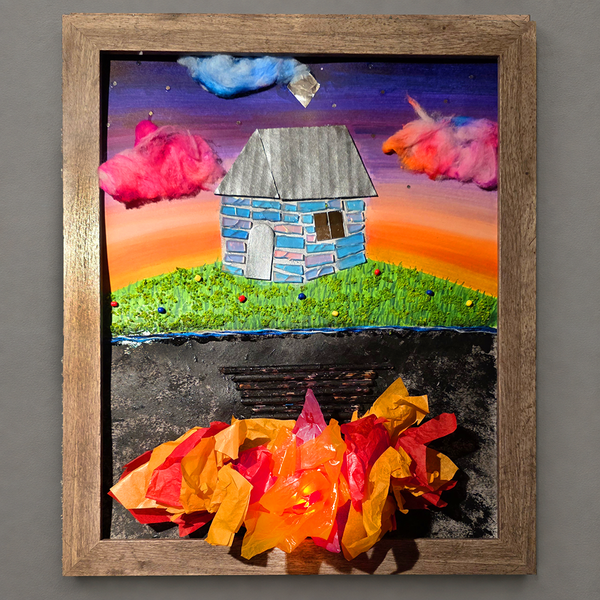

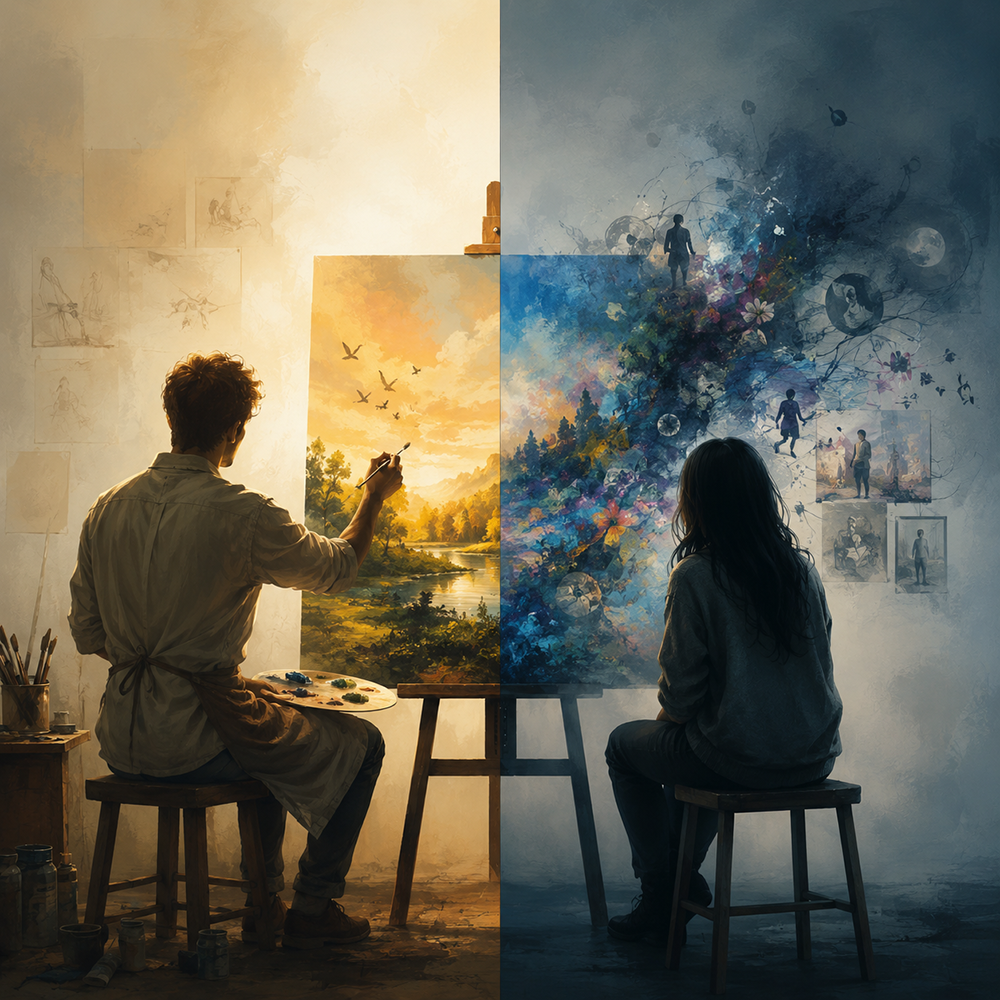
An artist makes something.
They choose the colors.
Make the marks.
Shape the materials.
Change things.
Start over.
Decide when it is finished—or at least finished enough to let someone else see it.
Perhaps they know exactly what the work means to them.
Perhaps they don’t.
Then something interesting happens.
They share it.
And suddenly, they are no longer the only person in the relationship.
 Jessica Carey
Someone Else Sees Something
Imagine an artist creates a painting.
Someone stands in front of it for a while and eventually says: “This makes me think about grief.”
The artist is surprised: “Really? I wasn’t thinking about grief at all.”
Maybe the painting was about childhood.
Maybe it came from curiosity about color.
Maybe the artist was thinking about a completely different experience.
Maybe it wasn’t about anything in particular.
And yet the viewer really did experience grief in it.
So, who is right?
The artist?
The viewer?
Both?
Neither?
Perhaps the problem is that we're asking one question as though it were actually only one question.
What I Meant and What You Found
There is a difference between saying: “This is what I meant.”
And: “This is what I found here.”
The first tells us something about the person who created the work.
The second tells us something about the encounter between the work and another person.
Those things may align perfectly.
But they don't have to.
A song written about one relationship can remind someone of another.
A painting inspired by joy can make someone unexpectedly sad.
A story can resonate with an experience its writer has never had.
An image can become connected to a memory the artist could never possibly have known existed.
The artist may think: that's not what I meant.
And they may be completely right.
The viewer may think: but that's what I experienced.
And they may be completely right too.
What Changes When We Share?
Before an artwork is shared, its maker has a particular relationship with it.
They know where it came from, what changed along the way, what was deliberate, and what happened accidentally.
Then another person encounters the work without necessarily knowing any of that.
They bring their own memories, associations, culture, questions, and experiences.
The artwork hasn't necessarily changed.
But another relationship with it now exists.
So, Does the Art Still Belong to the Artist?
Of course, there are literal forms of ownership.
An artist can own an original artwork.
Copyright and authorship don't disappear simply because something has been shown to another person.
And sharing art certainly doesn't mean surrendering privacy, boundaries, or the right to say what you actually intended.
But that's not quite the kind of belonging we're exploring here.
I'm wondering about meaning.
- Once something has entered another person's imagination, how much authority does its creator still have over what it means?
- Can an artist tell someone: “That's not what this means”?
- Can a viewer tell the artist: “You may not have intended it, but that's what your work really means”?
- Is there one correct interpretation hidden somewhere between them?
- Or could both people hold different kinds of authority?
Maybe sharing art doesn't mean that it stops belonging to its creator.
But perhaps something does change when another person is invited to encounter it.
The artist still has the experience of having made the work.
The viewer now has the experience of having met it.
And somewhere between what was intended and what was received, a fascinating question begins: who gets to decide what art means?
 Jessica Carey
The Artist Knows What They Intended
There are things about an artwork that its creator may know in a way nobody else can.
They may know why they chose blue.
Why one figure appears smaller than another.
Why they repeated a particular shape.
Why they changed the ending of a story.
Why one photograph made the final series while another didn't.
They may know which choices were carefully deliberate and which happened almost accidentally.
They may know that something viewers assume is deeply symbolic actually has a much simpler explanation.
I just liked how it looked.
And when an artist tells us those things, that information matters.
Intention Is Part of the Story
Sometimes artists really are trying to communicate something specific.
A work may respond to a political event.
Preserve a cultural tradition.
Explore a personal experience.
Memorialize someone.
Challenge an idea.
Tell a particular story.
Use symbols deliberately chosen for what they represent.
Knowing those intentions can completely change how we encounter the work.
Something we initially thought was decorative may carry historical significance.
A strange compositional choice may suddenly make sense.
An object we barely noticed may turn out to be central.
The artist's explanation doesn't necessarily tell us everything we are allowed to experience.
But it can tell us something no viewer can discover through interpretation alone: this is what I was trying to do.
Interpretation Isn't Mind Reading
Problems begin when we move from interpreting the artwork to claiming authority over the artist.
Imagine an artist says: “I chose blue because it reminded me of my childhood bedroom.”
A viewer might respond: “That's interesting. The blue feels lonely to me.”
There's no contradiction there.
The artist is describing their intention.
The viewer is describing their experience.
But imagine the viewer instead says: “No. You actually used blue because you were subconsciously expressing loneliness.”
Now something has changed.
The viewer is no longer saying what they found in the artwork.
They're telling another person what was happening inside them.
Maybe the artist was unconsciously influenced by something they hadn't recognized.
Human beings aren't perfectly self-aware, and making can reveal things we didn't consciously plan.
But possibility isn't proof.
An interpretation becoming plausible doesn't suddenly make a stranger more authoritative about someone's inner life than the person themselves.
The Artist Can Correct Claims About the Artist
This distinction becomes especially important when interpretation turns into biography.
A viewer might say: “This painting makes me think about an unhappy marriage.”
That's an interpretation.
But: “The artist made this because their marriage was unhappy,” is a factual claim about the artist.
Those aren't the same thing.
Likewise: “This character feels lonely to me” is different from: “The writer created this character because they were lonely.”
We can wonder.
We can notice patterns.
We can propose possibilities.
But when an artist actually tells us what they intended, we shouldn't need to erase their account to preserve our own response.
The viewer can interpret the artwork; they don't get to rewrite the artist.
Intention Matters Without Becoming a Cage
None of this means the artist gets to dictate every thought another person is allowed to have.
That's where the question becomes more interesting.
The artist may be the strongest authority on: what did I intend?
But that's not necessarily identical to: what can another person experience here?
A creator can explain where something came from without controlling everywhere it might go.
They can say: “That's not what I meant.”
Without necessarily being able to say: “Therefore, you couldn't possibly have experienced it that way.”
That leaves us with two things that can both matter: the intention behind the artwork and the experience that happens in front of it.
Protecting the first doesn't require erasing the second.
And that brings us directly to the other side of the question: what happens when the viewer genuinely finds something the artist never put there intentionally?
But Intention Doesn’t Control Experience
An artist can tell us what they meant.
They cannot completely determine what we feel.
Suppose the artist who painted that blue room explains: “I chose blue because it reminded me of my childhood bedroom.”
Now we know something important about the work.
But perhaps someone looking at the painting still feels grief.
The explanation doesn't make the grief disappear.
It doesn't mean the viewer misunderstood their own emotional response.
It simply means: the grief came from the encounter, not necessarily from the artist's intention.
We Don't Arrive at Art Empty-Handed
Nobody encounters art as a blank slate.
We bring ourselves with us.
Our memories.
Relationships.
Culture.
Knowledge.
Fears.
Losses.
Joy.
Associations.
The places we've lived.
The people we've known.
The things that have happened to us.
A particular shade of yellow might remind one person of their grandmother's kitchen.
Someone else might associate it with a childhood school.
Another person simply thinks it's beautiful.
The artist may have chosen it because it looked good beside the blue.
All four experiences can exist around the same color.
The artist couldn't possibly have anticipated them all.
 Jessica Carey
Art Can Touch Something the Artist Never Knew Was There
Sometimes this becomes much more personal.
A song might remind someone of a person they've lost, even though the songwriter wrote it about someone entirely different.
A character might make a reader feel understood in a way the writer never consciously intended.
A photograph of an ordinary place might overwhelm someone because it resembles somewhere important from their past.
A painting might feel hopeful to one person and lonely to another.
None of this requires the artist to have secretly planted those meanings in the work.
Sometimes art simply comes into contact with something already living inside the person experiencing it.
The artwork becomes part of an encounter the artist could never have planned.
“That's Not What I Meant” Doesn't Always Mean “That's Not There”
This is where the language gets interesting.
An artist might hear an interpretation and say: “That's not what I meant.”
And they may be entirely correct.
But that sentence answers a particular question: did you intend this?
It doesn't necessarily answer: can someone genuinely experience this when encountering the work?
Those are different questions.
Maybe the artist never intended the painting to feel lonely.
But it still feels lonely to someone.
Maybe the writer never thought of a particular character as representing isolation.
But a reader recognizes their own isolation in that character.
The viewer doesn't need to turn that response into a claim about the creator.
They can simply say: “I know that isn't what you intended. But it's something I found here.”
Two Viewers May Not Even Meet the Same Artwork
Put ten people in front of the same piece and, in one sense, they're all looking at the same thing.
But their experiences may be remarkably different.
One notices the colors first.
Another notices a tiny figure in the background.
Someone understands a historical reference immediately.
Someone else knows nothing about that history.
One person is reminded of home.
Another feels uncomfortable without knowing why.
Someone loves it.
Someone feels nothing particularly strong at all.
Even attention changes the encounter.
What we notice shapes what becomes available for us to interpret.
In that sense, the artwork may be physically the same while the experience of it changes from person to person.
That doesn't mean facts stop mattering.
It means encounters aren't identical.
The Viewer Has Authority, Too—Just a Different Kind
Perhaps this is where we can begin separating two kinds of authority.
The artist can say: “This is what I intended.”
The viewer can say: “This is what I experienced.”
Neither statement automatically cancels the other.
Problems arise when either person tries to turn one kind of authority into the other.
A viewer shouldn't need to tell the artist: “No, this is what you really meant.”
But an artist doesn't necessarily get to tell the viewer: “No, you didn't feel that.”
One is authority over intention.
The other is authority over experience.
And perhaps sharing art means accepting that, once another person encounters what we've made, something can happen that belongs neither entirely to our intention nor entirely to the object itself.
A new experience begins.
We can create the work.
We can choose what we put into it.
We can explain what we hoped to communicate.
But we cannot prewrite every memory, association, feeling, or connection another human being will bring to it.
The artist creates the artwork.
The viewer participates in the encounter.
And sometimes what happens between them surprises both.
Art Changes When the Context Changes
An artwork can stay exactly the same while the world around it changes.
The same words.
The same colors.
The same melody.
The same photograph.
The same story.
And yet something about encountering it years—or generations—later can be completely different.
Because art doesn't exist in a vacuum.
It exists somewhere.
At some time.
Among people whose lives keep changing long after the artist finishes making it.
The Work Stays Still. The World Doesn't.
Imagine someone writes a song about an ordinary experience.
At the time, perhaps that's all it is.
Then something happens.
The song becomes associated with a historical moment.
A community adopts it.
Someone important performs it.
People begin playing it at weddings, protests, funerals, celebrations, or memorials.
Years later, people may hear the opening notes and immediately think of something the songwriter never anticipated.
Did the songwriter intend that association?
No, but the association now exists.
The song hasn't changed; its history has.
And history becomes part of what later listeners bring to it.
Sometimes Life Writes Onto the Things We Make
This can happen on a much smaller scale too.
Someone gives you a handmade mug.
At first, it's simply a mug you like.
Years pass.
Perhaps the person who made it moves away.
Perhaps the friendship deepens.
Perhaps you lose touch.
Perhaps they die.
The mug is still physically the same object.
But now holding it feels different.
Nothing needed to be added to the clay.
Life added something around it.
The same thing can happen with photographs.
Songs.
Books.
Drawings.
Clothing.
Letters.
Objects made by children.
Things that seemed completely ordinary when they first entered our lives can become precious because of everything that happened afterward.
The creator didn't necessarily put that meaning there.
Time did.
Relationship did.
Memory did.
Culture Can Change the Encounter, Too
Art also moves between communities and cultures.
A symbol that seems purely decorative to one viewer may carry deep significance to another.
A story encountered outside its original culture may be understood differently from the way its first audience understood it.
Something considered ordinary in one historical moment may later become remarkable evidence of how people once lived.
And sometimes meanings themselves change.
Words change.
Symbols change.
Social norms change.
Knowledge changes.
What audiences notice changes.
That doesn't mean historical context becomes irrelevant.
Quite the opposite.
Understanding where something came from can help us distinguish between what a work meant in its original context and what it has come to mean somewhere else.
Both can matter without being identical.
Meaning Can Accumulate
If an artwork acquires new associations over time, that doesn't automatically overwrite what came before.
A song can still have been written about one particular experience even if thousands of people later connect it to something else.
A story can still emerge from a specific cultural context even if readers elsewhere find their own experiences reflected in it.
A handmade object can still have been created for an ordinary purpose even if it eventually becomes a treasured family keepsake.
Meaning can accumulate.
The original intention doesn't necessarily disappear when another layer appears.
The artist may know: this is where the work came from.
History may eventually add: and this is what happened to it afterward.
Context helps us hold those layers honestly. We can ask what the artist intended, what the work meant when it was created, and what it has come to mean since.
Sometimes those answers will be remarkably similar.
Sometimes they won't.
Because an artwork may stop changing when its creator finishes it.
But the world it lives in keeps going.
 Jessica Carey
Interpretation Has Limits
If everyone brings something different to art, does that mean every interpretation is equally correct?
Not necessarily.
There is enormous freedom in how we experience something.
But interpretation doesn't make facts disappear.
A viewer can find something in an artwork that its creator never intended.
They can form associations the artist never anticipated.
They can dislike something the artist hoped would be beautiful.
They can feel comforted by something intended to be unsettling.
Those experiences belong to the viewer.
But there is a difference between saying: “This is what I experience here.”
And: “This is objectively what happened.”
Personal Meaning Isn't the Same as a Factual Claim
Suppose someone looks at a painting and says: “This makes me feel trapped.”
There's not much for the artist to correct.
That's how the viewer feels.
But suppose the viewer says: “The artist painted this because they felt trapped in their marriage.”
Now we're somewhere else entirely.
That's no longer simply a description of the viewer's experience.
It's a claim about another person's life.
And claims require evidence.
The same distinction can apply to almost anything.
“This character reminds me of someone experiencing grief,” is different from: “The author wrote this character while grieving.”
“This symbol makes me think about freedom,” is different from: “This symbol has always historically represented freedom.”
“I experience this artwork as political,” is different from: “The artist created this as a political statement.”
One describes an encounter.
The other makes a claim about something beyond it.
Interpretation gives us room to wonder. It doesn't give us permission to turn every possibility into a fact.
Context Can Tell Us Things We Couldn't Know by Looking
Sometimes understanding art requires information outside the artwork itself.
- Who made it?
- When?
- Where?
- What was happening around them?
- What did particular symbols mean within that culture?
- What materials were available?
- Was the work created for a particular purpose?
- Did the artist ever speak or write about it?
We may look carefully at an artwork and still not be able to discover those things from observation alone.
That isn't a failure of seeing.
It simply means looking and knowing aren't identical.
Sometimes learning the context completely transforms what we thought we were seeing.
Our Own Associations Aren't Universal
This becomes particularly important across cultures.
Colors.
Animals.
Plants.
Gestures.
Clothing.
Religious imagery.
Patterns.
Materials.
Objects.
The same thing can carry radically different associations depending on where, when, and by whom it is encountered.
Something that symbolizes mourning in one context may not symbolize mourning somewhere else.
Something a viewer finds decorative may carry cultural, spiritual, political, or historical significance they don't recognize.
Our first response can still be genuine.
But genuine doesn't necessarily mean universal.
We can say: “This is what this brings up for me.”
While remaining curious enough to ask: “What might I not know yet?”
Sometimes the Artist Knows More Than We Do
There can be an odd tendency to treat the artist's explanation as merely one interpretation among many.
Sometimes that's appropriate.
But sometimes the artist simply possesses information the viewer doesn't.
If the artist says: “That figure is my grandmother,”
We don't gain anything by insisting: “Actually, I think it's your sister.”
If they explain that a particular material came from their childhood home, that's information about the work's creation.
If they tell us a shape was deliberately drawn from a cultural tradition they belong to, that context matters.
Our interpretation doesn't become more sophisticated because we refuse to listen.
Openness to interpretation should include openness to information.
But Context Doesn't Dictate Every Response Either
The reverse is also true.
Learning what an artwork was intended to communicate doesn't require us to experience it exactly as intended.
An artist might hope their work feels joyful.
We may understand that.
We may know why.
We may recognize the choices they made to create that feeling.
And it may still make us sad.
Knowing more can deepen or change our interpretation.
It doesn't necessarily replace our response with the artist's.
Perhaps mature interpretation asks us to hold both: what am I experiencing? and: what do I actually know?
One doesn't need to masquerade as the other.
Curiosity Is Different From Certainty
Maybe that's where interpretation becomes most interesting.
Not when we rush toward: I figured it out.
But when we remain willing to ask:
- What am I noticing?
- Why might I be responding this way?
- What did the artist intend?
- What does the context tell me?
- What am I bringing to this myself?
- What might I be missing?
We can make interpretations.
Change them.
Discover new information.
Notice contradictions.
Hear what the artist has to say.
Recognize meanings they never intended.
And still leave some uncertainty intact.
Because perhaps interpretation isn't about earning the authority to announce what an artwork really means.
Sometimes it's about learning to distinguish between what was intended, what can be known, and what we ourselves have found.
A viewer has authority over their experience of an artwork—not automatic authority over its creator, history, or context.
Maybe Art Can Belong to More Than One Relationship
Maybe the question isn't: does the art belong to the artist or the viewer?
Maybe there isn't only one relationship to choose from.
There is the relationship between the artist and the artwork.
And there is the relationship between the viewer and the artwork.
Those relationships aren't identical.
They don't begin in the same place.
They don't contain the same knowledge.
And perhaps they don't need to compete.
The Artist Has the Experience of Making It
The artist knows the work from the inside.
They remember the blank page.
The first mark.
The idea that changed halfway through.
The mistake they decided to keep.
The part they almost removed.
The material that refused to cooperate.
The meaning they intended.
The meaning they discovered.
Maybe even the things they still don't understand about what they made.
That history belongs uniquely to the maker.
Someone encountering the finished work doesn't automatically inherit it simply by looking.
The viewer sees the result.
The artist remembers the becoming.
That relationship matters.
The Viewer Has the Experience of Encountering It
But the viewer has something the artist doesn't have too:
the experience of meeting the work without having made it.
They may notice something the artist stopped noticing after staring at it for months.
They may make a connection the artist never considered.
They may encounter it years later, somewhere the artist never imagined.
They may bring a memory or experience that changes what happens when they see it.
The viewer doesn't have the artist's history with the work.
But they have their own.
And the moment those two histories meet, something happens that belongs specifically to that encounter.
Neither Relationship Has to Erase the Other
Perhaps this is where debates about interpretation sometimes become unnecessarily adversarial.
We imagine that if the viewer's interpretation matters, the artist must lose authority.
Or if the artist's intention matters, the viewer must surrender their own response.
But why?
An artist can say: “That's not what I intended.”
And a viewer can answer: “I understand. But this is what I experienced.”
Both statements can remain true.
The viewer doesn't need to persuade the artist that their interpretation was secretly the artist's intention.
The artist doesn't need to persuade the viewer that their emotional response never happened.
There is room for: this is what I made and this is what I found.
Sharing Creates Another Relationship
Maybe this is the thing that actually changes when art is shared.
Before sharing, the artist already has a relationship with what they've made.
Then another person encounters it.
Now another relationship exists.
Not ownership in the legal sense.
Not authorship.
Not permission to alter the artist's history or intentions.
But a relationship nonetheless.
The artwork becomes part of another person's experience.
Maybe they spend thirty seconds with it and never think about it again.
Maybe they remember it twenty years later.
Maybe it inspires something they make.
Maybe it gives language to something they hadn't understood.
Maybe they simply think: I like that.
The artist cannot completely determine which of those things happens.
And perhaps they don't need to.
Sharing Isn't the Same as Losing
There can be something vulnerable about sharing creative work.
Before anyone else sees it, it exists in a relatively private relationship with its maker.
Then other people can respond.
Interpret.
Misunderstand.
Love it.
Dislike it.
Find things in it.
Ask questions about it.
Connect it to experiences the artist never imagined.
That can feel strangely like losing control.
In one sense, it is.
But losing complete control over another person's response isn't the same as losing the work itself.
The artist doesn't cease to be its creator.
Their intention doesn't vanish.
Their relationship with what they made doesn't become less real because someone else develops one too.
Sharing doesn't necessarily transfer the artist's relationship to the viewer.
It creates another one.
Maybe Belonging Doesn't Have to Be Exclusive
Perhaps that's the limitation in the original question.
When we ask whether art still belongs to the artist once it's shared, the word belong can make us imagine that meaning has to be possessed by one person.
Either: the artist decides.
Or: the audience decides.
But maybe meaning doesn't always work like an object that can have only one owner.
The artist can retain the truth of: this is where it came from.
The viewer can hold the truth of: this is where it took me.
Context can tell us: this is what happened around it.
And none of those has to become permission to invent facts, erase history, or claim authority over another person's inner life.
Maybe the most interesting thing about sharing art isn't that the artist loses it.
It's that the artwork becomes capable of participating in relationships its creator could never have entirely planned.
The artist made the work.
The viewer encounters it.
And somewhere between them, something new becomes possible.
 Jessica Carey
Sharing Is Not the Same as Surrendering
So, does art still belong to the artist once it's shared?
Yes, and also, not entirely in the same way it did before.
The artist remains its creator.
They still know where it came from.
They retain the right to say what they intended, what influenced them, what was deliberate, what was accidental, and what the work means to them.
Sharing something doesn't erase authorship.
It doesn't erase context.
It doesn't give strangers ownership over the artist's inner life.
And it certainly doesn't mean: “Now that you've shown this to us, we get to tell you what you really meant.”
But sharing does change something.
Someone else can now encounter the work.
The Artist Can Offer the Work, Not Control the Encounter
An artist can choose what they make.
They can decide what to share.
They can explain their intentions.
Provide context.
Name the work.
Write an artist statement.
Tell us exactly why the blue is blue.
But eventually, another person stands in front of it.
Or hears it.
Reads it.
Watches it.
And that person brings an entire life the artist did not create.
A memory awakens.
An association forms.
Something feels familiar.
Something hurts.
Something comforts.
Something makes absolutely no impression at all.
The artist may have influenced the encounter.
They cannot completely author it.
Because another human being is now participating.
Being Misunderstood and Being Interpreted Aren't Always the Same Thing
That doesn't mean every response is equally accurate.
Sometimes people genuinely misunderstand.
They miss context.
Assume things that aren't true.
Project intentions onto the artist that the artist never had.
Ignore cultural or historical information.
Turn speculation into fact.
Artists are allowed to correct those things.
- “That's not what I meant.”
- “That isn't what this symbol means in this context.”
- “That interpretation assumes something about my life that isn't true.”
Listening to the creator still matters.
But interpretation isn't necessarily misunderstanding simply because it wasn't intended.
A viewer can understand perfectly well that a song was written about one experience while still connecting it to another.
They can know that a painting was created from joy while acknowledging that something in it makes them feel sadness.
Different doesn't automatically mean wrong.
Sometimes it simply means another relationship with the work has begun.
Maybe Meaning Isn't Something One Person Has to Win
Perhaps that is what makes the original question difficult.
We tend to think of ownership as exclusive.
If the meaning belongs to the artist, perhaps it can't belong to the viewer.
If the viewer gets to interpret the artwork, perhaps the artist has somehow lost control over it.
But maybe meaning doesn't require a winner.
The artist can hold: this is what I meant.
The viewer can hold: this is what I found.
History can add: this is what happened to the work afterward.
Context can tell us: this is what you need to know in order to understand where it came from.
Those aren't always competing answers.
They're different kinds of information.
And perhaps encountering art well requires learning not to collapse them into one another.
Art Can Have a Life Beyond Its Maker Without Leaving Them Behind
There's something vulnerable about this.
Making something can be deeply personal.
Then we release it into a world where people may respond in ways we never expected.
They might love the part we almost removed.
Ignore the thing we thought was central.
See themselves in something that had nothing to do with them when we created it.
Remember it years after we've forgotten making it.
Maybe that's frightening.
But perhaps it's also one of the remarkable things about sharing creative work.
An idea that once existed inside one person becomes capable of participating in experiences beyond them.
Not because the artist has disappeared.
Not because their intentions stopped mattering.
But because the work has encountered another life.
What Was Meant and What Was Found
Maybe sharing art isn't surrendering it.
It's opening a door.
The artist can tell us where the work came from.
They can tell us what they intended.
They can explain the choices they made.
They can tell us what it means to them.
And we should listen.
But they cannot completely determine what memories the work awakens in someone else.
What associations form.
What questions appear.
What another person notices.
What they feel.
What the artwork eventually becomes connected to in a life the artist has never lived.
The artist made the work.
The viewer encounters it.
Neither needs to erase the other.
So perhaps art doesn't stop belonging to its creator when it is shared.
It simply begins belonging to another relationship, too.
And somewhere between what was meant and what was found, the work begins having a life beyond the moment it was made.
Want even more content about creativity and art?
Be sure to check out all of our creative chronicles!
If you'd like to see examples of my work, you can find some of my art and creations at Redbubble and Gumroad!
Looking to learn more about my recent journey?
Check out some of these articles:
-Hidden Gems for St. Louis Artists
-Hidden Gems for Autistic & Neurodivergent Adults
-Learning What Love Was Supposed to Feel Like
-I Wasn't Broken--I'm Burned Out
-The Difference Between Resting and Giving Up
 Jessica Carey