


An autistic friend and I were recently talking about how confidently people explain autism to those of us who actually live with it.
She was diagnosed as a young child, while I received my autism diagnosis only recently, in adulthood.
Our histories are different, but we have both encountered the same frustrating contradiction.
Disabled people are often treated as though we are either incapable of understanding anything or far too capable to have meaningful disabilities at all.
If an autistic person experiences intense sensory distress, needs reassurance, struggles with an everyday task, or expresses joy in a way others associate with childhood, they may be infantilized.
They are called dramatic, immature, overly sensitive, a “big baby,” or “just a big kid.”
Their reactions are treated as evidence that they are less competent and should not be trusted to understand their own lives.
But let that same person write thoughtfully, create beautiful art, earn an advanced degree, communicate articulately, or demonstrate significant knowledge, and the judgment may suddenly reverse.
Now they are too intelligent to be disabled.
Their accomplishments become evidence that their struggles cannot be real.
- If they can do one complex thing, people assume they should be able to do everything society considers simple.
- If they communicate well in writing, they must be equally capable during an unexpected phone call or overwhelming meeting.
- If they earned a degree, they must be able to sustain a conventional full-time job.
- If they appear composed for an hour, the effort and recovery required afterward disappear from view.
In both versions, the autistic person’s actual experience is ignored.
We are either too incompetent to know ourselves or too competent to need support.
There is rarely room for the far more human truth: a person can be remarkably capable in some areas and profoundly limited in others.
Autism does not distribute abilities evenly; autistic people often have uneven—or “spiky”—profiles of strengths and challenges.
Someone may possess deep knowledge, creativity, pattern recognition, empathy, specialized skills, or an exceptional ability to express complex ideas while also struggling with executive functioning, sensory processing, transitions, communication demands, daily living tasks, or sustainable employment.
Those abilities and disabilities can exist in the same person at the same time.
Autistic people are not incompetent at everything because we are disabled. We are also not superhuman because we have strengths.
And we do not become neurotypical whenever our talents are useful to someone else.
Yet much of society seems unable—or unwilling—to understand a person whose capacities are uneven, contextual, and changeable.
Our culture prefers simple categories: capable or incapable, intelligent or unintelligent, independent or dependent, productive or lazy.
Those categories make systems easier to administer, but they do not make them accurate.
When an autistic person cannot consistently meet an expectation, the expectation itself is rarely questioned.
Instead, we are told to try harder, push through, develop a better attitude, take medication, work like everyone else, and stop making excuses.
The person becomes the problem.
The workplace, service system, social expectation, sensory environment, or unsustainable demand remains safely beyond examination.
This is why the struggles of autistic and disabled people reveal something larger than individual impairment.
We are trying to function within a society designed around particular assumptions about communication, productivity, independence, sensory tolerance, energy, and acceptable ways of being human.
When those assumptions harm us, society often treats our distress as proof that we are defective rather than evidence that its design is failing.
But a system does not become healthy simply because its dysfunction has been normalized.
And the people most visibly struggling within it may not be the problem.
They may be the ones showing everyone else where the structure is beginning to break.
 Jessica Carey
Too Competent to Be Disabled, Too Disabled to Be Competent
My friend recently overheard someone praising autistic workers for completing a particular task accurately while describing them as difficult to work with, incapable of doing anything beyond their assigned role, and unable to handle change.
The comments may have been intended as complimentary; that is part of the problem.
Autistic people are often discussed as though our humanity can be reduced to a list of workplace advantages and inconveniences.
We may be praised for precision, focus, reliability, honesty, memory, or specialized knowledge while simultaneously being portrayed as rigid, socially difficult, childish, unreasonable, or incapable of growth.
Our strengths are treated as useful traits for other people to manage.
Our needs are treated as defects for other people to tolerate.
Even positive stereotypes can become a kind of confinement.
An autistic person may excel at one task, but that does not mean it is the only thing they can do.
They may need preparation before a change, but that does not mean they are incapable of learning, adapting, making decisions, or contributing ideas.
They may communicate or process information differently without being unable to understand what is happening around them.
Often, what people describe as an autistic person being “difficult” is an autistic person struggling within conditions no one has tried to make accessible.
A sudden change may appear minor to someone else while requiring us to rapidly reconstruct an internal plan, absorb unfamiliar information, manage uncertainty, regulate sensory and emotional responses, and determine what is now expected—all while appearing calm enough that nobody becomes uncomfortable with our distress.
Then, if we cannot make that transition instantly and invisibly, we are blamed for “not handling change.”
Not every change can come with days of preparation.
Emergencies and unexpected circumstances exist, but many changes are announced at the last possible moment simply because nobody considered what advance notice might mean to someone else.
A brief warning, a written explanation, a reason for the change, time to ask questions, or a little patience during the adjustment may substantially reduce the difficulty.
Instead, autistic people are often expected to absorb the full cost of everyone else’s convenience:
- We must tolerate the noise.
- We must accept the sudden change.
- We must decipher the unclear instructions.
- We must suppress the distress.
- We must communicate in the preferred style of the non-autistic person.
- We must remain pleasant while our nervous systems are overwhelmed.
And if we cannot do all of that, we become the ones accused of being inflexible; yet society frequently demonstrates very little flexibility toward us.
The contradiction continues in how our overall competence is judged.
If we struggle visibly, experience heightened sensory pain, need support, or express joy in ways someone considers youthful, we may be patronized and treated as incapable of understanding our own lives.
If we write well, create art, earn degrees, solve complex problems, or speak insightfully, the disability may disappear in other people’s eyes.
They reason that someone so intelligent must be able to work, communicate, travel, socialize, organize, and complete daily tasks in the same ways as a neurotypical person.
There is little room for an uneven—or spiky—profile in which significant strengths and significant disabilities coexist.
Instead, other people decide which version of us is convenient at that moment.
Too disabled to be trusted.
Too capable to require help.
Useful enough to perform the task.
Difficult when we need the task or environment to change.
There is another trap when autistic people hear misinformation about ourselves.
If we correct it directly, our tone may be judged more harshly than the original stereotype.
We may be called rude, angry, disrespectful, or overly sensitive—especially if we are younger, visibly emotional, or speaking to someone presumed to hold greater authority.
If we remain silent because we know the correction will not be received safely, the misinformation continues uncontested.
Silence in that situation is not necessarily cowardice; it can be discernment.
Autistic people are often forced to calculate not only whether something is wrong, but whether naming it will cost us employment, support, credibility, safety, or whatever respect we currently possess.
That is an exhausting burden to place on the people being misrepresented.
Kindness is not praising an autistic person for doing one narrow task while assuming they can do nothing else.
It is not speaking to a disabled adult like a child.
It is not insisting that visible intelligence cancels invisible struggle.
Real respect allows autistic people to be complex.
We can be talented and need help.
We can dislike sudden change and still be capable of growth.
We can experience intense joy without being children.
We can require accommodations without surrendering our authority over our own lives.
Disability and competence are not opposites.
The insult lies in a society that keeps insisting we must choose only one.
 Jessica Carey
The World Was Not Built Around Our Nervous Systems
People often describe tasks as “simple,” “easy,” or “basic” as though those qualities exist within the task itself:
- Make the phone call
- Drive to the appointment
- Sit under the fluorescent lights
- Handle the schedule change
- Complete the paperwork
- Ignore the noise
- Talk to the unfamiliar person
- Work eight hours, travel home, prepare food, clean, and do it again tomorrow and the day after that and the day after that
If most people can perform something without consciously calculating its cost, anyone who struggles may be judged as lazy, immature, dramatic, difficult, or unwilling to try.
But a task that is easy for one nervous system is not automatically easy for another.
An autistic person may be processing sounds, lights, movement, social cues, spoken instructions, uncertainty, physical discomfort, and the effort of controlling their visible reactions all at once.
What appears to be one ordinary appointment may actually require preparing for the interaction, navigating transportation, entering an unpredictable environment, communicating under pressure, interpreting unclear expectations, masking distress, and recovering afterward.
The observer sees the appointment.
The autistic person’s nervous system experiences the entire chain of demands.
That hidden cost matters.
A person may successfully complete the task and still lose the capacity to cook, clean, respond to messages, create, work, or care for themselves afterward.
They may appear articulate during the meeting and collapse once they reach a private space.
They may use several days’ worth of energy to produce one hour of acceptable performance.
Success does not prove that the task was accessible.
Sometimes it proves how much the person sacrificed to complete it.
This becomes even more serious during chronic autistic burnout.
Burnout is not simply feeling tired after a demanding week.
It can involve a profound loss of functioning, reduced tolerance for sensory input and stress, greater difficulty with communication and executive functioning, and an increased need for rest and support.
Tasks that were already costly may become nearly impossible; yet this is often the moment when other people demand even more.
Try harder.
Become more disciplined.
Stop focusing on your limitations.
Do what everyone else does.
The environment remains loud, rushed, confusing, inflexible, and inaccessible, but the person whose nervous system can no longer survive it is told to change.
Autistic people are expected to communicate in neurotypical ways, tolerate neurotypical environments, follow neurotypical schedules, manage change at a neurotypical pace, and demonstrate distress only in ways that neurotypical people consider appropriate.
We are repeatedly asked to compromise our needs so other people do not have to reconsider what they regard as normal.
Then our inability to perform that conformity indefinitely is treated as a character flaw, but society was not built with autistic nervous systems at its center.
That does not mean every uncomfortable experience can be eliminated or that every person can receive exactly the conditions they prefer.
It means that many supposedly inevitable difficulties are intensified by choices about how environments and systems are designed.
Instructions can be provided in writing.
Changes can be communicated as early and clearly as possible.
Appointments can include quieter spaces, predictable steps, and alternatives to phone calls.
People can be given time to process rather than pressured for an immediate answer.
Expectations can account for recovery and fluctuating capacity.
Distress can be met with curiosity instead of punishment.
These changes may look small to the people who do not require them, but to an autistic person, they can determine whether participation is manageable or devastating.
Grace does not require preventing every unexpected event.
It means understanding that an abrupt change may carry a real neurological cost, allowing someone time to adjust when possible, and not treating their difficulty as a moral failure.
The same is true of sensory needs, communication differences, and uneven capacity.
Autistic people are not asking others to experience the world exactly as we do.
We are asking them to believe that we experience it differently.
When society calls something “easy,” it often means that the system was designed for the people making that judgment.
Those of us struggling at its edges are not necessarily revealing our unwillingness to function.
We may be revealing how narrow its definition of functioning has always been.
 Jessica Carey
“Push Through” Is the System Protecting Itself
When I try to explain chronic autistic burnout, people often respond as though pushing through is a strategy I have never considered.
I have been told to work harder, pull myself up by my bootstraps, medicate the burnout away, and do whatever is necessary to survive.
When I describe the loss of functioning or the cost of forcing myself through demands, the response is often another version of the same instruction: keep going anyway.
But pushing through is not new to me.
I have spent years overriding distress, ignoring exhaustion, masking autistic traits, and forcing myself to function without adequate support.
I kept moving when my body and nervous system were warning me that the way I was living was unsustainable.
I held myself together with sheer willpower because I had been taught that stopping was not an option.
That relentless effort did not protect me from burnout—it helped drive me deeper into it.
Telling someone in chronic autistic burnout to push through is therefore not neutral encouragement; it can mean prescribing more of the behavior that contributed to the collapse.
Yet “try harder” remains one of society’s favorite answers because it keeps responsibility with the individual.
If the problem is insufficient effort, nothing else has to change:
- The workplace does not have to reconsider its expectations.
- The service provider does not have to offer accessible communication.
- The family does not have to acknowledge how little support it provided.
- The community does not have to ask why survival requires so much relentless labor.
- The system remains reasonable while the person struggling within it becomes the failure.
This is especially harmful when the person is already trying harder than anyone can see.
Masking can make tremendous effort look effortless.
Someone may appear composed, articulate, productive, or calm because they are using nearly all their available capacity to create that appearance.
Other people witness the performance.
They do not witness the shutdown afterward.
They do not see the daily task that no longer gets completed, the message that cannot be answered, the meal that cannot be prepared, or the days of recovery required.
They see what the person managed to produce and use that result as proof that producing it did not cost too much.
Then the reward for pushing beyond one’s limits is the expectation to do it again.
This creates an impossible standard: if an autistic person forces themselves through the demand, their support needs are dismissed because they succeeded, but if they cannot force themselves through it, they are judged for not trying hard enough.
Either way, the demand escapes examination.
None of this means autistic people can never challenge themselves, build skills, work toward change, or do difficult things.
Support should not assume incapacity.
But there is a profound difference between growth and repeated self-abandonment.
Growth occurs when a challenge is meaningful, adequately supported, and followed by enough recovery.
Self-abandonment occurs when a person must continually override pain and neurological limits to prove that they deserve dignity, shelter, income, care, or respect.
A humane society would not measure effort only by visible output; it would ask what producing that output costs and whether the person can sustain it without losing the rest of their life.
Sometimes perseverance helps us cross a difficult stretch.
Sometimes perseverance becomes the name we give to being forced past the point of injury.
Before telling someone to push through, we should ask whether the obstacle is helping them grow—or whether the system simply finds their suffering more convenient than changing.
 Jessica Carey
If Everyone Is Burned Out, the System Is Not Working
When I tried to explain the seriousness of chronic autistic burnout, I was told that “everyone is burned out.”
The statement was meant to minimize my experience.
If everyone feels this way, the reasoning seemed to be, then I should be able to tolerate it, too; I should stop treating my condition as significant, accept that exhaustion is part of life, and continue meeting the same expectations.
But if everyone truly is burned out, that is not reassuring; it is an emergency.
General exhaustion, occupational burnout, and chronic autistic burnout are not interchangeable experiences.
Autistic burnout can involve a severe and prolonged loss of functioning, increased sensory sensitivity, reduced capacity for communication and executive functioning, and difficulty managing even basic parts of daily life.
Calling all of these experiences “burnout” does not make them interchangeable.
Still, widespread exhaustion should concern us.
If people across different jobs, incomes, families, abilities, and communities are chronically depleted, something larger is wrong.
If enormous numbers of people are surviving on insufficient rest, inadequate support, financial fear, impossible workloads, and constant pressure to do more, their shared suffering does not prove those conditions are healthy.
It proves they have been normalized.
Society often confuses what is common with what is acceptable:
- Working until our health deteriorates is common.
- Having too little time or money to recover is common.
- Answering messages outside working hours is common.
- Going without medical care, rest, community, or meaningful leisure may be common.
- Measuring human worth through productivity is common.
None of that makes it sustainable.
Yet when someone reaches the point where they can no longer keep up, the collective problem is individualized.
The person is advised to improve their attitude, become more productive, develop better coping skills, or learn to tolerate what everyone else supposedly tolerates.
The conditions remain untouched.
This is particularly dangerous for disabled people; we may reach visible collapse sooner because the baseline environment already demands more from our nervous systems.
Instead of treating that collapse as information about both the person’s disability and the environment, society uses everyone else’s continued participation as proof that the disabled person is the problem.
But continued participation does not necessarily mean people are doing well.
Many may be surviving through anxiety, chronic stress, medication, debt, neglected health, lost relationships, emotional numbness, or the belief that there is no alternative.
Others may have resources, abilities, or support that make the same conditions less damaging to them.
People can appear functional inside a system that is slowly harming them.
“Everyone deals with it” is not a defense of that system; it is a confession.
Human beings cannot indefinitely increase their output while receiving less time, security, support, and recovery.
Eventually, something gives: physical health, mental health, relationships, creativity, the ability to work, or the will to keep participating at all.
Autistic people may be among the first to reach a visible breaking point, but that does not mean we are the only people affected by what society demands.
Our distress may reveal the cost sooner.
The appropriate response is not to insist that we become better at enduring the damage.
It is to ask why damage has become an ordinary requirement of participation.
If everyone is burned out, no one should be told to accept it as normal; we should be questioning the conditions that are burning everyone.
When Medication Becomes a Substitute for Change
When people encounter distress they do not know how to accommodate, medication is often presented as the solution:
- Take something for the anxiety.
- Take something to sleep.
- Take something to concentrate.
- Take something that makes it easier to keep working.
Medication can be genuinely valuable.
It may help an autistic person manage anxiety, depression, attention difficulties, sleep problems, or another co-occurring condition.
Choosing medication does not represent weakness, and criticizing the way society uses it should never become criticism of the people who benefit from it.
But medication cannot make an autistic person neurotypical.
Medication may help with particular symptoms or co-occurring conditions, but it does not cure autism or address all autistic experiences.
It cannot make an inaccessible environment accessible.
It cannot provide financial stability, reliable housing, adequate rest, clear communication, sensory safety, or compassionate support.
It cannot transform an unsustainable workload into a sustainable one.
And there is no pill that simply makes chronic autistic burnout disappear while allowing every condition that contributed to it to remain unchanged.
When someone tells me to medicate my burnout away so I can return to pushing myself, the message is not merely about healthcare.
It reflects a larger social expectation: the person should be altered until they can tolerate the system, while the system should not have to alter anything.
That is not the same as treating an illness or helping someone reduce suffering; it is using treatment as a substitute for listening.
Medication can reduce a symptom without resolving what is causing or intensifying it.
If someone’s distress is connected to constant sensory overload, poverty, abuse, discrimination, an inaccessible workplace, inadequate support, or demands that exceed their sustainable capacity, easing one symptom may help them cope.
But it does not make those conditions healthy.
Sometimes symptom relief creates enough stability for a person to address the underlying problems; that can be profoundly important.
Sometimes, however, improved outward functioning is used to send the person straight back into the conditions that harmed them.
Now they can work more.
Mask more effectively.
Appear calmer.
Cause less concern.
The treatment is judged successful because the person has become easier for the surrounding system to manage—not necessarily because their life has become safer, freer, or more sustainable.
Medication also involves individual realities that casual advice ignores:
- Different medications affect different people differently.
- Benefits may come with side effects.
- Some medications require gradual changes rather than abrupt discontinuation.
- Access may depend on appointments, insurance, pharmacies, supply, and timely refills.
Physical dependence and addiction are not the same thing, and not every medication causes either—but these are precisely the kinds of distinctions that disappear when someone casually says: “Just medicate it.”
Medication decisions belong between a person and an appropriately qualified healthcare professional who listens to their goals, experiences, risks, and concerns.
They should not be issued as social commands by people who want disability to become less inconvenient.
A humane approach can hold two truths at once: medication may help, and the conditions surrounding the person may still need to change.
Healthcare should expand someone’s choices and quality of life; it should not become another tool for forcing their body and nervous system to endure what no one else is willing to repair.
The question should never be only: “How do we make this person function within the existing system?”
We should also ask: what is the system doing to this person—and why are we so determined to preserve it?
 Jessica Carey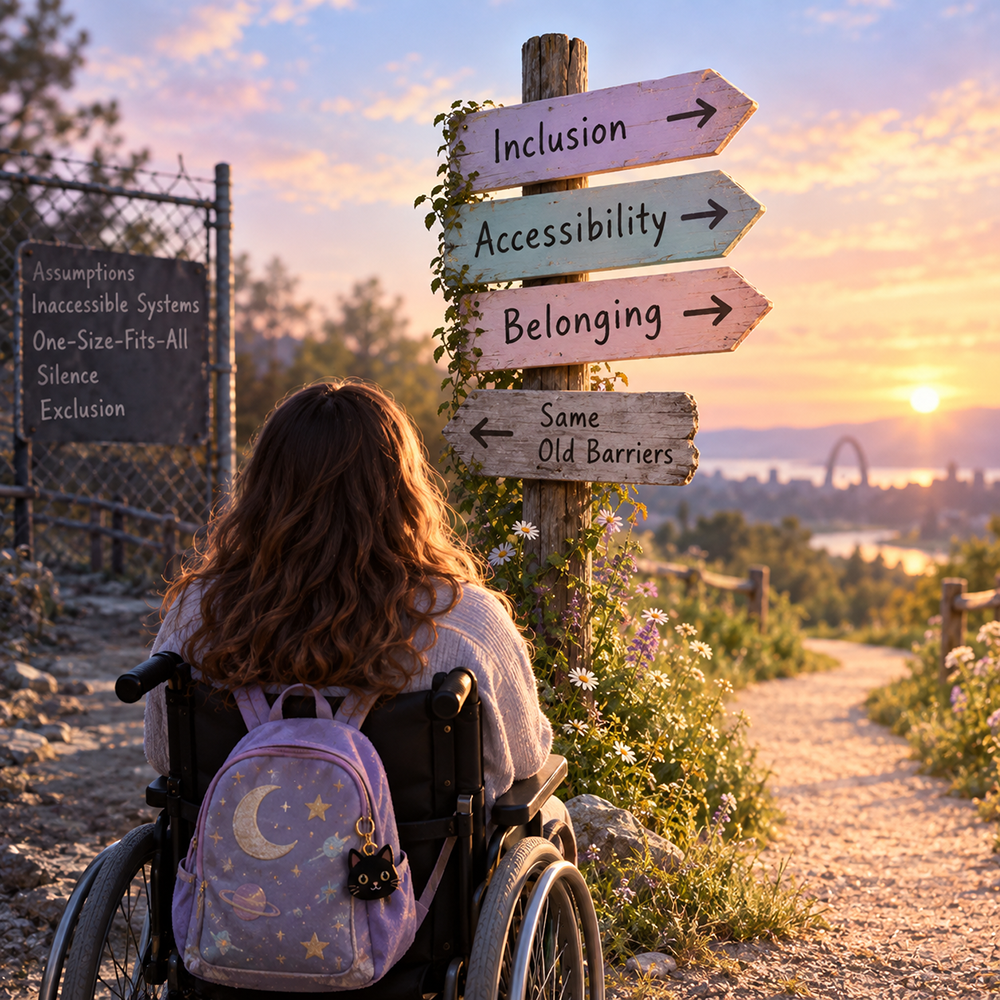
The Canaries Are Not the Problem
During our conversation, my friend described autistic people as canaries in society’s coal mine.
The metaphor stayed with me.
Canaries were once carried into mines because they were more vulnerable to toxic gases than the miners, and if the bird showed signs of distress, that distress warned the people nearby that the environment had become dangerous.
The canary was not defective for reacting; it was detecting something the others could not yet perceive.
Autistic people may sometimes occupy a similar position within society.
Our nervous systems may register sensory overload, uncertainty, relentless transitions, social performance, inadequate recovery, and escalating demands sooner or more intensely.
We may lose the ability to hide the effects while other people still appear to be functioning.
Society often interprets that visible distress as evidence that the autistic person is the problem:
- Too sensitive
- Too rigid
- Too emotional
- Too easily overwhelmed
- Unable to cope with ordinary life
But what if our distress is also communicating something truthful about the environment?
A workplace dependent on constant interruption, unclear expectations, sudden changes, sensory overload, and exhaustion may affect an autistic employee first or more visibly, but that does not make those conditions healthy for everyone else.
A service system that requires repeated phone calls, urgent responses, long travel, complex paperwork, and continual self-advocacy may become inaccessible to a disabled person sooner, but that does not make the system well designed.
A culture that expects people to work indefinitely without security, community, sufficient rest, or room for human limitation may push autistic people into collapse first, but that does not mean everyone else can survive it forever.
We may be showing where the air has already become difficult to breathe.
Yet society often responds by trying to change the canary:
- Teach it to tolerate more.
- Make it quieter.
- Question whether it is truly struggling.
- Praise the ones that remain productive.
- Medicate the symptoms.
- Remove it from view so nobody else has to confront what its distress might mean.
This is a convenient response because it allows the mine to remain open exactly as it is.
But silencing the warning does not remove the danger.
Calling suffering normal does not make it sustainable.
Calling a harmful demand reasonable does not change what it does to a human nervous system.
And calling the person who reacts “too sensitive” may say more about society’s commitment to the conditions than about the person who cannot endure them.
Autistic people often understand broken systems in particularly intimate ways because we repeatedly encounter their sharpest edges.
We learn where communication fails, where flexibility ends, where support disappears, and where a person’s worth becomes conditional on producing the right kind of performance.
That experience can give us valuable insight into what should be rebuilt.
But autistic people do not exist merely to warn everyone else.
The canary matters not only because its distress might save the miners; its distress matters because the canary is alive.
Autistic people deserve accessible environments, compassion, rest, dignity, and support even if changing society for us offered no benefit to anyone else; our humanity is enough.
Still, many changes that help autistic people would make life more humane for other, too:
- Clearer communication helps more than autistic people.
- Predictable expectations help more than autistic people.
- Flexible work, quieter environments, adequate recovery, and respect for different capacities help more than autistic people.
- A society that responds compassionately before someone reaches total collapse is safer for everyone.
Perhaps autistic people are not failing to adapt to a healthy world; perhaps our struggles are illuminating how much this world asks human beings to suppress, endure, and sacrifice in order to be considered functional.
The answer is not to teach the canaries to suffer silently; it is to listen while there is still time to change the air.
 Jessica Carey
A More Humane Society Would Listen
Autistic people do not expect every environment to be perfectly comfortable or every circumstance to unfold according to plan.
We understand that emergencies happen.
People make mistakes.
Plans change unexpectedly.
Resources and time are limited.
Our needs may sometimes conflict with someone else’s.
But acknowledging those realities is different from using them to justify making no effort at all.
There is an enormous space between perfectly accommodating every need and repeatedly disregarding a person’s needs because consideration would require change.
A more humane society would begin by listening.
When an autistic person says a sound is painful, listening means resisting the urge to call them dramatic.
When someone says a last-minute change has overwhelmed them, listening means helping them understand and adjust rather than scolding them for reacting.
When a person says that a task carries a hidden cost, listening means becoming curious about that cost instead of pointing to their intelligence as proof that it cannot exist.
When someone says they are no longer able to sustain what they once forced themselves to do, listening means recognizing that previous performance may not represent present capacity—or reveal what that performance cost.
Listening does not require agreeing with every interpretation or promising every requested outcome; it requires treating autistic people as credible participants in decisions affecting our own lives.
That means asking questions before issuing judgments:
- What part of this is creating the greatest difficulty?
- What would make the change easier to process?
- Would written information help?
- How much notice can we reasonably provide?
- Is there another way to accomplish the same goal?
- What happens after you force yourself through this?
- Are we asking both sides to compromise, or only the autistic person?
- What am I assuming that I should ask about instead?
Often, meaningful support is not complicated.
Give notice when notice is possible.
Explain what is changing and why.
Put important information in writing.
Allow additional processing time.
Reduce unnecessary sensory strain.
Make expectations explicit.
Offer choices where choices genuinely exist.
Accept communication that looks different from one’s own.
Do not require visible collapse as proof that support was needed.
Most importantly, stop treating every accommodation as an unfair advantage or personal inconvenience.
Accommodations do not make an autistic person less capable.
They can make it possible for our actual capabilities to emerge without requiring us to spend nearly all our energy surviving the environment.
This does not mean autistic people never stretch, learn, or compromise; we do those things constantly.
The imbalance lies in how rarely society recognizes its own obligation to move.
Autistic people are expected to alter our communication, suppress natural responses, withstand sensory pain, accept sudden changes, imitate neurotypical behavior, and hide the consequences so everyone else can remain comfortable.
Even when we do all of that, we may be told we are not trying hard enough.
Shared participation cannot depend on one group performing nearly all the adaptation.
Grace changes what adaptation feels like.
A sudden change accompanied by patience, information, and understanding is different from a sudden change followed by ridicule.
A difficult task offered with support is different from a demand backed by shame.
A limit received with curiosity is different from a limit treated as defiance.
Grace does not remove every difficulty.
It stops adding unnecessary cruelty to the difficulty that already exists.
A more humane society would also recognize interdependence as part of being human rather than evidence of failure.
Everyone relies on other people, infrastructure, knowledge, tools, and systems.
Some forms of dependence are simply more visible—and more stigmatized—than others.
Autistic and disabled people should not have to prove complete independence to earn adult respect, nor should receiving support require surrendering our autonomy.
We need what all people need: to be taken seriously, allowed complexity, supported where we struggle, respected where we are capable, and treated with kindness throughout.
Listening alone will not rebuild every inaccessible system.
But no meaningful change can begin while the people most affected are still being told that everyone else understands their lives better than they do.
 Jessica Carey
Change the Conditions, Not the Person
Autistic people are not failed neurotypicals.
We are not unfinished versions of the people society expected us to become.
Our differences are not character defects, and our disabilities do not disappear whenever our intelligence, creativity, or competence becomes visible.
We can have gifts without being superhuman.
We can need support without being incompetent.
We can experience joy intensely without being children.
We can know our own limits without being lazy, negative, or unwilling to grow.
And we can struggle within a system without being the reason that system is struggling.
For too long, society has responded to autistic distress by asking how the autistic person can be made quieter, easier, more productive, less sensitive, and more capable of enduring the existing conditions:
- Try harder.
- Mask better.
- Push through.
- Take something.
- Stop making excuses.
- Work like everyone else.
But many autistic people have already spent years trying to become tolerable to environments that made little effort to tolerate us; some of us pushed until the performance collapsed, taking pieces of our daily functioning with it.
The answer cannot always be more force.
Sometimes distress is not a refusal to participate; it is information.
It tells us that a demand is unsustainable, an environment is inaccessible, a transition needs more support, or a person has already exceeded their capacity.
Listening to that information does not mean abandoning every expectation. It means responding thoughtfully before another human being is harmed.
The same principle extends beyond autism.
A society that requires people to neglect their bodies, suppress their needs, medicate every response to intolerable conditions, and sacrifice their health to prove their worth is not functioning simply because many people still report to work.
A system can continue operating while the human beings inside it steadily deteriorate.
That is not success; it is delayed collapse.
My friend may be right that autistic people are among society’s canaries; our nervous systems can make it harder to conceal what relentless demands, sensory hostility, uncertainty, isolation, and inadequate recovery do to a person.
But the warning will mean nothing if society continues blaming the people who make the danger visible.
We do not need more people confidently explaining autism while refusing to listen to autistic people.
We do not need kindness that becomes patronizing, help that becomes coercion, or praise that confines us to whatever narrow role someone else has chosen.
We need humility.
Grace.
Compassion.
Accessible systems.
Shared compromise.
And the recognition that people do not have to function identically to possess equal human worth.
If autistic people are struggling to breathe inside the world society has built, the humane response is not to lecture us about resilience; it is to listen to what our lives are revealing and then change the air.
 Jessica Carey
Want even more content about creativity and art?
Be sure to check out all of our creative chronicles!
If you'd like to see examples of my work, you can find some of my art and creations at Redbubble and Gumroad!
Looking to learn more about my recent journey?
Check out some of these articles:
-Hidden Gems for St. Louis Artists
-Hidden Gems for Autistic & Neurodivergent Adults
-Learning What Love Was Supposed to Feel Like
-The Difference Between Resting and Giving Up
-When You Had to Raise Yourself
 Jessica Carey