

Sometimes the hardest things to recognize are not the things that are obviously wrong.
Sometimes the hardest things to recognize are the things everyone around you called normal.
The things that happened so often they became background noise.
The things you learned to explain away.
The things you stopped questioning because questioning them never seemed to change anything.
Humans are incredibly adaptable.
It is one of our greatest strengths.
We can adjust.
We can endure.
We can find ways to survive situations we never should have had to survive.
But sometimes that same ability that keeps us going can also make us forget:
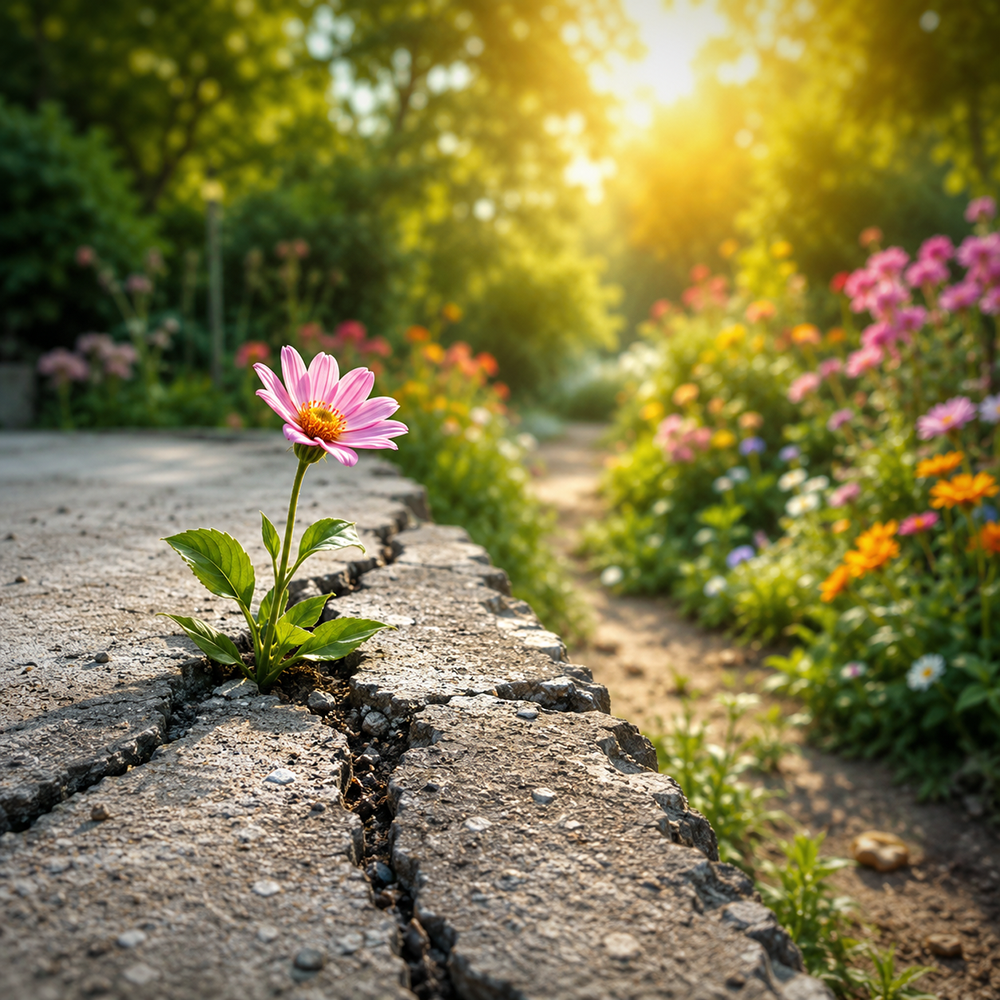
A plant growing through a crack in concrete is incredible.
Its strength is beautiful.
Its persistence is inspiring.
Its ability to survive despite everything working against it is worth honoring.
But the fact that the plant survived does not mean concrete was the environment it needed.
People are not so different.
Sometimes we spend years adapting to environments that require us to shrink.
To stay quiet.
To ignore our own needs.
To carry things that were never ours to carry.
To become experts at reading moods, avoiding conflict, and keeping everything together.
And because we become good at surviving, other people may even praise us for it.
- “You are so strong.”
- “You are so independent.”
- “You handle everything so well.”
But sometimes underneath what looks like strength is a person who learned they had no other choice.
This does not mean every difficult experience is abuse.
It does not mean every mistake someone makes is intentional harm.
Humans are imperfect. Relationships are imperfect. We all have moments where we misunderstand, react from pain, or realize we could have handled something differently.
The difference is whether there is room for growth.
For accountability.
For listening.
For change.
Because healthy relationships are not relationships where nobody ever gets hurt.
They are relationships where harm matters.
In unhealthy environments, pain often gets explained away.
Ignored.
Minimized.
Covered with phrases like:
- “They meant well.”
- “That’s just how they are.”
- “Other people have it worse.”
- “You’re too sensitive.”
- “Just let it go.”
And slowly, people learn to question their own reality more than they question the behavior hurting them.
That is why recognizing dysfunction can be so difficult.
Not because people are foolish.
Not because they should have known better.
But because when something surrounds you long enough, it starts to feel like the way things are.
A bird born inside a cage may not immediately recognize the bars.
It only knows the space it was given.
But that does not mean the sky was never there.
Sometimes healing begins with one quiet question: “What if this was never normal?”
Not asked with shame.
Not asked with blame.
But with curiosity.
With compassion.
With the possibility that maybe life was always meant to feel different than constant survival.
Maybe peace was supposed to feel possible.
Maybe safety was supposed to exist.
Maybe you were not meant to spend your whole life just learning how to endure.
Like many of the things I write about here, this reflection comes not from having everything figured out, but from slowly learning.
For much of my life, I became very good at surviving.
Pushing through.
Understanding everyone else.
Explaining everything away.
Trying harder.
But one of the most surprising parts of healing has been realizing that sometimes the question is not: “How do I become better at handling this?”
Sometimes the question is: “Was I ever supposed to carry this much in the first place?”
And that question changed everything.
Familiar Does Not Mean Healthy
One of the hardest parts about recognizing unhealthy patterns is that our brains often confuse familiar with safe.
We naturally compare life to what we have already experienced.
The relationships we saw.
The environments we grew up around.
The behaviors everyone treated as normal.
Our minds quietly create a blueprint:
- “This is what love looks like.”
- “This is what friendship looks like.”
- “This is what family looks like.”
- “This is what I should expect.”
 Jessica Carey
But sometimes that blueprint was built from survival, not truth.
If someone grows up in an environment where yelling happens every day, quiet may feel uncomfortable.
Not because peace is bad.
But because peace is unfamiliar.
If someone grows up where kindness always has strings attached, genuine kindness may feel suspicious.
Not because kindness is unsafe.
But because their past taught them to look for the hidden cost.
If someone grows up where their needs were dismissed, being considered may feel strange.
Not because they do not deserve consideration.
But because they learned not to expect it.
Humans adapt to the worlds we live in.
A child growing up in chaos does not have the option to say: “This environment does not meet my emotional needs, so I will find a healthier one.”
A child adapts.
They learn the rules of the environment they are given.
They learn:
- What keeps me safe?
- What creates conflict?
- What gets approval?
- What makes people upset?
- What parts of myself do I need to hide?
And those lessons can follow us long after we leave the environments that created them.
The person who was criticized constantly may become a perfectionist.
The person who was ignored may stop asking for help.
The person who had to manage everyone else’s emotions may become the person who always says, “It’s okay,” even when it is not.
The person who learned love could disappear at any moment may hold tightly to relationships that hurt them because losing them feels scarier.
Not because something is wrong with them.
Because adaptation is powerful.
The difficult part is that survival skills often work.
That is why we keep them.
People-pleasing may have reduced conflict.
Staying silent may have prevented arguments.
Becoming hyper-independent may have helped you keep going when nobody showed up.
Ignoring your needs may have helped you get through situations where your needs were not an option.
Those responses existed for a reason.
But sometimes the same things that helped us survive one environment keep us from fully living in another.
A bird that spent its whole life in a cage may hesitate when the door finally opens.
The open sky can feel overwhelming.
Unknown.
Unsafe.
Not because the cage was better.
But because the cage was known.
And sometimes healing means slowly learning: “I do not have to choose the cage just because I understand it.”
A different life can feel uncomfortable before it feels peaceful.
Supportive relationships can feel strange before they feel natural.
Rest can feel wrong before it feels restorative.
Being respected can feel surprising before it feels expected.
Sometimes healing is simply giving yourself enough time in healthier environments for your mind and body to realize: “I am allowed to live differently now.”
Learning the difference between genuine care and control disguised as care is an important part of rebuilding trust.
 Jessica Carey
When Survival Looks Like Strength
Strength is a beautiful thing.
The ability to overcome challenges, adapt, and keep going through difficult seasons is something worth honoring.
Human resilience is incredible.
But sometimes we confuse surviving something with being unaffected by it.
Sometimes we look at someone carrying a weight they never should have had to carry and only notice: “How impressive that they can hold so much.”
Instead of asking: “Why did they have to carry all of that alone?”
Many people who grew up in survival environments hear the same things:
- “You are so mature.”
- “You are so responsible.”
- “You are so independent.”
- “You are so easy.”
- “You never ask for anything.”
And sometimes those things are genuine strengths.
Sometimes they come from wisdom, confidence, and self-trust.
But sometimes there is a quieter story underneath.
Sometimes “mature” means: “I learned very young that I could not just be a child.”
Sometimes “independent” means: “I learned asking for help usually led to disappointment.”
Sometimes “easy” means: “I learned having needs created problems.”
Sometimes “responsible” means: “I learned I had to manage things that were never mine to manage.”
The outside world often sees the result.
They see someone capable.
Someone organized.
Someone who works hard.
Someone who handles everything.
They do not always see what created that ability.
They do not see the person quietly wondering:
- “Would anyone still care about me if I stopped being useful?”
- “Would people still value me if I needed something?”
- “Would I still matter if I had nothing to give?”
A tree growing in harsh conditions can develop incredibly strong roots.
That strength deserves respect.
But we would never look at a tree damaged by constant storms and say: “The storms were good because look how strong it became.”
We can honor survival without pretending survival was the ideal environment.
There is a difference between choosing strength and having no other option.
There is a difference between independence born from confidence and independence born from abandonment.
There is a difference between: “I know I can handle things.”
And: “I believe I have to handle everything alone because nobody will be there.”
One feels empowering.
The other feels exhausting.
Sometimes healing means learning that you are allowed to be more than your ability to endure.
You are allowed to need rest.
You are allowed to receive.
You are allowed to ask.
You are allowed to not have everything figured out.
You do not have to constantly prove you deserve support by showing how much pain you can tolerate.
Because a person’s worth was never supposed to come from how quietly they suffer.
Strength is not only surviving the storm.
Sometimes strength is admitting:
- “I need shelter.”
- “I need help.”
- “I cannot keep carrying this the same way.”
And sometimes the bravest thing a person can do after years of surviving alone is allow themselves to experience something different.
For many people, spending years in survival mode eventually comes with a cost. Sometimes what looks like ‘functioning’ on the outside is actually exhaustion underneath.
 Jessica Carey
When Society Celebrates the Wrong Things
Sometimes dysfunction continues because it does not always look like dysfunction from the outside.
Sometimes it looks impressive.
Successful.
Responsible.
Powerful.
Even admirable.
Because society often teaches us to measure outcomes without asking enough questions about the path someone took to get there.
We see achievement and assume wisdom.
We see confidence and assume competence.
We see authority and assume maturity.
We see wealth and assume success.
We see someone being liked by many people and assume they must treat everyone well.
But appearances only tell part of a story.
A person can be admired publicly and harmful privately.
A person can accomplish impressive things and still have inner work to do.
A person can have power and not know how to use it with kindness.
Sometimes the traits that get rewarded are not actually signs of emotional health.
Always being right.
Never needing anyone.
Winning at all costs.
Having the last word.
Working until exhaustion.
Ignoring emotions.
Controlling every situation.
Refusing to apologize.
Being “brutally honest” without considering whether the brutality was necessary.
These things are often mistaken for strength.
But strength without compassion easily becomes harm.
Real strength is not refusing to admit mistakes.
It takes strength to say:
- “I was wrong.”
- “I did not understand.”
- “I hurt you, and I want to do better.”
- “I need to learn.”
Because growth requires humility.
It requires being willing to see ourselves clearly — including the parts we might not want to see.
And maybe that is why harmful patterns continue for so long.
Because questioning them requires discomfort.
It requires people to ask:
- “Did something I thought was normal actually hurt someone?”
- “Did something I learned need to be unlearned?”
- “Did I repeat something because it was right, or because it was familiar?”
Those questions are not easy.
But they matter.
The goal is not perfection.
Nobody moves through life without hurting someone.
Nobody understands everything immediately.
Nobody gets every relationship, conversation, or decision right.
Being human means we will make mistakes.
The difference is what happens afterward.
Healthy people and healthy communities make space for repair.
They listen.
They reflect.
They grow.
They care more about understanding than defending an image of always being right.
Because a person committed to growth can learn.
A person committed only to protecting their ego stays stuck.
Maybe we need to rethink what we celebrate.
Not just:
- “Who has the most?”
- “Who looks the strongest?”
- “Who seems the most impressive?”
But:
- Who creates safety?
- Who treats people well when there is nothing to gain?
- Who takes responsibility when nobody is watching?
- Who uses their strength to protect rather than control?
- Who leaves people feeling more free, more valued, and more themselves?
Because a beautiful life is not only built by what we achieve.
It is built by how we treat the living beings sharing the journey with us.
 Jessica Carey
Silence Does Not Mean Something Was Okay
One of the biggest misunderstandings about unhealthy situations is the assumption that silence equals acceptance.
That if someone did not speak up, they must have been fine.
That if someone stayed, it could not have been that bad.
That if someone kept functioning, they must not have been hurting.
But humans are far more complicated than that.
People stay silent for many reasons.
Sometimes they tried speaking before and nothing changed.
Sometimes honesty created more conflict than pretending.
Sometimes they depended on the people hurting them.
Sometimes they were afraid of what would happen if they told the truth.
Sometimes they did not have the words yet to explain what they were experiencing.
Sometimes everyone around them insisted:
- “That is normal.”
- “You are overreacting.”
- “You are making things difficult.”
So eventually, they learned: “Maybe speaking does not matter.”
When someone stops asking for help, it is easy to assume they no longer need any.
But sometimes they stopped asking because asking became another source of pain.
A child who cries and receives comfort learns: “My voice matters.”
A child who cries and is repeatedly ignored, criticized, or punished learns something different:
- “My needs create problems.”
- “My feelings are inconvenient.”
- “It is safer to handle things alone.”
And those lessons can follow someone for years.
Sometimes people mistake endurance for evidence that something was acceptable.
They say:
- “But you handled it.”
- “You got through it.”
- “You turned out fine.”
But surviving something is not proof that it was harmless.
People can survive things that deeply affected them.
People can continue showing up while quietly struggling.
People can smile, work, create, care for others, and still be carrying pain nobody sees.
Imagine seeing someone walking barefoot across broken glass.
When they finally reach the other side, we would not say: “Well, your feet healed eventually, so the glass must not have hurt.”
We would understand: the healing afterward does not erase the injury.
The strength it took to keep walking does not make the path okay.
And sometimes people do not recognize what happened until they experience something different.
They do not realize how loud an environment was until they finally experience quiet.
They do not realize how much tension they carried until their body finally relaxes.
They do not realize how often they were shrinking until they are somewhere they can expand.
Sometimes contrast reveals what familiarity hid.
That is why compassion matters.
When someone finally starts talking about something they stayed silent about for years, they usually do not need: “Why didn’t you say something sooner?”
They need: “I am listening now.”
Because sometimes finding your voice is not one moment.
It is a process.
A process of remembering:
- “My experiences matter.”
- “My feelings are information.”
- “My voice deserves space.”
And real healing begins when people finally have enough safety to tell the truth.
The Difference Between Peace and Avoidance
Many people are taught to “keep the peace.”
Do not cause problems.
Do not make things awkward.
Do not upset anyone.
Do not bring up the thing everyone is trying to ignore.
And peace sounds like a beautiful goal.
Because it is.
A peaceful life matters.
A peaceful home matters.
Peaceful relationships matter.
But sometimes what people call peace is not actually peace.
Sometimes it is avoidance.
There is a difference between a quiet house and a peaceful home.
A quiet house may simply mean everyone learned which topics not to mention.
Which emotions not to express.
Which person not to upset.
Which truth not to acknowledge.
From the outside, everything can look calm.
But underneath, everyone is holding their breath.
Real peace has room for honesty.
It has room for:
- “I felt hurt.”
- “I need something different.”
- “I think there was a misunderstanding.”
- “Can we talk about this?”
Because safe connections do not require pretending nothing is ever wrong.
They create enough safety to work through what happens when things are wrong.
Avoidance asks: “How do we make this uncomfortable feeling disappear?”
Peace asks: “How do we understand what this feeling is trying to show us?”
Avoidance says: “Stop talking about the problem.”
Peace says: “Let’s work together so the problem can actually heal.”
Avoidance protects the appearance of harmony.
Peace creates genuine harmony.
Sometimes the person naming the problem gets treated like they are the one creating it.
The person saying:
- “This hurts.”
- “This is not okay.”
- “Something needs to change.”
Becomes labeled as difficult, dramatic, negative, or disruptive.
But noticing smoke does not mean someone started the fire.
Pointing toward something that needs attention is not the same as causing the thing that needs attention.
Imagine a house with a leaking roof.
Everyone knows water is dripping inside.
Everyone steps around the puddle.
Everyone gets used to placing buckets underneath.
Then one day someone says: “Maybe we should fix the roof.”
And everyone responds: “Why are you creating problems?”
But the problem was already there.
Someone finally stopped pretending it was normal.
That is why honesty can feel disruptive in unhealthy systems.
Not because truth destroys peace.
But because truth interrupts pretending.
And when people have mistaken pretending for peace, honesty feels like a threat.
Real peace does not require everyone to shrink.
It does not require one person’s comfort at the expense of everyone else’s well-being.
It does not require silence from the people hurting the most.
Real peace is something everyone gets to experience.
Not just the people benefiting from things staying the same.
Because peace is not the absence of difficult conversations.
Sometimes difficult conversations are the path that leads there.
Peace is safety.
Respect.
Understanding.
Repair.
The ability to breathe because you know honesty will not cost you belonging.
Finding Your Own Compass Again
One of the hardest parts about leaving unhealthy patterns behind is learning to trust yourself again.
Because when you have spent a long time being told your experiences are wrong, you may start looking outside yourself for permission to believe what you already know.
- Was that actually hurtful?
- Was I allowed to be upset?
- Was that really a problem?
- Am I asking for too much?
- Am I being unreasonable?
When other people repeatedly rewrite your reality, eventually you may begin questioning your own understanding of it.
You may become better at explaining someone else’s behavior than listening to your own feelings about how that behavior affected you.
You may immediately ask:
- “What did they mean?”
- “Why did they do that?”
- “What happened to them that made them this way?”
Those can be compassionate questions.
Understanding others matters.
But there is another question that matters, too: “What happened inside of me?”
- Did I feel safe?
- Did I feel respected?
- Did I feel like I could be honest?
- Did I feel like my boundaries mattered?
- Did I feel like a person?
Because compassion for someone else should not require abandoning compassion for yourself.
Both can exist together.
Many people who grew up around dysfunction become incredibly skilled at seeing everyone else.
They notice tiny changes in tone.
They sense shifts in mood.
They anticipate needs before anyone asks.
They understand why people behave the way they do.
They become experts at studying everyone around them.
But sometimes, they were never given enough space to study themselves.
Healing often involves turning some of that awareness inward.
Learning:
- What do I feel?
- What do I need?
- What matters to me?
- What kind of relationships help me become more myself?
- What kind of environments allow me to breathe?
It is not about becoming selfish.
It is about remembering that you are also someone you are responsible for caring about.
You are not only here to understand everyone else.
You are also a living being having an experience.
Your feelings are information.
Your needs are information.
Your exhaustion is information.
Your joy is information.
Your peace is information.
Sometimes we look for complicated explanations when our hearts have been whispering simple truths for a long time.
- “This hurts.”
- “I feel smaller here.”
- “I cannot relax.”
- “I am always preparing for something bad to happen.”
Or:
- “I feel safe here.”
- “I feel peaceful here.”
- “I can breathe.”
- “I feel more like myself.”
Those quiet signals matter.
Not because feelings are always perfect facts.
Not because we never misunderstand situations.
But because our inner experiences deserve curiosity instead of automatic dismissal.
Finding your compass again does not mean deciding you are always right and everyone else is always wrong.
It means rebuilding a relationship with yourself where your own voice gets a seat at the table.
Where you can listen.
Reflect.
Learn.
Grow.
And finally ask: “Does the life I am living align with the kind of person and world I want to help create?”
Because maybe healing is not about becoming someone entirely new.
Maybe it is about slowly uncovering the parts of yourself that had to hide.
The creativity.
The curiosity.
The hope.
The kindness.
The dreams.
The pieces of you that were waiting for enough safety to come home.
 Jessica Carey
Creating Something Different
Recognizing dysfunction is not about staying angry forever.
It is not about looking back at every moment of your life searching for what was wrong.
It is not about believing people are hopeless or that the world is only harmful.
It is about awareness.
Because we cannot change patterns we are not allowed to see.
Many harmful cycles continue simply because nobody stops to question them.
Someone experiences pain.
They adapt.
They survive.
They pass along what they learned because it is all they know.
Generation after generation.
Relationship after relationship.
Community after community.
Until someone finally pauses and asks: “Is this really the way things have to be?”
And that question is powerful.
Because every healthier pattern humanity has ever created started with someone imagining something different.
Someone looked at what was considered normal and said: “Maybe we can do better.”
Maybe strength does not have to mean suffering silently.
Maybe love does not have to mean control.
Maybe success does not have to come without kindness.
Maybe peace does not have to require pretending.
Maybe support does not have to come with shame.
We are all learning.
We are all carrying things we inherited.
Beliefs.
Habits.
Fears.
Ways of protecting ourselves.
Ways of seeing the world.
But the beautiful thing about being human is that we can grow.
We can reflect.
We can choose.
We can decide: “This pattern reached me, but it does not have to continue through me.”
And maybe that is one of the greatest acts of hope.
To experience darkness and still choose to create light.
To experience harm and still choose compassion.
To recognize what was missing and decide to help build it.
Not because we can fix everything.
Not because we have to carry the whole world.
But because every moment of understanding, kindness, honesty, and courage matters.
A flower that grew through concrete does not have to spend forever proving how strong it was.
And maybe part of healing is learning to create more gardens.
For ourselves.
For each other.
For the people who come after us.
Because surviving something difficult is powerful.
But we were always meant for more than survival.
We were meant to grow.
 Jessica Carey
Want even more content about creativity and art?
Be sure to check out all of our creative chronicles!
If you'd like to see examples of my work, you can find some of my art and creations at Redbubble and Gumroad!
Looking to learn more about my recent journey?
Check some of these articles:
-The Difference Between Resting and Giving Up
-Hidden Gems for St. Louis Artists
-Hidden Gems for Autistic & Neurodivergent Adults
-I Think I Might Be Autistic... Now What?
 Jessica Carey