
Where do we go when we don't need to be anywhere?
Not home.
Not work.
Not the grocery store because we're out of milk.
Not the doctor's office because we have an appointment.
Not somewhere we're rushing into, accomplishing something, paying, and leaving.
Just somewhere we can be for a while.
Somewhere we might recognize a face.
Somewhere someone might eventually recognize ours.
Somewhere we don't necessarily need an invitation.
Somewhere we can arrive alone without that feeling like a problem.
For many of us, that question may be surprisingly difficult to answer.
The Space Between Home and Work
Sociologist Ray Oldenburg gave a name to one answer: the third place.
If home is our first place and work is our second, third places are the informal gathering places that exist somewhere outside those two worlds—the cafés, libraries, neighborhood gathering spots, and other places where people can return regularly, spend time, encounter familiar faces, and participate in the social life around them.
The important part isn't simply that other people happen to be there.
A crowded store can contain hundreds of people without creating much connection at all.
A third place becomes meaningful because people have opportunities to linger, interact, return, and gradually become familiar to one another.
Contemporary work on third places makes a similar distinction: the building itself isn't enough; what matters is what people are able to do together inside it.
That can sound remarkably ordinary.
And perhaps that's the point.
We Need Places Where Nothing Extraordinary Has to Happen
Not every human connection begins with a profound conversation.
Sometimes it begins because you've seen the same person four Tuesdays in a row.
Someone remembers what you were working on last week.
You learn somebody's name.
Someone scoots their supplies over so you can sit down.
You ask how they made something.
They ask what you're making.
Eventually, you stop feeling like a stranger walking into a room full of strangers.
Nothing dramatic happened.
You just kept being there together.
There is something valuable about places that allow this kind of familiarity to accumulate.
But those places aren't equally available to everyone.
Some require money every time we enter.
Some require memberships.
Some aren't nearby.
Some aren't accessible.
Some are designed for people to move through rather than stay.
And some may technically welcome us without ever quite becoming places where we feel comfortable enough to return.
So I don't think it's quite accurate to say that third places have simply disappeared.
Libraries, parks, cafés, community centers, religious and civic spaces, and many other gathering places still exist, and libraries in particular continue to be studied as important community and third-place environments.
But perhaps many of us have too few places where repeated, informal belonging is actually accessible to us.
And that's where creativity becomes interesting.
What Does Art Have to Do With Any of This?
Think about some of the places where making happens.
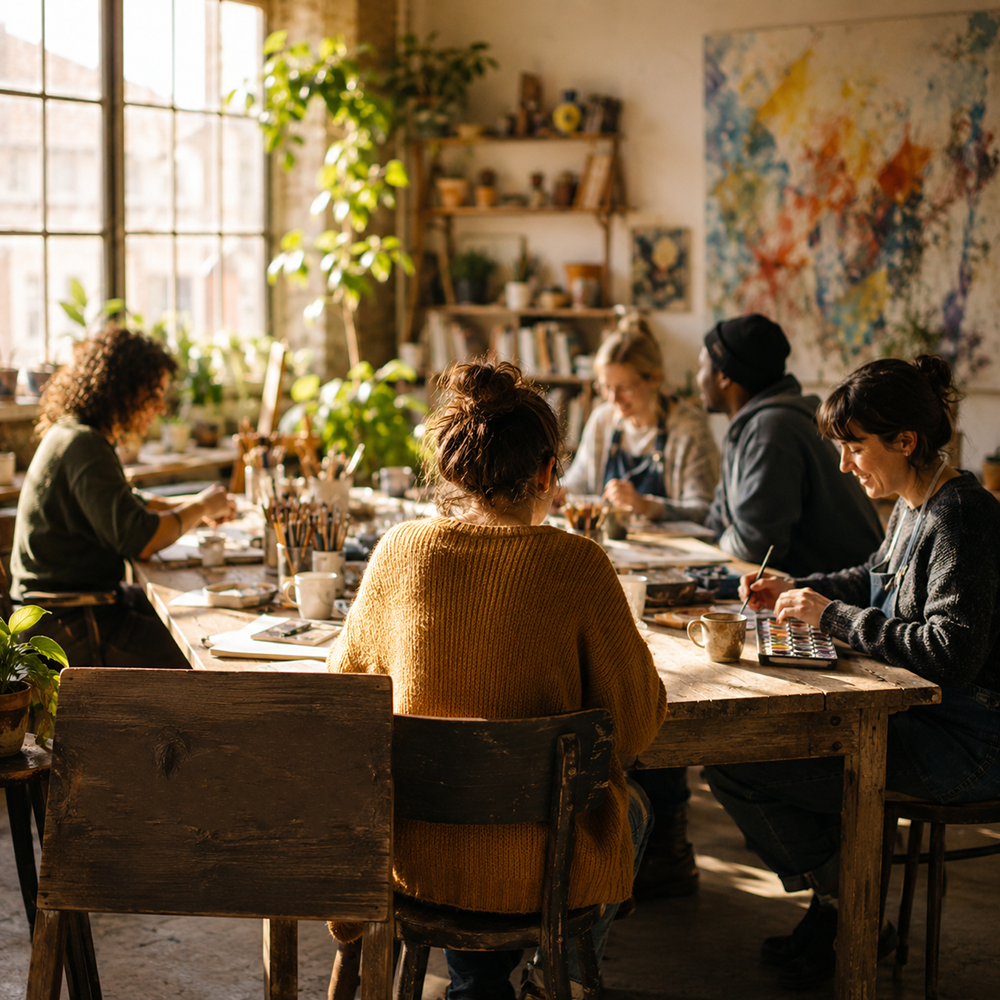
A community art studio.
A library craft program.
A makerspace.
An open studio.
A knitting circle.
An art club.
A creative reuse center.
A pottery studio.
A community workshop.
On the surface, we might describe these places according to what people go there to do.
You go to the pottery studio to make pottery.
You go to the makerspace to use the equipment.
You join the knitting group to knit.
You attend art club to make art.
You visit the library because there's a workshop you want to try.
And all of that may be true.
But something else can happen alongside the making.
Creative spaces give people a reason to gather before they necessarily have a relationship with one another.
We don't have to walk through the door already knowing how to make friends.
We don't even have to make socializing the primary reason we're there.
There is already something to do.
We can make something beside another person who is making something, too.
And perhaps, over time, the activity becomes more than the reason we came.
Maybe it becomes the thing that allows us to keep encountering one another long enough for familiarity to grow.
The art still matters.
But maybe it isn't the only thing being created.
What if one of the most important things a creative space can make isn't an object at all—but community?
Instead of asking only: where can I make art?
Maybe there's another question worth asking: where is creativity helping people find one another?
Community Usually Doesn't Begin With “Let's Become Friends”
Making friends as an adult can sound strangely formal when we talk about it.
- Go meet people.
- Put yourself out there.
- Join a group.
- Make some friends.
As though friendship begins when two strangers deliberately decide: we should become important to one another.
Sometimes it does.
But a lot of human connection begins much more quietly.
You see someone once.
Then you see them again.
Eventually, you recognize them.
Eventually, they recognize you.
And somewhere along the way, a stranger becomes a familiar person.
Familiarity Has to Start Somewhere
Imagine going to the same art club every week.
The first time, you may not know anybody.
You find somewhere to sit.
Take out your supplies.
Maybe introduce yourself.
Maybe mostly keep to yourself.
The next week, one of the people from before is there again.
Then again the week after that.
Eventually you know what they're working on.
They know what you're working on.
Someone remembers that you were struggling with something last week and asks how it turned out.
Someone brings the same enormous bag of yarn every time.
Someone always sits near the window.
Someone is usually experimenting with something you've never seen before.
None of this is particularly dramatic.
But that's exactly what makes it important.
Third places depend partly on this kind of regularity: people returning often enough that repeated contact can create familiarity, trust, and a sense that the place has recognizable people in it rather than an endlessly changing collection of strangers.
Community can begin before anybody realizes community is being built.
We Don't Have to Arrive With a Relationship
This is one of the things creative gathering spaces can offer.
You don't necessarily need someone to invite you.
You don't necessarily need a friend to come with you.
You don't have to organize a gathering yourself.
You can arrive because there's something you want to do.
- I want to learn pottery.
- I want to use the sewing machine.
- I want somewhere to work on this painting.
- I want to try printmaking.
- I want to knit with other people.
- There's an art program at the library that sounds interesting.
The creative activity provides the initial reason for being there.
And that matters because finding community can be difficult when finding community is the entire assignment.
Walking into a room with the explicit purpose of meeting people can carry a lot of pressure.
Walking into a room because you're going to make something gives you somewhere to begin.
The relationships can come later.
Small Interactions Can Accumulate
Maybe someone asks to borrow your scissors.
You ask what kind of paint they're using.
Someone compliments the color of your yarn.
Another person knows how to fix the machine that keeps giving you trouble.
Someone laughs when their supposedly simple project goes spectacularly wrong.
You ask the person beside you what they're making.
Next week, you ask how it turned out.
These interactions may seem insignificant individually.
Most won't immediately become friendships.
Some never will.
But they can accumulate.
A person becomes someone whose name you know.
Someone whose work you recognize.
Someone you expect to see.
Someone you notice is missing.
Someone you're glad to find sitting at the table when you arrive.
Contemporary third-place thinking emphasizes this repeated, informal contact rather than merely having many people pass through the same location.
A crowded place isn't automatically a community space; regular return and opportunities for interaction are part of what allows relationships to develop.
Sometimes belonging grows in increments too small to notice while they're happening.
Not Every Connection Has to Become a Friendship
This matters, too.
If we measure the social value of a place only by whether people make close friends there, we may miss much of what community actually looks like.
There are people we know without knowing deeply.
The person at art club whose name we know.
The librarian who recognizes us.
The person at the makerspace who always knows how to fix something.
The woman who knits across the table every Monday.
The person whose latest project we genuinely want to see.
We may never go to one another's homes.
We may never exchange phone numbers.
We may know surprisingly little about one another's lives.
And still: hey, good to see you can matter.
Being recognized can matter.
Recognizing others can matter.
Walking into a place and knowing that you are not entering a room composed entirely of strangers can matter.
Community has room for acquaintances, familiar faces, regulars, casual conversations, and people whose lives overlap ours only in this particular place.
Not every meaningful human connection needs to become an intimate one.
Sometimes We Find One Another Because We Kept Showing Up
Maybe that's part of what third places make possible.
They don't necessarily manufacture friendship.
They create conditions in which familiarity has somewhere to grow.
We have somewhere to go, a reason to be there, and a reason to return.
Maybe some of those relationships eventually travel outside the creative space.
Maybe they don't.
Either outcome can still matter.
Because sometimes community isn't something we deliberately build from scratch.
Sometimes it grows because people keep having reasons to return to one another.
And creativity can provide one of those reasons.
 Jessica Carey
Making Gives Us Something to Do While We're Together
There is a particular kind of advice people often receive when they're lonely or looking for community: go meet people.
Which sounds simple until we actually have to do it.
Where and then what?
- Walk into a room full of strangers and introduce ourselves?
- Approach someone who is already talking to someone else?
- Figure out when to speak?
- Keep a conversation going with someone we've never met?
- Know whether they actually want to talk to us?
For some people, that may come naturally.
For others, a space built entirely around socializing can make connection feel like a task we have to perform correctly.
Creative spaces can offer something different.
There is already something else to do.
We Don't Have to Make Conversation the Whole Activity
At an art club, we can draw.
At a knitting group, we can knit.
At a makerspace, we can work on a project.
At a community studio, we can paint, sculpt, sew, print, build, experiment, or simply watch what someone else is doing.
Conversation can happen.
But conversation doesn't necessarily have to carry the entire experience.
Maybe we talk for ten minutes and then return to our work.
Maybe someone asks about what we're making.
Maybe we ask someone how they created a particular effect.
Maybe several people are talking while someone else mostly listens.
Maybe there are stretches when nobody says much at all.
And the silence doesn't necessarily mean the gathering has failed.
We can be together without having to interact every second we're together.
That can make social connection feel less like a performance and more like something allowed to emerge.
The Project Can Give Us Somewhere to Begin
Creative work also gives us an unusually convenient conversation starter.
We don't necessarily have to invent something to say to a stranger.
There's already something sitting on the table between us.
- What are you making?
- How did you do that?
- What kind of yarn is that?
- Have you used this material before?
- Do you know how this machine works?
- What happens if you try this?
The conversation has somewhere to begin because our attention doesn't have to be entirely on one another.
It can be on the thing we're making.
And perhaps that's part of why shared creative activity can create opportunities for unexpected interaction.
Research on making programs in public libraries, for example, has documented moments when participants' ideas and feedback influenced one another's creative processes rather than making remaining entirely individual.
The object between us can become a kind of bridge.
Not because every conversation about paint or yarn is going to become a friendship.
But because it gives two people who don't know one another something they already have in common for the next few minutes.
Helping Each Other Can Happen Naturally
Making also creates little opportunities for people to exchange knowledge.
Someone knows how to thread the machine.
Someone else has used that material before.
One person knows why the clay keeps cracking.
Another knows an easier way to cast on.
Someone has extra glue.
Someone needs scissors.
Someone figured out the printer.
Someone has absolutely no idea what they're doing, and the person sitting beside them happens to know.
These aren't necessarily formal acts of teaching.
Sometimes they're simply: here, let me show you.
And the interesting thing is that the roles can change.
Today, I'm the person asking for help.
Next month, someone new walks through the door struggling with the thing I finally learned how to do.
Now I'm the person saying: oh, I had trouble with that, too. Here's what worked for me.
Makerspace research has described this social and communal dimension of making alongside the individual practice of crafting itself.
The space isn't only holding individual people making individual things.
Knowledge can begin moving around the room.
 Jessica Carey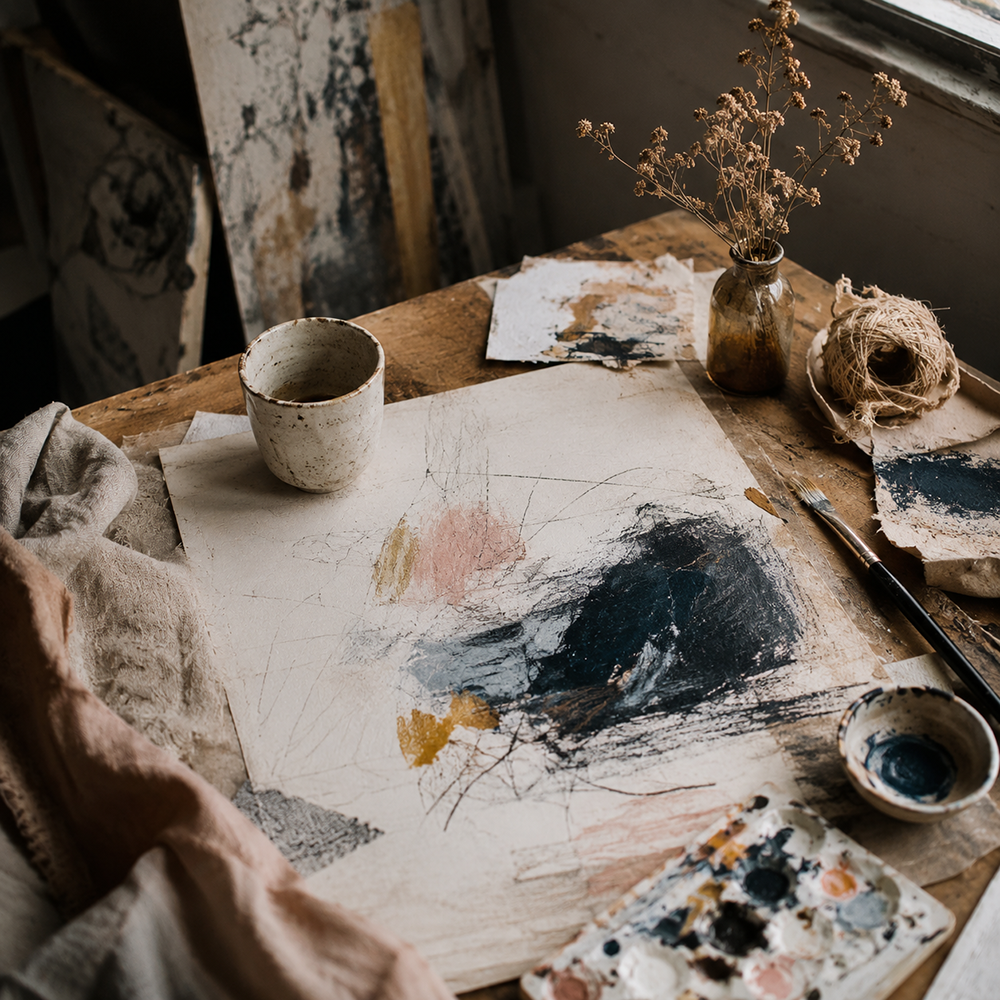
We Can Participate Without Performing Constant Sociability
This may be one of the most valuable possibilities creative gathering spaces offer.
Someone can be part of the room without necessarily needing to be the most social person in it.
They can listen.
Work quietly.
Join a conversation when they want to.
Return to their project when they don't.
Ask a practical question without needing to turn it into a twenty-minute conversation.
Sit beside other people without constantly having to prove that they belong there.
That doesn't mean every creative space actually works this way.
Some groups are cliquish.
Some environments carry strong social expectations.
Some people may still feel excluded.
And different people need different amounts and kinds of interaction.
Research examining what people want from third places has similarly found value in having choice between privacy and connection, rather than assuming everyone wants constant social interaction.
But at their best, creative spaces can allow multiple ways of being present.
Participation doesn't always have to look like conversation.
Sometimes participation looks like sitting at the table and making something alongside everyone else.
Sometimes Belonging Begins Side by Side
Maybe that's part of what making offers us.
We don't necessarily have to begin by looking directly at another person and trying to create a relationship.
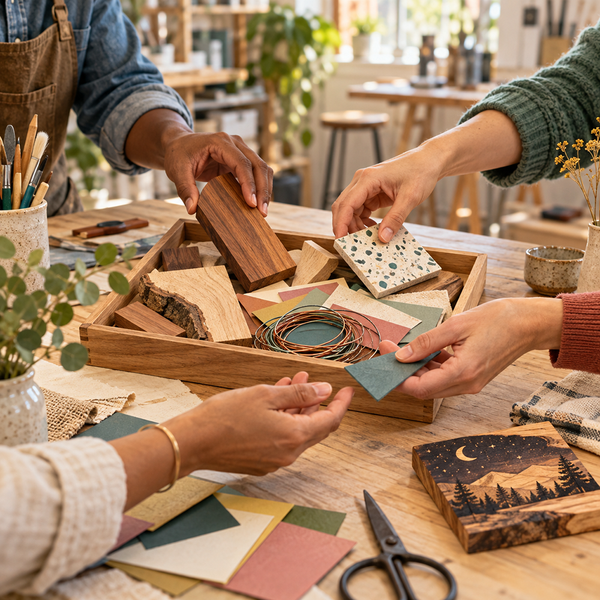
We can begin with the paper.
The yarn.
The clay.
The sewing machine.
The pile of scraps in the middle of the table.
We can work beside one another.
Ask questions.
Exchange ideas.
Notice what other people are doing.
Offer help.
Receive help.
Laugh occasionally.
Sit quietly occasionally.
Come back next week.
And perhaps eventually we realize that the people who once happened to be making beside us have become part of the reason we keep returning.
Making gives us something to do together before we know what to say to one another.
And sometimes belonging begins side by side rather than face to face.
The Difference Between Visiting a Place and Belonging Somewhere
Anyone can visit a place.
We can attend a workshop once.
Drop into an open studio.
Take a class.
Go to an event.
Spend an afternoon at the library.
Have a wonderful experience—and never go back.
There's value in that.
But there's something different about a place we return to.
The first time, we have to figure everything out.
- Where do I go?
- Where should I sit?
- Where are the supplies?
- Who do I ask if I need something?
- What does everyone else seem to know that I don't?
The second time, perhaps we recognize the room.
The third time, we recognize a person.
Eventually, we don't have to figure everything out anymore.
We know where the scissors are.
We know which table usually fills up first.
We recognize the person who always brings knitting.
Someone recognizes us.
And somewhere in all that repetition, a place we once visited can begin to feel like somewhere we belong.
Belonging Can Grow Through Repetition
One of the important qualities of third places is the presence of regulars—not necessarily people who are there constantly, but people who return often enough that their presence becomes familiar.
That repetition can seem almost too ordinary to matter.
We go to art club again.
Someone is sitting in the same place.
We work on our project.
We talk a little.
We leave.
Then we do it again.
Not every interaction has to accomplish something. Sometimes we're simply accumulating familiarity.
I've seen you before becomes I know your name.
Which might eventually become: we missed you last time.
The repetition is what gives those small interactions somewhere to grow.
A Place Can Become Familiar, Too
And it isn't only the people who become familiar.
The space itself does.
At first, everything requires attention.
Later, we know where things are.
We know how the room works.
We know whether people tend to arrive early or wander in late.
We know which supplies are communal.
We know the strange noise the machine makes when it's working correctly.
We know where the outlets are.
We know which chair we like.
That kind of knowledge can seem trivial.
But it changes our relationship with a place.
We are no longer spending all of our energy figuring out how to exist there.
We have some history with it.
Maybe it's the table where our projects always seem to spread farther than we intended.
Maybe it's the shelf where something we made is displayed.
Maybe it's the corner with the best light.
Maybe it's the person who knows what we've been working on for the last three weeks.
Little by little, the place begins to contain evidence that we've been there before.
Eventually, We Know How to Participate
There's another shift that can happen when we return often enough.
At first, we're the newcomer.
Someone shows us where things are.
Someone explains the rules.
Someone helps us use the equipment.
Someone tells us what everybody normally does.
But eventually, another new person walks through the door.
And now we know.
We can point toward the supplies.
Explain how something works.
Make room at the table.
Answer the question we once had to ask.
Say: you can sit here.
That is a subtle but meaningful transition.
We've moved from simply receiving access to the space toward participating in the life of it.
And perhaps that's another part of belonging: we begin to have something to give back to the place that has been making room for us.
Not because we owe it anything.
Not because we need to become volunteers, leaders, or experts.
Sometimes what we give back is simply familiarity.
We become one of the recognizable faces that makes the room a little less unfamiliar for someone arriving after us.
 Jessica Carey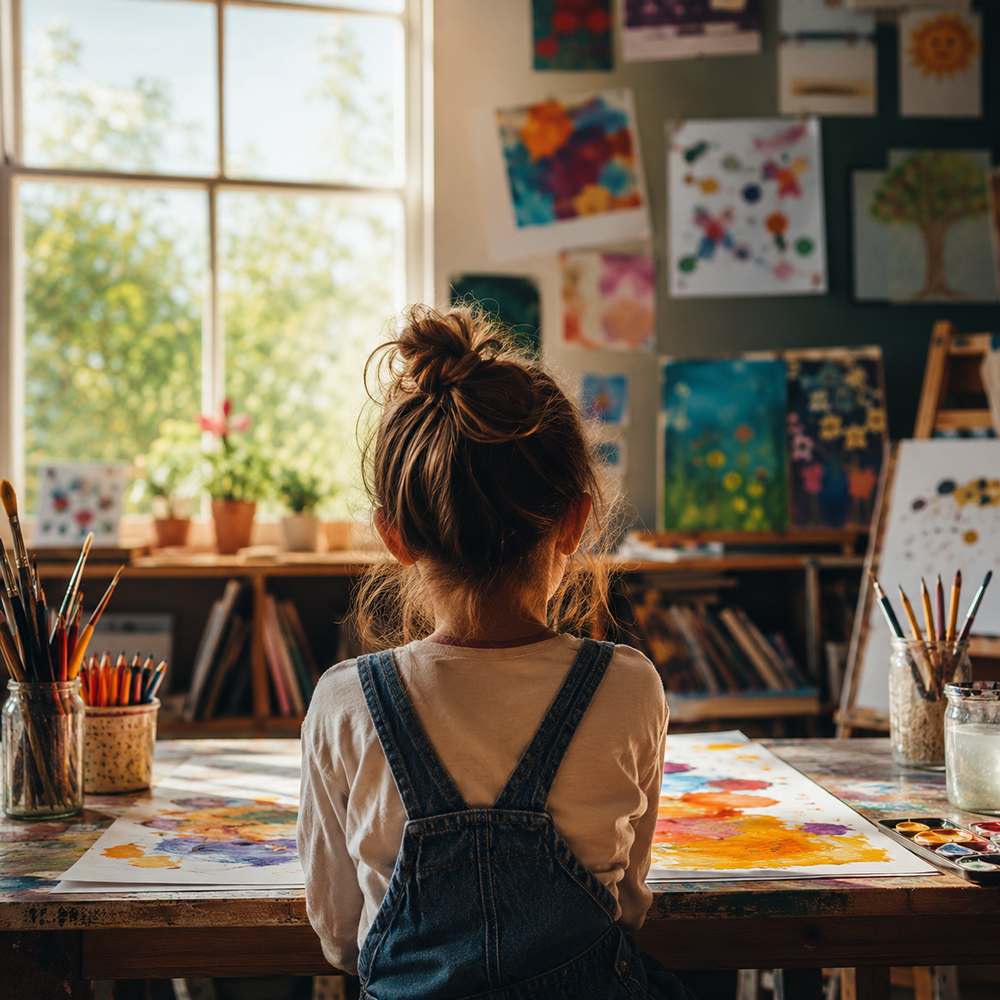
Familiarity Doesn't Have to Mean Sameness
Of course, belonging shouldn't require a place to become a closed circle.
There's a tension here worth acknowledging.
Regulars can make a place feel warm and familiar.
But a group of regulars can also make a newcomer feel as though they've walked into a room where everyone already belongs except them.
A healthy creative gathering space needs room for both.
People who have been coming for years.
And someone who walked through the door ten minutes ago.
People who know exactly what they're doing.
And people who don't know where the scissors are yet.
People deeply involved in the community.
And people who may simply want to sit quietly and make something.
The goal isn't to create an exclusive little world for the people who got there first.
It's to create enough continuity that people can become familiar without closing the circle around themselves.
That's part of what makes welcome an ongoing practice rather than something a space can simply claim about itself.
A Place Becomes Ours Because We Can Return to It
Maybe that's ultimately the difference between visiting somewhere and belonging somewhere.
A visitor experiences a place.
A regular begins accumulating a relationship with it.
Not ownership.
Not entitlement.
History.
We've made things there.
Learned things there.
Been frustrated there.
Had conversations there.
Sat quietly there.
Recognized people there.
Been recognized there.
Perhaps we've watched other people arrive for the first time and eventually become familiar, too.
Third places depend on this kind of return.
A single spectacular event may create a wonderful memory, but predictable rhythms give people the opportunity to encounter one another often enough for a community to take shape.
And maybe that's why some of the most meaningful community spaces aren't necessarily the most impressive ones.
Sometimes they're simply the places that keep making room for us.
Week after week.
Project after project.
Conversation after conversation.
Until one day we walk through the door without wondering quite so much whether we're supposed to be there.
A place becomes ours partly because we have been allowed to return to it.
A Third Place Isn't Really a Third Place If You Can't Access It
It's easy to imagine the ideal creative third place.
A welcoming studio.
A library full of materials.
An inexpensive makerspace.
A neighborhood art club where people gather every week.
Somewhere we can walk in, make something, recognize familiar faces, and return often enough that eventually the place begins to feel like ours.
But there's an important question underneath all of this: who can actually get there?
Because a place can be wonderful and still remain inaccessible to many of the people who might want or need it.
“Open to Everyone” Doesn't Always Mean Everyone Can Participate
Maybe the art club is free.
But it's twenty miles away.
Maybe the library has an incredible makerspace.
But someone doesn't have reliable transportation.
Maybe the community studio offers affordable classes.
But they're held while someone is working.
Maybe the building is physically inaccessible.
Maybe the environment is so loud, crowded, bright, or unpredictable that someone can't comfortably remain there.
Maybe participation depends heavily on verbal communication.
Maybe supplies aren't included.
Maybe membership is inexpensive by some people's standards and completely unaffordable by someone else's.
Maybe the website says everyone is welcome, but a newcomer walks through the door and has no idea where to go, what they're allowed to touch, or how they're supposed to participate.
None of these necessarily means the organization doesn't care about accessibility.
But they illustrate something important: being permitted to enter a space isn't necessarily the same thing as being able to belong there.
Access Has More Than One Door
We often talk about accessibility as though something either is accessible or isn't.
Reality is more complicated.
There is financial access.
Physical access.
Transportation access.
Sensory access.
Communication access.
Scheduling access.
Access to materials and equipment.
Access to information about how the place actually works.
And there is the social question of whether someone entering the space feels that there is genuinely room for them once they arrive.
Third-place theory has long treated accessibility and accommodation as important characteristics: these spaces need to be easy enough to reach and use that visiting can become an ordinary part of life rather than an exceptional undertaking.
Contemporary community-development work similarly emphasizes removing barriers and making spaces genuinely welcoming rather than assuming the existence of a gathering place automatically creates belonging.
Because a place we can only reach through enormous effort is going to have difficulty becoming somewhere we casually return.
And return is what allows so much of the connection we've been talking about to happen.
Free Matters—but Free Isn't Everything
Cost deserves particular attention.
One reason libraries, community programs, parks, and other public or nonprofit spaces can be so important is that belonging becomes difficult when every place to gather requires us to continually purchase our right to remain there.
A café may function beautifully as someone's third place.
But buy a drink every time you want to be around people isn't equally sustainable for everyone.
A makerspace membership may be completely reasonable for the equipment provided while still being beyond someone's budget.
An inexpensive art class may still be impossible when we add transportation and supplies.
Oldenburg explicitly identified low cost as one of the qualities that helps third places function, alongside convenient access and the ability to come and go relatively freely.
But removing the price tag doesn't automatically remove every barrier.
Free is one form of access, but it isn't the only one.
 Jessica Carey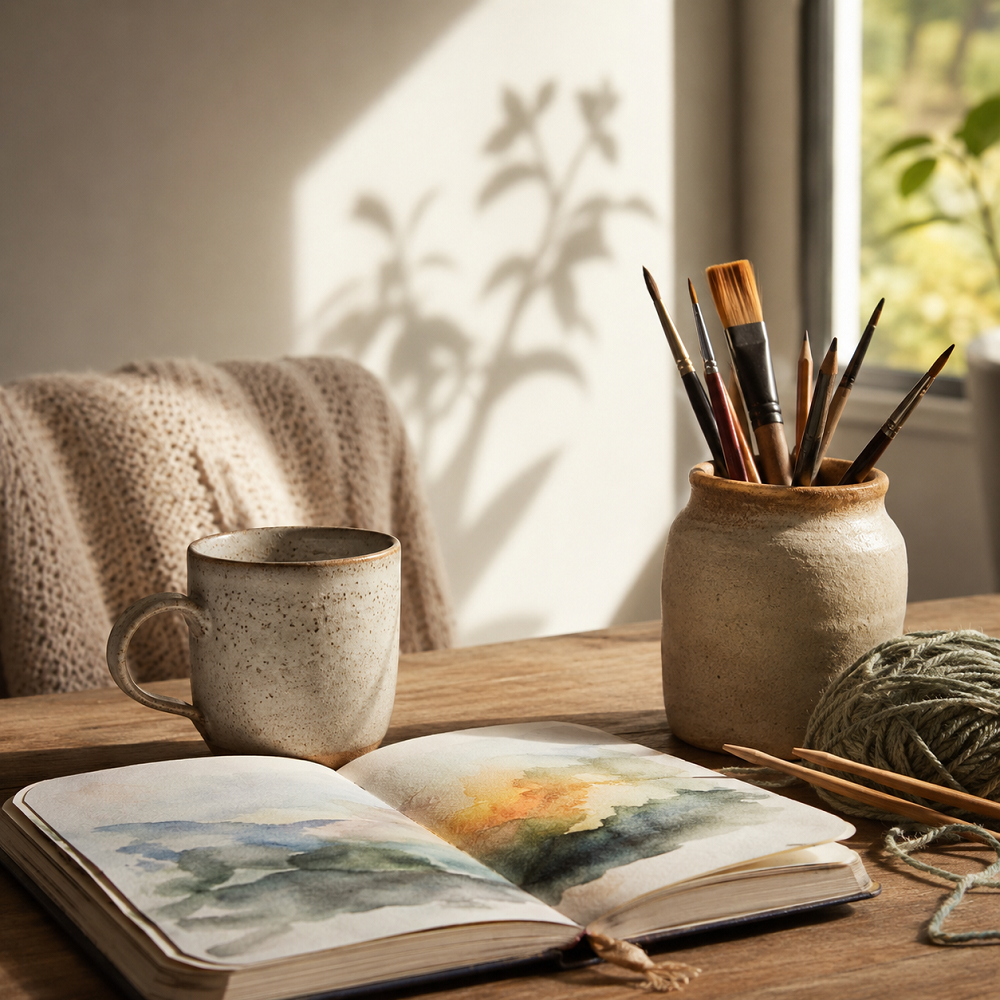
Welcome Has to Be Something People Can Experience
There is also a less tangible kind of access.
We can put ALL ARE WELCOME on a website.
We can hang a sign on the door.
We can describe a program as inclusive.
Those things can matter.
But eventually, welcome has to become something a person can actually experience.
- Does someone acknowledge the newcomer?
- Does anybody explain what happens here?
- Can someone ask a question without feeling foolish?
- Are different ways of participating accepted?
- Can someone work quietly without being pressured into conversation?
- Can someone need help without becoming a burden?
- Do regulars make room for newcomers, rather than treating the space like a private club?
- Can people arrive without already understanding all of the unwritten rules?
This connects directly to something important in the original third-place idea: regulars help give these spaces their character, but their acceptance of newcomers matters, too.
A group of familiar people can make a place feel alive—or, if that familiarity becomes closed off, make everyone else feel as though they've walked into somebody else's private gathering.
A welcoming space isn't simply one where nobody tells us to leave.
It's somewhere we can begin to understand: there is a place for me here, too.
Accessibility Makes Repetition Possible
This brings us back to something we've already seen throughout this article.
Community often needs repetition.
We recognize someone because we've seen them before.
They remember our project because they watched us work on it last week.
We learn how the space functions because we've used it repeatedly.
We become comfortable enough to help the next newcomer because we were once the newcomer ourselves.
But all of that depends on being able to come back.
If attending requires too much money, travel, energy, planning, explanation, sensory endurance, or social navigation every single time, repeated participation becomes much harder.
And that means accessibility isn't separate from community building.
Accessibility is part of what makes community possible.
A third place has to be reachable—not merely in the sense that its doors physically open, but in the sense that people have a realistic way to become regulars there.
Who Gets to Become a Regular?
Maybe that's one of the most useful questions we can ask about any space claiming to build community.
Not simply: who is allowed in?
But: who gets to come back often enough to belong?
- Who can afford it?
- Who can reach it?
- Who can use the building?
- Who understands how to participate?
- Whose communication needs can fit there?
- Who can tolerate the environment?
- Who has access to the materials?
- Who feels welcomed by the people already inside?
No community space will remove every possible barrier for every possible person.
But the questions still matter.
Because if creative spaces can help restore some of what we've lost in third places, their greatest potential isn't simply giving people somewhere to make things.
It's giving more people somewhere they can keep returning.
And perhaps the measure of an accessible third place isn't only whether someone can get through the door once.
It's whether they have a real chance to become one of the familiar faces on the other side of it.
Maybe the Art Isn't the Only Thing Being Made
Walk into a creative space and the most visible evidence of what's happening is usually the stuff.
Paintings drying against a wall.
Ceramic pieces waiting to be fired.
Yarn stretched across knitting needles.
Paper scraps scattered across a table.
Wood being cut.
Fabric being sewn.
Prints hanging to dry.
Half-finished experiments waiting for someone to return next week.
Those things make sense as the outcomes of a creative space.
People came to make.
And now there are things that didn't exist before.
But if we only look at what's sitting on the tables, we might miss some of what the space is actually making.
Some of the Outcomes Aren't Objects
Over time, something else can begin accumulating.
Someone knows your name.
Someone remembers what you've been working on.
You know who to ask when you can't figure something out.
Someone saves an interesting scrap because they thought you might like it.
You notice when one of the regulars isn't there.
Someone who once needed help using a tool is now showing a newcomer how it works.
There are shared jokes.
Familiar stories.
Little traditions nobody formally decided to create.
None of these things can be put on a shelf beside the pottery.
But they're still things that weren't there before people began gathering.
Creative spaces can function this way because the activity and the social life don't have to be separate.
Third-place research emphasizes that these environments become meaningful through interaction, regulars, informal participation, and repeated opportunities for people to build relationships—not simply through the existence of the physical space itself.
Maybe a creative space is producing more than its most visible products.
Making Can Move Between People
The creativity itself can become communal, too.
Someone shows us a technique.
We show someone else.
We see what another person is making and suddenly have an idea we wouldn't have had alone.
Someone brings leftover materials and puts them in the middle of the table.
A person experimenting with one medium becomes curious about what the person beside them is doing.
Projects remain individual, but knowledge moves.
Ideas move.
Materials move.
Encouragement moves.
Research and community-development work on third places emphasizes this potential for informal exchange and relationship-building, while creative third spaces can also create opportunities for collaboration and shared learning.
And sometimes the most important thing exchanged isn't artistic knowledge at all.
Maybe someone tells us about another community program.
A free event.
A resource.
A class.
A job opportunity.
A place that can help with something.
Maybe they introduce us to another person.
Maybe we simply learn something about a life different from ours because we happened to spend several Tuesdays sitting beside it.
The art gave us a reason to share the table.
What travels across that table can become much larger.
 Jessica Carey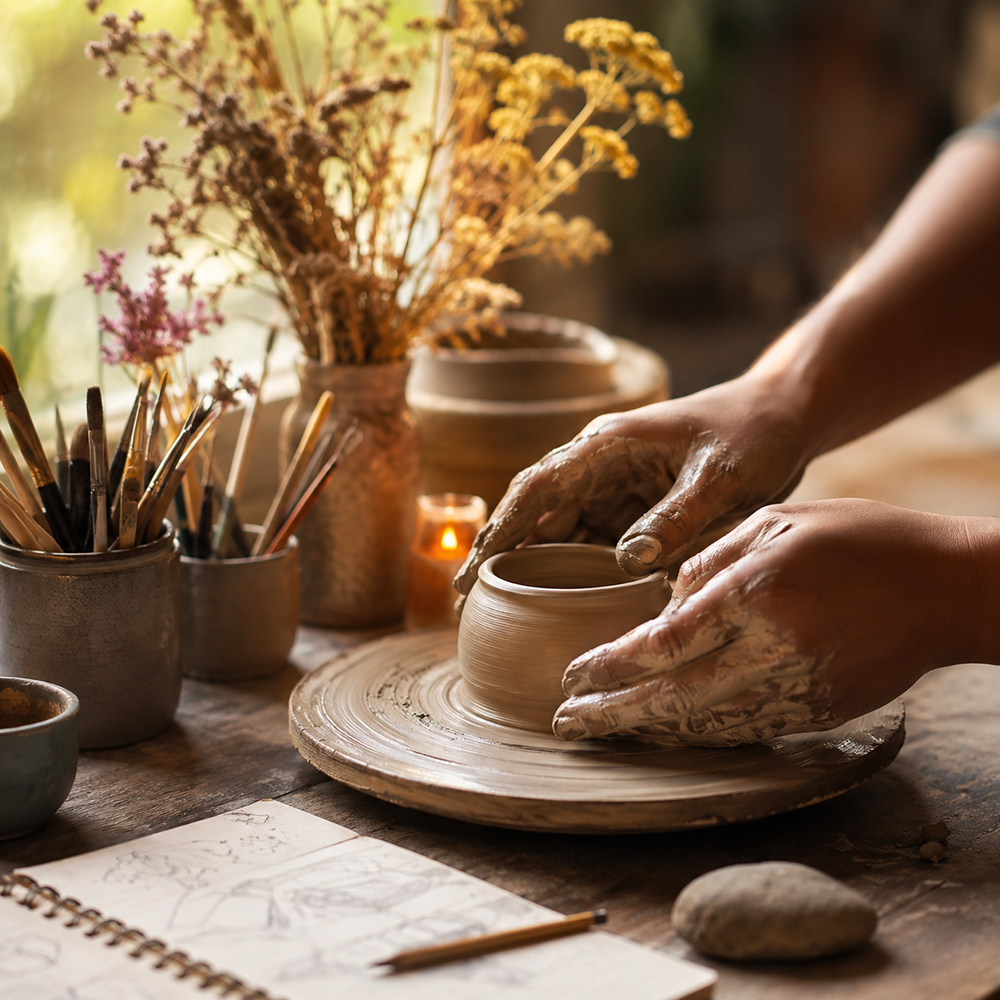
Community Doesn't Have to Be Dramatic to Count
Maybe nothing extraordinary ever happens.
That's worth saying explicitly.
The art club doesn't have to transform everyone's life.
The makerspace doesn't have to create lifelong friendships.
The library program doesn't have to solve loneliness.
The community studio doesn't have to become someone's second family.
Sometimes we can place so much pressure on the word community that it begins to sound like another extraordinary outcome a space is supposed to manufacture.
But community can be ordinary.
It can look like:
Is anyone sitting here?
No, go ahead.
Or: how did that project turn out?
Or: I brought those scraps I told you about.
Or: do you want me to show you how I did that?
Or simply: see you next week.
Maybe that ordinariness is part of what makes third places valuable in the first place.
They provide opportunities for connection to develop through ordinary life rather than requiring every encounter to become an event.
Missouri Extension's recent third-place guidance similarly emphasizes predictable rhythms over one-time events: consistency allows familiarity to develop, and familiarity gives relationships somewhere to grow.
Community doesn't always announce itself while it's being made.
Sometimes people simply keep showing up.
Maybe We're Making a Place Together
So perhaps there are two kinds of making happening in a creative third place.
There's the making we can see.
The scarf.
The painting.
The ceramic bowl.
The print.
The sculpture.
The collage.
The strange experiment nobody is entirely sure what to call yet.
And then there's another kind.
People are learning the rhythm of the room.
Recognizing one another.
Sharing knowledge.
Making space at the table.
Developing small rituals.
Helping newcomers become regulars.
Leaving and returning.
The physical place may have existed before any of them arrived.
But the community doesn't exist in quite the same way without the people repeatedly inhabiting it together.
That's an important distinction in discussions of third places: the existence of a library, café, park, studio, or community center doesn't automatically make it a third place.
What matters is what people are able to do there—the interaction, lingering, familiarity, and relationships that develop through use.
Maybe that's one of the most interesting things about creative spaces.
We walk through the door thinking we're going there to make something.
And we are.
But week after week, project after project, something else may slowly be taking shape around us.
Maybe the painting, scarf, print, or ceramic bowl isn't the only thing being made.
Maybe, slowly and almost accidentally, people are making a place together.
Where Is Creativity Helping People Find One Another?
Maybe the question isn't only: where can I make art?
That's a useful question.
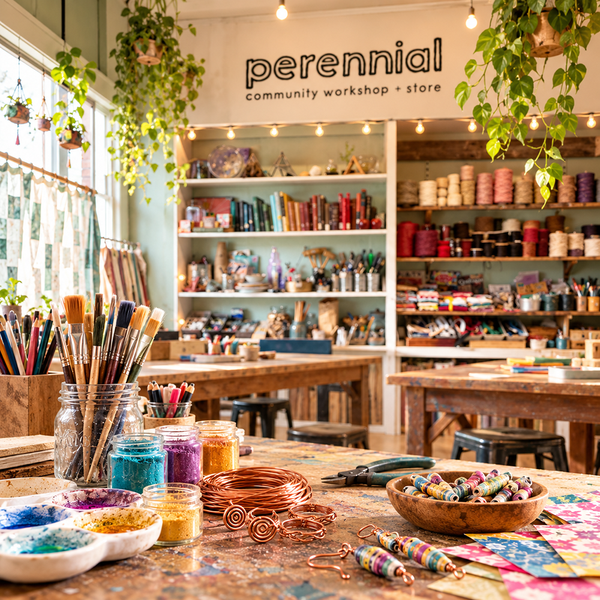
It can lead us toward studios, libraries, makerspaces, art clubs, workshops, community centers, creative reuse spaces, and all kinds of places where materials and tools become more accessible.
But perhaps there's another question hiding underneath it: where can I keep showing up?
- Where can I arrive without needing a special invitation?
- Where can I make something beside other people?
- Where might I recognize someone next time?
- Where might someone eventually recognize me?
- Where can I become familiar enough with a place that I stop feeling quite so much like a visitor?
Because maybe what we're looking for isn't always another activity.
Sometimes we're looking for somewhere to belong.
A Creative Space Can't Promise Community
None of this means that putting art supplies in a room automatically creates a third place.
A studio can be isolating.
A makerspace can be inaccessible.
An art club can become cliquish.
A class can end before anyone learns one another's names.
A library can contain dozens of people who never interact.
And someone can participate in the same program for months without finding friendship there.
Community can't simply be advertised into existence.
Even the broader idea of a third place depends on what actually happens within a space—not merely what the building is called.
Oldenburg's conception emphasizes regulars, accessibility, informal interaction, and the ability to return, while contemporary community-development work similarly argues that predictable rhythms and repeated participation give relationships time to develop.
Creative spaces don't guarantee connection.
They can, however, create conditions in which connection has somewhere to happen.
And maybe that's enough to take seriously.
Maybe the Art Is the Invitation
And this is where I keep returning to creativity.
Art doesn't have to solve loneliness.
A knitting circle doesn't have to save society.
A community studio doesn't have to become everyone's chosen family.
That's far too much responsibility to place on creativity—or on the people creating these spaces.
Maybe art can do something much smaller.
It can give us a reason to gather.
Come draw.
Come knit.
Come make pottery.
Come learn how to use this machine.
Come bring whatever you're working on.
Come experiment with these materials.
Come sit at the table.
We may think we're accepting an invitation to make something.
But that invitation also places us in proximity to other people who accepted it.
Then perhaps we accept it again next week.
And someone else does, too.
And eventually, without anyone formally deciding that today we will build community, something begins to accumulate between us.
Familiarity.
Recognition.
Shared knowledge.
Stories.
Routines.
Little acts of help.
The expectation that we might see one another again.
The art may be the invitation.
The returning is what gives the relationship time to grow.
Where Is Creativity Helping People Find One Another?
Maybe that's the question I want to leave with.
Not simply: where are people making art?
But: where is creativity helping people find one another?
- Where are there tables people can return to?
- Where are supplies being shared?
- Where can someone arrive alone?
- Where can people make quietly beside one another without needing to perform constant sociability?
- Where can someone be new without remaining new forever?
- Where are people learning one another's names?
- Where is there room for another chair?
Maybe these places are already around us.
Maybe some need more support.
Maybe some could become more accessible.
Maybe there are communities that don't have enough of them at all.
And maybe some of the creative spaces we think of primarily as places to make things are also doing something harder to see.
A painting leaves with one person.
A ceramic bowl leaves with another.
Someone carries home a scarf.
Someone else takes home the strange little experiment they spent three weeks trying to figure out.
But perhaps something remains behind, too.
A relationship with the place.
A relationship with the people inside it.
A reason to return.
Because maybe the most important thing a community art space makes isn't something we can take home with us.
Maybe it's the possibility that when we come back, someone else will come back, too.
And we'll recognize one another.
Maybe community begins when a place gives us enough reasons to keep returning that, eventually, we begin returning for one another.
Want even more content about creativity and art?
Be sure to check out all of our creative chronicles!
If you'd like to see examples of my work, you can find some of my art and creations at Redbubble and Gumroad!
Looking to learn more about my recent journey?
Check out some of these articles:
-Hidden Gems for St. Louis Artists
-Hidden Gems for Autistic & Neurodivergent Adults
-Learning What Love Was Supposed to Feel Like
-I Wasn't Broken--I'm Burned Out
-The Difference Between Resting and Giving Up
-What Chronic Autistic Burnout Actually Feels Like
-When You Had to Raise Yourself
 Jessica Carey