


How parentification, emotional poverty, unsupported autism, and unequal childhood foundations follow us into adulthood
Content note: This article discusses childhood neglect, parentification, family abuse and dysfunction, adoption-related emotional deprivation, trauma, housing instability, and chronic autistic burnout. Please read with care.
The lives people build after growing up with supportive parents versus difficult ones may be drastically different.
People raised with dependable support often enter adulthood with more than pleasant childhood memories.
They may carry confidence developed through encouragement, emotional security built through consistent care, practical skills taught with patience, and the knowledge that someone will help them if life becomes overwhelming.
That does not guarantee an easy life.
Supportive parents cannot prevent disability, illness, discrimination, financial hardship, grief, failure, or every painful experience.
What they can provide is a foundation from which those difficulties may be faced.
Other children are never given that foundation.
Some grow up managing unpredictable adults, suppressing their needs, preventing conflicts, caring for siblings, and attempting to earn love through usefulness.
Instead of being taught that they can rely on someone, they learn that everyone relies on them.
Instead of receiving help when they struggle, they are treated as the problem for struggling at all.
Society often behaves as though these differences disappear when childhood ends—as though everyone enters adulthood with the same internal resources, practical preparation, support network, and safe place to return.
Once someone reaches a certain age, they are expected to function independently regardless of what they were taught, what was withheld, what they survived, or what they are still carrying.
But people do not enter adulthood from the same starting line.
Some begin adulthood standing on a foundation their families helped them build.
Others arrive already exhausted from being used as the foundation for everyone else.
I was expected to “be the adult” while I was still a tiny child.
I had to remain calm while the actual adults screamed, blamed, withdrew, avoided responsibility, or behaved like children throwing tantrums.
I learned to monitor everyone else’s moods, anticipate what might go wrong, help care for younger siblings, and ask for as little as possible.
I was expected to give patience, labor, understanding, emotional regulation, forgiveness, and support to everyone around me; receiving those things in return was apparently too much to ask.
Autism made many parts of life inherently more demanding for me, but autism did not create that environment.
I needed greater clarity, predictability, sensory consideration, protection, and help understanding my own nervous system.
Instead, I grew up undiagnosed and unsupported in a home where needs were treated as inconveniences, distress was ridiculed, boundaries were ignored, and emotional safety did not exist.
My autistic nervous system needed a secure foundation.
Trauma repeatedly shook the ground beneath it with massive earthquakes.
A friend recently described another version of the same deprivation.
Her family emphasizes that adoption rescued her from poverty and insists that she was never left wanting.
Yet material stability did not provide the genuine connection, emotional safety, and dependable support she needed.
Financial poverty may have been relieved while emotional poverty remained.
Her experience is her own and is not a claim about every adoption or adoptive family; it illustrates how material rescue and emotional safety are not necessarily the same thing.
Neither my friend nor I owes silence as payment for whatever our families provided; recognizing what we received does not require denying what we desperately needed and never had.
This is not about demanding perfect parents or blaming childhood for every later difficulty.
Parents are human; they carry histories, limitations, wounds, and generational patterns of their own.
Some may have sincerely done what they understood as their best, but intention does not build the foundation a child did not receive.
And “we did the best we could” cannot become a wall that prevents an honest conversation about what that best actually did.
The deeper question is not merely whether adults provided something; it is whether the child was safe, supported, known, protected, guided, and permitted to be a child.
- What happens when the answer is no?
- What happens when a child is expected to provide the patience, maturity, responsibility, and emotional regulation that no adult is providing for them?
- What does adulthood require from someone who must somehow learn to stand while building—often without help—the foundation that should have been beneath them all along?
What a Supportive Foundation Actually Provides
Supportive parenting involves far more than keeping a child physically alive.
Food, clothing, shelter, education, and medical care are essential.
Children need material stability, and failing to provide basic necessities can cause profound harm, but meeting physical needs does not automatically create emotional security, healthy attachment, confidence, or a genuine sense of home.
A supportive foundation is built through thousands of ordinary interactions.
It is built when a frightened child knows someone will come.
It is built when mistakes are treated as opportunities to learn rather than proof that the child is defective.
It is built when adults remain responsible for their own emotions instead of requiring children to manage them.
It is built when a child can say: “This hurts,” “I need help,” “I do not understand,” or “I am not comfortable with that” without being mocked, punished, ignored, or accused of ruining everything.
Supportive parents do not need to respond perfectly every time.
No parent can prevent every misunderstanding, lose patience only on schedule, or always know what a child needs.
What matters is the broader pattern—and what happens after something goes wrong.
Healthy care includes repair.
An adult can admit:
- “I misunderstood you.”
- “I was overwhelmed, but it was not acceptable for me to take that out on you.”
- “I am sorry.”
- “What do you need from me now?”
- “How can I handle this differently next time?”
Those conversations teach a child that conflict does not automatically mean abandonment, retaliation, humiliation, or the loss of love.
They show that relationships can bend without breaking and that someone can cause harm without requiring the injured person to pretend it never happened.
A healthy childhood foundation may include:
- Predictable physical and emotional safety
- Comfort when the child is sick, frightened, overwhelmed, or grieving
- Age-appropriate responsibilities
- Protection from adult disputes and emotional burdens
- Guidance without humiliation
- Boundaries that apply to adults as well as children
- Respect for the child’s body, preferences, possessions, and privacy
- Freedom to make mistakes without becoming a family joke
- Support in identifying emotions and regulating distress
- Encouragement that helps confidence develop gradually
- Practical preparation for adulthood
- Genuine interest in who the child is—not only who the adults want them to become
- A dependable place to return when life becomes difficult
Through these experiences, children gradually learn:
- My needs are not inherently dangerous.
- I can ask questions.
- I can make a mistake and remain worthy of love.
- Other people’s emotions are not automatically my responsibility.
- I can trust my perceptions.
- Help may be available when I cannot manage something alone.
- I do not have to earn my place in the family through constant usefulness.
That final lesson can shape an entire life.
People raised with dependable support may be more willing to take healthy risks because failure does not threaten their entire sense of safety.
They may pursue education, change careers, leave harmful relationships, ask for accommodations, try unfamiliar things, or admit that they do not know something because they have learned that needing assistance does not make them unworthy.
They may also have practical resources that are easy for outsiders to overlook: guidance, emergency assistance, transportation, housing, encouragement, and somewhere safe to return.
None of this means that people with supportive parents never struggle, develop mental-health conditions, become disabled, make harmful choices, or experience financial hardship.
A strong foundation does not prevent every storm; it changes what someone has beneath them when the storm arrives.
That distinction matters when we compare people’s adult lives.
One person may appear more confident, independent, resilient, or successful without recognizing how much invisible support helped make those qualities possible.
Another may be performing the exhausting work of surviving the present while also trying to teach themselves everything their childhood failed to provide.
Support does not eliminate effort; it helps effort take root.
And when someone grows up without that support, the difficulty is not simply that they missed a few pleasant childhood experiences.
They may have been denied the conditions through which security, self-trust, emotional regulation, healthy boundaries, and sustainable independence ordinarily develop.
They were not given less decoration around the structure; they were asked to build adulthood without essential parts of the foundation.
When the Child Becomes the Adult
In a healthy family, responsibility expands gradually as a child develops.
Children might put away toys, help set the table, care for a pet with supervision, or take on household tasks appropriate to their age and ability.
These responsibilities can build confidence, competence, and a sense of belonging when adults remain responsible for the household and the child remains free to learn, play, make mistakes, and receive care.
That is very different from parentification.
Parentification occurs when a child is expected to perform emotional or practical roles that belong to adults; the child may care for siblings, mediate conflicts, manage a parent’s emotions, absorb adult problems, or become responsible for keeping the family functioning.
The family may praise the child for being mature, helpful, responsible, or “an old soul.”
But apparent maturity does not mean the child no longer needs parenting.
Sometimes it means they have learned not to expect it.
I was assigned responsibility long before I had the development, authority, resources, or protection that should accompany it.
When I was approximately four years old, I had to change my baby brother’s diapers because our father would not get out of bed.
I was still a small child, yet I was already expected to compensate for an adult’s refusal to parent.
My mother has repeatedly described how one of my younger brothers would cling to her leg, cry, and refuse to let go; she says she would become so overwhelmed that she felt like “punting him.”
Then I would arrive, take his hand, and say: “Let’s go play.”
The story was told as evidence that I was unusually helpful.
But why was a young child responsible for recognizing the danger, soothing another child, and relieving an adult who could not regulate their own frustration?
I learned to watch what was happening around me.
I noticed changes in tone, posture, volume, and energy.
I learned when someone was becoming angry, when conflict might erupt, and when a sibling needed to be redirected.
Hypervigilance became a form of unpaid household labor.
I was not only expected to care for younger siblings.
I was repeatedly pulled into conflicts between my parents and pressured to decide who was “right.”
They would demand that I take sides even when I had not witnessed the event they were arguing about.
Remaining neutral did not protect me; neutrality became another offense.
When other family members made choices my mother disliked, I was blamed as though I controlled them: “He’s YOUR father!” and “She’s YOUR sister!”
The words assigned me authority I did not possess and responsibility I could never fulfill; I was treated as though I were accountable for everyone else while having very little control over my own life.
This is one of the impossible contradictions parentified children inhabit: they are given adult responsibility without adult power.
They may be expected to prevent conflict but have no authority to set rules.
They may care for siblings but be unable to protect them from the adults.
They may manage a parent’s emotions but receive punishment for expressing their own.
They may be blamed when the family becomes unstable but have no meaningful ability to change the conditions creating that instability.
My role required me to anticipate needs, prevent problems, remain useful, and absorb blame; it did not allow me to be tired, frightened, confused, overwhelmed, or in need of protection.
The adults could scream, throw things, slam doors, withdraw, avoid responsibility, or become consumed by their own feelings while I was expected to remain calm.
The adults were permitted to behave like distressed children while the child was required to behave like the adult.
Over time, this can create a person who appears exceptionally capable while feeling internally unsupported.
They may solve everyone else’s problems while struggling to identify their own needs.
They may offer endless patience but feel ashamed when they reach a limit.
They may become the person everyone calls during a crisis while believing they have no right to call anyone themselves.
That pattern can continue long after childhood.
The child who survived by becoming useful may enter adulthood believing that belonging must still be earned through service.
Others may admire their generosity, independence, or maturity without recognizing the fear and resignation that helped create those qualities.
I genuinely value helping others; my compassion, awareness, and desire to make life gentler are real parts of who I am.
I do not want every act of care reduced to trauma.
But healthy generosity includes choice.
Parentification taught me that care was not something I could freely offer according to my capacity; it was the price of belonging.
I was expected to give continually while needing nothing in return.
A child should not have to become indispensable to deserve a place in their family.
They should not have to keep everyone else upright while no one notices that there is nothing beneath them.
I needed parenting, too.
 Jessica Carey

The Child Who Manages Everything May Disappear Inside
People raised by difficult parents may never learn to manage their emotions or set boundaries.
That can be true for some people.
Children learn regulation partly through co-regulation: a calm, dependable adult helps them understand what they feel, tolerate distress, and return to safety.
When adults model explosive, avoidant, or unpredictable behavior, children may reach adulthood without those skills.
But there is another possibility: some children learn to manage themselves far too much.
They do not become visibly explosive; they become quiet, hypervigilant, accommodating, and overcontrolled.
They learn to swallow their reactions, conceal their needs, and remain outwardly composed because other people’s emotions have already consumed all the available space.
I was told about an incident from when I was very small.
I had somehow become wedged between my crib and the wall, my feet dangling in the air; while trapped there, I repeatedly told myself: “I’m okay. I’m okay. I’m okay. I’m okay.”
I cannot know everything happening inside that young version of me, and one childhood moment cannot explain an entire life.
Still, the image feels painfully consistent with what followed.
I was stuck.
I was frightened.
And I was trying to reassure myself.
That became the pattern.
When I was sick or had a nightmare, comfort was not reliably available. If we disturbed our parents at night due to illness or nightmares, we could be told to sleep on the floor.
Sick days were not allowed because our needs inconvenienced the adults.
Emotional pain was treated as weakness, drama, manipulation, or an interruption.
I learned that distress did not necessarily bring care.
It could bring ridicule.
It could bring anger.
It could become another reason I was accused of being difficult.
My father would tell me to stop being a baby and grow up when I became too overwhelmed to contain my tears.
My mother could scream, throw things, stomp, slam doors, or turn the entire household around her feelings.
Yet my natural reactions to that instability were treated as the problem.
The message was clear: adults were allowed to lose control while I was not allowed to visibly have feelings about what their loss of control did to me.
So I turned inward.
I tried to become perfect enough, quiet enough, helpful enough, and undemanding enough to avoid the next explosion.
I learned to retreat into myself, cry privately, and keep functioning.
I became highly aware of everyone else’s moods while growing increasingly disconnected from my own body, preferences, exhaustion, anger, and limits.
That is not the absence of emotional management.
It is emotional management distorted into self-erasure.
Healthy regulation does not mean never becoming distressed; it means being able to recognize an emotion, understand what it may be communicating, respond without causing unnecessary harm, and seek appropriate support.
What I learned was different:
- Suppress the emotion before anyone notices.
- Keep the peace, even when maintaining it harms you.
- Explain other people’s behavior before acknowledging its impact.
- Ask for less and endure more.
- Never expect another person to help carry what you feel.
The same distortion affected boundaries.
I understood that other living beings had boundaries.
I could recognize when a cat was frightened, overwhelmed, or trying to escape.
I knew not to turn an animal into the object of a tug-of-war because the animal would be hurt.
But within my family, my own boundaries never carried the same weight.
A polite refusal could be treated as hatred.
Removing myself from an overwhelming situation could be described as ruining a holiday.
Sensory distress was dismissed as pickiness or childishness.
A limit was not interpreted as information about my capacity; it was treated as disobedience.
When saying no repeatedly leads to punishment, guilt, ridicule, or withdrawal of affection, the child does not learn that boundaries are healthy; they learn that boundaries are dangerous.
They may enter adulthood knowing intellectually that they are allowed to say no while feeling physically terrified when they attempt it.
Guilt may appear even when they have done nothing wrong.
Their nervous system may interpret another person’s disappointment as evidence of impending danger.
This helps explain why someone can appear highly reflective and emotionally responsible while still struggling profoundly.
They may be excellent at understanding other people’s perspectives but unable to prioritize their own.
They may remain composed through crises and collapse only when they are finally alone.
They may give thoughtful advice but struggle to ask for help.
They may apologize automatically, explain excessively, or assume that another person’s discomfort proves they have done something wrong.
They may call themselves “fine” because they learned that no safer answer was available.
The quiet child is not necessarily the unaffected child.
The helpful child is not necessarily the secure child.
The child who requires the least visible care may be the one who has most completely surrendered hope of receiving it.
My survival depended partly upon becoming small enough to fit around everyone else’s emotions, but adulthood now requires something very different: learning that I am allowed to exist at my full human size.
- I can have needs without becoming a burden.
- I can feel anger without becoming cruel.
- I can reach a limit without becoming defective.
- I can decline something without hating the person who asked.
- I can stop regulating everyone else long enough to hear what my own nervous system has been trying to tell me.
The child repeating “I’m okay” was doing everything she could with what she had, but she should never have had to convince herself alone.
 Jessica Carey

Autism Did Not Create the Unsafe Environment—but It Increased the Support I Needed
Autism did not cause my family’s dysfunction.
It did not make adults scream, avoid responsibility, disregard boundaries, rewrite events, or blame a child for problems she did not create.
Autism did not produce the emotional coldness, instability, parentification, or absence of repair within the household.
Those conditions would have been harmful to any child, but being autistic affected how I experienced them, what I needed in order to feel safe, and how much energy surviving them required.
Autistic people are not all alike, but many of us experience differences involving sensory processing, communication, executive functioning, interoception, social interpretation, emotional regulation, and adaptation to change.
Some require greater predictability, clearer instructions, more recovery time, or specific environmental accommodations.
These are not character flaws; they are features of how our nervous systems process the world.
I grew up without knowing that I was autistic.
The adults around me did not understand my nervous system, and I had no language for explaining it myself.
I could not say:
- “The sound, light, smell, texture, or movement in this environment is overwhelming my nervous system.”
- “I need clear and specific instructions.”
- “I am interpreting your words literally.”
- “This change is costing me more processing energy than you can see.”
- “I am not refusing to cooperate. I am reaching neurological overload.”
- “I need quiet, predictability, recovery time, and somewhere safe to regulate.”
Instead, my needs were interpreted through moral judgments.
- Sensory distress became pickiness.
- Overwhelm became immaturity.
- Literal interpretation became something people could laugh at.
- Difficulty with unexpected changes became stubbornness.
- Shutdown was mistaken for coldness, laziness, or refusal.
- A boundary became evidence that I was selfish, difficult, dramatic, or ruining something for everyone else.
One of the most damaging parts of growing up unsupported was not merely that people failed to accommodate what they did not understand; they often mocked or punished the visible signs that something was wrong.
- When I became overwhelmed, I was told to stop being a baby.
- When an experience was unbearable, I was expected to endure it because someone else wanted it.
- When I expressed discomfort, the focus shifted toward how my reaction inconvenienced the adults around me.
The lesson was not simply that my needs would go unmet; it was that having those needs made me defective.
That message became especially destructive because I was already working so hard to understand and adapt to a world that frequently overwhelmed me.
Rather than receiving help identifying my limits, I learned to push past them.
Rather than being taught how to regulate my nervous system, I learned to mask distress until my body could no longer contain it.
For example, my family sometimes treated activities they enjoyed as though those activities should automatically be enjoyable or manageable for me.
When they decided to take me on a cruise, the trip could be presented to other people as an act of generosity: "loving" parents had paid for a vacation.
But my concerns, sensory needs, and knowledge of my own capacity were not meaningfully considered.
The environment became more overwhelming than I had feared.
I could not sleep or regulate.
I spent much of the trip curled in the dark cabin, repeatedly entering shutdown and meltdown.
From the outside, I had received an expensive experience; inside my body, I was trapped in a neurological crisis.
Material generosity without attunement is not the same as support.
Someone can spend money on an autistic person while refusing to listen to that person.
They can provide an opportunity that looks desirable to outsiders while disregarding whether it is accessible, wanted, or safe.
They can insist that the recipient should be grateful while ignoring the harm caused by forcing their own preferences onto another nervous system.
Support requires more than deciding what should be good for someone; it requires curiosity about what that person actually experiences.
My family’s approach was often the opposite; they assumed that because something did not bother them, it should not bother me.
If I reacted differently, the problem was located within my attitude rather than in the mismatch between my nervous system and the environment.
This left me carrying two overlapping burdens:
- First, there were the inherent demands of being autistic in a world not designed for autistic people.
- Then there was the trauma of being punished for how those demands affected me.
Autism may have made school, social interaction, communication, driving, transitions, noise, conflict, and crowded environments more costly.
Trauma added hypervigilance, fear, self-doubt, emotional suppression, and the belief that I had to endure distress without help.
Each compounded the other.
An overwhelmed autistic nervous system needed calm and predictability, but the "home" environment supplied volatility.
A literal, detail-oriented mind needed clear communication, yet the adults supplied vague demands, contradictions, accusations, and expectations that I should somehow know what they meant.
A child with sensory sensitivity needed her limits respected, but the family taught her to distrust those limits and push through them.
A person already spending enormous energy trying to process the world was also required to monitor adults, care for others, conceal distress, and remain constantly useful.
This distinction matters because trauma and autism are sometimes collapsed into one explanation.
My autism was not caused by being mistreated.
I would still be autistic if I had grown up with supportive, emotionally mature parents.
I may still have struggled with sensory processing, executive functioning, communication, transitions, employment, and energy regulation.
But those struggles did not need to be surrounded by shame, fear, ridicule, and chronic insecurity.
Supportive parenting would not have made me non-autistic.
It could have helped me become an autistic person who understood herself earlier, trusted her own needs, received appropriate accommodations, and knew that reaching a limit did not make her unworthy of love.
Instead, I became exceptionally practiced at overriding myself.
That survival strategy eventually contributed to chronic autistic burnout; a nervous system can be forced beyond its limits only so many times before continuing becomes impossible.
Decades of masking, overfunctioning, suppressing distress, accepting inaccessible expectations, and remaining useful to everyone else did not prove that I had no disability.
They helped conceal how much support I had always needed.
My adult struggles are therefore not explained by one simple cause.
Some difficulties arise from autism itself.
Some come from trauma.
Some come from poverty, instability, and inaccessible systems.
Some come from having no dependable foundation or safe place to recover.
And many emerge where all of these realities intersect.
Recognizing that complexity is not avoiding responsibility for my life; it is necessary if I am going to build one that stops repeating the conditions that harmed me.
I do not need to cure my autism; I need to stop treating my nervous system as an enemy.
I need environments, relationships, expectations, and forms of support that recognize how I actually function—not how other people insist I should.
Autism did not make my childhood unsafe, but when an autistic child’s needs are repeatedly misunderstood, mocked, denied, and punished within an already unsafe environment, the damage becomes far greater than either autism or family dysfunction can explain alone.
 Jessica Carey
Material Provision Is Not the Same as Emotional Wealth
A friend recently told me how her family describes her childhood.
They emphasize that they adopted her out of poverty; they point to the material stability and opportunities she received and insist that she was never left wanting.
Within that version of the story, adoption becomes a rescue with a clear moral conclusion: she was given a better life, so she should feel grateful.
There may be truth within part of that story.
Material poverty can be devastating; reliable food, secure shelter, clothing, healthcare, education, and opportunities matter.
Being moved away from severe material deprivation may have changed important parts of her life.
But it did not meet every need she had.
She was still left wanting genuine connection.
She was left wanting emotional safety, understanding, dependable support, and love that could tolerate honest conversation.
Financial poverty may have been replaced by greater material security, but another form of deprivation remained.
She described it as trading financial poverty for emotional poverty; that distinction matters.
Financial poverty and emotional poverty are not equivalent, and they should not be carelessly compared as though one form of suffering can be neatly exchanged for another.
Material deprivation threatens health, housing, education, safety, and survival in specific and serious ways.
But financial stability does not automatically produce a healthy childhood.
A child can have a bedroom and still have nowhere emotionally safe to rest.
A child can receive gifts and remain unknown.
A child can attend good schools while receiving no guidance for navigating their inner life.
A child can live in a clean, comfortable house where no difficult feeling is welcome.
A child can be surrounded by adults and still have no dependable adult to lean on.
A child can be repeatedly told how fortunate they are while privately wondering why love still feels so lonely.
When parents define successful caregiving only through what they purchased or provided materially, they may overlook everything a child needed relationally.
- Did the child feel safe telling the truth?
- Could they express pain without being accused of ingratitude?
- Did adults show curiosity about who they were?
- Were their feelings taken seriously?
- Could conflict lead to accountability and repair?
- Did affection remain available when the child disagreed, struggled, or failed to perform the expected role?
- Was the child supported—or merely managed?
Those questions cannot be answered by showing receipts, photographs, report cards, vacations, or the size of a house.
My own family also confused provision with love.
They could purchase gifts, pay for activities, or include me in an experience they wanted.
From the outside, those actions could be presented as evidence of generosity and family closeness, but being given something is not the same as being known.
Sometimes what they provided reflected their preferences rather than mine. My concerns got ignored, my limits overridden, and my distress dismissed—then the purchase itself became proof that they were loving parents.
The cruise described earlier is one example: money was spent, but my stated needs and knowledge of my nervous system were disregarded.
The expense did not transform an inaccessible experience into care.
Care is not measured only by what something costs the giver; it must also consider what it costs the recipient.
The same is true on a smaller scale.
A gift chosen without understanding someone may create a pleasing family photograph while leaving the person feeling invisible.
An opportunity forced upon someone may look generous while removing their choice.
Providing basic necessities may keep a child alive while emotional neglect teaches them that their inner world does not matter.
Material provision matters, but it is simply not the whole of love.
This becomes especially complicated in adoption, where gratitude can be treated as a lifelong debt; an adopted person may be expected to view their adoptive family only as rescuers and any criticism as betrayal.
But adoption does not remove a child’s need for emotional attunement, identity, honesty, belonging, grief support, or unconditional care.
Being adopted does not obligate someone to deny neglect or dysfunction.
A person can recognize the material stability they received while also naming the emotional support they did not.
Both can be true: “My circumstances changed in ways that benefited me.”
And: “I was still harmed by what happened within my family.”
Acknowledging the second truth does not erase the first, and acknowledging the first does not invalidate the second.
Gratitude should not require self-abandonment.
A child does not enter a family as an indebted recipient who must spend the rest of life proving that the adults made a good investment; caregiving is the adult’s responsibility.
Children do not owe silence, obedience, emotional caretaking, or a flattering family narrative in exchange for being raised.
The words “We saved you” can become particularly damaging when they are used to end every difficult conversation.
They transform the child’s pain into an accusation against the parents’ goodness; rather than asking what the child experienced, the family defends what it believes the child should have experienced.
The conversation becomes: “How can you be hurt after everything we gave you?”
Instead of: “What did you need that you did not receive?”
It is possible to appreciate what was provided without pretending it was sufficient.
It is possible to recognize a parent’s sacrifices while also recognizing the harm they caused.
It is possible to feel grateful for material stability and grieve the emotional security that never accompanied it.
My friend was not wrong or ungrateful for still feeling deprived; she was identifying a form of poverty that her family’s preferred story could not acknowledge.
- A house can protect someone from the weather while failing to become a home.
- A family can prevent material hunger while leaving a child starving for connection.
- And no amount of insistence that someone should have felt loved can replace the experience of actually being loved in ways they could feel.
 Jessica Carey

“We Gave You Everything” Can Become a Form of Control
Families often defend themselves by listing what they provided.
- “You always had food.”
- “You had a roof over your head.”
- “We paid for everything.”
- “We gave you opportunities we never had.”
- “Other children had it worse.”
- “You should be grateful.”
- “We did the best we could.”
Some of these statements may be factually true.
Parents may have worked long hours, endured hardship, sacrificed opportunities, and provided things they never received during their own childhoods.
Those efforts can be acknowledged without allowing them to end the entire conversation.
The problem begins when provision is treated as immunity from accountability.
“We gave you everything” can become less of a description and more of a demand:
- Therefore, you are not allowed to feel hurt.
- Therefore, our intentions matter more than your experience.
- Therefore, you owe us access, obedience, forgiveness, and a flattering version of the past.
- Therefore, anything you say about what was missing proves that you are selfish or ungrateful.
Gratitude then stops being a freely felt response and becomes a tool of control.
The child is expected to protect the parents’ identity as loving, self-sacrificing people—even when doing so requires denying their own reality.
This shifts the focus away from what happened and toward whether the parents deserve blame.
The moment the adult child names pain, the family hears an accusation: “You are saying we were terrible people.”
But describing harm is not necessarily a declaration that someone was entirely bad; it is an attempt to address a specific reality.
A healthier family becomes curious about what happened, what impact it had, what the child needed, whether the pattern continued, and what meaningful repair would require.
A defensive family searches instead for evidence that the parents were good and the child has no right to remain hurt.
The conversation is no longer about understanding the person who was hurt; it becomes an emergency effort to protect the family narrative.
The conversation is no longer about understanding the person who was hurt; it becomes an emergency effort to protect the family narrative.
I have encountered this pattern repeatedly.
When I tried to address a problem, the discussion rarely remained focused on the original behavior; it shifted toward how I was allegedly ruining things by mentioning it.
My need for accountability became “hatred.”
My inability to pretend nothing happened became “unforgiveness.”
My boundaries became evidence that I was supposedly cruel, selfish, unreasonable, or determined to destroy the family.
The person causing harm could remain centered as someone deserving endless understanding.
The person naming the harm became the threat.
This is how material provision, family loyalty, forgiveness, religion, and even the word love can be weaponized; the concepts sound virtuous, but they are used to demand silence rather than cultivate health.
A child may hear: “After everything we’ve done for you…”
The unfinished sentence contains the real condition: “…you are not allowed to hold us accountable.”
But care is not a purchase that makes another person’s reality belong to the giver.
Parents do not acquire ownership of a child’s voice because they paid bills, purchased gifts, funded activities, or provided experiences.
Children do not become permanent debtors because adults fulfilled responsibilities they chose by becoming caregivers.
This does not mean children should never appreciate their parents; gratitude can be genuine, meaningful, and deeply deserved.
Many parents offer extraordinary support at great personal cost.
Healthy adult relationships often include mutual care and appreciation.
The difference is that genuine gratitude is not coerced.
It does not require someone to deny injury.
It does not erase their autonomy.
It does not become a lifetime payment plan.
It does not mean that whatever was given was the same as what was needed.
The phrase “We did the best we could” deserves similar nuance.
Perhaps they did.
People parent from within their own histories, wounds, knowledge, resources, emotional development, and cultural expectations.
Someone may have sincerely believed that providing materially, enforcing obedience, suppressing emotion, or avoiding difficult conversations was responsible parenting.
Understanding that context can create compassion, but it does not automatically create absolution.
A person’s best can still be harmful; their limitations can explain why they failed without changing the fact that someone else had to live with the consequences.
The most important question is not whether their best was sincere; it is what they do after learning that their best caused harm.
- Do they become curious?
- Do they listen without immediately defending themselves?
- Do they offer a specific apology?
- Do they respect the injured person’s boundaries?
- Do they change their behavior?
- Do they attempt repair without demanding immediate reconciliation?
- Or do they repeat “I did my best” as though it were a locked door through which no further truth may pass?
Good intentions matter, but they are not the final measure of care.
Impact matters.
Accountability matters.
Repair matters.
A parent who could not meet a need decades ago may not be able to undo the past, but they can choose whether the present relationship continues to revolve around denial.
They can acknowledge that their intentions did not erase the impact, offer a specific apology, respect the injured person’s boundaries, and demonstrate through changed behavior that the present relationship will not continue repeating the past.
That kind of response does not make someone a perfect parent; it makes honest relationship possible.
The deepest danger of “We gave you everything” is not merely that the statement may be inaccurate.
It is that it leaves no room for the child to say: “You gave me some things that mattered—and I still went without things no child should have had to live without.”
A family cannot build closeness by forcing one person to bury that truth; it can only build an appearance of closeness over an unhealed wound.
The Support Gap Does Not Disappear in Adulthood
Childhood eventually ends.
Its conditions do not vanish simply because someone reaches a particular birthday.
Society often treats adulthood as though it resets everyone to the same starting point.
Once people are legally grown, they are expected to support themselves, regulate their emotions, manage money, maintain a home, build healthy relationships, navigate employment, handle emergencies, advocate within complicated systems, and make major decisions with confidence.
When someone struggles, the explanation is often reduced to motivation or personal responsibility:
- “You are an adult now.”
- “You need to move on.”
- “Everyone has problems.”
- “Your childhood is over.”
- “You cannot keep blaming your parents.”
Adults are responsible for how they treat other people and for the choices they make within their capacity; a painful childhood does not excuse abusing others, refusing every opportunity for growth, or requiring everyone nearby to absorb unresolved harm.
But responsibility is not the same as pretending history has no consequences.
Adulthood does not retroactively provide the emotional security, practical education, healthy modeling, neurological accommodation, or dependable support that childhood failed to build.
People raised with supportive families may enter adulthood carrying resources they barely recognize as resources.
They may have someone to call when a car breaks down, a form is confusing, a relationship ends, or an unexpected bill appears.
They may be able to return home after losing housing or employment.
A parent might help them understand insurance, taxes, budgeting, repairs, healthcare, or workplace decisions.
Even when no money changes hands, emotional support can alter what feels survivable.
Someone may hear:
- “We will figure this out.”
- “You can stay here while you get back on your feet.”
- “Making a mistake does not make you a failure.”
- “I may not know the answer, but you do not have to face it alone.”
- “Rest tonight. We can decide what to do tomorrow.”
That knowledge creates margin; it allows a person to recover rather than solve every crisis while terrified of total collapse.
Someone without that foundation may face the same adult difficulty while also carrying its entire practical, emotional, and financial weight alone.
A broken car is not only a repair; it may threaten employment, housing, medical appointments, and access to food.
Losing a job is not only an interruption in income; it may mean having no safe place to go and no one able—or willing—to help.
Burnout is not only exhaustion; it may become a crisis because there is no family support, financial cushion, stable home, or protected time in which recovery can occur.
A confusing system is not merely frustrating; it may require the person to decipher everything alone while already depleted, disabled, traumatized, or afraid.
The problem is not that supported adults never experience these consequences; it is that they may have buffers that prevent one difficulty from becoming a chain reaction.
Support changes the shape of risk.
The effects are especially significant for disabled people.
My autism did not disappear when I became an adult; I still needed clarity, predictability, sensory accommodation, recovery time, practical help, and people willing to communicate in accessible ways.
But adulthood brought increasingly complex demands while the support underneath me remained dangerously thin.
At the same time, the coping strategies that had once kept me functioning were becoming unsustainable.
I had learned to push through.
I had learned to appear capable.
I had learned to solve problems quietly and ask for little.
I had learned to remain useful even when I was depleted.
From the outside, this could look like independence; in reality, it often meant completing necessary tasks without a safety net and absorbing the consequences privately.
The more competent someone appears, the easier it is for others to assume they do not need support, yet apparent competence may be built from fear, masking, perfectionism, and the knowledge that failure is not safe.
A person with supportive parents may use much of their energy to build a life.
A parentified, traumatized, unsupported person may have to use substantial energy simply preventing life from collapsing.
They may be simultaneously:
- Recovering from childhood trauma
- Learning skills no one taught them
- Navigating disability without adequate accommodation
- Unlearning shame around natural needs
- Developing boundaries for the first time
- Trying to recognize safe relationships
- Managing financial instability without family assistance
- Grieving the family they needed but never had
- Resisting pressure to continue caring for the people who failed them
- Building an identity outside the role of helper, scapegoat, or peacekeeper
Then they are compared with people who spent childhood developing confidence, exploring interests, making mistakes with support, and gradually learning independence.
The comparison ignores what each person had to do with the same years.
While one child was learning that the world could be explored safely, another was learning to scan the room for danger.
While one was developing preferences, another was learning to suppress them.
While one was permitted to fail and try again, another was trying to become perfect enough to avoid punishment.
While one was supported in building independence, another was already caring for everyone else.
These differences do not determine every future outcome; people can grow beyond the environments that shaped them.
Some individuals from supportive homes struggle profoundly; some from abusive or neglectful homes build meaningful, stable lives.
But possibility is not equality.
The fact that someone can survive without a foundation does not mean the missing foundation was irrelevant.
It certainly does not mean everyone who struggles failed to try.
I have spent much of adulthood attempting to meet ordinary expectations while carrying circumstances that made those expectations extraordinarily costly.
Chronic autistic burnout did not appear from nowhere; it developed after decades of pushing beyond my limits, masking distress, accepting inappropriate responsibility, and functioning without the recovery, accommodation, or safety my nervous system required.
Now that my capacity has collapsed, society often asks why I cannot simply continue doing what I did before.
The answer is partly that what looked sustainable never was; I was borrowing from a future body and mind because no present support existed, and, eventually, the debt came due.
This is why advice such as “Just be independent,” “Work harder,” or “Stop dwelling on the past” can feel so disconnected from reality.
Independence is not created by denying interdependence.
Human beings develop through support, and even the most capable adults continue to rely upon relationships, institutions, infrastructure, knowledge, and one another.
Some people’s support is so ordinary and dependable that it becomes invisible.
Others are judged for needing the same kinds of help because their need is more visible, more urgent, or arrives outside a socially approved family structure.
The goal should not be to prove that unsupported people can survive indefinitely without anyone.
It should be to build forms of support that do not require a person to reach total collapse before their needs are believed.
Adult responsibility matters.
So does developmental history.
So does disability.
So does access to resources.
So does whether someone has ever had a safe place to fall.
People do not become less deserving of support because they were denied it early.
If anything, those who spent childhood carrying more than they should have may enter adulthood needing opportunities to finally set some of that weight down.
Adulthood may bring responsibility for building differently; it does not make it honest to pretend everyone was given the same tools, materials, time, or ground on which to build.
When Giving Is Expected but Receiving Is Treated as Failure
The foundation I inherited did not merely leave me unsupported; it taught me that support was something I was supposed to provide—not something I was permitted to need.
I was expected to notice what everyone else required, anticipate problems, absorb emotional fallout, offer practical help, remain patient, and continue making myself available.
My usefulness was treated as ordinary, expected, and often invisible.
But when I needed understanding, accommodation, protection, rest, or reciprocal care, my needs became evidence that something was wrong with me.
Other people’s needs were responsibilities while mine were inconveniences.
This creates a deeply unequal relational contract:
- I must understand why you hurt me, but you do not have to understand why I am hurt.
- I must forgive without repair, but you do not have to take accountability.
- I must respect your limits, but mine are negotiable.
- I must remain available when you need something, but needing anything from you makes me demanding.
- I must give without keeping score, but everything you give me can be used as proof that I owe you.
Within that kind of system, generosity stops being a freely chosen expression of love; it becomes a role.
For much of my life, I believed being a good person meant constantly making room for everyone else.
I listened, helped, drove people places, researched solutions, shared resources, offered emotional support, adjusted my communication, forgave repeated harm, and tried to understand the wounds behind other people’s behavior.
I still believe in compassion, but compassion without reciprocity can become self-abandonment.
Understanding why someone behaves harmfully does not make their behavior harmless.
Recognizing their trauma does not obligate me to become the place where they discharge it.
Offering grace does not mean allowing the same injury indefinitely while the other person refuses accountability.
I was conditioned to give people endless context:
- They are stressed.
- They had a difficult childhood.
- They did not mean it that way.
- They are doing the best they can.
- They do not know any better.
Meanwhile, the impact on me disappeared beneath explanations for them.
When I finally reached a limit, people often treated the boundary as a sudden moral failure.
They could overlook years of my patience, labor, accommodation, and attempts to repair the relationship.
The moment I stopped giving unlimited access, I became selfish, hateful, unforgiving, difficult, or ungrateful.
This revealed something important:
Some people did not value my generosity as a gift.
They experienced it as an entitlement.
They were comfortable with the relationship only while I continued performing the role assigned to me.
That role did not end with my family.
The patterns we learn in childhood can become the blueprint through which later relationships initially make sense; when someone has been taught that love means overfunctioning, they may enter friendships, workplaces, romantic relationships, institutions, or helping systems where the same unequal expectations reappear.
They may become:
- The friend everyone contacts in crisis but rarely checks on
- The employee who quietly absorbs abandoned responsibilities
- The partner who carries the emotional work of the relationship
- The family member expected to coordinate every emergency
- The disabled person required to educate every professional
- The client expected to adapt to inaccessible support
- The person praised for being strong precisely because no one intends to help
These patterns can be difficult to recognize because they resemble what the person has always known.
Being needed may feel safer than being known.
Giving may feel safer than receiving.
Competence may feel safer than vulnerability.
Exhaustion may feel more familiar than care.
Even genuinely supportive relationships can initially feel uncomfortable.
When someone offers help without demanding repayment, the nervous system may search for the hidden condition.
When someone asks what is needed, the answer may be difficult to find.
When another person insists that rest is allowed, guilt may arrive before relief.
Receiving care requires a kind of vulnerability that giving does not.
When I am helping, I retain some control.
I can focus on another person’s needs and avoid exposing my own.
When I receive help, I must acknowledge that I cannot do everything alone.
I must trust that my need will not later be used to humiliate, control, or obligate me.
After a lifetime of conditional care, that trust does not appear simply because a safe person says: “Let me help.”
It has to be learned through experience.
This is part of why advice to “just ask for help” can miss the deeper struggle.
Asking is not merely a communication task; for someone whose needs were repeatedly punished, it can feel like violating a survival rule.
The body may remember:
- Needing makes people angry.
- Receiving creates debt.
- Help gives someone leverage.
- If I cannot manage alone, I have failed.
- I must prove that I deserve whatever is offered.
These beliefs may remain active even when the current people are not behaving like the past ones.
Healing therefore involves more than learning to say no; it also involves learning that a healthy yes can exist.
I can say yes when someone offers support freely.
I can receive kindness without immediately calculating how to repay it.
I can contribute according to my actual capacity rather than trying to earn my place.
I can recognize that reciprocity does not require every exchange to be equal in every moment.
Healthy relationships move over time.
Sometimes one person has more to give, and sometimes the other does.
Both remain human, valuable, and entitled to boundaries throughout the exchange.
Reciprocity does not mean keeping an exact ledger; it means that care is not expected to travel permanently in only one direction.
I do not want to stop being generous.
My attentiveness, creativity, compassion, and desire to help are meaningful parts of me.
The goal is not to become cold, transactional, or unwilling to support others; the goal is to stop offering myself as an unlimited resource.
My care should be something I choose, not a tax I pay for belonging.
My boundaries should not erase every good thing I have given.
My need for support should not be treated as proof that I have contributed nothing.
And a relationship that can survive only while I give everything and receive almost nothing is not being damaged by my boundary.
The boundary is revealing what the relationship required me to sacrifice.
 Jessica Carey

Why Families Resist Honest Conversations
If a family truly wants healing, it must be willing to talk honestly about what happened.
That sounds simple. In dysfunctional systems, it can feel almost impossible.
My friend has tried to discuss the emotional deprivation she experienced despite having material needs met after her adoption.
Rather than becoming curious about the difference between provision and connection, her family returns to the story that they rescued her from poverty and gave her a better life.
Within that story, her pain has nowhere to go.
If she was rescued, she must be grateful.
If she is grateful, she must not criticize.
If she criticizes, she is accused—directly or indirectly—of denying everything they provided.
The family narrative leaves room for only one truth: “We saved you.”
It cannot tolerate: “You provided things I needed, and I was still emotionally harmed.”
My family operates through a similar form of denial; when I try to address neglect, mistreatment, abuse, broken trust, or the continuing impact of what happened, the conversation rarely remains focused on the actual issue.
Instead, attention turns toward my supposed wrongdoing in mentioning it.
- Why am I being so negative?
- Why can I not let go?
- Why am I trying to ruin everything?
- Why am I hateful or unforgiving?
- Why am I focusing on the past?
These questions appear to be about healing, but they often function as commands: stop telling the truth in a way that makes us uncomfortable.
The family’s comfort becomes more important than the harmed person’s reality.
This happens because honest conversation threatens more than a memory; it threatens the family’s understanding of itself.
A family may be deeply invested in beliefs such as:
- We were good parents.
- We gave our children everything.
- Our family is close.
- We always tried our best.
- Any conflict was caused by the difficult child.
- What happened was normal.
- We are loving people because we say we love one another.
- Whatever occurred inside the home should remain inside the home.
- Family loyalty requires continued access and silence.
If one person begins describing events that contradict those beliefs, the system may respond as though that person is attacking the family itself.
The truth-teller becomes dangerous—not because they created the dysfunction, but because they made it harder to ignore.
This is one reason families scapegoat the person who names a problem; if the system can label that person unstable, dramatic, hateful, confused, unforgiving, or overly sensitive, no one else has to examine the behavior being described.
The question shifts from: “Did this happen, and what did it do to you?” to: “What is wrong with you for continuing to bring it up?”
That shift protects the people who caused harm while placing another burden on the person already carrying its consequences.
Families may also resist because accountability awakens painful emotions.
A parent might have to confront guilt.
A sibling might have to acknowledge that they participated in harm or remained silent while witnessing it.
Extended relatives might have to accept that the family they defended was unsafe.
People who insist that “everyone did their best” may have to recognize how generational trauma continued through them rather than ending with them.
These realizations can be painful, but discomfort is not the same as danger.
The harmed person should not be required to carry everyone else’s unprocessed shame simply because the family refuses to face it.
There is an important difference between blame and accountability.
Blame often seeks somewhere to deposit shame; it reduces a person to what they did and may care more about punishment than understanding, change, or repair.
Accountability asks:
- What happened?
- Who was affected?
- What responsibility belongs to whom?
- What needs to change?
- What repair is possible?
- How can the harm be prevented from continuing?
Accountability does not require declaring that another person is completely evil; it requires enough honesty to stop pretending that their behavior was harmless.
A sincere conversation might include:
- “I remember it differently, but I want to understand your experience.”
- “I intended to help, and I see that the impact was harmful.”
- “You should not have been placed in that role.”
- “I am sorry that I dismissed your needs.”
- “I cannot change what happened, but I can change how I respond now.”
- “What would accountability look like to you?”
These words do not erase the past; they create the possibility that the present will stop repeating it.
But some families want reconciliation without truth.
They want access without accountability.
They want forgiveness without apology.
They want the harmed person to return to the assigned role while everyone else remains unchanged.
That is not repair; it is restoration of the old arrangement.
When the harmed person refuses, the family may claim that they are choosing estrangement, bitterness, or division.
Yet the relationship was not broken merely because someone finally described the damage; it was damaged by the original behavior and by every subsequent refusal to address it.
Silence may preserve contact, but it does not necessarily preserve relationship.
A relationship requires enough safety for reality to be spoken.
If closeness depends upon one person denying their own experience, then the family is not asking for connection; it is asking for compliance.
My friend is not harming her family by acknowledging emotional poverty.
I am not harming mine by refusing to call abuse love.
We are challenging stories that require our pain to remain invisible.
The goal is not revenge; it is not to humiliate people, destroy families, or pretend that no good moments ever existed.
It is to stop carrying false responsibility for consequences we did not create and could not resolve alone.
Healing does not begin when everyone agrees upon a perfect account of the past; it begins when the truth no longer has to be sacrificed to protect someone’s image.
A family cannot repair what it refuses to name, and a person should not have to keep reopening their own wounds merely to help everyone else continue pretending there was never an injury.
 Jessica Carey

Building a Foundation Later Is Possible—but It Costs Something
Jerry Wise offers a hopeful message: you cannot change the childhood you were given, but you can build the life you deserve now.
I believe that.
I also believe it needs to be said carefully.
Hope should not become another way of placing every responsibility onto the person who was harmed; “You can build differently now” must not quietly become:
- “Therefore, what happened no longer matters.”
- “You have no reason to continue struggling.”
- “If your life is not better yet, you must not be trying hard enough.”
- “No one owes you support because healing is your responsibility.”
Building later is possible; it is not free.
People who received secure foundations during childhood may spend adulthood extending, repairing, or renovating what already exists.
Those without them may be trying to construct a foundation beneath a life that is already expected to stand.
The work may include:
- Grieving the childhood and family that should have existed
- Learning to recognize emotions after decades of suppression
- Identifying needs that were treated as inconveniences
- Developing boundaries while tolerating the guilt those boundaries awaken
- Separating disagreement from danger
- Learning practical skills no one taught
- Recognizing healthy relationships
- Accepting help without assuming it will become leverage
- Accommodating disability rather than continually overriding it
- Developing self-trust after years of gaslighting and blame
- Resting after decades of overfunctioning
- Creating financial, physical, and emotional stability without a dependable safety net
These tasks require energy.
They may also be attempted while the person is working, disabled, parenting, experiencing poverty, navigating housing instability, managing chronic illness, or trying to recover from burnout.
The person is not healing in a quiet laboratory where the past has ended and every resource is available; they are often trying to recover while responding to current emergencies created or intensified by the missing foundation.
That is part of my reality.
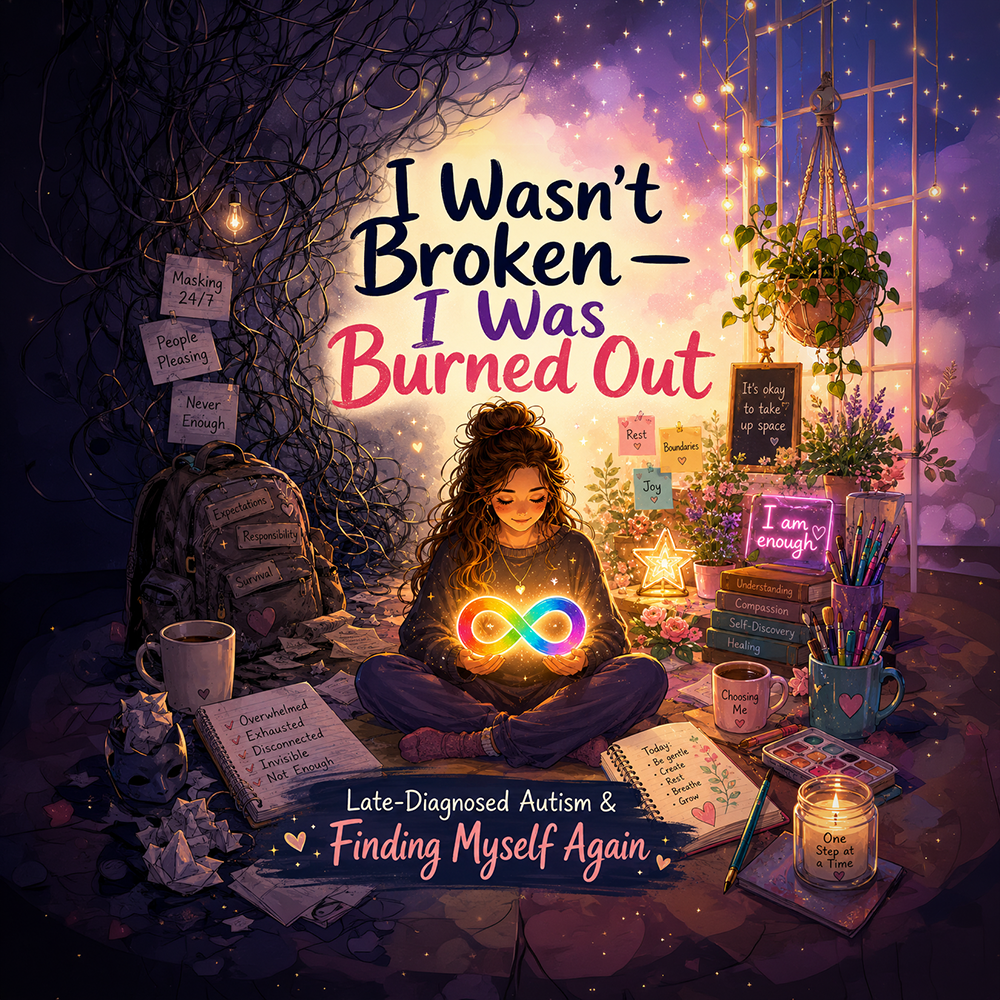
I am trying to understand myself after receiving an autism diagnosis in adulthood.
I am trying to recover from chronic autistic burnout after spending decades pushing beyond my capacity.
I am trying to unlearn the belief that needing help makes me burdensome.
I am trying to develop safer relationships while navigating severe financial and housing instability.
At the same time, I am expected to complete forms, attend appointments, advocate for accommodations, find income, preserve transportation, manage debt, locate resources, explain my history to new professionals, and make decisions about a future I do not yet have the stability to see clearly.
Building a foundation requires stability, and lack of foundation creates instability; that circular problem is rarely acknowledged.
People may tell someone to heal while the person remains focused on immediate survival.
They may encourage therapy while ignoring whether the person can afford it, reach it, recover from it, or return to a safe environment afterward.
They may advise rest while the person has nowhere secure to rest.
They may recommend asking for help while every system redirects them elsewhere.
The person is then judged for struggling to make progress under conditions that continually consume the energy progress requires.
This does not mean healing is impossible until every external problem disappears; important changes can begin during difficult circumstances.
Naming what happened, learning new language, meeting one safer person, setting one boundary, receiving one accommodation, or experiencing one relationship that does not require self-abandonment can begin shifting what seems possible.
But we should not romanticize rebuilding without resources.
Resilience is not an adequate substitute for safety.
Insight is not housing.
Self-compassion is not income.
A boundary cannot replace accessible healthcare.
A coping strategy cannot create a support network by itself.
Healing requires inner work, but people also need material conditions in which that work can take root.
I am beginning to encounter relationships and communities that feel different from what I knew.
Some people are genuinely glad to see me; they appreciate my creativity, generosity, knowledge, and perspective without treating those qualities as resources they are entitled to consume.
My therapist encourages me to take up space and ask for help rather than treating every need as evidence that I have failed.
These experiences are teaching me that support does not always contain a hidden demand.
That lesson cannot be learned through positive thinking alone; it is learned when people repeatedly behave in trustworthy ways.
A safe person says they will help—and follows through.
They accept no without retaliation.
They do not punish honesty.
They do not convert generosity into permanent access.
They notice when something is overwhelming and adjust.
They allow care to move in both directions without keeping a cruel ledger.
Each experience offers a small piece of a foundation I did not receive early enough.
That does not make the earlier deprivation irrelevant; in some ways, receiving healthy care makes the contrast more visible.
Safety can illuminate how unsafe the past actually was.
Being listened to can reveal how long one went unheard.
Rest may finally allow grief to surface.
Healing can therefore feel worse before it feels better—not necessarily because something has gone wrong, but because the body no longer has to devote every resource to immediate survival.
This is another reason the process should not be rushed.
People rebuilding after developmental trauma may need time to learn that stability will not disappear the moment they rely upon it.
They may test boundaries, withdraw, overexplain, apologize unnecessarily, or struggle to believe that kindness is real.
These responses are not proof that they are incapable of healthy connection; they may reflect how thoroughly experience taught them that connection was unsafe.
The goal is not to become a person who never needs anyone.
It is to develop interdependence: the ability to give and receive care without control, coercion, self-erasure, or shame.
For me, building differently may mean:
- Believing my nervous system before it reaches collapse
- Choosing environments that respect rather than punish my limits
- Allowing other people to contribute
- Refusing relationships built upon unlimited access to me
- Creating a home where safety is real rather than performative
- Developing community with people who see one another as human beings, not roles
- Letting creativity, rest, meaning, and connection belong in life now—not only after every crisis is solved
I cannot recover the childhood I should have had.
I cannot return to my younger self and provide every moment of protection, comfort, explanation, or encouragement she needed.
But I can stop agreeing with the people who taught her that she needed too much.
I can build a life in which she would not have to whisper “I’m okay” while facing everything alone.
That possibility matters, but so does the cost of reaching it.
The years behind me are not meaningless, but neither are they a debt I must repay by pretending they did not wound me.
Building a safer life now does not absolve the people who made safety necessary to construct from scratch; it means their choices will not be the only architecture my life is allowed to know.
 Jessica Carey

You Were Not Weak—You Were Unsupported
For much of my life, I compared myself with people who seemed able to move through the world more easily.
They worked consistently, maintained homes, navigated relationships, managed responsibilities, recovered from setbacks, and made decisions without appearing to collapse beneath their weight.
I wondered what was wrong with me.
Why did ordinary life seem to cost me so much?
Why could I accomplish certain things only by pushing myself into the ground?
The comparison left out almost everything that shaped the starting point.
I was autistic without knowing it.
I grew up without the sensory understanding, accommodations, emotional safety, guidance, and dependable support my nervous system needed.
I was expected to care for others before I understood what it meant to be cared for.
I learned to suppress my needs, manage adults’ emotions, anticipate danger, remain useful, and continue functioning without somewhere safe to recover.
Then I entered adulthood and was expected to perform as though none of that had cost me anything.
My struggles were not evidence that I was inherently lazy, weak, defective, or unwilling to grow; they reflected the demands of living with a disability while carrying trauma, adult responsibilities, unmet developmental needs, and the continuing absence of a dependable safety net.
The same broader truth applies to my friend.
She was not “left wanting nothing” simply because adoption gave her greater material security; she was left wanting the emotional nourishment children require: genuine connection, safety, support, understanding, and love that could withstand honesty.
Children who appear unusually mature, independent, or strong may have learned that no one intended to protect them.
Those adaptations do not expire when childhood ends; they follow people into boundaries, relationships, work, disability, and every demand placed upon an already exhausted nervous system.
Society then compares people who were permitted to develop with people who had to devote their developmental years to survival; that comparison is not honest.
People do not begin adulthood with equal foundations.
Some arrive with confidence, guidance, practical preparation, family resources, secure attachment, and somewhere dependable to return.
Others arrive carrying the rubble of childhood while still being asked to hold everyone else upright.
Recognizing that inequality is not a refusal of personal responsibility; it is how responsibility becomes grounded in reality.
I am responsible for what I do with my pain.
I am responsible for refusing to pass it forward as permission to harm others.
I am responsible for learning what safety, accountability, reciprocity, and healthy love look like.
But I am not responsible for pretending the harm never occurred.
I am not responsible for protecting the image of people who refused to protect me.
I am not responsible for calling neglect a normal childhood, control a form of care, or chronic self-abandonment evidence of maturity.
I am not required to offer silence as payment for whatever my family provided.
Neither is my friend.
Gratitude and truth can coexist.
We can acknowledge food, shelter, education, opportunities, sacrifices, or moments of kindness without claiming that those things erased emotional deprivation.
We can understand that parents had wounds and limitations without treating those wounds as permission to wound us indefinitely.
We can appreciate what was present and grieve what was absent.
Healing requires enough honesty for both.
Perhaps our families did what they understood as their best, but if they want a relationship in the present, their response to the truth matters now.
- Do they listen?
- Do they take responsibility?
- Do they apologize without shifting blame?
- Do they respect boundaries?
- Do they change?
- Do they care more about repair than preserving the appearance that repair was never needed?
A family cannot demand reconciliation while refusing the conditions that make reconciliation possible, and an adult child does not have to keep abandoning themselves to preserve a family story.
I cannot change the childhood I was given.
I cannot return and build safety beneath the child who needed it then.
I cannot undo the years spent overriding my nervous system, carrying responsibilities that were not mine, or trying to become easy enough to deserve care.
But I can tell her the truth now:
- You were not too sensitive.
- You were not too needy.
- You were not failing at life.
- You were responding to conditions no child should have been expected to manage.
- You deserved parenting and protection, too.
I can begin building differently.
I can choose people who allow honesty.
I can receive care without converting it into debt.
I can create a home in which safety is felt rather than merely claimed.
That work is difficult, and I should not have to do all of it alone; healing from insufficient support requires actual support—not merely more demands for independence disguised as encouragement.
Children should not have to earn care by becoming useful.
They should not have to regulate the adults, carry the family, or surrender their needs in exchange for belonging.
They should be protected, guided, comforted, known, and permitted to grow at a human pace.
Some people enter adulthood standing on a foundation their families helped them build.
Others arrive carrying the materials, the tools, the injuries, and the expectation that they should somehow construct it alone.
If you are one of those people, your struggle does not prove that you are incapable of standing.
It may mean no one ever made the ground stable beneath you.
Building now is possible.
Safer relationships, support, self-trust, accommodation, rest, and genuine home can still become part of your life.
But telling the truth about what was missing is not refusing to heal; it is how you stop blaming yourself for struggling to stand on ground no one ever made stable beneath you.
 Jessica Carey

Questions to Carry With You
If this reflection brought parts of your own history to mind, these questions may offer a starting point for understanding what you were given, what you were denied, and what you may be building differently now.
- What did support mean in your childhood home—emotionally, practically, and financially?
- Were material provisions ever used as proof that you had no right to discuss emotional neglect or harm?
- Were you permitted to be a child, or expected to manage siblings, soothe adults, prevent conflict, or carry responsibilities beyond your age?
- What happened when you expressed distress or needed help?
- Is it easier for you to offer support than receive it?
- Which qualities others praise—independence, reliability, calmness, selflessness, or maturity—developed partly because support was unavailable?
- What would safe, reciprocal support look like in your life now?
- What parts of your life are you building according to your actual needs rather than the role your family assigned you?
These questions are not meant to create another assignment or demand that every painful memory be examined at once.
Reflection should happen at a pace that respects capacity and safety; sometimes recognizing one pattern is enough for today.
You do not have to reconstruct an entire childhood in order to validate what your body, relationships, and present struggles are communicating.
You also do not have to build the entire missing foundation at once.
One trustworthy relationship, one respected boundary, one accessible accommodation, one honest conversation, or one experience of receiving care without punishment can become part of steadier ground.
The foundation should have been given to you.
You are still worthy of support while you build it now.
Want even more content about creativity and art?
Be sure to check out all of our creative chronicles!
If you'd like to see examples of my work, you can find some of my art and creations at Redbubble and Gumroad!
Looking to learn more about my recent journey?
Check out some of these articles:
-Hidden Gems for St. Louis Artists
-Hidden Gems for Autistic & Neurodivergent Adults
-Learning What Love Was Supposed to Feel Like
-What Chronic Autistic Burnout Actually Feels Like
-Building a Life from What Remains
 Jessica Carey