
An Invitation to Share a Table
Sometimes an invitation offers more than an opportunity to attend an event; it offers an opportunity to experience what community can look like when people intentionally make room for one another.
Tonight, my friend's grandmother invited me to attend the annual Thanksgiving Friendship Dinner hosted by the Turkish American Society of Missouri (TASOM).
It was a complimentary gathering celebrating gratitude, friendship, community, and a meaningful milestone for the organization: their new building was finally ready to welcome people for events and dinners.
I hadn't known about the gathering before receiving the invitation.
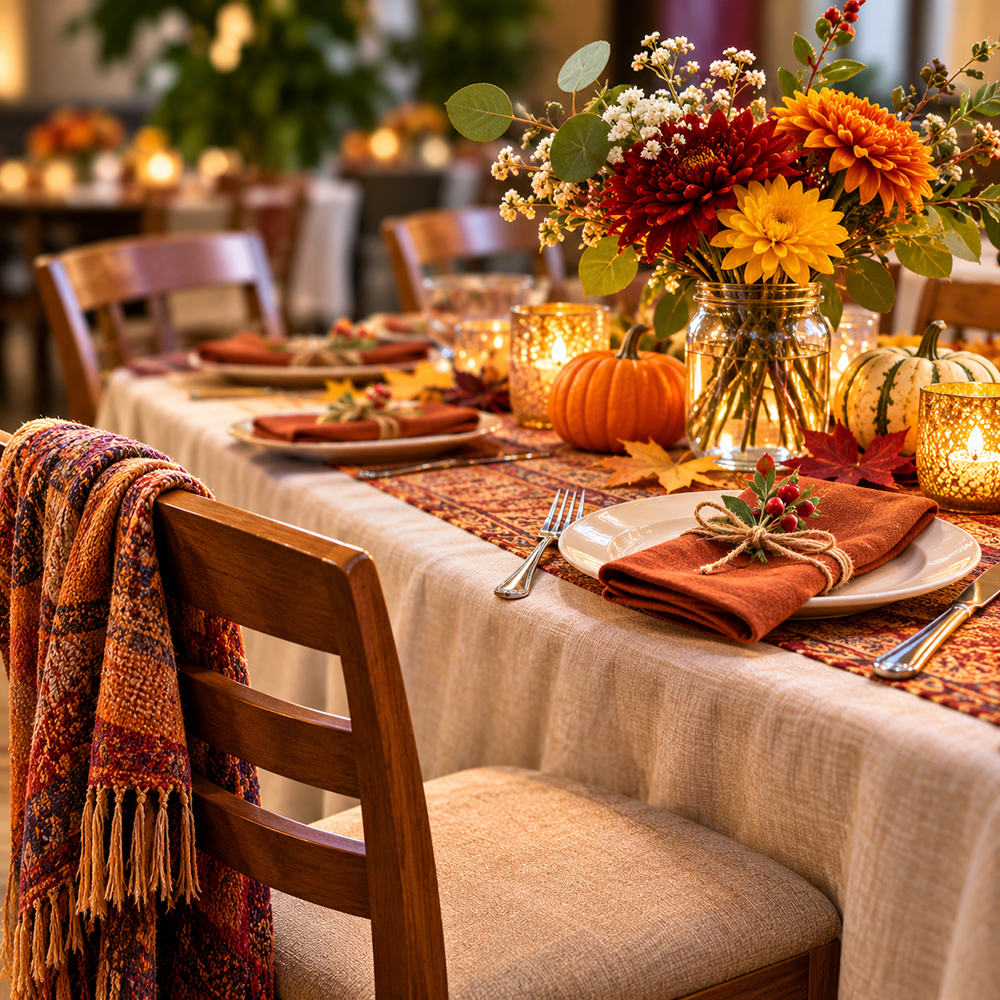
Yet there I was, sitting at a thoughtfully prepared table decorated with autumn flowers, little pumpkins, and touches of gold, sharing an evening with people from different backgrounds.
The tables included conversation prompts encouraging us to reflect on our blessings, aspirations, meaningful experiences, and the possibilities we might pursue if certain limitations were removed.
The food hadn't been ordered from a catering company; it had been prepared in the homes of community members who contributed their time, resources, and efforts to create a meal for everyone to enjoy.
Throughout the evening, expressions of gratitude extended far beyond the food on our plates, encompassing relationships, community, future generations, and the many gifts received from God.
What struck me was how closely the evening's actions reflected the sentiments being expressed.
Rather than celebrating gratitude exclusively within their own community, TASOM had created an opportunity to share that celebration with others.
And I think there's something worth reflecting on in that.
Thanksgiving is often associated with gathering around a table, sharing a meal, and recognizing the things for which we're grateful, but what happens when we extend that spirit beyond our familiar circles?
What happens when gratitude influences how we welcome others, share what we have, and build the communities in which we live?
The friendship dinner offered a glimpse of those possibilities.
It was a reminder that community isn't simply something we belong to; it's also something we participate in creating.
And sometimes, that begins with something as ordinary—and as meaningful—as an invitation to share a table.
More Than a Thanksgiving Dinner
The Turkish American Society of Missouri's annual Thanksgiving Friendship Dinner carried particular significance this year.
As the organization explained in its invitation, after a long journey of planning, building, and dreaming together, its new building was finally ready to host events and dinners.
The evening was an opportunity to celebrate that milestone, express appreciation for the friendships and support the community had received throughout the years, and welcome others into this new chapter.
There was something fitting about celebrating the opening of a community space by bringing people together within it.
After all, the significance of a gathering place extends beyond its walls. Its value also lies in the experiences, relationships, and possibilities those walls help make room for.
Celebrating a New Chapter Together
Community Spotlight: TASOM's Annual Thanksgiving Friendship Dinner
- Host: Turkish American Society of Missouri (TASOM)
- Date: Monday, November 23, 2026
- Time: 6–8 p.m.
- Location: 9201 Watson Road, St. Louis, Missouri 63126
- Cost: Free, with an invitation to RSVP
- Focus: Gratitude, friendship, community, and celebrating the organization's new gathering space
The evening included a Thanksgiving meal, opportunities to reconnect with familiar faces and meet new people, expressions of gratitude, and reflections on the journey that had brought the community to its new home.
What I appreciated was that this milestone wasn't celebrated exclusively among the people who had worked toward it.
The community extended an invitation to others, allowing guests to participate in the celebration and experience the space for themselves.
The friendship dinner offered an early glimpse of the connections and shared experiences this new gathering space could help cultivate.
TASOM's mission centers on fostering friendship, collaboration, cultural understanding, and opportunities for people from different backgrounds to learn from one another.
Its programs include cultural gatherings, educational opportunities, book clubs, and activities for children and young people.
The friendship dinner offered a firsthand glimpse of those values in practice.
Creating Space for Meaningful Conversation
One detail I particularly appreciated was the collection of conversation prompts placed on each table.
At Table 7, where I was seated, we found the following questions:
- What is one blessing from this past year that you find yourself especially thankful for?
- If you could spend a week anywhere in the world for free, where would you choose to go?
- If financial constraints disappeared, how would you spend the rest of your life?
- What is the most meaningful advice you have received in your life?
- If you could share a Thanksgiving meal with any person from history, who would you choose and why?
These questions invited us to consider more than the usual introductory topics of where we live or what we do for work.
They created opportunities to learn about people's values, dreams, experiences, interests, and sources of inspiration.
I found the question about financial constraints particularly thought-provoking.
So much of our daily decision-making can be shaped by what we can afford, what we need to accomplish, and what our circumstances allow.
Being invited to imagine life beyond those constraints creates room for a different kind of conversation—one about what genuinely matters to us.
The other questions similarly offered opportunities to reflect on the people, experiences, and possibilities that have shaped our lives.
Thoughtful conversation prompts can also make social gatherings more approachable.
For someone who finds initiating conversations difficult, having a shared starting point can reduce some of the uncertainty involved in interacting with unfamiliar people.
Of course, meaningful connection cannot be manufactured simply by placing questions on a table.
People also need the freedom to participate at their own comfort level.
But providing an invitation to connect can make that connection a little easier.
It's a small detail that reflects a larger principle: creating a welcoming environment involves considering not only whether people can enter a space, but also how they might participate once they're there.
The decorations, conversation prompts, invitations, and meal were all different parts of that experience.
And behind each of those details were people who had contributed something to make the evening possible.
A Meal Made by a Community
One of the details that made the Thanksgiving Friendship Dinner particularly meaningful to me was learning where the food had come from: it hadn't been catered.
The food had been prepared in the homes of members of the Turkish American community, who contributed to creating a meal that everyone gathered that evening could enjoy.
As I looked at the food on my plate, I thought about how much happens before a meal like this reaches the table.
There are ingredients to gather, dishes to prepare, food to cook, and arrangements to coordinate.
There is time spent in kitchens, attention given to preparation, and effort that guests may never directly witne
What we experienced during the dinner was the culmination of those contributions.
The meal itself became an expression of community.
Everyone Bringing Something to the Table
There's something meaningful about people contributing individually toward an experience that becomes collectively shared.
Not everyone needs to bring the same thing.
One person might prepare a dish.
Another might help organize the gathering, arrange the tables, prepare decorations, communicate with guests, or assist with serving and cleanup.
Each contribution serves a different purpose, yet together they help create an experience that would be much more difficult for one person to provide alone.
We sometimes imagine generosity in terms of a single person making a significant contribution, but generosity can also emerge through many smaller contributions working together.
A meal prepared in someone's kitchen becomes part of a larger celebration.
Time spent arranging decorations helps transform a room into a welcoming gathering space.
An invitation extended to someone outside the immediate community creates another opportunity for connection.
Individually, these actions might seem ordinary.
Collectively, they can create something memorable.
As an artist, I find myself drawn to this kind of process; individual elements can come together to form something that none of them could have created independently.
Community can work in a similar way.
People bring different skills, experiences, resources, and perspectives; their contributions don't need to be identical to be valuable.
And importantly, not everyone needs to contribute something tangible to deserve a place at the table.
There is room for people to give, receive, participate, and simply be present.
 Jessica Carey
Generosity Beyond Financial Giving
When we think about generosity, financial donations are often among the first things that come to mind.
Money can certainly make important things possible. Community spaces, ingredients, supplies, and events all require resources.
But generosity also takes forms that aren't always as easily measured.
Preparing food for others involves knowledge, creativity, time, and care.
Decorating a gathering space involves considering how different elements can come together to create an atmosphere.
Organizing an event involves anticipating needs, coordinating details, and making decisions that help the experience unfold.
These contributions are sometimes overlooked precisely because they are so familiar.
Cooking, arranging a table, extending an invitation, and welcoming a guest may not seem particularly extraordinary, yet these everyday actions can communicate consideration and care in ways that matter deeply.
Food, especially, can become a meaningful way of sharing something of ourselves with others.
Recipes can carry cultural traditions, family memories, personal preferences, and knowledge passed between generations.
Preparing and sharing a meal can create opportunities for people to experience something of another community's culture without needing to share the same background.
The significance of the homemade food at the friendship dinner wasn't that a catered meal would have been any less worthy of appreciation.
It was that, in this particular gathering, the preparation reflected the collaborative spirit being celebrated throughout the evening.
The community was expressing gratitude for what it had received while offering something of its own.
And the guests were able to experience the results of that generosity firsthand.
It's worth recognizing the often-unseen contributions behind gatherings like this one.
The people preparing food, coordinating details, and creating welcoming environments remind us that ordinary acts of care can collectively make something extraordinary possible.
What appeared on the table was food.
What brought it there was cooperation, generosity, and a willingness to share.
And that made the meal a particularly fitting expression of the gratitude at the heart of the evening.
Gratitude Beyond the Obvious
Throughout the friendship dinner, gratitude was expressed in many different forms.
There was appreciation for the community's new building and the journey that had made it possible.
There was gratitude for friends, family, and the relationships that had developed over the years.
There was gratitude for being welcomed into St. Louis, for the opportunity to share with others, and for the children and young people who represent the future.
There was appreciation for the gifts received from God, including something as fundamental as the air we breathe.
I found the breadth of these expressions particularly meaningful.
Gratitude wasn't limited to accomplishments, material possessions, or circumstances that had unfolded favorably; it extended to relationships, possibilities, the natural world, and the experience of being alive.
It was an invitation to notice the many different ways in which our lives are sustained and enriched.
Recognizing the Gifts We Often Overlook
When we're asked what we're grateful for, we may initially think of significant events.
- A new opportunity.
- An accomplishment we've worked toward.
- A meaningful relationship.
- An unexpected kindness.
- A long-awaited answer to something we've been hoping for.
These experiences certainly deserve recognition.
But much of what sustains us exists within the quieter details of everyday life.
- The air we breathe.
- The water we drink.
- The warmth of a meal.
- The knowledge someone took the time to share.
- The presence of someone who listens.
- The natural processes that allow food to grow and life to continue.
Because many of these things are familiar, their significance can easily fade into the background.
We may eat a meal without considering the people who grew its ingredients, the natural conditions that allowed them to grow, or the knowledge and effort involved in preparing them.
We may enter a community space without knowing the years of planning, cooperation, and contributions that made its existence possible.
We may benefit from someone's kindness without ever fully understanding the experiences that inspired them to extend it.
Gratitude can invite us to look more closely.
As a neurodivergent artist, I'm often drawn to the details that are easily overlooked—the textures, materials, ordinary objects, and small moments that reveal something interesting when given our attention.
I think gratitude can involve a similar way of seeing.
It encourages us to recognize significance in things that might otherwise pass unnoticed.
For those who understand life through a spiritual lens, this recognition may also become an expression of reverence for the gifts of God.
Others may understand it through an appreciation of nature, human interconnectedness, or the remarkable conditions that make life possible.
Our understandings may differ, yet we can still share an appreciation for the many things that sustain us beyond our individual efforts.
There is something humbling about recognizing how much of life involves receiving.
None of us independently created the air we breathe, the natural world that sustains us, or all the knowledge that has been passed down through generations.
We participate in a world shaped by countless contributions, many of which we may never fully recognize.
Gratitude offers an opportunity to acknowledge some of them.
 Jessica Carey

When Gratitude Moves Beyond Ourselves
Perhaps what I appreciated most about the friendship dinner was the relationship between the gratitude being expressed and the actions taking place around us.
The community expressed gratitude for being welcomed into St. Louis while welcoming others into its own gathering space.
It celebrated having a new building by sharing that space with guests.
It expressed appreciation for the gifts of God while offering gifts of its own through food, hospitality, time, and care.
There was a beautiful consistency between what was being celebrated and how the celebration unfolded.
It made me reflect on what can happen when gratitude becomes more than something we experience privately.
Appreciation for what we've received might inspire us to share a meal, pass along knowledge, extend an invitation, or make a valued resource more accessible to someone else.
These responses aren't obligations; gratitude doesn't have to be demonstrated through a particular action, and people have different capacities for sharing at different points in their lives.
But when appreciation naturally inspires generosity, the good someone has received can extend beyond their own experience.
It can become part of another person's story.
I think that's one of the possibilities that makes gratitude particularly meaningful within a community.
It allows us to celebrate what has enriched our lives while remaining attentive to opportunities to enrich the lives of others.
Gratitude can begin with recognizing what we've received, but it doesn't have to end there.
Sometimes, it becomes an invitation to share.
And in sharing, we can create opportunities for others to experience something worth being grateful for, too.
Hospitality Without Conditions
One of the things I appreciated about the Thanksgiving Friendship Dinner was that people didn't need to share the same background to participate.
The Turkish American Society of Missouri was celebrating its own community, expressing its gratitude, and sharing something of its cultural and spiritual identity.
Yet the invitation extended beyond that community.
We could gather around the same tables, enjoy the same meal, and participate in the evening without needing to have identical experiences, traditions, or beliefs.
There was room for both cultural identity and shared humanity.
I think there's something important in that distinction, particularly in a world where differences are so often presented as reasons for separation.
Connection Without Requiring Sameness
Sometimes, conversations about unity seem to imply that people need to become more alike to coexist peacefully.
But meaningful connection doesn't require everyone to understand the world in the same way.
We can have different cultural backgrounds, spiritual beliefs, traditions, interests, and experiences while still recognizing things we have in common.
We can appreciate another community's traditions without abandoning our own.
We can listen to someone express gratitude through their spiritual understanding without needing to interpret that experience identically.
And we can share a meal with someone whose life has unfolded differently from ours.
In fact, some of the richness of community comes from those differences.
Another person's experiences may introduce us to perspectives we hadn't considered.
Their traditions may help us recognize unfamiliar ways of expressing values we already share.
Through these encounters, the world can become a little less unfamiliar.
I've experienced something similar through other recent invitations, including the opportunity to attend a Bahá'í Holy Day celebration.
Being welcomed into a gathering outside my own background offered an opportunity to learn, observe, and appreciate the ways another community expresses its values.
Experiences like these remind me that curiosity and respect can create possibilities for connection without requiring agreement on everything.
We don't have to resolve every difference before treating one another with kindness.
Nor do we have to erase the things that make us distinct to recognize our shared humanity.
Unity can make room for diversity rather than requiring its disappearance.
 Jessica Carey
The Difference Between Being Allowed and Being Welcomed
There's also a meaningful difference between being allowed into a space and being welcomed into it.
A person might technically be permitted to attend an event while still feeling uncertain about whether their presence is wanted.
They might not know how to participate, what is expected of them, or whether they will be accepted if they are unfamiliar with the community's traditions.
Hospitality can help bridge some of that uncertainty.
At the friendship dinner, the tables had been prepared, the food had been made, and invitations had been extended.
The conversation prompts offered a starting point for interaction.
The expressions of gratitude acknowledged the relationships and support that had helped the community reach this moment.
These details reflected consideration for the people who would be gathering.
And consideration is an important part of hospitality.
It involves thinking beyond our own familiarity with a space and recognizing that someone else may be entering it for the first time.
- What might help them feel comfortable?
- What might make participation easier?
- How can we communicate that their presence is welcome without placing unnecessary expectations upon them?
The answers may differ depending on the person and the circumstances.
Some people enjoy lively conversation, while others appreciate being able to participate more quietly.
Some arrive with familiar faces, while others may know very few people.
Some have the energy to engage extensively, while others may simply appreciate having somewhere to be.
A welcoming environment leaves room for these differences.
No single gathering can anticipate every person's needs, and hospitality doesn't automatically remove every accessibility barrier, but the willingness to consider other people's experiences is a meaningful starting point.
It shifts our attention from merely providing a space toward considering how people experience that space.
And perhaps that's one of the most meaningful aspects of hospitality: the opportunity to communicate that someone doesn't need to prove their usefulness, explain their circumstances, or become more like everyone else before their presence has value.
A shared table offers a simple illustration of that possibility.
People can arrive with different stories, needs, and understandings of the world, yet still find opportunities to receive nourishment, exchange perspectives, listen, learn, or simply be present.
Their differences don't have to disappear for that moment of connection to be meaningful.
 Jessica Carey

Gratitude and Hardship Can Coexist
One of the things I find important when discussing gratitude is recognizing that it doesn't require life to be going well in every respect.
We can experience something meaningful while navigating circumstances that remain difficult.
We can appreciate an unexpected kindness while still needing additional support.
We can enjoy an evening of connection while experiencing uncertainty about what tomorrow might bring.
We can recognize the good without denying the difficult.
My experience at the Thanksgiving Friendship Dinner existed within that complexity.
I'm still navigating housing instability, financial hardship, and chronic autistic burnout.
Attending a community gathering doesn't resolve those circumstances, nor does it eliminate the uncertainty and exhaustion that accompany them.
And yet, I was genuinely grateful for the invitation, the meal, the hospitality, and the opportunity to experience an evening centered on friendship and community.
Those experiences weren't less meaningful because my circumstances remained difficult.
And my difficulties didn't become less legitimate because I had experienced something good.
Both realities could exist together.
 Jessica Carey

Gratitude Doesn't Require Denying Pain
Sometimes, conversations about gratitude unintentionally create the impression that acknowledging hardship is incompatible with appreciating what we have.
People experiencing difficulties may be encouraged to focus on their blessings, remember that others have it worse, or concentrate on the positive aspects of their circumstances.
While these suggestions may be well-intentioned, they can become dismissive when they leave little room for someone to acknowledge what they're actually experiencing.
Having access to a nourishing meal doesn't eliminate the need for reliable access to food.
Experiencing a welcoming community gathering doesn't eliminate the need for stable housing.
Receiving an unexpected kindness doesn't erase the exhaustion of navigating prolonged uncertainty.
I can appreciate the generosity of the people who prepared the friendship dinner while recognizing that I still need rest, stability, and support.
Neither reality invalidates the other.
In fact, I think allowing these realities to coexist creates room for a more authentic experience of gratitude.
Rather than requiring ourselves to reinterpret everything positively, we can recognize the particular moments, relationships, and experiences that bring something meaningful into our lives.
We don't have to describe an entire season as good to acknowledge the goodness that exists within it.
Even a difficult or uncertain season can contain moments of beauty, unexpected kindness, and experiences worth cherishing.
Those moments don't need to compensate for everything that hurts to have value of their own.
Something good doesn't have to fix everything to be genuinely good.
Gratitude as an Invitation, Not a Demand
I also think there's an important difference between gratitude that arises naturally and gratitude that is expected or demanded.
When gratitude becomes an expectation, particularly for people experiencing hardship, it can create pressure to minimize needs, conceal disappointment, or demonstrate appreciation in ways that make others comfortable.
Receiving assistance can sometimes come with an unspoken expectation that the recipient should no longer express dissatisfaction with their circumstances.
But kindness doesn't need to come with that condition.
Someone can be grateful for what has been offered while still acknowledging what is missing; they can appreciate someone's generosity without becoming indebted to them emotionally.
And they can receive care without immediately having the capacity to offer something in return.
What I appreciated about the friendship dinner was that the community had created an opportunity to share an experience.
The meal was offered freely.
People from different backgrounds were welcomed.
Gratitude was the theme of the evening, but it was also expressed through the generosity of those who had made the gathering possible.
There is something meaningful about creating an experience that people can appreciate without requiring them to demonstrate that appreciation in a particular way.
For some, gratitude may be expressed through words or prayer; for others, it may be a quiet recognition of what a moment means to them.
Someone may leave a gathering feeling encouraged, nourished, or a little more connected to the world around them.
Others may simply appreciate having had a pleasant evening amid difficult circumstances.
There is room for all of these experiences.
From a spiritual perspective, I don't believe honoring the gifts of God requires pretending that suffering doesn't exist.
There can be room for thanksgiving alongside lament, hope alongside uncertainty, and appreciation alongside the acknowledgment that something needs to change.
Recognizing blessings need not mean accepting preventable suffering as inevitable.
Perhaps a compassionate understanding of gratitude allows us to appreciate what is present while remaining attentive to what is needed—both in our own lives and in the lives of others.
The friendship dinner didn't need to change every aspect of my circumstances to make a meaningful difference in my evening.
It offered nourishment, hospitality, and an opportunity for connection.
And those things were worth appreciating for what they were.
Sometimes, grace is found not in the disappearance of every difficulty, but in the meaningful experiences that meet us along the way.
 Jessica Carey

Building the Communities We Hope to See
The Thanksgiving Friendship Dinner was made possible not only by the people who prepared the meal and organized the evening, but also by the longer journey that had brought the community to its new building.
Before there could be tables filled with food and people gathered around them, there had been a vision of what that space could become.
There had been planning, cooperation, and sustained effort.
What we experienced that evening was one of the possibilities that had emerged from that work.
It made me reflect on the relationship between the communities we hope to experience and the communities we actively participate in creating.
Community Is Something We Create
A physical gathering space can provide a foundation for experiences that might otherwise be difficult to facilitate.
It can offer somewhere for people to celebrate, learn, exchange ideas, preserve cultural traditions, share resources, develop relationships, and explore new possibilities together.
But a building alone doesn't create community.
What gives a gathering space its deeper significance is what people choose to cultivate within it.
The relationships they nurture.
The opportunities they create.
The people they welcome.
The ways they respond to one another's needs.
The friendship dinner offered an example of how a physical space can become a setting for these expressions of care.
As someone who has been developing a vision for an inclusive creative community through the Everyone Creates Project, I found this particularly meaningful.
Much of my own vision centers on creating environments where people can explore their creativity, access resources, learn from one another, and experience belonging without needing to fit a narrow definition of who an artist is or what participation should look like.
Although the purposes of these spaces may differ, there is a shared principle underlying them: intentionally creating opportunities for people to come together.
Not every community needs the same kind of gathering space.
Different communities have different needs, interests, resources, and aspirations.
What matters is considering what a space could make possible for the people it serves.
A room might become somewhere a person discovers a new interest.
A shared meal might introduce people who otherwise would never have met.
A workshop might provide access to knowledge or materials someone couldn't independently afford.
The possibilities extend beyond the physical structure itself.
And while creating dedicated community spaces can require considerable resources, cultivating community doesn't always require a building of our own.
Libraries, parks, borrowed rooms, shared studios, homes, and existing gathering spaces can all become places where meaningful connections develop.
We can begin with what is available while continuing to imagine what might become possible.
 Jessica Carey

Gratitude for the Future
Another aspect of the evening that stayed with me was the gratitude expressed for children and young people.
They were recognized as the future of the community.
And while children represent the future, they're also meaningful members of our communities in the present.
Their curiosity, perspectives, creativity, and experiences deserve consideration today, not only for what they may contribute as adults.
I think this adds another dimension to the conversation about gratitude.
We can appreciate what previous generations have contributed, celebrate what exists in the present, and consider what we are helping create for those who will come after us.
Children learn about community not only through what adults tell them, but also through what they have opportunities to witness and experience.
When they see people cooperating to prepare a meal, welcoming guests from different backgrounds, and sharing the results of their collective efforts, they encounter examples of what generosity and hospitality can look like in practice.
These experiences can help shape their understanding of what it means to live alongside others.
- What might become possible if more young people grew up experiencing communities where differences were approached with curiosity rather than fear?
- Where asking for help was understood as part of human interconnectedness?
- Where people could contribute according to their abilities and receive support according to their needs?
- Where creativity, kindness, cooperation, and consideration were recognized as meaningful parts of everyday life?
We cannot determine every aspect of the world future generations will inherit.
But we can participate in shaping the environments, relationships, and values that become part of their experiences.
The new TASOM building represents possibilities that extend beyond a single Thanksgiving dinner.
There are experiences yet to unfold, relationships yet to develop, and people who have yet to walk through its doors.
That is one of the meaningful possibilities of investing in community: the good that emerges from our efforts may extend far beyond what we personally witness.
Perhaps gratitude for what has been entrusted to us can also inspire thoughtful stewardship of what we leave behind.
Making Room at the Table
When my friend's grandmother invited me to the Thanksgiving Friendship Dinner, she opened the door to an experience I might otherwise never have encountered.
That invitation became an evening of homemade food, thoughtfully prepared tables, expressions of gratitude, and opportunities to experience the hospitality of another community.
It also offered a reminder of what can become possible when people intentionally make room for one another.
I'm grateful to the Turkish American Society of Missouri for opening its doors, sharing its celebration, and welcoming people into this new chapter of its journey.
I'm grateful to the people who prepared the food, organized the gathering, and contributed to the many details that made the evening possible.
And I'm grateful to my friend's grandmother for thinking to include me.
Each of these contributions played a part in creating an experience that I can now carry with me.
It makes me wonder how many other opportunities for connection exist within the ordinary moments of our lives.
Sometimes, making room for someone might involve extending an invitation to a gathering.
It might involve sharing a meal, passing along information about a community resource, making space for another perspective, or offering someone an opportunity to participate in something they might not otherwise experience.
Sometimes, it involves listening.
Sometimes, it involves recognizing that another person's needs or circumstances may differ from our own and allowing room for those differences.
And sometimes, we're the person who needs someone else to make room for us.
There is dignity in receiving as well as giving; both are part of living within an interconnected world.
We don't need to possess extraordinary resources, have everything figured out, or exhaust ourselves in service to others to participate in creating more compassionate communities.
We can recognize the possibilities that exist within our circumstances, honoring our capacities while remaining open to the ways kindness can move between us.
Perhaps one of the most meaningful expressions of gratitude is recognizing the good we've received and, when we're able, helping make that good accessible to someone else.
A shared table cannot solve every problem in the world.
But it can offer nourishment, create opportunities for understanding, and remind us that differences need not prevent connection.
It can become a place where gratitude is not only spoken but experienced.
Sometimes, it begins with something as simple as making room at the table.
Want even more content about creativity and art?
Be sure to check out all of our creative chronicles!
If you'd like to see examples of my work, you can find some of my art and creations at Redbubble and Gumroad!
Looking to learn more about my recent journey?
Check out some of these articles:
-Hidden Gems for St. Louis Artists
-Hidden Gems for Autistic & Neurodivergent Adults
-Learning What Love Was Supposed to Feel Like
-What Chronic Autistic Burnout Actually Feels Like
-Building a Life from What Remains
 Jessica Carey