

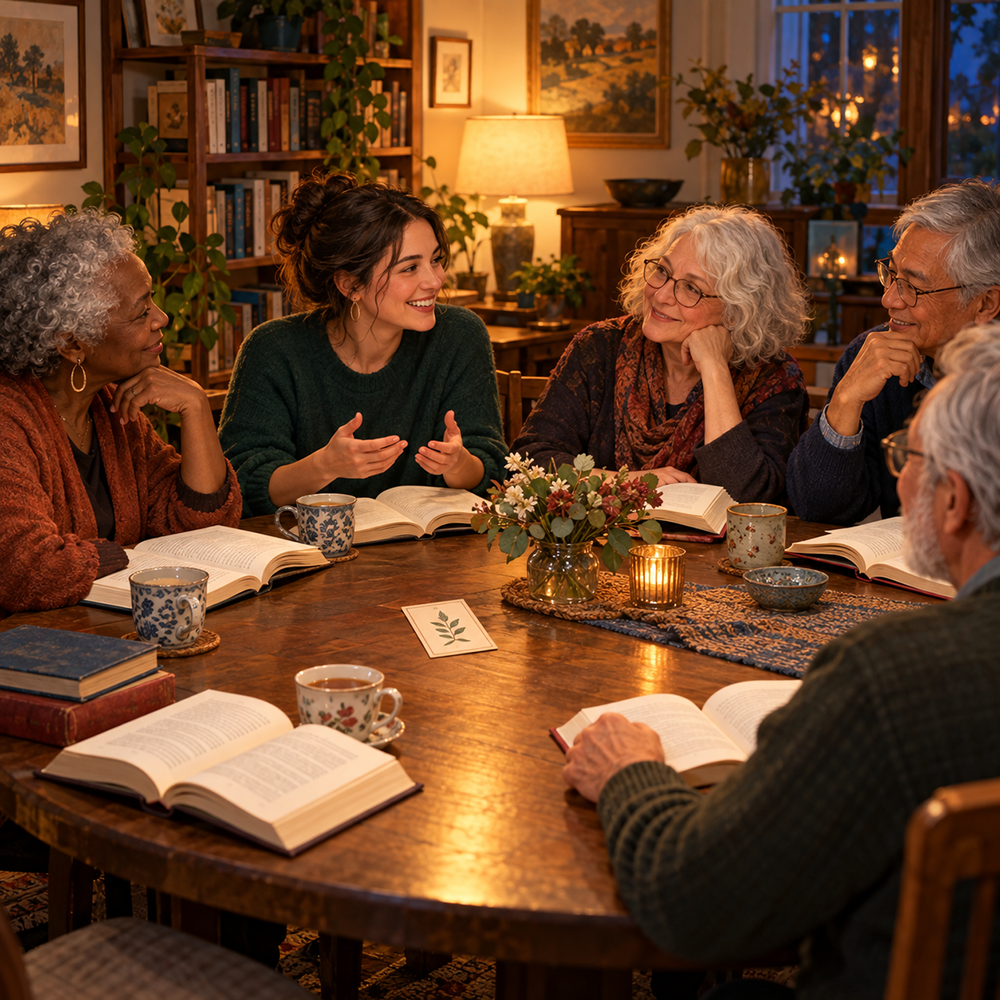
Tonight, the grandmother of the friend I am staying with invited me to dinner and a book discussion with a group of her friends.
Everyone else at the table was a grandparent, which made me the youngest person there by a considerable distance.
I knew almost no one, and they were discussing The Secret of Divine Civilization by ‘Abdu’l-Bahá—a book I had never read or even heard of before that evening.
Written in Persian in 1875 and addressed to the rulers and people of Persia, the work examines questions surrounding social progress, education, leadership, and the development of a true civilization.
At first, there seemed to be some concern that the discussion might be too deep for me.
That assumption did not offend me as much as it made me curious about what the evening would become.
I could not contribute prior knowledge of the book, its historical context, or what the group had discussed during earlier meetings.
I entered without preparation, expertise, or any certainty that I would know what to say.
What I could do was listen.
As the conversation unfolded, I asked questions, reflected on the ideas being raised, connected them with other things I had learned or experienced, and offered observations from my own perspective.
I did not need to pretend that I knew the text. I could engage with the ideas honestly as they were introduced.
The group seemed surprised by how much insight I contributed.
By the end of the evening, the concern that the conversation might be too deep for me had disappeared.
Instead, people were telling me how much they enjoyed having me there and asking me to join them again.
That reversal stayed with me.
The evening was not meaningful simply because I proved that I could understand a serious conversation.
Its deeper gift was the reminder that we do not always need complete preparation before we are allowed to participate.
We do not have to be the expert in the room to contribute something valuable.
Thoughtful conversation requires knowledge, but it also requires curiosity, attention, lived experience, openness, and the ability to make connections.
Sometimes the person encountering an idea for the first time can ask a question or notice a possibility that someone more familiar with it has stopped seeing.
I brought what I had: careful listening, genuine interest, a love of exploring ideas, and a willingness to engage sincerely.
Apparently, that was more than enough.
The group also has a beautiful weekly practice; at each gathering, they draw a virtue card and reflect on how they might cultivate that quality in the days ahead.
That evening’s virtue was courage.
The timing felt unexpectedly appropriate.
I had entered an unfamiliar room, joined a discussion about an unfamiliar book, and allowed myself to participate without believing that I needed to know everything first.
My friend’s grandmother had also taken a chance by inviting someone from a very different generation into an established gathering.
The group, in turn, allowed my presence and contributions to change its initial expectations.
By the end of the night, I had not simply followed a deep conversation.
I had been given an unexpected seat at the table—and discovered that the people around it genuinely wanted me to return.
 Jessica Carey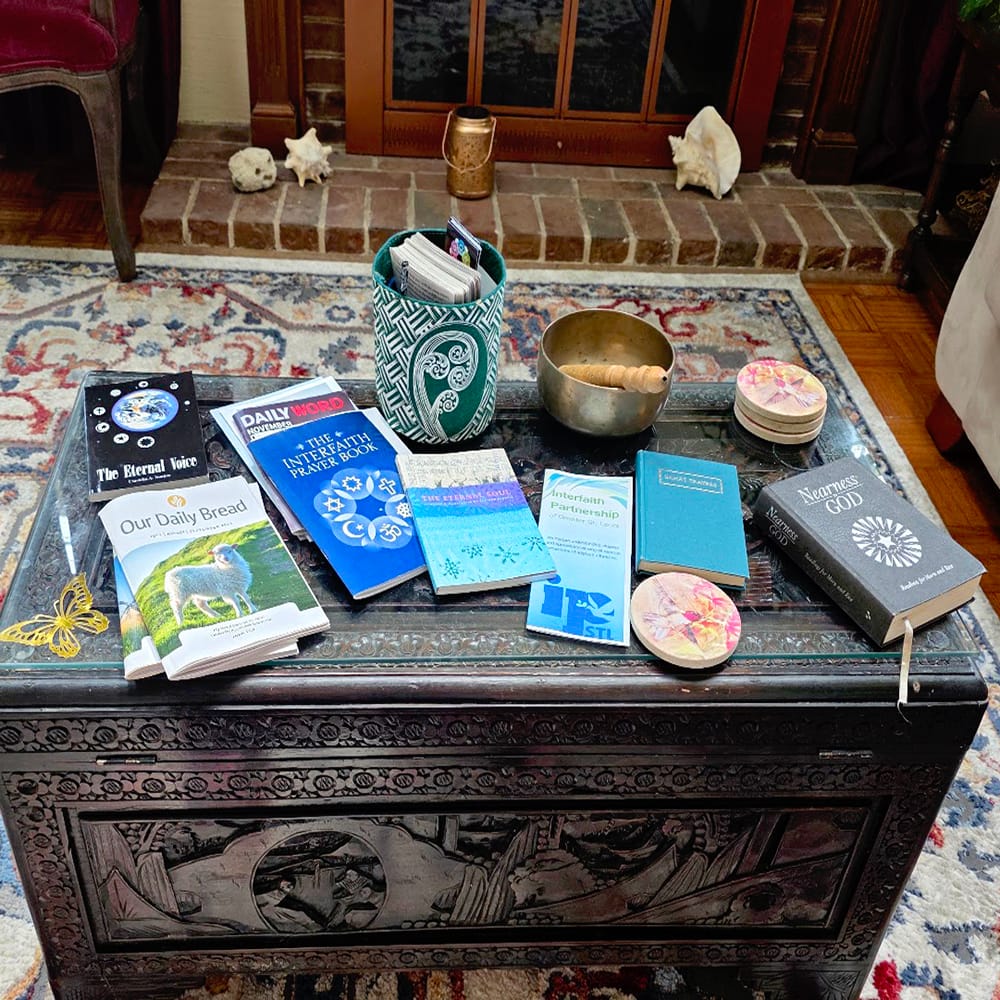
You Do Not Need to Know Everything to Contribute
There is an important difference between pretending to know something and being willing to think deeply about something we are still learning.
I could not speak as an expert on The Secret of Divine Civilization.
I had no previous knowledge of the text and no opportunity to prepare for the discussion, but unfamiliarity did not make me incapable of listening, asking questions, recognizing themes, or connecting the ideas with other parts of life.
In some ways, entering without prior knowledge encouraged a different form of attention.
I had to listen closely enough to understand what people were discussing.
I could not rely on having memorized the text or already formed an interpretation.
I needed to remain curious, notice what stood out, and let the conversation teach me as it unfolded.
That kind of participation still has value.
Knowledge is important, especially when a subject has historical, cultural, spiritual, or political depth.
A fresh perspective should not replace careful study. But knowledge alone does not automatically create meaningful conversation.
Conversation also needs people who are willing to:
- Listen without immediately preparing a response
- Ask sincere questions
- Recognize connections across different experiences
- Consider an idea from more than one angle
- Admit what they do not know
- Remain open to having their understanding changed
I have always enjoyed exploring ideas beneath the surface.
Even when I am unfamiliar with a particular book, I may recognize its questions:
- How do people create meaningful change?
- What responsibilities do individuals and communities have toward one another?
- What allows a society to grow?
- How do spiritual principles become lived action rather than abstract ideals?
Those questions can be approached through study, but they can also be approached through lived experience.
I brought years of thinking and writing about relationships, community, social systems, human behavior, creativity, suffering, responsibility, and what helps people flourish.
I had not read this particular book, but I was not arriving with an empty mind or an empty life.
None of us enters a conversation with nothing.
We bring the questions we have carried, the patterns we have noticed, the losses and relationships that have shaped us, and the ways we have learned to interpret the world.
We also bring the possibility of listening to experiences that differ from our own.
That evening reminded me that preparation is not the same as worthiness.
There are situations where preparation is necessary, but there are also invitations we cannot fully prepare for.
If we believe we must understand everything before participating, we may exclude ourselves from the very conversations through which understanding could grow.
Sometimes contribution begins with the humility to say: I have never encountered this before, but I am listening.
From there, curiosity can open a door that expertise alone cannot.
 Jessica Carey
Courage Was Already Happening at the Table
The group’s weekly virtue practice added another layer to the evening.
At each meeting, they draw a card naming a quality to consider and cultivate during the week ahead.
That evening’s virtue was courage: the willingness to move beyond familiar limits, face truth openly, and accept the invitations life places before us.
At first, I thought about how appropriately that word described my own decision to participate.
Entering an established social group can already feel vulnerable.
Entering as the youngest person in the room, knowing almost no one, and joining a serious discussion about an unfamiliar book added several more layers of uncertainty.
I could have remained quiet.
I could have assumed that my lack of preparation meant I had nothing worthwhile to say.
I could have listened politely while keeping every question and connection inside my own mind.
Instead, I allowed myself to participate.
That may appear like a small act from the outside, but courage is not always dramatic.
Sometimes it is speaking when part of us expects to be dismissed.
Sometimes it is asking a question without knowing whether everyone else considers the answer obvious.
Sometimes it is trusting that we are allowed to occupy space before anyone has confirmed that we belong there.
But courage was not mine alone.
My friend’s grandmother practiced courage by extending the invitation; she brought someone from a different generation into a gathering that already had its own relationships, rhythm, and shared history.
The other people at the table also demonstrated openness.
They may initially have wondered whether the conversation would be too deep for me, but they did not cling to that assumption once my participation gave them different information.
They listened, responded, welcomed my perspective, and invited me to return.
That willingness to revise an expectation matters.
Sometimes the most meaningful intergenerational connections begin when people become curious enough to move beyond the roles they have unconsciously assigned one another.
Younger people are not empty vessels waiting for older people to provide all the wisdom.
Older people are not outdated or incapable of understanding experiences beyond their generation.
Everyone at the table carried something worth hearing.
The virtue card did not magically create the evening’s meaning, but it gave us language for what was already taking place.
Courage had entered through the invitation, through my willingness to accept it, and through the group’s decision to make room for an unexpected voice.
Perhaps courage is not always walking into a room without fear.
Sometimes it is walking in without certainty—and remaining open to discovering that the room may hold a place for us after all.
Why Children and Older Adults Often Understand Me
The evening also reminded me of a pattern that has followed me throughout much of my life: children and older adults often seem to recognize and appreciate me more readily than people within my own age group.
This is not true of every child, older adult, or peer.
Still, it has happened often enough to feel meaningful.
Children have frequently been drawn to my imagination, playfulness, patience, and willingness to enter their worlds without treating their interests as unimportant.
I do not assume that a conversation matters less because the person having it is young.
A child’s drawing, story, question, collection, invented creature, or passionate interest may contain an entire inner world—and I genuinely want to know about it.
Older adults often seem to appreciate a related part of me.
They may enjoy my willingness to listen to their stories, consider questions that do not have quick answers, and engage with subjects that reach beyond everyday small talk.
I am interested in what people have learned, what they believe, what has changed during their lives, and which questions they are still carrying.
In both cases, the connection is not built solely upon shared age or circumstances.
It is built through attention.
 Jessica Carey
Children and older adults may have very different lives, but both can be overlooked within a culture that often centers busy, productive, working-age adulthood.
Children may be dismissed as too young to understand.
Older people may be treated as though their experiences are no longer relevant.
The details differ, but both groups know something about having other people make assumptions before listening.
Perhaps this makes sincere attention especially noticeable.
I also wonder whether these relationships sometimes contain less pressure to perform the unwritten social expectations that can shape interactions among peers.
I do not have to prove that I have reached the same milestones, built the same kind of life, or learned the correct version of adulthood on the expected timeline.
The conversation can begin somewhere else.
With curiosity.
With imagination.
With a story.
With a question neither person has completely answered.
As an autistic person, I often find greater comfort in conversations that have sincerity, substance, or a shared point of interest.
Small talk and social positioning can be far more difficult to navigate than an honest discussion about an idea, a creative project, a personal history, or something someone deeply loves.
Children often understand enthusiasm.
Older adults often understand that life is complicated.
Both may be more willing than expected to move beyond appearances and meet the person in front of them.
That evening, the grandparents around the table did not merely allow me to remain.
They became interested in what I thought.
They responded to my questions, listened to my observations, and asked me to return.
That distinction matters.
There is a profound difference between being tolerated and being wanted.
Again and again, children and older adults have shown me that my curiosity, intensity, imagination, and desire for meaningful connection are not inherently too much.
In the right relationships, those same qualities are precisely what make someone glad I am there.
 Jessica Carey
Belonging Does Not Always Follow Demographic Lines
We are often encouraged to search for belonging among people who appear similar to us.
We look for those who share our age, background, stage of life, interests, beliefs, profession, diagnosis, or experience.
Those similarities can be deeply valuable.
Being understood without needing to explain every part of ourselves can bring a rare sense of relief.
But similarity does not guarantee connection, and difference does not prevent it.
I did not share the same generation or life circumstances as the other people at dinner.
They had accumulated decades of experiences I had not lived.
I entered the group without their shared history and without familiarity with the book around which the evening had been organized.
Yet we still found one another through ideas.
We could be curious together.
We could consider how principles become actions, connect abstract questions with lived experience, and allow one person’s observation to lead someone else toward another.
Our different histories did not make conversation impossible; they gave us more perspectives from which to approach it.
That is one of the gifts of intergenerational connection.
People of similar ages may share cultural reference points, but people from different generations can offer one another access to worlds beyond their own.
An older person may carry memories of social changes someone younger knows only through history.
A younger person may bring language, questions, and perspectives that were less available in earlier decades.
Neither perspective is automatically complete.
Meaning emerges through the exchange.
Intergenerational relationships can also remind us that age is a limited measure of what someone can contribute.
A younger person may possess unusual depth because of what they have studied, endured, observed, or questioned.
An older person may retain curiosity, adaptability, humor, and openness that stereotypes often deny them.
We become more capable of seeing one another when we stop treating age as a summary of the person.
Sometimes belonging is less about finding people who resemble us and more about finding people willing to see us accurately.
The people at the table did not need me to have lived the same lives they had.
I did not need them to understand every part of my history before the evening could become meaningful.
We needed only enough openness to listen, respond, and allow our expectations to become more flexible.
That does not erase the value of finding peers who understand our specific experiences; it expands the places where connection might be possible.
Belonging may appear in a classroom, studio, support group, neighborhood, faith community, or around a dinner table filled with people we never expected to know.
Sometimes our people are not the people we would have thought to search for.
Sometimes they are the ones who make room, listen closely, and say: we would like you to come back.
An Invitation Can Challenge an Old Story
An invitation may appear small to the person offering it.
To the person receiving it, however, it can challenge an entire collection of old expectations.
When someone has repeatedly been misunderstood, underestimated, excluded, or made to feel out of place, unfamiliar rooms can carry more than ordinary uncertainty.
They can activate questions built from previous experiences:
- Will people understand me?
- Will I say too much or not enough?
- Will my way of thinking make sense to anyone else?
- Do I need to prepare perfectly before I am allowed to participate?
Those questions do not always appear consciously.
Sometimes they become hesitation, overthinking, masking, silence, or the instinct to remain at the edge of a group until someone clearly confirms that participation is safe.
I have often been underestimated in contradictory ways.
At times, people have seen my intelligence, education, or competence and assumed that I should be able to handle anything without meaningful support.
At other times, autism, burnout, vulnerability, or unfamiliarity have led people to speak as though I could not understand situations that I was fully capable of exploring.
Both assumptions reduce a person to an incomplete story.
That evening offered something different.
The group may initially have wondered whether the discussion would be too deep for me, but the evening gave them the opportunity to encounter who I actually was rather than remain inside that assumption.
My lack of familiarity with the book did not prevent me from listening carefully or contributing insight.
I also received new evidence.
I could enter an unfamiliar space without preparing for every possibility.
I could acknowledge what I did not know without treating that uncertainty as proof that I had nothing to offer.
I could contribute without first earning permission through perfect performance.
And when I allowed myself to become visible, the response was not rejection. It was an invitation to return.
One welcoming evening cannot erase every experience of exclusion or misunderstanding.
It does not guarantee that every unfamiliar room will become safe.
But it can become a new piece of evidence—one that exists alongside the older stories and quietly challenges their authority.
Perhaps I will not always be misunderstood.
Perhaps unfamiliarity does not automatically mean inadequacy.
Perhaps the qualities that have sometimes made me feel out of place are the same qualities another community will value.
Perhaps belonging does not always need to be chased, negotiated, or earned through self-erasure.
Perhaps belonging does not always need to be chased, negotiated, or earned through self-erasure.
Sometimes a welcoming experience becomes new evidence that another kind of connection is possible.
 Jessica Carey
Accepting the Seat
I entered the evening knowing almost no one and knowing nothing about the book being discussed.
I left with an invitation to return.
Between those two moments, nothing dramatic happened.
I did not suddenly become an expert, deliver a perfect interpretation, or prove that I belonged through some extraordinary achievement.
I listened.
I asked questions.
I made connections.
I allowed other people to encounter my perspective, and I remained open to theirs.
That was enough for something meaningful to form.
The evening reminded me that belonging does not always begin with confidence.
Sometimes it begins with accepting an invitation before we know exactly what we will bring to it.
We may enter uncertain, unfamiliar with the subject, and unsure how our presence will be received.
Courage does not require those feelings to disappear.
It asks us to participate honestly despite them.
I brought what I had: curiosity, lived experience, careful attention, a love of exploring ideas, and a willingness to engage sincerely.
Those qualities did not make me the most knowledgeable person at the table, but they allowed me to become part of the conversation.
The people around me brought their own histories, questions, reflections, and decades of experience.
We did not need to be the same in order to learn from one another.
Perhaps that is what made the evening feel so unexpectedly affirming.
I was not welcomed because I successfully made myself resemble everyone else.
I was welcomed because I arrived as myself and contributed from where I genuinely stood.
There will always be rooms for which preparation matters.
There will be subjects that require careful study and situations where listening is more appropriate than speaking.
But we should not confuse humility with the belief that we have nothing to offer.
We can admit what we do not know and still trust that our questions, observations, and experiences may matter.
We can enter without certainty and still find connection.
We can belong before we have mastered everything being discussed.
That evening’s virtue was courage, but the lesson I carried home was belonging.
Sometimes courage is accepting a seat at an unfamiliar table.
Sometimes belonging is discovering that our presence added something the table did not have before.
And sometimes the clearest evidence that we mattered is wonderfully simple: they want us to come back.
Have you ever found an unexpected sense of belonging with people from a different generation or background?
What allowed that connection to become meaningful?
 Jessica Carey
Want even more content about creativity and art?
Be sure to check out all of our creative chronicles!
If you'd like to see examples of my work, you can find some of my art and creations at Redbubble and Gumroad!
Looking to learn more about my recent journey?
Check out some of these articles:
-Hidden Gems for St. Louis Artists
-Hidden Gems for Autistic & Neurodivergent Adults
-Learning What Love Was Supposed to Feel Like
-I Wasn't Broken--I'm Burned Out
-What Chronic Autistic Burnout Actually Feels Like
-Building a Life from What Remains
 Jessica Carey