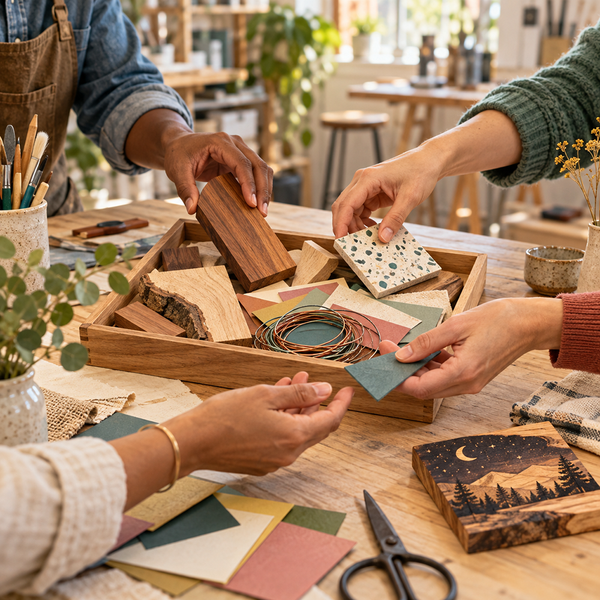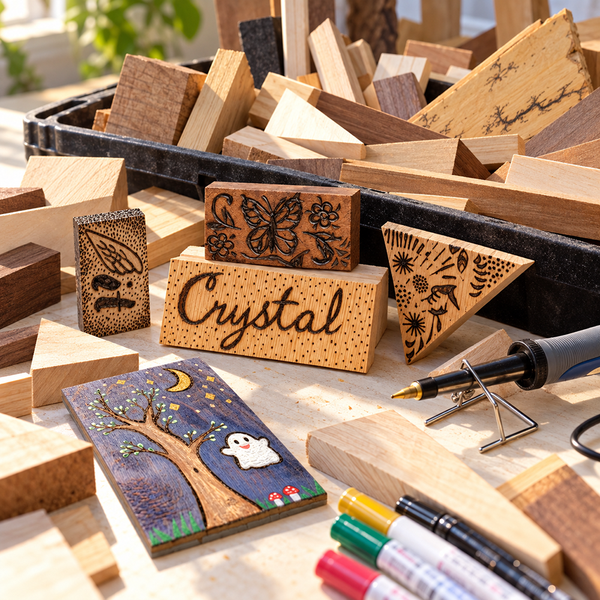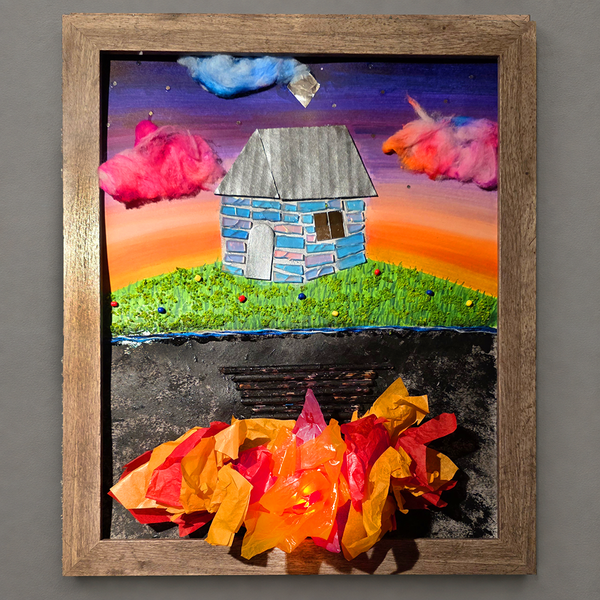
There is a particular moment that happens in making things.
You've started.
Something exists in front of you.
And then you realize: I have absolutely no idea what I'm supposed to do next.
Maybe you know what you want the finished thing to look like.
Maybe you only have a vague feeling.
Maybe you had a perfectly reasonable plan until the material did something unexpected and the plan stopped being useful.
So you stare at it.
Turn it around.
Move something.
Put it back.
Try something else.
And eventually think: well...what if I did this?
Then you find out.
We Don't Always Know Before We Make
There is an assumption hidden inside the way we sometimes talk about creativity.
First, the artist has the idea.
Then, they know how to make it.
Then, they make it.
Idea → plan → execution → finished work.
And certainly, making can happen that way.
But sometimes the reality looks more like:
Idea → attempt → confusion → strange discovery → new idea → wait, what if...? → attempt → completely different direction.
The making itself becomes part of the thinking.
We aren't simply transferring something fully formed from our imagination into the physical world.
We're discovering what it could become while we're making it.
Not Knowing Can Be Part of the Process
That distinction matters.
There is: I don't know how to do this yet.
But there is also: I can't know exactly what happens next because it depends on what happens when I try.
Those aren't quite the same problem.
Sometimes there isn't an answer sitting somewhere that we're supposed to already know.
We have to create the conditions that allow an answer to emerge.
Mix the colors.
Bend the wire.
Move the pieces.
Write the sentence.
Try the material.
Make the mark.
See what happens.
Then respond to what actually happened rather than what we imagined would happen.
Let's See What Happens
Maybe that's one of the simplest creative methods available to us: let's see what happens.
Not: I don't care what happens.
Not: I'll do something completely random and hope for the best.
But: I don't know the answer yet, so I'm going to interact with the problem and learn something from what happens next.
There is uncertainty in that.
But there is also possibility.
Because if every creative decision had to be known before we began, experimentation wouldn't really be experimentation.
Discovery wouldn't be discovery.
We'd only be executing answers we already had.
Sometimes we begin with a map.
Sometimes we have a destination but no idea how to reach it.
And sometimes we're standing somewhere unfamiliar, holding a material or an idea, wondering where it could possibly go.
Perhaps we don't always need to know.
Sometimes the next creative step can simply be:
Try something.
And find out.
Knowing the Destination Isn’t the Same as Knowing the Route
Sometimes the strange thing is that we do know what we want.
We can see it.
Or at least something like it.
A sculpture that balances in a particular way.
A piece of fabric that needs to hold a certain shape.
A story that ends with a particular moment.
A color that exists perfectly in our imagination but apparently nowhere inside the paints we actually own.
The destination isn't necessarily the problem.
The problem is: how on earth do I get there?
An Idea Doesn't Arrive With Instructions
Ideas can be wonderfully inconsiderate that way.
They show up without diagrams.
No materials list.
No troubleshooting guide.
No helpful little note explaining: by the way, here's how you make me physically possible.
We can imagine something our current knowledge doesn't immediately know how to produce.
And that creates a gap between: I want to make this and I know how to make this.
But that gap doesn't necessarily mean the idea has to be abandoned.
Sometimes it becomes the space where the making actually begins.
The Problem Can Teach Us What to Ask
Maybe we want two materials to connect.
They won't.
Okay, why not?
- Do they need a different adhesive?
- A mechanical connection?
- Something wrapped around them?
- A hole?
- A support?
- Do they need to stop being connected in the way we originally imagined?
Now we're experimenting.
One problem creates a question.
The question creates an attempt.
The attempt gives us information.
And that information changes the next question.
We might eventually arrive at a solution we never could have planned from the beginning because we needed the earlier attempts to teach us what the problem actually was.
 Jessica Carey
We Can Learn the Route While We're Traveling It
This is different from having no direction at all.
We may have a strong sense of: I want to get over there.
We simply don't have a map.
So we move toward it.
Try something.
Look at what happened.
Adjust.
Maybe we move closer.
Maybe we discover that the route we imagined is impossible.
Maybe we find a strange little side path.
Maybe that path leads somewhere better.
And sometimes the destination itself changes once we understand more about what we're making.
The original idea gave us somewhere to begin.
It didn't have to dictate everything that happened afterward.
Sometimes “How?” Is a Creative Question
We often treat how as though it should have a factual answer: how do I make this?
Find the instructions.
Learn the technique.
Follow the steps.
And sometimes that's exactly what we need. There is no particular virtue in reinventing a technique someone else can teach us in five minutes.
But other times, there isn't one established answer.
Or the established answer doesn't work for what we're trying to do.
Then how? becomes something different:
- How could this work?
- How else could I do it?
- What could hold this together?
- What happens if I change the material?
- What if the limitation becomes part of the design?
Now we're not simply looking up an answer.
We're inventing one.
Not Knowing the Route Can Change the Destination
And perhaps this is the most interesting part.
If we knew exactly how to execute everything we imagined, the finished work might look exactly like the original idea.
But uncertainty interferes.
The material behaves differently.
Our first solution fails.
The second creates something unexpected.
We discover a technique halfway through.
A limitation forces a different choice.
And by the end, the thing we've made isn't quite the thing we originally pictured.
Maybe it's stranger.
Simpler.
More complicated.
More interesting.
Maybe we like it better.
Maybe we don't.
But we learned something we couldn't have learned merely by imagining the destination.
Because sometimes the route doesn't simply take us to the work.
The route helps decide what the work becomes.
 Jessica Carey
Sometimes the Material Knows Something You Don’t
We can have a wonderful idea.
The material may have other plans.
Clay slumps.
Paint runs.
Ink bleeds.
Paper buckles.
Wire bends somewhere we didn't expect.
Yarn stretches.
Wood follows its grain.
Glue refuses to stick to the one surface we desperately need it to stick to.
We think: you're supposed to go there.
The material responds: apparently not.
And suddenly we're no longer simply executing an idea.
We're negotiating with reality.
Materials Have Their Own Logic
Every material has properties.
Some are flexible.
Some brittle.
Some absorbent.
Some slippery.
Some heavy.
Some unpredictable.
We can learn techniques for working with those properties, of course. Experience gives us a better sense of what something is likely to do.
But knowing a material doesn't mean controlling every interaction with it.
Sometimes we only discover what this particular piece of material will do once we start working with it.
The paper tears along a strange line.
Two colors mix into something unexpected.
A piece of wire naturally curves into a shape we hadn't considered.
A scrap fits perfectly somewhere it was never intended to go.
The material gives us information.
And now we get to decide what to do with it.
We Can Fight the Material—or Listen to It
Sometimes the right response is: no, I really do need you to do what I intended.
So we change techniques.
Add support.
Use another tool.
Research a solution.
Try again.
But other times, we might ask: what are you trying to do instead?
Not literally, of course.
The clay isn't secretly harboring artistic ambitions.
But its behavior can reveal possibilities our original plan didn't contain.
- What happens if we let the curve stay?
- What if we use the tear instead of hiding it?
- What if the drip becomes part of the image?
- What if we stop forcing this material to behave like another one?
Sometimes the obstacle is something to solve.
Sometimes it's information.
Making Can Become a Conversation
Maybe that's why working with materials can feel less like issuing instructions and more like having a conversation.
We do something.
The material responds.
We look at what happened.
Then we respond to that.
Make a mark.
See the mark.
Add another.
Bend the wire.
Notice the shape.
Turn it.
Bend it again.
Arrange the pieces.
Notice the space between them.
Move one.
Now the whole composition feels different.
The work develops through this back-and-forth.
We aren't necessarily discovering some hidden artwork the material wanted to become.
We're discovering what becomes possible through the interaction between our intentions and what the material actually does.
The Unexpected Can Become the Idea
Sometimes the most interesting moment happens when something doesn't behave as expected.
We were trying to make one thing.
Then that happened.
And instead of immediately correcting it, we look again.
Wait, that's interesting.
Maybe the accidental texture becomes something we deliberately repeat.
Maybe the strange bend suggests a new form.
Maybe two materials interact in a way we hadn't anticipated.
Maybe something originally treated as a problem becomes the organizing idea for the whole piece.
We couldn't have planned that discovery because we didn't have the information yet.
The material had to do something first.
Then we could see it.
We Don't Have to Control Everything to Make Deliberate Choices
This doesn't mean creative work is entirely accidental.
The material doesn't make every decision for us.
We still choose.
Keep this.
Change that.
Follow this possibility.
Ignore that one.
Try again.
Stop.
Our role isn't necessarily to control every variable from beginning to end.
Sometimes it's to notice what happened and decide what deserves a response.
Perhaps that's another form of creative knowledge: not knowing exactly what a material will do—but knowing how to pay attention when it does something.
Because sometimes we enter the process asking: how do I make this material do what I want?
And somewhere along the way, another question becomes just as interesting: what can I make because it did something I didn't expect?
 Jessica Carey
“What If I Tried...?”
Some of the most useful words in creativity might be: what if...?
- What if I turn it upside down?
- What if I put these together?
- What if I use this material for something it wasn't designed to do?
- What if I make it enormous?
- What if I make it tiny?
- What if I make it transparent?
- What if I make it uneven?
- What if I remove something instead of adding something?
- What if I stop following the original plan?
We don't ask what if? because we already know the answer.
We ask because we don't.
A Question Can Become an Experiment
There's a difference between wondering about something and giving ourselves a way to find out.
What would happen if I mixed these colors?
Mix them.
Could I knit with this strange material?
Try it.
Would this shape stand on its own?
Build it and see.
What happens if I arrange these pieces differently?
Move them.
Now the question isn't only happening inside our heads.
We've turned it into an experiment.
Something happens.
And whatever happens gives us new information.
Maybe: yes!
Maybe: absolutely not.
Maybe: well...that wasn't what I expected.
And sometimes that third answer is the most interesting one.
Experiments Don't Have to Produce Something Useful
We often want an experiment to justify itself.
If we're going to spend materials, time, or energy trying something, surely it should produce something worth keeping.
But sometimes the useful result is simply: oh, so that's what happens.
The colors turn muddy.
The structure collapses.
The material melts.
The texture becomes fascinating.
The pieces won't stay together.
The combination looks completely different than we imagined.
We know something now that we didn't know ten minutes ago.
That knowledge can influence the next attempt.
Not everything we make while exploring has to become the artwork.
Some things help us discover what the artwork could be.
“Wrong” Materials Can Ask Interesting Questions
Creative experimentation gets particularly interesting when we stop treating an object's intended use as the limit of what it can become.
What happens if we weave with something that isn't yarn?
Sculpt with something that isn't traditionally considered a sculpting material?
Make jewelry from something discarded?
Print on a surface that isn't normally printed on?
Combine materials that aren't usually neighbors?
There may be practical limitations, of course. Some materials aren't safe or structurally appropriate for certain uses.
But within those boundaries, what if? can loosen categories.
A material doesn't necessarily have to remain what it was sold, manufactured, or originally used to be.
Sometimes creativity begins by looking at something and asking: what else could you do?
We Can Follow the Interesting Thing
Experiments also give us permission to change direction.
Maybe we begin trying to answer one question and notice something completely different.
We wanted to know whether the material would bend.
It does.
But the interesting thing isn't the bend.
It's the shape created by the shadow.
Or the way two colors overlap.
Or the texture left behind.
Or the strange little structure that appeared accidentally while we were testing something else.
Now we have a choice: return to the original question or follow this new one?
There isn't always a reason the original plan deserves more loyalty than the discovery happening in front of us.
Sometimes the most interesting thing in the room wasn't part of the plan.
Creativity Can Be a Way of Asking Questions
We often think of creative work as producing answers.
The artist knows what they want to communicate.
The designer solves the problem.
The maker knows what they're building.
Then the finished thing becomes the answer.
But creativity can also be a way of asking.
- What happens if...?
- How could...?
- What else can this become?
- What changes when...?
- Could these things work together?
And instead of answering entirely with words, we answer by doing something.
We make.
Test.
Move.
Combine.
Remove.
Observe.
Then perhaps ask another question.
In that sense, experimentation isn't what we do because we failed to figure everything out beforehand.
Sometimes the experiment is how we figure it out.
And perhaps creativity isn't always the execution of an answer we already possess.
Sometimes it's building a question we can actually try.
 Jessica Carey
Improvisation Isn’t Randomness
Not knowing what happens next doesn't necessarily mean: do anything.
Grab something at random.
Make an arbitrary mark.
Hope it works.
Improvisation can look spontaneous from the outside, but spontaneity and randomness aren't the same thing.
Often, improvisation is deeply responsive.
Something happens.
We notice it.
And we decide what to do next.
The Next Choice Depends on the Last One
A musician improvising doesn't necessarily decide every note before beginning.
They play something.
Hear it.
Respond.
Another musician responds to them.
The music develops through decisions being made inside the moment.
Something similar can happen in visual art, writing, craft, movement, and other forms of making.
Make a mark.
Look at it.
That needs something over here.
Add it.
Now the balance changes.
Actually, maybe this needs to move.
Move it.
Now something else becomes interesting.
The next choice couldn't necessarily have been made ten steps earlier because the conditions for making that choice didn't exist yet.
We needed to see what happened first.
We Aren’t Starting From Nothing
Improvisation also doesn't mean forgetting everything we know.
We bring things with us.
Experience.
Technique.
Preferences.
Curiosity.
Knowledge of the material.
Memories of what worked before.
A sense that something feels balanced—or doesn't.
An idea of what we're interested in exploring.
Even when we don't have a plan, we aren't necessarily making decisions in a vacuum.
Someone who has spent years working with clay may improvise very differently from someone touching it for the first time.
Someone who knows music deeply may improvise without knowing the next note while still drawing on years of understanding rhythm, harmony, and sound.
Not knowing what comes next isn't the same as knowing nothing.
Constraints Can Help Us Improvise
Sometimes having fewer possibilities actually makes improvisation easier.
Use only these materials.
Work within this size.
Don't buy anything new.
Use what is already on the table.
Make something in twenty minutes.
Respond only to the marks already there.
Suddenly, the enormous question—what could I possibly make?—becomes smaller: what can I do with this?
Constraints give us something to respond to.
They don't necessarily tell us the answer.
They simply create the little world inside which we'll discover one.
Improvisation Requires Attention
If the next decision depends partly on what just happened, then we have to notice what just happened.
- What changed?
- What became interesting?
- What isn't working?
- What does the material seem willing to do?
- What possibility appeared that wasn't there before?
That makes improvisation less like moving without direction and more like paying attention in real time.
We aren't blindly following a predetermined plan.
But we aren't necessarily wandering blindly either.
We're looking.
Responding.
Choosing.
Then looking again.
 Jessica Carey
We Can Make One Decision at a Time
Maybe that's one of the freeing things about improvisation.
We don't always need to solve the entire artwork.
We may only need to solve: what happens next?
And sometimes even that question is too large.
So: what is one thing I could try next?
Make that decision.
Then see what world that decision creates.
Maybe it gives us an obvious next step.
Maybe it creates a problem.
Maybe it changes the direction completely.
Maybe we undo it.
But now we're responding to something real rather than trying to predict an entire creative process that hasn't happened yet.
Improvisation doesn't require knowing where every choice will lead.
It asks us to pay enough attention to make the next choice from where we actually are.
Discovery Requires Something We Didn’t Already Know
There is a peculiar contradiction in wanting to discover something while also wanting to know exactly what will happen.
Discovery requires a gap.
Something we haven't seen yet.
Something we haven't figured out.
Something we couldn't completely predict from where we started.
Otherwise, we aren't really discovering it.
We already knew.
Execution and Discovery Aren’t the Same Thing
Sometimes making is largely about execution.
We know what we're creating.
We know the technique.
We understand the materials.
We know the sequence of steps.
And now we're bringing that knowledge into physical form.
There is nothing lesser about that kind of making.
It can require extraordinary skill, attention, patience, and care.
But discovery asks something different:
- What happens if I try this?
- What can this material do?
- Where is this idea going?
- Is there another way to solve this?
- What am I noticing that I didn't expect to find?
Those questions can't be completely answered before the process begins.
If they could, they wouldn't really be questions.
Sometimes We Discover the Work Itself
We may begin thinking we know what we're making.
Then somewhere in the process, something shifts.
The experiment becomes more interesting than the original idea.
A side detail becomes the center.
A material suggests a different direction.
A sentence changes what the story seems to be about.
A strange little accident raises a better question.
And suddenly we realize: oh, maybe this is what I'm actually making.
The work wasn't completely waiting inside our heads before we started.
Some part of it had to be found through making.
We Can Discover Ourselves, Too
And sometimes what we discover isn't only about the work.
We discover:
- I really like working this way.
- Apparently I'm fascinated by this texture.
- I thought I wanted precision, but I keep being drawn toward irregularity.
- I didn't expect these materials to interest me this much.
- I want to know what happens if I keep exploring this.
Creative preferences don't always arrive as facts we already know about ourselves.
Sometimes we learn what interests us by noticing what we keep moving toward.
What we repeat.
What makes us curious.
What we can't quite leave alone.
Making can reveal the maker, too.
Uncertainty Leaves Somewhere for the New to Enter
Perhaps that's why not knowing can feel uncomfortable and exciting at the same time.
We don't have complete control over what we'll find.
Maybe the experiment produces nothing particularly interesting.
Maybe we end up exactly where we expected.
But maybe something appears that couldn't have existed in the original plan because we didn't know about it yet.
A technique.
A solution.
A form.
A combination.
A question.
A direction.
An idea for an entirely different project.
Not knowing leaves an opening.
And perhaps creativity sometimes needs that opening.
Because if we already knew every decision, every step, every outcome, and everything the process had to teach us, there would be nothing left to discover.
Sometimes the unknown isn't standing between us and the creative process.
Sometimes it's where the creative process is taking us.
 Jessica Carey
Find Out
Maybe you don't know what happens next.
You don't know where the next line goes.
How the pieces fit together.
Whether the material will cooperate.
What happens if you combine those things.
Whether the strange idea in your head will work at all.
Maybe all you have is: I wonder what would happen if...
That might be enough.
You Don't Need the Whole Answer
Look at what's actually in front of you.
Touch the material.
Move something.
Make a mark.
Try the combination.
Turn it around.
Take something away.
Add something unexpected.
See what happens.
Then respond to what actually happened.
Maybe it works.
Maybe it doesn't.
Maybe the result answers the question.
Maybe it gives you a completely different question.
You don't have to know which one before you begin.
Not Knowing Leaves Somewhere to Go
There are times when we need instructions.
Times when we need to research.
Learn a technique.
Ask someone who knows more.
Make a plan.
But creativity also has room for something less certain.
I don't know.
Not as the end of the conversation.
As an invitation.
I don't know, so let's find out.
Because sometimes the process is how we discover what the process needed to be.
The route appears while we're traveling it.
The material teaches us something by behaving differently than we expected.
The experiment produces information we couldn't have had beforehand.
The work becomes something we couldn't have completely imagined before making it.
And maybe that's one of the quiet pleasures of creating.
We don't always make because we already know the answer.
Sometimes we make because we want to find out.
So when you reach that strange little moment—
when you're looking at the thing in front of you thinking: I have absolutely no idea what I'm doing.
Maybe you don't always need to panic.
Maybe you can get curious.
Ask: what if...?
Try something.
Pay attention.
And find out.
Want even more content about creativity and art?
Be sure to check out all of our creative chronicles!
If you'd like to see examples of my work, you can find some of my art and creations at Redbubble and Gumroad!
Looking to learn more about my recent journey?
Check out some of these articles:
-Hidden Gems for St. Louis Artists
-Hidden Gems for Autistic & Neurodivergent Adults
-Learning What Love Was Supposed to Feel Like
-I Wasn't Broken--I'm Burned Out
-The Difference Between Resting and Giving Up
 Jessica Carey