

There are seasons when life becomes much smaller than we expected.
Illness, disability, burnout, trauma, poverty, grief, caregiving, or instability can reduce what is possible.
Tasks that once seemed ordinary may require enormous effort.
Plans may be postponed.
Resources disappear.
Energy has to be rationed carefully because using it in one place means not having it somewhere else.
During those seasons, it is easy to focus on everything we cannot do.
We may not be able to work as much as we want, contribute financially, travel, attend events, solve the problems surrounding us, or help others in the ways we once imagined.
We may look at people with greater energy, money, influence, or stability and wonder what meaningful difference someone in our position could possibly make.
I understand that feeling.
My life is currently restricted in countless ways.
Chronic autistic burnout has left me with very little energy.
My financial resources are extremely limited.
Instability consumes capacity I would rather devote to creativity, community, and building a different future.
There is so much I want to do and cannot presently sustain, but limited capacity is not the same as having nothing to offer.
Sometimes a meaningful contribution begins by looking away from the enormous list of what is unavailable and noticing one small thing that remains possible.
That does not mean denying our limitations.
“Focus on what you can do” can become another harmful demand when it is used to dismiss disability, pressure someone to remain productive, or avoid addressing the barriers restricting their life.
It can sound like:
- Stop talking about what is difficult.
- Be grateful for what you have.
- Find another way to push through.
- Prove that your limitations cannot stop you.
That is not what I mean.
We should be allowed to tell the truth about what hurts.
We should be able to grieve lost possibilities, ask for support, challenge unjust systems, and rest without turning every moment of our lives into something productive.
Sometimes what we can do today is survive.
Sometimes it is rest.
Sometimes it is say no before our condition becomes worse.
Those choices matter, too.
But there may also be moments when something small sits within our genuine capacity: sending a message, sharing information, making something gradually, offering encouragement, or letting another person know that their presence has mattered.
The action may not look impressive from the outside.
It may not earn money, attract attention, solve a systemic problem, or change the entire course of someone’s life.
It may still matter more than we can see.
Over the summer, I learned how to knit at a free community art club.
Recently, I used that developing skill to make a gift for someone who has helped me tremendously.
It was something I could create slowly, using what I had, within the limitations of the life I am living now.
When I gave it to her, I was reminded of something I often forget:
- What feels small from the giver’s side may not feel small to the person receiving it.
- A restricted life is not necessarily an insignificant life.
- And a small act of care does not have to change the entire world to change something meaningful within it.
 Jessica Carey
What I Could Make With What I Had
My therapist has supported me through some of the most difficult circumstances of my life.
She has helped me understand late-diagnosed autism, chronic autistic burnout, lifelong trauma, and the ways I was taught to abandon my own needs.
She has believed me when other people dismissed my experiences, helped me identify harmful patterns, and continued showing up while I have tried to rebuild a life with very little stability or support.
I cannot adequately repay what that has meant to me.
Gratitude does not have to become a debt that must be repaid in equal measure.
This gift was not an attempt to settle an account.
It was simply a way to let her know that her care had reached me and mattered.
I do not have much money.
I cannot buy an extravagant gift.
I do not have the energy or resources to create everything I might imagine making under different circumstances.
But even though I was still a beginner, knitting gave me something I could do gradually.
A few rows could be completed when I had the energy.
The project could rest when I did not.
Progress did not require me to finish everything at once.
Using pink, light pink, and purple yarn, I made a long, wide piece that could serve as a scarf, shawl, headwrap, or lap blanket; its purpose did not have to be rigid.
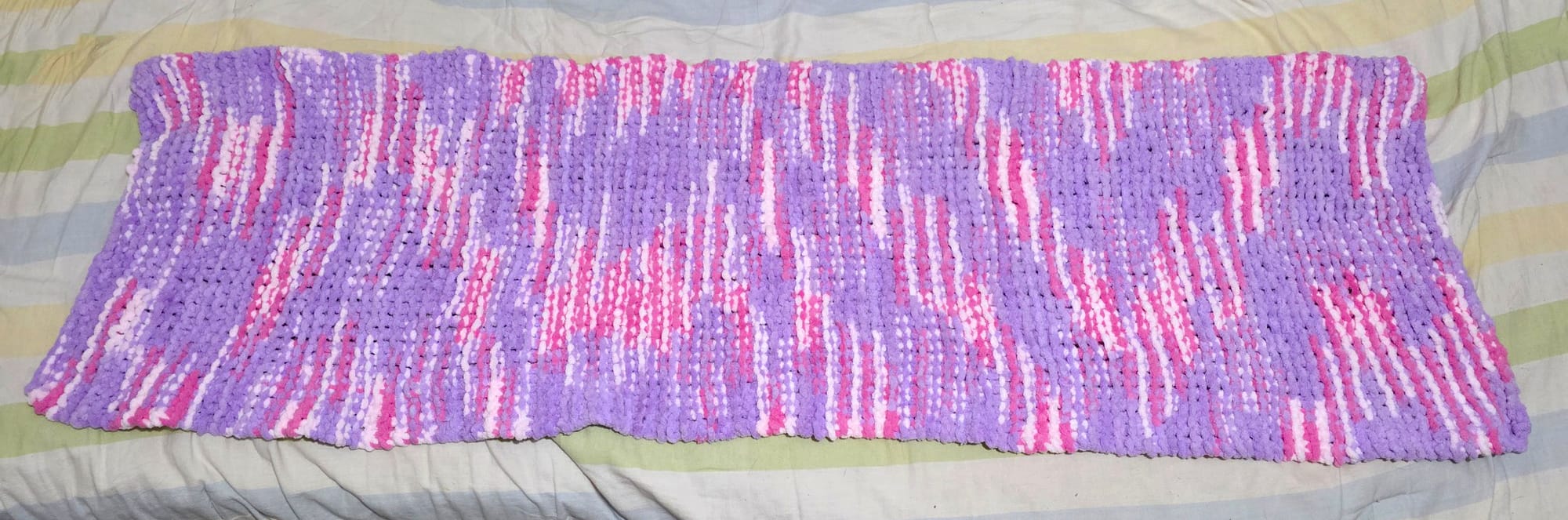
I wanted my therapist to be able to use it in whatever way brought her the most warmth or comfort.
Today, I dropped it off for her as an expression of gratitude.
Her response reminded me that we do not always understand the meaning of what we create once it reaches another person.
She called it beautiful, said she could not wait to wear it when the weather became colder, and thanked me for thinking of her.
Then she added: “It is PERFECT!”
From one perspective, it was yarn transformed through a skill I only recently began learning.
From another, it carried hours of attention, gratitude, experimentation, persistence, and care.
It said:
- I remember what you have done for me.
- Your kindness did not disappear unnoticed.
- I wanted to create something warm for the person who has helped me find warmth within myself.
It created one moment of connection.
It gave me a way to express something that money could not have expressed any better.
And it gave something tangible back to a person who has offered me so much that cannot be held in the hands.
What I could do was limited.
What that limited act communicated was not.
 Jessica Carey
We Cannot Always See How Far a Small Act Travels
Modern society often measures contribution through numbers.
- How much money did it earn?
- How many people did it reach?
- How quickly was it completed?
- How impressive does it look?
- Did it solve something large enough to be noticed?
By those standards, many of the most meaningful things people do may appear insignificant.
A handmade gift may reach only one person.
A thoughtful message may take only a few minutes to write.
A shared resource may never receive public recognition.
A sincere compliment may be forgotten by the person who offered it almost immediately.
But the recipient may carry that moment much longer.
What looks small from the outside can communicate something deeply human:
- I noticed you.
- I remembered you.
- Your effort mattered.
- You are not alone.
- You deserve care, too.
- Something is warmer, gentler, or more hopeful because you are here.
We rarely know what another person has been carrying when our small act reaches them.
A message may arrive on the day someone feels invisible.
A shared resource may provide the missing direction they did not know how to find.
A handmade object may become a reminder that someone thought about them even when they were not in the room.
A genuine expression of gratitude may help a person recognize that work they considered ordinary has changed someone else’s life.
This does not mean every small gesture produces a dramatic transformation.
Kindness does not need an extraordinary outcome to be worthwhile.
The point is that significance cannot always be measured by scale.
A candle does not illuminate the entire world; it changes the space immediately surrounding it.
A stitch is tiny, and repeated carefully, it becomes something capable of holding warmth.
A single act of care may not repair everything that is broken; it can still make one moment safer, softer, or less lonely.
That matters.
The difference we make is not always visible to us.
We may never know which sentence remained with someone, which gesture restored a little faith, or which small offering reminded them that they mattered.
Our influence often continues beyond the moment in ways we cannot track or prove.
Perhaps that is why small acts should not be dismissed simply because they are small.
Their size describes the action.
It does not determine the depth of what someone receives from it.
Begin With What Is Already in Your Hands
When our resources are limited, we may assume that making a difference must wait.
We will contribute when we have more money.
We will create when we have better supplies.
We will help when we have more energy.
We will encourage someone when our own life feels less overwhelming.
Sometimes waiting is necessary; we are not required to give what we do not have, and generosity should not require self-destruction.
But sometimes we already possess something small that can be offered safely.
It may be a developing skill.
A piece of useful information.
A material that has been sitting unused.
A few sincere words.
An introduction between people who could help one another.
A willingness to listen.
A way of noticing beauty or possibility that someone else has forgotten how to see.
The question does not have to be: what enormous thing am I capable of accomplishing?
It can be: what is already within my hands—and what can I do with it without abandoning myself?
A person with limited money might make something from available materials.
Someone with little physical energy might send a message telling another person what they appreciate about them.
Someone without an answer might listen without trying to fix the situation.
A person who cannot provide direct help might share a reliable resource or make a useful connection.
Someone whose own life is overwhelming may simply offer honesty: “I cannot do much right now, but I wanted you to know that I care.”
None of these actions should become obligations.
You do not have to search constantly for new ways to make yourself useful.
You do not owe the world productivity in exchange for your right to rest, receive care, or exist.
Your worth remains intact on the days when you create nothing, help no one, answer no messages, and accomplish only the work of staying alive.
But when you genuinely want to offer something and feel discouraged by what you lack, it may help to ask:
- What do I know how to do?
- What can I offer without worsening my health or circumstances?
- What could be completed gradually?
- Who might feel remembered, encouraged, or less alone because of it?
- What is small enough to be possible now?
The answer does not need to impress anyone.
It only needs to be honest about both your care and your capacity.
We cannot always offer what we wish we could.
But sometimes what is already in our hands is enough to create warmth.
 Jessica Carey
Let the Small Thing Be Enough
I could not give my therapist everything I wished I could give her in gratitude for how much she has helped me.
I could not repay every hour she spent listening, every experience she helped me understand, or every moment when her belief in me helped counter the voices telling me that my needs and limitations were not real.
What I could give her was yarn transformed through time, attention, and care.
I could make something warm.
I could let her know that what she has done for me has not gone unnoticed.
And that was enough to create joy.
My circumstances are still difficult.
Making the gift did not restore my energy, resolve my financial struggles, or remove the larger restrictions shaping my life.
Something meaningful still happened within those restrictions.
That is what I want to remember.
We do not have to wait until we possess unlimited time, money, energy, expertise, or influence before anything we do can matter.
Sometimes the difference available to us is quiet and personal.
One person feels remembered.
One burden becomes slightly lighter.
One useful piece of information reaches the person who needs it.
One handmade object carries warmth into a colder day.
One honest expression of gratitude assures someone that their care made a difference.
These moments may never attract attention; they may not look impressive when measured against everything still left undone.
They are not meaningless because they are incomplete.
At the same time, none of us has to produce kindness constantly in order to prove our value.
There will be days when what remains possible is rest, survival, or receiving from someone else.
A human life is not made worthy by how useful it remains under impossible conditions.
We matter before we give anything.
But when we do have something we want and are able to offer, we should not underestimate it merely because it appears small.
Perhaps we can begin with one gentle question: what can I do with what is already in my hands?
The answer might be a message.
A resource.
A few minutes of listening.
A slowly made gift.
A single stitch.
Small does not mean insignificant.
Sometimes one stitch becomes another, and then another, until what once seemed like almost nothing becomes something capable of holding warmth.
Want even more content about creativity and art?
Be sure to check out all of our creative chronicles!
If you'd like to see examples of my work, you can find some of my art and creations at Redbubble and Gumroad!
Looking to learn more about my recent journey?
Check out some of these articles:
-Hidden Gems for St. Louis Artists
-Hidden Gems for Autistic & Neurodivergent Adults
-Learning What Love Was Supposed to Feel Like
-What Chronic Autistic Burnout Actually Feels Like
-When You Had to Raise Yourself
-Building a Life from What Remains
 Jessica Carey