


Content note: This article discusses late-diagnosed autism and ADHD, chronic burnout, trauma, neglect, disability-related barriers, and the emotional and practical consequences of going unsupported. It includes personal experiences and reflections from other writers. Individual experiences vary, and the article is not intended to suggest that all neurodivergent people experience these difficulties.
The Invisible Years: Growing Up Without Answers
Imagine spending decades of your life struggling with things that seem to come naturally to everyone else.
You work harder, try to adapt, and push yourself to meet expectations, even when doing so leaves you exhausted.
You wonder why certain situations overwhelm you, why you need more time to recover, or why the strategies that work for other people don't seem to work quite the same way for you.
And when you struggle, the explanations you receive aren't always kind.
- You're too sensitive.
- You're overthinking.
- You're not trying hard enough.
- You need to stop making excuses and learn to deal with things like everyone else.
Eventually, you may begin to believe those explanations yourself.
Then, years or even decades later, you discover something that changes the way you understand your entire life: you're autistic, you have ADHD, or perhaps both.
Suddenly, experiences that once seemed disconnected begin to make sense.
But understanding why you struggled doesn't erase what happened while you were struggling.
For many late-diagnosed neurodivergent adults, receiving answers is only one part of a much larger journey.
Years of misunderstood needs, chronic stress, masking, and inadequate support may have already affected their health, relationships, employment, financial stability, and sense of self.
And even after receiving a diagnosis, finding appropriate support can remain extraordinarily difficult.
I was diagnosed with autism at 33, after spending much of my life without understanding my own neurological needs.
My experiences have profoundly shaped how I understand the consequences of being overlooked, but I'm far from alone.
Through my own experiences, the shared reflections of other neurodivergent adults, and emerging research, I want to explore a question that deserves far more attention:
What does it cost someone to spend much of their life without the understanding and support they needed—and what happens when those consequences don't disappear after diagnosis?
The Children Who Were Missed
Growing up, I didn't have the language to explain many of my experiences, let alone understand why certain things affected me so intensely, why I struggled in ways others didn't seem to, or why I could accomplish some incredibly demanding things while finding seemingly ordinary situations extraordinarily difficult.
I learned to adapt because I believed I had to.
And from the outside, there were plenty of reasons people might have assumed I was doing fine.
I earned a bachelor's degree and a master's degree in Art Education.
I worked with children, supported students with different needs, and maintained demanding responsibilities.
At one point, I was juggling multiple jobs and extraordinarily long days for years.
But being able to accomplish something doesn't necessarily mean doing so is sustainable.
Capability and capacity are not the same thing.
Someone can be intelligent, creative, compassionate, hardworking, and accomplished while simultaneously struggling with sensory overload, executive functioning, emotional regulation, or the demands of everyday life.
For many neurodivergent people, these struggles are overlooked precisely because they've become so skilled at compensating for them.
Some learn to mask their differences, suppress their discomfort, imitate social expectations, or push through exhaustion because they don't realize another way of living is possible.
Research has also examined associations between autistic camouflaging and mental health difficulties, highlighting the potential costs of continually hiding or compensating for one's differences.
Others are misunderstood because their experiences don't match familiar stereotypes about autism or ADHD.
And sometimes, the people who most desperately need understanding are the ones who have become exceptionally good at appearing as though they don't need anything at all.
 Jessica Carey
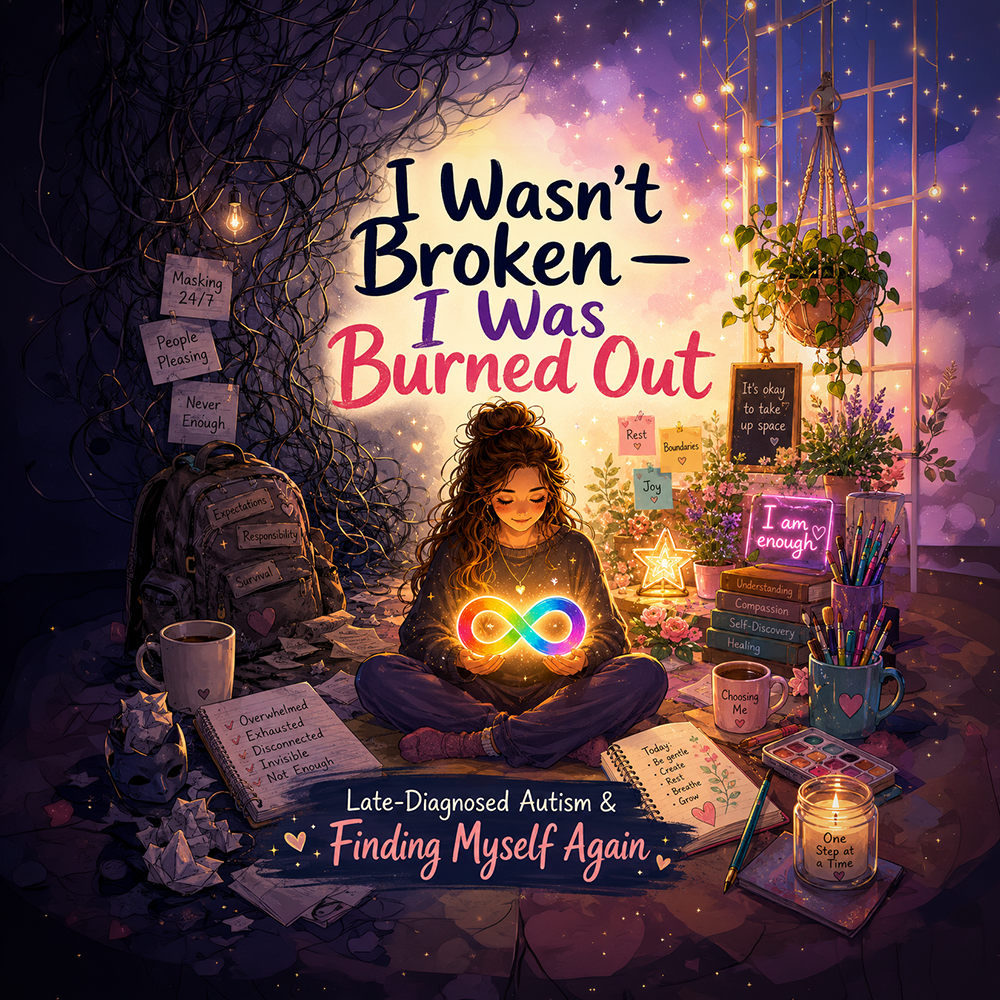
When Survival Becomes Your Normal
One of the most complicated aspects of growing up without understanding your neurodivergence is that you may never realize how much effort you're expending simply to get through the day.
You don't necessarily recognize that you're masking, overcompensating, or repeatedly exceeding your limits; it's just life.
You learn which behaviors are acceptable, which emotions are inconvenient, and which needs are likely to be dismissed.
You may become exceptionally attentive to other people's expectations while gradually losing touch with your own.
For those who also experience childhood trauma, neglect, or unsafe relationships, the situation can become even more complicated.
Neurodivergence and trauma are not the same thing, and autism is not caused by trauma, but their effects can overlap, and the coping strategies someone develops in response to one may become intertwined with the other.
Writer and artist Jamie Bishop, through her publication The Weight of Stillness, has explored this uncertainty in her own life.
In her essay To Some, I Am Simply a Lot, Jamie reflects on revisiting childhood experiences, questioning the relationship between autism and complex trauma, and trying to understand patterns she had lived with for decades.
Her writing illustrates something important: when you've spent much of your life surviving difficult circumstances without answers, untangling the different influences on your behavior and well-being isn't always straightforward.
Jamie describes childhood difficulties with food textures, longstanding anxiety around phone calls, and the distress that unexpected changes can create.
Experiences that might appear insignificant to someone else could be profoundly overwhelming to her, particularly when she lacked the language to explain what was happening.
Her reflections also illustrate how easily genuine difficulties can be interpreted as stubbornness, excessive sensitivity, or personal shortcomings when the underlying needs aren't understood.
A similar theme appears in the writing of Robin E. S. Carter, creator of Starcozi, who explores neurodivergence, slow living, and the pressures of modern life.
In AuDHD: When You Are Both the Storm and the One Trying to Survive It, Robin describes the conflicting demands that can arise when autistic and ADHD traits coexist, including the tension between needing predictability and seeking novelty.
Although our individual experiences differ, these reflections raise a shared concern: how much of someone's life can be spent trying to manage needs they haven't yet learned to recognize or accommodate?
For some, the consequences extend far beyond feeling misunderstood.
Years of chronic stress, unsupported needs, and relentless pressure can affect health, relationships, employment, and everyday functioning.
And sometimes, the full extent of those consequences only becomes apparent when the strategies that once helped someone survive are no longer sustainable.
 Jessica Carey

The Accumulated Cost of Going Unsupported
For many late-diagnosed neurodivergent adults, the consequences of growing up without adequate understanding or support don't simply disappear once childhood ends; they accumulate.
Years of masking, suppressing needs, navigating overwhelming environments, and pushing beyond personal limits can take a significant toll.
What may begin as exhaustion, anxiety, or difficulty keeping up with everyday demands can gradually develop into more serious challenges affecting someone's health, relationships, employment, and independence.
And because these struggles are often invisible, the people experiencing them may receive criticism instead of support.
When Pushing Through Stops Working
For much of my life, I survived by pushing myself harder.
I juggled multiple jobs, worked extraordinarily long days, and continued meeting responsibilities even when I was already exhausted.
At the time, I didn't fully understand how much I was asking of myself—or how unsustainable it had become.
Then, in 2020, I reached a dangerous breaking point.
What followed wasn't simply a period of ordinary exhaustion that could be resolved with a few days of rest.
I began experiencing severe, persistent difficulties with functioning that have continued for years.
Autistic burnout is described in emerging research as a state of profound exhaustion, reduced functioning, and increased sensitivity to stimuli, often associated with prolonged stress and a mismatch between an autistic person's needs and the demands placed upon them.
Although researchers are still working to better understand its causes, duration, and recovery, autistic people's accounts consistently demonstrate that it can be far more debilitating than ordinary tiredness.
For someone experiencing burnout, tasks they once managed may become extraordinarily difficult.
Social interaction, decision-making, errands, household responsibilities, and even basic daily activities can require more energy than they have available.
I often think of it like an aging battery.
A healthy battery can be depleted and recharged repeatedly, but imagine a battery that has been pushed beyond its limits for years.
Eventually, it may no longer hold the charge it once did.
Even when given opportunities to recharge, its capacity remains diminished.
That's one way I describe my experience.
I haven't simply needed a vacation. I've needed a fundamentally different relationship with demands, expectations, and support.
And yet, when someone has a history of being capable, others may struggle to understand why they can no longer do what they once did.
The assumption becomes that they should be able to push through again.
But past performance is not proof of present capacity, and continuing to demand more from someone who is already overwhelmed can deepen the very difficulties they're trying to overcome.
The Ripple Effects on Everyday Life
The consequences of prolonged burnout and unsupported needs rarely remain confined to one area of life.
When someone's ability to work becomes compromised, their financial stability may suffer.
Financial instability can threaten housing, healthcare access, transportation, and other basic necessities.
Those additional pressures can create even more stress, making recovery increasingly difficult.
It's a cycle that can be extraordinarily hard to escape.
In my own life, chronic burnout has significantly affected my ability to maintain employment and support myself financially.
Combined with traumatic experiences and housing instability, this has created challenges that cannot be resolved simply by trying harder or developing a more positive attitude.
And this is one reason I believe discussions of late diagnosis need to go beyond awareness and identity.
We're not only talking about understanding why someone thinks or experiences the world differently.
We're also talking about the potential consequences of spending decades without the accommodations, protections, and support that might have helped them build a sustainable life.
Of course, not every late-diagnosed neurodivergent person experiences severe burnout, trauma, or financial instability.
Individual circumstances vary considerably, and these outcomes cannot be attributed to late diagnosis alone.
But for those who do experience such difficulties, the consequences are real—and they deserve to be taken seriously.
The Emotional Cost of Being Misunderstood
Alongside the practical consequences, there can be an enormous emotional toll.
Imagine spending years believing you're somehow failing at things other people seem to manage effortlessly.
You may internalize criticism, question your own perceptions, or become ashamed of needs you don't understand.
You might feel guilty for requiring rest, frustrated by your limitations, or afraid that asking for help will make others see you as incapable.
For people who have also experienced trauma, these feelings may become even more deeply ingrained.
In her essay Drop the Reins and Get Out of the Swamp, Jamie Bishop reflects on the exhaustion of repeatedly criticizing herself for her limitations and trying to force herself to function differently.
Her experience illustrates how the pressure to meet expectations can become internalized, even when those expectations are incompatible with someone's needs.
The result can be a complicated mixture of exhaustion, grief, anxiety, self-doubt, and difficulty trusting one's own needs, and receiving a diagnosis doesn't automatically make those feelings disappear.
It may provide an explanation, but it doesn't erase years of conditioning, restore lost opportunities, or immediately repair the effects of chronic stress.
When Your Needs Seem to Contradict Each Other
Not every neurodivergent person experiences the world in the same way.
For individuals who are both autistic and have ADHD—sometimes described as AuDHD—even understanding their own needs can be complicated.
In her Starcozi essay, AuDHD: When You Are Both the Storm and the One Trying to Survive It, Robin E. S. Carter explores the sometimes-conflicting needs that can accompany co-occurring autism and ADHD, particularly the tension between craving predictable routines and seeking novelty or stimulation.
Someone may crave predictability and routine while simultaneously needing novelty and stimulation.
They may find change overwhelming but struggle with repetition.
They may desperately need rest while finding it difficult to quiet their thoughts or disengage from activity.
Without understanding these patterns, a person may interpret their difficulties as inconsistency, lack of discipline, or personal failure.
And when other people don't understand what's happening, those judgments can become even more deeply ingrained.
Experiences like these demonstrate why neurodivergent support cannot rely on a single set of assumptions.
Even people who share a diagnosis may have very different—and sometimes competing—needs.
Meaningful understanding begins with listening to the individual rather than expecting their experiences to fit a predetermined description.
When the Answers Finally Come: Relief, Grief, and Relearning Who You Are
Receiving a neurodivergent diagnosis later in life can be a profoundly complicated experience.
For some, it brings an overwhelming sense of relief.
Suddenly, experiences that once seemed confusing or contradictory begin to make sense.
Patterns emerge. Longstanding struggles have explanations.
Things that were once interpreted as personal shortcomings can finally be understood through a different lens.
But alongside that relief, there may also be grief.
Because understanding yourself at 30, 40, 50, or even 70 doesn't change the fact that you spent all those years without that understanding.
And sometimes, the more you learn, the more you begin to recognize just how much you were carrying.
Finally Understanding What Was Never a Personal Failure
When I received my autism diagnosis at 33, it helped me understand experiences I'd struggled to make sense of throughout my life.
Things I had interpreted as personal weaknesses or difficulties I simply needed to overcome began to look different.
I started recognizing how much effort I'd spent adapting to environments that weren't necessarily compatible with my needs, how often I'd pushed myself beyond my limits, and how little understanding I'd received about what was happening.
It didn't mean every difficulty in my life could suddenly be explained by autism because trauma, environmental circumstances, and other factors have also played significant roles.
But it provided an essential piece of a much larger puzzle.
And perhaps one of the most important realizations was that struggling with something doesn't automatically mean you're doing something wrong.
Sometimes, it means the expectations placed upon you don't account for how your mind and body function.
Sometimes, it means you've been trying to meet needs and demands without the tools, accommodations, or understanding necessary to do so sustainably.
And sometimes, what looks like someone failing to keep up is actually someone who has been working extraordinarily hard just to survive.
Different Experiences, Similar Questions
The process of understanding neurodivergence later in life isn't always straightforward, particularly when someone's history also involves trauma.
In The Weight of Stillness, writer and artist Jamie Bishop explores questions surrounding identity, childhood experiences, and the complicated relationship between neurodivergence and trauma.
Her reflections highlight how difficult it can be to distinguish longstanding neurological differences from coping mechanisms developed in response to difficult environments.
For some people, the question isn't simply: "Why am I like this?"
It's also: "Which parts of myself have I never had the opportunity to understand outside of survival?"
These questions don't always have simple answers.
Autism and trauma can coexist, their effects can overlap, and understanding their relationship may require considerable time, reflection, and appropriate professional support.
But having an explanation for one's experiences can still be profoundly meaningful, even when that explanation doesn't resolve every uncertainty.
Grieving the Life That Might Have Been
One of the more painful aspects of late diagnosis is looking back and wondering what might have been different.
- What if someone had recognized the signs earlier?
- What if the adults responsible for supporting you had understood your needs?
- What if you'd been taught how to recognize sensory overload, establish boundaries, manage your energy, or ask for accommodations before reaching a breaking point?
- Would you have developed a healthier relationship with yourself?
- Would certain experiences have been less damaging?
- Might you have avoided some of the exhaustion, shame, or isolation?
There are no definitive answers to these questions.
Earlier identification doesn't guarantee understanding, protection, or appropriate support, and not every difficulty someone experiences can be traced back to being undiagnosed.
But it's reasonable to grieve opportunities for support that were never available.
It's also possible to appreciate the strengths you've developed through difficult experiences while recognizing that you shouldn't have been required to endure those experiences in the first place.
Resilience can emerge from hardship, but hardship is not a prerequisite for becoming strong, compassionate, creative, or capable.
We can recognize what we've gained without pretending that what we've lost doesn't matter.
 Jessica Carey

Learning to Live With Understanding Instead of Survival
For many late-diagnosed adults, discovering their neurodivergence is only the beginning of a much longer process.
After years of adapting to other people's expectations, it can be surprisingly difficult to recognize your own needs.
You may have to learn what genuine rest feels like, which environments are overwhelming, how much social interaction you can comfortably manage, or when you're approaching your limits.
You may need to reconsider beliefs you've carried for decades about productivity, independence, success, and what it means to be a capable person.
And for those whose experiences also involve trauma, rebuilding trust in their own perceptions and boundaries can be especially challenging.
This process isn't necessarily about becoming an entirely different person; it's about developing a more accurate, compassionate understanding of the person you've always been.
For me, creativity has remained an important part of that journey.
Art, writing, and creative exploration offer ways to process experiences, express things that can be difficult to articulate, and reconnect with parts of myself that were overshadowed by years of survival.
But self-understanding, however meaningful, is not a substitute for practical support.
A diagnosis may help someone recognize what they need, yet they can still face enormous barriers to obtaining those accommodations, services, and resources.
And that raises another difficult question: what happens when someone finally receives the answers they've spent a lifetime searching for, only to discover that the systems meant to help them still don't know how to support them?
 Jessica Carey

Diagnosed, But Still Unsupported: When the Systems Meant to Help Become Barriers
Receiving a diagnosis can provide answers to questions someone has carried for decades, but those answers don't necessarily come with a roadmap, meaningful accommodations, or access to the services needed to rebuild their life.
For many late-diagnosed neurodivergent adults, discovering why they've struggled is only the beginning of another difficult journey: trying to find help.
And sometimes, the systems designed to provide that help create additional obstacles.
The Gap Between Recognition and Support
Much of the public conversation surrounding autism and ADHD focuses on identifying these conditions, particularly in children; early recognition matters, but what happens to the adults who were overlooked?
Someone diagnosed later in life may have spent decades without accommodations, developed significant mental or physical health difficulties, or experienced disruptions to employment, relationships, and financial stability.
Yet the availability of appropriate adult services can be limited, fragmented, or difficult to navigate.
In my own experience, receiving an autism diagnosis at 33 helped me understand many longstanding difficulties, but it didn't automatically connect me with the support I needed.
I've spent considerable time researching resources, contacting organizations, completing applications, and trying to explain my circumstances to different service providers.
Despite assistance from professionals familiar with my needs, finding meaningful, accessible support has remained extraordinarily difficult.
And there's something deeply discouraging about finally understanding why you've struggled, only to discover that obtaining help can be another struggle entirely.
When Eligibility Requirements Overlook the People Who Were Missed
One particularly troubling challenge involves programs that require evidence that a disability began during childhood or before a particular age.
Although a childhood diagnosis isn't necessarily required, establishing that history can be difficult for adults whose needs went unrecognized and undocumented.
Someone may have experienced significant developmental differences without ever receiving a formal evaluation, special education services, or an individualized education program (IEP).
Years later, they may be expected to reconstruct a history that no one thought to document at the time.
These challenges can be particularly significant for people who performed well academically, masked their struggles, or grew up in environments where their difficulties were dismissed rather than documented.
The absence of childhood records doesn't necessarily mean the absence of childhood disability.
In my own efforts to access services, I've encountered eligibility requirements involving childhood documentation that I simply don't have.
I wasn't identified as autistic during childhood, so the records that might have helped establish my history were never created.
This creates a frustrating contradiction: people who were overlooked earlier in life may face additional obstacles precisely because they were overlooked.
Of course, different programs have different legal requirements, and documentation rules often serve legitimate eligibility purposes, but systems should also recognize that childhood disability can exist without a formal childhood diagnosis or extensive educational records.
Alternative evidence, developmental histories, and individualized assessments can be particularly important for adults whose needs went unrecognized.
When Asking for Help Requires More Than Someone Can Give
Even when assistance technically exists, accessing it may require enormous amounts of time, energy, organization, and persistence.
Applications can involve complicated paperwork, repeated phone calls, lengthy waiting periods, multiple appointments, and extensive documentation.
For someone experiencing autistic burnout, executive functioning difficulties, sensory overload, trauma-related challenges, or severe exhaustion, these requirements can become significant barriers.
I've repeatedly encountered situations where services expected me to communicate or participate in ways that weren't accessible to me.
For example, written communication is considerably more manageable for me than phone calls, particularly when discussing complicated or stressful matters.
Yet obtaining assistance has sometimes depended on navigating phone-based processes or other requirements that didn't adequately account for my needs; the irony is difficult to ignore.
People seeking assistance because they're struggling to function may be expected to demonstrate extraordinary levels of functioning just to access that assistance.
And when they can't meet those demands, their inability to navigate the process may be mistaken for a lack of effort, motivation, or genuine need.
This isn't simply inconvenient; for someone already facing serious health, financial, or housing challenges, delays and inaccessible processes can have meaningful consequences.
 Jessica Carey

Support Shouldn't Depend on Reaching Another Breaking Point
A diagnosis can help someone understand their needs, but understanding alone doesn't provide stable housing, accessible healthcare, financial security, or the accommodations necessary to participate in everyday life.
Nor should someone have to repeatedly exhaust themselves proving that their difficulties are real.
Meaningful support requires more than identifying a condition.
It requires systems that can recognize different presentations of disability, accommodate different communication and processing needs, and respond to the circumstances of people who were missed earlier in life.
For late-diagnosed adults, that means acknowledging both their current needs and the consequences of years spent without appropriate support.
Because the purpose of assistance shouldn't be to see how many obstacles someone can overcome before receiving help.
It should be to reduce the obstacles preventing them from living safely, sustainably, and with dignity.
Beyond Awareness: What Meaningful Support and Recovery Actually Require
Understanding neurodivergence is an important first step, but awareness alone doesn't prevent burnout, undo years of trauma, or provide the resources someone needs to rebuild their life.
For people diagnosed later in life, meaningful progress often requires more than finally having an explanation for their experiences.
It requires environments, relationships, and support systems that recognize their needs and respond to them appropriately.
And perhaps most importantly, it requires moving beyond the expectation that neurodivergent people must continually adapt to systems that were never designed with them in mind.
Understanding Is Only the Beginning
Earlier recognition of autism and ADHD matters, but so does the support available afterward—especially for adults whose needs were overlooked for decades.
Meaningful assistance requires knowledgeable professionals, individualized assessments, accessible services, and a willingness to listen to people's lived experiences rather than relying on stereotypes or assumptions about what disability should look like.
A person shouldn't have to appear visibly distressed to be taken seriously; they shouldn't have to demonstrate that they're completely incapable of functioning before their support needs are acknowledged.
And they shouldn't be denied understanding simply because they've spent years becoming exceptionally skilled at hiding their struggles.
Meaningful support might involve flexible communication methods, sensory accommodations, additional processing time, help navigating complex systems, accessible healthcare, financial assistance, or adjustments to work and daily responsibilities.
Not everyone needs the same accommodations.
What matters is recognizing that different people require different forms of support to participate safely and sustainably.
Equality doesn't always mean expecting everyone to do things the same way; sometimes, it means removing the barriers that prevent people from having a fair opportunity in the first place.
Recovery Isn't Always About Returning to Who You Were
One of the most difficult expectations surrounding burnout and disability is the assumption that recovery means returning to a previous level of productivity.
But what if that previous level of functioning was never sustainable?
What if someone spent years meeting expectations by sacrificing their health, suppressing their needs, and repeatedly exceeding their capacity?
Returning to those same circumstances may not represent recovery at all.
For someone experiencing prolonged autistic burnout, rebuilding a sustainable life may involve reducing demands, establishing boundaries, accommodating sensory and executive functioning needs, and developing routines that allow for genuine rest.
It may also require practical stability: safe housing, reliable access to healthcare, financial support, and relationships where someone's limitations aren't treated as personal failures.
These aren't luxuries; for many people, they're essential foundations for well-being.
Recovery can look different for everyone, and there isn't a universal timeline or guaranteed outcome.
Some people gradually regain abilities or capacity, while others continue to experience substantial limitations and require ongoing accommodations.
Neither experience makes someone less worthy of dignity, belonging, or support.
For me, part of moving forward has involved reconsidering what a meaningful life looks like when I can no longer rely on the same capacity I once had.
Creativity, writing, learning, and connecting with supportive communities remain deeply important to me.
But so does recognizing that my well-being cannot continually be sacrificed to meet expectations that exceed what I can sustainably manage.
The goal shouldn't be to become better at enduring harmful conditions; it should be to create conditions where enduring harm is no longer necessary.
 Jessica Carey

Building a World Where Fewer People Are Missed
The consequences of late identification aren't solely an individual concern.
Families, educators, healthcare professionals, employers, service providers, and policymakers all have opportunities to improve how neurodivergent people are recognized and supported.
That begins with moving beyond narrow stereotypes and understanding that autism and ADHD can present differently across individuals, ages, genders, and circumstances.
It also means recognizing that academic achievement, professional accomplishments, or an outward appearance of independence don't necessarily reveal how much someone is struggling behind the scenes.
Schools and workplaces can create more accessible environments.
Healthcare providers can listen more carefully to lived experiences.
Assistance programs can offer flexible communication and consider alternative documentation when appropriate.
Communities can create spaces where different needs are accommodated rather than treated as inconveniences.
And perhaps most importantly, we can stop assuming that someone must reach a crisis before their struggles deserve attention.
Earlier recognition matters, but so does what happens afterward.
A diagnosis without understanding, accommodations, or meaningful support can leave someone with answers but few practical ways to address the difficulties those answers help explain.
Real progress requires both.
Being Seen Shouldn't Take a Lifetime
For those of us diagnosed later in life, finally understanding our neurodivergence can be life-changing.
It can help us reinterpret experiences we never understood, recognize needs we were taught to ignore, and begin separating who we are from the judgments and expectations we've carried for years.
But it doesn't give us back the time we lost.
It doesn't automatically repair the effects of chronic stress, restore our health, rebuild financial stability, or erase the consequences of growing up misunderstood.
And it doesn't guarantee that the systems we turn to for help will know how to support us.
My experiences are only one part of a much larger conversation.
The stories shared by other neurodivergent adults remind us that these struggles aren't confined to a single person, family, or circumstance.
Our experiences may differ, but they raise an important question about how many people have spent years struggling unnecessarily because their needs were overlooked, misunderstood, or dismissed.
Being autistic or having ADHD isn't inherently a tragedy.
Neurodivergent people have diverse strengths, challenges, identities, and ways of experiencing the world.
But preventable suffering matters.
The missed opportunities for understanding matter.
The accumulated exhaustion matters.
The people whose lives have been disrupted by unmet needs matter.
And those who are still trying to recover deserve more than being told to keep pushing through.
We cannot change the fact that some people spent decades without the understanding and support they needed, but we can change how we respond to them now.
We can listen without dismissing, accommodate without shaming, recognize limitations without reducing people to those limitations, and build systems that respond to actual needs rather than expecting everyone to fit the same mold.
No one should have to spend a lifetime proving that their struggles are real, and no one should have to reach a breaking point before they're considered worthy of support.
Want even more content about creativity and art?
Be sure to check out all of our creative chronicles!
If you'd like to see examples of my work, you can find some of my art and creations at Redbubble and Gumroad!
Looking to learn more about my recent journey?
Check out some of these articles:
-Hidden Gems for St. Louis Artists
-Hidden Gems for Autistic & Neurodivergent Adults
-Learning What Love Was Supposed to Feel Like
-What Chronic Autistic Burnout Actually Feels Like
-When You Had to Raise Yourself
-Building a Life from What Remains
 Jessica Carey