

Three Conversations at a Time: Finding Creative Connection at a Local Craft Fair
After a long and demanding week, I had planned to spend the day resting.
Then the grandmother of the friend I was staying with invited me, almost at the last minute, to visit a craft & vendor fair with her.
Part of me wanted to remain with the quiet day I had already imagined.
Rest was not an excuse or something I needed to overcome; I genuinely needed it.
At the same time, local craft fairs do not happen every day, and this invitation offered a temporary opportunity to explore one without needing to plan the trip myself.
I decided to go.
When we arrived, there was an enormous amount to take in.
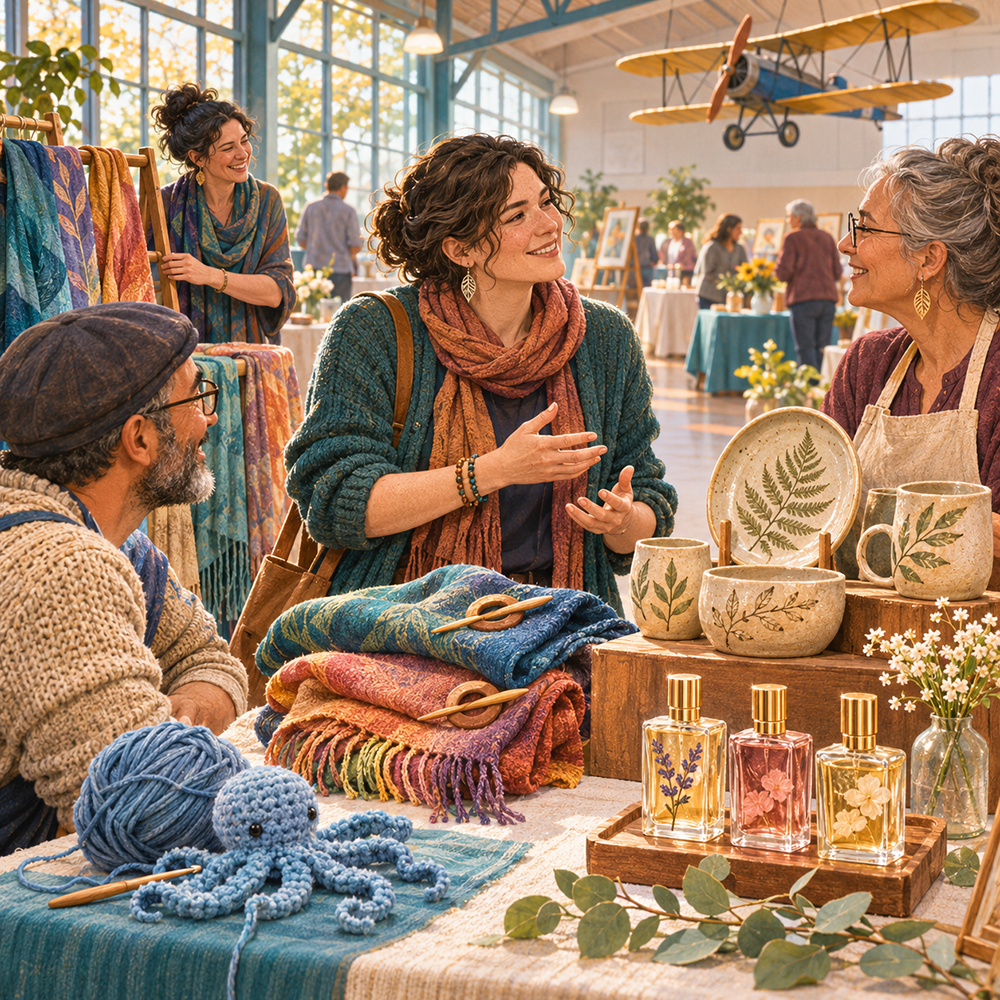
The vendor list contained approximately 100 spaces, with tables offering ceramics, scarves, crochet, skincare, fragrances, jewelry, illustrations, books, woodworking, food, holiday decorations, and many other handmade or independently created products.
Even the building itself was unusual, with full-size airplanes suspended above the recreation center’s lobby.
The fair was visually exciting, but it could also become overwhelming.
Some areas grew crowded enough that moving through them or concentrating on individual tables became difficult.
Rather than forcing myself into the densest parts of the room, I continued through quieter aisles and returned after the crowds had dissipated.
At first, I mostly kept to myself.
I looked at the displays, noticed how different artists presented their work, and tried to absorb the sheer variety of things people had made.
Talking with strangers can require a great deal of effort for me as an autistic person, especially in a busy environment already consuming considerable sensory and social energy.
I was interested in the people behind the tables, but interest did not automatically make approaching them easy.
Gradually, however, a few people opened small doors.
A woman selling handmade lotions, perfumes, and soaps invited me toward her display and shared that she had created them for years before only recently beginning to sell them.
Another vendor showed me how carved wooden pieces could secure and decorate scarves.
A ceramics business with the wonderfully honest name Most Awkward Ceramics made me curious enough to ask where the name came from.
Each conversation made the next one feel slightly more possible.
Before the fair ended, several small conversations had changed what I understood about creative beginnings, connection, and my own ability to participate.
I even found the courage to mention my own book and offer ideas and resources to another new vendor.
I had arrived expecting to look at crafts; I left thinking about the people and processes behind them.
The evening did not transform me into a fearless extrovert.
Crowds were still overwhelming, starting conversations still required effort, and I still needed to approach the experience in a way that respected my own capacity.
But the fair reminded me that social courage does not always arrive fully formed before we enter the room.
Sometimes it begins quietly.
It begins with observing.
With waiting for an aisle to become less crowded.
With accepting someone else’s invitation to come closer.
With asking one sincere question about an unusual business name.
Entering a Room With a Lot to Take In
The scale of the fair became apparent before I had visited even a fraction of the tables.
Approximately 100 vendor spaces filled the building with art, textiles, ceramics, skincare, books, jewelry, woodworking, food, and other independently created products.
Every table introduced another combination of color, material, signage, conversation, and movement.
That variety was exciting, but it also created a substantial amount of sensory and visual information to process at once.
People moved in several directions, conversations overlapped, displays extended into the aisles, and every moment brought decisions about where to look, when to stop, and how to move through the room.
Even when every individual interaction was friendly, the combined environment could become overwhelming.
Some areas were crowded enough that I could not comfortably examine what was being sold.
In the past, I might have believed I had only two options: force myself through the discomfort or conclude that I could not participate at all.
Instead, I used a third option; I moved toward a quieter part of the fair and returned later.
That choice sounds simple, but it represents an important change in how I understand accessibility.
Accommodating myself did not require the event to become completely quiet or uncrowded.
It meant noticing when a particular area exceeded my capacity and allowing myself to approach it differently.
I did not need to prove that I could tolerate every aisle at its busiest.
I did not need to see every table immediately, follow the room in perfect order, or remain in a conversation after my attention had become overloaded.
I could pause, move, observe from a distance, and revisit something when the conditions had changed.
Continuing therefore did not mean pretending that the crowd was comfortable; it meant responding to the discomfort rather than treating it as an instruction to override myself.
At first, observing felt more accessible than interacting.
I could study how vendors arranged their work, what kinds of signs they used, how products were grouped, and which displays naturally drew people closer.
As someone developing my own artistic practice—and beginning to imagine how my work might appear at future fairs—there was value in simply paying attention.
I noticed that the tables communicated before their vendors ever spoke.
As someone developing my own artistic practice—and beginning to imagine how my work might appear at future fairs—I studied how vendors used color, height, lighting, packaging, signs, and product groupings to draw people closer and help visitors understand their work.
I was gathering information even when I was not talking.
That quieter period gave me time to acclimate to the room; the environment did not become less complex, but it became more familiar.
Once I had walked through part of the fair, understood its layout, and allowed my nervous system time to adjust, conversation no longer felt quite as unreachable.
I did not enter the room ready to network.
I entered ready to look—and looking became the first step toward everything that followed.
The First Invitations Came From Other People
My first meaningful conversations at the fair did not begin because I suddenly summoned the confidence to approach strangers.
They began because other people noticed me looking and invited me closer.
One of the first was a woman selling custom lotions, perfumes, soaps, and other scented products.
She welcomed me to her table and explained that she had been making them for years, but selling them publicly was a much newer step.
That distinction stayed with me; the beginning of a creative practice and the beginning of a creative business do not always happen at the same time.
Someone may spend years learning a process, refining recipes, making gifts, or creating privately before deciding to place that work on a table with prices attached.
As we talked, she encouraged me to consider participating in craft fairs myself and to begin putting my work before people.
Her encouragement carried weight because she was not speaking from a distant place where every uncertainty had disappeared.
She was also learning how to place work she had created privately before the public.
Her example suggested that beginning did not require feeling completely established or fearless first.
Another invitation came from a woman selling scarves.
The scarves were displayed with decorative wooden and shell pieces containing two openings.
When she noticed my interest, she showed me how the fabric could be threaded through them to secure and style the scarves.
The brief demonstration changed what I was seeing.
The carved pieces were not merely decorations beside the scarves; they were functional objects whose purpose became clear through the maker’s explanation.
Her table became a small teaching space.
These early exchanges did not require me to introduce myself with a polished pitch or immediately explain everything I create.
Someone else provided the opening; my only task was to accept it, listen, and respond.
That made conversation feel less like a performance and more like curiosity shared between people.
The women behind those first tables may not have realized they were helping me acclimate socially.
They were simply doing what welcoming vendors often do: acknowledging someone nearby, sharing what they had made, and offering information freely.
Yet each interaction lowered the threshold for the next one.
Sometimes courage begins internally, with the decision to approach.
At other times, it begins relationally—with another person making the first movement and communicating, in a hundred small ways: you are welcome to come closer.
The Story Behind Most Awkward Ceramics
One table kept pulling my attention back because of its name: Most Awkward Ceramics.
The display held an assortment of handmade ceramic pieces—small dishes, ornaments, vessels, plant-inspired forms, and objects that embraced irregularity rather than attempting to look mechanically identical.
The name felt unusually honest, but I did not want to assume what it meant.
Eventually, I worked up the courage to ask.
The artist behind the business explained that the name grew from her beginnings in ceramics.
Her earliest attempts felt awkward.
She had tried learning through YouTube, but the process did not click for her through videos alone.
Later, she enrolled in a community-college class, where the opportunity to work with the material directly and receive in-person guidance helped the process begin making sense.
I appreciated that history because creative businesses are often presented through their most polished stage.
Visitors see the finished work, coordinated display, business name, and years of knowledge without seeing the period when the artist’s hands did not yet understand the material.
She had not erased that beginning from her creative identity.
She had incorporated it into the name.
The awkwardness was not evidence that she was incapable of learning ceramics; it was part of how the learning began.
Our conversation moved toward the natural materials she uses to create impressions in clay.
Leaves and other plant forms preserve their veins, edges, and textures when pressed into the surface, allowing something temporary from the natural world to leave a more lasting record in ceramic.
She mentioned that the coming winter would make plant life harder to find; I observed that most of it would disappear for the season, but pine trees would remain.
She paused and became curious.
She had not worked with pine before, but she could.
It was a small exchange, yet it captured what I love about creative conversation.
I had approached her table as someone interested in learning about her process.
A few minutes later, something I noticed had offered another possible direction for that process.
Expertise did not make the conversation one-way; curiosity could move between us.
The discussion expanded beyond ceramics.
The ceramist, her friend, and I talked about neurodivergence, our different backgrounds, learning, and the ways conventional schooling does not always serve every kind of mind.
Her experience with ceramics illustrated that problem clearly; the information technically existed online, but access to information is not the same as access to learning.
A video may work beautifully for one person and fail to provide what another person needs.
Someone else may require physical demonstration, immediate feedback, a shared studio, repeated practice, or the chance to ask questions while their hands are actually working with the material.
When one method fails, people are often tempted to conclude that they lack talent.
Sometimes the problem is not the learner or the medium; it is simply that the instruction has not yet been offered in a form that allows understanding to take root.
The artist behind the business found an environment where ceramics began to click, and she continued practicing until her awkward beginnings developed into a body of work she was willing to place before the public.
That does not mean awkwardness vanished entirely—and perhaps it did not need to.
Handmade ceramics can preserve fingerprints, variations, uneven edges, material surprises, and evidence of the person who shaped them.
What might appear imperfect through an industrial standard can become part of an object’s character.
I approached the table because the name made me curious; I left thinking about how many creative practices begin awkwardly—and how different our lives might become if we treated that stage as a beginning rather than a verdict.
Courage Became Easier With Practice
After several people had invited me into conversation, initiating one myself began to feel slightly more possible.
The change was not dramatic.
I did not suddenly become socially fearless or begin approaching every table; I simply felt a little less frozen than I had when I entered.
At a crochet table, I noticed the artist working with blue yarn; instead of observing silently and walking away, I asked what she was making.
It was a blue octopus she was making especially for her son.
The question opened a conversation about crochet and the experience she had developed over approximately 20 years.
Looking at finished crocheted objects, it is easy to imagine that their patterns must be overwhelmingly complicated.
She explained that much of the process comes down to counting.
That did not mean crochet required no knowledge or skill; twenty years of experience cannot be reduced to a single instruction.
Yet her explanation made the complexity feel more understandable.
The finished object may appear intricate, but it is created through a sequence of smaller actions: one stitch, one count, one repeated pattern, and one section at a time.
The thought applied surprisingly well to the social experience I was having.
“Talk to strangers at a networking event” can feel like one enormous and inaccessible assignment.
“Ask one person what she is making” is smaller and more concrete.
I did not need to know where the conversation would lead before asking the question; I only needed enough courage for its first sentence.
Later, I encountered an author selling a book about love and communication styles.
The subject immediately connected with the themes I had been researching and writing about, but mentioning my own book still felt vulnerable.
There can be a strange difference between privately knowing that I have written a book and introducing myself to another person as an author.
The book exists either way, but speaking about it requires allowing someone else to recognize that part of me.
I found the courage to bring up Learning What Love Was Supposed to Feel Like, my book about healthy relationships, love, safety, boundaries, reciprocity, and the difference between connection and control.
As we talked, I learned that she was also a therapist.
I had not approached her with a rehearsed sales pitch or an attempt to prove that our books were comparable.
The conversation grew from a genuine overlap in subject matter; her work gave me a natural reason to share mine.
That distinction mattered.
Talking about my book did not have to mean forcing it into every interaction; it could arise when the conversation already contained an authentic connection.
Each exchange made the next one a little less unfamiliar.
I was learning the social environment in much the same way someone learns a creative process: not by mastering the entire experience at once, but through a series of manageable attempts.
A crocheted octopus begins with one counted stitch, and a conversation begins with one sincere question.
 Jessica Carey

From Receiving Encouragement to Offering It
Another fragrance table led to a conversation that revealed how much my role had changed over the course of the fair.
The woman behind it shared that this was her first day publicly selling her products.
Earlier, I had met someone who had created lotions, perfumes, and soaps for years before recently beginning to sell them.
Now I was meeting someone at the very beginning of that transition.
This time, I was not only receiving encouragement.
As we talked, I shared a few ideas and resources she might explore.
I mentioned that local libraries sometimes offer small-business classes, databases, events, and other resources that new makers may not realize are available.
I could not know which opportunities would fit her particular business, but I could offer another place to look and another question to ask.
That exchange helped me recognize that I had brought something valuable into the room even though I was not participating as a vendor.
Over the past several months, I had spent considerable time researching creative resources, attending a small-business and nonprofit conference, exploring artist opportunities, and learning how local organizations can support makers.
 Jessica Carey

Much of that knowledge developed because I was trying to find help for my own creative practice and future community work.
At the fragrance table, some of what I had learned became useful to someone else.
Earlier in the fair, a vendor had encouraged me to put myself out there and consider participating in events like this one.
Later, I found myself encouraging another new seller and pointing toward possibilities she might not have encountered yet.
The relationship between visitor and vendor was not as one-directional as it first appeared.
She had products and experience I could learn about.
I had research, questions, and connections I could share.
Neither of us needed to possess every answer for the conversation to become valuable.
That reciprocity is part of what genuine creative community can offer.
 Jessica Carey
Networking is often described as though every person enters a room primarily to determine who can advance their goals.
This conversation did not feel like that; it felt like two people talking honestly about a new beginning and exchanging whatever knowledge each happened to have available.
By the end of the evening, I had moved from wondering whether I could enter conversations with vendors to recognizing that I could contribute something to them.
I did not need my own booth before I was allowed to belong in the exchange.
Sometimes experience becomes valuable long before we feel established enough to call ourselves experts.
Sometimes the resource we found while trying to solve our own problem becomes the breadcrumb someone else needs.
And sometimes courage is not only finding the confidence to speak; it is realizing that when we do, we may have something worth offering.
 Jessica Carey
Networking Does Not Have to Mean Performing
One of the ideas I encountered through Artist INC came from an artist and author who identifies as an introvert.
At social gatherings and professional events, she gave herself one concrete goal: speak with three people.
After those three conversations, she had permission to become a wallflower, spend the rest of the event quietly observing, or leave altogether.
She did not require herself to work the entire room, collect the maximum number of contacts, or remain socially engaged until the event ended.
The simplicity of that practice stayed with me.
It turns an abstract demand—network—into something finite: one person, one conversation, and then another.
Just as importantly, it includes permission to stop.
Three conversations are not a price someone must pay to earn a place in the room; they are a compassionate structure that can make participation more accessible.
At the craft fair, I eventually spoke with more than three people; that does not mean the rule should now become six, eight, or ten.
The point was never to keep moving the finish line each time I exceeded it.
Three conversations offered a doorway; once the pressure became finite, curiosity sometimes carried me farther.
This approach felt especially relevant as an autistic introvert.
Social interaction is not difficult only because I may not know what to say.
A conversation also involves processing speech, reading context, deciding when to respond, shifting attention, tolerating uncertainty, and managing the surrounding sensory environment.
A crowded fair adds even more layers.
Having a small, concrete goal does not remove those demands, but it reduces the additional pressure of believing I must become socially limitless before the event counts as a success.
The conversations themselves also challenged some of what I associated with networking.
I did not walk from table to table reciting a memorized introduction or distributing business cards to everyone I encountered.
I asked why a ceramics business had an unusual name.
I asked a crochet artist what she was making.
I listened to people explain how they began.
I mentioned my book when its subject genuinely connected with another author’s work.
I shared resources when they seemed potentially useful.
Those interactions were not strategically optimized, but they were real.
Networking, at its healthiest, may be less about performing importance and more about becoming willing to participate in an exchange:
- Notice what someone has made.
- Ask a sincere question.
- Listen to the answer.
- Share something relevant when it naturally belongs.
- Allow the interaction to be worthwhile even if it produces no immediate opportunity.
Not every conversation needs to become a collaboration, sale, referral, friendship, or permanent contact.
Sometimes its value is the knowledge exchanged within those few minutes.
Sometimes it makes the next conversation less intimidating.
Sometimes it simply reminds two people that creative work is made by human beings with beginnings, uncertainties, and stories.
Three conversations were not the price I had to pay before I was allowed to retreat.
They were a compassionate structure that made entering the room feel more possible.
Once I entered, I discovered that networking did not require becoming someone else; it could begin with the person I already was: observant, curious, thoughtful, and willing to ask one honest question at a time.
What the Makers Behind the Tables Taught Me
From the aisle, a vendor table can look like the finished stage of a creative journey.
Products are arranged, prices have been chosen, signs identify the business, and the artist stands behind enough work to fill an entire display.
What visitors cannot immediately see are the experiments, classes, uncertainties, mistakes, and private years that came first.
My conversations revealed several of those hidden histories.
No two makers had followed exactly the same path.
One had created privately for years before beginning to sell.
Another was experiencing her first day as a vendor.
One needed in-person instruction before a medium finally clicked, while another had accumulated approximately 20 years of practice.
Every table represented more than a product category; it contained accumulated knowledge.
Those stories made participating in a future craft fair feel more imaginable.
Vendors were not a separate category of people born knowing how to price, display, explain, and sell their work.
They were makers who had eventually taken another step—gathering what they had created, arranging it on a table, and allowing strangers to encounter it.
That step still requires substantial labor.
Participating in a craft fair involves more than making enough products; it can include application fees, inventory, pricing, packaging, transportation, table design, payment systems, signage, customer interaction, and hours spent in a stimulating public environment.
For a disabled or neurodivergent artist, those demands may require additional planning, accommodation, assistance, or recovery.
The evening did not convince me that I should immediately commit to the next available fair without considering those realities; it made the possibility feel less abstract.
I could begin by observing what worked.
I could think about which parts of my practice might translate well to a table, what amount of inventory would be realistic, whether sharing a booth could help, and what support I would need to participate without exceeding my capacity.
A first display may change.
Prices may need adjustment.
Some products may receive an unexpected response, and conversations may reveal possibilities that could not have been predicted in the studio.
Every polished table was preceded by something less certain: an awkward piece, an unfamiliar process, a lesson that did not click, a counted stitch, a private experiment, or a first day of selling.
Seeing those beginnings hidden within the finished work made my own next beginning feel a little less impossible.
Accepting an Invitation Without Glorifying Overextension
It would be easy to turn the evening into a simple lesson about always saying yes.
I had planned to rest, accepted an unexpected invitation, and discovered meaningful conversations and possibilities I could not have predicted.
From the outside, that sequence could sound like evidence that leaving the house was the courageous choice and resting would have meant missing an opportunity.
But that is not the lesson I want to take from it.
I genuinely needed rest.
After a demanding week, my energy was limited, and chronic autistic burnout means that seemingly ordinary activities can carry consequences other people do not see.
 Jessica Carey

Attending one event can require sensory processing, social effort, decision-making, travel, transitions, and recovery long after the event itself has ended.
Staying home would not have been laziness, fear, or failure.
A meaningful opportunity does not automatically become an accessible one simply because it is temporary.
You never know what might happen can inspire curiosity, but it should not become another reason to distrust legitimate limits.
This time, I felt that I had enough capacity to try.
Trying did not require engaging at the highest possible intensity.
I could attend without seeing every table, speaking with every vendor, or remaining in the most crowded areas.
I could move elsewhere when an aisle became overwhelming, return when it was quieter, spend time observing, and allow conversations to develop gradually.
Those choices were part of what made the experience possible.
There is an important difference between expanding a comfort zone and abandoning the needs that make participation sustainable.
Growth does not have to mean overriding every warning from the nervous system.
Sometimes it means finding a slightly wider way to participate while retaining the right to pause, adapt, or stop.
I do not want to romanticize pushing through exhaustion.
Much of my chronic burnout developed because I spent years being expected to function beyond my limits, meet other people’s definitions of what I should be able to do, and treat the consequences as personal weakness.
A healthy opportunity should not require repeating that pattern.
The craft fair was worthwhile not because I proved that I could ignore my need for rest.
It was worthwhile because I made a choice based on the capacity I had that day and continued adjusting the experience as I moved through it.
Courage and rest are not opposites.
Courage may look like accepting an unexpected invitation; it may also look like honoring a limit before the body is forced to enforce it more severely.
The wisest choice is not always the one that creates the most visible story.
This time, saying yes opened a door; what mattered was that I entered without surrendering the right to care for myself once I was inside.
 Jessica Carey
One Question at a Time
The evening did not unfold the way I expected.
I had planned to spend the day recovering from a long week.
When I accepted a spontaneous invitation to the craft fair, I imagined that I would mostly walk through the room, look at what people had made, and quietly return home.
That would have been a worthwhile experience on its own.
Instead, I encountered stories hidden behind finished objects, learned how many forms a creative beginning can take, and discovered that the knowledge I had gathered through my own searching could be useful to someone else.
None of those exchanges required me to become the loudest, most confident, or most socially effortless person in the room.
They required smaller things.
Looking closely.
Remaining curious.
Accepting an invitation when someone welcomed me toward a table.
Allowing enough silence to listen to the answer.
Finding one sincere question when I was ready to begin a conversation myself.
The Artist INC three-conversation practice gave me a manageable structure, but the evening’s meaning did not come from reaching a particular number.
It came from discovering that social participation could grow gradually.
I could begin as an observer, warm to the environment, respond to people who approached me, and eventually take a few steps toward others.
That is a very different story from suddenly overcoming autism or becoming fearless.
Crowds were still overwhelming.
Conversation still required effort. I still needed time to process the environment, wait for certain areas to become quieter, and decide carefully where to place my limited energy.
I simply left with more evidence that connection does not always require becoming someone else first.
Perhaps courage is often less dramatic than we imagine.
Sometimes courage looks like entering the room.
Sometimes it looks like moving away from an overwhelming aisle and returning later.
Sometimes it looks like admitting that the finished work on someone’s table makes us curious.
Sometimes it looks like saying: “I wrote a book, too.”
Sometimes it looks like offering another person one useful resource we happened to discover while finding our own way.
And sometimes an entire evening opens from one honest question: what are you working on?
Want even more content about creativity and art?
Be sure to check out all of our creative chronicles!
If you'd like to see examples of my work, you can find some of my art and creations at Redbubble and Gumroad!
Looking to learn more about my recent journey?
Check out some of these articles:
-Hidden Gems for St. Louis Artists
-Hidden Gems for Autistic & Neurodivergent Adults
-Learning What Love Was Supposed to Feel Like
-I Wasn't Broken--I'm Burned Out
-Building a Life from What Remains
 Jessica Carey