
There are things we understand as necessities.
Food.
Housing.
Healthcare.
Transportation.
Safety.
Things that keep us alive, sheltered, functioning, and able to meet the demands of everyday life.
And then there are the things we tend to put in another category.
Art supplies.
Yarn.
Books.
Music.
Classes.
Creative hobbies.
Things we make simply because we want to make them.
When money gets tight, these are often among the first things we're expected to cut.
You don't really need that.
And technically?
Maybe we don't.
You can survive without a sketchbook.
You can survive without knitting.
You can survive without painting, pottery, music, photography, collage, or whatever form creativity takes for you.
But I've started wondering whether “I can survive without this” and “this is unnecessary” are actually the same statement.
When Everything Important Comes First
The same thing happens with time and energy.
Do the work.
Answer the emails.
Go to the appointments.
Buy the groceries.
Clean.
Cook.
Pay the bills.
Solve the problem.
Handle the responsibility.
Recover enough to handle the next responsibility.
And then, if anything remains: maybe I'll make something.
Creativity gets pushed toward the bottom because there is almost always something more important we could be doing.
Sometimes that's unavoidable.
There are periods when survival really does have to take priority.
If someone is trying to keep a roof over their head, telling them to simply prioritize their creative practice would be wildly disconnected from reality.
But there's another problem hiding inside: what happens when everything else is never finished?
There's always another chore.
Another expense.
Another problem.
Another obligation.
Another thing we could justify doing before something creative.
If creativity is what we're allowed to have only after every practical need has been satisfied, some of us may spend a very long time waiting.
For Me, Creativity Isn't Just Entertainment
This question feels particularly personal to me as a neurodivergent person.
Creativity can certainly be fun.
I love making things.
Experimenting with materials.
Discovering what something can become.
Learning new techniques.
Following an idea simply because I'm curious about where it might lead.
But making can also do something else for me.
It can help me settle.
Regulate.
Focus.
Process.
Self-soothe.
Sometimes repetitive creative processes can give my mind and body something steady to hold onto.
Sometimes working with my hands gives all the activity inside me somewhere to go.
Sometimes making something gives me a way to process an experience that I can't neatly think or talk my way through.
Sometimes it simply creates a small pocket of life in which I'm not solving a problem.
I'm making.
And that distinction matters.
For some neurodivergent people, creative activities can similarly become part of how they regulate, express themselves, engage with sensory experiences, or process the world.
That won't be true for everyone, and what feels regulating to one person may be frustrating or overwhelming to another.
But I think that variation actually strengthens the larger point.
Something doesn't have to serve everybody in the same way to matter deeply to the people it does serve.
“Not Necessary for Survival” Isn't the Same as “Unnecessary”
None of this means creativity should compete with food, housing, healthcare, or safety.
There are genuine hierarchies of urgency, and pretending otherwise doesn't help anyone.
But perhaps we've made an unnecessary leap from: this isn't required to keep a human body alive to: therefore, this doesn't really matter.
Creativity doesn't have to outrank our basic needs before we're allowed to recognize that it can meet needs of a different kind.
So perhaps the better question isn't: can I survive without creativity?
But: what happens to a life when creativity continually disappears from it?
We Confuse “Luxury” With “Not Required for Survival”
There are things we cannot reasonably do without:
- Food
- Water
- Shelter
- Safety
- Healthcare
Our need for them isn't philosophical.
Without them, people suffer.
Without enough of them, people can die.
So when resources are limited, of course some things have to take priority.
The problem isn't recognizing that hierarchy.
The problem is what sometimes happens to everything underneath it.
We start dividing life into two categories:vnecessary and luxury.
And that's an awfully large distance to cover with only two words.
Less Urgent Doesn't Mean Meaningless
Suppose someone has $20 left and needs groceries.
Buying groceries instead of paint isn't evidence that art doesn't matter.
It means food is more urgent right now.
Those are different conclusions.
Something can matter enormously and still lose to a more immediate need.
We understand this in plenty of other situations.
Sleep matters, but sometimes an emergency keeps us awake.
Relationships matter, but sometimes work demands our attention.
Rest matters, but sometimes something genuinely has to be finished.
Temporarily placing one need behind another doesn't prove the first was never important.
And yet creativity can be treated differently.
Once it loses the competition for urgency, it can get demoted all the way to: well, you don't need it.
But perhaps the better description is: I need something else more urgently right now.
That leaves room for creativity to still matter.
Human Needs Aren't All the Same Kind of Need
The word need gets tricky because we use it to mean different things.
There are things a body requires to remain alive.
But there are also things people may need to function well.
To feel connected.
To regulate.
To rest.
To communicate.
To experience autonomy.
To maintain relationships.
To have some sense of identity and meaning.
Those categories overlap, and they're not identical for every person.
I'm not interested in arguing that a tube of paint is equivalent to a meal.
It isn't.
But perhaps that's the wrong comparison in the first place.
Creativity doesn't have to prove that it belongs in the same category as food before it can belong somewhere other than “frivolous.”
There is a lot of human life between: I will die without this and this has no meaningful value.
Creativity can live there.
“Optional” Can Become a Dangerous Word
Calling something optional sounds neutral.
Sometimes it is.
But when resources are scarce, optional things tend to be the things that disappear.
And if scarcity lasts long enough, they may stay gone.
No art supplies.
No class.
No hobby.
No trip to the museum.
No time spent making because there's always something more practical to do.
Again, sometimes those choices are unavoidable.
The concern isn't: people should spend money they don't have on hobbies.
It's what happens when we begin treating the absence itself as though it doesn't cost anything.
Because something can be financially optional while still having a meaningful role in someone's life.
The $5 material isn't only $5 worth of material if using it gives someone an evening of pleasure.
The free library workshop isn't only an unnecessary activity if it's also someone's opportunity for connection.
The knitting isn't only yarn becoming fabric if the repetitive process helps someone settle after an overwhelming day.
The sketchbook isn't only paper if it's where someone puts thoughts they can't express another way.
The object and the function aren't always the same thing.
A Life Can Become Very Efficient and Very Empty
If we follow the survival-only definition far enough, an enormous amount of human life becomes unnecessary.
Music isn't necessary.
Stories aren't necessary.
Decorating isn't necessary.
Games aren't necessary.
Hobbies aren't necessary.
Celebrations aren't necessary.
Making something beautiful instead of merely functional isn't necessary.
Neither is spending an afternoon learning how to make something you could have bought much more efficiently.
From a strictly survival-oriented perspective, that's true.
But most of us probably wouldn't look at a life stripped of all play, beauty, curiosity, expression, connection, and personally meaningful activity and think: perfect, nothing important is missing.
We know intuitively that keeping a person alive and giving that person opportunities to have a life aren't precisely the same project.
And creativity can be part of that second project.
The “Extra” May Be Doing More Than We Realize
This becomes especially important when someone has very little.
If a person's life already contains enormous amounts of obligation, uncertainty, stress, or restriction, the supposedly extra thing may be one of relatively few places where they experience:
- Choice
- Pleasure
- Curiosity
- Control
- Expression
- Something that simply belongs to them
Removing it doesn't necessarily create a neutral blank space.
Something may actually be lost.
That's why I think we should be cautious about judging importance only by asking: what happens if I don't have this? Will I survive?
Sometimes a better question is: what does having this make possible?
Maybe creativity makes play possible.
Or expression.
Regulation.
Connection.
Experimentation.
A sense of accomplishment.
A moment of quiet.
A way of imagining something different from what already exists.
Not every creative activity will provide all of those things.
Not every person needs creativity in the same way.
But when it does provide something important, calling the activity a luxury because a person can technically survive without it misses much of what's actually happening.
It Doesn't Have to Be the Most Important Thing to Be Important
Maybe that's the distinction we need.
Creativity doesn't have to come before housing.
It doesn't have to come before food.
It doesn't have to come before safety or healthcare.
It doesn't have to win some imaginary competition against every other human need before we're permitted to care about it.
Sometimes it will come second.
Or fifth.
Sometimes circumstances will push it almost completely out of someone's life for a while.
But: less urgent isn't the same as unnecessary.
Optional in one sense isn't meaningless in every sense.
And something doesn't have to keep us alive before it can help make being alive more livable.
Creativity doesn't need to be the most important thing in a human life.
It only needs room to be recognized as one of the things that can matter.
Sometimes Creativity Is Regulation
Sometimes I make something because I want the thing.
I want the painting.
The knitted piece.
The jewelry.
The finished project I can hold in my hands and say:
I made this.
But sometimes the finished object isn't really the point.
Sometimes I need to make.
As a neurodivergent person, I've come to understand that creativity can do far more for me than fill spare time.
It can help me regulate.
Settle.
Focus.
Process.
Self-soothe.
Reconnect with myself when everything feels like too much.
That doesn't make creativity a cure.
It doesn't mean every creative activity is regulating.
And it certainly doesn't mean every neurodivergent person experiences creativity the way I do.
But it does mean that when someone looks at creative activity and sees only an optional hobby, they may be seeing only the part that's visible from the outside.
The Hands Can Have Somewhere to Go
There are creative processes built around repetition.
Knit.
Purl.
Knit.
Purl.
One stitch becomes a row.
One row becomes another.
Something gradually grows beneath your hands.
Other processes have their own rhythms.
Rolling clay.
Stringing beads.
Folding paper.
Cutting shapes.
Making marks.
Wrapping wire.
Repeating a pattern.
Sorting colors.
Working a material again and again.
For some people, that repetition can feel grounding.
The activity gives the hands something to do and the mind something concrete to return to.
There is a next stitch.
A next mark.
A next piece.
A small, understandable action inside a world that may otherwise feel overwhelmingly complicated.
And sometimes that's exactly what I need.
Making Can Narrow an Overwhelming World
Creative work can also change what I'm paying attention to.
Instead of everything at once, there is:
- What color goes here?
- Where does this piece fit?
- What happens if I bend this?
- How do I fix that?
- What should I try next?
Those are small questions.
Manageable questions.
Questions I can actually answer.
Sometimes creative concentration gives all the noise somewhere to funnel.
Not necessarily because everything difficult disappears.
It doesn't.
But for a while, my attention has somewhere else to live.
There's a material in front of me.
A process.
A decision.
A problem that might actually have an answer.
Creativity Can Give Us Choice
This matters, too.
Much of adult life isn't particularly interested in what we feel like doing.
Bills still need to be paid.
Appointments still happen.
Responsibilities still exist.
Bodies have needs.
Other people need things.
Systems have requirements.
There are forms to complete and messages to answer and tasks that cannot simply be wished away.
Creativity can offer something very different: what do I want this to become?
I choose the color.
The material.
The texture.
The shape.
I can follow the instructions.
Change the instructions.
Abandon the instructions entirely.
I can make something useful.
Something beautiful.
Something strange.
Something nobody else understands.
Something that exists simply because I wanted to see what would happen.
That sense of agency may look small from the outside.
But when much of life is governed by things we have to do, having a space organized around: what do I want to do? can matter enormously.
 Jessica Carey
Some Things Are Easier to Make Than Explain
Creativity can also give internal experiences somewhere to go.
Not everything we experience arrives conveniently formatted as language.
Sometimes we don't have the words yet.
Sometimes the words feel inadequate.
Sometimes explaining requires more capacity than we have.
But perhaps there is a color.
A texture.
An image.
A movement.
A shape.
A collection of objects.
A repeated stitch.
A piece of writing that doesn't need to explain everything literally.
Creative expression doesn't always mean intentionally making art about our feelings.
Sometimes the process itself creates room for those feelings to exist.
Sometimes we understand something while making.
Sometimes we don't understand anything more clearly afterward—but we've had somewhere to put our attention while moving through it.
Both can matter.
Regulation Doesn't Always Look Like Rest
I think this is another reason creativity can be misunderstood.
From the outside, making can look like more activity:
- Why would someone who's overwhelmed start an art project?
- Why would someone who's exhausted knit?
- Why spend limited energy arranging tiny pieces of something?
- Wouldn't it be better to simply rest?
Sometimes, yes.
Sometimes the body needs actual rest.
Creativity isn't a substitute for sleep, recovery, food, safety, medical care, or whatever else someone genuinely needs.
And sometimes a creative project can become frustrating, overstimulating, demanding, or exhausting rather than regulating.
But rest isn't always synonymous with doing absolutely nothing.
Sometimes repetitive movement is restful.
Sometimes focused attention is restful.
Sometimes doing something chosen feels different from completing another obligation.
Sometimes our brains settle more easily when they have something interesting but manageable to engage with.
That's one reason the question: why are you doing that if you're already tired? may miss what the activity is actually doing.
Maybe the making isn't competing with regulation.
Maybe the making is part of it.
The Same Activity Can Work Differently for Different People
None of this gives us a universal prescription.
One person finds knitting deeply calming.
Another finds dropped stitches infuriating.
Someone loves the tactile experience of clay.
Someone else can't tolerate having it on their hands.
One person settles into detailed repetitive work.
Another becomes restless and needs something larger, faster, or more physical.
Someone wants familiar materials when overwhelmed.
Someone else needs novelty.
And even the same person may respond differently on different days.
That's important.
Saying creativity can be regulating isn't the same as saying creativity is inherently regulating.
The value is partly in discovering what works for the individual:
- What materials feel good?
- What processes provide the right amount of stimulation?
- What activities ask enough of your attention without asking too much?
- What can you pick up when you need somewhere to go?
- What can you put down when you've had enough?
Sometimes finding a creative practice is also finding another way of understanding what your own mind and body respond to.
Sometimes the Artwork Is the Byproduct
And this brings me back to the way we judge creative activities.
From the outside, someone may see:
- a scarf
- a sketch
- a handful of beads
- a collage
- a little sculpture
- something decorative
- something unnecessary
- something that could have been purchased more efficiently—or perhaps something nobody needed in the first place
But the object doesn't necessarily tell you everything that happened.
Maybe those stitches helped someone settle after an overwhelming day.
Maybe the drawing gave an anxious mind somewhere to focus.
Maybe working with clay provided sensory input someone needed.
Maybe making the collage helped someone process something they couldn't articulate.
Maybe experimenting with materials provided an hour of curiosity in a week otherwise dominated by obligation.
The object is what remains afterward.
But sometimes the artwork is almost a byproduct. The thing we actually needed was the making.
And when creativity serves that kind of role, calling it a luxury starts to feel especially inadequate.
Because perhaps we're not talking only about something a person enjoys doing when they have spare time.
Sometimes we're talking about one of the ways a person has learned to come back to themselves.
What Disappears When Creativity Is Always the First Thing Cut?
When life becomes difficult, something has to give.
There are only so many hours.
So much money.
So much energy.
So much attention.
And creativity can be remarkably easy to sacrifice.
Skip the class.
Don't buy the supplies.
Put the project away.
Use the afternoon for something productive.
You'll get back to it later.
Sometimes that's simply reality.
There are moments when the urgent thing really does need whatever resources we have.
But if creativity is always the first thing we cut, it's worth asking: what are we actually removing?
Because it may be more than an activity.
We Lose Play
Adults don't get many invitations to play.
We're encouraged to be productive.
Efficient.
Responsible.
Useful.
Even hobbies can acquire expectations remarkably quickly:
- Can you sell it?
- Can you monetize it?
- Can you post it?
- Can you become good at it?
- Can it improve you somehow?
- Can it accomplish something?
Creativity can offer something wonderfully different: what if I do this because I want to see what happens?
No business plan.
No measurable outcome.
No justification.
Maybe the result is useful.
Maybe it's beautiful.
Maybe it's an inexplicable little creature made from scraps that nobody on Earth needed.
It still gave someone permission to play.
And play doesn't become worthless simply because adulthood has fewer socially acceptable places for it.
We Lose Curiosity
Creativity asks questions:
- What happens if these colors mix?
- Could I make this material do something it wasn't intended to do?
- What if I change the pattern?
- Can I turn this into that?
- What else could this become?
Curiosity shifts us temporarily away from:
- What is wrong?
- What needs fixing?
- What am I supposed to do?
Toward: I wonder...
That's a small linguistic shift with an enormous amount of possibility inside it.
We don't know the outcome yet.
We're exploring rather than managing.
And if every available resource has to be justified by necessity, experimentation becomes difficult to defend.
Curiosity rarely knows in advance whether it will produce something useful.
That's part of what makes it curiosity.
 Jessica Carey
We Can Lose Pieces of Identity
There's also a difference between: I make things and I used to make things.
Sometimes creative practices disappear temporarily.
Life changes.
Capacity changes.
Interests change.
There's nothing inherently wrong with that.
But sometimes people aren't choosing to leave creativity behind.
It's simply being crowded out.
Again.
And again.
And again.
Until something that once felt like part of them becomes something they vaguely remember doing:
- I used to draw.
- I used to write.
- I used to play music.
- I used to sew.
- I used to make things all the time.
There can be real grief inside used to.
Because creativity isn't always merely something we do.
Sometimes it becomes part of how we recognize ourselves.
 Jessica Carey
We Lose Things to Look Forward To
Not everything meaningful has to be profound.
Sometimes there's yarn waiting for you.
A class on Saturday.
A project sitting half-finished on the table.
A new material you haven't tried yet.
An idea you want to test.
And you think: I can't wait until I get to work on that.
That's something.
A small point of anticipation in the future.
Life contains plenty of things we anticipate because we have to deal with them.
Appointments.
Deadlines.
Bills.
Responsibilities.
Having something waiting for us because we want to return to it creates a different relationship with time.
Maybe that's not survival.
But it isn't nothing.
We Can Lose Connection
Creativity can also bring people together.
Classes.
Art clubs.
Knitting groups.
Studios.
Workshops.
Maker spaces.
Online communities.
Collaborative projects.
People sitting around a table working on completely different things while talking.
Sometimes the activity gives people a reason to gather.
And sometimes connection forms more easily when the entire purpose isn't simply: now we will socialize.
There's something to do with your hands.
Something to talk about.
Something to show.
Something to ask.
Something another person can teach you.
So when access to creativity disappears, access to certain kinds of community can disappear with it.
Again, the loss isn't necessarily visible if we're looking only at the object that would have been made.
A Life Can Become Nothing but Maintenance
Maybe this is the part that concerns me most.
There are endless ways to maintain a life:
- Earn the money
- Pay the bills
- Buy the groceries
- Prepare the food
- Clean the space
- Maintain the car
- Answer the messages
- Attend the appointments
- Complete the paperwork
- Solve the problem
- Recover
- Prepare to do it again
Every one of those things can be necessary.
But if they consume everything—what exactly are we maintaining?
A life needs maintenance.
But maintenance can't be the entirety of the life.
There has to be something inside it.
Something that belongs to us.
Something that isn't merely keeping the machinery running.
For one person, that may be relationships.
Nature.
Travel.
Reading.
Sport.
Music.
Faith.
Community.
Creativity.
Usually some combination of many things.
I'm not arguing that everyone needs art specifically.
I'm arguing against a way of thinking that treats the parts of life that make us feel most like ourselves as frivolous simply because our bodies won't immediately stop functioning without them.
The Cost of Cutting Creativity Isn't Always Visible
If someone stops painting, there isn't necessarily an obvious consequence.
Nothing breaks.
No overdue notice arrives.
Nobody sends a warning saying: you haven't done anything creative in six weeks.
Life simply continues.
That's part of why creativity can be so easy to sacrifice.
Its absence may be quiet.
But quiet doesn't mean meaningless.
Maybe someone has one fewer way to regulate.
One fewer source of pleasure.
One fewer place to experiment.
One fewer community.
One fewer thing to anticipate.
One fewer part of life that feels chosen rather than required.
One fewer way to recognize themselves.
When creativity disappears, we don't only lose whatever might have been made.
We can lose something that was helping the maker keep going.
And perhaps that's why the question isn't merely whether we can survive without creativity.
Of course we can.
The more interesting question is: what kind of life remains when everything that isn't strictly necessary is continually removed from it?
Creativity Isn’t a Luxury—but Access Often Is
There's a phrase that sometimes appears in conversations about creativity: you don't need much to make art.
And in one sense, that's true.
A pencil and scrap of paper can become a drawing.
Discarded cardboard can become sculpture.
Old magazines can become collage.
Fabric scraps can become something entirely new.
Creativity doesn't require the most expensive supplies, a dedicated studio, or professional equipment.
But I think we need to be careful about where we take that idea.
Because: creativity can happen with very little is not the same as: lack of resources doesn't matter.
It does.
Making Things Still Requires Resources
Art supplies cost money.
Paint.
Paper.
Yarn.
Clay.
Fabric.
Beads.
Tools.
Adhesives.
Canvases.
Printing.
Equipment.
Some creative practices require considerably more.
A sewing machine.
A kiln.
Woodworking equipment.
Photography gear.
Specialized software.
A computer capable of running it.
Studio space.
And even when the activity itself is inexpensive, accessing it may require transportation, childcare, class fees, internet access, storage space, or other resources we don't immediately categorize as art supplies.
Someone with a fully stocked studio has different creative possibilities from someone deciding whether they can afford a $6 sketchbook.
Pretending otherwise doesn't make creativity more accessible.
It simply makes the barrier less visible.
Time Is a Creative Resource, Too
Money isn't the only form of scarcity.
Creativity takes time.
And time isn't distributed equally either.
Someone working multiple jobs may technically own a pencil.
That doesn't mean they have an uninterrupted hour to draw.
A caregiver may have materials sitting in a closet but very little time that truly belongs to them.
Someone may spend enormous amounts of time navigating appointments, paperwork, transportation, household responsibilities, or other demands.
Someone else may have leisure time every evening.
Those people don't have equal access to creative practice simply because both are technically capable of making something.
And then there's capacity.
Sometimes a person has thirty free minutes on paper but has absolutely nothing left to give during them.
That's different from having thirty minutes of usable creative time.
I think that's especially important when we talk about accessibility.
Having time on the clock and having the capacity to use that time aren't necessarily the same thing.
Space Matters
Creativity also has to happen somewhere.
A dedicated studio makes certain kinds of work dramatically easier.
You can leave materials out.
Work on something over several days.
Store tools.
Make a mess.
Return when you're ready.
Now compare that with making art in a space where everything has to be packed away immediately.
Or where there isn't a table.
Or adequate lighting.
Or storage.
Or ventilation.
Or somewhere safe to use a particular material.
Or somewhere a project can remain undisturbed.
Again, creativity can absolutely happen in imperfect spaces.
People make extraordinary things at kitchen tables, on couches, in bedrooms, outside, and wherever else they can find room.
But possible and equally accessible aren't synonyms.
The fact that people creatively adapt to barriers doesn't mean the barriers aren't real.
Resourcefulness Is Powerful—but It Shouldn’t Become Romanticized Scarcity
I love creative reuse.
I love asking: what else can this do?
A discarded object can become raw material.
Packaging can become sculpture.
Scraps can become collage.
Old clothing can become fiber.
An overlooked material can become the beginning of an experiment.
There is something wonderfully creative about looking at an object that has been assigned one purpose—or no remaining purpose at all—and imagining another possibility.
But I don't want to turn that into: see? Nobody needs art supplies. Just use trash!
That's not the point.
Resourcefulness can expand creative access.
It doesn't erase scarcity.
Someone shouldn't be required to prove how ingeniously they can make do without resources before they're considered deserving of resources.
And creative reuse can be exciting when it's a genuine artistic choice.
It feels very different when it's the only choice available.
We can celebrate ingenuity without romanticizing deprivation.
Access Changes What Becomes Possible
Imagine two people who both want to try ceramics.
One can afford classes.
They have transportation.
The studio provides clay, tools, glaze, and kiln access.
They have enough free time to attend regularly.
The other person has the same curiosity.
But no transportation.
No money for the class.
No kiln.
No place to work with clay.
No realistic way to participate.
The difference between them isn't: one person is creative and the other isn't.
The difference is access.
That distinction matters.
Because when someone isn't making art, we can be remarkably quick to assume:
- Maybe they're just not that interested.
- Maybe they're not creative.
- Maybe art isn't important to them.
But sometimes the question isn't: do you want to create?
It's: what would you need in order to be able to?
Those are very different questions.
This Is Why Community Resources Matter
And this is where free and low-cost creative resources become more meaningful than they may initially appear.
Libraries with equipment.
Community art spaces.
Creative reuse centers.
Free workshops.
Open studios.
Shared tools.
Supply exchanges.
Scholarships.
Donated materials.
Accessible programming.
Maker spaces with reduced-cost access.
Accessibility matters here, too.
A program can be free and still remain inaccessible because of its physical environment, sensory demands, communication expectations, scheduling, transportation requirements, or other barriers.
Removing the price tag is one form of access—not the only one.
These aren't merely ways to give people fun things to do.
They can reduce the amount of surplus someone needs before creativity becomes possible.
You don't have to own the expensive machine if there's one you can access.
You don't necessarily have to purchase every material if supplies can be shared or reused.
You don't need a private studio if there is welcoming community space available.
You don't need to afford the full cost of a class if scholarships exist.
None of these things eliminate every barrier.
But they can move creativity from: I'd love to do that, but I can't a little closer to: maybe there's a way I can.
And that matters.
 Jessica Carey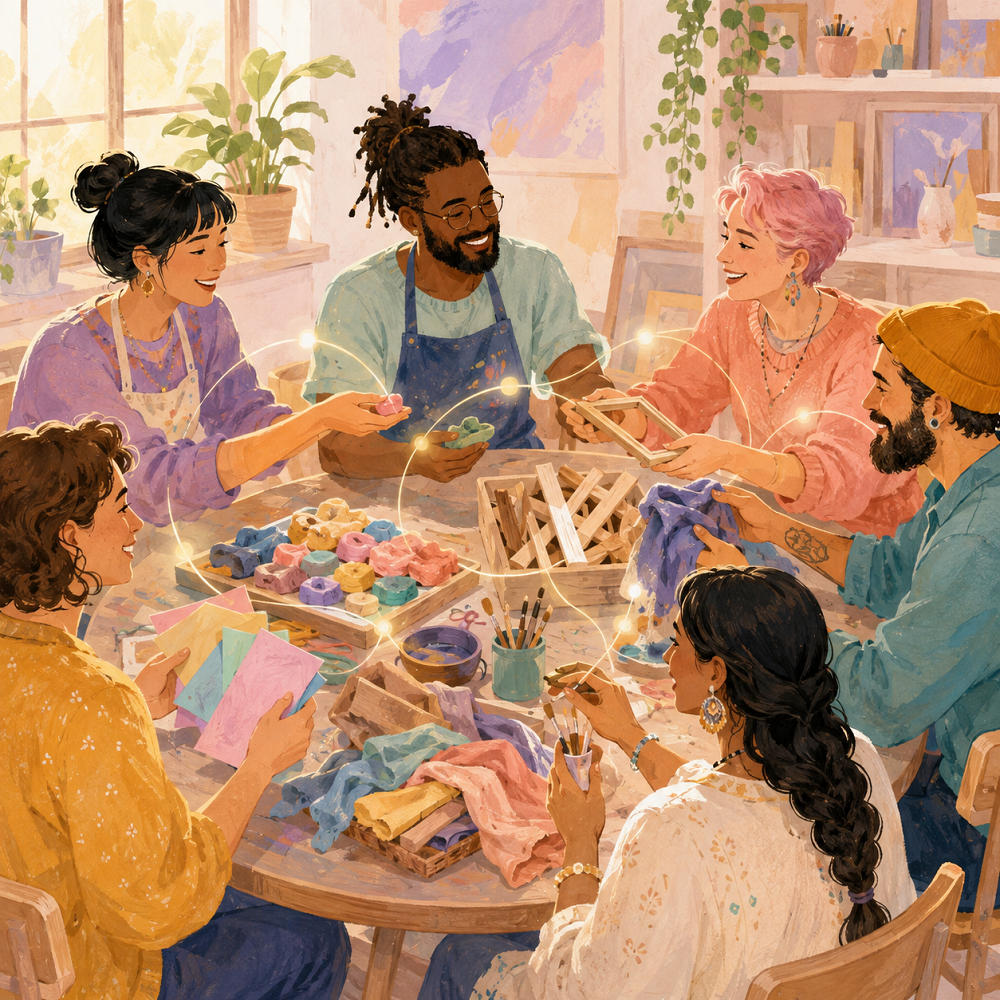
Creativity May Be Human. Access Is Unequal.
I don't think the answer is to insist: everyone can be creative! It doesn't cost anything!
That's too simple.
Human beings can have enormous creative capacity while lacking the resources necessary to explore particular forms of it.
Someone can have ideas they can't afford to execute.
Interests they can't access.
Skills they'd love to learn.
Materials they'd love to explore.
Projects that require more space, money, equipment, energy, or time than they currently have.
That doesn't make creativity a luxury.
It means creative access is an equity issue.
If we believe creativity contributes to expression, regulation, connection, curiosity, identity, pleasure, and a life that contains more than maintenance, then access to those opportunities matters too.
And perhaps that's why the distinction is so important: creativity may not be a luxury.
But the time, materials, space, tools, education, energy, and freedom to practice it can absolutely become luxuries.
Acknowledging that doesn't weaken the argument for creativity.
It strengthens it.
Because instead of telling people with limited resources that they should simply become more resourceful, we can ask a much more useful question: what barriers are keeping people from creating—and what could make the doorway wider?
Creativity Doesn’t Have to Justify Itself by Becoming Productive
There's a very easy way to defend creativity.
We can talk about everything it does.
Creativity can help people regulate.
Process experiences.
Express themselves.
Develop skills.
Solve problems.
Build confidence.
Connect with other people.
Learn.
And sometimes, it can even become a career or source of income.
Those are meaningful things.
I've spent much of this article talking about some of them.
But there's something that makes me a little uncomfortable about relying on those arguments too heavily.
Because if we're not careful, we can rescue creativity from the category of luxury only by giving it another job:
- See? Art is useful!
- Look at everything it accomplishes!
- It improves us!
- It helps us function!
- It can make money!
And suddenly creativity is allowed to matter—but only because we've successfully proven that it's productive.
We should be careful not to rescue creativity from the category of luxury only by giving it another job.
Not Everything Has to Become Something Else
There's enormous pressure to turn interests into outcomes.
You like making jewelry?
You should sell that.
You're good at painting?
Have you thought about commissions?
You knit?
You could open a shop.
You write?
Are you going to publish it?
You enjoy photography?
You could make money doing that.
Sometimes those suggestions are exciting.
A hobby can become a business.
Creative work can become a career.
Someone may genuinely want to sell what they make.
There's nothing wrong with that.
But there's also something revealing about how quickly: I enjoy doing this can become: how could you make this productive?
- What if the answer is: I don't want to?
- What if someone paints for twenty years and never sells a painting?
- What if they knit things only for themselves and people they love?
- What if they make strange little sculptures nobody else ever sees?
- What if they become remarkably skilled at something and still have absolutely no interest in monetizing it?
Nothing has gone wrong.
Not every interest is an undeveloped business.
Sometimes a hobby gets to remain a hobby.
It Doesn’t Have to Improve You, Either
Productivity doesn't always mean money.
Sometimes we justify creativity through self-improvement instead.
This builds fine-motor skills.
That develops problem-solving.
This improves concentration.
That teaches patience.
This activity is educational.
That one supports emotional well-being.
Again, wonderful.
Those can all be meaningful benefits.
But what if you spend an afternoon making something and emerge exactly as accomplished, employable, educated, efficient, and enlightened as you were before?
Was the afternoon wasted?
I don't think so.
Maybe you enjoyed yourself.
Maybe you were curious.
Maybe you wanted to see whether you could make a tiny frog out of clay.
And now there is a tiny clay frog.
Perhaps that's the entire story.
An experience doesn't have to improve us before we're allowed to value having experienced it.
Even Regulation Shouldn’t Become a Requirement
I think this distinction matters especially in this article.
I've talked about how creativity can help me regulate as a neurodivergent person.
That's real.
It's one reason creative access matters deeply to me.
But I don't want to accidentally turn that into another rule: creativity is justified because it's regulating.
Because what about the creative activity that isn't?
Sometimes making is calming.
Sometimes it isn't.
Sometimes I may become frustrated.
Make a mess.
Try something that absolutely refuses to cooperate.
Spend far longer solving a creative problem than any reasonable person probably should.
Sometimes creativity can be energizing rather than calming.
Exciting rather than soothing.
Challenging rather than restful.
And sometimes I may simply want to make something because making it sounds fun.
That gets to count too.
The value of creativity doesn't disappear the moment we can't identify a therapeutic function for it.
Pleasure Is Allowed to Be an Outcome
This can feel strangely difficult to say.
We are allowed to enjoy things.
Not because they improve our résumés.
Not because they generate income.
Not because they're educational.
Not because they're optimizing our health.
Not because they make us better at something useful.
Sometimes: I liked doing that is information enough.
Maybe you spent two hours painting something you don't particularly like.
But you enjoyed mixing the colors.
Maybe you made an impractical object that now occupies shelf space.
Maybe you decorated something that functioned perfectly well before you touched it.
Maybe you used twelve steps to make something you could have bought for five dollars.
From the perspective of efficiency, some creative activities make very little sense.
That's okay.
Efficiency isn't the only value a human life can be organized around.
Maybe the Making Gets to Be the Point
Perhaps this is where the argument becomes simplest.
You don't have to sell the thing.
You don't have to display the thing.
You don't have to post the thing.
You don't have to become exceptionally skilled at making the thing.
You don't have to turn it into content.
You don't have to explain what you learned.
You don't have to prove that the activity made you healthier, calmer, smarter, or more productive.
Maybe you keep it.
Give it away.
Take it apart.
Reuse it.
Put it in a drawer.
Eventually throw it away.
The finished object doesn't necessarily have to justify the time spent creating it.
Maybe the making gets to be the point.
And perhaps that's one of the clearest reasons creativity belongs in a human life.
Not because it always accomplishes something beyond itself.
But because a life doesn't have to consist entirely of activities that can defend their existence through productivity.
Sometimes we get to explore.
Play.
Wonder.
Experiment.
Make.
Enjoy.
Not because those things will eventually become useful.
Because being alive is allowed to contain things we do simply because we're glad they're there.
 Jessica Carey
A Life Needs More Than Maintenance
Sometimes creativity really does have to wait.
There isn't enough money.
There isn't enough time.
There isn't enough energy.
There isn't enough space.
Something more urgent needs our attention.
Sometimes life becomes survival for a while.
I don't think anyone should feel guilty about that.
If you haven't touched your sketchbook in months, you haven't failed creativity.
If the supplies are sitting untouched, you don't need to justify them.
If something you once loved feels impossible right now, forcing yourself to do it isn't necessarily the answer.
There are times when we simply don't have more to give.
But I don't think we need to turn those circumstances into a philosophy.
I can't make room for this right now doesn't have to become: this never really mattered.
Creativity Can Change Shape
A creative life doesn't always look the same.
Sometimes it might mean hours spent working on an ambitious project.
Sometimes it's a class.
A studio.
A community.
A practice you return to every day.
And sometimes it's much smaller.
Knitting on the couch.
Doodling on a scrap of paper.
Taking a photograph because the light looked interesting.
Rearranging something because you want it to feel beautiful.
Making a tiny object nobody needs.
Cutting apart discarded packaging because you suddenly wondered: what else could this become?
Maybe there are periods when even those things aren't possible.
That's okay, too.
Creativity doesn't disappear from your life forever because your capacity for it changes.
A creative life can expand and contract with the life containing it.
We Don't Have to Earn Our Way Back to It
I think that's part of what bothers me about treating creativity as a luxury.
Luxury is something extra.
Something indulgent.
Something we're supposed to consider only after the important things have been handled, but when exactly does that happen?
- When are all the bills permanently paid?
- All the chores finished?
- All the problems solved?
- All the responsibilities handled?
- When do we finally reach the point where there is nothing more practical we could possibly be doing?
Probably never.
There will always be something.
Another email.
Another errand.
Another task.
Another reason we could tell ourselves: not yet.
And if creativity requires a perfectly maintained life before we're allowed to return to it, we may wait forever.
Creativity Is Part of the Life We're Maintaining
So no, I don't think creativity needs to outrank our basic needs.
It doesn't need to.
Sometimes food comes first.
Sometimes housing comes first.
Sometimes safety comes first.
Sometimes rest comes first.
Sometimes the art supplies stay on the shelf because today simply isn't the day.
But coming second doesn't mean meaning nothing.
And having to wait doesn't mean being a luxury.
There will always be something more practical we could be doing.
Another chore.
Another bill.
Another problem.
Another responsibility.
Creativity doesn't have to outrank our basic needs to matter.
It doesn't have to become productive enough to justify its existence.
And it doesn't have to wait until we've accumulated enough money, time, energy, or stability to finally deserve it.
Creativity isn't something we add to life after all the important parts are finished.
For many of us, it's one of the things that helps make the life we're working so hard to maintain feel like ours.
Sources & Further Reading
World Health Organization. What Is the Evidence on the Role of the Arts in Improving Health and Well-Being? A Scoping Review. WHO Regional Office for Europe, 2019. A synthesis of more than 3,000 studies examining arts engagement, health, and well-being.
Collis, E., et al. Self-Report of Restricted Repetitive Behaviors in Autistic Adults: A Systematic Review. Autism, 2026. Reviews research on autistic adults' self-reported repetitive behaviors, including sensory experiences and self-regulatory functions involving emotion and attention.
National Endowment for the Arts. Arts Attendance, Art-Making, and Social Connectedness: Spring/Summer 2024. Examines U.S. Census Bureau data on arts participation and measures of social connectedness among U.S. adults.
Want even more content about creativity and art?
Be sure to check out all of our creative chronicles!
If you'd like to see examples of my work, you can find some of my art and creations at Redbubble and Gumroad!
Looking to learn more about my recent journey?
Check out some of these articles:
-Hidden Gems for St. Louis Artists
-Hidden Gems for Autistic & Neurodivergent Adults
-Learning What Love Was Supposed to Feel Like
-I Wasn't Broken--I'm Burned Out
-The Difference Between Resting and Giving Up
-What Chronic Autistic Burnout Actually Feels Like
-When You Had to Raise Yourself
 Jessica Carey