
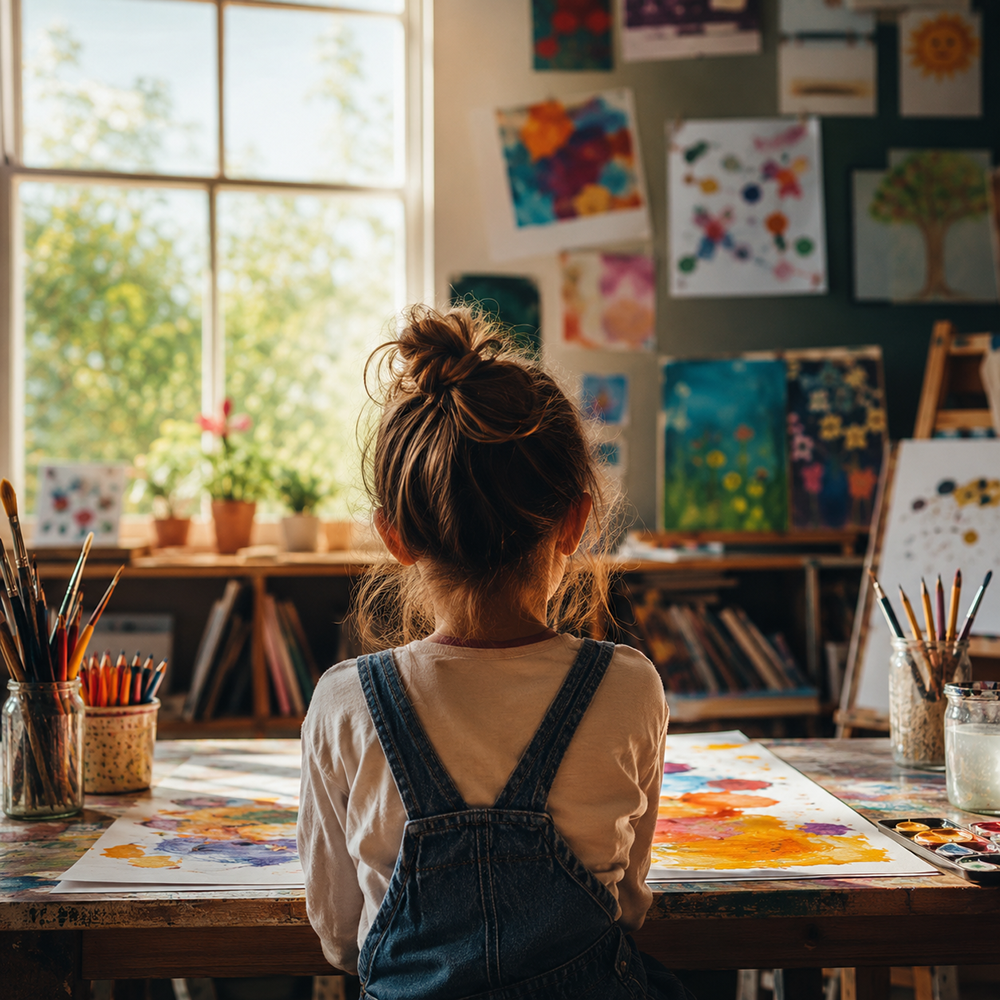
I've seen children cry in art rooms.
Not because they hated art.
Not because they didn't care.
Sometimes, almost the opposite.
They cared so much about making something good that looking around the room became devastating.
Another student's drawing looked more realistic.
Someone else's painting was cleaner.
Their sculpture looked more like the example.
And sometimes, sitting at the front of the room, was the teacher's version of the project—the example everyone had been shown before beginning.
An artwork made by an adult with years, perhaps decades, more experience than the children looking at it.
Of course a child's work may not look the same.
Why should it?
When the Example Becomes the Standard
Teacher examples can be useful.
They can demonstrate a technique.
Show how materials behave.
Make unfamiliar instructions easier to understand.
Help students visualize a process.
Teacher-directed lessons can be useful, too.
Students need opportunities to learn techniques, encounter artists and art history, develop vocabulary, understand materials, and experience processes they might never discover independently.
I don't want to throw any of that away.
But I've watched something else happen.
A demonstration becomes an example.
The example becomes an expectation.
And the expectation becomes a measuring stick.
A student looks from the teacher's artwork to their own and thinks: mine doesn't look like that.
Then looks at the student beside them, recognizing: mine doesn't look like theirs either.
And somehow the conclusion becomes: I'm bad at art.
That's the part that has always troubled me.
What Are We Actually Trying to Teach?
An elementary student shouldn't have to produce artwork comparable to that of an adult art educator.
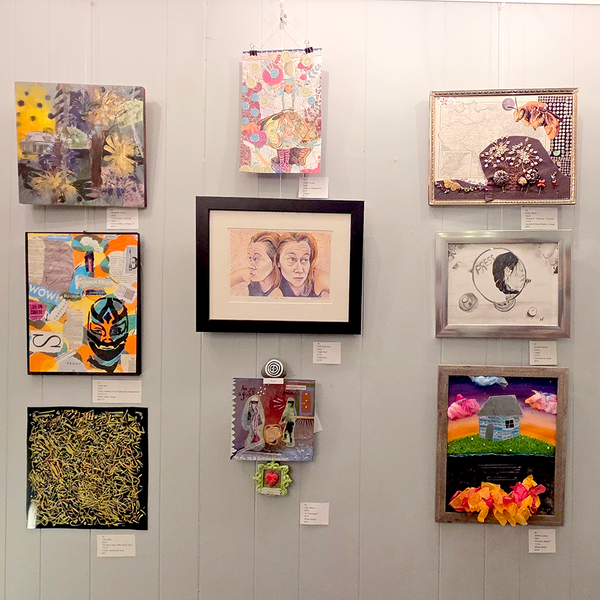
A student who struggles with realistic drawing might have an extraordinary instinct for color.
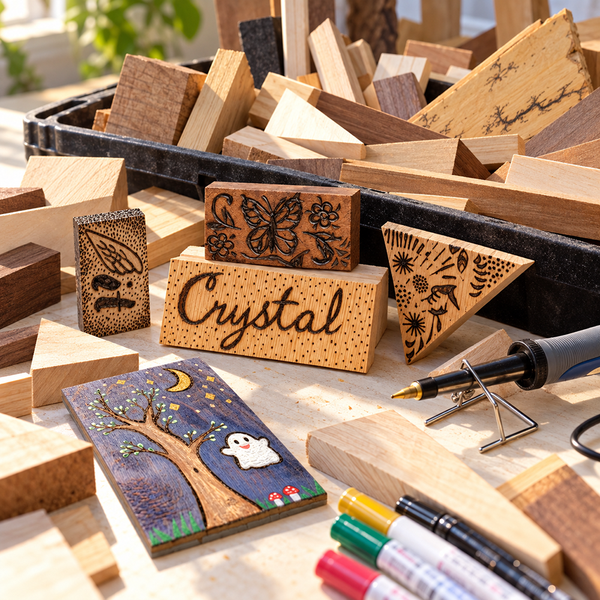
Someone frustrated by painting might come alive while building.
Another might love fiber.
Collage.
Clay.
Photography.
Assemblage.
Digital art.
Storytelling.
Design.
The child who appears to struggle when everyone is completing the same project may not be bad at art at all.
We may simply be looking at a very narrow slice of what they can do.
And when students repeatedly experience art as something where everybody receives the same instructions and then sees whose result most successfully resembles the expected outcome, I wonder what we're inadvertently teaching alongside the intended lesson.
Are we teaching: here's a new artistic technique you can use.
Or might some students also hear: here's what good art looks like. See whether you can measure up.
Those are very different lessons.
 Jessica Carey
The Approach That Made Sense to Me
When I studied art education, I kept finding myself drawn toward Teaching for Artistic Behavior, usually called TAB.
Its philosophy resonated with something I already believed:
Students aren't merely people preparing to become artists someday.
They can behave as artists now.
That doesn't mean handing children a pile of supplies, abandoning all structure, and saying: good luck!
It means taking their artistic agency seriously.
Students can make choices.
Develop ideas.
Explore materials.
Encounter problems.
Change direction.
Ask questions.
Learn from one another.
Discover what interests them.
And gradually develop their own ways of working.
The teacher still teaches.
But perhaps the teacher doesn't have to make every meaningful artistic decision before the student begins.
I Got to See the Difference
One of the people who helped me see this more clearly was my own middle school art teacher.
After I graduated from middle school, she moved toward TAB.
Years later, she became one of my practicum teachers, which meant I returned to a familiar art room and encountered a different approach to learning inside it.
I wasn't merely reading about TAB in an education textbook.
I was seeing what happened when students were given more ownership of their creative work.
Later, my cooperating teacher during student teaching was also interested in moving toward TAB.
The more I encountered the philosophy, the more I found myself wondering why more art classrooms weren't making room for it.
Not necessarily every minute.
Not necessarily every project.
And certainly not because TAB is the only legitimate way to teach art.
But enough for students to experience something beyond:
- Here is what we're making.
- Here is how we're making it.
- Here is what it should approximately look like when we're done.
What If the Goal Were Bigger Than the Project?
I've encountered plenty of resistance to that idea professionally.
Traditional approaches remain deeply embedded in what many schools expect art education to look like, and my preference for more choice-based learning hasn't always aligned with what school leadership wanted.
But I keep coming back to the children.
Especially the ones who looked around an art room and decided that somebody else's ability meant they didn't have any.
Because perhaps the question isn't only: did students successfully complete today's project?
Maybe we should also ask: what did this experience teach them about themselves as creative people?
Did they learn a technique?
Wonderful.
Did they encounter an artist they'd never known?
Excellent.
Did they learn something about composition, color, history, materials, or visual communication?
Those things matter.
But did they also leave believing:
- My ideas matter.
- I can make artistic decisions.
- Something not working gives me a problem to investigate.
- I can learn from the people around me without needing to become them.
- There are many ways to be an artist.
- I can figure things out.
Because an art room can teach more than how to make an artwork.
It can teach students what they believe about their own capacity to create.
And that is one of the reasons I've remained so drawn to TAB.
Not because structure has no value.
Not because technical instruction doesn't matter.
Not because every traditional art lesson harms students.
But because I want art education to do more than teach children how to successfully complete art projects.
I want it to empower them to think, choose, experiment, problem-solve, and begin seeing themselves as artists.
And perhaps that starts with a deceptively simple idea: what if we let them be?
TAB: Students Are Artists
At the heart of Teaching for Artistic Behavior is an idea that sounds almost too simple: the student is the artist.
Not someday.
Not after mastering enough techniques.
Not after producing something impressive enough to hang in a gallery.
Not after an adult decides they're talented.
Now.
That changes the question from: how do I get students to make this artwork?
To something closer to: how do I help students develop the knowledge, resources, habits, and confidence they need to make artistic decisions of their own?
Those questions can lead to very different art rooms.
TAB is often grounded in three deceptively simple ideas: the child is the artist, the classroom is the child's studio, and the central question becomes, “What do artists do?”
That last question matters. TAB isn't simply about giving students more options.
It's about creating conditions where students can practice the thinking, decision-making, experimentation, problem-solving, and reflection that artists actually use.
 Jessica Carey
Artists Make Decisions
Think about what artists actually do.
They don't only draw, paint, sculpt, sew, photograph, print, or build.
They decide:
- What am I interested in?
- What do I want to explore?
- Which material makes sense for this idea?
- How could I make this work?
- What isn't working?
- Should I change direction?
- What do I need to learn?
- Is this finished?
Some decisions are intuitive.
Some require research.
Some require technical knowledge.
Some lead directly to other questions.
And some turn out to be decisions we'd make completely differently the next time.
But decision-making itself is part of artistic behavior.
If students rarely get to make meaningful artistic decisions, they can become very skilled at completing art assignments without necessarily getting as much practice developing an artistic process of their own.
TAB creates more room for that practice.
Choice Doesn't Mean “Do Whatever You Want”
This is an important distinction because choice-based art education can sound remarkably simple from the outside:
Put out the supplies.
Tell everyone to make whatever they want.
Teacher sits back.
Chaos presumably follows.
That's not what meaningful choice requires.
Students can't make informed choices about materials they've never encountered.
They can't independently use tools they haven't learned to use safely.
They don't automatically know every technique.
They may not know what artistic possibilities exist beyond the things they've already seen.
Choice needs something to choose from.
That's where teaching remains essential.
A teacher can demonstrate a technique.
Introduce a material.
Share an artist's work.
Teach tool safety.
Ask questions.
Provide vocabulary.
Model ways of thinking through a problem.
Help a student find resources.
Notice when someone is stuck.
Suggest possibilities without making the decision for them.
The goal isn't to remove the teacher.
It's to make the teacher's knowledge something that expands what students are capable of choosing.
Teaching Can Give Students More Possibilities
Imagine a student who has never encountered printmaking.
They can't meaningfully decide: printmaking would be perfect for this idea.
They don't know it exists yet.
So introduce it.
Demonstrate it.
Let students experiment with it.
Show them artists who use it in completely different ways.
Talk about what the process can and can't easily do.
Now something has changed.
The student has another possibility available to them.
Maybe they love it.
Maybe they don't.
Maybe they don't touch it again for months.
Then one day they're working on an entirely different idea and think: wait, that technique we learned might work here.
The original lesson has become part of their creative vocabulary.
That's a very different purpose for instruction than: I taught printmaking, so everyone needs to produce the same printmaking project.
The technique doesn't have to be the destination.
It can become another tool students carry with them.
The Teacher Can Become a Resource, Not the Answer Key
This may be one of the shifts I appreciate most about TAB.
In a heavily teacher-directed project, the teacher often possesses the answer before the students begin.
What should we make?
The teacher knows.
Which materials should we use?
The teacher chose them.
What steps should we follow?
The teacher wrote them.
What should it roughly look like?
There's often an example.
When students make more of those decisions themselves, the teacher can't always provide an answer key.
A student might ask: how do I make this stand up?
And instead of immediately saying: do this.
The teacher might ask:
- What have you tried?
- Why do you think it's falling?
- What could make the base stronger?
- Is there anyone in the room who's solved something similar?
Maybe the student still needs direct instruction.
Sometimes we really do need someone to show us how something works.
But other times, the question helps the student discover that they can think through the problem, too.
A Studio Can Hold Many Kinds of Artists
One of the things I find particularly powerful about this philosophy is that students don't all have to demonstrate artistic ability in exactly the same way.
One student may become fascinated by drawing.
Another builds.
Another experiments endlessly with paint.
Someone loves fibers.
Someone works carefully and methodically.
Someone makes quickly and follows ideas as they appear.
Someone cares deeply about storytelling.
Someone is fascinated by materials themselves.
Their strengths may look completely different.
That doesn't mean students should never be stretched beyond what they already like. Education should expose us to unfamiliar things.
But exposure doesn't have to mean deciding that one particular kind of artistic success is the measure of everyone in the room.
A studio can make room for different interests, approaches, problems, strengths, and ways of thinking.
And when we do that, we may begin noticing abilities that a single predetermined project never gave a student the opportunity to show us.
The Goal Changes
Maybe this is the distinction I keep returning to.
If the primary goal is: every student will successfully make this project, then our teaching naturally organizes itself around helping everyone reach that predetermined result.
But if one of our goals becomes: students will learn how to think and work as artists, then the process matters differently.
Choosing matters.
Wondering matters.
Experimenting matters.
Seeking information matters.
Changing direction matters.
Solving problems matters.
Talking with other artists matters.
Reflecting on what happened matters.
The finished artwork still matters.
But it isn't the only evidence that learning occurred.
A student might make something that doesn't look particularly spectacular to an adult observer while having done extraordinary thinking to get there.
And another student might produce something visually impressive while still needing opportunities to make more of the decisions behind it.
TAB asks us to pay attention not only to what students make, but to what students are learning to do as artists.
That doesn't make the teacher less important.
It changes what we're helping students become capable of doing without us.
Because perhaps the goal isn't to create a classroom full of students who are excellent at following an art teacher's creative process.
It's to help create a classroom full of young artists who are gradually learning how to develop their own.
The Power—and Responsibility—of Choice
What do you want to make?
It sounds like an easy question.
Until someone actually has to answer it.
If we're accustomed to being told:
- Use this paper.
- Get these materials.
- Follow these steps.
- Make this subject.
- Turn it in on Friday.
Then suddenly hearing: "What do you want to explore?" can feel enormous.
Because choice isn't simply freedom.
Choice asks something of us.
Choice Requires Decisions
Once the teacher stops making every decision, those decisions don't disappear.
They move to the student.
Now the student has to consider what they want to make, what materials might work, what they need to learn, whether their approach is working, and what should happen next.
Those aren't interruptions to the artistic process.
They are the artistic process.
And students become more capable of making those decisions partly by having opportunities to actually make them.
Choice Is Something We Learn How to Use
This is why I don't think choice should be reduced to: make anything you want!
For some students, that might feel exhilarating.
For another, it might produce: I don't know.
That makes sense.
If someone has spent years waiting for an adult to tell them what the assignment is, generating the assignment themselves requires a different set of skills.
Students may need starting points.
Prompts.
Examples.
Conversations.
Menus of materials.
Mini-lessons.
Questions.
Time to experiment without committing to a final idea.
They may begin with relatively small choices: which material do you want to use?
Then larger ones: what could you do with it?
Eventually: what are you interested in exploring?
Agency doesn't have to mean removing every scaffold at once.
We can support students in learning how to choose without choosing everything for them.
Ownership Changes the Question
There's also something different about encountering a problem inside an idea that belongs to you.
If I'm completing someone else's project and something goes wrong, my first question might be: how am I supposed to do this?
And the teacher may possess the correct answer because the teacher designed the project.
But if I'm developing my own idea, the question becomes: how could I make this work?
Maybe there isn't one correct answer.
Maybe I need wire.
Or cardboard.
Or stronger glue.
Maybe I need to change the structure.
Maybe my original idea isn't physically possible with the materials I chose.
Maybe another student knows a technique that could help.
Maybe I need to research.
Maybe I need to invent something.
The student isn't only executing.
They're problem-solving on behalf of an idea they have ownership of.
 Jessica Carey
Choice Can Reveal Students We Weren't Seeing
This matters enormously when we think about ability.
Imagine a student struggling through a drawing-heavy curriculum.
Their proportions aren't as accurate as another student's.
Their lines aren't as controlled.
Their work doesn't resemble the teacher's example as closely.
It would be very easy for that student—and sometimes the adults around them—to conclude: they're just not very artistic.
Then give them cardboard.
Suddenly they're building elaborate structures.
Give them fibers and they understand pattern intuitively.
Let them work with clay and they think beautifully in three dimensions.
Give them collage materials and they create compositions nobody expected.
Maybe the problem wasn't an absence of creativity.
Maybe we kept asking them to demonstrate it in the same language.
Choice gives students more ways to show us what they notice, imagine, understand, and care about.
Choice Doesn't Mean Never Being Challenged
There's a complication here worth acknowledging.
If students always choose only what is comfortable, they may never encounter something that initially feels difficult or unfamiliar.
The student who loves drawing might never touch clay.
The student who builds might avoid painting.
Someone may choose the same material every time because they already know how to use it.
That's where thoughtful teaching still matters.
We can introduce unfamiliar materials.
Create constraints.
Offer challenges.
Teach new techniques.
Invite students to work in ways they wouldn't automatically choose.
The difference is that exposure can expand choice rather than permanently replace it.
Perhaps everyone learns a printmaking process together.
Wonderful.
But afterward:
- What could you do with this?
- Where could this technique fit into your own work?
- Do you want to combine it with something else?
Now instruction has given students another language rather than another template.
There Is Responsibility in Agency
Choice also means students begin carrying more responsibility for what happens.
Not blame.
Responsibility.
Those are different.
If I chose the material and it isn't working, I need to think about why.
If I abandoned an idea, I can reflect on what made me change direction.
If I spent most of my studio time experimenting and didn't produce a polished final piece, I can still explain what I investigated and learned.
If something worked beautifully, I can begin understanding which decisions helped make that happen.
The question becomes less: did I do what the teacher wanted?
And more: what happened because of the choices I made?
That kind of reflection matters far beyond art.
Agency Can Become Confidence of a Different Kind
There is a kind of confidence that comes from being told: you did it correctly.
That can feel good.
But there's another kind:
- I didn't know what to do, and I figured something out.
- I had an idea and found a way to make it possible.
- Something went wrong, and I changed my approach.
- I needed information and knew where to look for it.
- I made a decision and can explain why I made it.
That confidence doesn't depend entirely on whether our work looks better than somebody else's.
It comes partly from discovering: I can think creatively.
And perhaps that's one of the most powerful things meaningful choice can offer students.
Not simply: you can make whatever you want.
But:
- Your ideas are worth developing.
- Your decisions matter.
- You can learn what you need.
- You can change your mind.
- You can solve problems.
- You can ask for help.
- You can discover what kind of artist you are becoming.
If we want students to eventually become independent creative thinkers, we can't make every meaningful decision for them indefinitely.
At some point, we have to give them something both exciting and difficult: something real to decide.
What Happens When Something Doesn’t Work?
Something will go wrong.
The clay cracks.
The structure falls over.
The paint turns muddy.
The paper tears.
The pieces refuse to stay attached.
The drawing doesn't look the way the student imagined.
The brilliant idea that seemed completely possible five minutes ago turns out to have one tiny problem: it doesn't work.
Now what?
That question might be more educational than we realize.
When “Wrong” Is Easy to See
In a highly predetermined project, students may have a very clear picture of what success is supposed to look like.
The teacher made an example.
Everyone is working with similar materials.
Everyone follows roughly the same process.
Everyone is aiming toward a similar outcome.
So when something goes differently, the comparison can be immediate: mine doesn't look like that; I did it wrong.
And sometimes there really is a technical error worth correcting.
Maybe the student misunderstood the process.
Maybe a particular tool needs to be used differently.
Maybe learning the technique requires practice.
But artistic learning can become limited if every unexpected result is experienced primarily as distance from the correct example.
Because artists encounter things that don't work all the time.
What matters is what they learn to do next.
A Problem Can Become a Question
Consider a cardboard sculpture that keeps collapsing.
We could say: you did this part wrong. Here, let me show you how it's supposed to go.
And sometimes direct instruction really is appropriate.
But we might also begin with: why do you think it keeps falling?
Now we have something to investigate.
- Is the base too small?
- Is the top too heavy?
- Are the joints weak?
- Would another attachment method work?
- Could the shape change?
- Does it need internal support?
- Has another student solved a similar problem?
Suddenly: it doesn't work has become: why doesn't it work?
And that creates another question: what could I try?
The mistake hasn't disappeared.
It has become information.
Not Every Mistake Needs to Be Rescued
This can be difficult for teachers too.
We can often see the problem.
We know what's about to happen:
- That is definitely going to fall over.
- That much water is going to destroy that paper.
- Those materials are not going to stick together.
And sometimes we absolutely need to intervene—especially when safety, expensive materials, or irreversible consequences are involved.
But sometimes?
Maybe we let them find out.
The tower falls.
The paper buckles.
The pieces separate.
And now the student possesses information that is different from: my teacher told me not to do that.
They know: I tried that. Here's what happened.
That experience can become part of their understanding of the material.
There is value in preventing unnecessary frustration.
There can also be value in not rescuing every student from every solvable problem before they have the opportunity to encounter it.
We Don't Have to Pretend the Mistake Was Wonderful
There's a tendency in conversations about creativity to turn every mistake into something inspirational: there are no mistakes!
But sometimes there are.
We used the wrong adhesive.
Measured incorrectly.
Cut the piece too short.
Ruined the color.
Broke something.
Forgot an important step.
Made a decision we wish we hadn't.
And a student is allowed to look at something and say: I don't like what happened.
We don't have to convince them that they secretly created a masterpiece.
The more useful question might be: okay, what did you learn from it?
Maybe:
- Next time I'll use less water.
- That connection needs more support.
- I don't like those colors together.
- I need to practice this technique.
- I should test this on scrap material first.
- This isn't the material I want for this idea.
That's learning, too.
A mistake doesn't have to become beautiful to become useful.
The Goal Can Shift From Avoiding Mistakes to Responding to Them
If students believe success means making no mistakes, then experimentation becomes risky.
- Why try something uncertain when uncertainty could make the artwork worse?
- Why choose an unfamiliar material?
- Why attempt an ambitious idea?
- Why deviate from the example?
The safest strategy becomes: figure out what the teacher wants and do that as correctly as possible.
But artists can't always work that way.
Sometimes we don't know whether something will work until we try it.
That's where a choice-based environment can make room for a different understanding:
- I can try something.
- I can observe what happens.
- I can decide whether to keep it.
- I can change direction.
- I can ask for help.
- I can try again.
The goal isn't to eliminate frustration.
It's to help students develop ways of moving through it.
 Jessica Carey
Students Can See Adults Problem-Solve, Too
Teachers don't have to pretend we know everything.
I actually think there can be something powerful about a student asking: will this work?
and occasionally hearing: I don't know. Let's find out.
Try it.
Look.
Think.
Research.
Ask someone else.
Maybe the teacher's first suggestion doesn't work either.
Now the student sees something important.
Knowledge isn't always: the authority already knows the answer and gives it to me.
Sometimes knowledgeable people encounter unfamiliar problems too.
They test.
Revise.
Look things up.
Ask questions.
Change their minds.
That is also artistic behavior.
The Classroom Can Change What “Failure” Means
Imagine two students whose experiments don't work.
One concludes: I'm bad at art.
The other concludes: okay, that didn't work. What else can I try?
The unsuccessful experiment may be identical.
What differs is the meaning attached to it.
And classrooms help teach those meanings—not through inspirational posters telling students that failure is wonderful, but through what actually happens when something goes wrong.
Does the teacher immediately fix it?
Does the student feel embarrassed?
Does everyone compare the result to the example?
Or does someone become curious?
- What happened?
- What were you trying to do?
- What did you discover?
- What might you change?
- What do you want to try next?
Over time, those responses can help create a studio where an unexpected result doesn't automatically mean: I failed.
Sometimes it means: I learned something.
And that learning may not always be obvious in the finished artwork.
A strange, unresolved, technically imperfect piece might represent enormous growth.
Maybe the student attempted something difficult, tested several solutions, asked another student for advice, changed materials, learned a new technique, and reconsidered the original idea.
If we look only at the final object, we might miss most of the education.
Because sometimes the evidence of learning isn't: look how perfectly this turned out.
It's: look at everything I know now that I didn't know when I started.
A choice-based art room can't promise that everything students make will work.
But it can help them discover something perhaps more useful: when something doesn't work, they still have somewhere to go.
From a Classroom of Students to a Community of Artists
Something changes when everyone in the art room isn't making the same thing.
One student is building with cardboard.
Another is painting.
Someone is weaving.
Someone is trying to make two materials stay together that clearly have no interest in cooperating.
Someone has spent fifteen minutes figuring out how to create exactly the texture they imagined.
And somewhere across the room, another student looks up and says: wait, how did you do that?
Now something important has happened.
The teacher didn't provide the answer.
Another student did.
Everyone Can Know Something
In a traditional classroom structure, knowledge can easily appear to move in one primary direction: teacher → student.
The teacher knows.
The students are there to learn.
Of course, teachers do possess important knowledge. That's why we're there.
We understand materials.
Techniques.
Safety.
Art history.
Development.
Curriculum.
We have experience students haven't had yet.
But that doesn't mean the teacher is the only person in the room capable of knowing something useful.
Give students enough time to explore and something interesting begins to happen.
One student figures out a clever attachment method.
Another discovers how to mix a particular color.
Someone becomes remarkably good at manipulating wire.
Someone knows the digital program better than anyone else.
Someone develops a way of organizing tiny collage pieces that another student wants to try.
Suddenly, expertise isn't located in one place.
It starts appearing all over the room.
“Go Ask Them”
There can be something powerful about a teacher responding to a question with: you know who figured that out? Go ask them.
Now the student with the knowledge gets to become the teacher.
They explain.
Demonstrate.
Answer questions.
Maybe they realize while explaining the process that they understand it better than they thought.
And the student asking for help experiences another classmate not as competition, but as a resource.
Later, the roles may reverse.
The student who needed help with weaving might be the person someone asks about painting.
The student who struggled to build a structure might know exactly how to create a particular texture.
Nobody has to be the best artist in the room to have something valuable to contribute.
Everyone can know something.
Everyone can still be learning something.
Sometimes both are true at exactly the same time.
Comparison Can Become Curiosity
Students will compare themselves.
TAB doesn't magically eliminate that.
Put human beings together and we're remarkably talented at noticing differences.
But perhaps we can help change what those differences mean.
Instead of: their work is better than mine.
Maybe sometimes it becomes: how did they do that?
Instead of: I can't do what they can do.
Perhaps: they know something I could learn.
And instead of another student's success becoming evidence of our own inadequacy, it can become evidence of what is possible.
That's a very different relationship to difference.
We don't need every student to possess the same skills at the same level.
A community actually becomes more interesting when they don't.
 Jessica Carey
Students Can Inspire Without Everyone Becoming the Same
There is also a difference between inspiration and imitation.
A student sees someone using yarn in an unexpected way.
They don't necessarily need to make the same artwork.
Maybe they think: I didn't know we could use yarn like that.
Now they have another possibility.
Someone sees a classmate combining drawing with collage.
Another notices a construction technique.
Someone overhears a conversation about an artist.
A student sees an experiment fail spectacularly and learns something without having to make the same attempt themselves.
Ideas move.
Techniques move.
Questions move.
Students influence one another.
But the room doesn't have to converge toward twenty versions of the same artwork.
Shared knowledge can create more possibilities rather than more sameness.
The Teacher Doesn't Have to Know Everything
This changes something for teachers too.
We don't have to pretend to be an encyclopedia with legs.
There will be things students want to do that we haven't done.
Materials we haven't mastered.
Questions we can't immediately answer.
Techniques a student discovers before we do.
And perhaps that's okay.
- I don't know. Let's look it up.
- I've never tried that. Let's test it.
- I think Maya was experimenting with something similar. Maybe ask her what happened.
Those responses don't necessarily diminish the teacher's authority.
They model something useful:
Knowing how to learn can matter as much as already knowing the answer.
Students get to see an adult encounter uncertainty without treating uncertainty as incompetence.
We investigate.
Ask.
Research.
Experiment.
Consult someone who knows more.
That's what learners do.
And artists do it, too.
Community Can Make Risk Feel Less Lonely
Trying something uncertain is easier when we're not doing it entirely alone.
A student gets stuck.
Someone offers an idea.
A structure collapses and another student says: that happened to mine, too. I had to reinforce this part.
Someone doesn't know how to begin and sees three completely different approaches happening around them.
A student discovers something exciting and has people nearby who understand why they're excited.
That matters.
The classroom can become more than a collection of individuals completing assignments beside one another.
It can become a place where people are making in the presence of other makers.
Helping.
Watching.
Borrowing ideas.
Offering feedback.
Sharing discoveries.
Solving problems.
Celebrating when somebody finally gets the stubborn thing to work.
The Teacher Is Still Part of the Community
None of this means the teacher disappears.
The teacher is still responsible for creating the conditions in which the community can function.
We teach students how to use materials safely.
Help establish expectations.
Make resources accessible.
Introduce possibilities.
Ask questions.
Intervene when necessary.
Notice who isn't being included.
Help students learn how to give useful feedback rather than simply saying “I like it” or “that's bad.”
And we bring knowledge of our own.
But perhaps the teacher can be both: someone with expertise and someone who is still capable of learning.
That creates a very different atmosphere from one in which every important answer must come from the adult.
A Community of Learners Is Also a Community of Teachers
Maybe that's what I find so compelling about this kind of art room.
The roles become less rigid.
The teacher teaches.
Students teach.
The material teaches us something through what happens when we use it.
Artists from different times and places introduce ideas through the work we study.
A failed experiment gives us information.
Someone else's question changes how we think about our own work.
Knowledge travels: teacher → student
But also:
- student → student
- student → teacher
- experience → everyone paying attention
And eventually, the room begins to operate on a remarkably generous assumption: you might know something I don't.
That's a powerful way to learn.
It also offers an alternative to one of the things that troubles me most about art education: the classroom as a place of constant comparison.
Maybe the student beside us doesn't have to be the person whose artwork proves ours isn't good enough.
Maybe they can be the person who knows something we don't.
The person who asks us for help tomorrow.
The person whose experiment gives us an idea.
The person who sees something in our work that we hadn't noticed.
The person making something completely different beside us.
Because perhaps an art classroom doesn't have to be twenty students independently trying to measure up to one standard.
It can be a studio full of artists who are different from one another—and therefore have something to offer one another.
Where Traditional Art Education Fits
For all my preference toward Teaching for Artistic Behavior, I don't think the alternative is: get rid of traditional art education.
There are things teachers know that students don't.
There are artists students haven't encountered.
Materials they don't know exist.
Techniques they haven't learned.
Historical and cultural contexts they couldn't reasonably be expected to discover entirely on their own.
Sometimes the teacher really does need to stand in front of the room and say: let me show you something.
That matters.
The question is what happens afterward.
What DBAE Brings to the Art Room
Discipline-Based Art Education, or DBAE, traditionally approaches art education through several interconnected areas, including: art production, art history, art criticism, and aesthetics.
Students don't simply make things. They can study artists and artworks, learn about historical and cultural contexts, discuss and interpret art, develop vocabulary, consider aesthetic questions, and build technical knowledge through making.
There is real value in that.
Art education shouldn't necessarily become: here are some supplies. Have fun.
Students deserve access to the enormous world of art that existed before they entered the classroom.
They deserve teachers who can say:
- Have you ever seen this?
- Did you know artists have approached this problem in completely different ways?
- Here's a technique you might not know exists.
- Here's what was happening when this artwork was created.
- Why do you think the artist made this decision?
- What do you notice?
Those experiences can expand what students know is possible.
We Can't Choose What We Don't Know Exists
This is one reason I don't think choice and instruction are opposites.
Imagine asking a student: what medium would you like to use?
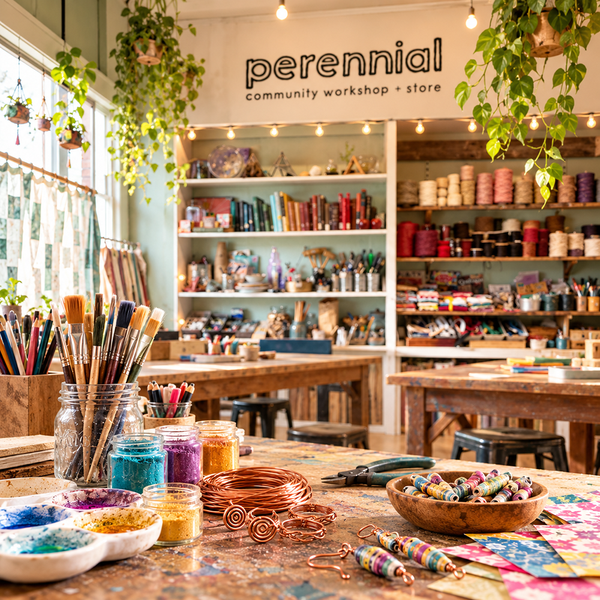
When their entire understanding of art materials consists of pencils, crayons, markers, and watercolor.
Technically, we've given them choice.
But it's a very small choice because their knowledge is small.
Then introduce:
- Printmaking
- Fibers
- Clay
- Collage
- Sculpture
- Assemblage
- Digital media
- Bookmaking
- Different painting processes
- Different drawing materials
- Artists who combine media in ways the student never imagined
Now ask again: what might work for your idea?
The student has more possibilities to choose from.
Knowledge can increase agency.
That's one of the places where structured teaching and TAB can work beautifully together.
Sometimes Everyone Can Learn Something Together
There can also be good reasons for a whole class to focus on the same thing.
Maybe everyone is learning how to safely use a new tool.
Maybe we're introducing a technique nobody has encountered before.
Maybe we're studying a particular artist, tradition, historical period, or artistic question.
Maybe students need some shared experience before they're ready to use a process independently.
A teacher-led lesson doesn't automatically undermine artistic agency.
The question is whether every lesson has to end with: and now all of you will make approximately the same thing.
Perhaps everyone can learn the same technique without having to arrive at the same artwork.
We can demonstrate printmaking.
Then ask: what could you do with this?
We can study an artist.
Then ask: what ideas does their work give you?
We can explore color theory.
Then let students decide where that knowledge belongs in their own work.
Shared learning doesn't require identical outcomes.
 Jessica Carey
The Teacher Example Isn't Inherently the Problem
I think this distinction matters too, especially considering those students who become discouraged when their work doesn't resemble the teacher's.
The existence of a teacher example isn't necessarily harmful.
Sometimes seeing a finished example makes an unfamiliar process much easier to understand.
But we can think carefully about what the example communicates.
Is it: this is what yours should look like?
Or: this is one thing that can happen when these materials and techniques are used?
- Could we show multiple possibilities rather than one ideal result?
- Could we demonstrate on scraps rather than creating a polished exemplar students feel expected to reproduce?
- Could we show professional artwork alongside children's work?
- Could we explicitly discuss why different solutions are expected?
The example can become a possibility rather than a standard.
That distinction may seem small to an adult.
To a child staring back and forth between their artwork and ours, it may not feel small at all.
Structure Can Expand Agency—or Replace It
Maybe this is where my concern with heavily traditional approaches really lives.
The problem isn't structure.
Students need structure.
The problem isn't instruction.
Students deserve instruction.
The problem isn't teaching skills.
Skills give people more ways to express what they're trying to express.
The question is: what is all that structure ultimately for?
A demonstration can give a student another tool.
An artist study can reveal another possibility.
A technical exercise can build capability.
A teacher-directed experience can introduce something a student never would have encountered independently.
Those things can all increase what a student is able to do.
But if the teacher continually decides: what will be made, which materials will be used, what steps will be followed, what successful work should look like, and when the work is complete, then students may gain artistic knowledge while receiving comparatively fewer opportunities to decide what to do with that knowledge.
That's the distinction I care about.
It Doesn't Have to Be All or Nothing
And perhaps this is particularly important in schools where completely restructuring an art program around TAB isn't realistic.
TAB doesn't have to appear only as: we're a TAB classroom now; everything changes.
- What if students had one choice-based project?
- One open studio period?
- A unit in which everyone learned several techniques and then selected which one supported their own idea?
- What if a teacher-directed project contained three meaningful student choices?
- What if students could select materials? Subject matter? Scale? Presentation?
What if the final part of a structured unit asked students to take what they'd learned and do something the teacher hadn't already designed for them?
Even small shifts can move some artistic decision-making back toward the student.
A classroom doesn't have to fit perfectly into one educational philosophy before students can benefit from greater agency.
Perhaps the Best Question Isn't “TAB or DBAE?”
Educational philosophies can easily become camps.
Which approach is better?
Which one should schools use?
Which one is right?
But perhaps there's a more useful question: what does this particular teaching decision allow students to learn and practice?
Sometimes they need information.
Teach it.
Sometimes they need a demonstration.
Show them.
Sometimes they need structure.
Provide it.
Sometimes they need feedback.
Give it.
Sometimes they need to encounter an artist, material, technique, or idea they never would have chosen because they didn't know it existed.
Introduce them.
And sometimes—they need us to stop making the next decision for them.
Give them what they need to make an informed choice.
Then give them a real choice to make.
Because perhaps the most powerful relationship between traditional instruction and TAB isn't choosing one and rejecting the other.
It's recognizing that what we teach students can become the foundation for what they eventually learn to choose for themselves.
Give Them Something Worth Choosing With
Art students need knowledge.
They need materials.
Techniques.
Demonstrations.
History.
Vocabulary.
Examples.
Feedback.
Guidance.
They need teachers who can introduce them to possibilities they don't know exist yet.
But they need something else, too.
They need opportunities to decide what to do with what they've learned.
More Than Completing the Project
There will always be value in learning how something works.
How to mix a color.
Build a structure.
Use a tool safely.
Create a print.
Work with clay.
Understand an artistic movement.
Look closely at an artwork.
But perhaps art education shouldn't end with: can you successfully do what I just taught you?
Eventually, another question matters: what can you do with it that I didn't tell you to do?
That's where knowledge begins becoming agency.
What we've taught becomes something students can draw from while developing ideas of their own.
And what began as: here's what I want to teach you can eventually become: now, what will you do with it?
What Do They Learn About Themselves?
Years from now, most students probably won't remember every art project they completed.
They may not remember the vocabulary from every unit.
They may forget which technique belonged to which lesson.
But they may remember something much more fundamental about how the art room made them feel.
I'm good at this.
Or:
- I'm terrible at art.
- Other people are creative, and I'm not.
Or perhaps:
- I can have ideas.
- I can figure things out.
- I can learn something I don't know.
- I can ask someone for help.
- I can try again when something doesn't work.
- I can make choices that are different from someone else's.
- There are things I can do that someone else can't—and things they can teach me, too.
Those beliefs can extend far beyond one artwork.
Maybe Empowerment Is Part of the Curriculum
This is why I keep coming back to TAB.
Not because every art room must implement it identically.
Not because teacher-led instruction has no place.
Not because every student should have unlimited choice at every moment.
And not because TAB can magically eliminate comparison, frustration, or insecurity.
But because its central philosophy asks us to take students seriously as creative thinkers.
Give them tools.
Teach them skills.
Introduce them to artists.
Expose them to unfamiliar possibilities.
Help when they need help.
Challenge them.
Create boundaries where boundaries are necessary.
Build a community where knowledge can move between people.
And then, sometimes: trust them with a decision that actually belongs to them.
Let Them Become Someone We Couldn't Have Designed
Maybe that's the part I find most beautiful.
If we decide exactly what every student will make, how they'll make it, and approximately what successful work should look like, we already know quite a lot about what will emerge.
But when students begin making meaningful choices, something becomes less predictable.
One child becomes fascinated with fibers.
Another starts building elaborate structures.
Someone discovers printmaking.
Someone combines materials in a way we hadn't considered.
Someone develops an idea we never would have assigned.
Someone struggles, changes direction, asks a classmate for help, and eventually finds a solution that belongs entirely to them.
The teacher couldn't have designed all of those outcomes in advance.
Perhaps we weren't supposed to.
Our job doesn't have to be creating twenty little versions of our own artistic thinking.
It can be helping twenty different people develop theirs.
And maybe the child who once looked across the room and thought: their art is better than mine can gradually learn to ask something else: what kind of artist am I?
We don't need to answer that question for them.
We can give them knowledge.
Possibilities.
Tools.
Community.
Room to experiment.
And enough meaningful choice to begin discovering the answer themselves.
Because perhaps the art room shouldn't only be a place where students learn about artists.
It can be a place where they learn how to become one.
Want even more content about creativity and art?
Be sure to check out all of our creative chronicles!
If you'd like to see examples of my work, you can find some of my art and creations at Redbubble and Gumroad!
Looking to learn more about my recent journey?
Check out some of these articles:
-Hidden Gems for St. Louis Artists
-Hidden Gems for Autistic & Neurodivergent Adults
-Learning What Love Was Supposed to Feel Like
-I Wasn't Broken--I'm Burned Out
-The Difference Between Resting and Giving Up
 Jessica Carey