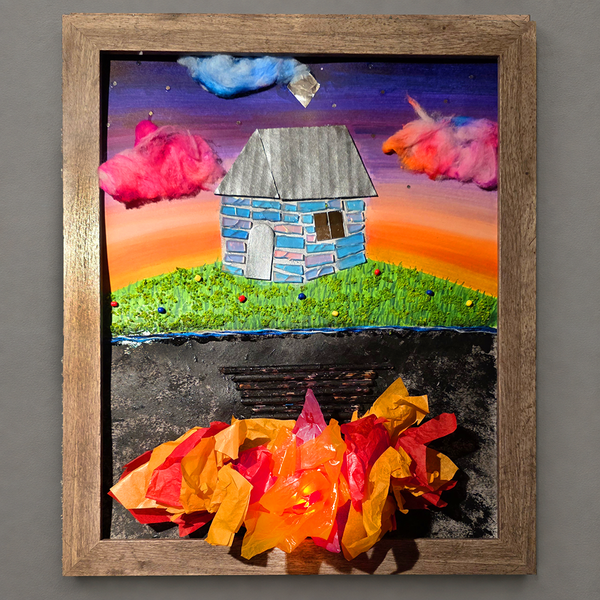

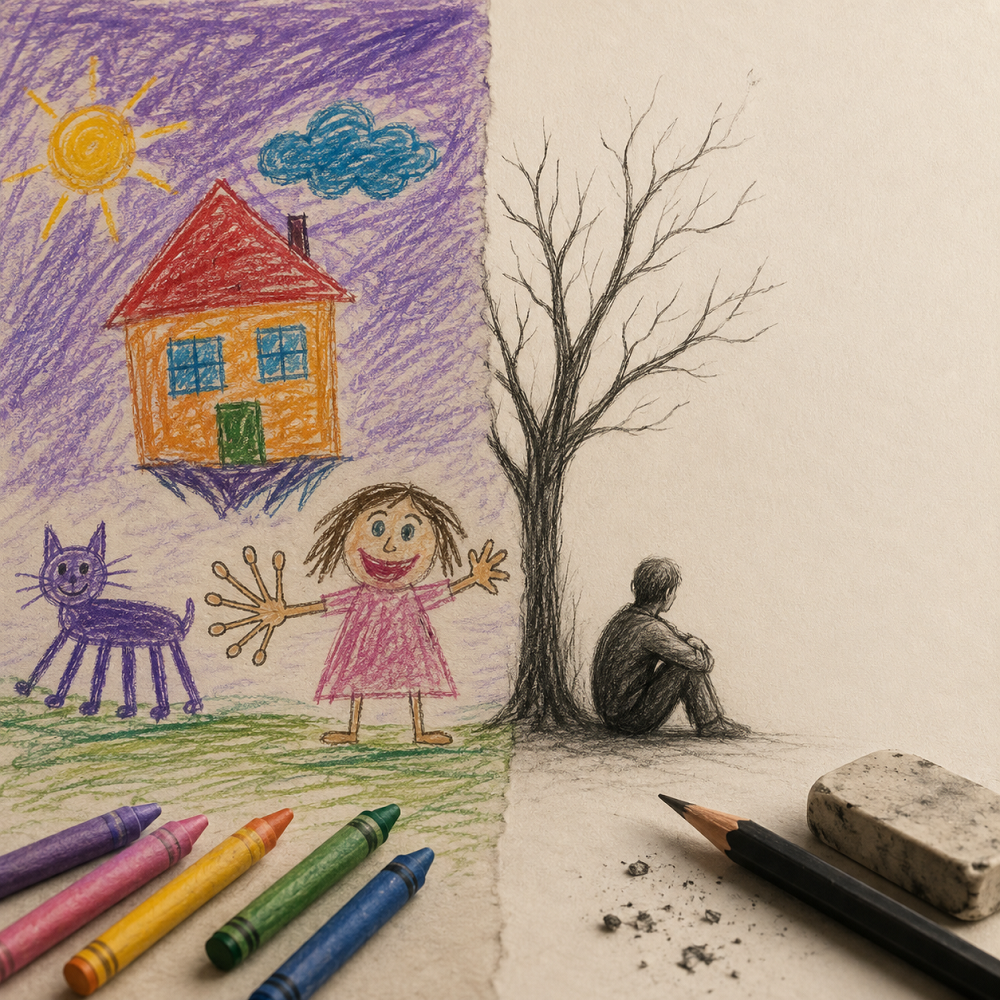
A child makes a drawing.
The day-time sky is purple.
The cat has six legs.
The house is floating slightly above the ground for reasons nobody can explain.
One hand has twelve fingers while the other has three.
And the child comes running over: look what I made!
Not:
- Are the proportions correct?
- Does this demonstrate enough technical skill?
- Is this worth showing anyone?
- Do you think I'm talented?
- Should I even bother drawing if this is what my drawings look like?
Just: look what I made.
There's something wonderfully uncomplicated about that.
Something existed in their imagination.
Now, in some imperfect little way, it exists outside of them too.
Somewhere, Making Gets More Complicated
Of course, childhood isn't a magical period when nobody cares whether they're good at anything.
Children compare themselves.
They become embarrassed.
They notice when another child can draw something they can't.
They can become painfully aware that the teacher's example looks nothing like theirs.
Some children decide remarkably young: I'm bad at art.
So perhaps the interesting thing isn't that children are naturally fearless creators and adults somehow ruin everything.
It's that many of us begin making before we understand that making is something we're supposed to be good at.
A toddler doesn't need to establish artistic competence before picking up a crayon.
A child doesn't necessarily need to know how a cardboard box will become a spaceship before cutting holes into it.
They can begin with: I wonder what happens if...
And somewhere along the way, many of us become much more interested in another question: what if it turns out bad?
 Jessica Carey
When Did “Bad” Become a Reason Not to Begin?
That's the shift I find fascinating.
Adults routinely say things like:
- I can't draw.
- I'm terrible at painting.
- I'd love to try pottery, but I'd probably be awful at it.
- I'm not creative enough for that.
And sometimes I want to ask: how would you possibly be good at something you've never learned how to do?
We understand this perfectly well in other contexts.
Nobody expects to sit at a piano for the first time and immediately perform a concerto.
Nobody puts on ice skates for the first time and thinks something has gone terribly wrong because they aren't an Olympic figure skater.
And yet creativity can carry this peculiar expectation that if we have any real artistic ability, evidence of it should appear almost immediately.
If the first drawing looks bad, maybe we can't draw.
If the first painting is muddy, maybe painting isn't for us.
If everyone else in the class seems more capable, maybe we don't belong there.
A beginning becomes a verdict.
Maybe the Problem Isn't Bad Art
Because making something badly isn't particularly remarkable.
Beginners make beginner work.
People misunderstand materials.
Hands don't yet know how to do what brains are asking them to do.
Ideas exceed technical ability.
Experiments fail.
Sometimes we make something that looks absolutely nothing like what we imagined.
That's not a strange malfunction in the creative process.
It's part of having a creative process at all.
Perhaps what's more interesting is how much meaning we eventually attach to that outcome.
A child can make an objectively questionable drawing and proudly say: look what I made!
An adult can make an objectively questionable drawing and think: this proves I shouldn't draw.
Same ugly drawing.
Very different conclusion.
So perhaps adults aren't simply afraid of making bad art.
We're afraid of what making bad art might say about us.
That we're untalented.
Uncreative.
Embarrassing.
Not really artists.
That everyone else belongs here more than we do.
That we should have known better than to try.
And once an imperfect object becomes evidence about the person who made it, beginning becomes much more dangerous.
Because now we're not simply asking: what happens if I try this?
We're asking: what happens if I try this and discover I'm bad at it?
Maybe that's where the beginner begins to disappear.
Not when we develop standards.
Not when we learn to recognize skill.
Not even when we start wanting our work to be good.
But when being bad at something becomes a reason we're afraid to begin.
And perhaps the way back isn't convincing ourselves that everything we make is secretly good.
Maybe it's learning that we're allowed to make something bad and still make the next thing.
Somewhere Along the Way, the Stakes Changed
As we grow, we get better at seeing.
We notice proportion.
Technique.
Craftsmanship.
Control.
We recognize when something looks polished and when it doesn't.
We become better at comparing what we intended to make with what actually appeared.
That's part of learning.
The strange part is what we sometimes do with that knowledge.
Instead of: this drawing doesn't look the way I wanted it to.
We arrive at: I'm bad at drawing.
And sometimes: I'm bad at art.
Or even: I'm not creative.
A judgment about an object becomes a judgment about the person who made it.
We Learn What “Good” Looks Like
A very young child may not recognize all the ways their drawing differs from the thing they're trying to represent.
An adult usually does.
We know that the eye is too high.
The perspective is wrong.
The shadow makes no sense.
The supposedly symmetrical bowl is leaning dramatically to one side.
Our ability to see often develops faster than our ability to make.
That can create an uncomfortable gap.
We know what we wanted.
We can recognize what skilled work looks like.
And we can see perfectly well that ours isn't there yet.
That awareness isn't the enemy.
It's part of developing discernment.
But it can become painful when we interpret the gap as evidence that we don't belong.
Comparison Gives Us a Measuring Stick
Then there are other people.
The classmate whose drawing seems effortless.
The friend who's been crocheting for ten years.
The artist online whose watercolor washes behave in ways ours absolutely refuse to.
The instructor demonstrating a technique they've practiced hundreds of times.
We see the result.
What we don't always feel is the time inside it.
Years of practice can become invisible when we're looking only at the finished work.
So we place their hundredth attempt beside our first and treat the difference as evidence of talent.
Of course we're not measuring equivalent things.
But emotionally, that doesn't always matter.
Their work looks good.
Ours doesn't.
And suddenly I'm learning becomes they're artistic and I'm not.
 Jessica Carey
The Artwork Starts Proving Something
This is where the stakes really change.
If I make something purely to see what happens, an ugly result isn't particularly threatening.
Well, that happened.
But if I'm making something to discover whether I'm good at art, the exact same result carries much more weight.
Now the painting isn't just a painting.
It's a test:
- Did I pass?
- Am I talented?
- Do I belong in this class?
- Was buying these supplies a waste of money?
- Should I show anyone?
- Should I try again?
Perhaps even: who did I think I was, believing I could do this?
That's an enormous burden to place on one little experiment.
Standards Aren't the Problem
I don't think the solution is pretending we can't tell when something is technically stronger than something else.
We can.
And wanting to improve isn't a tragedy.
There's nothing wrong with looking at your drawing and thinking: I want to understand anatomy better.
Or: that composition isn't working.
Or: I need more practice controlling this material.
Standards can help us grow.
Discernment can help us identify what we want to learn next.
The problem comes when: this needs work turns into: I shouldn't be doing this.
One evaluates the work.
The other disqualifies the maker.
And those are very different judgments.
A Bad Result Can Stay Small
Maybe this is one of the things we lose as beginnerhood becomes uncomfortable: the ability to let an unsuccessful attempt mean only what it means.
The watercolor became muddy.
The clay cracked.
The drawing looks strange.
The knitting has somehow acquired three extra stitches despite nobody inviting them.
The experiment didn't work.
That's information.
It doesn't necessarily need to become a statement about our creativity, intelligence, potential, or right to continue.
Because perhaps one of the most important differences between a beginner who keeps making and one who stops isn't that the first beginner makes better work.
It's that they can survive making work they don't like.
They can say: that didn't work without automatically adding: therefore I can't do this.
It's much easier to experiment when a bad result means: “That didn't work” rather than: “I'm bad at this.”
And perhaps keeping the beginner alive begins with learning to tell the difference.
Adults Think Beginners Should Somehow Already Be Good
There's something peculiar about becoming an adult.
We know how learning works.
We know nobody emerges from the womb knowing how to throw pottery, paint with watercolor, carve wood, knit a sweater, or draw a convincing human hand.
We understand that skill develops through practice.
And then we try something new and think: why am I so bad at this?
Well... because you've done it twice.
Of course you're bad at it.
Or at least, you might be.
You're a beginner.
And somehow that perfectly ordinary explanation can feel surprisingly difficult to accept.
We don't merely want to learn.
We want to already know.
We Want to Skip the Awkward Part
Beginning is messy.
Your hands don't know what they're doing yet.
You use too much water.
Too little pressure.
The wrong needle size.
The clay collapses.
The glue gets everywhere.
You discover approximately fourteen things you didn't know you needed to know.
You watch someone experienced perform the same process and think: why does that look so easy when they do it?
Because eventually, some things do become easy.
Movements become familiar.
Materials become predictable.
You recognize problems sooner.
You learn what to do when something goes wrong.
You stop having to consciously think through every tiny decision.
But we usually encounter skilled people after they've accumulated all of that experience.
We see fluency.
We don't see every awkward attempt that helped create it.
Then we pick up the material for the first time and expect our hands to somehow know what theirs learned over years.
“I'm Bad at This” May Be Completely True
Maybe you are bad at it.
I don't think we need to be afraid of saying that.
Sometimes reassurance becomes: no, you're amazing! Everything you make is wonderful!
But that isn't necessary.
Your first painting might genuinely be terrible.
Your first knitted square may be shaped more like an unidentified continent.
Your first ceramic bowl may technically meet the definition of container only because gravity is helping.
That's okay.
Because I'm bad at this and I will always be bad at this are two completely different statements.
So are: I'm bad at this and I shouldn't be doing this.
Being bad at something can simply describe your current relationship with a skill.
It doesn't have to become an identity.
We Compare Our Beginning to Someone Else's Middle
This becomes especially difficult because we live surrounded by finished work.
We see the beautiful illustration.
Not the abandoned sketches.
The perfect sweater.
Not the tangled yarn and uneven first attempts.
The polished ceramic collection.
Not every collapsed pot.
The twenty-second version of an idea.
Not versions one through twenty-one.
Even demonstrations can be deceptive—not because the instructor is doing anything wrong, but because someone who knows a process well can make difficult things look remarkably simple.
So we try.
It doesn't look like theirs.
And instead of concluding: they have significantly more experience than I do,
We conclude: I don't have whatever they have.
Maybe sometimes natural aptitude does play a role.
People begin with different strengths.
Some skills come more easily to some people than others.
But even aptitude doesn't magically eliminate learning.
And someone else's advanced ability doesn't tell us very much about what our beginner ability might eventually become.
You Can't Practice Without Producing Beginner Work
This is the part perfectionism doesn't particularly enjoy.
If you want to learn to draw, you probably have to make drawings that aren't very good.
If you want to paint, some paintings probably won't work.
If you want to sew, seams may wander.
If you want to sculpt, forms may collapse.
If you want to try something unfamiliar, you have to make decisions before you possess all the knowledge you wish you had.
There's no clever way around that.
We can learn from teachers.
Watch demonstrations.
Read instructions.
Practice foundational skills.
Prepare ourselves.
Those things can make learning easier.
But eventually, we still have to do the thing we're not yet good at.
And doing it imperfectly is often part of how we become less imperfect.
Maybe making bad art isn't evidence that you shouldn't make art. Maybe making bad art is one of the ways people learn how to make art.
Beginner Is a Stage, Not a Verdict
There's a tremendous difference between: this looks like beginner work and this person isn't capable of making art.
The first might be entirely accurate.
Beginners often make beginner work.
That's why we have the word.
But beginner isn't an insult.
It doesn't mean untalented.
It doesn't mean uncreative.
It doesn't mean hopeless.
It means: you are near the beginning.
And perhaps adults would find learning less threatening if we allowed that to be an ordinary place to stand.
You don't have to know whether you'll eventually become excellent.
You don't have to promise yourself that enough practice will turn you into a master.
You don't even have to want mastery.
Maybe you're trying pottery because pottery looks fun.
Maybe you want to learn enough knitting to make a scarf.
Maybe you bought watercolors because you wondered what painting would feel like.
That's enough reason to begin.
The Only Way Out Is Through
There's an uncomfortable truth here:
If you're unwilling to be bad at something, you may never get the opportunity to discover whether you could become good at it.
Because the person who eventually makes their hundredth drawing has to make the first one.
The experienced ceramicist once touched clay without knowing how it would behave.
The confident knitter once had to figure out how to hold the needles.
Every developed skill contains a history of not knowing yet.
Maybe some people progress faster.
Maybe some begin with advantages.
Maybe some never reach the level they imagined.
But nobody gets to begin from the end.
And perhaps that's one of the things adulthood can make us forget.
Being bad at something isn't necessarily evidence that you've reached your limit.
Sometimes it's simply evidence that you've reached your beginning.
The Beginner Has to Be Willing to Look a Little Ridiculous
Being a beginner requires a peculiar kind of vulnerability.
You have to do something before you know how to do it.
Your hands may not cooperate.
Your idea may exceed your ability.
You may misunderstand the instructions.
Ask an obvious question.
Use the wrong tool.
Make a strange decision.
Watch someone beside you accomplish effortlessly what you've been struggling with for twenty minutes.
And sometimes, other people are there to see it.
That's uncomfortable.
Especially as an adult.
Children are expected to be learning things constantly.
Adults are often expected—or expect themselves—to be competent.
We know things.
We handle things.
We solve problems.
We develop expertise.
So voluntarily entering a space where we don't know what we're doing can feel surprisingly exposing.
Maybe that's why the sentence: I've never done this before can feel less like neutral information and more like a warning.
 Jessica Carey
Creativity Makes Our Not-Knowing Visible
There's a difference between privately not knowing something and producing physical evidence of it.
The crooked drawing exists.
The lopsided bowl exists.
The scarf that's somehow getting wider with every row exists.
We can look at the thing and see: yep, I did not know what I was doing there.
And someone else can see it too.
That's part of what makes creative beginnerhood vulnerable.
Our learning leaves artifacts.
But perhaps we've confused visible learning with embarrassment.
Of course the beginner's work looks different from the expert's.
It should.
If it didn't, there wouldn't be much learning left to do.
We Want to Look Capable While Becoming Capable
That's the impossible bargain.
We want to learn something new while avoiding ever appearing inexperienced.
We want to become skilled without producing evidence that we once lacked skill.
We want to ask questions without revealing that we don't know the answers.
We want to experiment without anything visibly failing.
We want the freedom of beginnerhood without the awkwardness of actually being a beginner.
But those things don't fit together very well.
To become capable, we sometimes have to tolerate looking incapable for a while.
Not because humiliation is somehow good for us.
Not because anyone deserves to be mocked for learning.
But because uncertainty and imperfection are ordinary consequences of doing something unfamiliar.
Maybe Nobody Is Judging as Much as We Think
And sometimes, the audience we're afraid of isn't particularly interested.
Someone else's crooked pottery bowl probably isn't occupying much space in your mind.
You're busy trying to keep your bowl from collapsing.
The person beside you may be thinking: everyone here knows what they're doing except me.
while you're thinking exactly the same thing.
Even when someone does notice our mistakes, noticing isn't necessarily condemnation.
They might recognize the problem because they've made it themselves.
They might help.
They might laugh with us when something goes spectacularly wrong.
They might not care at all.
And yes, occasionally someone may judge.
We can't guarantee otherwise.
But if avoiding all possible judgment becomes a requirement for trying something new, the cost is enormous.
We have to avoid being seen learning.
Looking Ridiculous Is Sometimes Evidence That You Tried Something
There's something freeing about allowing a creative experiment to be a little embarrassing.
Wear the terrible first handmade hat.
Keep the bizarre ceramic creature.
Laugh at the drawing whose hands appear to belong to an entirely different species.
Not because everything unsuccessful needs to be celebrated.
But because sometimes the object says something more interesting than: I wasn't very good at this.
It also says: I tried something I didn't know how to do.
That matters.
The person who never attempts anything unfamiliar can protect themselves remarkably well from looking like a beginner.
They can also protect themselves from discovering a great deal.
There Is No Dignified Shortcut Through Beginner-hood
You can prepare.
Learn.
Watch.
Read.
Ask questions.
Practice.
Those things help enormously.
But eventually, you still have to make the first mark.
Throw the first lump of clay.
Cast on the first stitches.
Cut the material.
Try the unfamiliar technique.
And whatever happens next may not be particularly impressive.
That's okay.
To become good at something, we sometimes have to tolerate being visibly not-good at it first.
Maybe that's one of the quiet acts of courage inside creativity.
Not producing something extraordinary.
Not impressing anyone.
Not proving that we were secretly talented all along.
Just being willing to stand in that uncomfortable space between I don't know how to do this and I'm learning.
Because perhaps the beginner doesn't disappear when we become adults.
The beginner disappears when protecting ourselves from looking inexperienced becomes more important than giving ourselves permission to experience something new.
Perfectionism Makes the Creative World Smaller
Wanting to make something well isn't a problem.
Wanting to improve isn't a problem.
Caring about craftsmanship isn't a problem.
Noticing that something could be better isn't a problem.
Those things can help us grow.
The problem begins when I want to make this well quietly becomes if I can't make this well, I shouldn't make it at all.
Because once that happens, perfectionism doesn't merely affect the finished artwork.
It starts deciding what we're willing to attempt.
We Choose What Feels Safe
If failure feels dangerous, unfamiliarity starts looking dangerous too.
Maybe we stop experimenting with materials we don't understand.
We choose the subject we already know how to draw.
Use the technique that reliably works.
Follow the tutorial exactly rather than wondering what would happen if we changed something.
Avoid the ambitious idea because we're not sure we can execute it.
Leave the expensive supplies untouched because we're afraid of wasting them.
Keep the beautiful sketchbook pristine because the first imperfect drawing would somehow ruin it.
Sometimes the fear isn't even that the result will embarrass us.
It's that an unsuccessful result will make the time, money, or materials feel wasted:
- Why use the good paper if the drawing might be terrible?
- Why pay for a class if we might discover we're not naturally good at it?
- Why spend an afternoon making something we may eventually throw away?
But learning consumes resources, too.
We don't necessarily waste materials by using them imperfectly; sometimes we're using them to learn what we couldn't have learned without making something.
There is nothing wrong with returning to familiar things.
Sometimes we genuinely want to.
But there's a difference between I love making this and this is the only thing I trust myself not to mess up.
One is preference.
The other is a boundary built from fear.
The Better Our Standards Become, the Easier It Can Be to Freeze
There's a strange irony here.
As we learn more about art, we often become better at imagining what something could be.
We can picture the composition.
The colors.
The texture.
The finished object.
We can recognize extraordinary work when we see it.
And then we look at what our current abilities can actually produce.
There's a gap.
Perfectionism looks at that gap and says: don't start until you know you can cross it.
But creativity often works in exactly the opposite direction.
You discover what the piece can become by making it.
You make a decision.
Respond to what happened.
Change direction.
Discover something unexpected.
Make another decision.
Sometimes the finished piece isn't what you originally imagined because the process taught you something your imagination couldn't have predicted.
But none of that can happen if the imagined perfect result becomes a prerequisite for beginning.
 Jessica Carey
Perfectionism Can Disguise Itself as High Standards
This is what makes it tricky: I just have high standards.
Maybe, but high standards and perfectionism don't necessarily produce the same behavior.
A useful standard might say: this isn't working yet. What could I change?
Perfectionism may say: this isn't working. I shouldn't have tried it.
A useful standard can encourage revision.
Practice.
Learning.
Attention.
Perfectionism can make the existence of an imperfect attempt feel intolerable.
And eventually, the safest artwork becomes the artwork we never make.
It can't be ugly.
Can't fail.
Can't embarrass us.
Can't reveal what we don't know.
It also can't teach us anything.
We Lose More Than Failed Artwork
That's the real cost.
When we avoid making something because it might turn out badly, we don't only avoid the bad outcome.
We also lose every other possible outcome.
The technique we might have discovered.
The material we might have loved.
The mistake that might have produced a better idea.
The skill that would have developed through practice.
The strange little object that wasn't good but made us laugh.
The project that might have become something completely different halfway through.
Maybe even the medium we could have fallen in love with if we'd been willing to be terrible at it first.
We don't know what would have happened.
That's precisely the point.
Perfectionism doesn't only change how we make; it changes what we're willing to attempt.
And every time the acceptable range becomes: only make what you already know you can make well,
the creative world gets a little smaller.
Standards Can Stay. Fear Doesn't Have to Run Them.
The answer isn't to stop caring.
It isn't to declare every piece successful.
It isn't to pretend we can't distinguish between our strongest work and the thing that went spectacularly wrong yesterday.
We can want to improve.
We can develop technical skill.
We can redo something.
We can dislike what we made.
We can even decide: nope, this one's terrible.
And still make another one.
Because perhaps the healthiest alternative to perfectionism isn't: everything I make is good.
It's: everything I make doesn't have to be good for me to keep making.
That leaves room for standards and experimentation.
For discernment and curiosity.
For wanting to improve without demanding that improvement happen before we've had the experiences necessary to create it.
The goal isn't to make bad art forever.
It's to stop treating the possibility of bad art as a reason not to make anything at all.
Because a creative practice that contains some failures can keep expanding.
A creative practice that must guarantee success before it begins has almost nowhere left to go.
What If Bad Art Is Allowed to Exist?
Maybe the painting is bad.
Not secretly brilliant.
Not misunderstood.
Not “good in its own way.”
Just... bad.
The colors don't work.
The composition is awkward.
The idea didn't translate.
The technique wasn't there yet.
The thing you imagined and the thing sitting in front of you appear to have only a distant acquaintance with each other.
Okay, what happens now?
We Don't Have to Rescue Everything We Make
There's a temptation to make creativity safe by insisting that nothing is ever really bad.
There's no such thing as bad art!
I understand the impulse.
Especially when someone is learning, harsh judgment can crush the willingness to continue.
But perhaps we don't need to eliminate the possibility of bad art in order to protect creativity.
Maybe we can eliminate something else: the idea that making bad art is catastrophic.
You can dislike something you made.
You can recognize that it doesn't work.
You can compare it with what you hoped to accomplish and conclude: yeah, I missed that one.
You don't have to hang it on the wall.
You don't have to post it.
You don't have to keep it.
You certainly don't have to convince yourself that you love it.
Sometimes an unsuccessful artwork can simply be an unsuccessful artwork.
Not Everything Has to Become a Lesson, Either
We often try to redeem failure by saying: but you learned something!
And hopefully, sometimes you did.
Maybe you discovered why the clay cracked.
Learned what happens when those colors mix.
Realized that material doesn't behave the way you expected.
Figured out what you'd change next time.
Those lessons are valuable.
But I think there's another kind of permission worth offering: maybe you don't have to extract a profound lesson from every bad thing you make either.
Maybe the experiment failed and you're not entirely sure why.
Maybe you learned very little.
Maybe you spent an hour making something ugly.
Maybe it wasn't even particularly fun.
That's allowed, too.
A creative practice doesn't have to justify every unsuccessful object by proving that it contributed directly to future greatness.
Sometimes well, that didn't work is enough.
The Bad Piece Can Go Somewhere
Maybe you paint over it.
Unravel it.
Break it down for parts.
Reuse the materials.
Cut it apart for collage.
Stick it in a drawer.
Keep it because something about its ridiculousness makes you happy.
Throw it away.
Or leave it exactly as it is.
The object doesn't have to become precious merely because you made it.
And getting rid of something you created doesn't erase the fact that you created.
That's another freedom beginners sometimes need.
Making something doesn't obligate us to preserve it forever.
The point can be the making.
Your Creative Practice Is Bigger Than One Object
Perfectionism can make every artwork feel strangely important.
This piece has to work.
This drawing has to prove I can draw.
This project has to justify the materials.
This attempt has to demonstrate improvement.
But a creative practice can contain hundreds or thousands of objects.
Some might be wonderful.
Some might be ordinary.
Some might teach you something.
Some might surprise you.
Some might be catastrophes.
One bad painting doesn't have to carry the weight of your entire relationship with painting.
It's one painting.
One attempt.
One moment in a much larger practice.
And maybe that's one of the freedoms experienced artists eventually discover: you can make another thing.
We Usually Don't See Everyone Else's Bad Art
It's easy to forget this when we're surrounded by polished work.
People show us what they choose to show us.
An exhibition contains selected pieces.
A portfolio is curated.
An artist's social media may feature their strongest work.
A finished book doesn't contain every discarded draft.
We encounter the things that survived the process.
We don't necessarily see everything that didn't.
So when our own creative life includes awkward experiments, abandoned projects, and spectacular failures, it can seem unusually messy compared with everyone else's.
But we're comparing our entire process with their selected evidence.
Artists make things that don't work.
Beginners make things that don't work.
People who have been creating for fifty years make things that don't work.
The existence of unsuccessful work isn't evidence that something has gone wrong with the creative life.
It may simply be evidence that there is a creative life.
Not Everything You Make Has to Earn Its Existence
Maybe that's the permission we've been missing.
Not everything you make has to become:
- Beautiful
- Useful
- Sellable
- Displayable
- Impressive
- Meaningful
- Educational
- Evidence that you're improving
Sometimes you can make a weird little thing.
Look at it.
Think: well, that's unfortunate.
And move on.
Because not everything you make has to earn the right to have been made.
The bad drawing was allowed to exist.
The collapsed sculpture was allowed to exist.
The muddy painting was allowed to exist.
And you are allowed to exist on the other side of making it without turning the experience into a verdict about yourself.
Maybe you try again.
Maybe you don't.
Maybe you switch materials.
Maybe you laugh.
Maybe you decide that particular medium isn't for you.
But the possibility of making something bad no longer has to be an emergency.
And once bad art is allowed to exist, something else becomes possible, too: we become free to make things before we know whether they'll be good.
 Jessica Carey
Let Yourself Be a Beginner Again
Maybe we can't completely return to: look what I made!
Adulthood changes the way we see.
We know more.
We notice more.
We recognize skill.
We develop standards.
We can look at something we've made and see exactly where it falls short of what we imagined.
That awareness isn't something we need to get rid of.
Perhaps we don't need to become less discerning.
Maybe we need to become less afraid of what our discernment might find.
Because you can know the drawing is awkward and still draw another one.
You can see that the painting didn't work and still pick up the brush again.
You can recognize that everyone else in the class has more experience and still belong in the room.
You can be disappointed.
Frustrated.
Embarrassed.
Completely baffled by what your hands just produced.
And still be a beginner.
Make Before You Know How
Try the unfamiliar material.
Take the class you're convinced everyone else will be better at.
Open the beautiful sketchbook.
Use the supplies you've been saving because you're afraid of wasting them.
Make the first crooked stitches.
The strange drawing.
The lopsided bowl.
Start the project you aren't entirely sure how to finish.
Not because the outcome doesn't matter.
Not because everything you make will secretly be wonderful.
But because you cannot require yourself to already possess the knowledge you're trying to gain.
Some things can only be learned by entering the part where you don't know yet.
Let the First Thing Be the First Thing
Maybe your first attempt is terrible.
Let it be terrible.
It doesn't have to prove anything.
It doesn't have to justify buying the supplies.
It doesn't have to reveal hidden talent.
It doesn't have to become the beginning of a new career.
It doesn't even have to become something you particularly enjoy.
It can simply be: the first time I tried this.
And if you want to make a second one, make the second one.
If that one's bad too?
Well, now you've made two.
That's how a practice begins.
Not with proof that we're destined to become extraordinary.
With the willingness to continue without that proof.
 Jessica Carey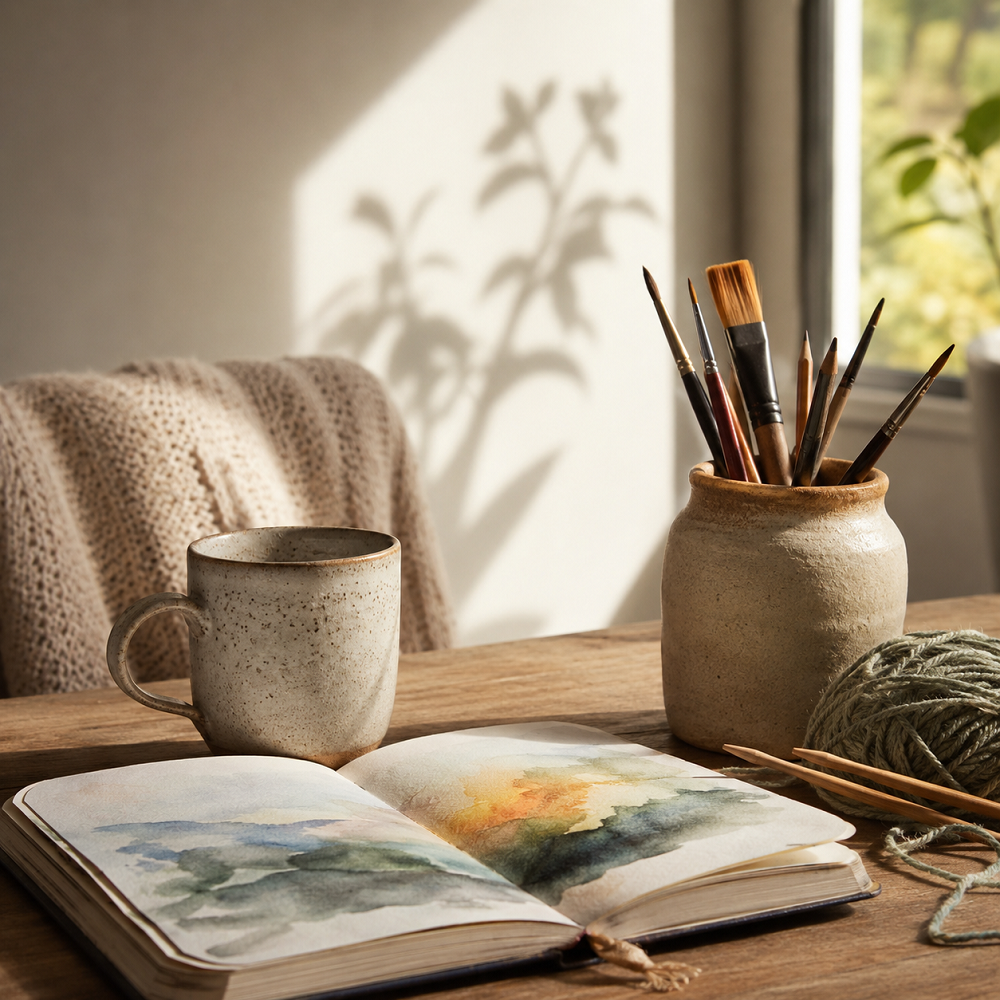
Keep the Beginner Alive
Maybe that's what children sometimes understand before the stakes become so complicated.
The joy isn't always: look how good this is.
Sometimes it's simply: look what I made.
Something exists because you wondered what would happen if you made it.
Perhaps adulthood doesn't require us to lose that entirely.
We can develop standards without turning every object into a test.
We can recognize skill without using someone else's skill as evidence against ourselves.
We can want to improve without demanding improvement before we've begun.
We can make something bad without deciding that making was a mistake.
And when something goes wrong, perhaps instead of: see? I'm not good at this. I shouldn't have tried.
We can practice something smaller: well, now I know what happens when I try that.
And then, if we want to—make something else.
Because the beginner isn't someone who has failed to become good yet.
The beginner is someone willing to make before they know how.
And perhaps that's a part of ourselves worth keeping alive.
Want even more content about creativity and art?
Be sure to check out all of our creative chronicles!
If you'd like to see examples of my work, you can find some of my art and creations at Redbubble and Gumroad!
Looking to learn more about my recent journey?
Check out some of these articles:
-Hidden Gems for St. Louis Artists
-Hidden Gems for Autistic & Neurodivergent Adults
-Learning What Love Was Supposed to Feel Like
-I Wasn't Broken--I'm Burned Out
-The Difference Between Resting and Giving Up
-What Chronic Autistic Burnout Actually Feels Like
-When You Had to Raise Yourself
 Jessica Carey