There is a peculiar moment that can happen while making something.
You step back.
Look at it.
Tilt your head.
Something doesn't seem quite right.
So you change it.
You step back again.
Maybe that's better.
Or maybe now something else looks wrong.
So you change that.
Then you wonder whether the first version was actually better.
You change it back.
Almost.
Now there's another tiny thing bothering you.
And eventually a completely different question begins creeping in: am I still making this better?
There Is Almost Always Something Else We Could Do
A painting could receive another brushstroke.
A paragraph could be rewritten.
A photograph could be cropped differently.
A sculpture could be adjusted.
A song could be rearranged.
Even something we've declared finished could probably become something slightly different if we picked it up again tomorrow.
That's part of what makes finishing strange.
Beginning can be obvious.
There was nothing there.
Then we started.
But where exactly is the corresponding moment when making becomes done?
Sometimes the answer comes from outside the work.
The pattern ends.
The performance reaches its final note.
The assignment has requirements.
The commission has specifications.
The deadline arrives whether we're emotionally prepared for it or not.
But many creative works don't contain a little alarm that announces: Congratulations! You have now reached the precise point at which this artwork is finished. Please put everything down.
We have to decide.
And that can be surprisingly difficult.
Because could continue and should continue are not the same thing.
Maybe Stopping Is Part of Making
We often think of creativity through actions:
Add.
Shape.
Write.
Paint.
Cut.
Build.
Revise.
Change.
But eventually, creating something may require a very different kind of decision: leave it alone.
That doesn't necessarily mean the work is perfect.
It doesn't mean another version couldn't exist.
It simply means that, at some point, continuing to change something may stop being the same thing as helping it.
Perhaps knowing how to make something also means learning how to recognize when not to make another change.
And that leaves us with a deceptively difficult question: when is an artwork actually finished?
Some Things Tell Us When They’re Done
Sometimes finishing seems simple.
There is a pattern to complete.
A final page to write.
A last stitch to make.
A final note to play.
A deadline to meet.
A set of instructions that eventually reaches: done.
The work itself—or the circumstances surrounding it—gives us a stopping point.
But even those endings can be less definite than they first appear.
There Are Different Kinds of Finished
Imagine someone knitting from a pattern.
They reach the final row.
Bind off.
Cut the yarn.
The project is finished.
Except perhaps they decide it needs a border.
Or they notice something they'd like to alter.
Or several years later, they unravel part of it and turn it into something else.
Was it not actually finished before?
Of course it was.
It was finished in that form, at that time.
The same thing happens across creative work.
A writer finishes a manuscript and later revises it.
A musician records a song and eventually creates a different arrangement.
An artist completes a painting and years later decides to alter it.
A recipe someone has made hundreds of times changes slightly when they discover a new ingredient.
Something can be finished without becoming permanently incapable of change.
Sometimes the Ending Comes From Outside the Work
Not every artwork gets to tell us when it's done.
Sometimes the deadline does: submit by Friday.
The gallery needs the piece.
The client is waiting.
The performance is tonight.
The assignment is due.
The kiln is being loaded.
At some point, we have to stop.
That can feel frustrating when we still see things we'd like to change.
But perhaps it reveals something useful about finishing: a work doesn't have to exhaust every possibility before it can exist as a finished thing.
Sometimes we stop because we've reached the endpoint available to us.
And that doesn't automatically make the work incomplete.
Finished Can Mean Different Things
When someone says: “It's finished,” they might mean:
- I completed the instructions.
- It does what it needs to do.
- It's ready to share.
- I've accomplished what I wanted with it.
- I don't want to change it anymore.
- I've taken this as far as I can right now.
Or simply: I need to stop.
Those aren't exactly the same statement.
A work can be ready to share while still containing things its creator might change.
It can fulfill its purpose without matching the image that originally existed in someone's head.
It can be finished because the artist has decided that continuing would no longer be useful.
Sometimes finished describes the artwork.
Sometimes it describes our relationship with it.
Finished Doesn't Have to Mean Forever
Maybe that's one reason finishing can feel so difficult.
We can treat the decision as though we're declaring: this is the final and perfect form this thing should have for all eternity.
That's a lot of pressure to put on one brushstroke.
Finishing doesn't have to mean we'd make every choice exactly the same way again.
It doesn't mean we'll never develop more skill.
It doesn't mean we couldn't imagine another version.
It doesn't even necessarily mean we'll never return to the work.
Sometimes it simply means: this is where I'm leaving it.
For now, that is enough.
And perhaps that gives us a more useful way to think about completion.
A work doesn't need to become unchangeable in order to become finished.
Because if finished meant reaching a point where nothing could possibly be different, we'd run into another problem: how could anything ever be finished if we're waiting for it to become perfect?
Finished Is Not the Same as Perfect
Perhaps one of the biggest obstacles to finishing something is the belief that we're supposed to finish improving it first.
Every awkward line should be fixed.
Every inconsistency resolved.
Every color exactly right.
Every sentence polished.
Every stitch even.
Every note where it belongs.
Then, presumably, we'll reach some magical point where we look at the work and think: there, nothing about this could possibly be better.
But what if that moment never comes?
There Is Almost Always Another Version
Take something you consider finished and look at it long enough.
Eventually, you'll probably find something.
A sentence you could phrase differently.
A line you could straighten.
A color you could adjust.
A detail you could add.
Something you could remove.
And another artist might make completely different choices.
That doesn't necessarily mean something is wrong with the work.
It means possibility didn't disappear when we finished it.
There may always be another version.
Another interpretation.
Another solution.
Another choice we could have made.
If finished means reaching the only possible correct version, we may be waiting for something that doesn't exist.
Perfection Keeps Moving
Perfection can be especially tricky because the closer we get, the more closely we look.
Something that once seemed wonderful starts revealing tiny imperfections.
We improve one area and suddenly another looks weaker beside it.
We learn a new technique and begin judging something we made before we knew it.
Our skills change.
Our taste changes.
Our expectations change.
Even our idea of what the work should be can change while we're making it.
So the finish line moves: just fix this.
Then: well...now fix that.
Then: maybe one more thing.
At some point, we have to ask whether we're still responding to the artwork—or responding to the discomfort of allowing something imperfect to exist.
Imperfect Doesn't Mean Incomplete
A finished artwork can contain things we wish we'd done differently.
A handmade object can have an uneven stitch.
A drawing can have an awkward line.
A story can contain a sentence its writer later wishes they'd phrased differently.
The presence of an imperfection doesn't automatically mean the work is unfinished.
Otherwise, finished would require flawless.
And flawless is an extraordinarily fragile standard for anything made by human hands.
Maybe completion asks something different.
Not: is there anything here I could criticize?
But: does this exist fully enough as what it has become?
“Good Enough” Doesn't Have to Mean Careless
There can be something uncomfortable about the phrase good enough.
It can sound like:
- I don't care anymore.
- Whatever.
- This isn't worth doing well.
But there is another kind of good enough: I care about this, and I also recognize that endless refinement isn't the same as care.
We can revise thoughtfully.
Learn.
Correct genuine problems.
Try again when something isn't working.
And eventually decide: this can exist now.
That isn't necessarily settling.
Sometimes it's acceptance.
Finished Can Still Have Flaws
Maybe a finished artwork isn't one we've made impossible to improve.
Maybe it's one we've decided no longer needs to prove that it deserves to be finished.
There might still be something we'd change.
Someone else might make a different choice.
We might look at it five years from now and see all kinds of things our present selves cannot see.
That's okay.
Because finished is not a synonym for perfect.
Finished can mean:
- This is enough.
- This says what I needed it to say.
- This does what I needed it to do.
- This has become something I can let exist.
There is almost always something else we could change.
The more important question may be whether changing it would actually serve the work—or whether we're simply afraid to stop.
Because sometimes the next step toward finishing isn't another improvement.
It's allowing an imperfect thing to be complete.
 Jessica Carey
Sometimes Continuing Makes It Worse
There is a dangerous little phrase in creative work: just one more thing.
One more highlight.
One more brushstroke.
One more sentence.
One more adjustment.
One more layer.
One more tiny detail that will surely make everything finally click into place.
Sometimes it does.
And sometimes we step back afterward and think: oh no.
The color is muddy now.
The paragraph has lost its rhythm.
The drawing feels stiff.
The composition has become crowded.
The spontaneous little detail we liked has disappeared beneath everything we added to “improve” it.
Suddenly, we're trying to figure out how to get back to where we were three changes ago.
More Work Doesn't Automatically Mean Better Work
It's easy to assume that continuing to work on something must improve it.
After all, we're putting more effort into it.
More time.
More attention.
More skill.
But artwork doesn't necessarily improve in direct proportion to the number of hours we spend touching it.
Sometimes another hour genuinely helps.
Sometimes another hour simply makes it different.
And sometimes another hour slowly removes what was already working.
That can be difficult to recognize when we're deeply inside the process.
We're so focused on individual details that we stop seeing the whole thing.
So we keep fixing.
Adjusting.
Correcting.
Polishing.
Until eventually we realize we aren't responding to a problem anymore.
We're responding to the fact that we haven't given ourselves permission to stop.
 Jessica Carey
Sometimes We Start Fussing
There is a difference between developing something and fussing with it.
Developing says: something here still needs attention.
Fussing says: surely there must be something else I can change.
From the inside, those can feel remarkably similar.
Both involve looking closely.
Both involve noticing imperfections.
Both can involve making tiny adjustments.
But one is moving the work somewhere.
The other may simply be keeping our hands busy because stopping feels uncomfortable.
Maybe we don't trust our judgment yet.
Maybe we're afraid we'll notice a problem later.
Maybe finishing means someone else can finally see—and judge—what we've made.
Maybe we've simply spent so long changing things that not changing something feels wrong.
At some point, another adjustment isn't necessarily care.
Sometimes it's difficulty letting go.
We Can Polish the Life Out of Something
Some creative work depends on spontaneity.
A loose brushstroke.
An unexpected drip.
A strange sentence.
A slightly uneven shape.
A moment in a performance that could never happen exactly the same way twice.
When we keep correcting those things, we can accidentally remove the very quality that made them interesting.
We smooth.
Straighten.
Clean.
Refine.
Perfect.
And then step back to discover that the work is technically neater—but somehow less alive.
That doesn't mean mistakes should never be corrected.
Sometimes something genuinely isn't working.
But irregularity and error aren't always the same thing.
A handmade object doesn't necessarily need to look machine-made.
A sketch doesn't necessarily need to become a polished drawing.
A spontaneous idea doesn't necessarily become stronger because every rough edge has been removed.
Sometimes the roughness is carrying something.
Knowing What to Leave Is Part of Making
Creative skill isn't only knowing what to do.
It can also be knowing what not to do.
What not to add.
What not to correct.
What not to smooth over.
What not to fill.
What not to touch again.
Nobody looks at a painting and sees the brushstroke the artist wisely decided not to add.
Nobody reads the sentence that was wisely deleted.
Nobody hears the extra note the musician decided the song didn't need.
But those absences still shape the finished work.
Sometimes making a good decision means leaving no new mark at all.
And that isn't the same as giving up.
There is a difference between abandoning something because we no longer want to engage with it and deliberately recognizing: anything I do now is more likely to interfere than help.
There will almost always be another possibility.
The existence of another possible change doesn't mean the artwork is asking for it.
Maybe the Question Changes
Early in the process, we might ask: what does this need?
- Another layer?
- More contrast?
- A different word?
- Something removed?
- Something rearranged?
Those questions help us make.
But eventually, perhaps another question needs to join them: does this still need anything from me?
Sometimes the answer is yes.
Keep going.
Try the thing.
Follow the possibility.
Something isn't resolved yet.
But sometimes the answer is: no, leave it.
Not because the artwork is perfect.
Not because another version couldn't exist.
But because continuing would no longer mean helping this particular work become itself.
And perhaps that's one of the strangest skills making asks us to develop: knowing when the most useful thing our hands can do is nothing at all.
What About Things That Look Unfinished?
What does a finished artwork look like?
Maybe polished.
Clean.
Resolved.
Every area considered.
Every loose end tied up.
Every blank space filled.
Every question answered.
Except... why would finished have to look like any of those things?
A drawing can contain visible sketch lines.
A painting can leave part of the surface untouched.
A sculpture can retain rough edges.
A story can end without answering every question.
A textile can expose seams, knots, or irregularities.
A song can end somewhere we expected it to continue.
Something can appear unfinished according to one set of expectations and still be completely finished according to the work itself.
Unfinished-Looking Isn't the Same as Unfinished
Sometimes we look at something and think: there's something missing.
But what do we actually mean?
Perhaps we're comparing it to what we expect that kind of artwork to look like.
A sketch should become a polished drawing.
A painting should cover the entire canvas.
A story should resolve every conflict.
A handmade object should hide evidence of construction.
A rough edge should be smoothed.
An empty space should be filled.
But those aren't universal requirements.
They're choices.
The visible pencil lines might be part of the drawing.
The blank canvas might be part of the composition.
The unresolved ending might be exactly where the story needs to stop.
The seam might be something the maker wants us to notice.
Something isn't necessarily incomplete simply because we can see where more could have been done.
 Jessica Carey
Sometimes What Isn't There Is Part of the Work
Empty space does something.
Silence does something.
An unanswered question does something.
So does an unfinished sentence—we experience absence too.
A painter deciding not to fill an area has still made a decision about that area.
A musician deciding not to add another note has shaped the silence that follows.
A writer who refuses to explain what happens next leaves the reader somewhere different than one who provides a neat conclusion.
What isn't added can affect the work just as much as what is.
This is easy to overlook because we often imagine creativity as accumulation: what should I put here?
But sometimes the creative question is: what happens if I leave this alone?
Complete Doesn't Have to Mean Closed
Maybe this is where another distinction becomes useful.
Something can be complete without being closed.
It can leave room.
For uncertainty.
Interpretation.
Imagination.
Continuation.
Participation.
A story can end while its characters' lives presumably continue beyond the final page.
A painting can suggest something outside its edges.
A photograph captures one instant without telling us everything that happened before or after it.
An abstract work doesn't have to resolve into one identifiable subject.
The artwork can stop without answering every question it creates.
Sometimes leaving something open is not a failure to finish.
It is how the work was finished.
Process Can Remain Visible
We can also have a strange expectation that finished work should hide how it was made.
Erase the construction lines.
Hide the stitches.
Smooth the surface.
Clean the edges.
Remove the evidence of revision.
Make it look effortless.
And sometimes that's exactly what the artist wants.
But sometimes the evidence of making belongs there.
A fingerprint in clay.
A pencil line beneath paint.
An uneven stitch.
A correction left visible.
A brushstroke that announces itself as a brushstroke.
Those things remind us that the finished object didn't simply appear.
Someone interacted with a material.
Something changed.
The process left traces behind.
Finishing doesn't necessarily require erasing the evidence of becoming.
Incomplete and Open Aren't the Same Thing
Of course, sometimes something really is incomplete.
The artist intended to keep working and stopped.
The story ends because its writer abandoned it.
The sculpture lacks a piece that was supposed to be there.
The work never reached the point its maker was trying to reach.
We don't need to romanticize every unfinished thing as secretly complete.
But perhaps we can distinguish between: something is missing that this work needs.
And: something is absent because this work doesn't need it.
Those can look remarkably similar from the outside.
The difference may live partly in intention, function, and the relationship between the maker and the work.
Maybe Finished Is About Wholeness, Not Fullness
Perhaps a finished work doesn't need to contain everything it could contain.
It only needs enough to become itself.
A few lines can be a finished drawing.
A few words can be a finished poem.
A single gesture can complete a performance.
A blank area can remain blank.
A question can remain unanswered.
A rough edge can stay rough.
There can still be space around what was made.
Because full and complete aren't necessarily synonyms.
Sometimes adding more would make the work fuller.
But not more whole.
And sometimes the thing that appears unfinished to someone else is exactly where its maker meant to stop.
What looks like an absence may actually be one of the choices that makes the artwork complete.
 Jessica Carey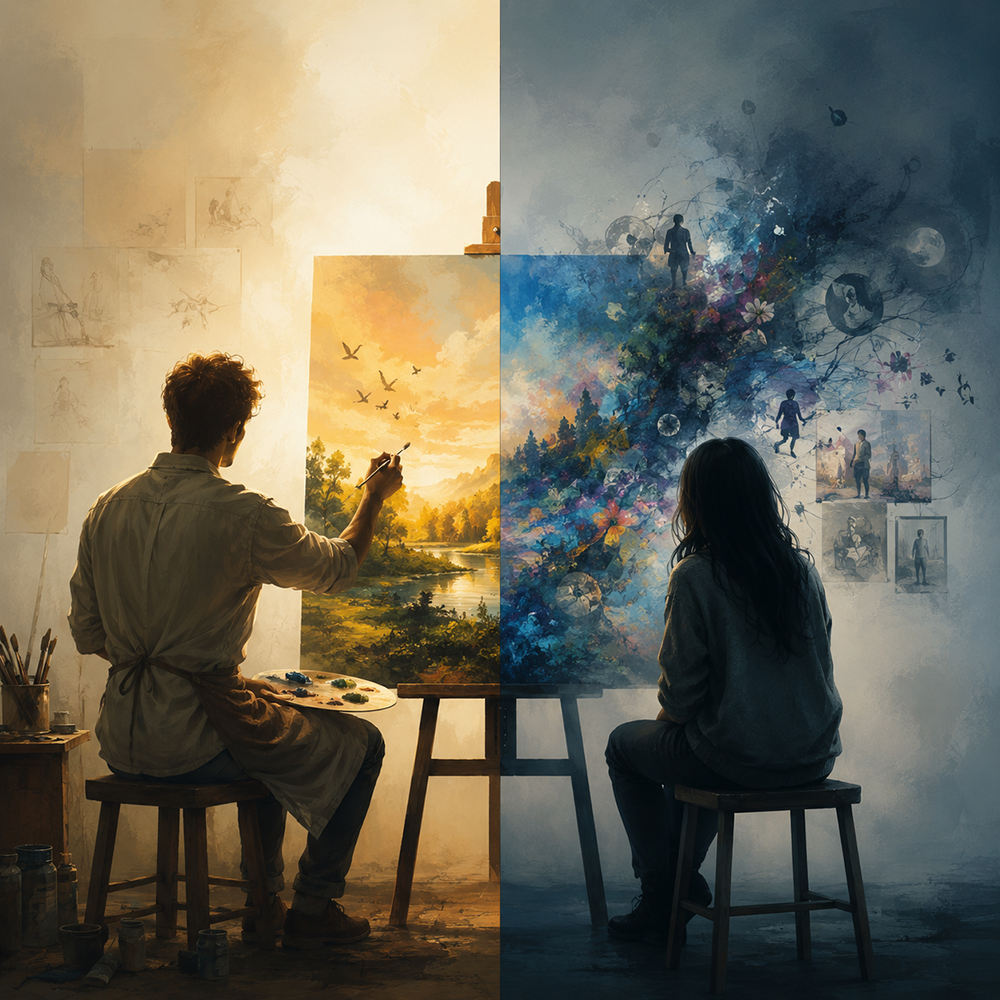
Maybe Finished Is a Relationship, Not a Fact
Maybe there isn't always a precise moment when an artwork objectively becomes finished.
No invisible switch flips.
No universal rule announces: everything necessary has now been accomplished.
Sometimes the artist simply reaches a point where something changes between themselves and the work.
The question stops being: what should this become?
And becomes: can I let this be what it is?
Different Works Ask for Different Endings
Not everything tells us it's finished in the same way.
One work might reach a point where everything suddenly clicks: there.
Another slowly becomes quieter.
There are fewer things we want to change.
Fewer questions pulling us back.
Eventually, we realize we've been looking at it for ten minutes without actually wanting to touch anything.
Sometimes finishing feels satisfying.
Sometimes uncertain.
Sometimes anticlimactic.
Sometimes we're completely sure.
Sometimes the best we can manage is: I think I'm done.
And perhaps that's normal.
If making is partly a relationship between a person, an idea, and whatever they're working with, why would every ending feel the same?
Sometimes We've Taken a Work as Far as We Can
There is also a difference between: this is everything this artwork could ever become.
And: this is as far as I need to take it.
Maybe we've explored the question that started the work.
Learned what the material had to teach us.
Solved the problem we were interested in solving.
Expressed what we wanted to express.
Reached the edge of what we currently know how to do.
That doesn't make the artwork perfect.
It doesn't mean another artist couldn't take the same idea somewhere else.
It doesn't even mean we couldn't return years later with different skills and make something different.
But perhaps this particular conversation has reached its natural stopping point.
We don't have to exhaust every possibility before we're allowed to leave.
Sometimes Continuing Would Create a Different Work
Imagine changing one thing.
Then another.
Then another.
At some point, perhaps we're no longer completing the work we started.
We're beginning to transform it into something else.
That isn't necessarily bad.
Creative work changes direction all the time.
Sometimes following that change produces something far more interesting than the original plan.
But there may also be moments when we recognize: I could keep going, but then this would become a different piece.
Maybe the work in front of us already exists fully enough.
The other possibility doesn't need to replace it.
It can become the beginning of something new.
Sometimes We're Finished
And then there is an answer we don't always give enough legitimacy: I don't want to work on this anymore.
Sometimes we've spent enough time with something.
Our attention has moved elsewhere.
We've learned what we wanted to learn.
We would rather begin something new.
That doesn't automatically mean we've failed the work.
Perhaps finished sometimes describes not only the state of the object, but the state of the maker: I'm finished with this.
And we may never feel completely certain.
We might publish the story knowing we could revise it again.
Hang the painting while still wondering about one area.
Give away the handmade object while remembering the imperfect stitch.
Sometimes we simply decide: I'm going to let this exist now.
Perhaps finishing requires letting go not only of perfection, but also of the belief that the work must eventually become exactly what we first intended.
Making changes things.
Materials respond.
Mistakes happen.
New possibilities appear.
Something unexpected works beautifully.
At some point, we can stop comparing: what this is to what I thought it would be.
And look instead at what actually exists.
Maybe it became something else.
Maybe that's okay.
 Jessica Carey
The Conversation Can End Without Exhausting Everything There Is to Say
There could always be another brushstroke.
Another revision.
Another arrangement.
Another possibility.
But perhaps finishing doesn't require us to eliminate every possible future change.
Maybe it means recognizing that this particular exchange has reached its end.
We've responded to the work.
The work has responded to us.
We've changed it.
It has changed our ideas about it.
And eventually, there may come a moment when we no longer need to ask it to become something else.
Not because it is flawless.
Not because there is objectively nothing left that could change.
But because we can finally say:
- This is what you became.
- And I'm going to let you be that.
Maybe finishing isn't the moment when an artwork becomes incapable of change.
It's the moment we decide to stop asking it to become something else.
 Jessica Carey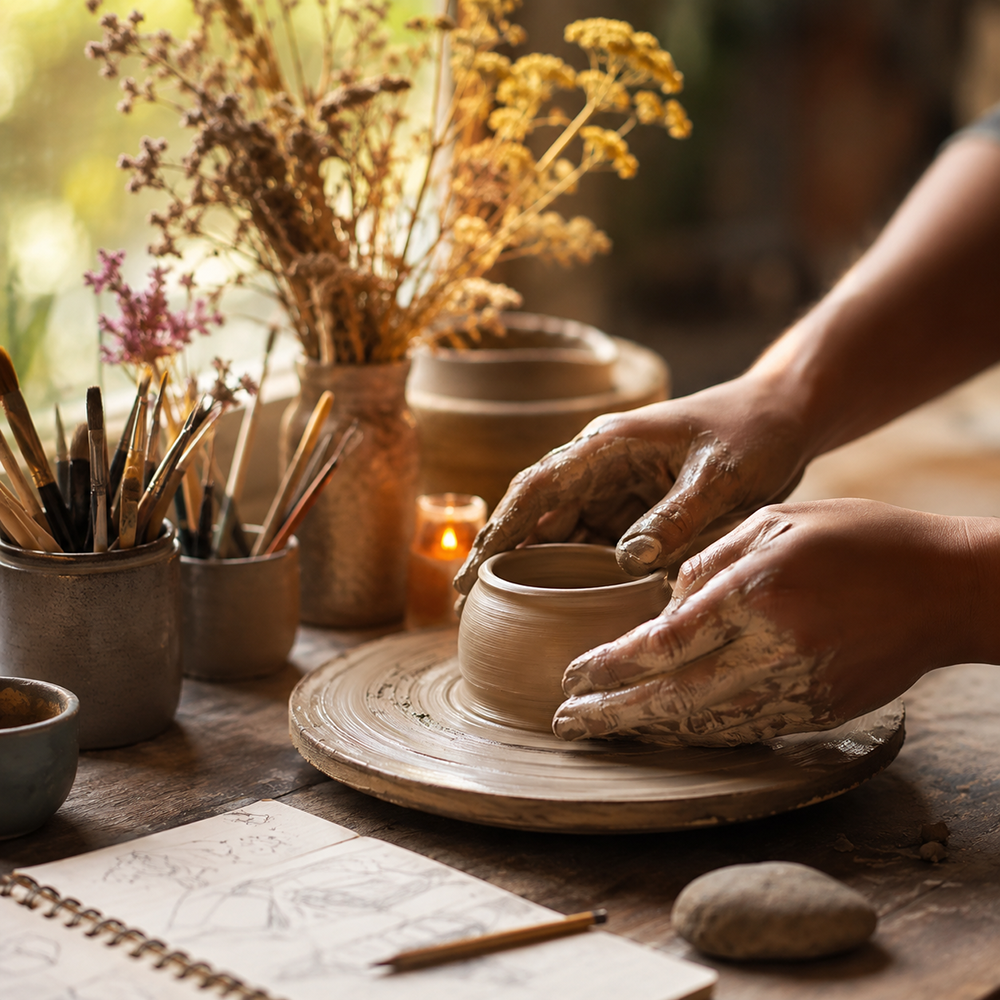
Put the Brush Down
There is almost always something else we could do.
Another brushstroke.
Another revision.
Another stitch.
Another adjustment.
Another attempt to make the thing in front of us match the thing we imagined.
Maybe that's why finishing can be so difficult.
Possibility doesn't disappear just because a work has reached its end.
But perhaps could I keep working? was never the most useful question.
Maybe the question is: does this still need me to?
Sometimes the answer is yes.
Something genuinely isn't working.
There's another possibility worth exploring.
So we continue.
But sometimes the answer is quieter: no, leave it.
Another version could exist.
Tomorrow, we might make different choices.
Years from now, we may see things we would change.
None of that necessarily makes the work unfinished.
Finishing doesn't require exhausting possibility.
Eventually, the final creative decision may simply be deciding not to make another change.
So we put down the brush.
Save the document.
Tie off the thread.
Set down the pencil.
Let the last note disappear.
Step back.
Not because the work is perfect.
Not because nothing else could be done.
But because this is the version we're allowing to exist.
Maybe that's what finished ultimately asks of us.
Not perfection.
Not certainty.
Not the exhaustion of every possibility.
Just the willingness, eventually, to say: there, that's enough.
And then leave it alone.
Want even more content about creativity and art?
Be sure to check out all of our creative chronicles!
If you'd like to see examples of my work, you can find some of my art and creations at Redbubble and Gumroad!
Looking to learn more about my recent journey?
Check out some of these articles:
-Hidden Gems for St. Louis Artists
-Hidden Gems for Autistic & Neurodivergent Adults
-Learning What Love Was Supposed to Feel Like
-I Wasn't Broken--I'm Burned Out
-The Difference Between Resting and Giving Up
 Jessica Carey