There is a particular moment almost every person who makes things eventually encounters.
You are working.
Things are going reasonably well.
And then—oops.
The brush drips.
The ink bleeds somewhere it wasn't supposed to go.
The paper tears.
The photograph catches a strange reflection.
Two colors mingle before you can stop them.
The clay squishes when you remove it from the mold.
The print doesn't transfer completely.
Something slips, smears, wrinkles, warps, bubbles, splatters, cracks, or lands somewhere you absolutely did not intend for it to land.
And for a fraction of a second, there is only one thought: I messed it up.
Sometimes that's true.
Sometimes we really did mess it up.
But every once in a while, something interesting happens after that first flash of disappointment.
We look again.
And... wait.
That drip actually looks kind of beautiful.
The torn edge is more interesting than the clean one was.
The colors created something we never would have thought to mix intentionally.
The incomplete print has a strange, ghostly quality that the perfect transfer didn't.
The reflection we didn't notice when taking the photograph becomes our favorite part of the image.
Suddenly the question changes.
It isn't only: how do I fix this?
It's: what did this create?
When the Work Surprises Us
We tend to imagine creativity as something that moves in one direction.
We have an idea.
We choose our materials.
We make decisions.
We use our skills to bring the idea into existence.
And, of course, that really is part of making art.
But materials aren't always perfectly obedient.
Water moves.
Ink spreads.
Paint drips.
Paper tears.
Clay bends.
Cameras capture things our eyes didn't notice.
Tools leave marks.
Colors interact.
Gravity gets involved.
Our hands don't always do precisely what our brains intended.
And sometimes those moments introduce something into the work that we didn't consciously put there.
That doesn't automatically make it good.
An accident isn't valuable simply because it was an accident.
But neither is something automatically bad simply because it wasn't planned.
That's where things get interesting.
Because there's a difference between: this isn't what I intended and: this shouldn't be here.
Those sentences can feel almost identical when we're staring at something that has just gone wrong.
But they aren't.
The Happy Accident
A happy accident is one of those moments when the unexpected creates a possibility.
Maybe we incorporate the accidental mark.
Maybe we repeat it intentionally.
Maybe it sends the entire piece in another direction.
Maybe we discover a texture, technique, color combination, composition, or material behavior we didn't know existed.
And suddenly something that began as: oh no becomes: oh... what if I did this?
That's serendipity entering the creative process.
Not the belief that every mistake secretly happens for a reason.
Not pretending ruined materials aren't frustrating.
Not abandoning technique, planning, or skill and hoping chaos will make something brilliant for us.
Just the recognition that our original intention isn't the only place artistic possibility can come from.
Sometimes we have an idea and shape the material around it.
Sometimes the material does something unexpected—and our idea changes in response.
That requires a slightly different creative skill.
Not control.
Responsiveness.
The ability to pause before immediately erasing the unintended thing and ask:
- Is this actually a problem?
- Is there something interesting happening here?
- What would happen if I followed it?
Because sometimes the thing we never meant to make becomes the thing we couldn't have thought to make.
And that raises an interesting possibility: what if not everything unplanned is actually a mistake?
Not Everything Unplanned Is a Mistake
We use the word mistake remarkably quickly.
The line went somewhere we didn't intend.
Mistake.
The watercolor spread beyond the boundary.
Mistake.
The photograph came out differently than we imagined.
Mistake.
The clay warped.
Mistake.
But sometimes what we really mean is much simpler: that isn't what I intended to happen.
And those aren't necessarily the same thing.
Intention tells us what we were trying to make.
It doesn't automatically tell us the value of what we actually made.
Different Doesn't Automatically Mean Worse
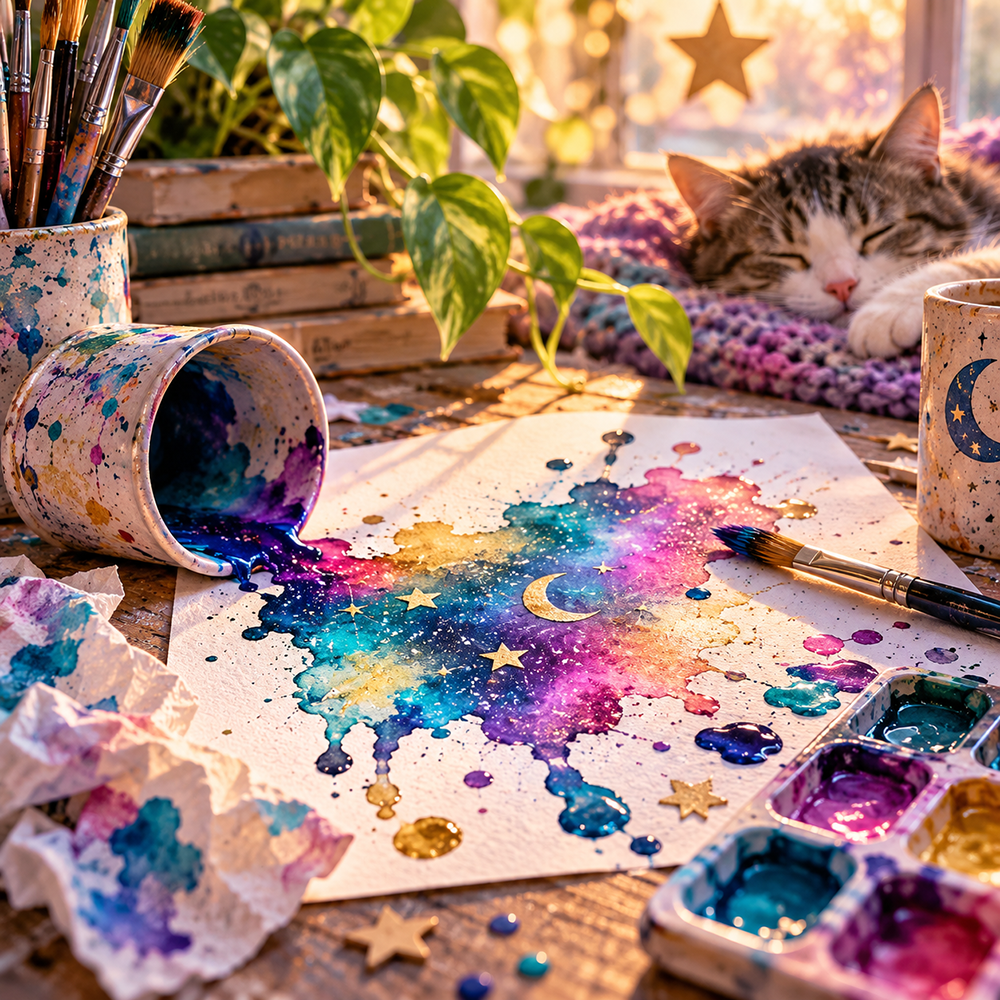
Suppose you're painting a smooth watercolor wash and the water pools unexpectedly, leaving behind an irregular bloom.
If your goal was technical consistency, then yes—the material behaved differently than you wanted it to.
But look at the mark by itself.
- Is it ugly?
- Is it unusable?
- Did it actually ruin the image?
- Or is the problem simply that you weren't expecting it to be there?
Those are different questions.
The bloom might create an interesting cloud.
An unexpected shadow.
A patch of atmospheric texture.
Or something completely abstract that makes the composition more interesting.
The original plan may not have included it.
But the artwork that now exists does.
And at some point, the artist has to respond to the work in front of them, not only the work that existed in their imagination.
Intention Isn't the Only Source of Value
This can be uncomfortable because artistic skill is often associated with control.
We practice so our hands become steadier.
We learn how materials behave.
We study techniques so we can produce particular effects deliberately.
That matters.
There is a meaningful difference between knowing how to control watercolor and simply hoping the paint lands somewhere interesting.
There is a difference between deliberately creating motion blur and accidentally taking a blurry photograph because we haven't learned how the camera works.
Technique gives us choices.
But technique doesn't mean every valuable thing in an artwork must have been deliberately engineered from the beginning.
Sometimes an experienced artist encounters an unexpected effect, too.
The difference may be what happens next.
- Do I remove this?
- Do I leave it?
- Do I repeat it?
- Can I use it?
- Did the work just become something slightly different?
The accident may not have been intentional.
Choosing what to do with it can be.
And that distinction matters.
Serendipity Still Requires an Artist
We can't completely plan a happy accident.
If we could, it wouldn't really be an accident.
But that doesn't mean the artist disappears from the process.
Something unexpected happens.
We notice it.
Then we decide whether to leave it, remove it, repeat it, or build around it.
The accident offered something; the artist decided whether to accept the offer.
That's what makes serendipity so interesting: it exists somewhere between control and randomness.
Sometimes the Material Knows Something We Don't
Of course, materials don't literally have intentions.
Paint isn't secretly trying to improve our composition.
Clay isn't critiquing our design choices.
But materials do have properties that exist independently of what we want from them.
Water flows.
Gravity pulls.
Paper absorbs.
Ink spreads.
Clay shrinks.
Fibers stretch.
Light reflects.
Surfaces resist.
When we work with a material, we're not inventing those behaviors. We're encountering them.
And sometimes an accident reveals something about the material that our plan didn't account for.
- Oh, the ink does that on this paper.
- Those colors separate when they mix.
- That surface creates this texture.
- The light reflects differently from this angle.
Something that initially looked like failure becomes information.
And information can become possibility.
Unplanned Doesn't Mean Uncritical
None of this means we should keep everything simply because it happened.
An unexpected mark can still weaken a composition.
A warped form can still be unusable.
A blurry photograph can simply be a blurry photograph.
We don't need to look at every spilled cup of paint and declare that the universe has become our artistic collaborator.
The point isn't: mistakes are secretly masterpieces.
It's much smaller than that.
Before deciding that something is wrong solely because it wasn't planned, look at what actually happened.
Separate the unexpected from the unsuccessful.
Maybe you'll still fix it.
Maybe you'll start again.
Maybe you'll decide you hate it.
But every once in a while, you'll notice something worth keeping.
And that suggests another way of thinking about artistic control.
Maybe the goal isn't always to eliminate unpredictability.
Sometimes we can deliberately leave a little room for it.
Because art has always had a little chaos in it.
Art Has Always Had a Little Chaos in It
For all the control we try to develop as artists, we're working with a surprisingly unruly collection of things.
Water.
Pigment.
Light.
Heat.
Pressure.
Gravity.
Chemicals.
Fibers.
Ink.
Paper.
Clay.
Our own hands.
None of them behave with absolute predictability.
We can learn them.
We can practice.
We can become extraordinarily skilled at anticipating what they'll do.
But somewhere between what we intend and what actually happens, there is almost always a little room for surprise.
And artists haven't only tolerated that uncertainty.
Sometimes we've learned how to play with it.
Paint Doesn't Always Stay Where We Put It
Watercolor may be one of the clearest examples.
Add pigment to wet paper and suddenly we're collaborating with water.
Colors spread.
Edges soften.
Pigments mingle.
Water pools.
Blooms appear.
Some of that can be controlled through technique—but not down to every microscopic movement.
Other kinds of paint bring their own surprises.
A pour creates patterns we couldn't possibly draw individually.
A splatter lands differently every time.
A drip changes direction because the surface tilts slightly.
Two wet colors meet and create an edge, gradient, or muddy little collision we didn't anticipate.
We can fight those behaviors.
Or sometimes we can create the conditions and see what the paint does.
That's a very different relationship with a material.
A Perfect Print Isn't Always the Most Interesting Print
Printmaking introduces another kind of uncertainty.
Pressure varies.
Ink distributes unevenly.
Paper shifts.
A surface doesn't transfer quite as completely as expected.
An earlier image leaves behind a faint ghost.
Something that might technically be described as an imperfect print can also produce texture, atmosphere, fragmentation, or layering that a pristine impression doesn't have.
And once an artist notices an effect they like, something funny can happen:
They try to make the accident happen again.
Of course, the second time it isn't quite an accident anymore.
It has become a technique.
That's one of the fascinating ways art develops.
Chance can introduce the possibility. Attention can turn it into a choice.
Cameras Can See Things We Didn't
Photography might seem different because the camera records something already in front of us.
But photography is full of surprises.
A person moves during the exposure.
Light hits the lens at an unexpected angle.
A reflection appears in a window.
Something crosses the background just as the shutter clicks.
The camera moves.
The focus lands somewhere other than where we intended.
A shadow creates a shape we didn't notice.
Sometimes the result is simply unusable.
But sometimes the photograph captures something stranger or more alive than the carefully composed image we were trying to make.
Motion blur can communicate movement.
Lens flare can alter the atmosphere.
Reflections can layer two spaces together.
An unexpected figure can completely change the story of an image.
The camera doesn't necessarily record the world exactly as we consciously noticed it.
Sometimes it gives something back and makes us say: I didn't even see that.
Materials Have Their Own Ways of Surprising Us
The same thing happens outside painting, printing, and photography.
Clay can slump, stretch, crack, warp, pick up an unintended impression, or take on a peculiar shape when handled.
Glazes can interact in ways that aren't completely obvious before firing.
Resin can trap bubbles or move inclusions.
Paper can tear along a beautiful irregular edge.
Collage materials can wrinkle when adhesive dries.
Fibers can stretch.
Wood can reveal grain, knots, marks, or irregularities once it's cut.
Mixed-media materials can interact in ways we've never tested before.
Even something as simple as cutting can produce a scrap whose shape is more interesting than the piece we were trying to cut.
That's especially fascinating to me.
Because sometimes the byproduct becomes the material.
The thing we weren't making becomes the thing we want to use.
 Jessica Carey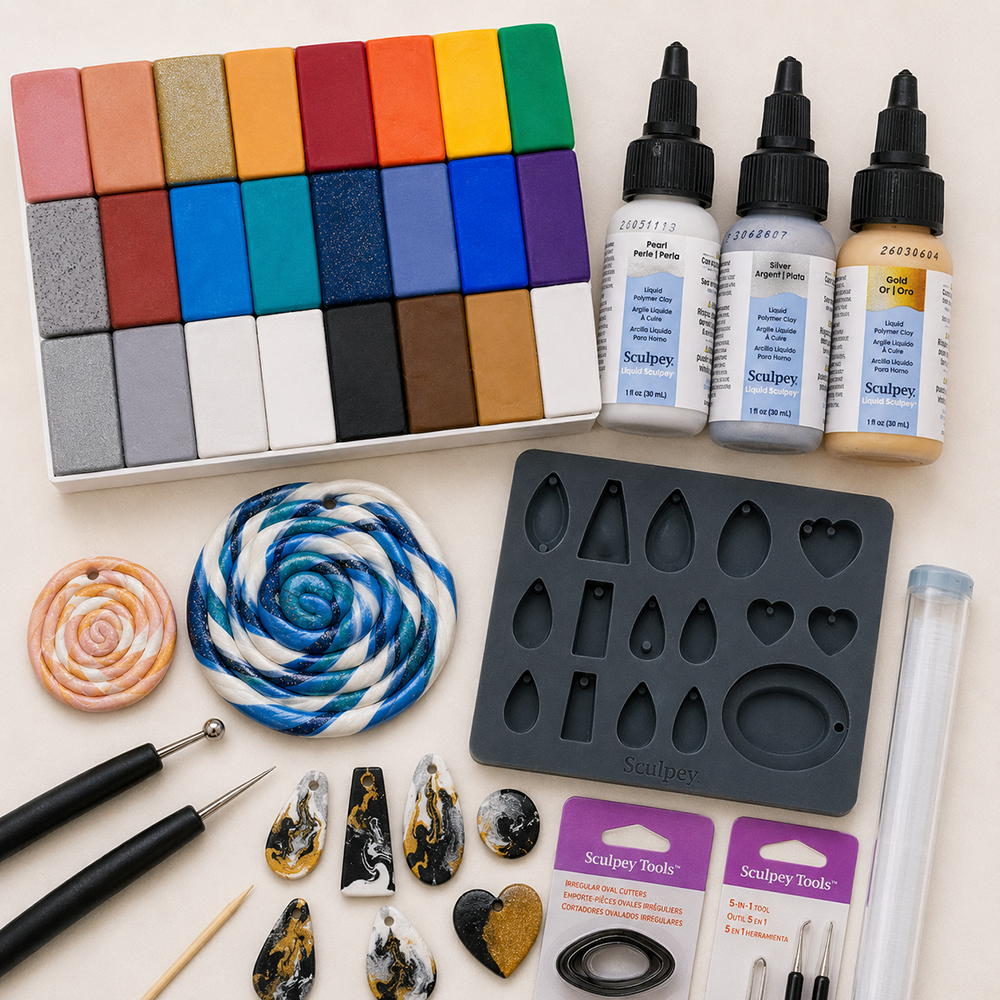
We Can Invite Uncertainty Without Giving Up Control
There's an important distinction here.
Leaving room for chance doesn't mean abandoning skill.
An artist can understand watercolor deeply and still allow pigment to move.
A photographer can understand exposure and intentionally experiment with movement.
A printmaker can know exactly how to produce a clean impression and decide to explore uneven transfers.
Knowledge doesn't eliminate experimentation.
Often, knowledge gives us more ways to experiment.
We can choose how much uncertainty to introduce.
Tilt the canvas.
Wet the paper first.
Drop one color into another.
Tear instead of cut.
Move the camera.
Press an unfamiliar texture into clay.
Layer materials we've never combined.
Make a print from something that wasn't designed to become a printing plate.
Then see what happens.
There's a subtle but important difference between: I have no idea what I'm doing and hope this works and: I know I can't completely predict what this will do—and I'm curious enough to try it anyway.
Both can lead somewhere interesting.
But the second deliberately makes room for serendipity.
 Jessica Carey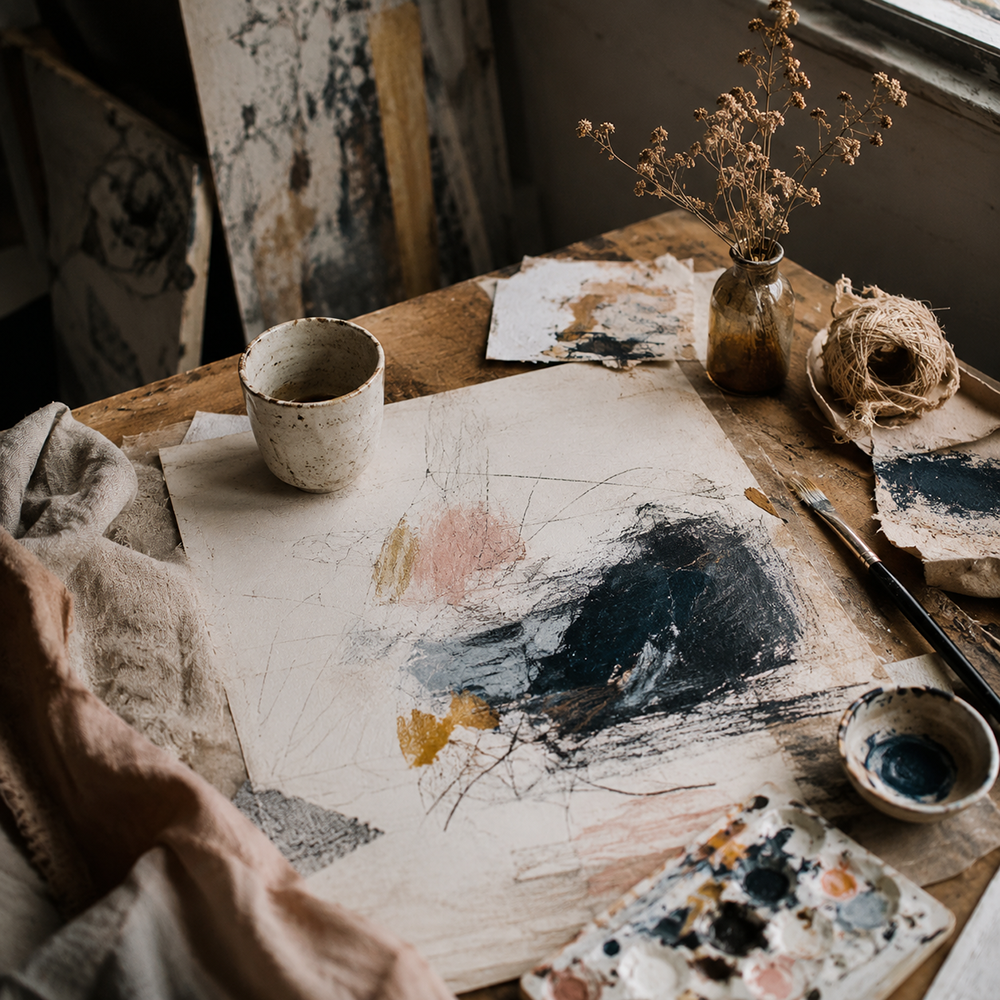
Creating Conditions Instead of Creating Outcomes
Maybe that's one of the most interesting things chance teaches us about making art.
Sometimes the artist's role is to create the outcome.
But sometimes the artist creates the conditions in which an outcome can emerge.
Add water. Apply pressure. Move the material. Let gravity pull. Then watch.
What happens belongs partly to our decisions and partly to forces we didn't completely control.
And whatever emerges gives us something new to respond to.
We don't have to keep it.
We don't have to like it.
But first, we have to notice it.
The Artist's Job Can Become Noticing
A happy accident doesn't become part of the artwork simply because it happened.
First, someone has to notice it.
That might sound obvious, but I think it's actually one of the most interesting parts of creative serendipity.
When something goes wrong, our attention often jumps immediately to correction:
- How do I get rid of that?
- Can I cover it?
- Can I undo it?
- Did I ruin this?
We're comparing what exists in front of us with the image we expected to see.
And sometimes we're so busy looking at the difference that we don't really look at what the difference created.
Pause Before You Fix It
Imagine a drop of paint lands somewhere you didn't intend.
Your hand may reach for the paper towel before you've even really looked at the mark.
Sometimes that's exactly what you should do.
But what happens if you wait five seconds?
Look at it.
Turn the piece around.
Step back.
Ask:
- What is this doing?
- Does it actually bother me?
- Is there something interesting about it?
- What would happen if I built on it instead of removing it?
That tiny pause creates room between accident and judgment.
And inside that room, there may be a possibility.
The drip might suggest another drip.
The tear might create an interesting edge.
The strange texture might need to appear somewhere else in the composition.
The accidental mark might become a shape.
Or you might look carefully and decide: nope, I still hate it.
That's useful, too.
The point isn't that we must keep the mistake.
The point is that we actually look before deciding what it is.
Making Can Become a Conversation
There's a way of thinking about artmaking that I really like:
I do something.
The material does something back.
Now what do I want to do with what happened?
Of course, the material isn't literally answering us.
But making can still feel remarkably conversational.
We make a mark.
We look at the mark.
The mark changes what the composition needs.
So we make another decision.
That decision produces something else.
We respond again.
Back and forth.
The original idea may still guide the work, but it isn't the only source of information anymore.
The artwork itself starts giving us information.
Maybe that blue needs something warmer beside it.
Maybe the empty area we planned to fill actually looks better empty.
Maybe the texture created by an accident is more interesting than the texture we were deliberately trying to make.
Maybe the strange shape suddenly resembles something.
And the artist's role shifts slightly.
We're no longer only asking: how do I make this look like the thing I imagined?
We're also asking: what does the thing I've actually made need now?
Noticing Is an Artistic Skill
We tend to talk about artistic skill in terms of doing.
Drawing accurately.
Mixing colors.
Controlling a brush.
Using a camera.
Manipulating clay.
Understanding composition.
Mastering a tool.
But noticing is a skill, too.
It's noticing that two accidentally overlapping colors created something beautiful.
Noticing the shape of the negative space.
Noticing the torn scrap on the table is more interesting than the carefully cut piece beside it.
Noticing that the photograph you almost deleted has something strange happening in the reflection.
Noticing that what you thought was the problem may actually be the most interesting part.
This kind of noticing isn't passive.
It changes what happens next.
Because once we've seen the possibility, we can make a decision about it.
 Jessica Carey
Chance Can Start Something. Choice Can Continue It.
This is where the line between accident and intention starts becoming wonderfully blurry.
The first drip may be accidental.
The second might not be.
Something that entered the work through chance becomes something the artist begins exploring through choice.
The accident introduces the possibility while the artist develops it.
Happy accidents aren't really the opposite of artistic skill.
Recognizing what an accident has given us—and figuring out what to do with it—can require its own kind of skill.
We Can't Notice Possibility If We're Only Looking for Error
Maybe that's the larger challenge.
If we approach the work with only one acceptable outcome in mind, everything that moves away from that outcome starts looking like failure.
Wrong color.
Wrong mark.
Wrong texture.
Wrong shape.
Wrong result.
But if we loosen our grip just enough to look at what's actually happening, another category becomes possible: unexpected.
Not good.
Not bad.
Not yet.
Just: I didn't know it could do that.
And sometimes curiosity gets to arrive before judgment.
That doesn't mean abandoning our intentions.
It means allowing the work in front of us to have a voice alongside the work we imagined.
Because sometimes creativity isn't only the ability to make something happen.
Sometimes it's the ability to recognize when something interesting has already happened.
Sometimes the Mistake Changes the Destination
Sometimes a happy accident is small.
A drip becomes part of the background.
A torn edge stays.
An unexpected texture gets incorporated into the surface.
The artwork remains essentially what we intended to make.
It just contains something we didn't intend to put there.
But sometimes the unexpected thing does something much bigger.
It changes where the work is going.
The Original Plan Isn't a Contract
We can become surprisingly attached to the first version of an idea.
- This is supposed to be a landscape.
- This is supposed to be a scarf.
- This photograph is supposed to look like this.
- This piece is supposed to have a smooth surface.
There's nothing wrong with having a plan. Plans give us somewhere to begin.
But the moment we start making something, the plan meets reality.
And reality has opinions.
The material behaves differently than expected.
Our skills don't quite match the image in our head.
We discover something more interesting halfway through.
The dimensions change.
Something breaks.
Something doesn't work.
Something else unexpectedly does.
At that point, we have a choice.
We can keep trying to pull the work back toward the original destination.
Or we can ask: what if this is going somewhere else?
Sometimes the Detour Becomes the Work
When I first learned to knit, I was trying to make a scarf.
It did not become a particularly successful scarf.
But eventually, instead of continuing to measure the project against what it was supposed to be, I realized the strange little thing I had made could become a bag.
So it did.
I didn't successfully execute the original plan.
But I did make something.
And I think there's something important in that distinction.
If the only acceptable outcome had been scarf, then the project was a failure.
But once the question became what could this become now? another possibility appeared.
That's the kind of creative pivot a happy accident can sometimes invite.
A torn piece of paper becomes the edge of a mountain.
A misshapen piece of clay starts looking like a character.
An unintended photograph becomes more compelling than the carefully composed one beside it.
A color mixture sends the entire painting toward a different palette.
A piece breaks, and the break suggests a new way of assembling it.
The accident doesn't get hidden.
It changes the destination.
 Jessica Carey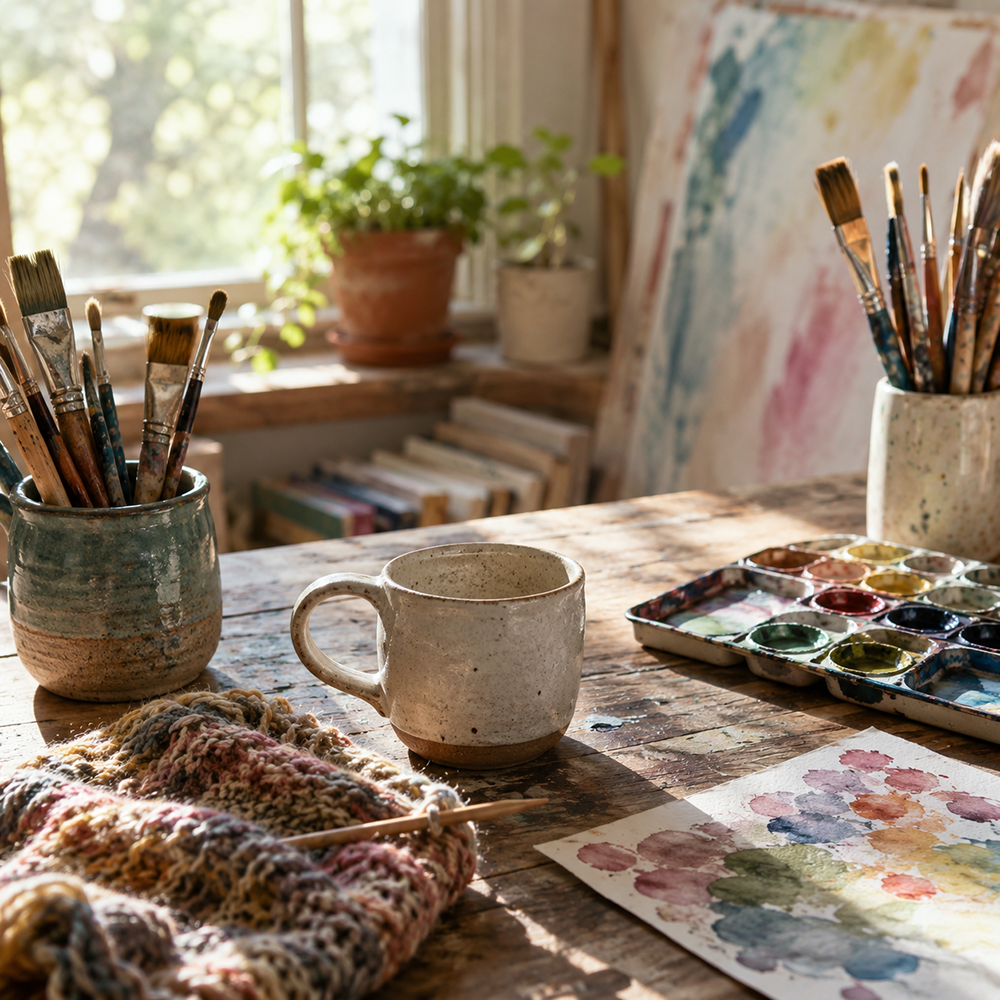
Adaptation Isn't Always Repair
When something goes wrong, we often immediately enter repair mode.
- How can I get this back to what it was?
- How can I disguise the mistake?
- How can I make it look like nothing happened?
Sometimes that's exactly what we want.
But adaptation can be different from repair.
Repair asks: how do I return to the original plan?
Adaptation asks: given what exists now, where could I go from here?
That's a much more open question.
And it can lead somewhere the original plan couldn't.
Not necessarily somewhere better.
That's important.
There's a temptation to turn happy accidents into a tidy inspirational story: the mistake happened because something even better was meant to happen!
I don't think we need to believe that.
Sometimes Plan B is wonderful.
Sometimes it's merely workable.
Sometimes we still wish Plan A had succeeded.
And sometimes there isn't a Plan B at all.
But creativity gives us the ability to ask whether one might exist.
Improvisation Happens in Response to Reality
This is where serendipity and improvisation meet.
Improvisation isn't necessarily creating without intention.
Often, it's responding to conditions as they change.
You begin somewhere. Something happens. You adjust. Something else happens. You respond again.
The ability to improvise doesn't mean the original plan was meaningless.
It means we're capable of working with more information than we had when we made it.
Before we started, we didn't know the paper would tear there, the pigments would interact that way, or the photograph would catch that reflection.
Now we do.
And the work can change because we've learned something from making it.
The Work Doesn't Owe the Sketch
Maybe that's one of the stranger freedoms of creating something.
The finished work doesn't owe absolute loyalty to the idea that started it.
A sketch can be a beginning without becoming a command.
A plan can guide us without trapping us.
An intention can matter even if the final result moves away from it.
Sometimes the most interesting thing we can do is notice that the artwork has become something we didn't expect—and stop trying to force it back into what we expected.
Not because changing direction is always better.
But because the thing we're actually making deserves some attention too.
Maybe the accident becomes one small detail.
Maybe it becomes the entire direction.
Maybe we fix it.
Maybe we abandon the piece and begin again.
All of those are legitimate creative decisions.
And that's why I don't think the lesson of the happy accident is: every mistake is a gift.
Some mistakes really are just mistakes.
The more useful lesson might be: a mistake doesn't get to decide, all by itself, what happens next; we do.
You Don't Have to Love Every Mistake
There is a very cheerful version of creative advice that goes something like: there are no mistakes in art!
I understand the sentiment.
It's usually meant to make creativity feel safer.
To encourage experimentation.
To reassure us that one wrong mark doesn't have to destroy everything.
But I'm not sure I completely believe it.
Sometimes there are mistakes.
Sometimes we spill something across a piece we've spent hours making.
Sometimes the clay cracks in exactly the wrong place.
Sometimes the photograph is out of focus and there's nothing interesting about it.
Sometimes we mix two beautiful colors and somehow produce the least appealing brown we've ever seen.
Sometimes something breaks.
Sometimes an experiment wastes material.
Sometimes we look at what happened from every possible angle and conclude: nope, I really don't like this.
And that's okay.
The happy accident doesn't require us to pretend otherwise.
Curiosity Isn't Forced Optimism
There's an important difference between being open to possibility and insisting that every disappointment must secretly be a gift.
If something goes wrong, we don't have to immediately transform it into a profound lesson.
We can be annoyed.
We can wish it hadn't happened.
We can decide the piece was better before.
We can mourn the expensive sheet of paper, the ruined photograph, the broken ceramic piece, or the hours of work we can't recover.
Being creatively flexible doesn't mean becoming emotionally delighted by every unfortunate outcome.
It simply gives us another option before we decide what the accident means.
Instead of automatically declaring: it's ruined.
We might ask: is it?
And instead of automatically insisting: this is secretly wonderful!
We can ask the exact same question: is it?
That little bit of uncertainty leaves room for an honest answer.
Sometimes the Lesson Is “Don't Do That Again”
Not every experiment gives us something worth keeping.
But unsuccessful experiments can still give us information.
Maybe we discover that a particular marker bleeds horribly on a certain paper.
Maybe an adhesive warps the material we're using.
Maybe two products don't interact well.
Maybe a technique that looked interesting in our imagination simply doesn't produce an effect we like.
Maybe we learn that the next time we try something similar, we need less water, more pressure, a different temperature, another tool, or a completely different approach.
That's not necessarily a happy accident.
It's just learning.
And learning doesn't always need a beautiful artifact at the end of it to count.
Sometimes the thing we made isn't valuable to us.
What we learned while making it is.
Knowing When to Let Go Is Part of the Process
There can also be a strange pressure to save everything.
Once we've invested time or materials into a piece, abandoning it can feel wasteful.
So we keep trying.
Another layer.
Another correction.
Another attempt to hide the thing we don't like.
Sometimes that works beautifully.
And sometimes we spend three more hours trying to rescue something we stopped enjoying two hours ago.
We are allowed to stop.
We can reuse whatever materials are salvageable.
We can cut the interesting parts out.
We can photograph the piece before taking it apart.
We can keep it as an experiment.
We can throw it away.
We can start again.
Openness to possibility includes the possibility that this particular piece isn't going anywhere we want to follow.
That isn't a failure of imagination.
It's a decision.
 Jessica Carey
We Don't Have to Make Every Mistake Meaningful
Some accidents become techniques.
Some change the entire artwork.
Some teach us something.
Some become funny stories.
Some make us swear at the table for a minute.
And some are completely forgettable.
That's part of making things.
The point of embracing serendipity isn't to convince ourselves that every mistake was secretly necessary.
It's to become a little less certain that unexpected automatically means unsuccessful.
Because if we decide every deviation is failure before we've even looked at it, we may erase possibilities along with the mistakes.
But if we pause long enough to become curious?
Every once in a while, we get to say: I didn't mean to do that, but I think I'm going to keep it.
And perhaps that's all a happy accident ever needed from us.
Leave a Little Room for Surprise
A lot of learning to make art is learning how to gain control.
How to make the line go where we want it.
How much water to use.
How colors interact.
How to expose a photograph.
How to manipulate clay.
How much pressure to apply.
How to make the material behave a little more like the thing we imagined.
Those skills matter.
There is something deeply satisfying about reaching a point where our hands can do what our minds are asking them to do.
But maybe artistic growth isn't only about gaining more control.
Maybe it's also about learning when to loosen it.
Because no matter how skilled we become, making things still involves encountering something that doesn't entirely exist yet.
We can plan.
We can sketch.
We can measure.
We can practice.
We can know our materials extraordinarily well.
And then we actually begin.
The paint moves.
The light changes.
The paper tears.
The clay shifts.
Our hand slips.
Two things interact in a way we didn't anticipate.
And suddenly there is something in front of us that wasn't in the plan.
Maybe Don't Fix It Yet
Our first instinct may still be: oops.
That's probably never going away.
But perhaps we can become a little slower about what comes next.
Before wiping away the drip, deleting the photograph, covering the mark, or declaring the experiment a failure—look.
Maybe you'll still fix it.
Maybe you'll start over.
Maybe you'll learn exactly what you don't want to do next time.
But every once in a while, you'll find something you didn't know to look for.
Control Is a Skill. Responsiveness Is, Too.
I think that's ultimately what the happy accident has to teach us.
Creative skill isn't only the ability to make what we intended.
It's also the ability to respond intelligently, curiously, and imaginatively to what actually happens.
We don't control everything.
But we aren't powerless in the face of chance, either.
Something unexpected happens.
We notice it.
We decide whether it matters.
We decide whether to remove it, repeat it, develop it, work around it, or let it change the destination entirely.
The accident may have entered the artwork by chance.
What happens next doesn't have to.
And perhaps that's why some of the most interesting moments in making happen somewhere between intention and surprise.
We bring something to the material.
The material gives something back.
And the work emerges from the conversation between them.
We often imagine creativity as the process of bringing an idea from our minds into the world.
But making doesn't always happen in only one direction.
Sometimes we shape the material.
Sometimes the material changes the idea.
And every once in a while, the moment that makes us think—well... I didn't mean to do that—becomes the part we couldn't imagine the work without.
Want even more content about creativity and art?
Be sure to check out all of our creative chronicles!
If you'd like to see examples of my work, you can find some of my art and creations at Redbubble and Gumroad!
Looking to learn more about my recent journey?
Check out some of these articles:
-Hidden Gems for St. Louis Artists
-Hidden Gems for Autistic & Neurodivergent Adults
-Learning What Love Was Supposed to Feel Like
-I Wasn't Broken--I'm Burned Out
-The Difference Between Resting and Giving Up
-What Chronic Autistic Burnout Actually Feels Like
-When You Had to Raise Yourself
 Jessica Carey