
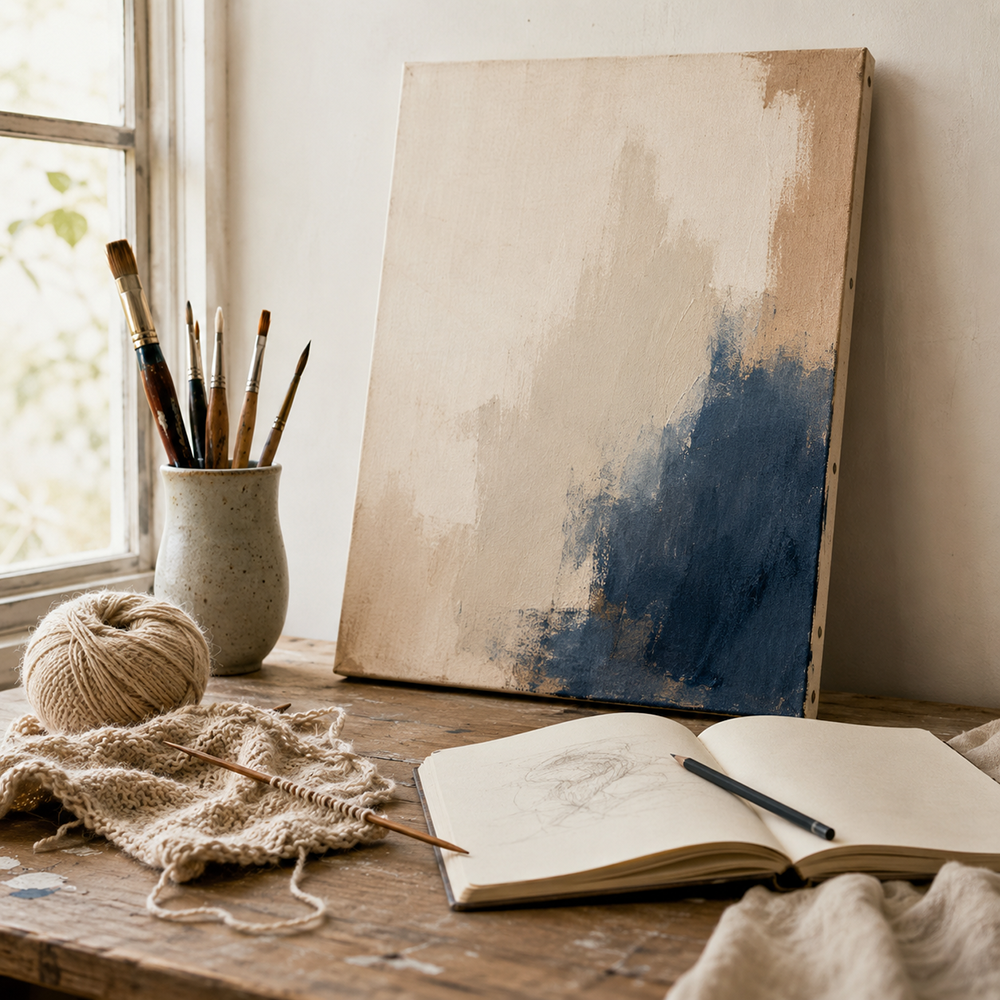
There are unfinished things everywhere.
A sketch that disappears halfway across the page.
A canvas turned toward the wall because we never quite figured out what to do next.
A scarf still attached to its knitting needles.
A draft that ends in the middle of a sentence.
A box of supplies purchased for an idea that seemed exciting at the time.
A half-built sculpture.
An experiment with a material that didn't behave the way we expected.
A project tucked into a drawer with the vague promise: I'll come back to this someday.
Maybe we will.
Maybe we won't.
We tend to have a particular vocabulary for these things:
- Unfinished
- Abandoned
- Never completed
- Gave up on it
- Didn't follow through
And sometimes those descriptions are accurate.
But they can also carry an assumption we don't always examine: the project was supposed to become a finished object, and because it didn't, something went wrong.
We Know How to Value the Finished Thing
Finished things are easier to understand.
The painting gets framed.
The scarf gets worn.
The ceramic bowl holds something.
The story gets published.
The photograph gets printed.
The sculpture goes on a shelf.
There's an object we can point to and say: look, I made this.
Completion gives us evidence.
It creates a clear before and after.
There was nothing.
We worked.
Now there is something.
And perhaps that's why unfinished work can feel strangely uncomfortable.
We can see what it didn't become.
The missing sleeve.
The blank corner.
The unresolved ending.
The loose yarn.
The sentence that never found its next sentence.
The idea that never became the thing we imagined when we started.
It's easy to look at that absence and conclude that the project somehow failed.
But What Happened While We Were Making It?
Maybe that's not the only question we could ask:
- What did you learn before you stopped?
- What did you discover?
- What did you try for the first time?
- What did you realize wasn't going to work?
- Did the project lead you toward another idea?
- Did you practice a technique you understand better now?
- Did you enjoy making it for a while?
- Did you answer the question that made you curious enough to begin?
Maybe the finished object never appeared.
But something still happened.
Learning, curiosity, discovery, and even realizing actually, I don't want to make this anymore may not leave behind something we can put on a shelf.
And yet those things can still be part of what a project gives us.
What If Completion Isn't the Only Possible Ending?
None of this means finishing things doesn't matter.
Sometimes finishing is important.
Sometimes the difficult part we want to avoid is exactly the part we need to work through.
Sometimes returning to an abandoned project months—or years—later leads somewhere wonderful.
And sometimes we really do wish we'd finished something.
But perhaps every project doesn't need the same ending.
Some things become finished artworks.
Some become gifts.
Some become practice.
Some become prototypes.
Some get taken apart and turned into something else.
Some teach us what not to do.
Some introduce us to a material or technique we carry into future work.
Some are interesting until, one day, they simply aren't.
And some seem to run their course before the object itself is finished.
That possibility interests me.
Because perhaps the question isn't always: why didn't I finish this?
Maybe sometimes it's:
- What did this already give me?
- What if completion isn't the only way a creative project can fulfill its purpose?
Maybe an unfinished project isn't automatically evidence of failure, wasted time, or something we should feel guilty about.
Maybe sometimes the project has already done what it came here to do.
Sometimes a project has already given us what we needed from it—even if we never finish the thing itself.
We Give Finished Things More Credit
Finished things are satisfying.
There is something undeniably pleasing about reaching the end of a project.
You bind off the final row.
Sign the painting.
Type the last sentence.
Fire the ceramic piece.
Hang the photograph.
Close the sketchbook on something that finally feels complete.
You can step back and say: I made that.
There is nothing wrong with appreciating that feeling.
The problem comes when the finished object becomes the primary evidence that the time spent making was worthwhile.
Finished Things Are Easier to Count
A completed object is visible.
We can photograph it.
Display it.
Wear it.
Gift it.
Sell it.
Put it in a portfolio.
Show it to someone else.
It becomes proof that something happened.
An unfinished project is harder to account for.
Maybe you spent six hours experimenting with watercolor and ended up with three pages you don't particularly like.
Maybe you knitted half of something before realizing you misunderstood the pattern.
Maybe you wrote several pages before discovering that the idea wasn't actually going anywhere.
Maybe you tried combining two materials and learned that they absolutely do not want to cooperate.
What do you have to show for that time?
Maybe not much.
At least, not much that can sit on a shelf.
But “nothing finished” and “nothing gained” aren't the same thing.
We Often Notice What the Project Didn't Become
An unfinished project almost invites us to imagine its missing ending.
The half-knitted sweater was supposed to become a sweater.
The sketch was supposed to become a drawing.
The draft was supposed to become an article.
The experimental sculpture was supposed to become something worth displaying.
So when we look at what's left, we may see the distance between what exists and what we originally imagined.
It didn't get there.
And from that perspective, the project can look like evidence of failure.
But that's only one way to measure what happened.
The half-knitted sweater may have taught you a new stitch.
The abandoned drawing may have helped you understand the shape you were struggling to see.
The discarded draft may contain an idea that belongs somewhere else.
The sculpture that didn't work may have taught you something important about the material.
The outcome changed.
That doesn't necessarily mean there wasn't one.
Some Outcomes Don't Look Like Objects
Creative work produces more than creative objects.
It can produce:
- knowledge
- skill
- questions
- preferences
- discoveries
- new ideas
- mistakes we understand better afterward
- familiarity with a material
- confidence to try something differently next time
Sometimes it produces something as simple as: well, now I know I don't like doing that.
That's information, too.
Maybe you took a class because you thought you'd love the technique and discovered that you don't.
Maybe you bought a material you'd been curious about and learned that you hate working with it.
Maybe you started an ambitious project and realized halfway through that you were much more interested in one tiny part of the process than in the finished thing.
The unfinished object might not show any of that.
But the maker carries it forward.
This may be part of why finished objects receive so much credit.
We can see them.
The other outcomes of making are often harder to see.
Nobody looking at an abandoned sketch necessarily knows that it was the first time you understood how to draw a particular form.
Nobody looking at a failed experiment knows that it led directly to the next experiment that worked.
Nobody looking at half a scarf knows that you learned three new techniques while making it.
Sometimes even we forget.
We look at the object and think:
I never finished that.
Instead of: that's where I learned how to do this.
Or: that's how I discovered I wanted to make something else.
Or even: I had a really good afternoon making that until I stopped wanting to.
The object may be incomplete.
The experience wasn't.
Finished Is One Kind of Value
None of this means we need to stop valuing completion.
Finishing something can require patience.
Persistence.
Problem-solving.
Revision.
The willingness to continue after the exciting beginning has passed.
And sometimes the satisfaction of finally holding the completed thing is exactly what we wanted from the project.
Finished work deserves its credit.
It just doesn't need all the credit.
Because a completed object is one possible outcome of creative work.
Learning is another.
Discovery is another.
Practice is another.
Enjoyment is another.
Finding out something doesn't work is another.
Following one idea until it leads you toward a better one is another.
A finished object is evidence that making happened. It isn't the only evidence that the making mattered.
And once we stop requiring every creative experience to leave behind a polished object as proof of its value, unfinished work starts looking a little different.
Not necessarily like something that failed to become complete.
Sometimes it looks more like evidence of somewhere we've already been.
 Jessica Carey
Sometimes the Experiment Already Answered the Question
Not every creative project begins with a clear picture of what the finished thing is supposed to be.
Sometimes it begins with a question:
- What happens if I try this?
- Can I make this material do that?
- What would these colors look like together?
- Can I knit this shape?
- What happens if I combine these techniques?
- I wonder if this will work.
And then we start making because there's really only one way to find out.
Some Things Are Made to Find Something Out
Sketches.
Studies.
Samples.
Swatches.
Prototypes.
Drafts.
Material experiments.
Practice pieces.
Tests.
We already have language for creative work whose purpose isn't necessarily to become a polished final object.
An artist might make several color studies before choosing a palette for a painting.
Someone learning to knit might make a small swatch to figure out a stitch.
A ceramic artist might test how different glazes behave.
A writer might draft a scene simply to understand a character better—even if the scene never belongs in the finished story.
Sometimes we make because making is how we investigate something.
And if that's the purpose, then the project may succeed long before it looks finished.
Sometimes the Answer Is No
Experiments don't always give us the answer we hoped for.
Sometimes we try something and discover: oh, that absolutely does not work.
The material won't bend the way we imagined.
The colors become muddy.
The structure won't hold.
The technique produces an effect we don't like.
The idea that seemed wonderful in our head looks completely different once it exists in front of us.
That can feel disappointing.
Especially if we've spent time or materials finding out.
But discovering that something doesn't work is still a discovery.
Before the experiment, we didn't know.
Afterward, we do.
And perhaps the strange little failed object sitting on the table doesn't need another five hours of work just so we can call it finished.
It may have already done its job.
An Experiment Doesn't Owe Us an Artwork
This is where I think our expectations can become confused.
We start experimenting.
Something begins taking shape.
And because we've made something, we start feeling obligated to turn that something into a finished thing.
The test becomes a project.
The project becomes an obligation.
Now we need to figure out what to do with it.
How to fix it.
How to finish it.
How to make the time and materials we've already used feel justified.
But maybe the experiment was never asking to become an artwork.
Maybe it was asking: will this work?
And now we know.
An experiment doesn't have to become an artwork to have succeeded as an experiment.
Sometimes the little piece of material covered in strange marks can simply remain evidence of the answer.
Sometimes the Answer Creates Another Question
Of course, experimentation doesn't always end with: yes, that works or: no, that doesn't.
Sometimes the answer is: wait, what is THAT?
You try one thing and accidentally discover another.
A mistake creates an interesting texture.
Two materials interact in a way you hadn't expected.
A color combination looks completely different than you imagined—but you like it.
The project starts moving somewhere you hadn't planned.
And suddenly the original question isn't particularly interesting anymore.
There's a new one: what happens if I follow this instead?
The unfinished experiment may become the beginning of another project.
Or maybe only the idea moves forward.
Either way, creativity has happened.
It just didn't follow the path we originally drew for it.
 Jessica Carey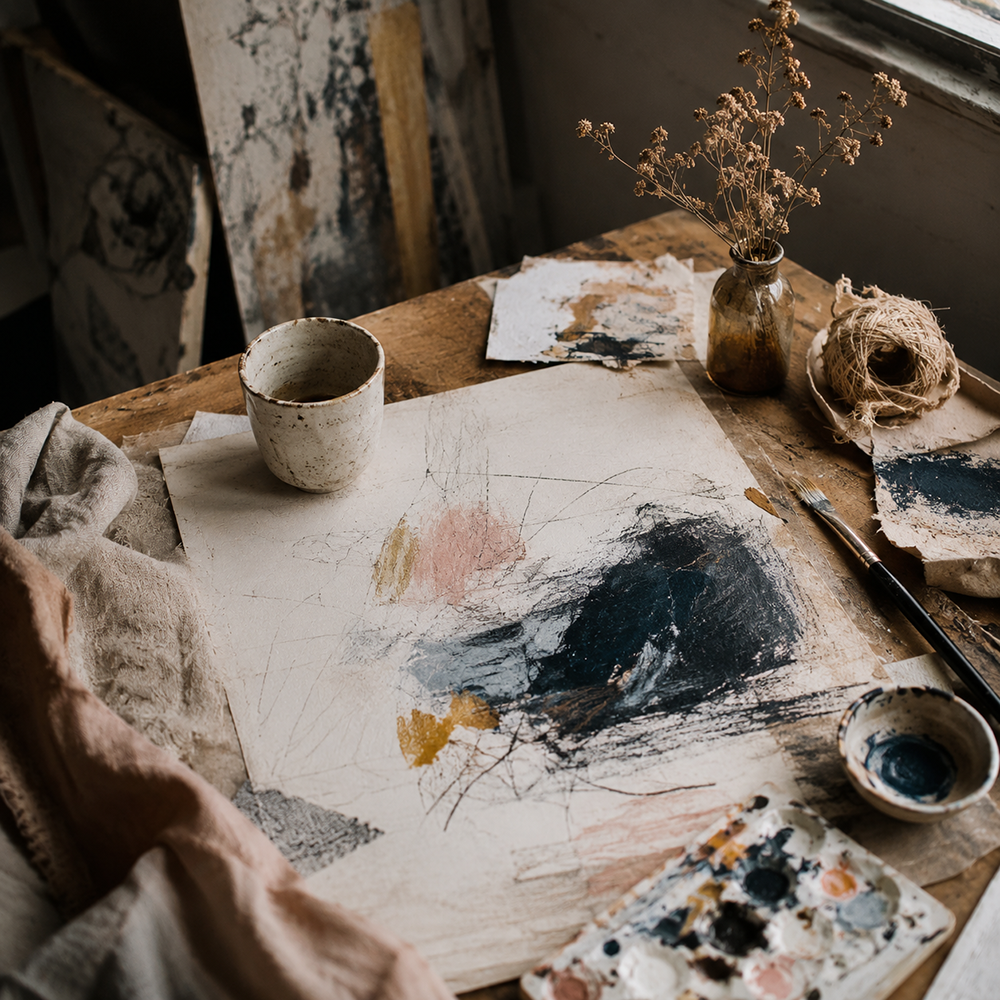
Curiosity Can Have an Ending
I think we sometimes assume that stopping means our motivation failed.
We lost discipline.
Got distracted.
Didn't follow through.
And sometimes that's exactly what happened.
But curiosity can also simply reach an ending.
Maybe you wanted to know whether you could knit with an unusual material.
You tried it.
You can.
You also discovered that you hate doing it.
Question answered.
Maybe you wondered whether two techniques would work together.
You tested them.
They don't.
Question answered.
Maybe you tried a new medium and found it fascinating—but realized you're more interested in one small aspect of it than in completing the original project.
The experiment did what experiments do.
It gave you information.
Continuing might still be worthwhile.
But continuing isn't necessarily what proves the experiment mattered.
Sometimes the project ends because the question that started it has already been answered.
And perhaps one of the freedoms of creative experimentation is being able to recognize when that has happened.
Not every question needs to become a finished object.
Sometimes an answer is enough.
Stopping Isn't Always Giving Up
There are plenty of good reasons to finish something.
Sometimes the part we want to abandon is simply difficult.
We're frustrated.
The exciting beginning is over.
The technique isn't coming easily.
The project has reached that awkward middle stage where it doesn't look like the thing we imagined yet.
And sometimes continuing through that discomfort teaches us something we couldn't have learned if we'd stopped.
Persistence matters.
Problem-solving matters.
Learning how to work through frustration matters.
But that doesn't mean every decision to stop is a failure of persistence.
Sometimes stopping is a decision, too.
Difficulty and Disinterest Aren't Always the Same Thing
Imagine you're learning to knit.
You reach a technique you've never done before.
It's confusing.
You make mistakes.
You pull out several rows.
Try again.
Get frustrated.
At that moment, “I don't want to do this anymore” might really mean: I don't know how to get through this part yet.
And perhaps some help, a break, a tutorial, or another attempt is exactly what you need.
But imagine something slightly different.
You've been working on the project for weeks.
You understand how to make it.
You know what comes next.
You simply realize: I don't actually want this anymore.
Maybe the project no longer interests you.
Maybe another idea has become more compelling.
Maybe you discovered that you dislike the process.
Maybe what seemed exciting when you started doesn't fit you now.
Those situations can feel similar from the outside.
Both end with an unfinished object.
But internally, they may be very different.
“This became difficult” and “this has run its course” aren't always the same thing.
 Jessica Carey
Sometimes We Keep Going Because We've Already Started
There's another reason we can have trouble stopping.
We've already put so much into it.
Hours.
Materials.
Energy.
Attention.
Maybe money.
Stopping can make all of that feel wasted.
So we think: I've come this far. I have to finish it now.
Sometimes that's a useful push.
But sometimes it means spending another ten hours on something we no longer want simply because we've already spent five.
Finishing the object can't travel backward in time and change whether those first five hours were worthwhile.
And abandoning it doesn't automatically erase whatever happened during them.
Maybe you learned something.
Maybe you enjoyed the beginning.
Maybe you discovered that this wasn't the project for you.
The time has already been spent.
The question now is different: do I still want to give this more?
Stopping Can Be Part of the Creative Decision
We tend to think of creative decisions as things that happen inside a project:
- Which color?
- Which material?
- What composition?
- What happens next?
But perhaps: I'm not going to continue this can also be a creative decision.
You might decide to dismantle the piece and reuse the materials.
Unravel the knitting.
Cut up the painting for collage.
Pull one paragraph from the abandoned draft and let the rest go.
Keep the prototype for reference.
Photograph the experiment and throw the physical object away.
Or simply put something down and never return to it.
Sometimes stopping creates room for something else.
Not because the next idea is automatically better.
But because our attention, energy, materials, and time are finite.
Choosing what not to continue can be part of choosing what we do want to pursue.
Some Projects Are Paused, Not Abandoned
Of course, we don't always know.
Sometimes something we thought we'd abandoned calls us back years later.
We open an old sketchbook and suddenly see where a drawing could go.
Find a half-finished piece in a box and feel curious again.
Rediscover a draft and realize we finally know what it was trying to become.
The project waited.
And perhaps we changed enough in the meantime to meet it differently.
That's another reason we don't necessarily need to force a decision.
An unfinished project doesn't always require us to declare: I WILL FINISH THIS or: I AM ABANDONING THIS FOREVER.
Sometimes it can simply be: not now.
We can leave the ending unresolved.
You Don't Need to Earn the Right to Stop
And sometimes we do know.
We know we're finished with something even though the thing itself isn't finished.
I think that can be surprisingly difficult to accept.
We may feel that we need a sufficiently respectable reason.
The materials became unusable.
We ran out of supplies.
The project became impossible.
Some external circumstance prevented us from continuing.
Those reasons feel easier to defend than: I don't want to anymore.
But creative work isn't a contract we sign with every idea that interests us.
Beginning something doesn't necessarily mean promising to carry it all the way to its originally imagined ending.
We are allowed to learn more about the project—and ourselves—after we begin.
Sometimes that new information changes the decision.
Knowing When to Continue Is Part of It, Too
There probably isn't a perfect test for deciding which unfinished projects deserve another chance.
Sometimes we're avoiding something because we're afraid of failing.
Sometimes we're frustrated because we're learning.
Sometimes we're bored because we've reached the less exciting part of the process.
And sometimes we're genuinely done.
We may only understand the difference afterward.
So the point isn't: if you feel like stopping, stop.
It's something gentler: stopping doesn't automatically mean you failed.
Sometimes persistence serves the work.
Sometimes letting go serves us better.
Finishing something because it still matters to us is different from finishing it because we believe we're not allowed to stop.
And maybe part of developing a creative practice is learning not only how to keep going—but also how to recognize when something has already gone as far as we want to take it.
The Unfinished Thing Can Still Contain Something
An unfinished project doesn't necessarily become a creative dead end.
Sometimes pieces of it keep moving.
A sketch contains a shape we return to later.
An abandoned painting introduces us to a color combination we hadn't considered before.
A half-written story contains a sentence that eventually belongs somewhere else.
A knitting project gets unraveled and the yarn becomes something entirely different.
A failed sculpture reveals a way of joining materials that works beautifully in another piece.
The original project may never become what we imagined.
But something inside it can continue.
Ideas Don't Always Stay Where They Started
Creative ideas are surprisingly difficult to contain within individual projects.
One thing leads to another.
A mistake becomes a technique.
A discarded composition becomes the starting point for another image.
An experiment with one material makes us wonder what would happen with another.
A fragment from an old draft suddenly makes sense in something we're writing years later.
Sometimes we don't even recognize the connection immediately.
We simply find ourselves using something we learned before.
The original project may be sitting unfinished in a drawer somewhere, while a small piece of it has quietly become part of everything we've made since.
Not everything a project gives us remains inside the project.
Materials Can Move On, Too
Sometimes the most literal thing we can do with an unfinished project is take it apart.
Yarn can be unraveled.
Paper can be cut up.
Fabric can become scraps for something else.
Beads can be removed.
Components can be salvaged.
A painting can become collage material.
A failed print can become the surface for another experiment.
There can be something strangely freeing about realizing that the unfinished object doesn't always have to remain frozen in its current form.
We don't necessarily have to choose between: finish this and waste this.
Sometimes there's a third possibility: use what is here differently.
Sometimes the more interesting creative question becomes: what else can this do?
The project doesn't have to remain intact for what went into it to keep having value.
 Jessica Carey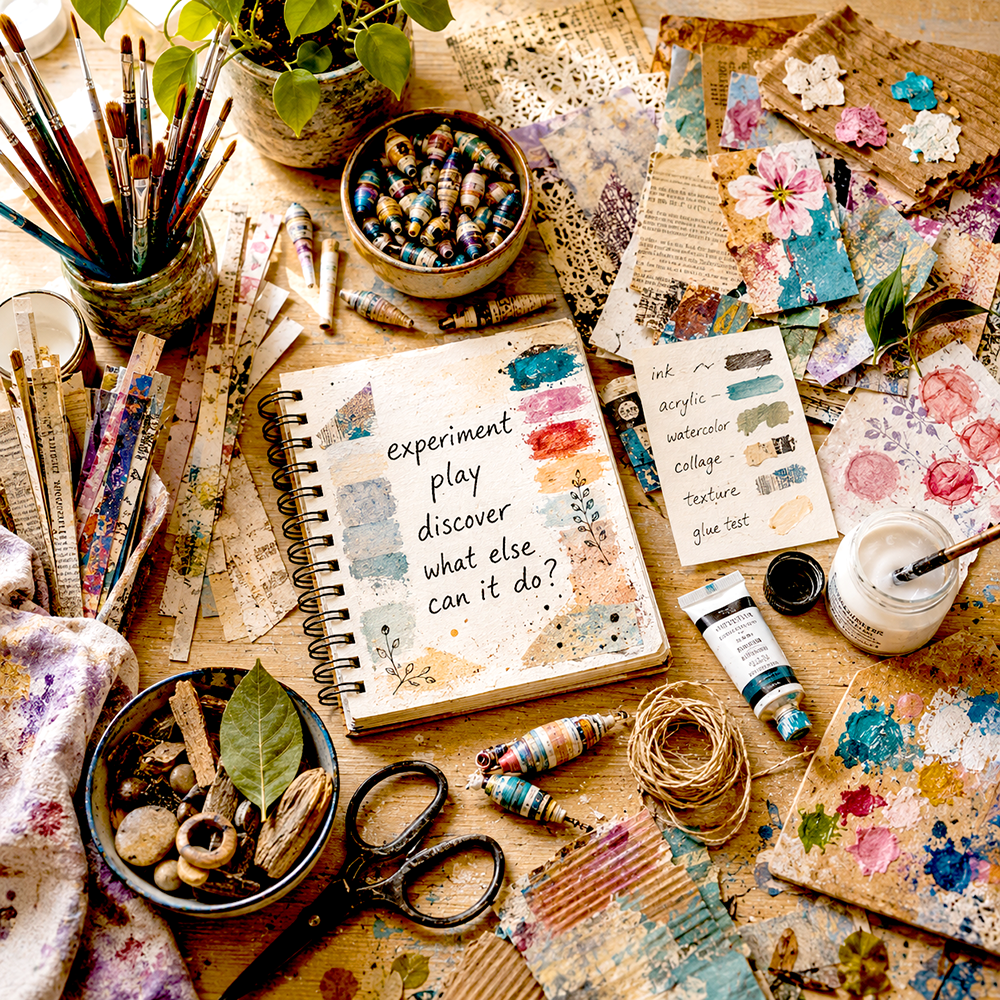
Sometimes One Small Part Is Enough
And sometimes we don't want to dismantle the whole thing.
Maybe there's one part we genuinely love.
A particular brushstroke.
A strange texture.
A sentence.
A tiny section of embroidery.
A shape that emerged accidentally.
A photograph of something that no longer physically exists.
We can keep that part without needing to rescue everything around it.
There's an impulse sometimes to believe that if a project isn't successful as a whole, nothing inside it counts.
But creative work doesn't have to be evaluated quite so completely.
We can say: I don't like this piece, but I love what happened here.
Or: this project didn't work, but this idea did.
The unfinished thing doesn't have to become successful in its entirety before we're allowed to take something valuable from it.
What the Maker Keeps
But perhaps the most important things aren't always the pieces we can physically salvage.
Maybe you learned how much pressure a material can withstand before it breaks.
Maybe your hands became more comfortable with a tool.
Maybe you understand color differently now.
Maybe you learned a stitch.
Maybe you found a writing rhythm that feels more natural.
Maybe you discovered that you work better at a different scale.
Maybe you became a little more comfortable improvising when something went wrong.
Those things can't necessarily be removed from the unfinished project and placed neatly into the next one.
They're already somewhere else.
They're in you.
The object may remain unfinished while the knowledge moves forward.
And that means an abandoned project can continue affecting work that comes long after we've stopped touching it.
There can also be something revealing about an unfinished thing precisely because it is unfinished.
A sketch may still contain the searching lines that would disappear beneath a finished drawing.
A draft can show where an idea was still trying to find its shape.
An experiment can preserve the evidence of decisions, mistakes, revisions, and possibilities that a polished object might eventually conceal.
Sometimes finishing clarifies a work.
But sometimes the unfinished state lets us see the making itself.
It doesn't mean every abandoned project is secretly beautiful.
But perhaps part of the beauty of unfinished things is that they can leave the process exposed—the uncertainty, exploration, and becoming that usually disappear once we arrive at the end.
Not Everything Has to Be Reclaimed
There is one trap here worth avoiding.
If we're trying to release unfinished projects from the requirement to become finished objects, we probably shouldn't replace that requirement with another one: every unfinished project must eventually become useful somehow.
Sometimes we won't reuse the materials.
We won't return to the idea.
We won't salvage a brilliant detail.
We won't transform the failure into our next great discovery.
Maybe we barely remember what we learned from it.
That doesn't necessarily make the experience meaningless.
We don't need to prove that every abandoned experiment secretly became productive later in order to justify its existence.
Sometimes we spent an afternoon making something.
We were curious.
We tried.
And then we stopped.
That can be the whole story.
The Project Isn't the Only Place Its Value Can Live
This changes the way we might look at unfinished work.
Instead of seeing only an object that failed to reach its intended destination, we can also see traces.
Something learned.
Something practiced.
Something discovered.
Something enjoyed.
Something salvaged.
Something carried into another project.
Or simply evidence of a period when we were interested enough in an idea to follow it for a while.
The project itself doesn't have to contain a visible record of everything that happened because of it.
Some of its value may have moved elsewhere long ago.
Into another artwork.
Another idea.
Another material.
Another skill.
Another way of seeing.
Or into the person who made it.
Not everything a project gives us remains inside the project.
Sometimes the unfinished thing is only what got left behind.
What mattered most may already have moved on.
 Jessica Carey
You Don't Have to Finish It to Justify Starting It
There is a particular kind of guilt that can accumulate around unfinished projects.
Not only: I should finish that.
But: why did I start it in the first place?
- Why did I buy those supplies?
- Why did I spend all that time on it?
- Why do I keep starting things I don't finish?
- Why did I think I was going to make this?
The unfinished project begins to feel like evidence of a bad decision.
And sometimes that feeling extends beyond the individual project.
We make rules for ourselves:
- I'm not allowed to start anything new until I finish what I've already started.
- I shouldn't buy supplies for another idea when I still have unfinished projects.
- I need to get better at following through.
Sometimes those rules are useful.
But sometimes they turn creativity into a system where starting something creates a debt that only completion can repay.
We Couldn't Know Before We Started
The strange thing about experimentation is that we usually have to begin before we know where something will lead.
You don't necessarily know whether you'll enjoy a technique until you try it.
You don't know whether an idea will work until you test it.
You don't know how a material will behave until you work with it.
You don't know whether the project that sounds wonderful in your head will still interest you after ten hours of making it.
You don't know what you'll discover halfway through.
If we did know all of that beforehand, it wouldn't really be experimentation.
Starting something is sometimes how we find out whether we want to continue.
That means there will inevitably be things we begin and decide not to finish.
Not because beginning was a mistake.
Because beginning gave us information we couldn't have had before.
Starting Doesn't Have to Be a Promise
Maybe part of the pressure comes from treating every beginning like a commitment.
Once we cast on the stitches, we owe the world a sweater.
Once paint touches canvas, we owe it a painting.
Once we write the first paragraph, we owe it an ending.
Once we buy the supplies, we have to produce the object that justified buying them.
But perhaps beginning can be something smaller:
- I'm interested in this.
- I want to see what happens.
- I'd like to try.
That's enough to begin.
We don't always have to know whether we're entering a lifelong practice, a six-month project, or an interesting afternoon.
Beginning something doesn't necessarily mean promising to carry it all the way to its originally imagined ending.
Sometimes we're simply giving an idea enough room to show us what it is.
“I Should Finish This First”
There can also be a strange hierarchy among creative ideas.
The old unfinished project becomes an obligation.
The new idea becomes a reward we're not allowed to have yet.
Finish the old thing first; then you can start the exciting thing.
Again, sometimes that's useful.
Constantly chasing the excitement of beginnings can make it difficult to develop the skills that come from staying with something.
But the opposite can become limiting, too.
If every old idea must be completed before a new one is allowed to exist, our past curiosity gets to control our future curiosity.
The person who began that project months or years ago made a choice with the interests, knowledge, circumstances, and energy they had then.
The person standing in front of it now may want something different.
We don't necessarily owe every past version of ourselves the completion of everything they once wanted to make.
Sometimes an unfinished project can remain unfinished while we follow the idea that matters to us now.
Unfinished Doesn't Automatically Mean Wasted
Time can be wasted.
Materials can be wasted.
Money can be spent on something we later regret.
We don't need to pretend otherwise.
But unfinished doesn't automatically prove that any of those things happened.
A sheet of expensive paper used for an experiment that didn't work still gave us the experience of using it.
Yarn from an abandoned project may have taught us a technique.
An afternoon spent making something we eventually throw away was still an afternoon in which we were making, thinking, learning, playing, concentrating, or simply being curious.
Maybe we wish we'd used the materials differently.
Maybe we genuinely regret buying them.
That's possible.
But the presence of an unfinished object isn't enough, by itself, to tell us that the resources spent on it were wasted.
The time wasn't necessarily wasted simply because there isn't a finished object to show for it.
 Jessica Carey
Some Things Are Worth Starting Without Knowing the Ending
If we required ourselves to know that every creative project would be finished before allowing ourselves to begin, we'd have to become remarkably cautious.
Choose ideas we're confident we can execute.
Use materials we already understand.
Avoid projects whose outcomes are uncertain.
Think carefully before following strange impulses.
Make sure the thing will be useful.
Make sure we'll stay interested.
Make sure it will work.
Make sure it will be worth it.
And eventually, perhaps, we'd become very good at starting only the things whose endings we could already predict.
But we'd lose something important in the process.
Because creativity often asks us to move before certainty arrives.
To wonder.
To test.
To follow something because we're curious about where it might go.
Sometimes it goes somewhere wonderful.
Sometimes it goes nowhere.
Sometimes it goes somewhere we never expected.
And sometimes we walk with it for a while and then leave it there.
You don't have to finish something to justify having started it.
Maybe the beginning was worthwhile because you were curious.
Maybe the middle taught you something.
Maybe stopping was the moment you realized what you actually wanted.
Maybe the project gave you an idea you'll use years from now.
Maybe you simply enjoyed making it until you didn't.
And maybe that's enough.
A creative life doesn't have to be a perfectly maintained inventory of completed projects.
It can also be full of fragments.
False starts.
Tests.
Experiments.
Things waiting for us.
Things we've outgrown.
Things we might return to.
And things we never will.
They aren't necessarily evidence that we failed to follow through.
Sometimes they're simply evidence that we were willing to begin without knowing exactly where the making would take us.
 Jessica Carey
Maybe It Already Gave You What You Needed
Maybe there is an unfinished project somewhere in your life right now.
A sketchbook you haven't opened in months.
A canvas leaning against a wall.
A half-knitted project still attached to its needles.
A draft sitting untouched in a folder.
A collection of materials waiting for the idea you once had for them.
Maybe you should finish it.
Maybe tomorrow you'll pick it up again and something will click.
Maybe you'll return months or years from now with different skills, different ideas, or simply a renewed desire to see where it goes.
Some unfinished things are waiting.
But some aren't.
Some projects may be done in a different sense.
Not completed.
Not polished.
Not ready to display.
But finished giving us what they had to give.
Maybe it taught us something, answered a question, led somewhere unexpected, or held our curiosity for as long as we needed it to.
None of those things requires a finished object in order to have happened.
Ask a Different Question
We often encounter unfinished projects with some version of the same question: why didn't I finish this?
Sometimes that's a useful question.
Maybe the answer reveals fear, frustration, perfectionism, or a difficulty worth working through.
Maybe it reminds us that we really do want to return.
But it doesn't have to be the only question.
We could also ask: what did this already give me?
Maybe the answer is a new skill.
An answered question.
A different idea.
A mistake you'll understand differently next time.
An unexpected discovery.
An hour of curiosity.
A material you now understand better.
A memory of making something simply because you wanted to see what would happen.
Or maybe there isn't a profound answer at all.
Maybe you made something for a while.
Then you stopped.
That can be enough, too.
Another Kind of Completion
There will always be value in finishing things.
In staying when something becomes difficult.
In seeing an idea all the way through.
In reaching that wonderful moment when something that once existed only in our imagination is finally sitting in front of us.
But perhaps completion doesn't have to be the price every creative experience pays before we're willing to call it worthwhile.
Some projects become finished objects.
Some become stepping stones.
Some become scraps.
Some become lessons.
Some become memories.
Some become other projects.
And some simply become things we once spent time making.
Not everything has to become a finished object before the time we spent making it can count.
Maybe that's part of the beauty of the unfinished.
It leaves behind evidence of curiosity without requiring every curiosity to become a destination.
Evidence that we tried something without requiring every attempt to become an achievement.
Evidence that making can matter even when there is nothing polished at the end to prove that it did.
Sometimes a project still needs something from us.
But sometimes?
The project has already given us what we needed from it.
And maybe that can be a kind of completion, too.
Want even more content about creativity and art?
Be sure to check out all of our creative chronicles!
If you'd like to see examples of my work, you can find some of my art and creations at Redbubble and Gumroad!
Looking to learn more about my recent journey?
Check out some of these articles:
-Hidden Gems for St. Louis Artists
-Hidden Gems for Autistic & Neurodivergent Adults
-Learning What Love Was Supposed to Feel Like
-I Wasn't Broken--I'm Burned Out
-The Difference Between Resting and Giving Up
-What Chronic Autistic Burnout Actually Feels Like
-When You Had to Raise Yourself
 Jessica Carey