
Walk into an art museum and finding the art seems easy enough.
There are paintings on the walls.
Sculptures on pedestals.
Photographs behind glass.
Objects carefully lit beneath little signs telling us the artist, title, materials, and year.
We already know what we're supposed to do: look at the art.
But take some of those objects out of the museum, and things can get considerably stranger.
- What about a child's drawing taped to a refrigerator?
- A hand-thrown ceramic mug we drink coffee from every morning?
- A quilt someone spent hundreds of hours piecing together?
- A beautifully plated meal that disappears twenty minutes after it's made?
- A pile of objects arranged deliberately on the floor?
- A photograph anyone with a phone could technically take?
- An image generated using artificial intelligence?
- A urinal?
Somewhere along the way, somebody is probably going to say: that's not art.
And that's where things get interesting.
We Seem to Know Art When We See It—Until We Don't
Some things enter the category so easily that we barely think about it.
A Renaissance painting?
Art.
A marble sculpture?
Art.
A symphony?
Art.
Then somebody hands us a ceramic mug.
Well...that's pottery.
We see an intricate quilt.
That's a craft.
A chef creates something visually extraordinary.
That's food.
A child covers a piece of paper in crayon.
That's children's art.
Someone puts an ordinary manufactured object into a gallery.
Come on, that's not art.
Someone generates an elaborate image using AI.
And suddenly the argument may become less about the image itself and more about authorship, labor, technology, intention, originality, and what exactly we think a person needs to have done before we're willing to call the result art.
The boundary can move surprisingly quickly.
And people can feel surprisingly strongly about where it belongs.
The Question Gets Bigger the Longer We Look at It
We could try to solve this by finding the rule.
Maybe art requires skill.
Except plenty of art deliberately rejects technical polish.
Maybe it has to be beautiful.
Except humans have made plenty of art that is disturbing, grotesque, painful, or intentionally unpleasant.
Maybe it has to express something.
Maybe it can't be useful.
Maybe the artist has to intend for it to be art.
Every answer seems promising until we encounter something that doesn't quite fit.
Every time we think we've found the fence, someone seems to build something directly across it.
Which may explain why people have been arguing about this for such a long time.
I'm Not Going to Solve What Art Is
Fortunately, I'm not going to try.
There are entire fields of philosophy devoted to aesthetics and generations of artists, critics, historians, scholars, and extremely opinionated people standing in museums who have wrestled with versions of this question.
We're not going to settle it in one discussion.
And I'm not sure settling it would be the most interesting thing we could do anyway.
Because underneath: what makes something art?
There may be another question: why do we care so much about deciding?
- Why does calling something a painting instead of a painting that isn't art matter?
- Why does the distinction between art and craft carry so much weight?
- Why can moving an object into a museum change how we look at it?
- Why does I don't like this sometimes become this isn't art?
- Why do new technologies make us reopen the argument all over again?
- And what exactly do we think we're protecting when we guard the boundary?
Maybe the disagreement itself can tell us something.
Maybe the Boundary Is the Interesting Part
Imagine placing a few things on a table.
A child's drawing.
A ceramic mug.
A handmade quilt.
A photograph.
A beautifully decorated cake.
An abstract sculpture.
An AI-generated image.
And, for good measure, a urinal.
Then ask ten people which ones count as art.
I'd be surprised if everyone drew the line in exactly the same place.
One person might care about technical skill.
Another might care about intention.
Someone else might care about originality.
Or beauty.
Expression.
Effort.
Human involvement.
Context.
Meaning.
Maybe someone would call everything on the table art.
Maybe someone would call almost none of it art.
And perhaps the most revealing part wouldn't be where each person drew the line.
It would be why.
Because every definition quietly tells us something about what we believe artistic creation is supposed to require.
- What if the question isn't only what gets to count as art?
- What if it's what our boundaries around art reveal about what we value?
That's the question I want to explore.
Not because I think we're going to find the official line.
But because humans seem remarkably compelled to keep drawing one.
 Jessica Carey
We Keep Looking for the Rule
There would be something wonderfully convenient about discovering the rule.
One quality shared by everything that counts as art.
Something we could point to and say: there, that's what makes it art.
Then the ceramic mug, child's drawing, museum installation, quilt, photograph, symphony, sculpture, and whatever strange thing someone just dragged into a gallery could all be evaluated against the same standard.
Art.
Not art.
Question settled.
Unfortunately, art doesn't seem particularly interested in cooperating.
Is It Skill?
Technical skill is one of the most tempting boundaries.
We admire what people can do.
A painter creates skin that seems almost translucent.
A ceramicist throws an impossibly thin vessel.
A musician performs something extraordinarily difficult.
A quilter fits hundreds of tiny pieces together with astonishing precision.
Someone draws a portrait that looks nearly photographic.
There is real knowledge in those things.
Practice.
Control.
Experience.
Technique.
And none of that needs to be dismissed simply because we're questioning whether skill defines art.
But if technical skill is what turns something into art, we immediately run into problems.
What happens to deliberately simple work?
Naive art?
Loose gestural drawings?
Conceptual work where the idea matters more than conventional craftsmanship?
A child's drawing?
A painting made by someone who has only been painting for three weeks?
We can certainly say one work demonstrates more technical skill than another.
But that's a different statement from saying one is art and the other isn't.
Maybe skill can help us evaluate how something was made without giving us a universal answer to whether it is art.
 Jessica Carey
Is It Beauty?
Beauty seems promising, too.
After all, art is often where we go looking for beautiful things.
Color.
Harmony.
Form.
Grace.
Something we want to keep looking at.
But humans also make art about grief.
Violence.
Fear.
War.
Disgust.
Loneliness.
Bodies.
Death.
Things deliberately designed to disturb us.
Sometimes an artwork is powerful precisely because it isn't pleasant to look at.
And even when artists are pursuing beauty, we don't necessarily agree about what beauty is.
One person's breathtaking abstraction is another person's: my kid could do that.
One person's elegant minimalism is another person's empty room.
One person's beautiful painting is another person's sentimental mess.
If art requires beauty, we'd first need to agree on beauty.
Good luck with that.
Is It Intention?
Maybe the answer is simpler.
Something is art when someone intends to make art.
This gets us somewhere.
Intention certainly seems important.
A branch falls onto the ground after a storm and happens to create an interesting shape.
We probably wouldn't say the tree made a sculpture.
But a person picks up that branch, combines it with several others, arranges them deliberately, and presents the result as a sculpture.
Now something has changed.
The materials may be nearly identical.
The human intention isn't.
But even this boundary gets slippery.
- What about someone who makes an intricate quilt because their family needs a blanket and never thinks of it as art?
- What about an object created for a practical, ceremonial, religious, or cultural purpose that is later displayed in an art museum?
- What about something someone doodled absentmindedly that another person finds extraordinarily expressive?
- What if the maker says: it's not art; I was just making something. Do they get the final word?
Maybe.
But then what happens when another person encounters it as art?
Suddenly we're dealing not only with the maker's intention, but with context, interpretation, culture, and the person doing the looking.
The rule has escaped again.
Maybe We're Asking One Word to Do Too Much
Perhaps part of the problem is that we use the word art to describe an enormous range of human activity.
A cave painting.
A movie.
A ballet.
A comic book.
A bronze sculpture.
A photograph.
A poem.
A video game.
A performance.
A textile.
A song.
A digital animation.
A conceptual installation.
These things don't necessarily use the same materials.
They don't require the same skills.
They don't serve the same purposes.
They don't produce the same experiences.
Some are made alone.
Some require hundreds of people.
Some exist for centuries.
Some disappear the moment they're performed.
Some are intensely personal.
Some are commercial.
Some are functional.
Some deliberately refuse to be useful at all.
And yet we keep placing wildly different things beneath this enormous umbrella called art.
Maybe that's why every simple definition seems to develop holes.
We're trying to find one property that explains an astonishingly diverse collection of human behaviors, objects, experiences, and intentions.
Every Rule Tells Us Something Anyway
But our failed definitions aren't necessarily useless.
Every rule reveals something about what we value.
If art requires skill, mastery matters.
If the artist has to make the thing themselves, authorship and labor matter.
If something can't be art because it's useful, function matters.
When we draw a boundary around art, we aren't only sorting objects into categories. We're revealing something about what we think artistic creation should require.
And that's where another strange boundary becomes especially interesting.
Because there are objects that can contain extraordinary skill, intention, beauty, history, and meaning—and yet have repeatedly been pushed toward the edge of what gets called art for a surprisingly simple reason: they're useful.
And that's where the mug and the quilt come back into the room.
The Boundary Gets Especially Strange Around Useful Things
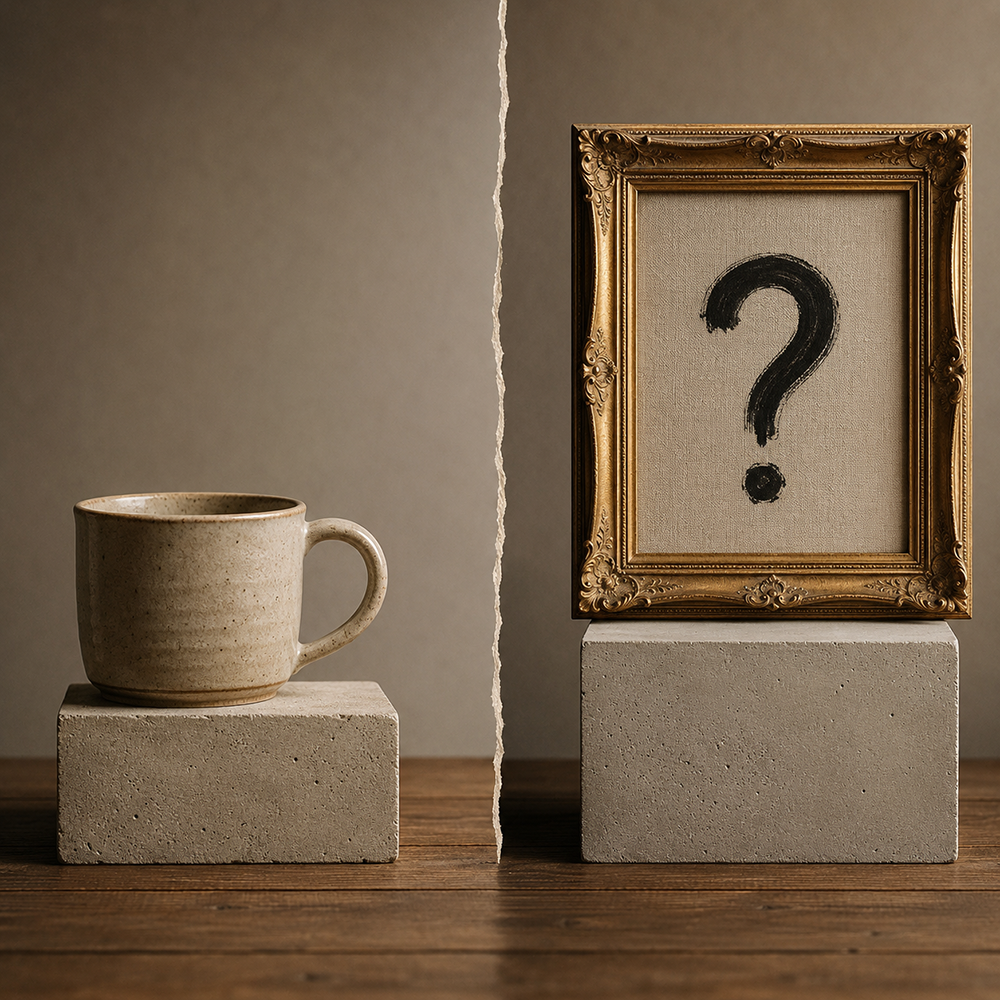
Let's put two ceramic objects beside each other.
One is a sculpture.
It sits on a pedestal in a gallery.
Nobody is expected to put anything inside it.
The other is a handmade mug.
Someone shaped the clay.
Considered the proportions.
Chose the glaze.
Thought about color and texture.
Designed the handle.
Made decisions about how the object should look and feel in someone's hands.
And then somebody pours coffee into it.
Suddenly, we may become less certain about what to call it:
- Art?
- Craft?
- Functional pottery?
- Design?
Why should the ability to drink coffee from something make its artistic status more questionable?
Art or Craft?
The same problem appears with textiles.
Imagine an extraordinarily intricate quilt.
Hundreds of pieces of fabric.
Careful choices about color, pattern, rhythm, balance, and composition.
Years of technical knowledge.
Hours upon hours of labor.
Perhaps family history stitched into it.
Maybe cultural traditions.
Maybe experimentation.
Maybe a completely original design.
Hang it on a museum wall and we may approach it as an artwork.
Put it on a bed and suddenly it becomes: a quilt.
Of course, it is a quilt.
But why would being a quilt prevent it from also being art?
We do something similar with jewelry.
Furniture.
Clothing.
Ceramics.
Embroidery.
Basketry.
Bookmaking.
Glass.
Woodworking.
Objects can contain extraordinary creativity and skill while simultaneously doing something useful.
And yet usefulness has often made certain forms of making easier to place in categories like craft or design than fine art.
The distinction isn't meaningless.
Craft, design, and art can describe genuinely different traditions, practices, purposes, and ways of working.
These categories aren't universal or timeless, either.
Different cultures and historical periods have organized making, usefulness, beauty, ritual, skill, and creative expression in different ways.
Even the boundaries we're trying to define have histories of their own.
The problem begins when those categories quietly turn into a ladder.
Art up here.
Craft down there.
Useful Doesn't Mean Uncreative
There's something strange about the assumption that artistic value increases as practical usefulness disappears.
A painting doesn't become less artistic because it covers an ugly wall.
A song doesn't stop being art because someone dances to it.
Architecture has to keep the rain out.
A beautifully illustrated book still has words we're supposed to read.
A ceramic mug can hold coffee and contain aesthetic decisions.
A quilt can keep someone warm and carry pattern, symbolism, memory, experimentation, and extraordinary skill.
Those functions don't necessarily cancel one another.
Sometimes the usefulness is actually part of the creative problem.
- How heavy should the mug be?
- How should the handle fit a hand?
- How does the fabric need to behave?
- How should a chair support a body?
- How can something be durable enough to use while still becoming what the maker imagined?
The function creates constraints.
And creativity often happens inside constraints.
Maybe the question doesn't have to be: is this art or is it useful?
Maybe something can be both.
Context Can Change the Category Without Changing the Object
Now take that handmade mug and move it.
First, it's sitting beside the sink.
Then it's displayed at a craft fair.
Then it's photographed for a design publication.
Then someone places it inside a glass case in a museum.
The mug hasn't necessarily changed.
But something around it has.
We're being given different instructions for how to encounter it.
At home: drink from this.
At the market: consider buying this.
In the museum: look at this.
Suddenly we may pay attention to things we barely noticed when the mug was holding coffee.
The curve of its body.
Finger marks left in the clay.
The glaze pooling near the bottom.
The relationship between the handle and the vessel.
The maker's choices.
Maybe those qualities were there the entire time.
The context didn't necessarily put artistry into the object.
It may simply have given us permission to notice what was already there.
 Jessica Carey
What Happens When We Change the Frame?
This is where the boundary starts becoming particularly slippery.
A quilt on a bed and a quilt on a gallery wall may be physically identical.
But the gallery wall says: pay attention.
The pedestal says: look closely.
The museum label says: this has been selected as something worth considering.
That framing has power.
It can preserve objects.
Give them visibility.
Provide historical context.
Invite careful attention.
But it also raises another question: who gets to provide the frame?
- Who decides which objects belong behind museum glass?
- Which makers enter art history?
- Which forms of making receive exhibitions?
- Which are studied as significant artistic practices?
- And which remain categorized primarily as domestic work, decoration, hobby, craft, or everyday object?
Now our innocent little question—what makes something art?—isn't only about the thing we're looking at.
It's also about who gets to tell us how we're supposed to look at it.
Maybe “Art” and “Craft” Don't Have to Be Opponents
None of this requires us to solve the debate by declaring: everything is art!
Nor do we have to rescue craft by saying: actually, craft was secretly fine art all along.
Craft doesn't need to become something else before it can have value.
A maker may proudly identify what they do as craft.
Someone may care deeply about functional design.
Another person may make pottery without caring whether anyone calls it art.
The interesting problem isn't that we have different words.
It's what happens when those words begin determining which kinds of creativity we take seriously.
Perhaps a ceramic mug doesn't need to stop being a mug to deserve our attention.
A quilt doesn't have to leave the bed and enter a museum before we're allowed to notice its composition.
A piece of jewelry doesn't have to become unwearable before its artistic decisions become visible.
Function and artistic possibility don't have to cancel each other out.
And once we admit that context can influence whether we're willing to see something as art, we run directly into an even stranger possibility.
What happens when the object wasn't handmade at all?
What if somebody takes an ordinary manufactured object, puts it in an exhibition, gives it a title, and says: look at this as art.
That's where a certain urinal becomes very difficult to avoid.
Sometimes the Frame Changes What We See
In 1917, an ordinary porcelain urinal became part of one of the most famous arguments about art.
Marcel Duchamp purchased a manufactured urinal, turned it on its side, signed it “R. Mutt 1917,” titled it Fountain, and submitted it to an exhibition of the Society of Independent Artists in New York.
The work was rejected from the exhibition.
More than a century later, we're still talking about it.
Which is almost annoyingly effective.
Because whatever else we think about Fountain, it exposes something strange about the question: what makes something art?
Duchamp didn't sculpt the porcelain.
He didn't paint an image of a urinal.
He didn't demonstrate extraordinary technical mastery in its manufacture.
He selected an existing object and presented it differently.
The original 1917 Fountain was subsequently lost, although Duchamp later authorized replicas that are now held in museum collections.
The work became one of the best-known examples of his readymades—ordinary manufactured objects selected and designated as artworks.
And suddenly, the rule becomes considerably harder to find.
The Object Barely Changed
Imagine encountering essentially the same object in two places.
In a restroom, we probably don't stop and contemplate it.
We know what it is.
We know what it's for.
We barely need to look.
Put it on display.
Give it a title.
Attach an artist's name.
Place it inside an exhibition.
Now we're being asked to do something completely different.
Look at it.
Think about it.
Ask why it's there.
Maybe become irritated that it's there.
Maybe laugh.
Maybe insist that somebody is playing a joke on us.
Maybe start arguing with another person about whether it deserves to be there.
The physical object hasn't transformed dramatically.
Our relationship to it has.
And that creates a wonderfully inconvenient possibility:
Maybe some part of what makes something art isn't located entirely inside the object itself.
Museums and galleries don't merely contain objects.
They also tell us something about how we're expected to encounter them.
A pedestal says: notice this.
A frame says: look inside here.
A spotlight says: pay attention.
A museum label says: someone decided this was worth preserving, identifying, and explaining.
That doesn't mean everything placed on a pedestal automatically becomes great art.
It doesn't mean institutions get the final word on what art is.
And it certainly doesn't mean we have to like something because a museum displayed it.
But context can change the questions we ask.
We may stop asking: what is this for?
And begin asking:
- Why am I being shown this?
- Why did someone choose it?
- What am I supposed to notice?
- What happens when I look at this differently?
The frame doesn't necessarily provide the answer.
Sometimes it provides the question.
“Anyone Could Have Done That”
This is where another familiar objection appears: anyone could have done that.
And sometimes that's literally true.
Anyone could have purchased a urinal.
Anyone could place an ordinary object on a pedestal.
Anyone could draw a line.
Anyone could make a pile of rocks.
Anyone could take a photograph of an everyday object.
But anyone could have done it and anyone did do it aren't quite the same thing.
Nor does difficulty necessarily answer the question of artistic significance.
Sometimes the creative act isn't primarily: look how difficult this was to physically produce.
Sometimes it's: what happens if I make you encounter this ordinary thing differently?
We don't have to find that interesting.
We don't have to admire it.
We don't even have to agree about whether the result deserves to be called art.
But technical difficulty and artistic intention aren't necessarily the same measurement.
And once those measurements separate, our tidy definition gets messy again.
Maybe the Artist Can Change the Question Without Changing the Thing
This might be one of the more interesting possibilities conceptual art introduces.
Perhaps artistic creation doesn't always require transforming material into something visually new.
Sometimes the intervention may be in selection, arrangement, framing, naming, juxtaposition, or context.
Take something from one environment.
Place it somewhere unexpected.
Put two ordinary things beside each other.
Give something a title that changes how we interpret it.
Direct our attention toward something we'd normally ignore.
Ask us to consider an object not only for what it does, but for what happens when we think about it.
That doesn't mean every act of selection is automatically meaningful.
Putting my stapler on the kitchen table and announcing: behold, art.
doesn't obligate anybody to be impressed.
But maybe that's another distinction worth making:
- Is this art?
- Is this good art?
- Do I like this art?
- Do I find this interesting?
- Do I think this deserves to be in a museum?
Those are not necessarily the same question.
Sometimes we collapse all of them into: that's not art.
When what we actually mean is: I don't think this is good.
Or: I don't value the kind of artistic decision being made here.
Or simply: this does absolutely nothing for me.
And we're allowed to think that.
Something doesn't have to be expelled from the category entirely before we're allowed to dislike it.
 Jessica Carey
The Museum Doesn't Get the Final Word, Either
There's a danger in taking this too far in the opposite direction.
If context matters, we might conclude that something becomes art simply because a powerful institution says it is.
Museum = art.
Gallery = art.
Everything outside those spaces = questionable.
But that returns us to the hierarchy we just encountered with quilts and mugs.
A child's drawing doesn't need museum acquisition paperwork before it can matter.
A community mural doesn't require a curator's approval.
A quilt doesn't need to hang behind glass.
A sculpture doesn't stop being art when it's sitting in someone's backyard.
And museums themselves make choices shaped by particular histories, institutions, cultures, tastes, resources, and systems of recognition.
So context can influence how we encounter something without possessing absolute authority over what the thing is.
Maybe the museum doesn't magically turn an object into art.
Maybe it does something both simpler and stranger: it asks us to look at something as though it might be.
And then we have to decide what happens next.
The Frame Can Move
Perhaps that's what Fountain demonstrates so effectively.
The boundary around art isn't always drawn around particular materials or techniques.
Sometimes it moves with context, intention, selection, presentation, interpretation, and attention.
And none of that gives us the universal definition we've been searching for.
Maybe asking: what changed about the object? isn't always enough.
Sometimes we also need to ask: what changed about the way we were invited to see it?
And if changing the frame can complicate what counts as art, changing the tools used to make something can complicate it even further.
Humans have encountered that problem before.
And right now, we're encountering one particularly contentious version of it all over again: what happens when a machine participates in making the image?
New Forms Keep Reopening the Argument
Every generation seems to find a new reason to worry that the latest way of making things might not really count.
Sometimes the objection is about skill.
Sometimes it's about technology.
Sometimes it's about authorship.
Sometimes it's about whether the maker has done enough to deserve the word artist.
And sometimes a new tool doesn't create an entirely new philosophical problem.
It simply makes an old one much harder to ignore.
We've Had Versions of This Argument Before
Today, photography sits comfortably inside art museums.
That doesn't seem particularly strange.
But photography complicated existing ideas about artistic creation because a machine was involved in producing the image.
If a device could capture what was in front of it, where exactly was the artist?
- In the composition?
- The lighting?
- The subject?
- The timing?
- The processing?
- The selection of one photograph rather than another?
Eventually, photography developed its own enormous artistic traditions, and the camera became one of many tools artists might use.
Newer technologies continued raising variations of the same questions.
Film.
Digital photography.
Computer graphics.
Digital painting.
Image manipulation.
Each changed what humans could make and sometimes changed where we located the creative act.
A painter might physically create every mark on a canvas.
A photographer might select a subject, frame it, choose when to release the shutter, and make decisions afterward.
A filmmaker might create something through the combined work of hundreds of people.
A conceptual artist might create primarily through an idea, instruction, selection, or arrangement.
There was never only one relationship between an artist and an artwork to begin with.
Which makes our newest arguments considerably more complicated.
And Then AI Walked Into the Art Room
Generative AI makes many people profoundly uncomfortable for reasons that aren't difficult to understand.
A person can type words into a system and receive an image they did not physically draw or paint.
That immediately raises questions:
- Who made this?
- How much did the person actually create?
- Is prompting an artistic act?
- Does selecting one result from twenty matter?
- What if the person extensively edits the image afterward?
- What if AI generated only one part of a much larger human-created work?
- How much human involvement is enough?
And then there are questions that go far beyond aesthetics.
How were the systems trained?
What work was included?
Did the people whose work contributed to those systems consent?
How should attribution, compensation, copyright, and creative labor work?
Those aren't minor side issues.
And I'm not going to pretend they can be resolved in a few paragraphs inside an article asking what art is.
But AI is useful to this particular conversation for another reason.
It forces us to say what we think a human needs to contribute before we're willing to call something art.
Where Does the Creative Act Have to Happen?
Suppose someone enters: make a beautiful picture of a sunset.
They choose the first result.
Done.
Now imagine someone else spends hours developing prompts, generating hundreds of possibilities, rejecting most of them, combining portions of different outputs, painting over parts, changing the composition, manipulating color, adding hand-drawn elements, and eventually producing something substantially different from any individual generation.
Are those situations identical?
If not, where did the difference begin?
- Number of decisions?
- Time?
- Skill?
- Control?
- Transformation?
- Intentionality?
- Human labor?
Maybe our answer is still: neither one is art.
Maybe it's: both are art, but they involve very different degrees of authorship.
Maybe it's: the finished images might be art, but that doesn't necessarily tell us whether the person generating them should be understood as their artist.
Maybe we draw the boundary somewhere else entirely.
The point here isn't to pick the correct answer.
It's to notice what we're measuring when we try.
Calling Something Art Doesn't Resolve Every Other Question
This distinction matters.
Sometimes arguments about whether AI-generated imagery is art become containers for several different questions at once.
- Is it art?
- Is it ethical?
- Is it original?
- Who authored it?
- Who owns it?
- Did making it require skill?
- Should it be copyrighted?
- Should someone disclose how it was made?
- Should it compete alongside work created under different conditions?
- What obligations exist toward the people whose creative work contributed to the technology behind it?
Those questions can overlap.
But they aren't interchangeable.
Something being art doesn't automatically make the way it was produced ethical.
Something being ethically produced doesn't automatically make it good art.
Something requiring skill doesn't automatically make it art.
Something being art doesn't necessarily tell us who its artist is.
And deciding that we dislike a technology doesn't, by itself, settle every philosophical question about the objects people make with it.
“Is this art?” may be only one question inside a much larger argument.
New Tools Make Old Values Visible
Tools alone have never told us everything about what people are doing with them.
A pencil can write a grocery list or draw a portrait.
A camera can document a parking violation or create a photograph intended for an exhibition.
A sewing machine can repair a torn seam or help construct an elaborate textile work.
A computer can calculate a tax return or become part of an artistic process.
That doesn't mean every tool is ethically equivalent.
And it certainly doesn't mean the relationship between a paintbrush and its user is identical to the relationship between a generative model and its user.
Different tools distribute human agency, labor, control, and authorship differently.
And maybe that's one reason new forms create such intense arguments.
They expose assumptions we didn't have to articulate before.
If AI makes us say: but the artist has to actually make it, then we have to decide what make means.
If we say: art requires human intention, we have to decide how much intention and where it has to appear.
If we say: art requires skill, we have to decide which skills count.
If we say: the artist needs control over the result,
we have to decide how much unpredictability artistic creation can contain.
Suddenly we're not only arguing about AI.
We're revealing what we thought art was before AI entered the conversation.
Maybe that's one useful thing these uncomfortable boundary cases can do.
They make our invisible rules visible.
They force us to explain why the line belongs where we've drawn it.
And once we begin doing that, we arrive at the question this entire article has been circling: why are we so invested in drawing the line at all?
Maybe the Boundary Tells Us More About Us Than the Object
After all of this, we still don't have a rule.
Skill didn't quite work.
Beauty didn't.
Intention got complicated.
Useful objects blurred the line between art and craft.
A urinal made context impossible to ignore.
AI brought authorship, labor, technology, and human involvement crashing into the conversation.
And still, somewhere, someone is probably looking at something and declaring: that's not art.
Maybe it's worth asking why.
Not: are they right?
But: why does the distinction matter so much to us?
“I Don't Like It” and “It Isn't Art” Aren't the Same Thing
There are plenty of artworks I don't like.
Presumably, there are plenty you don't like either.
Something can bore us.
Annoy us.
Confuse us.
Repulse us.
Leave us completely unmoved.
We might think it's badly made.
Pretentious.
Derivative.
Uninteresting.
Overrated.
Or simply ugly.
Those are all judgments we can make about something while still leaving it inside the category of art.
But sometimes we go further.
That's not art.
And that's a different kind of statement.
I don't like this describes our relationship with the thing.
This isn't art makes a claim about what the thing is allowed to be.
One evaluates.
The other excludes.
Why do we sometimes feel the need to do that?
Maybe We're Protecting Something
Perhaps when people defend the boundary around art, they're often protecting something they genuinely value.
If someone has spent decades developing extraordinary technical ability, they may resist a definition of art that seems to make skill irrelevant.
If someone believes art is fundamentally human expression, AI-generated imagery may feel like a threat to something deeply important about the category.
If someone values originality, imitation may feel disqualifying.
If someone understands art as communication, work without an apparent message may seem empty.
If someone values labor, something that appears effortless may feel undeserving of the same recognition as something that took hundreds of hours.
Maybe these disagreements aren't always about people failing to understand art.
Sometimes they're disagreements about which parts of artistic creation we most want the word art to honor:
- Skill
- Labor
- Expression
- Imagination
- Originality
- Humanity
- Intention
- Meaning
- Beauty
Perhaps that's why the arguments can become surprisingly emotional.
We're not only arguing about an object.
We're arguing about what deserves to matter.
 Jessica Carey
Categories Aren't Always Neutral
And the words we choose can have consequences.
Calling something art doesn't merely place it inside an abstract philosophical category.
It can affect what gets:
- Displayed
- Collected
- Preserved
- Studied
- Reviewed
- Taught
- Funded
- Purchased
- Entered into exhibitions
- Written into art history
A category can influence whose work receives attention and whose work remains at the edges.
That's part of why the old art-versus-craft boundary matters.
If one kind of making is treated as culturally significant while another is dismissed as merely decorative, domestic, amateur, functional, or recreational, we're doing more than describing different techniques.
We may also be constructing a hierarchy of whose making deserves serious attention.
That doesn't mean every handmade object belongs in a museum.
It doesn't mean every creative activity needs institutional recognition.
And it certainly doesn't mean everything has to be called art before it can matter.
But categories can carry power.
Which makes it worth noticing who gets included inside them—and who doesn't.
Sometimes the Argument Isn't Really About the Object
Imagine two people standing in front of the same artwork.
One says: that's incredible.
The other says: that's not art.
They're looking at the same thing.
The object hasn't changed between them.
What's different is what each person brought into the encounter.
Their expectations.
Experiences.
Knowledge.
Preferences.
Values.
Ideas about skill.
Ideas about artists.
Ideas about museums.
Ideas about what art is supposed to do.
Maybe that's part of why the question what makes something art? remains so difficult.
We're looking for an answer inside the object when some portion of the answer may exist in the relationship between object, maker, viewer, culture, and context.
The boundary isn't only around the thing.
Some of it may be inside us.
What Happens If We Ask Better Questions?
Maybe this doesn't mean we should stop asking whether something is art.
Categories can be useful.
Definitions can help us communicate.
Disagreement can be interesting.
And sometimes drawing distinctions genuinely matters.
But is this art? doesn't have to be the only question available to us.
We could also ask:
- What is happening here?
- What decisions were made?
- What was the maker trying to explore?
- What skills or processes are involved?
- What does the context change?
- What does this make me notice?
- What assumptions am I bringing to it?
- Why do I respond to it this way?
And maybe especially: why do I need this to be—or not be—art?
That question turns the boundary around.
Instead of demanding that the object defend its artistic credentials, we become curious about our own criteria.
 Jessica Carey
The Boundary Can Become a Mirror
Maybe that's what all of these strange examples have been doing.
The child's drawing asks whether skill is required.
The ceramic mug and quilt ask whether usefulness changes artistic value.
Fountain asks what selection and context can do.
AI-generated imagery asks difficult questions about authorship, labor, tools, originality, consent, and human involvement.
None of them gives us the final definition.
Instead, they expose the definitions we were already carrying.
And perhaps that's why boundary cases are so fascinating.
They make us explain ourselves.
They reveal what we value enough to defend.
They show us where we've built hierarchies.
They make assumptions visible that were much easier to overlook when everyone agreed: yes, obviously that's art.
Maybe the boundary around art isn't only a fence; sometimes it's a mirror.
And perhaps the most interesting thing we can do with that mirror isn't use it to finally decide which objects belong on which side.
Maybe it's to notice what we see reflected in it.
Maybe the Argument Is Part of Art
So what makes something art?
After all of this, I still don't have a particularly satisfying rule.
Maybe that's because there isn't one.
Or maybe there are many.
Skill can matter.
So can intention.
Beauty.
Expression.
Labor.
Originality.
Context.
Authorship.
Meaning.
Human involvement.
But none of them seems capable of standing alone and neatly sorting everything humans have ever called art into two tidy piles.
Art.
Not art.
Perhaps the category was never going to be that cooperative.
The Same Objects Are Still Sitting on the Table
The child's drawing is still there.
So is the ceramic mug.
The handmade quilt.
The photograph.
The beautifully decorated cake.
The abstract sculpture.
The AI-generated image.
And, yes, the urinal.
We could spend a very long time moving them back and forth across an imaginary line.
Maybe you would call all of them art.
Maybe only some.
Maybe your answer would change depending on who made them, why they were made, how they were made, where they're presented, or what happened during the process.
That's okay.
The goal was never to make everyone draw the boundary in the same place.
The interesting part is why we put it where we do.
Maybe Disagreement Isn't a Failure
There's a temptation with questions like this to believe that disagreement means we haven't found the answer yet.
If we could just create a precise enough definition, perhaps eventually everyone would agree.
But I'm not sure that's what art needs from us.
Art has always been entangled with changing cultures, technologies, materials, values, traditions, institutions, purposes, and ways of seeing.
What humans make changes.
How we make it changes.
What we value changes.
The questions change with us.
Perhaps disagreement isn't something we have to eliminate before we can talk meaningfully about art.
Maybe the disagreement is part of the conversation.
One person notices skill.
Another notices emotion.
Another notices cultural history.
Another notices labor.
Another notices an idea.
Another notices beauty.
Another sees something they don't believe belongs in the category at all.
And then we have to explain why.
That's where things can become interesting.
We Don't Have to Call Everything Art
None of this requires us to throw away the boundary completely.
We don't have to decide: everything is art!
A rock doesn't necessarily become art because I looked at it.
My grocery list doesn't necessarily become a poem because it contains words.
Dinner doesn't have to become performance art before I'm allowed to enjoy arranging it beautifully on a plate.
And craft doesn't need to be renamed art before craft can be valuable.
Different words can still be useful.
Different categories can still describe meaningful differences.
The point isn't that distinctions are bad.
It's that our distinctions are worth examining.
Especially when they begin determining which kinds of creativity we respect.
Maybe the Better Question Is Why
So perhaps the next time we encounter something and immediately think: that's not art.
we don't have to silence that reaction.
We don't have to force ourselves to like the thing.
We don't even have to change our minds.
But maybe we can stay with the reaction for another moment: why not?
- Is it because it seems too easy?
- Too useful?
- Too ordinary?
- Too ugly?
- Too commercial?
- Too mechanical?
- Not original enough?
- Not human enough?
- Not skillful enough?
- Not intentional enough?
And then: why does that particular quality matter to me?
Maybe the answer will strengthen the boundary.
Maybe it will move it.
Maybe we'll realize we were actually making a judgment about whether something was good art, rather than whether it was art at all.
Maybe we'll discover a hierarchy we hadn't noticed before.
Or maybe we'll simply understand our own response a little better.
We don't need to arrive at the same answer.
We only have to remain curious enough to ask the question.
Because maybe the most interesting thing about asking: what makes something art? isn't discovering the perfect boundary.
Maybe it's noticing what we reveal about ourselves every time we try to draw one.
Want even more content about creativity and art?
Be sure to check out all of our creative chronicles!
If you'd like to see examples of my work, you can find some of my art and creations at Redbubble and Gumroad!
Looking to learn more about my recent journey?
Check out some of these articles:
-Hidden Gems for St. Louis Artists
-Hidden Gems for Autistic & Neurodivergent Adults
-Learning What Love Was Supposed to Feel Like
-I Wasn't Broken--I'm Burned Out
-The Difference Between Resting and Giving Up
-What Chronic Autistic Burnout Actually Feels Like
-When You Had to Raise Yourself
 Jessica Carey